
Acts 3:24

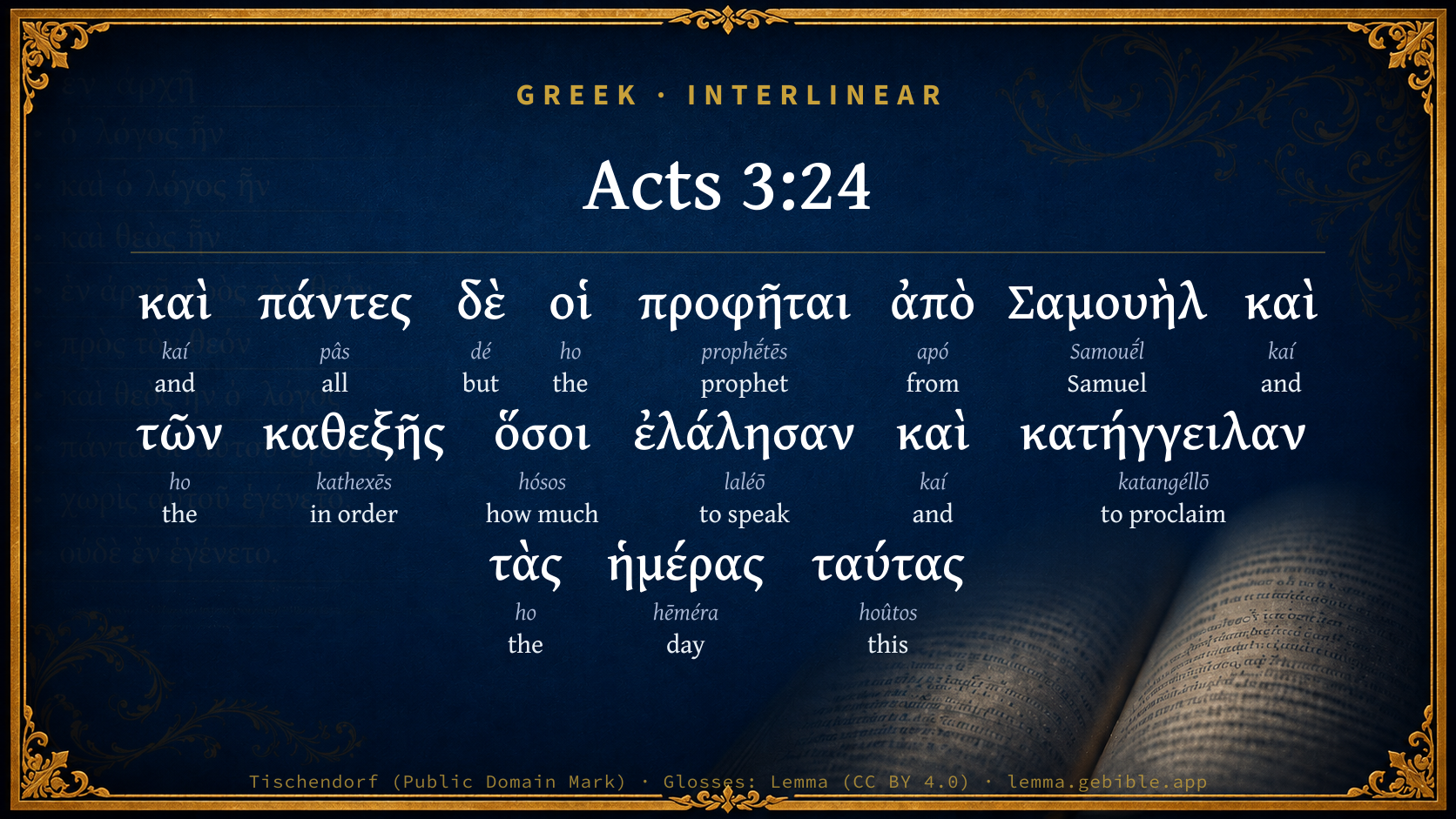
Greek (Tischendorf 8th ed.) Acts 3:24 appears in the Greek New Testament. The text above is from the Tischendorf 8th edition. Each word links to its Strong’s number and a concise gloss. Click any word for its full Thayer’s Greek Lexicon entry.
Download image
Cite this verse

Acts 3:24 (World English Bible). Public Domain. Lemma interlinear Bible study tool, https://lemma.gebible.app/v/acts/3/24.

Show BibTeX & RIS
BibTeX
RIS
English Translation
Yes, and all the prophets from Samuel and those who followed after, as many as have spoken, they also told of these days.
World English Bible · Public Domain
Highlights
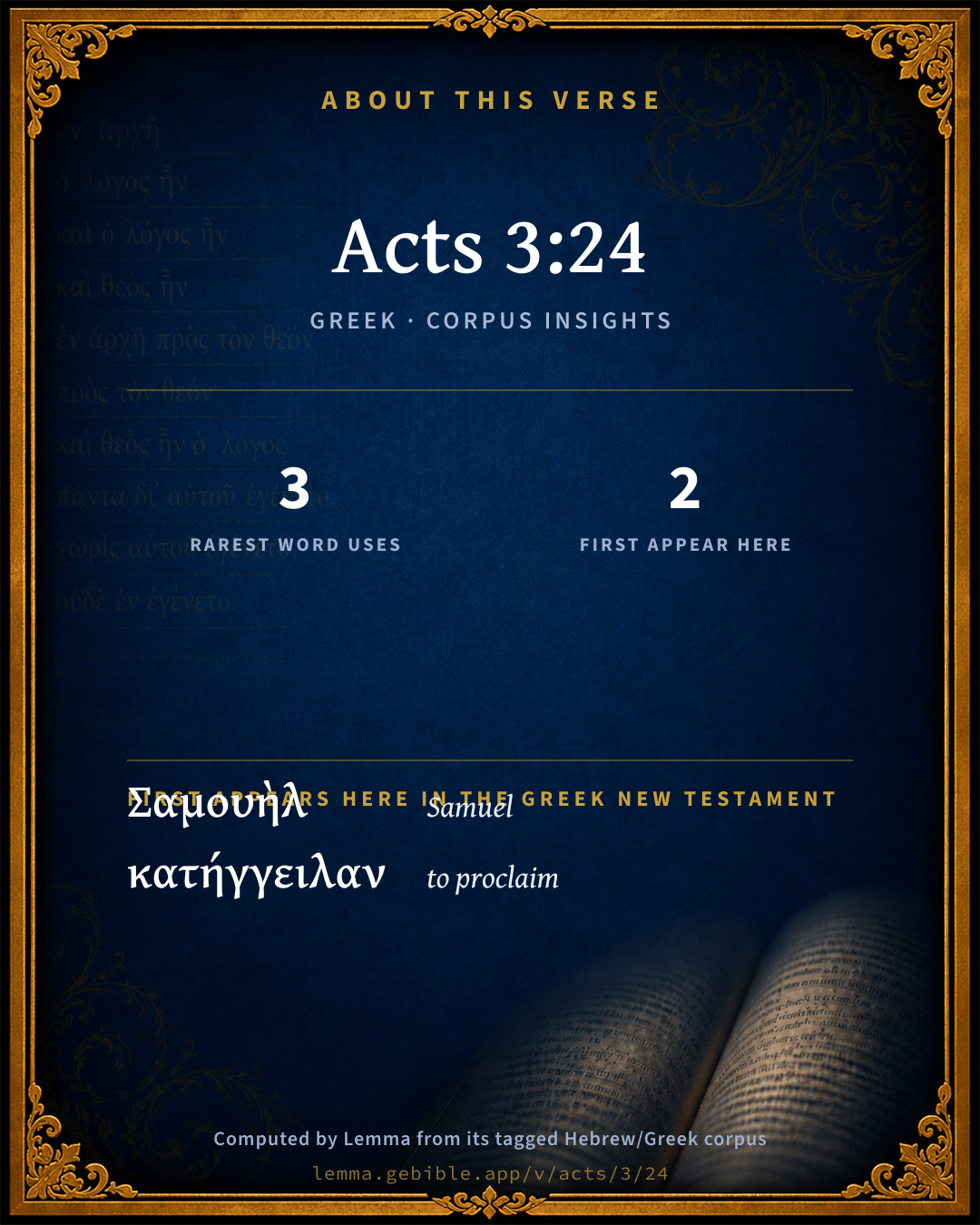
  • 2 first appearances in the Greek New Testament
Full analysis ↓
Download a study sheet

One document with this verse’s original text, its word-by-word gloss line, the meaning frame, cross-references with their text, attributed commentary, and full source and license credits — printable, and it pastes into notes with its structure intact.

This verse Autodidact and up

Study sheet (.html) Plain text (.txt)

A passage Seminary Student

Up to 50 verses in one chapter. A passage sheet keeps up to 6 commentary sources and 12 cross-references per verse, in the order this page ranks them, and says so on the sheet whenever that leaves anything out. Ask for a single verse and you get the Autodidact verse sheet above.

Everything on this page stays free to read, with no account — the sheet is a download of what is already on screen, not access to it.

Want to remove ads? Support Godless Engineer
Compare translations 3

The same verse in 3 English versions, stacked beneath the original-language interlinear above. Click any original word for its lexicon entry.

Each is an independent rendering of the whole verse — the interlinear is not word-aligned to these translations.

Highlighted words mark where these versions differ — a whole-verse word diff, not a word-by-word alignment.

  • World English Bible Public Domain
    Yes, and all the prophets from Samuel and those who followed after, as many as have spoken, they also told of these days.
  • King James Version Public Domain
    Yea, and all the prophets from Samuel and those that follow after, as many as have spoken, have likewise foretold of these days.
  • unfoldingWord Literal Text CC BY-SA 4.0
    And indeed, all the prophets from Samuel and those after him, as many as have spoken, have also announced these days.

unfoldingWord Literal Text — © unfoldingWord, licensed CC BY-SA 4.0. Word-aligned USFM3 via Door43 (git.door43.org/unfoldingWord/en_ult).

Versions to compare (up to 4)

3 of 4 selected

Show all 19 translations

Every available English version of this verse, each an independent rendering of the whole verse.

  • World English Bible Public Domain
    Yes, and all the prophets from Samuel and those who followed after, as many as have spoken, they also told of these days.
  • Berean Standard Bible Public Domain
    Indeed, all the prophets from Samuel on, as many as have spoken, have proclaimed these days.
  • Majority Standard Bible Public Domain
    Indeed, all the prophets from Samuel on, as many as have spoken, have proclaimed these days.
  • King James Version Public Domain
    Yea, and all the prophets from Samuel and those that follow after, as many as have spoken, have likewise foretold of these days.
  • American Standard Version (1901) Public Domain
    Yea and all the prophets from Samuel and them that followed after, as many as have spoken, they also told of these days.
  • Revised Version (1885) Public Domain
    Yea and all the prophets from Samuel and them that followed after, as many as have spoken, they also told of these days.
  • Geneva Bible (1599) Public Domain
    Also all the Prophets from Samuel, and thencefoorth as many as haue spoken, haue likewise foretolde of these dayes.
  • Douay-Rheims (1899) Public Domain
    And all the prophets, from Samuel and afterwards, who have spoken, have told of these days.
  • Young's Literal Translation Public Domain
    and also all the prophets from Samuel and those following in order, as many as spake, did also foretell of these days.
  • Literal Standard Version CC BY-SA 4.0
    and also all the prophets from Samuel and those following in order, as many as spoke, also foretold of these days.
  • Unlocked Literal Bible CC BY-SA 4.0
    Yes, and all the prophets from Samuel and those who came after him, they spoke out and announced these days.
  • unfoldingWord Literal Text CC BY-SA 4.0
    And indeed, all the prophets from Samuel and those after him, as many as have spoken, have also announced these days.
  • Darby Bible Public Domain
    And indeed all the prophets from Samuel and those in succession after [him], as many as have spoken, have announced also these days.
  • World Messianic Bible Public Domain
    Yes, and all the prophets from Samuel and those who followed after, as many as have spoken, also told of these days.
  • Webster's Bible Public Domain
    And all the prophets also from Samuel, and those that follow, as many as have spoken, have likewise foretold these days.
  • Free Bible Version CC BY-SA 4.0
    All the prophets who have spoken, from Samuel on, prophesied about these days.
  • Bible in Basic English Public Domain
    And all the prophets from Samuel and those who came after, every one of them, gave word of these days.
  • Text-Critical English NT CC BY 4.0
    Indeed, all the prophets who have spoken, beginning with Samuel and continuing with those who came afterward, also proclaimed these days.
  • Tyndale New Testament (1534) Public Domain
    Also all the Prophetes from Samuel and thence forth as many as have spoken have in lykwyse tolde of these dayes.

Literal Standard Version (2020), Covenant Press — licensed CC BY-SA 4.0. Text via the HelloAO Bible API (eBible.org). Unlocked Literal Bible (unfoldingWord) — licensed CC BY-SA 4.0. Text via the HelloAO Bible API (eBible.org). unfoldingWord Literal Text — © unfoldingWord, licensed CC BY-SA 4.0. Word-aligned USFM3 via Door43 (git.door43.org/unfoldingWord/en_ult). Free Bible Version, Dr. Jonathan Gallagher — licensed CC BY-SA 4.0. Text via the HelloAO Bible API (eBible.org).

Word by word

More ways to search: Search by grammar → Find every occurrence → Compare this word →

Practice this passage: Drill this verse → Learn its vocabulary →

Σαμουὴλ
Samouḗl
G4545
“Samuel”
Noun, Proper, indeclinable
Part of Speech
Noun · Proper, indeclinable
Full Thayer's Definition

Origin: of hebrew origin H8050

TDNT: None

Samuel = "his name is of God" 1. the son of Elkanah and Hannah, the last of the judges, a distinguished prophet, and a founder of the prophetic order, he gave the Jews there first kings, Saul, David
  1. καὶ kaí G2532 “and” Conjunction
  2. πάντες pâs G3956 “all” Adjective, Nominative, Plural, Masculine
  3. δὲ dé G1161 “but” Conjunction
  4. οἱ ho G3588 “the” Article, Nominative, Plural, Masculine
  5. προφῆται prophḗtēs G4396 “prophet” Noun, Nominative, Plural, Masculine
  6. ἀπὸ apó G575 “from” Preposition
  7. καὶ kaí G2532 “and” Conjunction
  8. τῶν ho G3588 “the” Article, Genitive, Plural, Masculine
  9. καθεξῆς kathexēs G2517 “in order” Adverb
  10. ὅσοι hósos G3745 “how much” Correlative pronoun, Nominative, Plural, Masculine
  11. ἐλάλησαν laléō G2980 “to speak” Verb, Aorist, Active, Indicative, 3rd person, Plural
  12. καὶ kaí G2532 “and” Conjunction
  13. κατήγγειλαν katangéllō G2605 “to proclaim” Verb, Aorist, Active, Indicative, 3rd person, Plural
  14. τὰς ho G3588 “the” Article, Accusative, Plural, Feminine
  15. ἡμέρας hēméra G2250 “day” Noun, Accusative, Plural, Feminine
  16. ταύτας hoûtos G3778 “this” Demonstrative pronoun, Accusative, Plural, Feminine

About this verse

These counts appear in no published source. They are computed here, from the morphology-tagged text and Lemma’s own curated glosses. What Lemma adds →

17
words
13
distinct lemmas
Acts
section

Notable vocabulary

The rarest word here is Σαμουὴλ Samuel G4545 — appearing just 3 times in the whole Greek New Testament.

First appearance in Scripture

These words make their first canonical appearance in the Greek New Testament here:

  • Σαμουὴλ Samuel G4545
  • κατήγγειλαν to proclaim G2605

Shared distinctive vocabulary

Σαμουὴλ Samuel G4545 occurs in 3 verses of the Greek New Testament. Also found in:
Repetition

Words recur within this verse:

Cross-references

10

Topical passages linked to Acts 3:24 in the Treasury of Scripture Knowledge — connected by theme and wording, ordered by reader-vote popularity; previews shown in the World English Bible.

  • Acts 3:21 whom heaven must receive until the times of restoration of all things, which God spoke long ago by the mouth of his holy prophets.
  • Luke 24:27 Beginning from Moses and from all the prophets, he explained to them in all the Scriptures the things concerning himself.
  • 1 Samuel 3:20 All Israel from Dan even to Beersheba knew that Samuel was established to be a prophet of Yahweh.
  • 1 Samuel 2:18 But Samuel ministered before Yahweh, being a child, girded with a linen ephod.
  • Psalms 99:6 Moses and Aaron were among his priests, Samuel among those who call on his name; They called on Yahweh, and he answered them.
  • 1 Samuel 3:1 The child Samuel ministered to Yahweh before Eli. The word of Yahweh was precious in those days; there was no frequent vision.
  • Acts 13:20 After these things he gave them judges until Samuel the prophet.
  • Romans 3:21 But now apart from the law, a righteousness of God has been revealed, being testified by the law and the prophets;
  • Jeremiah 15:1 Then said Yahweh to me, Though Moses and Samuel stood before me, yet my mind would not be toward this people: cast them out of my sight, and let them go forth.
  • Acts 3:19 "Repent therefore, and turn again, that your sins may be blotted out, so that there may come times of refreshing from the presence of the Lord,

Cross-references courtesy of OpenBible.info (CC BY 4.0).

Where the printed editions differ

1 variant

Places in this verse where the major printed Greek editions disagree on the wording in a way that affects the translation — a comparison of editions, not a manuscript-by-manuscript collation. The editions are the modern critical texts (Nestlé-Aland 28/27, SBL, Westcott-Hort, Tregelles, Tyndale House) and the traditional texts behind the KJV (the Textus Receptus and the Byzantine/Majority text). It is not a claim about which reading is original.

  1. Different wording
    κατήγγειλαν

    “told of”

    In NA28NA27TynSBLWHTregByz Not in TR

    προκατήγγειλαν (prokatēngeilan) 'fortold of' occurs in traditional manuscripts (TR) instead of κατήγγειλαν (katēngeilan) 'told of' in older manuscripts (NA28+NA27+Tyn+SBL+WH+Treg+Byz)

Textual data: Translators Amalgamated Greek New Testament (STEPBible TAGNT) · CC BY 4.0.

Commentary

Notes on Acts 3:24 from classic Christian and Jewish commentators (each source and its license shown beneath its notes). The classic Christian expositions comment on the surrounding passage and are grouped to its opening verse, so a note may address several verses; the Jewish commentaries on the Tanakh (Rashi and others) are per-verse, so they appear only where the commentator wrote on this verse.

Lemma curates 59 commentaries, every one of them public domain or Creative Commons licensed, each selected and text-cleaned for this edition rather than reprinted as found. About our sources →

Joseph Benson's Commentary

Act 3:24-26. Yea, and all the prophets — That succeeded Moses, particularly from Samuel, have likewise foretold these days — The days of the Messiah, which, by the singular favour of God to you, ye are now so happy as to see. Ye are the children of the prophets — You are the descendants of that people, among whom the prophets were raised up, and to whom the prophets were sent. Those of the latter ages of the Jewish Church, when prophecy had ceased, yet might be fitly, in general, called the children of the prophets, because they heard, though they did not know, the voices of the prophets, which were read in their synagogues every sabbath day; chap. Act 13:27. Now this ought to have quickened them to embrace Christ, their own prophets having foretold that this grace should be brought unto them in his days, (1Pe 1:10,) and therefore ought not to be neglected by them. And of the covenant which God made with our fathers — As children in the family. God’s covenant was made with Abraham and his seed; and they were that seed, and on them, therefore, the blessings of the covenant were entailed. As if the apostle had said, The promise of the Messiah was made to you, and therefore, if you forsake not your own mercies, and do not, by obstinate infidelity, lay an insuperable obstruction in your own way, you may confidently hope to be put in possession of them: saying to Abraham, In thy seed, &c. — This promise, though referring principally to Christ, (Gal 3:16,) yet respects the church also, which is his body, even all believers, that are the spiritual seed of Abraham. Unto you first — You Jews, though not to you only; God having raised up his Son Jesus — From the loins of that pious patriarch, or having appointed and authorized him to be a Prince and a Saviour; and in confirmation thereof, having raised him from the dead; sent him to bless you — With the greatest of all blessings; in turning every one of you from his iniquities — In saving you from the guilt and power of your sins, and from the misery consequent thereon. To explain this more fully: 1st, God raised up his Son Jesus, when he constituted him a prophet, owned him by a voice from heaven, filled him with his Spirit without measure, and then sent him to bear witness to the truth, and to seek and save lost souls. He raised him up more especially when he brought him back from the dead by a glorious resurrection, which was the first step toward his exaltation, and, as it were, the renewing of his commission. And though, having thus raised him up, he seemed presently to take him from his people, yet he did really send him afresh to them, in his gospel and Spirit. 2d, The apostle says, God sent him to the Jews first, because the personal ministry of Christ, as that of the prophets, was confined to them; and after his resurrection, though he was to be preached, indeed, by his apostles to all nations, yet they were to begin at Jerusalem, Luk 24:47; and when they went to other nations, they always first preached to the Jews they found there. The Jews, therefore, were so far from being excluded for having crucified Christ, that when he was risen he was first sent to them, and they were primarily intended to have benefit by his death. Indeed, had not the gospel been everywhere first offered to them, their prejudices would have been so heightened and confirmed, that, in all probability, many, who were converted in this method, would have been exasperated and lost. It must be observed, however, that when the apostle says to these Jews, God sent his Son to bless you, he speaks conditionally, as the event showed with respect to many of them, on whom the divine wrath and curse came, and not the blessing here spoken of; namely, because they rejected the counsel of God against themselves. Many commentators, therefore, give this sentence a different turn, rendering the last clause, upon your turning every one of you, &c., or, every one of you turning, &c. That is, “all those of you who turn from sin shall be entitled to his blessing.” And this is agreeable to the Syriac rendering, if you are converted, and repent of your sins. But the former seems the preferable reading, as the great gospel blessing is, to be turned from our iniquities, or to be converted from sin to righteousness. Nor can it be any reasonable objection to say, that Christ did not in fact turn every one of the Jews from their iniquities, since it must be allowed that he did every thing that was necessary in order thereto; yea, every thing except depriving them of their liberty of choice and action, and turning them into mere machines. He procured for them, and offered to them, and that sincerely and repeatedly, yea, continually during his own personal ministry, and afterward by his divinely-commissioned apostles, grace sufficient to enable them to turn from their iniquities; and by the help of that, they might every one of them have turned, and so have obtained the blessing here intended. But let us not suppose that this, or any other part of Peter’s discourse, was intended only for the Jews. It concerns us also, whom Christ was likewise sent to bless, and that in the same manner, even by turning us from our iniquities, by saving us from our sins. Mat 1:22. Sin is that which we naturally cleave to, and the design of divine grace is, to turn us from it; nay, to turn us against it, that we may not only forsake it, but hate it, and strive against it. And the gospel has a direct tendency to produce this effect, not only as it requires us to turn, but as it promises us grace to enable us to do so. Therefore let us apply to Christ for this, and by the aid and right use of it, repent and be converted, and so do our part; because he is ready to do his, namely, to give the grace we need, and thereby to save us from our sins, and the consequences thereof, and to bless us effectually, abundantly, and for ever.

Joseph Benson's Commentary on the Old and New Testaments (1811–1818) — public domain. Text from a community e-Sword module.

Bengel's Gnomon

Johann Albrecht Bengel

Act 3:24. Πάντες, all) The prophets, in Rev 10:7, are appealed to for the same purpose.—δὲ, truly) Answering to μὲν, indeed, in Act 3:22.—ἀπὸ Σαμουὴλ, from Samuel) Between the times of Moses and Samuel there was not much prophecy, until the authority of Moses alone was firmly established, according to whom the prophetical claims of all the others subsequently were to be decided. Then when the kingdom was introduced (beginning with king Saul), prophecy concerning the kingdom of Christ flourished: and it was through the very mother of Samuel that the first mention of the King and Messiah was made; and it was afterwards renewed frequently: 1Sa 2:10; 1Sa 2:35, etc., “The Lord shall judge the ends of the earth; and He shall give strength unto His King, and exalt the horn of His Anointed (= Messiah).”—τῶν) Repeat ἀπὸ before τῶν.—καὶ προλατήγγειλαν) καὶ, also, likewise.—ταύτας, these) Many things, when the time comes, are fulfilled at once.

Bengel's Gnomon of the New Testament — English translation (T&T Clark, Edinburgh, 1860) — public domain. Text from a community e-Sword module.

Expositor's Greek Testament

ed. W. Robertson Nicoll

Act 3:24 . Σαμουὴλ : On Samuel as the founder of the prophetic schools and the pattern of all later prophets, see Hamburger, Real-Encyclopädie des Judentums , i., 6, p. 854; “Prophet,” cf. Midrash Shemuel , c. 24, where Samuel is called the Rabban, the chief and teacher of the prophets (Wetstein, in loco , and Lumby), cf. also Heb 11:32 , Δαυείδ τε καὶ Σ . καὶ τῶν προφητῶν . καὶ τῶν καθεξῆς : an unmistakable tautology. Wendt considers the expression as inaccurate, see his note, and for a full discussion cf. Winer-Moulton, lxvii. 2, who compares Luk 24:27 , = “all the series of prophets beginning from Samuel” (Page); “longa tamen successione, uno tamen consensu” (Calvin). καθεξ . used by St. Luke alone, Luk 1:3 ; Luk 8:1 , Act 11:4 ; Act 18:23 . In Greek writers = ἐφεξῆς , not found in LXX. καὶ κατήγγ . τὰς ἡμέρας ταύτας : “have also told of these days,” i.e. , the present days, cf. Act 5:36 , Luk 24:18 . This interpretation does not prevent the identification of “these days” with the χρόνοι τῆς ἀποκαταστάσεως , since in one sense the restoration had already begun with the coming of the forerunner and of the Christ, and in the acceptance of the repentance which they had preached. Rendall renders “yea, so said all the prophets from Samuel … as many as have spoken and told of these days,” as if the fact which St. Peter wished to emphasise was that all the prophets had spoken threats of utter destruction like Moses. But the Greek does not by any means of necessity bear this construction (Viteau, Le Grec du N. T. , p. 55 (1896), and such an interpretation seems too harsh. As Wendt admits, the reference is not merely to the prophetical sayings relating to the last judgment, but also to the promises of salvation and to all which is connected with the χρόνοι ἀποκατ . Moreover the reference to Samuel is made because of Nathan’s prediction, “the fundamental prophecy respecting the seed of David,” 2Sa 7:12 ff., in which it is foretold that mercy shall not be taken away even in the midst of punishment. Blass explains the expression τἀς ἡμερ . ταύτ . “regni felicis Messianici”; but we must remember that it does not follow that the popular views of the Messianic kingdom and judgment were still held by St. Peter.

The Expositor's Greek Testament, edited by W. Robertson Nicoll (1897–1910) — public domain. Text from a community e-Sword module.

Geneva Bible (1599)

Geneva Bible translators

At what time the kingdom of Israel was established.

Geneva Bible (1599) marginal notes — public domain. Text via Bolls.life.

Jamieson, Fausset & Brown

Robert Jamieson, A. R. Fausset & David Brown

foretold of these days--of Messiah; all pointing to "the time of reformation" (Heb 9:10), though with more or less distinctness.

Jamieson, Fausset & Brown — Commentary Critical and Explanatory on the Whole Bible (1871) — public domain (CC PDM 1.0). Text via the HelloAO Bible API.

Adam Clarke's Commentary

Verse 24. All the prophets from Samuel] Dr. Lightfoot observes: "We have Moses and Samuel mentioned together in this place, as also Ps 99:6, because there were few or no prophets between these two, 1Sa 3:1, and the apparition of angels having been more frequent; but, after the decease of Phineas, it is a question whether there was any oracle by Urim and Thummim, through the defect of prophecy in the high priests, till the times of Samuel. But then it revived in Abimelec, Abiather, &c." The Jews have a saying, Hieros. Chagigah, fol. 77. גכיאים שמואל דבן של Samuel was the chief of the prophets. Perhaps it was in reference to this that Peter said, All the prophets from Samuel, &c.

Adam Clarke's Commentary on the Bible (1810–1826) — public domain. Text from a community e-Sword/MySword module.

John Calvin's Commentaries

24. And all When as he saith that all the prophets do with one consent send their scholars unto Christ, that appeareth more plainly hereby, which I said, that the commendation of the gospel is contained under that testimony of Moses, and so, consequently, that the conclusion of prophecies is principally noted. Again, this maketh much for the certainty of the gospel, that all the prophets, for a long time, [series of ages,] do yet, notwithstanding, so temper their form of teaching with one consent, that they do testify altogether that men ought to hope for a certain, better, and more perfect thing. Therefore, whosoever will believe Moses and the prophets, he must needs submit himself unto the doctrine of Christ, without which all that is lame and imperfect which they taught, (John 5:47.)

John Calvin's Commentaries (1540-1563) — public domain. Text from the Calvin Translation Society English edition (1840s-50s) via the Christian Classics Ethereal Library (ccel.org). Calvin's coverage is partial (roughly two-thirds of the Bible); uncommented books and verses are honest gaps, never fabricated. The 19th-century editor's footnotes and remarks are omitted so the notes are faithfully Calvin's own voice.

Ellicott's Commentary for English Readers

(24) All the prophets from Samuel.—Samuel is named, both as being the founder of the school of the prophets, and so the representative of the “goodly fellowship,” and as having uttered one of the earliest of what were regarded as the distinctively Messianic predictions (2Sa_7:13-14; Heb_1:5).

A Bible Commentary for English Readers, edited by Charles John Ellicott (1878–1897) — public domain. Text from a community e-Sword module.

The Cambridge Bible for Schools and Colleges

gen. ed. J. J. S. Perowne

24. all the prophets from Samuel] To other prophecies St Peter only makes a general reference. We learn (Midrash Shemuel, c. 24) that Samuel was called by the Jews “Rabban,” the chief and teacher of the prophets, and there are several reasons why he is put in this foremost place. (1) We never read of a school of the prophets before his time. (2) His mother Hannah is the first person in Holy Writ who speaks of the Messiah (1Sa_2:10), “God’s anointed.” (3) Jewish tradition says that the man of God who came to Eli (1Sa_2:27) was Elkanah. The Targum on 1Sa_10:12, “But who is their father?” explains father by Rabbi, and refers the word to Samuel, so that the question in that verse would imply: “Why do you wonder at Saul among the prophets? Who is it that instructs the prophets? Is it not Samuel? And has not Saul been with him just now and been anointed by him?” All this could be said without the speaker having any knowledge that Saul was to be king. For the use of father as = teacher or Rabbi cf. Elisha’s cry to Elijah (2Ki_2:12), “My father, my father.”

as many as have spoken, have likewise foretold of these days] The verbs are aorist. Read, as many as spake they also told of these days. The latter verb is without the preposition προ in the best MSS., and so is not = foretold but told. The prophet was one who spoke for God, gave a message from Him, but was not necessarily a foreteller of the future.

The Cambridge Bible for Schools and Colleges (gen. ed. J. J. S. Perowne; Cambridge University Press, 1878–1918) — public domain. Text from a community e-Sword module.

John Gill's Exposition

Yea, and all the prophets from Samuel,.... Who was, as the Jews call him, , "the master of the prophets" (l); and they say, that Samuel the prophet is , "the first prophet" in the chain of the Kabbala (m); and therefore is here particularly mentioned, as at the head of the prophets, and next to Moses; there being but very few prophets between him and Moses, when there were many after him; and in his days, the schools of the prophets were set up: now not only Moses spoke of Christ, but all the prophets from the time of Samuel; in the books that bear his name, stands a famous prophecy concerning Christ, Sa2 7:13.

And those that follow after; in order, as David, Solomon, Isaiah, Jeremiah, Ezekiel, &c.

and as many as have spoken; anything by way of prophecy:

have likewise foretold of these days; of the days of the Messiah, of his person, office, incarnation, obedience, sufferings, death, resurrection, ascension, the pouring down of the Spirit, the times of refreshing, the Gospel dispensation, the conversion of the Jews, the calling of the Gentiles, and the gathering in all the elect of God.

(l) T Hieros. Chagiga, fol. 77. 1. (m) Ganz Tzemach David, par. 1. fol. 9. 1. Vid. Kimchi in Psal. xcix. 6.

John Gill's Exposition of the Whole Bible (1746–1763) — public domain (CC PDM 1.0). Text via the HelloAO Bible API.

Trapp's Complete Commentary

John Trapp

24 Yea, and all the prophets from Samuel and those that follow after, as many as have spoken, have likewise foretold of these days.

Ver. 24. All the prophets] The prophet Isaiah especially, who speaks more like an evangelist than a prophet, and is therefore called the "evangelical prophet" (Jerome).

John Trapp, A Commentary or Exposition upon All the Books of the Old and New Testament (1647–1656) — public domain. Text from a community e-Sword module.

Albert Barnes' Notes on the Bible

All the prophets - That is, the prophets in general. It may be said of the prophets generally, or of all of them, that they have foretold these things. This expression is not to be pressed as if we were to look for distinct predictions of the Messiah in each one of the prophets. The use of language does not require so strict an interpretation.

From Samuel - In the previous verse (22) Moses was mentioned as the first in order. The next in order was Samuel. The same mention of Moses and Samuel occurs in Psa 99:6. The reason why Samuel is mentioned here is probably that he was the first prophet after Moses who recorded a prediction respecting the times of the Messiah. The Jews, in their divisions of the books of the Old Testament, reckoned the book of Joshua as the first of the prophets. But in Joshua and Judges there does not occur any distinct prediction of the Messiah. The prophecy in Samuel, to which Peter probably had reference, is in 2Sa 7:16. From the time of Moses to Samuel, also, it is probable that no prophet arose. God was consulted by Urim, and Thummim Exo 28:30; Num 27:21, and consequently no extraordinary messenger was sent to instruct the nation.

As many as have spoken - Whosoever has declared the will of God. This is to be taken in a general sense. The meaning is, that the prophets had concurred in foretelling these days. They not merely concurred in foretelling a happy future period, but they foretold distinctly the very things which had actually occurred respecting Jesus of Nazareth; and the Jews, therefore, should listen to the voice of their own prophets.

Albert Barnes' Notes on the Bible (1834–1885) — public domain. Text from a community e-Sword/MySword module.

Matthew Poole's English Annotations

Though there were some prophets betwixt Moses and Samuel, yet they were but such as prophesied in some particular exigences and cases; and in Samuel’s days the word of the Lord was precious, or rare, 1Sa 3:1; but then David, that lively type of Christ, appearing at the throne, the Messiah began to be more discovered in and by him: besides, Samuel was the first who wrote his prophecies, and erected the schools of the prophets, and therefore he is first mentioned; and the date of the prophets is here begun from him.

Matthew Poole's English Annotations on the Holy Bible (1683–1685) — public domain. Text from a community e-Sword/MySword module.

Whedon's Commentary on the Bible

Daniel D. Whedon

24. All—See note on Act_3:18.

From Samuel—Between Moses and Samuel prophecy was mostly withdrawn. In 1Sa_2:10; 1Sa_2:35, the Messiah (Anointed) or Christ is first mentioned. Before David, Moses is the type of the coming one; after king David, Messiah is imaged as a king.

These days—So that it is of these days, the days before the second advent, that all his holy prophets in Act_3:21 have spoken. That is, the times of the αποκαταστασις or fulfilment spoken of in Act_3:21 are these days of the present Gospel probation and of waiting for the judgment advent at the end of this world.

Daniel D. Whedon (gen. ed.), Commentary on the Old and New Testaments (1874–1909) — public domain. Text from a community e-Sword module.

The Pulpit Commentary

Them that followed for those that follow, A.V.: they also told for have likewise foretold, A.V. From Samuel, etc. Samuel and oiJ kaqexhv seems to denote what the Jews called "the former prophets the authors of the historical books. The whole phrase, therefore, comprehends "all the prophets" (of whom Samuel and oiJ kaqexhv were the first), to whose testimony concerning himself our Lord appeals. (Luk_24:27, Luk_24:44)

The Pulpit Commentary (1880–1919), ed. H.D.M. Spence-Jones & Joseph S. Exell — public domain. Text from a community e-Sword module.

John Wesley's Explanatory Notes

These days - The days of the Messiah.

John Wesley, Explanatory Notes Upon the Whole Bible (1754–1765) — public domain. Text via the GEBible commentary corpus.

Burkitt's Expository Notes on the New Testament

William Burkitt

That is, "All the prophets from Moses to Samuel, and particularly Isaiah, the evangelical prophet, did fortell the coming and kingdom of the Messias, the special mercies to them that believe on him, and the destruction of those that reject him."

Where note, That Samuel is mentioned as the first prophet between them, because he was the first prophet after Moses that wrote his prophecy, and first erected the schools of the prophets.

Learn hence, That Christ ws the sum of the law, as well as the substance of the gospel, all the legal sacrifices pointed at him, all the prophets prophesied of him, and received their completion in him. He was Abel’s sacrifice, Isaac’s Ram, Isaiah’s Emmanuel, Daniel’s Holy One, Zachary’s Branch, and Malachi’s Angel.

William Burkitt's Expository Notes on the New Testament (1700–1703) — public domain. Text from a community e-Sword module.

Godbey's Commentary on the New Testament

William B. Godbey

24. “And all the prophets from Samuel and successively so many as spoke also proclaimed these days.” How significantly true! The second coming of Christ is a most prominent thing with all the prophets in all dispensations. Even Enoch, in antediluvian times, was a powerful preacher of the Lord’s second coming (Jud 1:14-15). Read it and you will find a most vivid description of the great tribulation. Job, the oldest writer in the Bible, living in the patriarchal dispensation, preached powerfully on the Lord’s second coming:

“I know that my Redeemer liveth, and that he shall stand in the latter days upon the earth, — and with mine eyes I shall see God, whom I shall know for myself and not a stranger.”

The E. V. says, incorrectly, “not another.” The truth of it is, Job claims a happy acquaintance with his Redeemer, so that when He returns to the earth in the latter days and stands upon it, Job, a member of the Bridehood coming up in the first resurrection, will joyfully recognize Him. Shall we not preach a truth which constituted a glowing theme of all the prophets in all dispensations?

William B. Godbey, Commentary on the New Testament (1896–1900) — public domain. Text from a community e-Sword module.

McGarvey & Pendleton's Commentaries

J. W. McGarvey

24. Not content with bringing to bear the testimony of Moses, Peter adds to it the combined voices of all the prophets: (24) " And, indeed, all the prophets, from Samuel, and those following in order, as many as have spoken, have also foretold these days. " This declaration is to be understood only of those prophets whose predictions are recorded in the Old Testament, for to those alone could Peter appeal in proof of his proposition. It was conceded by the Jews, that all the prophets had spoken of the days of the Messiah, and it was already proved, by Peter's preceding remarks, that Jesus was the Messiah; hence the argument is now complete.

J. W. McGarvey (with Philip Y. Pendleton), Commentaries on the New Testament (The Fourfold Gospel, 1914; Acts; and the epistles) — public domain. Text from a community e-Sword/MySword module.

The People's New Testament

B. W. Johnson

24. And all the prophets also from Samuel. “The testimony of Jesus is the spirit of prophecy.” Samuel is named because he was the founder of the schools of the prophets.

B. W. Johnson's The People's New Testament with Notes (1889–1891) — public domain. Electronic text from the Christian Classics Ethereal Library (CCEL) ThML edition.

unfoldingWord translationNotes

Door43 World Missions Community

Connecting Statement:

Peter finishes his speech to the Jews that he began in Acts 3:12.

Yes, and all the prophets

"In fact, all the prophets." Here the word "Yes" adds emphasis to what follows.

from Samuel and those who came after him

"beginning with Samuel and continuing with the prophets who lived after he did"

these days

"these times" or "the things that are happening now"

You are the sons of the prophets and of the covenant

Here the word "sons" refers to heirs who will receive what the prophets and the covenant promised. AT: "You are the heirs of the prophets and heirs of the covenant" (See: Idiom and Ellipsis)

In your seed

"Because of your offspring"

shall all the families of the earth be blessed

Here the word "families" refers to people groups or nations. This can be stated in active form. AT: "I will bless all the people groups in the world" (See: Active or Passive)

After God raised up his servant

"After God caused Jesus to become his servant and made him famous"

his servant

This refers to the Messiah, Jesus.

turning every one of you from your wickedness

Here "turning ... from" is a metaphor for causing someone stop doing something. AT: "causing every one of you to stop doing wicked things" or "causing every one of you to repent from your wickedness" (See: Metaphor)

translationWords

prophet

Samuel

son

covenant

Abraham

seed

family

earth

bless

raise

servant

evil

unfoldingWord translationNotes — © Distant Shores Media and the Door43 World Missions Community, licensed CC BY-SA 4.0. Source: git.door43.org/Door43/en_tn.

Cambridge Greek Testament for Schools and Colleges

24. καὶ πάντες δὲ οἱ προφῆται. To other prophecies St Peter only makes a general reference. We learn (Midrash Shemuel, c. 24) that Samuel was called by the Jews the Rabban, the chief and teacher, of the prophets and there are several reasons why he is put in this foremost place. (1) We never read of a school of the prophets before his time. (2) His mother Hannah is the first person in Holy Writ who speaks of the Messiah (1Sa 2:10), ‘God’s anointed.’ (3) Jewish tradition says that the man of God who came to Eli (1Sa 2:27) was Elkanah. The Targum on 1Sa 10:12, ‘But who is their father?’ explains father by Rabbi, and refers the word to Samuel, so that the question in that verse would imply, ‘Why do you wonder at Saul among the prophets? Who is it that instructs the prophets? Is it not Samuel? And has not Saul been with him just now and been anointed by him?’ All this could be said without the speaker having any knowledge that Saul was to be king. For the use of father as = teacher or Rabbi cf. Elisha’s cry to Elijah (2Ki 2:12), ‘My father, my father.’

ὅσοι ἐλάλησαν καὶ κατήγγειλαν. Render, as many as spake they also told of these days. The προ which is prefixed to the latter verb in the Text. recept. seems to have been introduced with the notion that the words of a prophet must of necessity be predictive. Whereas the prophet was one who spake for God, gave a message in His name, but was not necessarily a foreteller of the future.

Cambridge Greek Testament for Schools and Colleges (Cambridge University Press, 1896; 21 vols, various authors incl. Carr, Maclear, Plummer, Farrar, Lumby, Moule, M. R. James, Simcox) — public domain. Text from a community e-Sword module.

Alford’s Greek Testament

Henry Alford

24.] See ver. 18, note.

The construction of the Vulg., defended by Casaubon and adopted by Valcknaer and Kuinoel, τῶν καθεξῆς ὅσοι ἐλάλ., ‘et omnes prophetæ a Samuel, et deinceps qui locuti sunt,’ is not so good as the ordinary one in E. V. Cf. ἀρξάμενος ἀπὸ Μωυσέως καὶ ἀπὸ πάντων τῶν προφ., Luk 24:27. Still less admissible is the rendering given in Dr. Burton’s note, as perhaps the literal one, ‘And to the same effect spoke) all the prophets from S. downwards, as many as spoke and predicted these days.’ To what effect? And would not the sentence thus amount to little more than saying, ‘As many prophets as predicted these days, predicted these days?’ Peter’s aim is to shew the unanimity of all the prophets in speaking of these times.

Samuel is named, more as being the first great prophet after Moses, than as bearing any part in this testimony. The prophetic period of which David was the chief prophet, began in Samuel (Stier).

τὰς ἡμ. ταύτ.] These days, now present, not the times of restoration, as De Wette and others understand: which would require ἐκείνας. ‘These days’ are, in fact, connected with the times of restoration, as belonging to the same dispensation and leading on to them; and thus the Apostle identifies the then time with this preparation for (ὅπως ἂν ἔλθ.) and expectation of (ἄχρι) those glories: but to make τὰς ἡμ. ταύτ. identical with the καιροὶ ἀναψ. and the χρόν. ἀποκατ., is to make him contradict himself.

Henry Alford, The Greek Testament (1849–1861) — public domain. Text from a community e-Sword module.

Lesson kit

Teaching starters — assembled from the data on this page, not authored interpretation. Every prompt links to the verse data it draws on. Edit before teaching.

Acts, in the Acts, opens this verse with 17 words (13 distinct Greek lemmas). Its most distinctive word is Samouḗl (“Samuel”). A historical commentator’s framing appears above. Read the whole chapter for the surrounding context.

Discussion questions

  1. What does “Samuel” (Samouḗl) contribute to the verse as a whole?
  2. 2 words here appear for the first time in Scripture. What is being introduced at this debut?
  3. Acts 13:20 shares the word «Samuel» with this verse. How do the two illuminate each other?
  4. “and” occurs 3× in this one verse. What is the effect of the repetition?
  5. These translations render this verse differently. What is at stake in choosing one wording over another?
  6. Reading how Joseph Benson's Commentary and Bengel's Gnomon read this verse, where do the two commentators agree and where do they part?

Things to notice

  • 2 words make their first canonical appearance in Scripture here.
  • These translations choose different wording for 12 words in this verse.
  • “and” occurs 3× in this single verse.
  • 13 distinct Greek lemmas span 17 words in this verse.

Reading settings

Reading text

Shown beneath each verse's original-language words.

Old Testament
Old Testament edition

Read the OT as the Masoretic Hebrew (MT) or the Greek Septuagint (LXX).

English shown for the Greek Septuagint (in the Hebrew ↔ Greek comparison).

Comparing translations? Open the Compare panel on any verse page to stack up to four side by side.