

Acts 6:9
Greek (Tischendorf 8th ed.) Acts 6:9 appears in the Greek New Testament. The text above is from the Tischendorf 8th edition. Each word links to its Strong’s number and a concise gloss. Click any word for its full Thayer’s Greek Lexicon entry.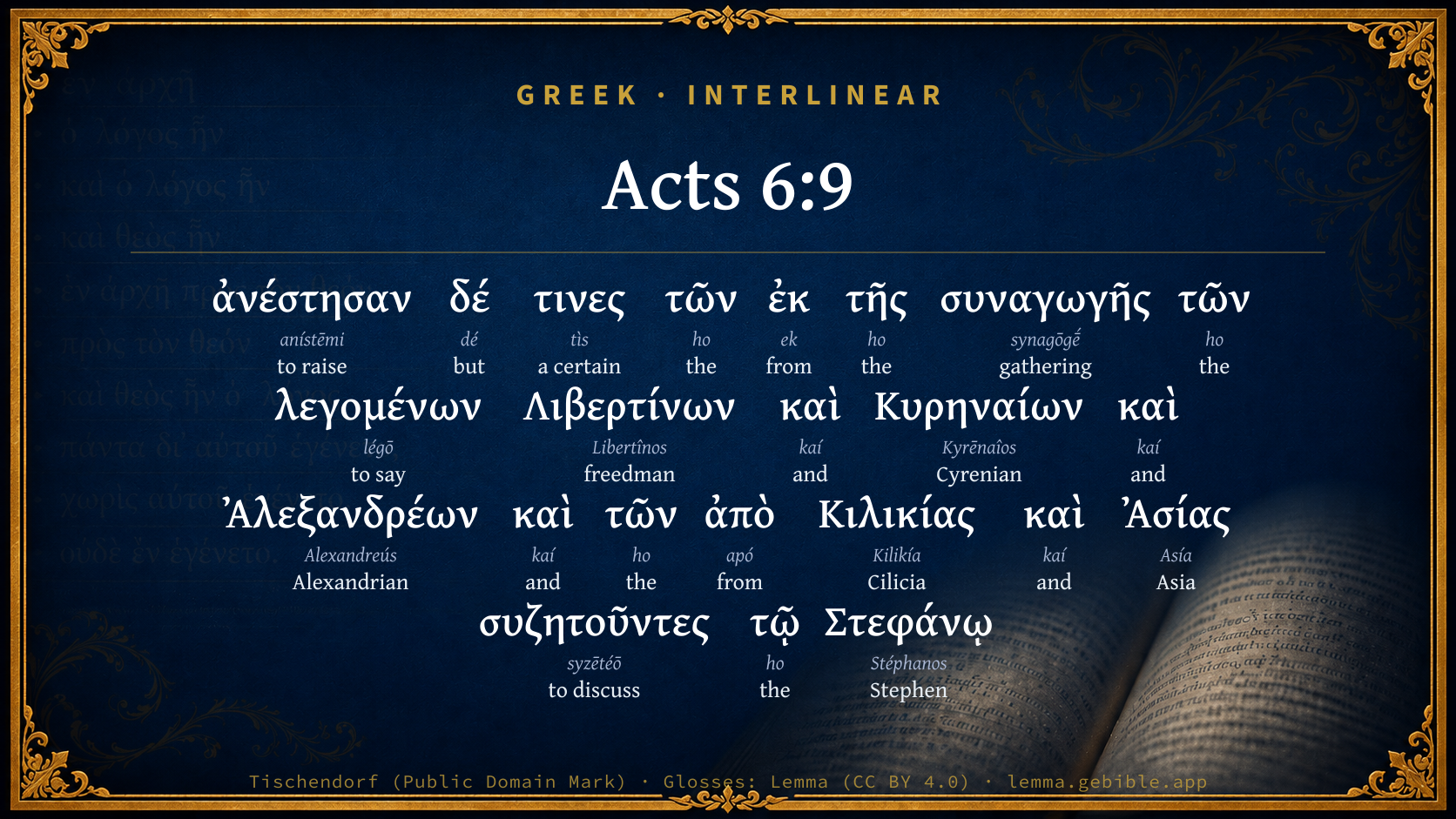
But some of those who were of the synagogue called "The Libertines," and of the Cyrenians, of the Alexandrians, and of those of Cilicia and Asia arose, disputing with Stephen.
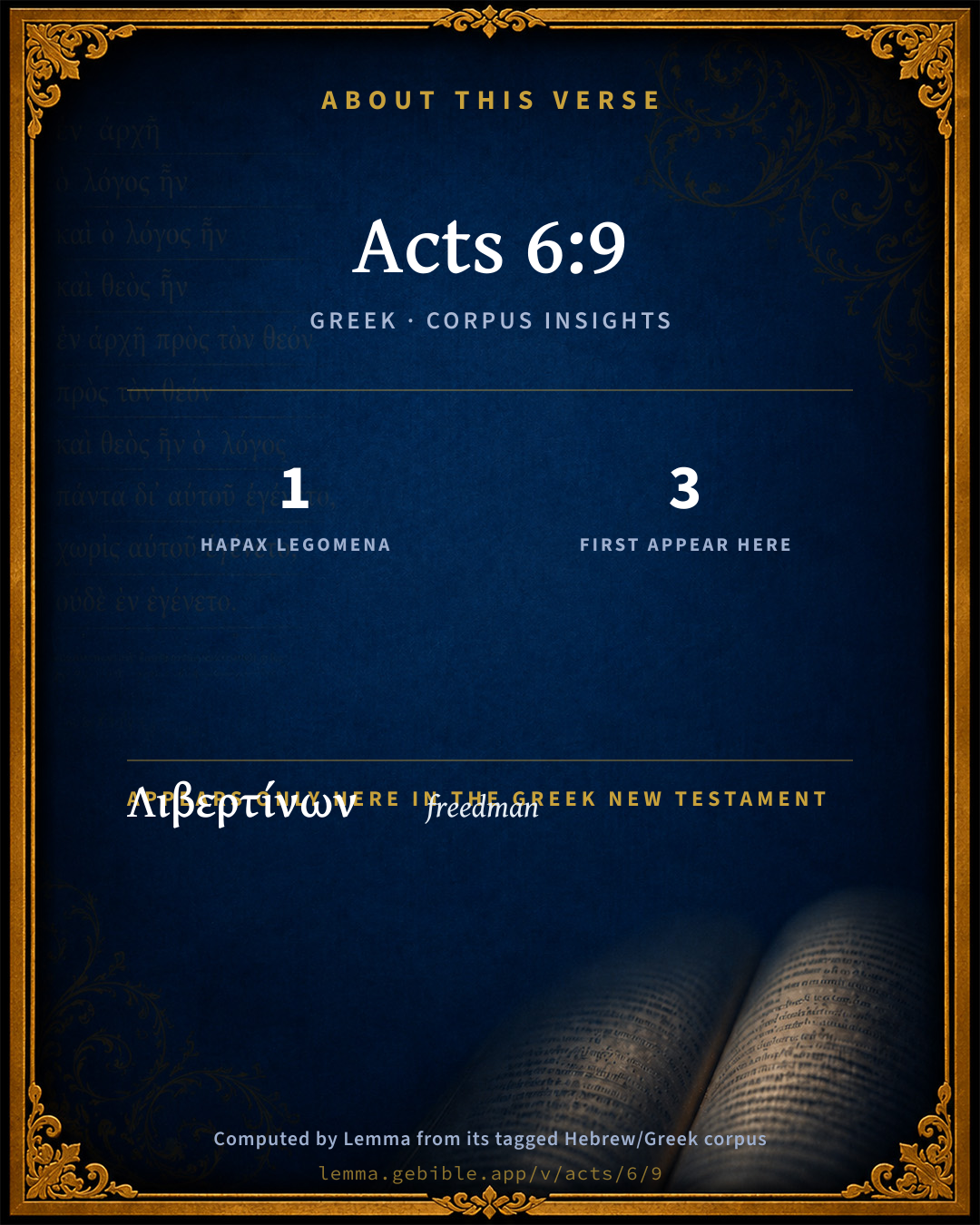
- 1 hapax legomenon — only here in the Greek New Testament
- 3 first appearances in the Greek New Testament
Download a study sheet
One document with this verse’s original text, its word-by-word gloss line, the meaning frame, cross-references with their text, attributed commentary, and full source and license credits — printable, and it pastes into notes with its structure intact.
This verse Autodidact and up
A passage Seminary Student
Up to 50 verses in one chapter. A passage sheet keeps up to 6 commentary sources and 12 cross-references per verse, in the order this page ranks them, and says so on the sheet whenever that leaves anything out. Ask for a single verse and you get the Autodidact verse sheet above.
Everything on this page stays free to read, with no account — the sheet is a download of what is already on screen, not access to it.
Compare translations 3
The same verse in 3 English versions, stacked beneath the original-language interlinear above. Click any original word for its lexicon entry.
Each is an independent rendering of the whole verse — the interlinear is not word-aligned to these translations.
Highlighted words mark where these versions differ — a whole-verse word diff, not a word-by-word alignment.
-
World English Bible Public Domain
But some of those who were of the synagogue called "The Libertines," and of the Cyrenians, of the Alexandrians, and of those of Cilicia and Asia arose, disputing with Stephen.
-
King James Version Public Domain
Then there arose certain of the synagogue, which is called the synagogue of the Libertines, and Cyrenians, and Alexandrians, and of them of Cilicia and of Asia, disputing with Stephen.
-
unfoldingWord Literal Text CC BY-SA 4.0
But there arose some people, the ones from the synagogue that is called Freedmen, and of the Cyrenians, and of the Alexandrians, and of those from Cilicia and Asia. They were debating with Stephen.
unfoldingWord Literal Text — © unfoldingWord, licensed CC BY-SA 4.0. Word-aligned USFM3 via Door43 (git.door43.org/unfoldingWord/en_ult).
Show all 19 translations
Every available English version of this verse, each an independent rendering of the whole verse.
-
World English Bible Public Domain
But some of those who were of the synagogue called "The Libertines," and of the Cyrenians, of the Alexandrians, and of those of Cilicia and Asia arose, disputing with Stephen.
-
Berean Standard Bible Public Domain
But resistance arose from what was called the Synagogue of the Freedmen, including Cyrenians, Alexandrians, and men from the provinces of Cilicia and Asia. They began to argue with Stephen,
-
Majority Standard Bible Public Domain
But resistance arose from what was called the Synagogue of the Freedmen, including Cyrenians, Alexandrians, and men from the provinces of Cilicia and Asia. They disputed with Stephen,
-
King James Version Public Domain
Then there arose certain of the synagogue, which is called the synagogue of the Libertines, and Cyrenians, and Alexandrians, and of them of Cilicia and of Asia, disputing with Stephen.
-
American Standard Version (1901) Public Domain
But there arose certain of them that were of the synagogue called `the synagogue' of the Libertines, and of the Cyrenians, and of the Alexandrians, and of them of Cilicia and Asia, disputing with Stephen.
-
Revised Version (1885) Public Domain
But there arose certain of them that were of the synagogue called the synagogue of the Libertines, and of the Cyrenians, and of the Alexandrians, and of them of Cilicia and Asia, disputing with Stephen.
-
Geneva Bible (1599) Public Domain
Then there arose certaine of the Synagogue, which are called Libertines, and Cyrenians, and of Alexandria, and of them of Cilicia, and of Asia, and disputed with Steuen.
-
Douay-Rheims (1899) Public Domain
Now there arose some of that which is called the synagogue of the Libertines, and of the Cyrenians, and of the Alexandrians, and of them that were of Cilicia and Asia, disputing with Stephen.
-
Young's Literal Translation Public Domain
and there arose certain of those of the synagogue, called of the Libertines, and Cyrenians, and Alexandrians, and of those from Cilicia, and Asia, disputing with Stephen,
-
Literal Standard Version CC BY-SA 4.0
and there arose certain of those of the synagogue, the [one] called Libertines (and Cyrenians, and Alexandrians, and of those from Cilicia, and Asia), disputing with Stephen,
-
Unlocked Literal Bible CC BY-SA 4.0
But there arose some people who belonged to the synagogue called the synagogue of the Freedmen, of the Cyrenians and Alexandrians, and some from Cilicia and Asia. These people were debating with Stephen.
-
unfoldingWord Literal Text CC BY-SA 4.0
But there arose some people, the ones from the synagogue that is called Freedmen, and of the Cyrenians, and of the Alexandrians, and of those from Cilicia and Asia. They were debating with Stephen.
-
Darby Bible Public Domain
And there arose up certain of those of the synagogue called of freedmen, and of Cyrenians, and of Alexandrians, and of those of Cilicia and Asia, disputing with Stephen.
-
World Messianic Bible Public Domain
But some of those who were of the synagogue called “The Libertines”, and of the Cyrenians, of the Alexandrians, and of those of Cilicia and Asia arose, disputing with Stephen.
-
Webster's Bible Public Domain
Then there arose certain of the synagogue, which is called the synagogue of the Libertines, and Cyrenians, and Alexandrians, and of them of Cilicia, and of Asia, disputing with Stephen.
-
Free Bible Version CC BY-SA 4.0
But some started arguing with him. They were from the synagogue called “the Free,” as well as Cyrenians, Alexandrians, and people from Cilicia and Asia Minor.
-
Bible in Basic English Public Domain
But some of those who were of the Synagogue named that of the Libertines, and some of the men of Cyrene and of Alexandria and those from Cilicia and Asia, had arguments with Stephen.
-
Text-Critical English NT CC BY 4.0
But some men from the synagogue of the Freedmen (as it was called), along with some of the Cyrenians and Alexandrians, and some men from Cilicia and Asia, rose up and began to argue with Stephen.
-
Tyndale New Testament (1534) Public Domain
Then ther arose certayne of the synagoge which are called Lybertines and Syrenites and of Alexandria and of Cilicia and Asia and disputed with Steven.
Literal Standard Version (2020), Covenant Press — licensed CC BY-SA 4.0. Text via the HelloAO Bible API (eBible.org). Unlocked Literal Bible (unfoldingWord) — licensed CC BY-SA 4.0. Text via the HelloAO Bible API (eBible.org). unfoldingWord Literal Text — © unfoldingWord, licensed CC BY-SA 4.0. Word-aligned USFM3 via Door43 (git.door43.org/unfoldingWord/en_ult). Free Bible Version, Dr. Jonathan Gallagher — licensed CC BY-SA 4.0. Text via the HelloAO Bible API (eBible.org).
Word by word
More ways to search: Search by grammar → Find every occurrence → Compare this word →
Practice this passage: Drill this verse → Learn its vocabulary →
- Appears 1× in the Greek New Testament
- First appears here
- Part of Speech
- Noun
- Case
- Genitive
- Number
- Plural
- Gender
- Masculine
Full Thayer's Definition
- ἀνέστησαν anístēmi G450 “to raise” Verb, Aorist, Active, Indicative, 3rd person, Plural
- δέ dé G1161 “but” Conjunction
- τινες tìs G5100 “a certain” Indefinite pronoun, Nominative, Plural, Masculine
- τῶν ho G3588 “the” Article, Genitive, Plural, Masculine
- ἐκ ek G1537 “from” Preposition
- τῆς ho G3588 “the” Article, Genitive, Singular, Feminine
- συναγωγῆς synagōgḗ G4864 “gathering” Noun, Genitive, Singular, Feminine
- τῶν ho G3588 “the” Article, Genitive, Plural, Masculine
- λεγομένων légō G3004 “to say” Verb, Present, Passive, Participle, Genitive, Plural, Masculine
- Λιβερτίνων Libertînos G3032 “freedman” Noun, Genitive, Plural, Masculine
- καὶ kaí G2532 “and” Conjunction
- Κυρηναίων Kyrēnaîos G2956 “Cyrenian” Noun, Genitive, Plural, Masculine
- καὶ kaí G2532 “and” Conjunction
- Ἀλεξανδρέων Alexandreús G221 “Alexandrian” Noun, Genitive, Plural, Masculine
- καὶ kaí G2532 “and” Conjunction
- τῶν ho G3588 “the” Article, Genitive, Plural, Masculine
- ἀπὸ apó G575 “from” Preposition
- Κιλικίας Kilikía G2791 “Cilicia” Noun, Genitive, Singular, Feminine
- καὶ kaí G2532 “and” Conjunction
- Ἀσίας Asía G773 “Asia” Noun, Genitive, Singular, Feminine
- συζητοῦντες syzētéō G4802 “to discuss” Verb, Present, Active, Participle, Nominative, Plural, Masculine
- τῷ ho G3588 “the” Article, Dative, Singular, Masculine
- Στεφάνῳ Stéphanos G4736 “Stephen” Noun, Dative, Singular, Masculine
About this verse
These counts appear in no published source. They are computed here, from the morphology-tagged text and Lemma’s own curated glosses. What Lemma adds →
- 23
- words
- 16
- distinct lemmas
- Acts
- section
Notable vocabulary
1 hapax legomenon — a word that appears only here in the entire Greek New Testament:
- Λιβερτίνων freedman G3032
First appearance in Scripture
These words make their first canonical appearance in the Greek New Testament here:
Shared distinctive vocabulary
Ἀλεξανδρέων Alexandrian G221 occurs in 2 verses of the Greek New Testament. Also found in:
Cross-references
25Topical passages linked to Acts 6:9 in the Treasury of Scripture Knowledge — connected by theme and wording, ordered by reader-vote popularity; previews shown in the World English Bible.
- Matthew 27:32 As they came out, they found a man of Cyrene, Simon by name, and they compelled him to go with them, that he might carry his cross.
- Acts 15:23 They wrote these things by their hand: "The apostles, the elders, and the brothers, to the brothers who are of the Gentiles in Antioch, Syria, and Cilicia: greetings.
- Acts 15:41 He went through Syria and Cilicia, strengthening the assemblies.
- Acts 22:3 "I am indeed a Jew, born in Tarsus of Cilicia, but brought up in this city at the feet of Gamaliel, instructed according to the strict manner of the law of our fathers, being zealous for God, even as you all are this day.
- Acts 23:34 When the governor had read it, he asked what province he was from. When he understood that he was from Cilicia, he said,
- Matthew 10:17 But beware of men: for they will deliver you up to councils, and in their synagogues they will scourge you.
- Mark 13:9 But watch yourselves, for they will deliver you up to councils. You will be beaten in synagogues. You will stand before rulers and kings for my sake, for a testimony to them.
- Luke 21:12 But before all these things, they will lay their hands on you and will persecute you, delivering you up to synagogues and prisons, bringing you before kings and governors for my name's sake.
- Acts 2:9–10 Parthians, Medes, Elamites, and people from Mesopotamia, Judea, Cappadocia, Pontus, Asia,
- Acts 16:6 When they had gone through the region of Phrygia and Galatia, they were forbidden by the Holy Spirit to speak the word in Asia.
- Acts 18:24 Now a certain Jew named Apollos, an Alexandrian by race, an eloquent man, came to Ephesus. He was mighty in the Scriptures.
- Acts 19:10 This continued for two years, so that all those who lived in Asia heard the word of the Lord Jesus, both Jews and Greeks.
- Acts 21:27 When the seven days were almost completed, the Jews from Asia, when they saw him in the temple, stirred up all the multitude and laid hands on him,
- Galatians 1:21 Then I came to the regions of Syria and Cilicia.
- Matthew 23:34 Therefore, behold, I send to you prophets, wise men, and scribes. Some of them you will kill and crucify; and some of them you will scourge in your synagogues, and persecute from city to city;
- Acts 11:20 But there were some of them, men of Cyprus and Cyrene, who, when they had come to Antioch, spoke to the Greeks, preaching the Lord Jesus.
- Acts 13:1 Now in the assembly that was at Antioch there were some prophets and teachers: Barnabas, Simeon who was called Niger, Lucius of Cyrene, Manaen the foster-brother of Herod the tetrarch, and Saul.
- Acts 13:45 But when the Jews saw the multitudes, they were filled with jealousy, and contradicted the things which were spoken by Paul, and blasphemed.
- Acts 17:17–18 So he reasoned in the synagogue with the Jews and the devout persons, and in the marketplace every day with those who met him.
- Acts 19:26 You see and hear, that not at Ephesus alone, but almost throughout all Asia, this Paul has persuaded and turned away many people, saying that they are no gods, that are made with hands.
- Acts 21:39 But Paul said, "I am a Jew, from Tarsus in Cilicia, a citizen of no insignificant city. I beg you, allow me to speak to the people."
- Acts 22:19 I said, 'Lord, they themselves know that I imprisoned and beat in every synagogue those who believed in you.
- Acts 26:11 Punishing them often in all the synagogues, I tried to make them blaspheme. Being exceedingly enraged against them, I persecuted them even to foreign cities.
- Acts 27:5–6 When we had sailed across the sea which is off Cilicia and Pamphylia, we came to Myra, a city of Lycia.
- 1 Corinthians 1:20 Where is the wise? Where is the scribe? Where is the lawyer of this world? Hasn't God made foolish the wisdom of this world?
Cross-references courtesy of OpenBible.info (CC BY 4.0).
Lesson kit
Teaching starters — assembled from the data on this page, not authored interpretation. Every prompt links to the verse data it draws on. Edit before teaching.
Acts, in the Acts, opens this verse with 23 words (16 distinct Greek lemmas). Its most distinctive word is Libertînos (“freedman”). A historical commentator’s framing appears above. Read the whole chapter for the surrounding context.
Discussion questions
- How does “freedman” (Libertînos) shape what this verse is saying?
- This verse holds 1 word here found nowhere else in the Greek New Testament. What might the rare word draw attention to?
- 3 words here appear for the first time in Scripture. What is being introduced at this debut?
- Acts 18:24 shares the word «Alexandrian» with this verse. How do the two illuminate each other?
- “the” occurs 5× in this one verse. What is the effect of the repetition?
- The translations on this page render this verse differently — a whole-verse word diff, not a word-by-word alignment. What might account for the different wordings?
- Reading how Whedon's Commentary on the Bible and Kretzmann's Popular Commentary read this verse, where do the two commentators agree and where do they part?
Things to notice
- 1 word in this verse appears nowhere else in the Greek New Testament.
- 3 words make their first canonical appearance in Scripture here.
- These translations choose different wording for 11 words in this verse.
- “the” occurs 5× in this single verse.
- 16 distinct Greek lemmas span 23 words in this verse.
Commentary
Notes on Acts 6:9 from classic Christian and Jewish commentators (each source and its license shown beneath its notes). The classic Christian expositions comment on the surrounding passage and are grouped to its opening verse, so a note may address several verses; the Jewish commentaries on the Tanakh (Rashi and others) are per-verse, so they appear only where the commentator wrote on this verse.
Lemma curates 59 commentaries, every one of them public domain or Creative Commons licensed, each selected and text-cleaned for this edition rather than reprinted as found. About our sources →
Whedon's Commentary on the Bible
Daniel D. Whedon
Daniel D. Whedon (gen. ed.), Commentary on the Old and New Testaments (1874–1909) — public domain. Text from a community e-Sword module.
Kretzmann's Popular Commentary
Paul E. Kretzmann
Paul E. Kretzmann, Popular Commentary of the Bible (1921–1924) — public domain. Text from a community e-Sword module.
Bengel's Gnomon
Johann Albrecht Bengel
Bengel's Gnomon of the New Testament — English translation (T&T Clark, Edinburgh, 1860) — public domain. Text from a community e-Sword module.
Expositor's Greek Testament
ed. W. Robertson Nicoll
The Expositor's Greek Testament, edited by W. Robertson Nicoll (1897–1910) — public domain. Text from a community e-Sword module.
Geneva Bible (1599)
Geneva Bible translators
Geneva Bible (1599) marginal notes — public domain. Text via Bolls.life.
Jamieson, Fausset & Brown
Robert Jamieson, A. R. Fausset & David Brown
Jamieson, Fausset & Brown — Commentary Critical and Explanatory on the Whole Bible (1871) — public domain (CC PDM 1.0). Text via the HelloAO Bible API.
Adam Clarke's Commentary
Adam Clarke's Commentary on the Bible (1810–1826) — public domain. Text from a community e-Sword/MySword module.
John Calvin's Commentaries
John Calvin's Commentaries (1540-1563) — public domain. Text from the Calvin Translation Society English edition (1840s-50s) via the Christian Classics Ethereal Library (ccel.org). Calvin's coverage is partial (roughly two-thirds of the Bible); uncommented books and verses are honest gaps, never fabricated. The 19th-century editor's footnotes and remarks are omitted so the notes are faithfully Calvin's own voice.
Ellicott's Commentary for English Readers
A Bible Commentary for English Readers, edited by Charles John Ellicott (1878–1897) — public domain. Text from a community e-Sword module.
The Cambridge Bible for Schools and Colleges
gen. ed. J. J. S. Perowne
The Cambridge Bible for Schools and Colleges (gen. ed. J. J. S. Perowne; Cambridge University Press, 1878–1918) — public domain. Text from a community e-Sword module.
John Gill's Exposition
John Gill's Exposition of the Whole Bible (1746–1763) — public domain (CC PDM 1.0). Text via the HelloAO Bible API.
Trapp's Complete Commentary
John Trapp
John Trapp, A Commentary or Exposition upon All the Books of the Old and New Testament (1647–1656) — public domain. Text from a community e-Sword module.
Albert Barnes' Notes on the Bible
Albert Barnes' Notes on the Bible (1834–1885) — public domain. Text from a community e-Sword/MySword module.
Haydock's Catholic Bible Commentary
George Leo Haydock (1774–1849), Haydock's Catholic Family Bible and Commentary, 1859 edition — public domain. Excludes Psalms (Douay-Rheims chapter numbering differs from Protestant) and Deuterocanonical books (Catholic canon only).
Matthew Poole's English Annotations
Matthew Poole's English Annotations on the Holy Bible (1683–1685) — public domain. Text from a community e-Sword/MySword module.
The Pulpit Commentary
The Pulpit Commentary (1880–1919), ed. H.D.M. Spence-Jones & Joseph S. Exell — public domain. Text from a community e-Sword module.
John Wesley's Explanatory Notes
John Wesley, Explanatory Notes Upon the Whole Bible (1754–1765) — public domain. Text via the GEBible commentary corpus.
McGarvey & Pendleton's Commentaries
J. W. McGarvey
J. W. McGarvey (with Philip Y. Pendleton), Commentaries on the New Testament (The Fourfold Gospel, 1914; Acts; and the epistles) — public domain. Text from a community e-Sword/MySword module.
The People's New Testament
B. W. Johnson
B. W. Johnson's The People's New Testament with Notes (1889–1891) — public domain. Electronic text from the Christian Classics Ethereal Library (CCEL) ThML edition.
Cambridge Greek Testament for Schools and Colleges
Cambridge Greek Testament for Schools and Colleges (Cambridge University Press, 1896; 21 vols, various authors incl. Carr, Maclear, Plummer, Farrar, Lumby, Moule, M. R. James, Simcox) — public domain. Text from a community e-Sword module.
Alford’s Greek Testament
Henry Alford
Henry Alford, The Greek Testament (1849–1861) — public domain. Text from a community e-Sword module.
Vincent's Word Studies in the New Testament
Marvin R. Vincent
Marvin R. Vincent, Word Studies in the New Testament (1887–1900) — public domain. Text from a community e-Sword/MySword module.