Acts 3:4

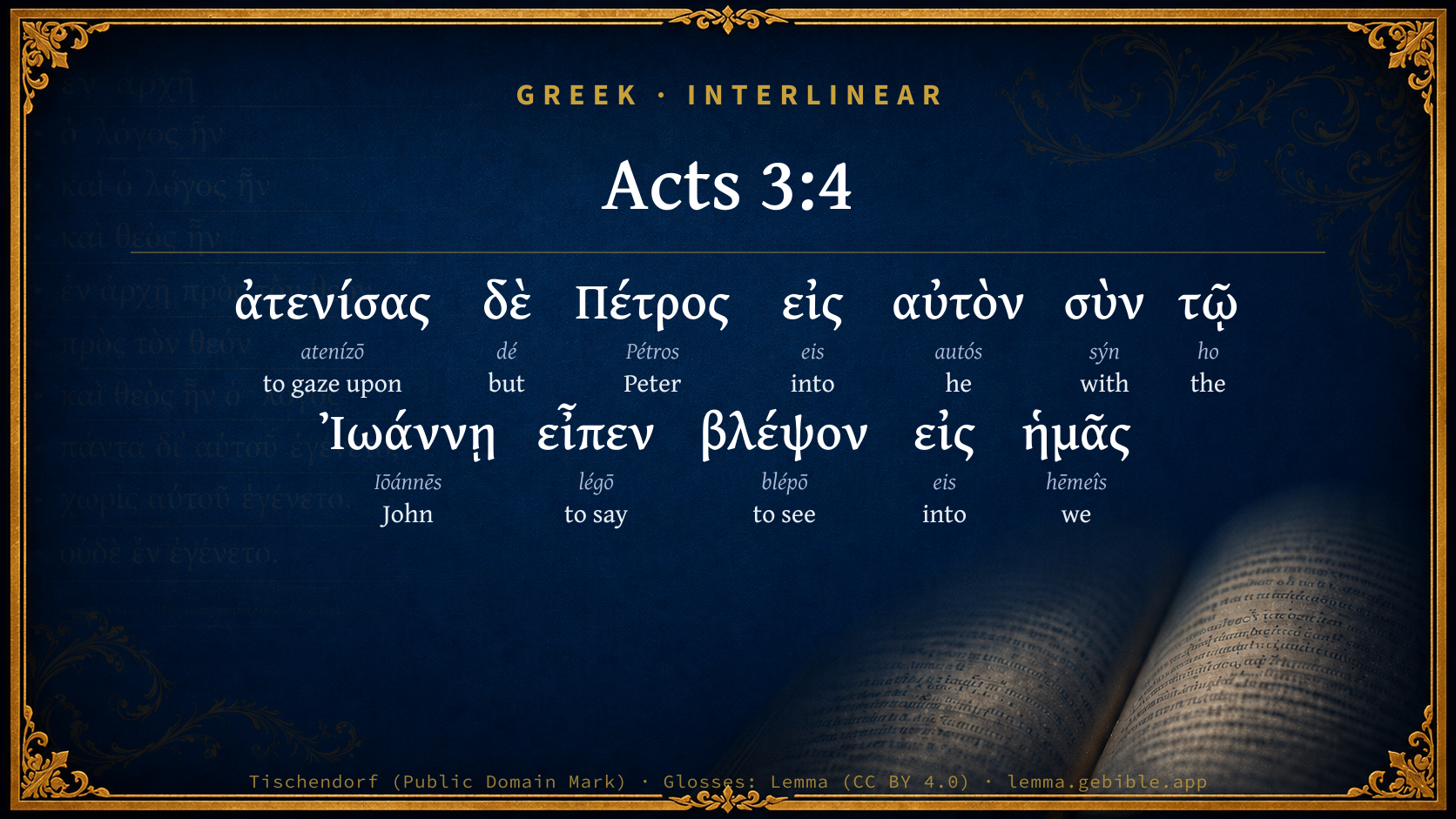
Greek (Tischendorf 8th ed.) Acts 3:4 appears in the Greek New Testament. The text above is from the Tischendorf 8th edition. Each word links to its Strong’s number and a concise gloss. Click any word for its full Thayer’s Greek Lexicon entry.
Download image
Cite this verse

Acts 3:4 (World English Bible). Public Domain. Lemma interlinear Bible study tool, https://lemma.gebible.app/v/acts/3/4.

Show BibTeX & RIS
BibTeX
RIS
English Translation
Peter, fastening his eyes on him, with John, said, "Look at us."
World English Bible · Public Domain
Download a study sheet

One document with this verse’s original text, its word-by-word gloss line, the meaning frame, cross-references with their text, attributed commentary, and full source and license credits — printable, and it pastes into notes with its structure intact.

This verse Autodidact and up

Study sheet (.html) Plain text (.txt)

A passage Seminary Student

Up to 50 verses in one chapter. A passage sheet keeps up to 6 commentary sources and 12 cross-references per verse, in the order this page ranks them, and says so on the sheet whenever that leaves anything out. Ask for a single verse and you get the Autodidact verse sheet above.

Everything on this page stays free to read, with no account — the sheet is a download of what is already on screen, not access to it.

Want to remove ads? Support Godless Engineer
Compare translations 3

The same verse in 3 English versions, stacked beneath the original-language interlinear above. Click any original word for its lexicon entry.

Each is an independent rendering of the whole verse — the interlinear is not word-aligned to these translations.

Highlighted words mark where these versions differ — a whole-verse word diff, not a word-by-word alignment.

  • World English Bible Public Domain
    Peter, fastening his eyes on him, with John, said, "Look at us."
  • King James Version Public Domain
    And Peter, fastening his eyes upon him with John, said, Look on us.
  • unfoldingWord Literal Text CC BY-SA 4.0
    But Peter, looking intently at him with John, said, “Look at us.”

unfoldingWord Literal Text — © unfoldingWord, licensed CC BY-SA 4.0. Word-aligned USFM3 via Door43 (git.door43.org/unfoldingWord/en_ult).

Versions to compare (up to 4)

3 of 4 selected

Show all 19 translations

Every available English version of this verse, each an independent rendering of the whole verse.

  • World English Bible Public Domain
    Peter, fastening his eyes on him, with John, said, "Look at us."
  • Berean Standard Bible Public Domain
    Peter looked directly at him, as did John. “Look at us!” said Peter.
  • Majority Standard Bible Public Domain
    Peter looked directly at him, as did John. “Look at us!” said Peter.
  • King James Version Public Domain
    And Peter, fastening his eyes upon him with John, said, Look on us.
  • American Standard Version (1901) Public Domain
    And Peter, fastening his eyes upon him, with John, said, Look on us.
  • Revised Version (1885) Public Domain
    And Peter, fastening his eyes upon him, with John, said, Look on us.
  • Geneva Bible (1599) Public Domain
    And Peter earnestly beholding him with Iohn, said, Looke on vs.
  • Douay-Rheims (1899) Public Domain
    But Peter with John fastening his eyes upon him, said: Look upon us.
  • Young's Literal Translation Public Domain
    And Peter, having looked stedfastly toward him with John, said, `Look toward us;'
  • Literal Standard Version CC BY-SA 4.0
    And Peter, having looked steadfastly toward him with John, said, “Look toward us”;
  • Unlocked Literal Bible CC BY-SA 4.0
    Peter, fastening his eyes upon him, with John, said, “Look at us.”
  • unfoldingWord Literal Text CC BY-SA 4.0
    But Peter, looking intently at him with John, said, “Look at us.”
  • Darby Bible Public Domain
    And Peter, looking stedfastly upon him with John, said, Look on us.
  • World Messianic Bible Public Domain
    Peter, fastening his eyes on him, with Yochanan, said, “Look at us.”
  • Webster's Bible Public Domain
    And Peter fastening his eyes upon him with John, said, Look on us.
  • Free Bible Version CC BY-SA 4.0
    Peter looked right at him. John did, too. “Look at us!” Peter said.
  • Bible in Basic English Public Domain
    And Peter, looking at him, with John, said, Keep your eyes on us.
  • Text-Critical English NT CC BY 4.0
    But Peter, along with John, looked at him intently and said, “Look at us.”
  • Tyndale New Testament (1534) Public Domain
    And Peter fastened his eyes on him with Iohn and sayde: looke on vs.

Literal Standard Version (2020), Covenant Press — licensed CC BY-SA 4.0. Text via the HelloAO Bible API (eBible.org). Unlocked Literal Bible (unfoldingWord) — licensed CC BY-SA 4.0. Text via the HelloAO Bible API (eBible.org). unfoldingWord Literal Text — © unfoldingWord, licensed CC BY-SA 4.0. Word-aligned USFM3 via Door43 (git.door43.org/unfoldingWord/en_ult). Free Bible Version, Dr. Jonathan Gallagher — licensed CC BY-SA 4.0. Text via the HelloAO Bible API (eBible.org).

Word by word

More ways to search: Search by grammar → Find every occurrence → Compare this word →

Practice this passage: Drill this verse → Learn its vocabulary →

ἀτενίσας
atenízō
G816
“to gaze upon”
Verb, Aorist, Active, Participle, Nominative, Singular, Masculine
Part of Speech
Verb
Tense
Aorist
Voice
Active
Mood
Participle
Case
Nominative
Number
Singular
Gender
Masculine
Full Thayer's Definition

Origin: from a compound of G1 (as a particle of union) and teino (to stretch)

TDNT: None

1. to fix the eyes on, gaze upon 2. to look into anything 3. metaph. to fix one's mind on one as an example
  1. δὲ dé G1161 “but” Conjunction
  2. Πέτρος Pétros G4074 “Peter” Noun, Nominative, Singular, Masculine
  3. εἰς eis G1519 “into” Preposition
  4. αὐτὸν autós G846 “he” Personal pronoun, Accusative, Singular, Masculine
  5. σὺν sýn G4862 “with” Preposition
  6. τῷ ho G3588 “the” Article, Dative, Singular, Masculine
  7. Ἰωάννῃ Iōánnēs G2491 “John” Noun, Dative, Singular, Masculine
  8. εἶπεν légō G3004 “to say” Verb, Aorist, Active, Indicative, 3rd person, Singular
  9. βλέψον blépō G991 “to see” Verb, Aorist, Active, Imperative, 2nd person, Singular
  10. εἰς eis G1519 “into” Preposition
  11. ἡμᾶς hēmeîs G2249 “we” Personal pronoun, 1st person, Accusative, Plural

About this verse

These counts appear in no published source. They are computed here, from the morphology-tagged text and Lemma’s own curated glosses. What Lemma adds →

12
words
11
distinct lemmas
Acts
section

Notable vocabulary

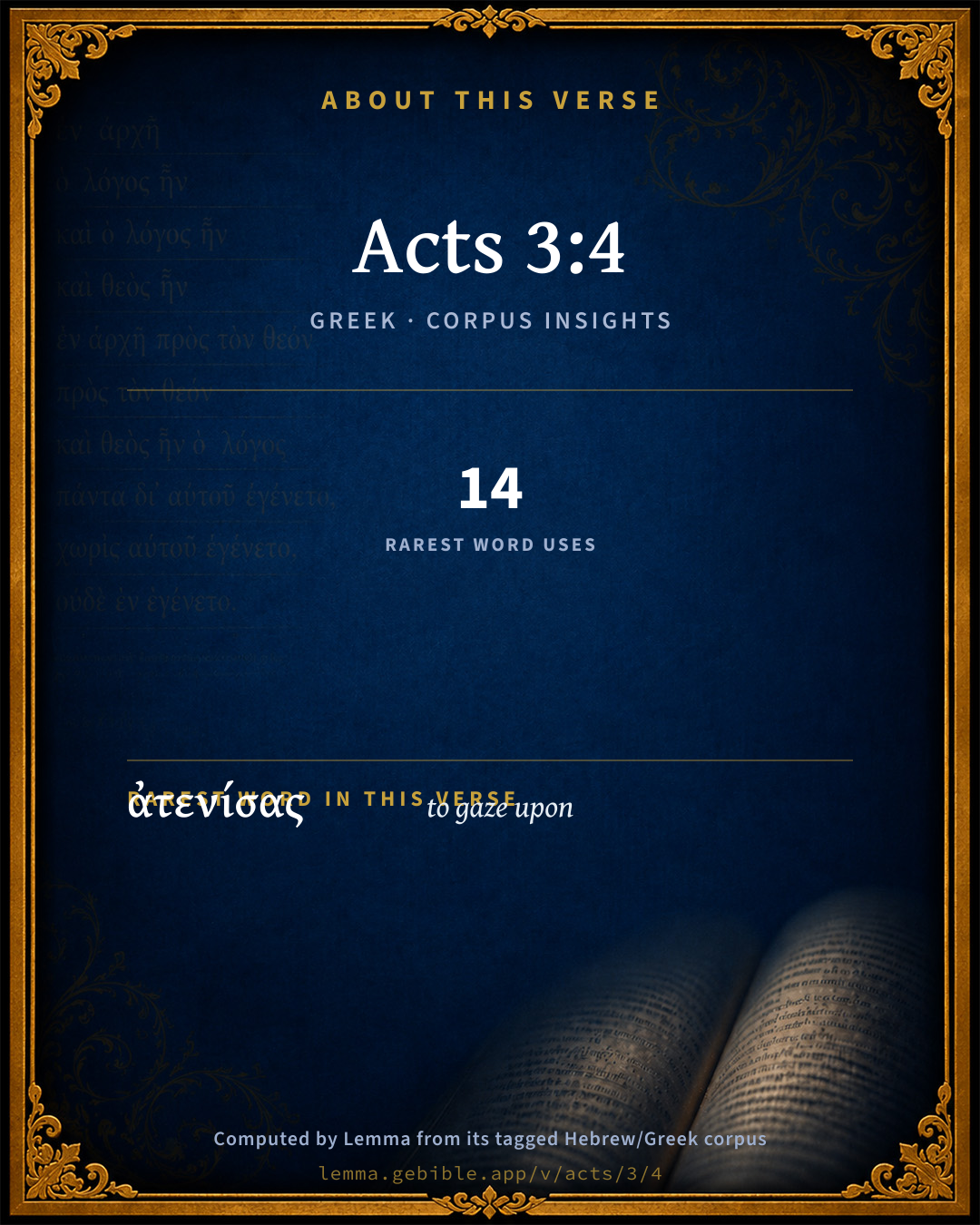
The rarest word here is ἀτενίσας to gaze upon G816 — appearing just 14 times in the whole Greek New Testament.

Shared distinctive vocabulary

ἀτενίσας to gaze upon G816 occurs in 14 verses of the Greek New Testament. Also found in:

Repetition

A word recurs within this verse:

Cross-references

5

Topical passages linked to Acts 3:4 in the Treasury of Scripture Knowledge — connected by theme and wording, ordered by reader-vote popularity; previews shown in the World English Bible.

  • Acts 14:9–10 He was listening to Paul speaking, who, fastening eyes on him, and seeing that he had faith to be made whole,
  • John 11:40 Jesus said to her, "Didn't I tell you that if you believed, you would see God's glory?"
  • Luke 4:20 He closed the book, gave it back to the attendant, and sat down. The eyes of all in the synagogue were fastened on him.
  • Acts 3:12 When Peter saw it, he responded to the people, "You men of Israel, why do you marvel at this man? Why do you fasten your eyes on us, as though by our own power or godliness we had made him walk?
  • John 5:6 When Jesus saw him lying there, and knew that he had been sick for a long time, he asked him, "Do you want to be made well?"

Cross-references courtesy of OpenBible.info (CC BY 4.0).

Commentary

Notes on Acts 3:4 from classic Christian and Jewish commentators (each source and its license shown beneath its notes). The classic Christian expositions comment on the surrounding passage and are grouped to its opening verse, so a note may address several verses; the Jewish commentaries on the Tanakh (Rashi and others) are per-verse, so they appear only where the commentator wrote on this verse.

Lemma curates 59 commentaries, every one of them public domain or Creative Commons licensed, each selected and text-cleaned for this edition rather than reprinted as found. About our sources →

The Biblical Illustrator

Joseph S. Exell

Act_3:4

And Peter, fastening his eyes upon him with John, said, Look on us.

The reciprocal gaze

The gaze was one which read character in the expression of the mans face, and discerned that he had faith to be healed (verse 16). And he, in his turn, was to look on them that he might read in their pitying looks, not only the wish to heal, but the consciousness of power to carry the wish into effect. (Dean Plumptre.)

The proper effects of the sight of misery

When thou seest misery in thy brothers face, let him see mercy in thine eye; the more the oil of mercy is:poured on him by thy pity, the more the oil in thy cruse shall be increased by thy piety. (F. Quarles.)

Magnetic influence over our fellow-creatures

You may take a lily and draw it through the sand, and it comes out clean. Nothing holds to it. You may take a magnet and draw it through, and out come the iron filings with it. The magnet knows and catches that which is germane to it--that which is susceptible to its attraction. There are some natures that are like magnets, and that touch lust in you. You do not know what it is that affects you. You feel unwashed after they are gone. There has been nothing said, and there has been nothing exactly done. It is that subtle magnetic power which feeling has on feeling. If on one instrument in the room you sound a given chord, every other instrument in that room has a tendency to sound its octave. If you go among men of strong natures there is a certain vibration in them of a feeling which is strong in you. When you have been with some persons you feel finer, you feel lifted up. And yet they have not exhorted you. There has been no magisterial instruction whatever given to you. You have drunk the wine of being, and by it you are lifted up and strengthened. (H. W. Beecher.)

The Biblical Illustrator, edited by Joseph S. Exell (c. 1880s–1900s) — public domain. Text from a community e-Sword module.

Bengel's Gnomon

Johann Albrecht Bengel

Act 3:4. Ἀτενίσας—βλέψον, fastening his eyes upon him—Look at) Great is the power of a stedfast gaze: ch. Act 13:9, “Saul set his eyes on Elymas.”

Bengel's Gnomon of the New Testament — English translation (T&T Clark, Edinburgh, 1860) — public domain. Text from a community e-Sword module.

Expositor's Greek Testament

ed. W. Robertson Nicoll

Act 3:4 . ἀτενίσας , cf. Act 1:10 . βλέψον εἰς ἡμᾶς : it has sometimes been thought that the command was given to see whether the man was a worthless beggar or not (Nösgen), or whether he was spiritually disposed for the reception of the benefit, and would show his faith (as in our Lord’s miracles of healing), or it might mean that the man’s whole attention was to be directed towards the Apostles, as he evidently only expects an alms, Act 3:5 . At the same time, as Feine remarks, the fact that the narrative does not mention that faith was demanded of the man, forms an essential contrast to the narrative often compared with it in Act 14:9 .

The Expositor's Greek Testament, edited by W. Robertson Nicoll (1897–1910) — public domain. Text from a community e-Sword module.

Jamieson, Fausset & Brown

Robert Jamieson, A. R. Fausset & David Brown

Peter fastening his eyes on him with John, said, Look on us. And he gave heed--that, through the eye, faith might be aided in its birth.

Jamieson, Fausset & Brown — Commentary Critical and Explanatory on the Whole Bible (1871) — public domain (CC PDM 1.0). Text via the HelloAO Bible API.

Adam Clarke's Commentary

Verse 4. Look on us.] He wished to excite and engage his attention that he might see what was done to produce his miraculous cure, and, it is likely, took this occasion to direct his faith to Jesus Christ. See Clarke on Ac 3:16. Peter and John probably felt themselves suddenly drawn by the Holy Spirit to pronounce the healing name in behalf of this poor man.

Adam Clarke's Commentary on the Bible (1810–1826) — public domain. Text from a community e-Sword/MySword module.

John Calvin's Commentaries

4. Look upon us. Peter doth not thus speak before he be certain of the purpose and intent of God. And surely in these words he commandeth him to hope for some singular and unwonted benefit; yet here may a question be moved, whether they had power to work miracles so often as they would? I answer, that they were ministers of God’s power in such sort, that they did attempt nothing of their own will or proper motion, but the Lord wrought by them, when he knew that it was expedient it should be so. Hereby it came to pass that they healed one and not all. Therefore, as in other things, they had the Spirit of God to be their guide and director, so also in this point. Therefore, before such time as Peter commandeth the lame man to arise, he did east and fasten his eyes upon him; this steadfast looking upon him was not without some peculiar motion of the Spirit. Hereby it cometh to pass that he speaketh so surely (and safely, without all fear) of the miracle. Furthermore, he meant by this word to provoke the lame man to receive the grace of God; yet doth he look for nothing but for an alms.

John Calvin's Commentaries (1540-1563) — public domain. Text from the Calvin Translation Society English edition (1840s-50s) via the Christian Classics Ethereal Library (ccel.org). Calvin's coverage is partial (roughly two-thirds of the Bible); uncommented books and verses are honest gaps, never fabricated. The 19th-century editor's footnotes and remarks are omitted so the notes are faithfully Calvin's own voice.

Ellicott's Commentary for English Readers

(4) Peter, fastening his eyes upon him . . .—See Notes on Luk_4:20, Act_1:10, where the same characteristic word is used. The gaze was one which read character in the expression of the man’s face, and discerned that he had faith to be healed (Act_3:16). And he, in his turn, was to look on them that he might read in their pitying looks, not only the wish to heal, but the consciousness of power to carry the wish into effect.

A Bible Commentary for English Readers, edited by Charles John Ellicott (1878–1897) — public domain. Text from a community e-Sword module.

The Cambridge Bible for Schools and Colleges

gen. ed. J. J. S. Perowne

4. And Peter, fastening his eyes upon him, &c.] And doubtless, like Paul at Lystra (Act_14:9), “perceiving that he had faith to be healed.” For the man’s first act after his cure—“he entered into the temple” (Act_3:8)—may be taken as an indication of his devout frame of mind.

The Cambridge Bible for Schools and Colleges (gen. ed. J. J. S. Perowne; Cambridge University Press, 1878–1918) — public domain. Text from a community e-Sword module.

John Gill's Exposition

And Peter fastening his eyes upon him,.... Or looking very wistly and intently at him, being, no doubt, under some uncommon impulse of the Spirit of God to take notice of him, and cure him of his disease:

with John; who was also under a like impulse at the same time; and who was equally concerned in this cure, as appears by the notice the man, when healed, took of the one, as well as the other; and by Peter's declaration, Act 3:11 as also by the following words:

said, look on us; which was said to raise his attention to them, to put him upon observing what manner of men they were, and how unlikely to perform the following cure, and to take notice of the manner in which it would be done. The Jews speak of a supernatural cure effected in such a manner, using such words; and which perhaps is told, with a view to lessen the glory of this (z).

"Elias appeared to one in the likeness of R. Chiyah Rabbah; he said to him, how does my Lord do? he replied to him, a certain tooth distresses me; he said to him, , "look on me"; and he looked on him, and put his finger on it, and he was well.''

(z) T. Hieros. Cetubot, fol. 35. 1.

John Gill's Exposition of the Whole Bible (1746–1763) — public domain (CC PDM 1.0). Text via the HelloAO Bible API.

Trapp's Complete Commentary

John Trapp

4 And Peter, fastening his eyes upon him with John, said, Look on us.

Ver. 4. Look on us] Together with this word there went forth a power, as Luk 5:17.

John Trapp, A Commentary or Exposition upon All the Books of the Old and New Testament (1647–1656) — public domain. Text from a community e-Sword module.

Albert Barnes' Notes on the Bible

Fastening his eyes - The word used here denotes “to look intently, or with fixed attention.” It is one of the special words which Luke uses (Luk 4:20; Luk 22:56; Act 1:10; Act 3:12; Act 6:15; Act 7:55; Act 10:4; etc.) 12 times in all. It is used by no other writer in the New Testament, except twice by Paul, 2Co 3:7, 2Co 3:13.

Look on us - All this Was done to fix the attention. He wished to call the attention of the man distinctly to himself, and to what he was about to do. It was also done that the man might be fully apprised that his restoration to health came from him.

Albert Barnes' Notes on the Bible (1834–1885) — public domain. Text from a community e-Sword/MySword module.

Haydock's Catholic Bible Commentary

Look upon us. St. Peter said this to raise his attention and expectation, but the poor man thought of nothing but an alms. (Witham)

George Leo Haydock (1774–1849), Haydock's Catholic Family Bible and Commentary, 1859 edition — public domain. Excludes Psalms (Douay-Rheims chapter numbering differs from Protestant) and Deuterocanonical books (Catholic canon only).

Matthew Poole's English Annotations

The eye affects the heart, and speaks the compassion he had of this poor man, whom he did not disdain thoroughly and seriously to behold: he excites the lame man’s expectation, and requires his attention, that he might the more mind the manner and means of his cure, and be the better prepared to give God the glory of it.

Matthew Poole's English Annotations on the Holy Bible (1683–1685) — public domain. Text from a community e-Sword/MySword module.

Whedon's Commentary on the Bible

Daniel D. Whedon

4. Peter—The junior apostle is reverently silent, (John, indeed, never speaks in the book of Acts,) while his senior alone speaks and performs. How graceful is reverence for honored age even in most honored youth!

Fastening his eyes—As if conscious of being prompted, perhaps even impelled, by the Spirit, with a power to perform a miracle upon this perfectly hopeless lame-born.

Look on us—Requiring, at least, a slight conditional response from the lame-born. And this whole solemn process served to mark and demonstrate the proceeding of cause and effect, showing that there was no mere accident, but the intended result of an intentional putting forth of power. (See note on Mar_8:22.) This gaze may, however, be but the glance of the spirit of discerning whether or not the man had faith to be healed. Every scientific physician knows that faith predisposes the patient’s system toward health. “It is,” says the celebrated physiologist, Dr. Carpenter, “to a state of fixed expectation with implicit confidence that we may fairly attribute most, if not all, the cures which have been worked through what has been popularly termed the ‘imagination.’ A couple of bread pills will produce copious purgation, and a dose of red poppy syrup will serve as a powerful narcotic, if the patient have entertained a sufficiently confident expectation of such a result.” This fact, no doubt, accounts completely for a large amount of the miracles of healing in the later Christian Church, especially in nervous cases. The preternatural is the avenue through which the supernatural may reach us. And we may even say that our Lord and his apostles often used the preternatural receptivity of the patient, arising from faith, to pour in upon the patient the supernatural force that worked the miracle. And thus was shadowed the healing of the soul through a similar, yet higher, willing, and expecting spiritual faith.

Paul, at Lystra, selected the cripple for a miracle, “beholding him and perceiving he had faith to be healed,” and, reciprocally, that he himself possessed the miraculous power. So with the elders of the Church, “the prayer of faith,” faith both of the elders and the patient, “shall save the sick.” This gift was a preternaturalism, but hardly, perhaps, a miracle. (See note on Act_8:24.) That power, we doubt not, still exists in the Church, were it faithfully exerted. The profoundly pious physician often possesses, perhaps, a means of health-giving of which he is unaware. Yet nothing less than true, full miracle could be supposed to restore sight to the blind-born, as did Jesus, or walking to the lame-born, as Peter here, or the cripple-born as Paul at Lystra. It is for this reason that the congenital character of the ailment is carefully stated.

Daniel D. Whedon (gen. ed.), Commentary on the Old and New Testaments (1874–1909) — public domain. Text from a community e-Sword module.

The Pulpit Commentary

Fastening his eyes (ajtenisav eijv aujton). Comp. san Luk_4:20, "The eyes of all were fastened upon him (h ajtenizontev);" and Act_22:5-6, "looking steadfastly." St. Luke also uses the phrase in Act_1:10 Act_3:12 Act_6:15 Act_7:55; but it is found nowhere else in the New Testament except 2Co_3:7, 2Co_3:13.

The Pulpit Commentary (1880–1919), ed. H.D.M. Spence-Jones & Joseph S. Exell — public domain. Text from a community e-Sword module.

Kretzmann's Popular Commentary

Paul E. Kretzmann

The miracle of healing:

v. 4. And Peter, fastening his eyes upon him with John, said, Look on us.

v. 5. And he gave heed unto them, expecting to receive something of them.

v. 6. Then Peter said, Silver and gold have I none; but such as I have give I thee: In the name of Jesus Christ of Nazareth rise up and walk.

v. 7. And he took him by the right hand and lifted him up; and immediately his feet and ankle-bones received strength.

v. 8. And he, leaping up, stood, and walked, and entered with them into the Temple, walking, and leaping, and praising God.

v. 9. And all the people saw him walking and praising God.

v. 10. And they knew that it was he which sat for alms at the Beautiful Gate of the Temple; and they were filled with wonder and amazement at that which had happened unto him.

v. 11. And as the lame man which was healed held Peter and John, all the people ran together unto them in the porch that is called Solomon’s, greatly wondering.

The attention of the apostles having thus been directed to the beggar, whom they otherwise might have passed, as they probably had done scores of times, Peter looked at him very intently. His heart was deeply moved at the helpless and pitiable condition of the cripple, and his earnest gaze may have held something of that wonderful sympathy which had so often shone forth from his Master’s face. Then he asked the beggar to look at him and John, with the intention of exciting his curiosity and attention, in order that the man might at once be conscious of the source of the miraculous cure. And as the cripple concentrated his attention upon the two apostles, expecting, of course, to receive some gift from them, Peter simply, but impressively, said to him: Silver and gold have I none; these he did not number among his possessions, thus sharing the condition of his Lord and of many servants of the Lord since his time. Worldly belongings were not included in his treasures; but what he did have was sure and lasting. And this Peter was willing to give, to share with the poor man. The power to perform miracles for the sake of establishing the Gospel had been given to the apostles, and Peter proposed to use this power for the healing of this unfortunate cripple. And so his command rang out: In the name of Jesus Christ of Nazareth get up and walk. Peter’s power to perform miracles was not absolute, he held it only by the command, in the power, and in the interest of his Lord and Master Jesus, and could use it only in His name. And then Peter took hold of the man’s hand, grasping him firmly to give him confidence, and lifted him up, drew him upright. The miracle was performed at once. The man’s feet became solid under his weight and his ankles firm; both bones and muscles received not only the strength, but also the ability to use this strength properly. Even while Peter still had hold of his hand, he jumped up; he stood upright first, as if to test the weight on his feet, or to feel the sensation of maintaining an upright position. And then he freely walked about, with no trace of lameness; he even went with Peter and John into the Temple, into the Court of Israel, the place where the men worshiped. And again and again, in the fullness of his joy, he walked about and even leaped, as though he felt constrained to convince himself that he was not dreaming, but that the miracle was a fact. His worshiping on that afternoon was done from the depth of a heart overflowing with thankfulness, wherefore he also praised God, giving all glory and honor to Him, to whom Peter had referred in his command of healing. All this, of course, was not done without attracting notice. Great numbers of people were at this time entering the Temple for the evening sacrifice, and they recognized the man that was walking about and leaping in the joy of his heart as the beggar whom they had often seen at the gate of the Temple. The conclusion in the matter was evident. A miracle had been performed which agitated and shocked them, filled them with wonder and amazement. Their astonishment was mixed with admiration and awe verging almost upon stupor. But there could be no doubt as to the actuality of the happening. For there was the man clinging to the apostles as his benefactors; there were the expressions of his joy and gratitude; there was the fact that he could walk and leap. It was not long, therefore, before all the people that had come into the Temple, forgetting the evening sacrifice and the time of incense, crowded about Peter and John, who had now come out into the beautiful portico or hall known as Solomon’s Porch. Note: Every one that has experienced the help of the Lord should give all due praise and thanks to Him and confess His blessings before men. Mark also: Though the gifts of miracles and extraordinary performances of miracles were a special distinction of the apostolic Church, yet the Lord’s hand is not shortened for the performing of miracles in the Church. The miracles of His grace, above all, are of such a nature as to provoke the admiration of even the children of the world at times.

Paul E. Kretzmann, Popular Commentary of the Bible (1921–1924) — public domain. Text from a community e-Sword module.

McGarvey & Pendleton's Commentaries

J. W. McGarvey

See notes on verse 1

J. W. McGarvey (with Philip Y. Pendleton), Commentaries on the New Testament (The Fourfold Gospel, 1914; Acts; and the epistles) — public domain. Text from a community e-Sword/MySword module.

unfoldingWord translationNotes

Door43 World Missions Community

Peter, fastening his eyes upon him, with John, said

Both Peter and John looked at the man, but only Peter spoke.

fastening his eyes upon him

Possible meanings are 1) "looking directly at him" or 2) "looking intently at him" (See: Idiom)

The lame man looked at them

Here the word "looked" means to pay attention to something. AT: "The lame man paid close attention to them"

Silver and gold

These words refer to money. (See: Metonymy)

what I do have

It is understood that Peter has the ability to heal the man. (See: Assumed Knowledge and Implicit Information)

In the name of Jesus Christ

Here the word "name" refers to power and authority. AT: "With the authority of Jesus Christ" (See: Metonymy)

translationWords

Peter

John (the apostle)

receive

silver

gold

Jesus

Nazareth

unfoldingWord translationNotes — © Distant Shores Media and the Door43 World Missions Community, licensed CC BY-SA 4.0. Source: git.door43.org/Door43/en_tn.

Cambridge Greek Testament for Schools and Colleges

4. ἀτενίσας δέ. So of St Paul in a similar case (Act 14:9). And doubtless too here Peter ‘perceived that the man had faith to be healed.’ For his first act after his cure—‘he entered into the temple’—bespeaks a devout frame of mind, and we may judge that though his infirmity had kept him at the gate for forty years, he had felt earnestly a longing to enter.

Cambridge Greek Testament for Schools and Colleges (Cambridge University Press, 1896; 21 vols, various authors incl. Carr, Maclear, Plummer, Farrar, Lumby, Moule, M. R. James, Simcox) — public domain. Text from a community e-Sword module.

Alford’s Greek Testament

Henry Alford

4. βλέψον εἰς ἡμᾶς] Calvin’s note is important: ‘Non ita loquitur Petrus quin de consilio Dei certus sit: et certe his verbis singulare aliquod et insolitum beneficium sperare jubet. Quæri tamen potest, an facultatem habuerint edendi miracula quoties liberet. Respondeo, sic ministros fuisse divinæ virtutis, ut nihil suo arbitrio vel proprio motu tentarint, sed Dominus per ipsos egerit quum ita expedire noverat. Hinc factum est ut unum sanarint, non autem promiscue omnes. Ergo, quemadmodum in aliis rebus ducem et directorem habebant Dei Spiritum, ita etiam in hac parte. Ideo priusquam claudum surgere jubeat Petrus, conjecit in eum et defixit oculos. Talis intuitus non carebat peculiari Spiritus motu. Hinc fit ut tam secure de miraculo pronuntiet. Porro, excitare hoc verbo claudum voluit ad recipiendam Dei gratiam: ille tamen nihil quam eleemosynam exspectat.’

Henry Alford, The Greek Testament (1849–1861) — public domain. Text from a community e-Sword module.

Vincent's Word Studies in the New Testament

Marvin R. Vincent

Fastening his eyes [ατενισας] . See on Luk 4:20; and compare Act 1:10.

Look [βλεψον] . Attentively. See on Mt 7:3.

Marvin R. Vincent, Word Studies in the New Testament (1887–1900) — public domain. Text from a community e-Sword/MySword module.

Lesson kit

Teaching starters — assembled from the data on this page, not authored interpretation. Every prompt links to the verse data it draws on. Edit before teaching.

Acts, in the Acts, opens this verse with 12 words (11 distinct Greek lemmas). Its most distinctive word is atenízō (“to gaze upon”). A historical commentator’s framing appears above. Read the whole chapter for the surrounding context.

Discussion questions

  1. How does “to gaze upon” (atenízō) shape what this verse is saying?
  2. Luke 4:20 shares the word «to gaze upon» with this verse. How do the two illuminate each other?
  3. “into” occurs 2× in this one verse. What is the effect of the repetition?
  4. The translations on this page render this verse differently — a whole-verse word diff, not a word-by-word alignment. What might account for the different wordings?
  5. Reading how The Biblical Illustrator and Bengel's Gnomon read this verse, where do the two commentators agree and where do they part?

Things to notice

  • These translations choose different wording for 5 words in this verse.
  • “into” occurs 2× in this single verse.
  • 11 distinct Greek lemmas span 12 words in this verse.

Reading settings

Reading text

Shown beneath each verse's original-language words.

Old Testament
Old Testament edition

Read the OT as the Masoretic Hebrew (MT) or the Greek Septuagint (LXX).

English shown for the Greek Septuagint (in the Hebrew ↔ Greek comparison).

Comparing translations? Open the Compare panel on any verse page to stack up to four side by side.