

Acts 6:1
Greek (Tischendorf 8th ed.) Acts 6:1 appears in the Greek New Testament. The text above is from the Tischendorf 8th edition. Each word links to its Strong’s number and a concise gloss. Click any word for its full Thayer’s Greek Lexicon entry.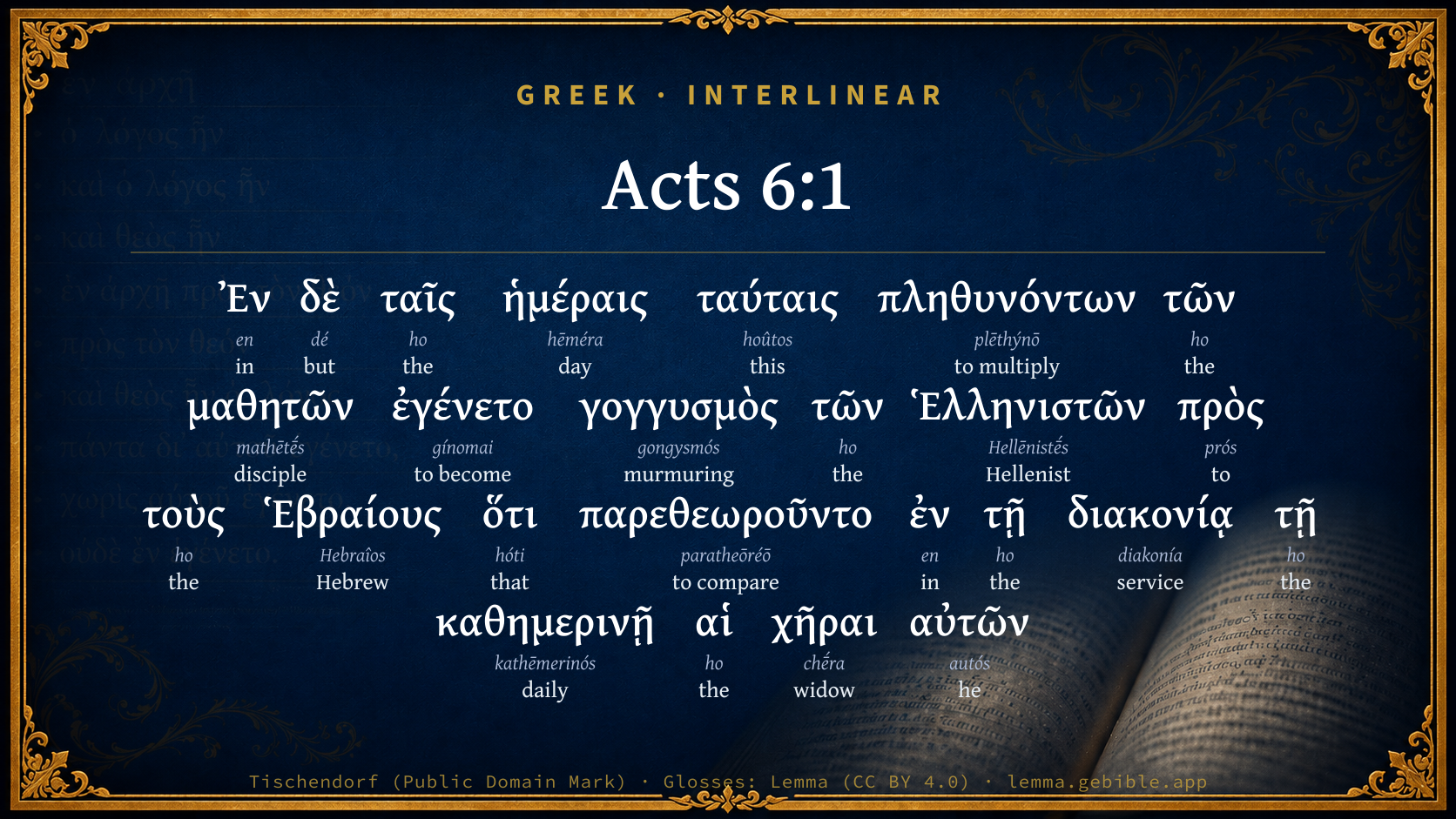
Now in those days, when the number of the disciples was multiplying, a complaint arose from the Grecian Jews against the Hebrews because their widows were neglected in the daily service.
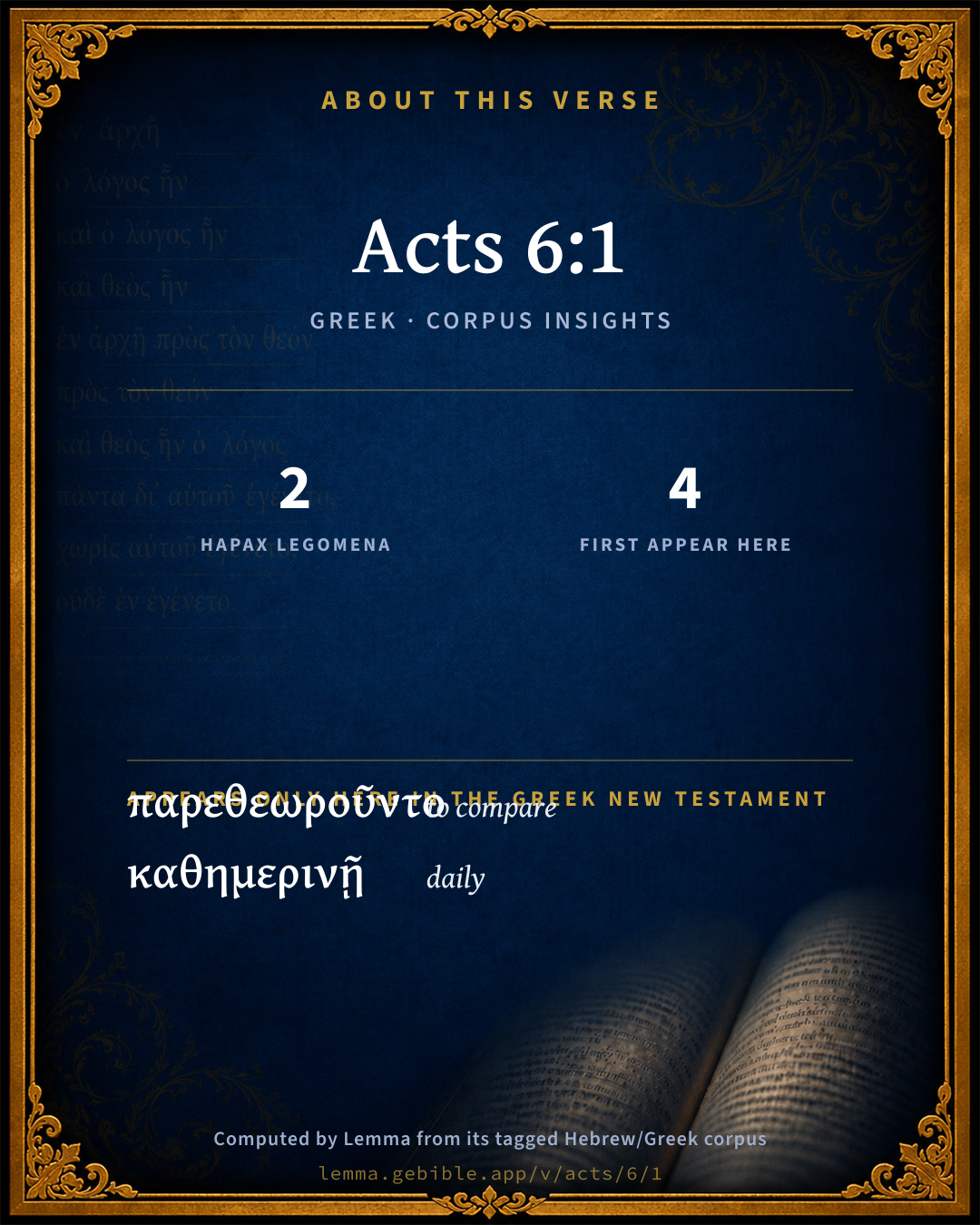
- 2 hapax legomena — only here in the Greek New Testament
- 4 first appearances in the Greek New Testament
Download a study sheet
One document with this verse’s original text, its word-by-word gloss line, the meaning frame, cross-references with their text, attributed commentary, and full source and license credits — printable, and it pastes into notes with its structure intact.
This verse Autodidact and up
A passage Seminary Student
Up to 50 verses in one chapter. A passage sheet keeps up to 6 commentary sources and 12 cross-references per verse, in the order this page ranks them, and says so on the sheet whenever that leaves anything out. Ask for a single verse and you get the Autodidact verse sheet above.
Everything on this page stays free to read, with no account — the sheet is a download of what is already on screen, not access to it.
Compare translations 3
The same verse in 3 English versions, stacked beneath the original-language interlinear above. Click any original word for its lexicon entry.
Each is an independent rendering of the whole verse — the interlinear is not word-aligned to these translations.
Highlighted words mark where these versions differ — a whole-verse word diff, not a word-by-word alignment.
-
World English Bible Public Domain
Now in those days, when the number of the disciples was multiplying, a complaint arose from the Grecian Jews against the Hebrews because their widows were neglected in the daily service.
-
King James Version Public Domain
And in those days, when the number of the disciples was multiplied, there arose a murmuring of the Grecians against the Hebrews, because their widows were neglected in the daily ministration.
-
unfoldingWord Literal Text CC BY-SA 4.0
Now in those days, when the disciples were multiplying, a complaint by the Hellenists happened against the Hebrews, because their widows were being overlooked in the daily serving.
unfoldingWord Literal Text — © unfoldingWord, licensed CC BY-SA 4.0. Word-aligned USFM3 via Door43 (git.door43.org/unfoldingWord/en_ult).
Show all 19 translations
Every available English version of this verse, each an independent rendering of the whole verse.
-
World English Bible Public Domain
Now in those days, when the number of the disciples was multiplying, a complaint arose from the Grecian Jews against the Hebrews because their widows were neglected in the daily service.
-
Berean Standard Bible Public Domain
In those days when the disciples were increasing in number, the Grecian Jews among them began to grumble against the Hebraic Jews because their widows were being overlooked in the daily distribution of food.
-
Majority Standard Bible Public Domain
In those days when the disciples were increasing in number, the Grecian Jews among them began to grumble against the Hebraic Jews because their widows were being overlooked in the daily distribution of food.
-
King James Version Public Domain
And in those days, when the number of the disciples was multiplied, there arose a murmuring of the Grecians against the Hebrews, because their widows were neglected in the daily ministration.
-
American Standard Version (1901) Public Domain
Now in these days, when the number of the disciples was multiplying, there arose a murmuring of the Grecian Jews against the Hebrews, because their widows were neglected in the daily ministration.
-
Revised Version (1885) Public Domain
Now in these days, when the number of the disciples was multiplying, there arose a murmuring of the Grecian Jews against the Hebrews, because their widows were neglected in the daily ministration.
-
Geneva Bible (1599) Public Domain
And in those dayes, as the nomber of ye disciples grewe, there arose a murmuring of the Grecians towards ye Hebrewes, because their widowes were neglected in the dayly ministring.
-
Douay-Rheims (1899) Public Domain
And in those days, the number of the disciples increasing, there arose a murmuring of the Greeks against the Hebrews, for that their widows were neglected in the daily ministration.
-
Young's Literal Translation Public Domain
And in these days, the disciples multiplying, there came a murmuring of the Hellenists at the Hebrews, because their widows were being overlooked in the daily ministration,
-
Literal Standard Version CC BY-SA 4.0
And in these days, the disciples multiplying, there came a murmuring of the Hellenists at the Hebrews, because their widows were being overlooked in the daily ministry,
-
Unlocked Literal Bible CC BY-SA 4.0
Now in these days, when the number of the disciples was multiplying, a complaint by the Grecian Jews began against the Hebrews, because their widows were being overlooked in the daily distribution of food.
-
unfoldingWord Literal Text CC BY-SA 4.0
Now in those days, when the disciples were multiplying, a complaint by the Hellenists happened against the Hebrews, because their widows were being overlooked in the daily serving.
-
Darby Bible Public Domain
But in those days, the disciples multiplying in number, there arose a murmuring of the Hellenists against the Hebrews because their widows were overlooked in the daily ministration.
-
World Messianic Bible Public Domain
Now in those days, when the number of the disciples was multiplying, a complaint arose from the Hellenists against the Hebrews, because their widows were neglected in the daily service.
-
Webster's Bible Public Domain
And in those days, when the number of the disciples was multiplied, there arose a murmuring of the Grecians against the Hebrews, because their widows were neglected in the daily ministration.
-
Free Bible Version CC BY-SA 4.0
At this time, when the number of believers was increasing rapidly, the Greek-speaking believers started arguing with the Aramaic-speaking believers. They complained that their widows were being discriminated against in the daily distribution of food.
-
Bible in Basic English Public Domain
Now in those days, when the number of the disciples was increasing, protests were made by the Greek Jews against the Hebrews, because their widows were not taken care of in the distribution of food every day.
-
Text-Critical English NT CC BY 4.0
In those days, as the disciples increased in number, a complaint arose against the Hebrews on the part of the Hellenists that their widows were being overlooked in the daily distribution of food.
-
Tyndale New Testament (1534) Public Domain
In those dayes as the nombre of the disciples grewe ther arose a grudge amonge the Grekes agaynst the Ebrues because their wyddowes were despysed in the dayly mynystracion.
Literal Standard Version (2020), Covenant Press — licensed CC BY-SA 4.0. Text via the HelloAO Bible API (eBible.org). Unlocked Literal Bible (unfoldingWord) — licensed CC BY-SA 4.0. Text via the HelloAO Bible API (eBible.org). unfoldingWord Literal Text — © unfoldingWord, licensed CC BY-SA 4.0. Word-aligned USFM3 via Door43 (git.door43.org/unfoldingWord/en_ult). Free Bible Version, Dr. Jonathan Gallagher — licensed CC BY-SA 4.0. Text via the HelloAO Bible API (eBible.org).
Word by word
More ways to search: Search by grammar → Find every occurrence → Compare this word →
Practice this passage: Drill this verse → Learn its vocabulary →
- Appears 1× in the Greek New Testament
- First appears here
- Part of Speech
- Verb
- Tense
- Imperfect
- Voice
- Passive
- Mood
- Indicative
- Person
- 3rd person
- Number
- Plural
Full Thayer's Definition
- Ἐν en G1722 “in” Preposition
- δὲ dé G1161 “but” Conjunction
- ταῖς ho G3588 “the” Article, Dative, Plural, Feminine
- ἡμέραις hēméra G2250 “day” Noun, Dative, Plural, Feminine
- ταύταις hoûtos G3778 “this” Demonstrative pronoun, Dative, Plural, Feminine
- πληθυνόντων plēthýnō G4129 “to multiply” Verb, Present, Active, Participle, Genitive, Plural, Masculine
- τῶν ho G3588 “the” Article, Genitive, Plural, Masculine
- μαθητῶν mathētḗs G3101 “disciple” Noun, Genitive, Plural, Masculine
- ἐγένετο gínomai G1096 “to become” Verb, Aorist, Middle deponent, Indicative, 3rd person, Singular
- γογγυσμὸς gongysmós G1112 “murmuring” Noun, Nominative, Singular, Masculine
- τῶν ho G3588 “the” Article, Genitive, Plural, Masculine
- Ἑλληνιστῶν Hellēnistḗs G1675 “Hellenist” Noun, Genitive, Plural, Masculine
- πρὸς prós G4314 “to” Preposition
- τοὺς ho G3588 “the” Article, Accusative, Plural, Masculine
- Ἑβραίους Hebraîos G1445 “Hebrew” Adjective, Accusative, Plural, Masculine
- ὅτι hóti G3754 “that” Conjunction
- παρεθεωροῦντο paratheōréō G3865 “to compare” Verb, Imperfect, Passive, Indicative, 3rd person, Plural
- ἐν en G1722 “in” Preposition
- τῇ ho G3588 “the” Article, Dative, Singular, Feminine
- διακονίᾳ diakonía G1248 “service” Noun, Dative, Singular, Feminine
- τῇ ho G3588 “the” Article, Dative, Singular, Feminine
- καθημερινῇ kathēmerinós G2522 “daily” Adjective, Dative, Singular, Feminine
- αἱ ho G3588 “the” Article, Nominative, Plural, Feminine
- χῆραι chḗra G5503 “widow” Noun, Nominative, Plural, Feminine
- αὐτῶν autós G846 “he” Personal pronoun, Genitive, Plural, Masculine
About this verse
These counts appear in no published source. They are computed here, from the morphology-tagged text and Lemma’s own curated glosses. What Lemma adds →
- 25
- words
- 18
- distinct lemmas
- Acts
- section
Notable vocabulary
2 hapax legomena — words that appear only here in the entire Greek New Testament:
First appearance in Scripture
These words make their first canonical appearance in the Greek New Testament here:
Shared distinctive vocabulary
Ἑλληνιστῶν Hellenist G1675 occurs in 2 verses of the Greek New Testament. Also found in:
Cross-references
33Topical passages linked to Acts 6:1 in the Treasury of Scripture Knowledge — connected by theme and wording, ordered by reader-vote popularity; previews shown in the World English Bible.
- Acts 2:41 Then those who gladly received his word were baptized. There were added that day about three thousand souls.
- Acts 4:35 and laid them at the apostles' feet, and distribution was made to each, according as anyone had need.
- Acts 2:47 praising God, and having favor with all the people. The Lord added to the assembly day by day those who were being saved.
- Acts 6:7 The word of God increased and the number of the disciples multiplied in Jerusalem exceedingly. A great company of the priests were obedient to the faith.
- Acts 9:39 Peter got up and went with them. When he had come, they brought him into the upper chamber. All the widows stood by him weeping, and showing the coats and garments which Dorcas had made while she was with them.
- James 5:9 Don't grumble, brothers, against one another, so that you won't be judged. Behold, the judge stands at the door.
- Hebrews 13:1 Let brotherly love continue.
- Matthew 23:13 "Woe to you, scribes and Pharisees, hypocrites! For you devour widows' houses, and as a pretense you make long prayers. Therefore you will receive greater condemnation.
- Acts 2:45 They sold their possessions and goods, and distributed them to all, according as anyone had need.
- Acts 4:4 But many of those who heard the word believed, and the number of the men came to be about five thousand.
- Acts 5:14 More believers were added to the Lord, multitudes of both men and women.
- Acts 9:41 He gave her his hand, and raised her up. Calling the saints and widows, he presented her alive.
- Acts 11:20 But there were some of them, men of Cyprus and Cyrene, who, when they had come to Antioch, spoke to the Greeks, preaching the Lord Jesus.
- Philippians 3:5 circumcised the eighth day, of the stock of Israel, of the tribe of Benjamin, a Hebrew of Hebrews; concerning the law, a Pharisee;
- Psalms 72:16 There shall be abundance of grain throughout the land. Its fruit sways like Lebanon. Let it flourish, thriving like the grass of the field.
- Isaiah 1:17 Learn to do well. Seek justice, Relieve the oppressed, Judge the fatherless, Plead for the widow."
- Isaiah 27:6 In days to come shall Jacob take root; Israel shall blossom and bud; and they shall fill the surface of the world with fruit.
- Jeremiah 30:19 Out of them shall proceed thanksgiving and the voice of those who make merry: and I will multiply them, and they shall not be few; I will also glorify them, and they shall not be small.
- Acts 9:29 preaching boldly in the name of the Lord. He spoke and disputed against the Grecian Jews, but they were seeking to kill him.
- 2 Corinthians 11:22 Are they Hebrews? So am I. Are they Israelites? So am I. Are they the seed of Abraham? So am I.
- Deuteronomy 24:19–21 When you reap your harvest in your field, and have forgot a sheaf in the field, you shall not go again to get it: it shall be for the foreigner, for the fatherless, and for the widow; that Yahweh your God may bless you in all the work of your hands.
- Deuteronomy 26:12 When you have made an end of tithing all the tithe of your increase in the third year, which is the year of tithing, then you shall give it to the Levite, to the foreigner, to the fatherless, and to the widow, that they may eat within your gates, and be filled.
- Job 29:13 The blessing of him who was ready to perish came on me, And I caused the widow's heart to sing for joy.
- Job 31:16 "If I have withheld the poor from their desire, Or have caused the eyes of the widow to fail,
- Psalms 110:3 Your people offer themselves willingly in the day of your power, in holy array. Out of the womb of the morning, you have the dew of your youth.
- Ezekiel 22:7 In you have they set light by father and mother; in the midst of you have they dealt by oppression with the foreigner; in you have they wronged the fatherless and the widow.
- Malachi 3:5 I will come near to you to judgment; and I will be a swift witness against the sorcerers, and against the adulterers, and against the perjurers, and against those who oppress the hireling in his wages, the widow, and the fatherless, and who deprive the foreigner of justice, and don't fear me," says Yahweh of Hosts.
- Acts 5:28 saying, "Didn't we strictly charge you not to teach in this name? Behold, you have filled Jerusalem with your teaching, and intend to bring this man's blood on us."
- 1 Corinthians 10:10 Neither grumble, as some of them also grumbled, and perished by the destroyer.
- 1 Timothy 5:4–5 But if any widow has children or grandchildren, let them learn first to show piety towards their own family, and to repay their parents, for this is acceptable in the sight of God.
- 1 Timothy 5:9 Let no one be enrolled as a widow under sixty years old, having been the wife of one man,
- James 1:27 Pure religion and undefiled before our God and Father is this: to visit the fatherless and widows in their affliction, and to keep oneself unstained by the world.
- James 4:5 Or do you think that the Scripture says in vain, "The Spirit who lives in us yearns jealously"?
Cross-references courtesy of OpenBible.info (CC BY 4.0).
Lesson kit
Teaching starters — assembled from the data on this page, not authored interpretation. Every prompt links to the verse data it draws on. Edit before teaching.
Acts, in the Acts, opens this verse with 25 words (18 distinct Greek lemmas). Its most distinctive word is paratheōréō (“to compare”). A historical commentator’s framing appears above. Read the whole chapter for the surrounding context.
Discussion questions
- The word paratheōréō carries the sense “to compare.” How does it shape the verse?
- This verse holds 2 words here found nowhere else in the Greek New Testament. What might the rare words draw attention to?
- 4 words here appear for the first time in Scripture. What is being introduced at this debut?
- Acts 9:29 shares the word «Hellenist» with this verse. How do the two illuminate each other?
- “the” occurs 7× in this one verse. What is the effect of the repetition?
- These translations render this verse differently; the difference is in the English rendering, not the original. What questions does that raise?
- Reading how Matthew Henry's Commentary and The Cambridge Bible for Schools and Colleges read this verse, where do the two commentators agree and where do they part?
Things to notice
- 2 words in this verse appear nowhere else in the Greek New Testament.
- 4 words make their first canonical appearance in Scripture here.
- These translations choose different wording for 19 words in this verse.
- “the” occurs 7× in this single verse.
- 18 distinct Greek lemmas span 25 words in this verse.
Commentary
Notes on Acts 6:1 from classic Christian and Jewish commentators (each source and its license shown beneath its notes). The classic Christian expositions comment on the surrounding passage and are grouped to its opening verse, so a note may address several verses; the Jewish commentaries on the Tanakh (Rashi and others) are per-verse, so they appear only where the commentator wrote on this verse.
Lemma curates 59 commentaries, every one of them public domain or Creative Commons licensed, each selected and text-cleaned for this edition rather than reprinted as found. About our sources →
Matthew Henry's Commentary
Matthew Henry's Commentary on the Whole Bible (1708–1710) — public domain (CC PDM 1.0). Text via the HelloAO Bible API.
The Cambridge Bible for Schools and Colleges
gen. ed. J. J. S. Perowne
The Cambridge Bible for Schools and Colleges (gen. ed. J. J. S. Perowne; Cambridge University Press, 1878–1918) — public domain. Text from a community e-Sword module.
The Biblical Illustrator
Joseph S. Exell
The Biblical Illustrator, edited by Joseph S. Exell (c. 1880s–1900s) — public domain. Text from a community e-Sword module.
Joseph Benson's Commentary
Joseph Benson's Commentary on the Old and New Testaments (1811–1818) — public domain. Text from a community e-Sword module.
The Preacher's Complete Homiletical Commentary
Joseph S. Exell (gen. ed.)
The Preacher's Complete Homiletical Commentary (gen. ed. Joseph S. Exell; Funk & Wagnalls, c. 1892) — public domain (pre-1929). A full-Bible homiletical/sermon-outline anthology covering 65 of 66 books (2 John is absent from the source module). Text from a community e-Sword module.
Lange's Commentary on the Holy Scriptures
Lange's Commentary on the Holy Scriptures (Critical, Doctrinal, and Homiletical), ed. John Peter Lange, English translation edited by Philip Schaff (1864–1880) — public domain. Text from a community e-Sword module.
The Annotated Bible
Arno C. Gaebelein
Arno C. Gaebelein, The Annotated Bible (1913–1922) — public domain. Text from a community e-Sword module.
The Sermon Bible
William Robertson Nicoll (ed.)
The Sermon Bible, ed. William Robertson Nicoll (1888–1900) — public domain. Text from a community e-Sword module.
Burkitt's Expository Notes on the New Testament
William Burkitt
William Burkitt's Expository Notes on the New Testament (1700–1703) — public domain. Text from a community e-Sword module.
The Expositor's Bible
William Robertson Nicoll, ed., The Expositor's Bible (London: Hodder & Stoughton, 1887–1910) — public domain. 65 of 66 books (1 Corinthians is not separately keyed, as that volume carries no machine-parseable verse references); section-level commentary keyed to the opening verse. Introductory and overview sections not keyed to a specific passage are excluded.
Tyndale Open Study Notes
Tyndale Open Resources
Tyndale Open Study Notes — © Tyndale Open Resources, licensed CC BY-SA 4.0. Text via the HelloAO Bible API.
Bengel's Gnomon
Johann Albrecht Bengel
Bengel's Gnomon of the New Testament — English translation (T&T Clark, Edinburgh, 1860) — public domain. Text from a community e-Sword module.
Meyer's Critical & Exegetical Commentary
Heinrich August Wilhelm Meyer
Meyer — Critical and Exegetical Commentary on the New Testament — English translation by Peter Christie, edited by Frederick Crombie (T&T Clark, 1880) — public domain. Text from a community e-Sword module.
Expositor's Greek Testament
ed. W. Robertson Nicoll
The Expositor's Greek Testament, edited by W. Robertson Nicoll (1897–1910) — public domain. Text from a community e-Sword module.
Cambridge Greek Testament for Schools and Colleges
Cambridge Greek Testament for Schools and Colleges (Cambridge University Press, 1896; 21 vols, various authors incl. Carr, Maclear, Plummer, Farrar, Lumby, Moule, M. R. James, Simcox) — public domain. Text from a community e-Sword module.
Alford’s Greek Testament
Henry Alford
Henry Alford, The Greek Testament (1849–1861) — public domain. Text from a community e-Sword module.
Geneva Bible (1599)
Geneva Bible translators
Geneva Bible (1599) marginal notes — public domain. Text via Bolls.life.
Adam Clarke's Commentary
Adam Clarke's Commentary on the Bible (1810–1826) — public domain. Text from a community e-Sword/MySword module.
John Calvin's Commentaries
John Calvin's Commentaries (1540-1563) — public domain. Text from the Calvin Translation Society English edition (1840s-50s) via the Christian Classics Ethereal Library (ccel.org). Calvin's coverage is partial (roughly two-thirds of the Bible); uncommented books and verses are honest gaps, never fabricated. The 19th-century editor's footnotes and remarks are omitted so the notes are faithfully Calvin's own voice.
Ellicott's Commentary for English Readers
A Bible Commentary for English Readers, edited by Charles John Ellicott (1878–1897) — public domain. Text from a community e-Sword module.
Trapp's Complete Commentary
John Trapp
John Trapp, A Commentary or Exposition upon All the Books of the Old and New Testament (1647–1656) — public domain. Text from a community e-Sword module.
Albert Barnes' Notes on the Bible
Albert Barnes' Notes on the Bible (1834–1885) — public domain. Text from a community e-Sword/MySword module.
Haydock's Catholic Bible Commentary
George Leo Haydock (1774–1849), Haydock's Catholic Family Bible and Commentary, 1859 edition — public domain. Excludes Psalms (Douay-Rheims chapter numbering differs from Protestant) and Deuterocanonical books (Catholic canon only).
Matthew Poole's English Annotations
Matthew Poole's English Annotations on the Holy Bible (1683–1685) — public domain. Text from a community e-Sword/MySword module.
Dummelow's Commentary on the Holy Bible
J. R. Dummelow
J. R. Dummelow, A Commentary on the Holy Bible (Macmillan, 1909) — public domain. Text from a community e-Sword module.
Whedon's Commentary on the Bible
Daniel D. Whedon
Daniel D. Whedon (gen. ed.), Commentary on the Old and New Testaments (1874–1909) — public domain. Text from a community e-Sword module.
The Pulpit Commentary
The Pulpit Commentary (1880–1919), ed. H.D.M. Spence-Jones & Joseph S. Exell — public domain. Text from a community e-Sword module.
John Wesley's Explanatory Notes
John Wesley, Explanatory Notes Upon the Whole Bible (1754–1765) — public domain. Text via the GEBible commentary corpus.
Scofield Reference Notes
C. I. Scofield
The Scofield Reference Bible (1917 edition), notes by C. I. Scofield — public domain. Text from a community e-Sword module.
Kretzmann's Popular Commentary
Paul E. Kretzmann
Paul E. Kretzmann, Popular Commentary of the Bible (1921–1924) — public domain. Text from a community e-Sword module.
Godbey's Commentary on the New Testament
William B. Godbey
William B. Godbey, Commentary on the New Testament (1896–1900) — public domain. Text from a community e-Sword module.
McGarvey & Pendleton's Commentaries
J. W. McGarvey
J. W. McGarvey (with Philip Y. Pendleton), Commentaries on the New Testament (The Fourfold Gospel, 1914; Acts; and the epistles) — public domain. Text from a community e-Sword/MySword module.
Darby's Synopsis of the New Testament
John Nelson Darby
John Nelson Darby — Synopsis of the Books of the Bible: the New Testament (c. 1857–1862) — public domain. Text from a community e-Sword module.
The People's New Testament
B. W. Johnson
B. W. Johnson's The People's New Testament with Notes (1889–1891) — public domain. Electronic text from the Christian Classics Ethereal Library (CCEL) ThML edition.
unfoldingWord translationNotes
Door43 World Missions Community
unfoldingWord translationNotes — © Distant Shores Media and the Door43 World Missions Community, licensed CC BY-SA 4.0. Source: git.door43.org/Door43/en_tn.
Vincent's Word Studies in the New Testament
Marvin R. Vincent
Marvin R. Vincent, Word Studies in the New Testament (1887–1900) — public domain. Text from a community e-Sword/MySword module.