
Acts 8:35

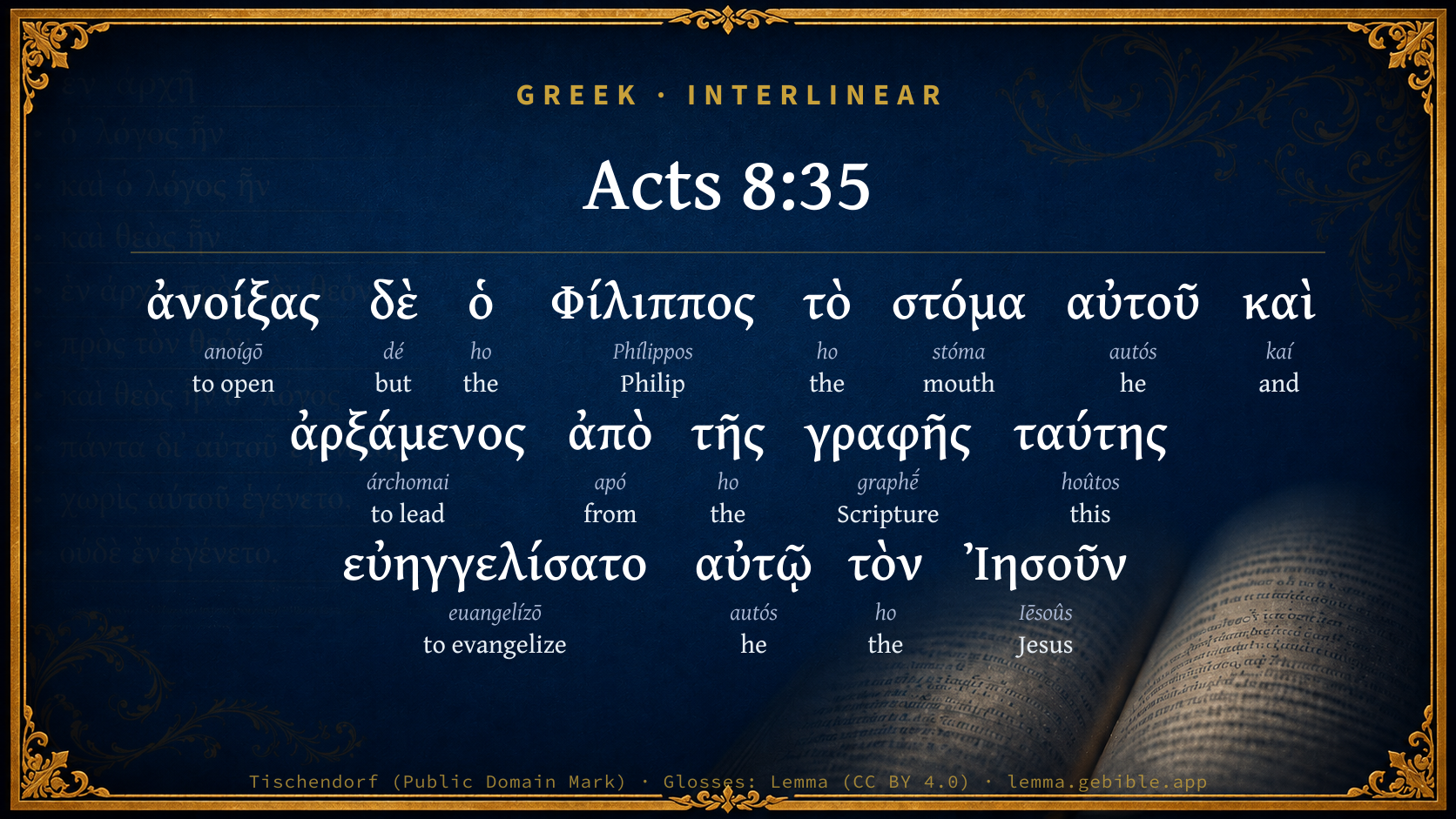
Greek (Tischendorf 8th ed.) Acts 8:35 appears in the Greek New Testament. The text above is from the Tischendorf 8th edition. Each word links to its Strong’s number and a concise gloss. Click any word for its full Thayer’s Greek Lexicon entry.
Download image
Cite this verse

Acts 8:35 (World English Bible). Public Domain. Lemma interlinear Bible study tool, https://lemma.gebible.app/v/acts/8/35.

Show BibTeX & RIS
BibTeX
RIS
English Translation
Philip opened his mouth, and beginning from this Scripture, preached to him Jesus.
World English Bible · Public Domain
Download a study sheet

One document with this verse’s original text, its word-by-word gloss line, the meaning frame, cross-references with their text, attributed commentary, and full source and license credits — printable, and it pastes into notes with its structure intact.

This verse Autodidact and up

Study sheet (.html) Plain text (.txt)

A passage Seminary Student

Up to 50 verses in one chapter. A passage sheet keeps up to 6 commentary sources and 12 cross-references per verse, in the order this page ranks them, and says so on the sheet whenever that leaves anything out. Ask for a single verse and you get the Autodidact verse sheet above.

Everything on this page stays free to read, with no account — the sheet is a download of what is already on screen, not access to it.

Want to remove ads? Support Godless Engineer
Compare translations 3

The same verse in 3 English versions, stacked beneath the original-language interlinear above. Click any original word for its lexicon entry.

Each is an independent rendering of the whole verse — the interlinear is not word-aligned to these translations.

Highlighted words mark where these versions differ — a whole-verse word diff, not a word-by-word alignment.

  • World English Bible Public Domain
    Philip opened his mouth, and beginning from this Scripture, preached to him Jesus.
  • King James Version Public Domain
    Then Philip opened his mouth, and began at the same scripture, and preached unto him Jesus.
  • unfoldingWord Literal Text CC BY-SA 4.0
    And Philip, opening his mouth and beginning with this scripture, proclaimed Jesus to him.

unfoldingWord Literal Text — © unfoldingWord, licensed CC BY-SA 4.0. Word-aligned USFM3 via Door43 (git.door43.org/unfoldingWord/en_ult).

Versions to compare (up to 4)

3 of 4 selected

Show all 19 translations

Every available English version of this verse, each an independent rendering of the whole verse.

  • World English Bible Public Domain
    Philip opened his mouth, and beginning from this Scripture, preached to him Jesus.
  • Berean Standard Bible Public Domain
    Then Philip began with this very Scripture and told him the good news about Jesus.
  • Majority Standard Bible Public Domain
    Then Philip began with this very Scripture and told him the good news about Jesus.
  • King James Version Public Domain
    Then Philip opened his mouth, and began at the same scripture, and preached unto him Jesus.
  • American Standard Version (1901) Public Domain
    And Philip opened his mouth, and beginning from this Scripture, preached unto him Jesus.
  • Revised Version (1885) Public Domain
    And Philip opened his mouth, and beginning from this scripture, preached unto him Jesus.
  • Geneva Bible (1599) Public Domain
    Then Philip opened his mouth, and began at the same Scripture, and preached vnto him Iesus.
  • Douay-Rheims (1899) Public Domain
    Then Philip, opening his mouth, and beginning at this scripture, preached unto him Jesus.
  • Young's Literal Translation Public Domain
    and Philip having opened his mouth, and having begun from this Writing, proclaimed good news to him -- Jesus.
  • Literal Standard Version CC BY-SA 4.0
    And Philip having opened his mouth, and having begun from this Writing, proclaimed good news to him—Jesus.
  • Unlocked Literal Bible CC BY-SA 4.0
    Philip began to speak, and beginning with this scripture he proclaimed the good news about Jesus to him.
  • unfoldingWord Literal Text CC BY-SA 4.0
    And Philip, opening his mouth and beginning with this scripture, proclaimed Jesus to him.
  • Darby Bible Public Domain
    And Philip, opening his mouth and beginning from that scripture, announced the glad tidings of Jesus to him.
  • World Messianic Bible Public Domain
    Philip opened his mouth, and beginning from this Scripture, preached to him about Yeshua.
  • Webster's Bible Public Domain
    Then Philip opened his mouth, and began at the same scripture, and preached to him Jesus.
  • Free Bible Version CC BY-SA 4.0
    Philip started explaining, beginning from this Scripture, telling him about Jesus.
  • Bible in Basic English Public Domain
    So Philip, starting from this writing, gave him the good news about Jesus.
  • Text-Critical English NT CC BY 4.0
    Then Philip opened his mouth to speak, and beginning from this Scripture, he told him the good news about Jesus.
  • Tyndale New Testament (1534) Public Domain
    And Philip opened his mouth and beganne at the same scripture and preached vnto him Iesus.

Literal Standard Version (2020), Covenant Press — licensed CC BY-SA 4.0. Text via the HelloAO Bible API (eBible.org). Unlocked Literal Bible (unfoldingWord) — licensed CC BY-SA 4.0. Text via the HelloAO Bible API (eBible.org). unfoldingWord Literal Text — © unfoldingWord, licensed CC BY-SA 4.0. Word-aligned USFM3 via Door43 (git.door43.org/unfoldingWord/en_ult). Free Bible Version, Dr. Jonathan Gallagher — licensed CC BY-SA 4.0. Text via the HelloAO Bible API (eBible.org).

Word by word

More ways to search: Search by grammar → Find every occurrence → Compare this word →

Practice this passage: Drill this verse → Learn its vocabulary →

Φίλιππος
Phílippos
G5376
“Philip”
Noun, Nominative, Singular, Masculine
Part of Speech
Noun
Case
Nominative
Number
Singular
Gender
Masculine
Full Thayer's Definition

Origin: from G5384 and G2462

TDNT: None

Philip = "lover of horses" 1. an apostle of Christ 2. an evangelist and one of the seven deacons of the Jerusalem church 3. tetrarch of Trachonitis, was brother to Herod Antipas, by the father's, but not by the mother's side. Philip was born of Cleopatra, of Jerusalem, and Herod of Malthace, a Samaritan: he died in the twentieth year of Tiberias, five years after his mention in Lk. 3:1 . He built Caesarea Philippi. His step brother Herod Antipas, married his wife unlawfully. (Gill) 4. see 2542, Caesarea Philippi
  1. ἀνοίξας anoígō G455 “to open” Verb, Aorist, Active, Participle, Nominative, Singular, Masculine
  2. δὲ dé G1161 “but” Conjunction
  3. ὁ ho G3588 “the” Article, Nominative, Singular, Masculine
  4. τὸ ho G3588 “the” Article, Accusative, Singular, Neuter
  5. στόμα stóma G4750 “mouth” Noun, Accusative, Singular, Neuter
  6. αὐτοῦ autós G846 “he” Personal pronoun, Genitive, Singular, Masculine
  7. καὶ kaí G2532 “and” Conjunction
  8. ἀρξάμενος árchomai G756 “to lead” Verb, Aorist, Middle, Participle, Nominative, Singular, Masculine
  9. ἀπὸ apó G575 “from” Preposition
  10. τῆς ho G3588 “the” Article, Genitive, Singular, Feminine
  11. γραφῆς graphḗ G1124 “Scripture” Noun, Genitive, Singular, Feminine
  12. ταύτης hoûtos G3778 “this” Demonstrative pronoun, Genitive, Singular, Feminine
  13. εὐηγγελίσατο euangelízō G2097 “to evangelize” Verb, Aorist, Middle, Indicative, 3rd person, Singular
  14. αὐτῷ autós G846 “he” Personal pronoun, Dative, Singular, Masculine
  15. τὸν ho G3588 “the” Article, Accusative, Singular, Masculine
  16. Ἰησοῦν Iēsoûs G2424 “Jesus” Noun, Accusative, Singular, Masculine

About this verse

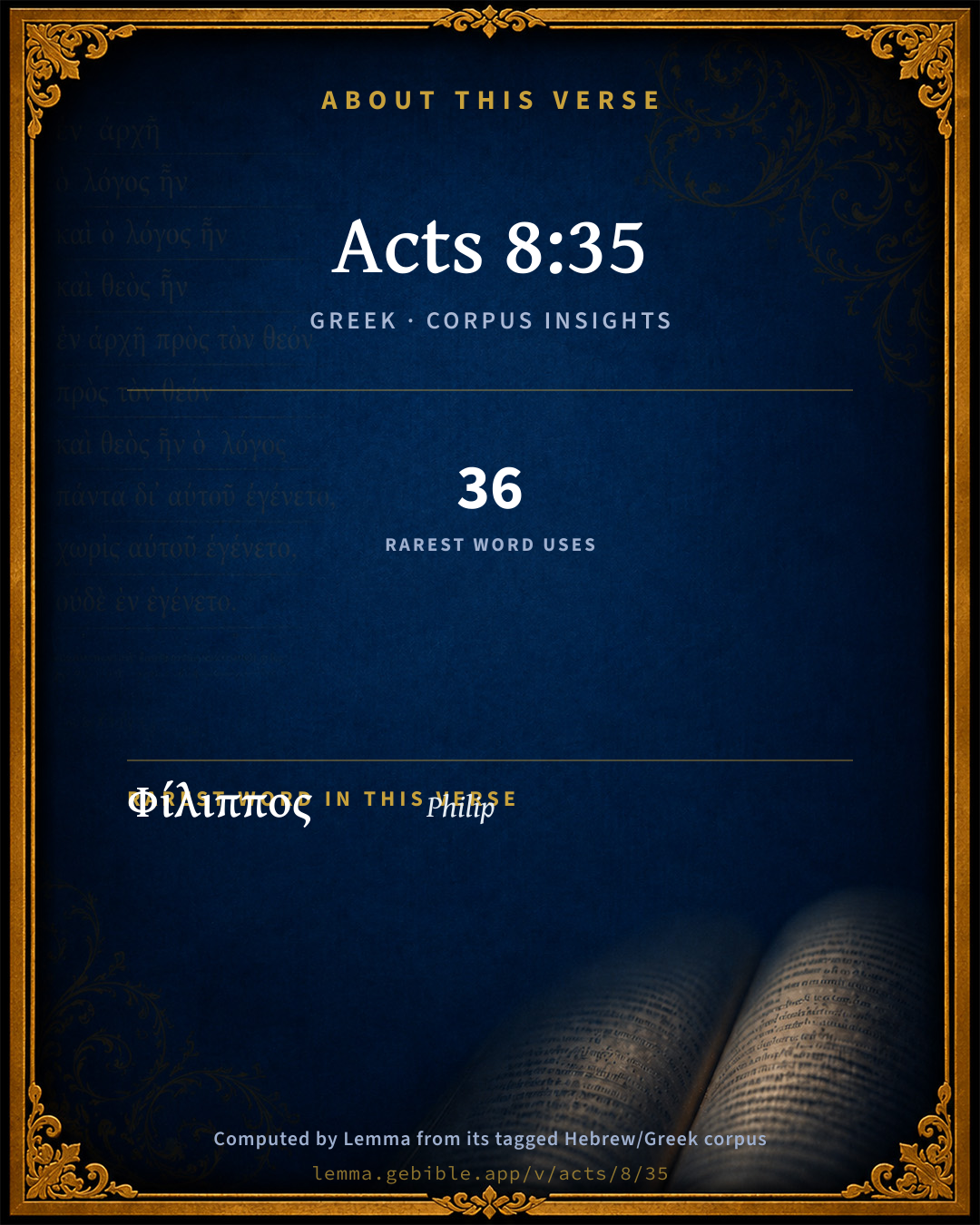
These counts appear in no published source. They are computed here, from the morphology-tagged text and Lemma’s own curated glosses. What Lemma adds →

17
words
13
distinct lemmas
Acts
section

Shared distinctive vocabulary

Φίλιππος Philip G5376 occurs in 35 verses of the Greek New Testament. Also found in:
Repetition

Words recur within this verse:

Cross-references

19

Topical passages linked to Acts 8:35 in the Treasury of Scripture Knowledge — connected by theme and wording, ordered by reader-vote popularity; previews shown in the World English Bible.

  • Luke 24:27 Beginning from Moses and from all the prophets, he explained to them in all the Scriptures the things concerning himself.
  • Acts 18:28 for he powerfully refuted the Jews, publicly showing by the Scriptures that Jesus was the Christ.
  • Matthew 5:2 He opened his mouth and taught them, saying,
  • Acts 28:23 When they had appointed him a day, many people came to him at his lodging. He explained to them, testifying about the Kingdom of God, and persuading them concerning Jesus, both from the law of Moses and from the prophets, from morning until evening.
  • 1 Corinthians 2:2 For I determined not to know anything among you, except Jesus Christ, and him crucified.
  • Acts 5:42 Every day, in the temple and at home, they never stopped teaching and preaching Jesus, the Christ.
  • Luke 24:44–47 He said to them, "This is what I told you, while I was still with you, that all things which are written in the law of Moses, the prophets, and the psalms, concerning me must be fulfilled."
  • Acts 3:20 and that he may send Christ Jesus, who was ordained for you before,
  • Acts 9:20 Immediately in the synagogues he proclaimed the Christ, that he is the Son of God.
  • Acts 10:34 Peter opened his mouth and said, "Truly I perceive that God doesn't show favoritism;
  • Acts 11:20 But there were some of them, men of Cyprus and Cyrene, who, when they had come to Antioch, spoke to the Greeks, preaching the Lord Jesus.
  • Acts 17:2–3 Paul, as was his custom, went in to them, and for three Sabbath days reasoned with them from the Scriptures,
  • Acts 19:13 But some of the itinerant Jews, exorcists, took on themselves to name over those who had the evil spirits the name of the Lord Jesus, saying, "We adjure you by Jesus whom Paul preaches."
  • Acts 26:22–23 Having therefore obtained the help that is from God, I stand to this day testifying both to small and great, saying nothing but what the prophets and Moses said would happen,
  • 1 Corinthians 1:23 but we preach Christ crucified; a stumbling block to Jews, and foolishness to Greeks,
  • 2 Corinthians 6:11 Our mouth is open to you, Corinthians. Our heart is enlarged.
  • Ephesians 4:21 if indeed you heard him, and were taught in him, even as truth is in Jesus:
  • 1 Peter 1:11–12 searching for who or what kind of time the Spirit of Christ, which was in them, pointed to, when he predicted the sufferings of Christ, and the glories that would follow them.
  • Acts 17:18 Some of the Epicurean and Stoic philosophers also were conversing with him. Some said, "What does this babbler want to say?" Others said, "He seems to be advocating foreign deities," because he preached Jesus and the resurrection.

Cross-references courtesy of OpenBible.info (CC BY 4.0).

Commentary

Notes on Acts 8:35 from classic Christian and Jewish commentators (each source and its license shown beneath its notes). The classic Christian expositions comment on the surrounding passage and are grouped to its opening verse, so a note may address several verses; the Jewish commentaries on the Tanakh (Rashi and others) are per-verse, so they appear only where the commentator wrote on this verse.

Lemma curates 59 commentaries, every one of them public domain or Creative Commons licensed, each selected and text-cleaned for this edition rather than reprinted as found. About our sources →

Bengel's Gnomon

Johann Albrecht Bengel

Act 8:35. Ἀνοίξας, having opened) Already he had spoken some things; but now he lays himself out (formally applies himself) to speak. So ch. Act 10:34.—ἀρξάμενος, having begun) A convenient mode of teaching, to begin with the text which has been presented to us, and to subjoin the remaining remarks which need to be made: ch. Act 13:17; Luk 4:21.—ἀπὸ, from) From every text of Scripture, not merely from so remarkable a one as this was, it is possible to come to Jesus: and then there is a wide field of speaking thrown open to us.—τῆς γραφῆς, this Scripture) which indeed treats concerning the Minister or Servant of the Lord (for so Christ is called in Isaiah [Isa 42:1]). And often it is from the predicate alone that this subject is known (recognised): Mat 2:23, “He shall be called a Nazarene;” Act 8:17 [where His name as the subject is not given, but His attributes show that it is He who is spoken of].

Bengel's Gnomon of the New Testament — English translation (T&T Clark, Edinburgh, 1860) — public domain. Text from a community e-Sword module.

Expositor's Greek Testament

ed. W. Robertson Nicoll

Act 8:35 . ἀνοίξας τὸ στ . αὐτοῦ : the phrase is used to introduce some weighty and important utterance, cf. Act 10:34 , Act 18:14 , and Luk 1:64 , so too Mat 5:2 , 2Co 6:11 , also frequent in LXX; “aperire os in Scriptura est ordiri longum sermonem de re gravi et seria. Significat ergo Lucas coepisse Philippum pleno ore disserere de Christo,” Calvin, cf. Hebrew phrase פָּתַח אֶת־פִּיו , in various senses. ἀρξάμενος , see on Act 1:22 , cf. Luk 24:27 . ταύτης , see above on Act 8:3 - εὐηγγελίσατο : used with an accusative both of the person addressed, as in Act 8:25 ; Act 8:40 , and of the message delivered, cf. Luk 8:1 , Act 5:42 ; Act 8:4 ; Act 8:12 , etc., but when the two are combined the person is always expressed by the dative, cf. Luk 1:19 ; Luk 2:10 (Act 17:18 ), Simcox, Language of the N. T. , p. 79. From the sequel it is evident that Philip not only preached the glad tidings of the fulfilment of the prophecies in Jesus as the ideal and divine Sufferer, but that he also pointed out to the eunuch the door of admission into the Church of Jesus; cf. Jerome, Epist. , liii., 5.

The Expositor's Greek Testament, edited by W. Robertson Nicoll (1897–1910) — public domain. Text from a community e-Sword module.

Jamieson, Fausset & Brown

Robert Jamieson, A. R. Fausset & David Brown

Then Philip opened his mouth--(See on Mat 5:2).

began at the same scripture--founding on it as his text.

preached unto him Jesus--showing Him to be the glorious Burden of this wonderful prediction, and interpreting it in the light of the facts of His history.

Jamieson, Fausset & Brown — Commentary Critical and Explanatory on the Whole Bible (1871) — public domain (CC PDM 1.0). Text via the HelloAO Bible API.

Adam Clarke's Commentary

Verse 35. Began at the same scripture] He did not confine himself to this one scripture, but made this his text, and showed, from the general tenor of the sacred writings, that Jesus was the Christ, or Messiah; and that in his person, birth, life, doctrine, miracles, passion, death, and resurrection, the Scriptures of the Old Testament were fulfilled. This preaching had the desired effect, for the eunuch was convinced of the truth of Philip's doctrine, and desired to be baptized in the name of Jesus.

Adam Clarke's Commentary on the Bible (1810–1826) — public domain. Text from a community e-Sword/MySword module.

John Calvin's Commentaries

35. Philip, opening his mouth. To open the mouth is taken in Scripture for, to begin a long speech concerning some grave and weighty matter. Therefore Luke’s meaning is, that Philip began to intreat [discourse] of Christ, as it were, with full mouth. He saith that he began with this prophecy, because there is no one which depainteth out Christ more lively; and it was then brought to his hand. Therefore, after that Philip had showed, by the prophet’s words, after what sort Christ should come, and what was to be hoped for at his hands, he conferred the thing itself afterward, that the eunuch might know that that Christ which was promised was already revealed and given, and that he might understand his power. Where we translate it, that he preached Christ, Luke saith that he preached the gospel. The sense is, that he taught that of Christ which he uttered in his gospel himself, and commanded to be taught; whereby we gather, that when Christ is known, we have the sum of the gospel.

John Calvin's Commentaries (1540-1563) — public domain. Text from the Calvin Translation Society English edition (1840s-50s) via the Christian Classics Ethereal Library (ccel.org). Calvin's coverage is partial (roughly two-thirds of the Bible); uncommented books and verses are honest gaps, never fabricated. The 19th-century editor's footnotes and remarks are omitted so the notes are faithfully Calvin's own voice.

Ellicott's Commentary for English Readers

(35) Philip opened his mouth.—The phrase, wherever it occurs in the New Testament, implies something like a set discourse. (Comp. Act_10:34; Acts 18, 14; Mat_5:2; Mat_13:35; 2Co_6:11). It always means something more than the mere act of speaking.

And preached unto him Jesus.—The sequel shows that the teaching must have included, not only an interpretation of the prophecy as fulfilled in Christ, but instruction as to the outward condition of admission to the society of the disciples. The eunuch hears enough to make him eager for the baptism which was to bring with it so great a blessing.

A Bible Commentary for English Readers, edited by Charles John Ellicott (1878–1897) — public domain. Text from a community e-Sword module.

The Cambridge Bible for Schools and Colleges

gen. ed. J. J. S. Perowne

35. and began at the same [this] scripture, and preached unto him Jesus] It can hardly be doubted that during his sojourn in Jerusalem the eunuch had heard the history of the new teachers who had created such an excitement in the city, and so he would have had some story told him of the founder of the new community, but his informants would have been Jews, and he would only have heard from them such a version of what had been done as represented Jesus as one of the many deceivers who abounded in those times.

The Cambridge Bible for Schools and Colleges (gen. ed. J. J. S. Perowne; Cambridge University Press, 1878–1918) — public domain. Text from a community e-Sword module.

John Gill's Exposition

And as they went on their way,.... In the road from Jerusalem to Gaza; Philip preaching, and the eunuch hearing, and conversing in a religious and spiritual way together; and Beza says in one exemplar it is added, "conferring one with another"; about the person and office of Christ, the doctrines of the Gospel, and the ordinances of it; as appears by what follows, both by the eunuch's request to be admitted to baptism, and his confession of faith:

they came unto a certain water; which some say was at Bethhoron, in the tribe of Judah or Benjamin; and others think it was the river Eleutherus; the former is more likely; concerning which Jerom (f) gives this account:

"Bethzur in the tribe of Judah, or Benjamin, and now called Bethhoron, is a village as we go from Aella (or Jerusalem) to Hebron, twenty miles from it; near which is a fountain, springing up at the bottom of a mountain, and is swallowed up in the same ground in which it is produced; and the Acts of the Apostles relate, that the eunuch of queen Candace was baptized here by Philip.''

This place was about two miles from Hebron; since that, according to the same writer (g), was twenty two miles from Jerusalem. Borchardus (h) seems to place it further off from Hebron:

"from Hebron are three "leucas", or six miles, northward, declining a little to the west, to Nehel Escol, that is, "the brook of the cluster", from whence the spies carried the cluster of grapes; to the left of this valley, for the space of a mile, or half a leuca, runs a river, in which Philip baptized the, eunuch of queen Candace, not far from Sicelech.''

And, according to Jerom (i), Escol lay in the way from Bethzur to Hebron. This account of the historian sets aside that weak piece of criticism on

Ac# 8:38 used by some persons; as if when Philip and the eunuch went down into the water, no more is meant, than that they went to the water side, or descended to the bank and brink of the river; seeing, here it is said, they came to a certain place of water; they came to the river itself, or the river side, and after this went down into it.

And the eunuch said, see here is water, what doth hinder me to be baptized? This question shows, that he had some knowledge of the ordinance of baptism, which he had received from the ministry and conversation of Philip; and that he had some desire after it, as regenerate persons have, after divine things, after Christ, his word, and ordinances; and that he was willing to take the first opportunity of submitting to it, but was jealous lest he should not be qualified for it; and therefore modestly proposes the affair to Philip, and desires to be examined and judged by him: and it also suggests, that there are some things which might be a just bar to this ordinance, as want of grace, and a disorderly life and conversation, which were the hindrances to the Pharisees and Sadducees, who came to John's baptism; and these are sufficient ones, even though persons may be born in a Christian land, and of believing parents, and have had a good education; yea, though they may have much notional light and speculative knowledge: but where the good work of grace is begun, and when a soul is spiritually enlightened, and has evangelical repentance for sin, and true faith in Christ, and sincere love to him, nothing should hinder: not any thing on his side; not a sense of his own unworthiness, which will never be otherwise, but rather increase; nor the corruptions of his heart and nature, which will always remain, as long as he is in the body; nor fears of falling away, since there cannot be more danger after baptism than before, and Christ is the same who is always able to keep from it; nor the reproaches of the world, which should be esteemed above riches; and more especially, since to be ashamed of Christ, his word, or ordinances, is highly resented by him; nor the opposition of relations and friends, who, though they are to be regarded and listened to in civil matters, yet should have no sway in religious ones to move from the cause of Christ; nor any difficulty in the ordinance itself, since it is but water baptism, and not a bloody one, such as Christ was baptized with, and some of his followers have been called unto: nor should anything hinder on the side of the administrator, when the above is the case; as not being circumcised, but Gentiles, as in the times of the apostles, Act 10:47 so not the former life and conversation of the person, though it has been ever so wicked, as the instances of the crucifiers of Christ, of the jailor, of Saul the persecutor, and many of the Corinthians, show; nor the weakness of grace; the day of small things is not to be despised, nor a bruised reed to be broken, or smoking flax to be quenched: agreeably to this the Ethiopic version renders it, "who doth hinder", &c.

(f) De locis Hebraicis, fol. 89. 6. (g) Ib. fol. 87. E. (h) Decscript. Terrae Sanct. c. 9. (i) Epitaph. Paulae, fol, 59. 6. H.

John Gill's Exposition of the Whole Bible (1746–1763) — public domain (CC PDM 1.0). Text via the HelloAO Bible API.

Trapp's Complete Commentary

John Trapp

35 Then Philip opened his mouth, and began at the same scripture, and preached unto him Jesus.

Ver. 35. And preached unto him] Of preaching we may say in comparison of other ordinances, for the getting of knowledge, as David did of Goliath’s sword, there is none to that.

John Trapp, A Commentary or Exposition upon All the Books of the Old and New Testament (1647–1656) — public domain. Text from a community e-Sword module.

Albert Barnes' Notes on the Bible

Opened his mouth - See Mat 5:2.

At the same scripture - Taking this as a “text” to be illustrated.

Preached unto him Jesus - Showed him that Jesus of Nazareth exactly corresponded to the description of the prophet, and that therefore he referred to the Messiah, and that the Messiah was Jesus of Nazareth. How far Philip detailed the circumstances of the life and death of Christ is unknown. What follows shows also that he stated the design of baptism, and the duty of being baptized.

Albert Barnes' Notes on the Bible (1834–1885) — public domain. Text from a community e-Sword/MySword module.

Matthew Poole's English Annotations

Opened his mouth; so they were said to do when they began to speak of some weighty matter.

Began at the same Scripture; showing that the prophet, in that most signal prophecy, Isa 53:7,8 could not mean such things of himself, nor of Jeremiah, or of any other.

Preached unto him Jesus; things in that prophecy are applicable unto our blessed Saviour, but to none else.

Matthew Poole's English Annotations on the Holy Bible (1683–1685) — public domain. Text from a community e-Sword/MySword module.

The Pulpit Commentary

And for then, A.V.; beginning from this Scripture for began at the same Scripture, A.V.; preached for and preached, A.V.

Jesus the Hope of the world.

Philip opened his mouth," etc. The two lines meeting in the desert. The Ethiopian traveler led on by Providence; the evangelist led by the angelic message; ignorant of one another, yet both in their way following Divine guidance. The importance of that meeting-place to the world"s future, both as opening the South and East to the gospel, and as helping the Church to look away to the ends of the earth. The underlying facts, the Old Testament and its work. Proselytes. Devout men. Isaiah preparing for Christ. "Of whom speaketh the prophet?" The world was ready and asking questions, and the Church was prepared to answer them. The Spirit presiding over all.

I JESUS THE BEGINNING AND THE END OF ALL GOD"S REVELATIONS.

1. Atonement the great want of the world.

2. The gospel facts fulfillments of the Old Testament prophecies.

3. A personal Redeemer preached as an object of faith, the satisfaction of the heart.

II THE PREACHING OF JESUS THE TRUE OPENING OF THE CHURCH"S LIPS TO THE WORLD.

1. In distinction from mere dry theology, vague sentiment, or barren speculation.

2. With no feeble or uncertain sound he opened his mouth. Boldness, directness, persuasiveness, faithfulness, he preached to him.

3. Scriptural preaching the great demand of the age. Beginning on a firm foundation of the written Word and the convictions of hearers.

III DIVINELY GIVEN OPPORTUNITY NUMBLY USED PRODUCTIVE OF GREAT RESULTS.

1. Missionary work should recognize the preparation God makes in men"s minds for his truth.

2. Individuals the objects of gracious communications, that messengers may be raised up who shall carry the Word into the strongholds of heathenism. We should always follow the Spirit.

3. Deserts rejoicing, prophecy of a recovered world. The nations shall be baptized. But we must see to it that we preach unto them Jesus. R.

The Pulpit Commentary (1880–1919), ed. H.D.M. Spence-Jones & Joseph S. Exell — public domain. Text from a community e-Sword module.

McGarvey & Pendleton's Commentaries

J. W. McGarvey

See notes on verse 31

J. W. McGarvey (with Philip Y. Pendleton), Commentaries on the New Testament (The Fourfold Gospel, 1914; Acts; and the epistles) — public domain. Text from a community e-Sword/MySword module.

Cambridge Greek Testament for Schools and Colleges

35. καὶ ἀρξάμενος ἀπὸ τῆς γραφῆς ταύτης κ.τ.λ., and he began at this Scripture, and preached unto him Jesus. It can hardly be doubted that during his sojourn in Jerusalem the eunuch had heard the history of the new teachers who had created such an excitement in the city. Thus he would have had some story told him of the founder of the new community, but his informants would have been Jews, and he would only have heard from them a version of what had been done of such a sort as to make him account Jesus one of the many deceivers who abounded in those times.

Cambridge Greek Testament for Schools and Colleges (Cambridge University Press, 1896; 21 vols, various authors incl. Carr, Maclear, Plummer, Farrar, Lumby, Moule, M. R. James, Simcox) — public domain. Text from a community e-Sword module.

Vincent's Word Studies in the New Testament

Marvin R. Vincent

Opened his mouth. Indicating a solemn announcement. Compare Mt 5:2.

Marvin R. Vincent, Word Studies in the New Testament (1887–1900) — public domain. Text from a community e-Sword/MySword module.

Lesson kit

Teaching starters — assembled from the data on this page, not authored interpretation. Every prompt links to the verse data it draws on. Edit before teaching.

Acts, in the Acts, opens this verse with 17 words (13 distinct Greek lemmas). Its most distinctive word is Phílippos (“Philip”). A historical commentator’s framing appears above. Read the whole chapter for the surrounding context.

Discussion questions

  1. How does “Philip” (Phílippos) shape what this verse is saying?
  2. How does Matthew 10:3, which shares the word «Philip», read alongside this verse?
  3. What does the repetition of “the” (4× in this one verse) do in this verse?
  4. The translations on this page render this verse differently — a whole-verse word diff, not a word-by-word alignment. What might account for the different wordings?
  5. Compare how Bengel's Gnomon and Expositor's Greek Testament read this verse. Where do they agree or differ?

Things to notice

Reading settings

Reading text

Shown beneath each verse's original-language words.

Old Testament
Old Testament edition

Read the OT as the Masoretic Hebrew (MT) or the Greek Septuagint (LXX).

English shown for the Greek Septuagint (in the Hebrew ↔ Greek comparison).

Comparing translations? Open the Compare panel on any verse page to stack up to four side by side.