Acts 7:21

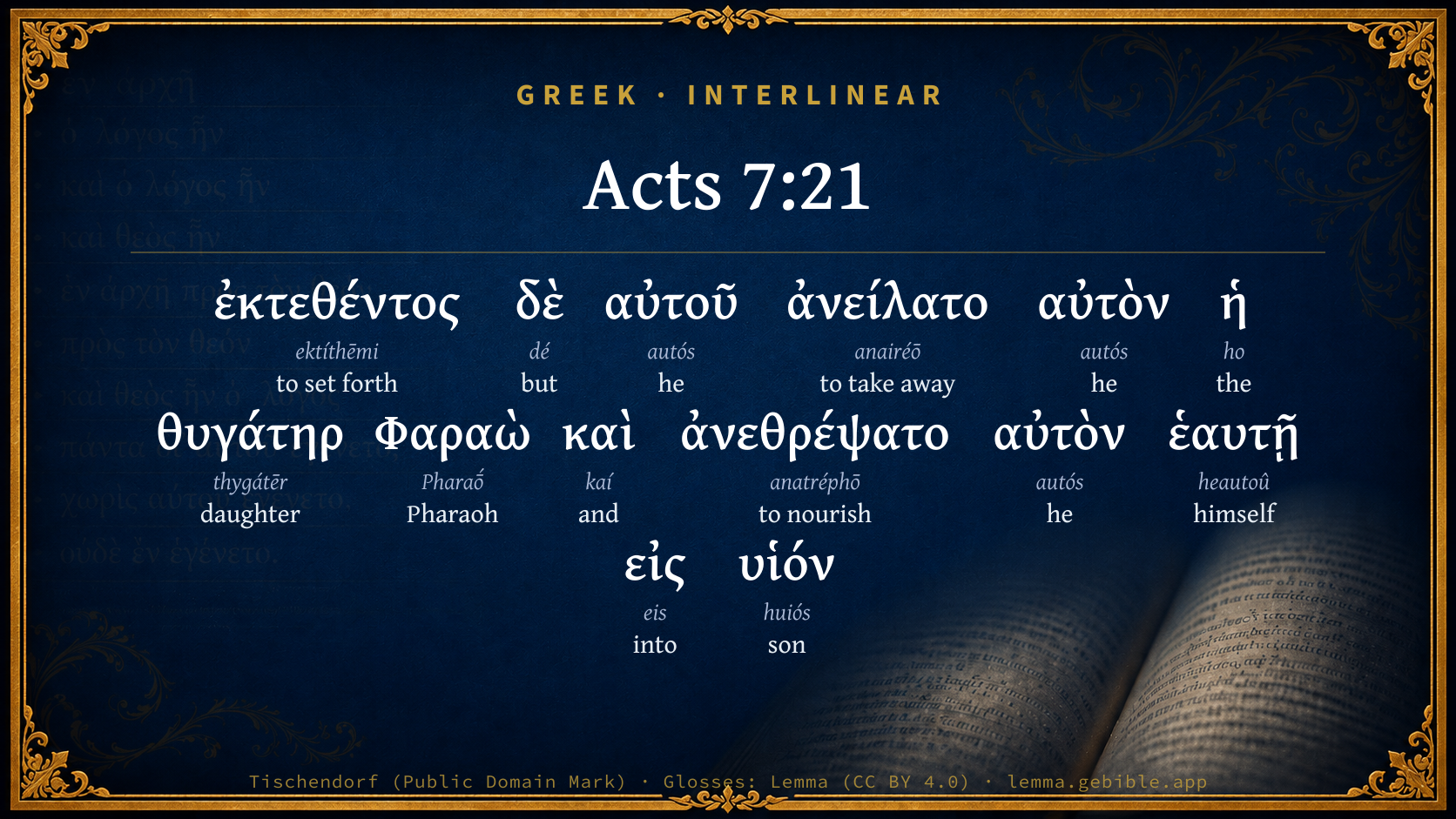
Greek (Tischendorf 8th ed.) Acts 7:21 appears in the Greek New Testament. The text above is from the Tischendorf 8th edition. Each word links to its Strong’s number and a concise gloss. Click any word for its full Thayer’s Greek Lexicon entry.
Download image
Cite this verse

Acts 7:21 (World English Bible). Public Domain. Lemma interlinear Bible study tool, https://lemma.gebible.app/v/acts/7/21.

Show BibTeX & RIS
BibTeX
RIS
English Translation
When he was thrown out, Pharaoh's daughter took him up, and reared him as her own son.
World English Bible · Public Domain
Highlights
  • 1 first appearance in the Greek New Testament
Full analysis ↓
Download a study sheet

One document with this verse’s original text, its word-by-word gloss line, the meaning frame, cross-references with their text, attributed commentary, and full source and license credits — printable, and it pastes into notes with its structure intact.

This verse Autodidact and up

Study sheet (.html) Plain text (.txt)

A passage Seminary Student

Up to 50 verses in one chapter. A passage sheet keeps up to 6 commentary sources and 12 cross-references per verse, in the order this page ranks them, and says so on the sheet whenever that leaves anything out. Ask for a single verse and you get the Autodidact verse sheet above.

Everything on this page stays free to read, with no account — the sheet is a download of what is already on screen, not access to it.

Want to remove ads? Support Godless Engineer
Compare translations 3

The same verse in 3 English versions, stacked beneath the original-language interlinear above. Click any original word for its lexicon entry.

Each is an independent rendering of the whole verse — the interlinear is not word-aligned to these translations.

Highlighted words mark where these versions differ — a whole-verse word diff, not a word-by-word alignment.

  • World English Bible Public Domain
    When he was thrown out, Pharaoh's daughter took him up, and reared him as her own son.
  • King James Version Public Domain
    And when he was cast out, Pharaoh's daughter took him up, and nourished him for her own son.
  • unfoldingWord Literal Text CC BY-SA 4.0
    But when he was exposed, the daughter of Pharaoh took him up and raised him for herself as a son.

unfoldingWord Literal Text — © unfoldingWord, licensed CC BY-SA 4.0. Word-aligned USFM3 via Door43 (git.door43.org/unfoldingWord/en_ult).

Versions to compare (up to 4)

3 of 4 selected

Show all 19 translations

Every available English version of this verse, each an independent rendering of the whole verse.

  • World English Bible Public Domain
    When he was thrown out, Pharaoh's daughter took him up, and reared him as her own son.
  • Berean Standard Bible Public Domain
    When he was set outside, Pharaoh’s daughter took him and brought him up as her own son.
  • Majority Standard Bible Public Domain
    When he was set outside, Pharaoh’s daughter took him and brought him up as her own son.
  • King James Version Public Domain
    And when he was cast out, Pharaoh's daughter took him up, and nourished him for her own son.
  • American Standard Version (1901) Public Domain
    and when he was cast out, Pharaoh's daughter took him up, and nourished him for her own son.
  • Revised Version (1885) Public Domain
    and when he was cast out, Pharaoh’s daughter took him up, and nourished him for her own son.
  • Geneva Bible (1599) Public Domain
    And when he was cast out, Pharaohs daughter tooke him vp, and nourished him for her owne sonne.
  • Douay-Rheims (1899) Public Domain
    And when he was exposed, Pharao's daughter took him up, and nourished him for her own son.
  • Young's Literal Translation Public Domain
    and he having been exposed, the daughter of Pharaoh took him up, and did rear him to herself for a son;
  • Literal Standard Version CC BY-SA 4.0
    and he having been set outside, the daughter of Pharaoh took him up, and reared him to herself for a son;
  • Unlocked Literal Bible CC BY-SA 4.0
    When he was placed outside, Pharaoh's daughter adopted him and raised him as her own son.
  • unfoldingWord Literal Text CC BY-SA 4.0
    But when he was exposed, the daughter of Pharaoh took him up and raised him for herself as a son.
  • Darby Bible Public Domain
    And when he was cast out, the daughter of Pharaoh took him up, and brought him up for herself [to be] for a son.
  • World Messianic Bible Public Domain
    When he was abandoned, Pharaoh’s daughter took him up and reared him as her own son.
  • Webster's Bible Public Domain
    And when he was cast out, Pharaoh's daughter took him up, and nourished him for her own son.
  • Free Bible Version CC BY-SA 4.0
    When he had to be abandoned, Pharaoh's daughter rescued him and took care of him as her own son.
  • Bible in Basic English Public Domain
    And when he was put out, Pharaoh's daughter took him and kept him as her son.
  • Text-Critical English NT CC BY 4.0
    and when he was abandoned, Pharaoh's daughter took him in and brought him up as her own son.
  • Tyndale New Testament (1534) Public Domain
    When he was cast out Pharoes doughter toke him vp and norisshed him vp for her awne sonne.

Literal Standard Version (2020), Covenant Press — licensed CC BY-SA 4.0. Text via the HelloAO Bible API (eBible.org). Unlocked Literal Bible (unfoldingWord) — licensed CC BY-SA 4.0. Text via the HelloAO Bible API (eBible.org). unfoldingWord Literal Text — © unfoldingWord, licensed CC BY-SA 4.0. Word-aligned USFM3 via Door43 (git.door43.org/unfoldingWord/en_ult). Free Bible Version, Dr. Jonathan Gallagher — licensed CC BY-SA 4.0. Text via the HelloAO Bible API (eBible.org).

Word by word

More ways to search: Search by grammar → Find every occurrence → Compare this word →

Practice this passage: Drill this verse → Learn its vocabulary →

ἐκτεθέντος
ektíthēmi
G1620
“to set forth”
Verb, Aorist, Passive, Participle, Genitive, Singular, Masculine
Part of Speech
Verb
Tense
Aorist
Voice
Passive
Mood
Participle
Case
Genitive
Number
Singular
Gender
Masculine
Full Thayer's Definition

Origin: from G1537 and G5087

TDNT: None

1. to place or set out, put outside, expose 2. to set up, exhibit 3. metaph. to set forth, declare, expound
  1. δὲ dé G1161 “but” Conjunction
  2. αὐτοῦ autós G846 “he” Personal pronoun, Genitive, Singular, Masculine
  3. ἀνείλατο anairéō G337 “to take away” Verb, Aorist, Middle, Indicative, 3rd person, Singular
  4. αὐτὸν autós G846 “he” Personal pronoun, Accusative, Singular, Masculine
  5. ἡ ho G3588 “the” Article, Nominative, Singular, Feminine
  6. θυγάτηρ thygátēr G2364 “daughter” Noun, Nominative, Singular, Feminine
  7. Φαραὼ Pharaṓ G5328 “Pharaoh” Noun, Proper, indeclinable
  8. καὶ kaí G2532 “and” Conjunction
  9. ἀνεθρέψατο anatréphō G397 “to nourish” Verb, Aorist, Middle, Indicative, 3rd person, Singular
  10. αὐτὸν autós G846 “he” Personal pronoun, Accusative, Singular, Masculine
  11. ἑαυτῇ heautoû G1438 “himself” Reflexive pronoun, 3rd person, Dative, Singular, Feminine
  12. εἰς eis G1519 “into” Preposition
  13. υἱόν huiós G5207 “son” Noun, Accusative, Singular, Masculine

About this verse

These counts appear in no published source. They are computed here, from the morphology-tagged text and Lemma’s own curated glosses. What Lemma adds →

14
words
12
distinct lemmas
Acts
section

Notable vocabulary

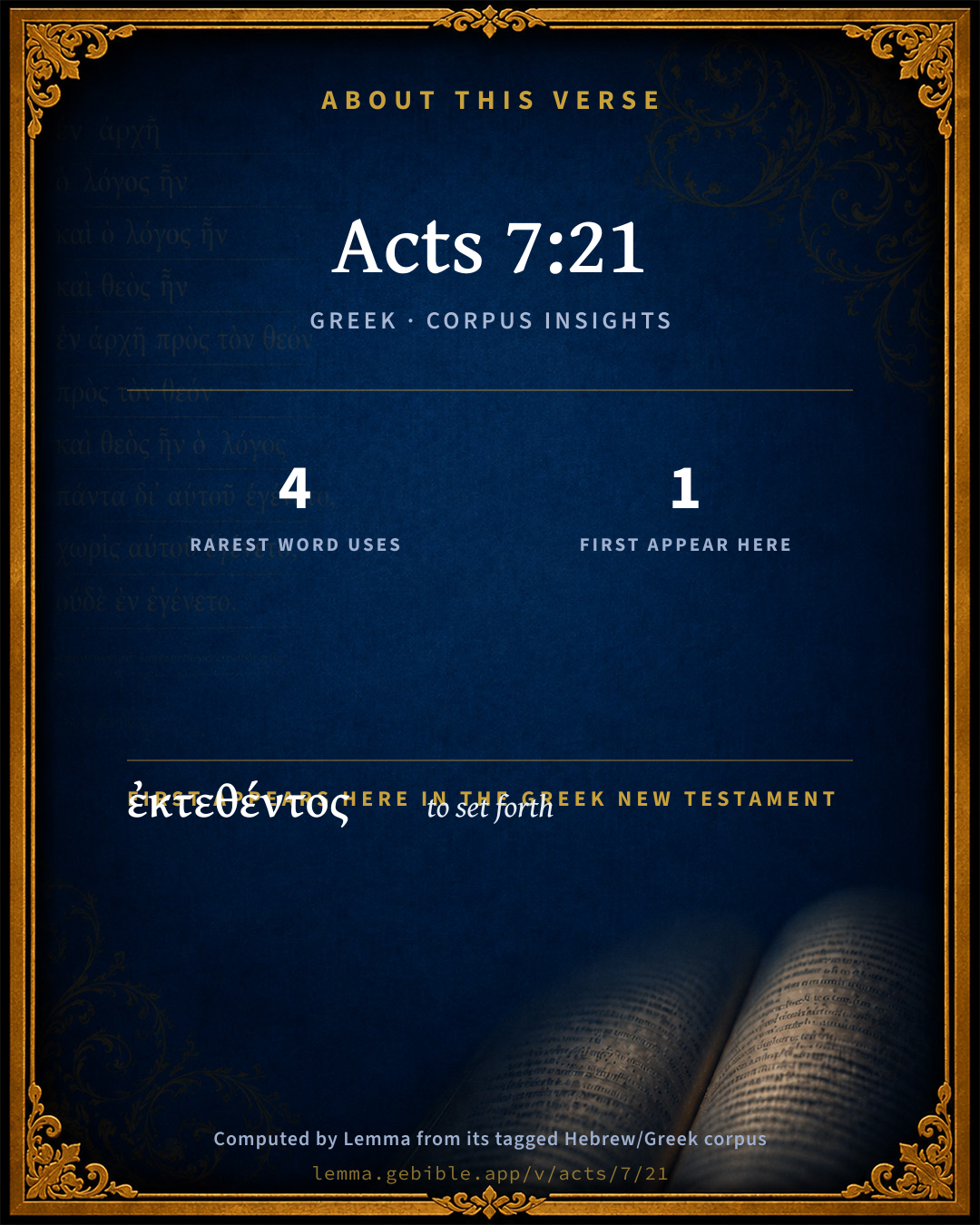
The rarest word here is ἐκτεθέντος to set forth G1620 — appearing just 4 times in the whole Greek New Testament.

First appearance in Scripture

This word makes its first canonical appearance in the Greek New Testament here:

  • ἐκτεθέντος to set forth G1620

Shared distinctive vocabulary

ἐκτεθέντος to set forth G1620 occurs in 4 verses of the Greek New Testament. Also found in:

Repetition

A word recurs within this verse:

  • αὐτοῦ he G846 ×3

Cross-references

3

Topical passages linked to Acts 7:21 in the Treasury of Scripture Knowledge — connected by theme and wording, ordered by reader-vote popularity; previews shown in the World English Bible.

  • Hebrews 11:24 By faith, Moses, when he had grown up, refused to be called the son of Pharaoh's daughter,
  • Exodus 2:2–10 The woman conceived, and bore a son. When she saw that he was a fine child, she hid him three months.
  • Deuteronomy 32:26 I said, I would scatter them afar, I would make the memory of them to cease from among men;

Cross-references courtesy of OpenBible.info (CC BY 4.0).

Commentary

Notes on Acts 7:21 from classic Christian and Jewish commentators (each source and its license shown beneath its notes). The classic Christian expositions comment on the surrounding passage and are grouped to its opening verse, so a note may address several verses; the Jewish commentaries on the Tanakh (Rashi and others) are per-verse, so they appear only where the commentator wrote on this verse.

Lemma curates 59 commentaries, every one of them public domain or Creative Commons licensed, each selected and text-cleaned for this edition rather than reprinted as found. About our sources →

Bengel's Gnomon

Johann Albrecht Bengel

Act 7:21. Ἐκτεθέντα δὲ αὐτὸν) The accusative absolute, as in ch. Act 26:3, γνώστην ὄντα σε πάντων.—εἰς υἱὸν, for her son) that he should be to her in the light of a son.

Bengel's Gnomon of the New Testament — English translation (T&T Clark, Edinburgh, 1860) — public domain. Text from a community e-Sword module.

Meyer's Critical & Exegetical Commentary

Heinrich August Wilhelm Meyer

Act_7:21-22. Ἐκτεθ. δὲ αὐτὸν, ἀνείλ. αὐτόν] Repetition of the pronoun as in Mat_26:71; Mar_9:28; Mat_8:1. See on Mat_8:1, Fritzsche, ad Marc. p. 377.

ἀνείλατο] took him up (sustulit, Vulg.). So also often among Greek writers, of exposed children; see Wetstein.

ἑαυτῇ] in contrast to his own mother.

εἰς υἱόν] Exo_2:10, for a son, so that he became a son to herself. So also in classical Greek with verbs of development. Bernhardy, p. 218 f.

πάσῃ σοφίᾳ Αἰγ.] Instrumental dative. The notice itself is not from the O. T., but from tradition, which certainly was, from the circumstances in which Moses (Philo, Vit. Mos.) was placed, true. The wisdom of the Egyptians extended mainly to natural science (with magic), astronomy, medicine, and mathematics; and the possessors of this wisdom were chiefly the priestly caste (Isa_19:12), which also represented political wisdom. Comp. Justin. xxxvi. 2.

δυνατὸς ἐν λόγ. κ. ἔργ.] see on Luk_24:19. ἐν ἔργ. refers not only to his miraculous activity, but generally to the whole of his abundant labours. With δυν. ἐν λόγοις (comp. Joseph. Antt. iii. 1. 4 : πλήθει ὁμιλεῖν πιθανώτατος) Exo_4:10 appears at variance; but Moses in that passage does not describe himself as a stammerer, but only as one whose address was unskilful, and whose utterance was clumsy. But even an address not naturally fluent may, with the accession of a higher endowment (comp. Luk_21:15), be converted into eloquence, and become highly effective through the Divine Spirit, by which it is sustained, as was afterwards the historically well-known case with the addresses of Moses. Comp. Joseph. Antt. ii. 12. 2. Thus, even before his public emergence (for to this time the text refers), a higher power of speech may have formed itself in him. Hence δύν. ἐν λόγ. is neither to be referred, with Krause, to the writings of Moses, nor to be regarded, with Heinrichs, as a once-current general eulogium; nor is it to be said, with de Wette, that admiration for the celebrated lawgiver had caused it to be forgotten that he made use of his brother Aaron as his spokesman.

Meyer — Critical and Exegetical Commentary on the New Testament — English translation by Peter Christie, edited by Frederick Crombie (T&T Clark, 1880) — public domain. Text from a community e-Sword module.

Expositor's Greek Testament

ed. W. Robertson Nicoll

Act 7:21 . ἐκτεθ .: the regular word for exposure of children in classical Greek; see also Wis 18:5 , peculiar to Luke in N.T., and only here in this sense; cf. Exo 2:3 , and [203] critical note above. ἀνείλετο same word in Exo 2:5 . The verb, though very frequent in Luke in the sense of to kill , is only used here in the sense of A. and R.V., Vulgate, sustulit but cf. Aristoph., Nub. , 531; Epict., Diss. , i. 23, 7. ἑαυτῇ : as in contrast to the child’s own mother. According to tradition, Pharaoh’s daughter designed him for the throne, as the king had no son, Jos., Ant. , ii., 9, 7. εἰς υἱόν , Exo 2:10 ; cf. Act 13:22 ; Act 13:47 ; Simcox, Language of N. T. , p. 80.

[203] R(omana), in Blass, a first rough copy of St. Luke.

The Expositor's Greek Testament, edited by W. Robertson Nicoll (1897–1910) — public domain. Text from a community e-Sword module.

The Cambridge Bible for Schools and Colleges

gen. ed. J. J. S. Perowne

21. nourished him for her own son] Jewish tradition says that the king had no son, and so Moses was designed by the king’s daughter to succeed to the kingdom. Josephus (Antiq. ii. 9. 7), where she speaks of him as “a child of a divine form and generous mind.”

The Cambridge Bible for Schools and Colleges (gen. ed. J. J. S. Perowne; Cambridge University Press, 1878–1918) — public domain. Text from a community e-Sword module.

John Gill's Exposition

And when he was cast out,.... Into the river, or by the river, as some copies read; the Syriac version adds, by his own people; by his father and mother and sister; who might be all concerned in it, and were privy to it; and which was done after this manner; his mother perceiving she could keep him no longer, made an ark of bulrushes, daubed with slime and pitch, into which she put him; and then laid it in the flags, by the river's side, and set his sister Miriam at a proper distance, to observe what would be done to him, Exo 2:3.

Pharaoh's daughter took him up; her name, according to Josephus (w), was "Thermuthis"; she is commonly, by the Jews (x), called "Bithiah"; and by Artapanus in Eusebius (y), she is called "Merrhis". This princess coming down to the river to wash, as she and her maidens were walking by the river side, spied the ark in which the child was laid, among the flags, and ordered one of her maids to go and fetch it; and which being done by her orders, is attributed to her; and opening the ark, she was struck at once with the loveliness of the babe, and being filled with compassion to it, which wept, she took him,

and nourished him for her own son: not that she took him to the king's palace, and brought him up there, but the case was this; Miriam the sister of Moses, observing what was done, and perceiving the inclination of Pharaoh's daughter to take care of the child, offered to call an Hebrew nurse, to nurse the child for her; to which she agreed, and accordingly went and fetched her own and the child's mother, who took it upon wages, and nursed it for her; and when it was grown, brought it to her, who adopted it for her son, Exo 2:5. According to Josephus (z), and some other Jewish writers (a), so it was, that when the child was taken out of the ark, the breast was offered it by several Egyptian women, one after another, and it refused to suck of either of them; and Miriam being present, as if she was only a bystander and common spectator, moved that an Hebrew woman might be sent for; which the princess approving of, she went and called her mother, whose breast the child very readily sucked; and at the request of the princess she took and nourished it for her: according to Philo the Jew (b), this princess was the king's only daughter, who had been a long time married, but had had no children, of which she was very desirous; and especially of a son, that might succeed in the kingdom, that so the crown might not pass into another family; and then relating how she came with her maidens to the river, and found the child; and how that the sister of it, by her orders, fetched an Hebrew nurse to her, which was the mother of the child, who agreed to nurse it for her; he suggests that from that time she gave out she was with child and feigned a big belly, that so the child might be thought to be ' "genuine, and not counterfeit": but according to Josephus (c), she adopted him for her son, having no legitimate offspring, and brought him to her father, and told him how she had taken him out of the river, and had nourished him; (Josephus uses the same word as here;) and that she counted of him to make him her son, and the successor of his kingdom; upon which Pharaoh took the child into his arms, and embraced him, and put his crown upon him; which Moses rolling off, cast to the ground, and trampled upon it with his feet: other Jewish writers say (d), that he took the crown from off the king's head, and put it on his own; upon which, the magicians that were present, and particularly Balaam, addressed the king, and put him in mind of a dream and prophecy concerning the kingdom being taken from him, and moved that the child might be put to death; upon which his daughter snatched it up, and saved it, the king not being forward to have it destroyed: and they also tell this story as a means of saving it, that Jethro who was sitting by, or Gabriel in the form of one of the king's princes, suggested that the action of the child was not to be regarded, since it had no knowledge of what it did; and as a proof of it, proposed that there might be brought in a dish, a coal of fire, and a piece of gold, or a precious stone; and that if he put out his hand and laid hold on the piece of gold, or precious stone, then it would appear that he had knowledge, and deserved death; but if he took the coal, it would be a plain case that he was ignorant, and should be free: the thing took with the king and his nobles, and trial was made, and as the child put out his hand to lay hold on the piece of gold or precious stone, the angel Gabriel pushed it away, and he took the coal, and put it to his lips, and to the end of his tongue; which was the cause of his being slow of speech, and of a slow tongue: by comparing Philo's account with this text, one would be tempted to think that Pharaoh's daughter did really give out, that Moses was her own son; and the author of the epistle to the Hebrews seems to confirm this, Heb 11:24 who says, "that Moses denied to be called, or that he was the son of Pharaoh's daughter"; as the words may be rendered.

(w) Antiqu. l. 2. c. 9. sect. 5, 7. & l0, 12. (x) Targum in 1 Chron. iv. 18. Shemot Rabba, sect. 1. fol. 91. 3. Vajikra Rabba, sect. 1. fol. 146. 3. & Pirke Eliezer, c. 48. T. Bab. Megilla, fol. 13. 1. & Derech Eretz Zuta, c. 1. fol. 19. 1. & Chronicon Mosis, fol. 4. l. (y) De prepar. Evangel l. 9. c. 27. (z) Antiqu. l. 2. c. 9. sect. 5. (a) Shemot Rabba, sect. 1. fol. 91. 3. Heb. Chronicon Mosis, fol. 4. 1. Jarchi in Exod. ii. 7. (b) De Vita Mosis, l. 1. p. 604, 605. (c) Antiqu. l. 2. c. 9. sect. 7. (d) Shemot Rabba, sect. 1. fol. 91. 3. Chronicoa Mosis, fol. 4. 2. Shalshalet Hakabala, fol. 5. 2.

John Gill's Exposition of the Whole Bible (1746–1763) — public domain (CC PDM 1.0). Text via the HelloAO Bible API.

Trapp's Complete Commentary

John Trapp

21 And when he was cast out, Pharaoh’s daughter took him up, and nourished him for her own son.

Ver. 21. {See Trapp on "Exo 2:5"}

John Trapp, A Commentary or Exposition upon All the Books of the Old and New Testament (1647–1656) — public domain. Text from a community e-Sword module.

Albert Barnes' Notes on the Bible

Was cast out - When he was exposed on the banks of the Nile, Exo 2:3.

And nourished him - Adopted him, and treated him as her own son, Exo 2:10. It is implied in this that he was educated by her. An adopted son in the family of Pharaoh would be favored with all the advantages which the land could furnish for an education.

Albert Barnes' Notes on the Bible (1834–1885) — public domain. Text from a community e-Sword/MySword module.

Haydock's Catholic Bible Commentary

Philo believes that the princess feigned him to be her own child; Moses denied that he was, and would not take advantage of this adoption. (Hebrews xi. 24.)

George Leo Haydock (1774–1849), Haydock's Catholic Family Bible and Commentary, 1859 edition — public domain. Excludes Psalms (Douay-Rheims chapter numbering differs from Protestant) and Deuterocanonical books (Catholic canon only).

Matthew Poole's English Annotations

Was cast out; exposed and left, Exo 2:2, &c.; now was the time for God to take him up, as in Psa 27:10.

Pharaoh’s daughter, an enemy to God’s Israel; yet God did make use of her to bring tip and educate Moses, who was their deliverer, adopting him for her son, Exo 2:10, and giving him education accordingly.

Matthew Poole's English Annotations on the Holy Bible (1683–1685) — public domain. Text from a community e-Sword/MySword module.

Whedon's Commentary on the Bible

Daniel D. Whedon

21. Part—A share by their own right or character.

Lot—By the allotment or assignment of God.

This matter—Of dispensing the Holy Ghost.

Not right—Literally, not straight. Rectitude is a straight line, with which the thoughts of a pure heart coincide.

In the sight of God—Who sees with perfect accuracy both the straight line and the crookedness of the heart not coinciding with it.

Daniel D. Whedon (gen. ed.), Commentary on the Old and New Testaments (1874–1909) — public domain. Text from a community e-Sword module.

John Wesley's Explanatory Notes

Pharaoh's daughter took him up - By which means, being designed for a kingdom, he had all those advantages of education, which he could not have had, if he had not been exposed.

John Wesley, Explanatory Notes Upon the Whole Bible (1754–1765) — public domain. Text via the GEBible commentary corpus.

Godbey's Commentary on the New Testament

William B. Godbey

21. “He having been deposited, the daughter of Pharaoh took him and adopted him unto herself for a son.” Contemporary Egyptian history says that this daughter of Pharaoh, the heir to the throne in the blood-royal, her father now very old, was then a widow without an heir, her husband having fallen on the battlefield of Thebes, while leading the Egyptian armies against the Ethiopians, during that long and exterminating war of several generations, in which the Egyptians and Ethiopians, the two greatest nations on the earth, desperately contested the metropolitanship of the globe, Egypt finally triumphing. Such was the anxiety of the young queen to transmit the kingdom in her own family, that seeing the foundling, charmed by his beauty and smitten with most profound sympathy by his crying, she at once conceives the idea of his adoption to herself for a son, and thus feigned maternity, circulating the report and sending away her two maid-servants, who alone knew to the contrary, to regions unknown, never again to be seen; receiving the baby in her arms, calling a nurse through the loving little sister, Miriam, who proved to be none other than the loving mother of the dear little foundling, now, with her husband and four-years- old Aaron and first-born Miriam, moving at once into a tenement house on the royal premises; Amram receiving the appointment of horticultural superintendent.

William B. Godbey, Commentary on the New Testament (1896–1900) — public domain. Text from a community e-Sword module.

McGarvey & Pendleton's Commentaries

J. W. McGarvey

See notes on verse 17

J. W. McGarvey (with Philip Y. Pendleton), Commentaries on the New Testament (The Fourfold Gospel, 1914; Acts; and the epistles) — public domain. Text from a community e-Sword/MySword module.

Cambridge Greek Testament for Schools and Colleges

21. ἐκτεθέντος δὲ αὐτοῦ with אABCD. Vulg. ‘exposito autem illo.’

21. ἀνείλατο, took him up. The word of the LXX. (Exo 2:5). Jewish tradition says that the king had no son, and so Moses was designed by the king’s daughter to succeed to the kingdom. See Josephus (Ant. II. 9. 7), where she speaks of him as ‘a child of a divine form and generous mind.’

Cambridge Greek Testament for Schools and Colleges (Cambridge University Press, 1896; 21 vols, various authors incl. Carr, Maclear, Plummer, Farrar, Lumby, Moule, M. R. James, Simcox) — public domain. Text from a community e-Sword module.

Vincent's Word Studies in the New Testament

Marvin R. Vincent

Took up [ανειλετο] . Used among Greek writers of taking up exposed children; also of owning new - born children. So Aristophanes : "I exposed (the child) and some other woman, having taken it, adopted [ανειλετο] it" (" Clouds, " 531). There is no reason why the meaning should be limited to took him up from the water (as Gloag).

Marvin R. Vincent, Word Studies in the New Testament (1887–1900) — public domain. Text from a community e-Sword/MySword module.

Lesson kit

Teaching starters — assembled from the data on this page, not authored interpretation. Every prompt links to the verse data it draws on. Edit before teaching.

Acts, in the Acts, opens this verse with 14 words (12 distinct Greek lemmas). Its most distinctive word is ektíthēmi (“to set forth”). A historical commentator’s framing appears above. Read the whole chapter for the surrounding context.

Discussion questions

  1. The word ektíthēmi carries the sense “to set forth.” How does it shape the verse?
  2. This is the first place “to set forth” appears in Scripture (first appears here). What does its debut here establish?
  3. How does Acts 11:4, which shares the word «to set forth», read alongside this verse?
  4. What does the repetition of “he” (3× in this one verse) do in this verse?
  5. These translations render this verse differently; the difference is in the English rendering, not the original. What questions does that raise?
  6. Compare how Bengel's Gnomon and Meyer's Critical & Exegetical Commentary read this verse. Where do they agree or differ?

Things to notice

  • 1 word makes its first canonical appearance in Scripture here.
  • These translations choose different wording for 11 words in this verse.
  • “he” occurs 3× in this single verse.
  • 12 distinct Greek lemmas span 14 words in this verse.

Reading settings

Reading text

Shown beneath each verse's original-language words.

Old Testament
Old Testament edition

Read the OT as the Masoretic Hebrew (MT) or the Greek Septuagint (LXX).

English shown for the Greek Septuagint (in the Hebrew ↔ Greek comparison).

Comparing translations? Open the Compare panel on any verse page to stack up to four side by side.