

John 16:20
Greek (Tischendorf 8th ed.) John 16:20 appears in the Greek New Testament. The text above is from the Tischendorf 8th edition. Each word links to its Strong’s number and a concise gloss. Click any word for its full Thayer’s Greek Lexicon entry.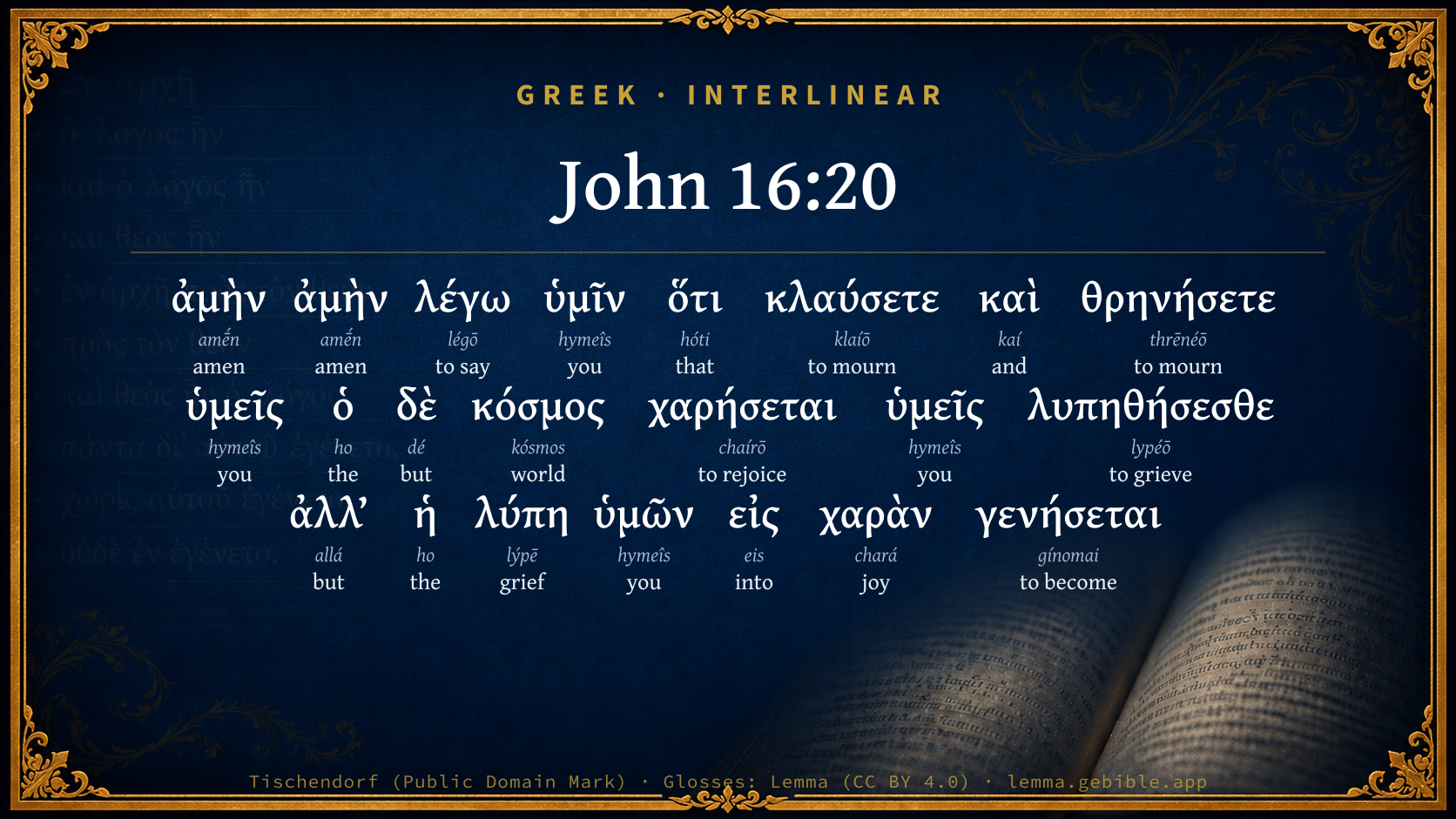
Most assuredly I tell you, that you will weep and lament, but the world will rejoice. You will be sorrowful, but your sorrow will be turned into joy.
Download a study sheet
One document with this verse’s original text, its word-by-word gloss line, the meaning frame, cross-references with their text, attributed commentary, and full source and license credits — printable, and it pastes into notes with its structure intact.
This verse Autodidact and up
A passage Seminary Student
Up to 50 verses in one chapter. A passage sheet keeps up to 6 commentary sources and 12 cross-references per verse, in the order this page ranks them, and says so on the sheet whenever that leaves anything out. Ask for a single verse and you get the Autodidact verse sheet above.
Everything on this page stays free to read, with no account — the sheet is a download of what is already on screen, not access to it.
Compare translations 3
The same verse in 3 English versions, stacked beneath the original-language interlinear above. Click any original word for its lexicon entry.
Each is an independent rendering of the whole verse — the interlinear is not word-aligned to these translations.
Highlighted words mark where these versions differ — a whole-verse word diff, not a word-by-word alignment.
-
World English Bible Public Domain
Most assuredly I tell you, that you will weep and lament, but the world will rejoice. You will be sorrowful, but your sorrow will be turned into joy.
-
King James Version Public Domain
Verily, verily, I say unto you, That ye shall weep and lament, but the world shall rejoice: and ye shall be sorrowful, but your sorrow shall be turned into joy.
-
unfoldingWord Literal Text CC BY-SA 4.0
Truly, truly, I say to you that you will weep and lament, but the world will be glad. You will be grieved, but your sorrow will become joy.
unfoldingWord Literal Text — © unfoldingWord, licensed CC BY-SA 4.0. Word-aligned USFM3 via Door43 (git.door43.org/unfoldingWord/en_ult).
Show all 19 translations
Every available English version of this verse, each an independent rendering of the whole verse.
-
World English Bible Public Domain
Most assuredly I tell you, that you will weep and lament, but the world will rejoice. You will be sorrowful, but your sorrow will be turned into joy.
-
Berean Standard Bible Public Domain
Truly, truly, I tell you, you will weep and wail while the world rejoices. You will grieve, but your grief will turn to joy.
-
Majority Standard Bible Public Domain
Truly, truly, I tell you, you will weep and wail while the world rejoices. You will grieve, but your grief will turn to joy.
-
King James Version Public Domain
Verily, verily, I say unto you, That ye shall weep and lament, but the world shall rejoice: and ye shall be sorrowful, but your sorrow shall be turned into joy.
-
American Standard Version (1901) Public Domain
Verily, verily, I say unto you, that ye shall weep and lament, but the world shall rejoice: ye shall be sorrowful, but your sorrow shall be turned into joy.
-
Revised Version (1885) Public Domain
Verily, verily, I say unto you, that ye shall weep and lament, but the world shall rejoice: ye shall be sorrowful, but your sorrow shall be turned into joy.
-
Geneva Bible (1599) Public Domain
Verely, verely I say vnto you, that ye shall weepe and lament, and the worlde shall reioyce: and ye shall sorowe, but your sorowe shalbe turned to ioye.
-
Douay-Rheims (1899) Public Domain
Amen, amen I say to you, that you shall lament and weep, but the world shall rejoice; and you shall be made sorrowful, but your sorrow shall be turned into joy.
-
Young's Literal Translation Public Domain
verily, verily, I say to you, that ye shall weep and lament, and the world will rejoice; and ye shall be sorrowful, but your sorrow joy will become.
-
Literal Standard Version CC BY-SA 4.0
Truly, truly, I say to you that you will weep and lament, and the world will rejoice; and you will be sorrowful, but your sorrow will become joy.
-
Unlocked Literal Bible CC BY-SA 4.0
Truly, truly, I say to you, you will weep and lament, but the world will be glad. You will become full of sadness, but your sorrow will be turned into joy.
-
unfoldingWord Literal Text CC BY-SA 4.0
Truly, truly, I say to you that you will weep and lament, but the world will be glad. You will be grieved, but your sorrow will become joy.
-
Darby Bible Public Domain
Verily, verily, I say to you, that ye shall weep and lament, ye, but the world shall rejoice; and ye will be grieved, but your grief shall be turned to joy.
-
World Messianic Bible Public Domain
Most certainly I tell you that you will weep and lament, but the world will rejoice. You will be sorrowful, but your sorrow will be turned into joy.
-
Webster's Bible Public Domain
Verily, verily, I say to you, that ye will weep and lament, but the world will rejoice: and ye will be sorrowful, but your sorrow shall be turned into joy.
-
Free Bible Version CC BY-SA 4.0
I tell you the truth, you will weep and mourn, but the world will rejoice. You will grieve, but your grief will turn into joy.
-
Bible in Basic English Public Domain
Truly I say to you, You will be weeping and sorrowing, but the world will be glad: you will be sad, but your sorrow will be turned into joy.
-
Text-Critical English NT CC BY 4.0
Truly, truly, I say to you, you will weep and lament, but the world will rejoice. You will be sorrowful, but your sorrow will turn to joy.
-
Tyndale New Testament (1534) Public Domain
Verely verely I saye vnto you: ye shall wepe and lamet and the worlde shall reioyce. Ye shall sorowe: but youre sorowe shalbe tourned to ioye.
Literal Standard Version (2020), Covenant Press — licensed CC BY-SA 4.0. Text via the HelloAO Bible API (eBible.org). Unlocked Literal Bible (unfoldingWord) — licensed CC BY-SA 4.0. Text via the HelloAO Bible API (eBible.org). unfoldingWord Literal Text — © unfoldingWord, licensed CC BY-SA 4.0. Word-aligned USFM3 via Door43 (git.door43.org/unfoldingWord/en_ult). Free Bible Version, Dr. Jonathan Gallagher — licensed CC BY-SA 4.0. Text via the HelloAO Bible API (eBible.org).
Word by word
More ways to search: Search by grammar → Find every occurrence → Compare this word →
Practice this passage: Drill this verse → Learn its vocabulary →
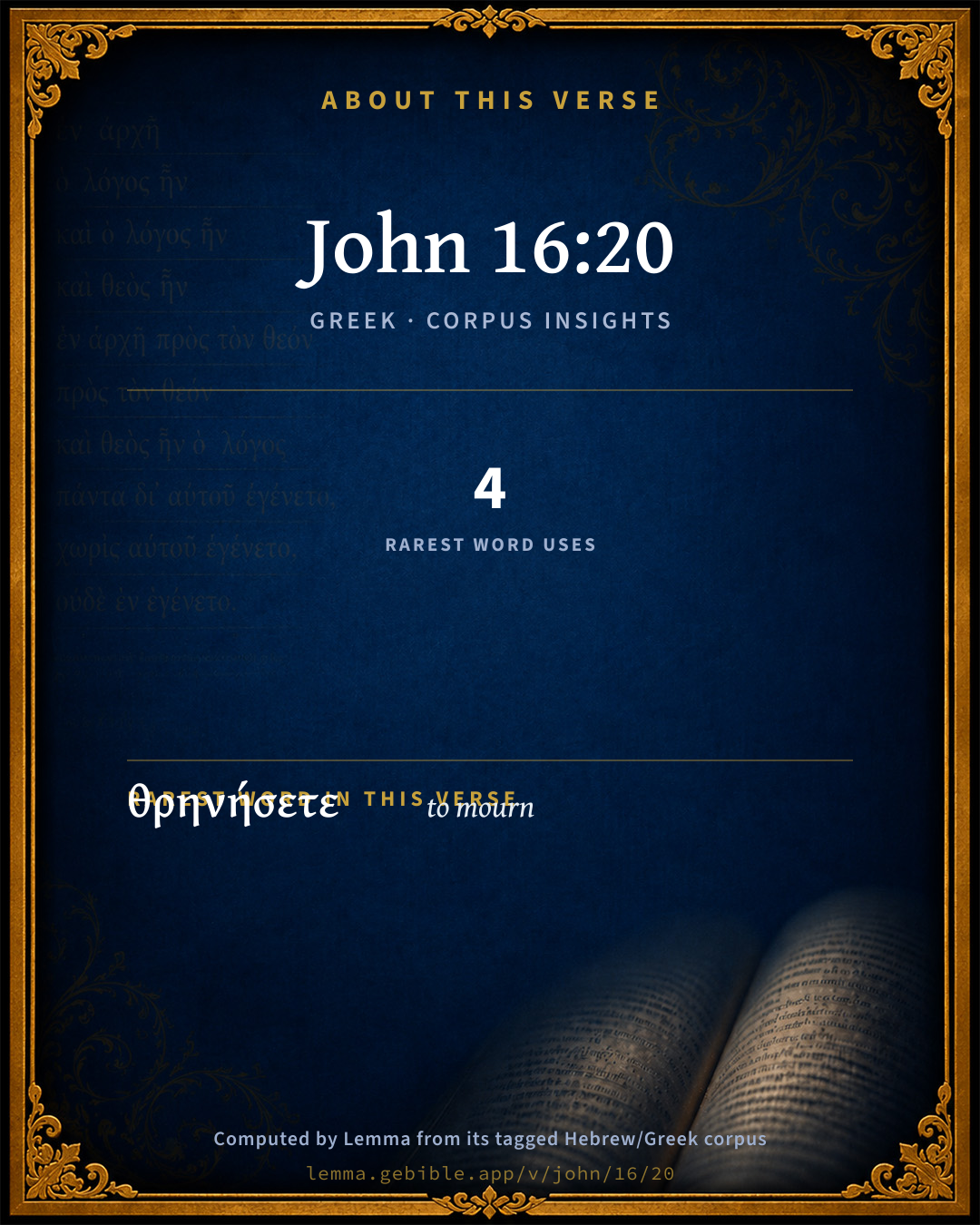
- Appears 4× in the Greek New Testament
- First appears at Matthew 11:17
- Part of Speech
- Verb
- Tense
- Future
- Voice
- Active
- Mood
- Indicative
- Person
- 2nd person
- Number
- Plural
Full Thayer's Definition
- ἀμὴν amḗn G281 “amen” Hebrew transliteration
- ἀμὴν amḗn G281 “amen” Hebrew transliteration
- λέγω légō G3004 “to say” Verb, Present, Active, Indicative, 1st person, Singular
- ὑμῖν hymeîs G5210 “you” Personal pronoun, 2nd person, Dative, Plural
- ὅτι hóti G3754 “that” Conjunction
- κλαύσετε klaíō G2799 “to mourn” Verb, Future, Active, Indicative, 2nd person, Plural
- καὶ kaí G2532 “and” Conjunction
- θρηνήσετε thrēnéō G2354 “to mourn” Verb, Future, Active, Indicative, 2nd person, Plural
- ὑμεῖς hymeîs G5210 “you” Personal pronoun, 2nd person, Nominative, Plural
- ὁ ho G3588 “the” Article, Nominative, Singular, Masculine
- δὲ dé G1161 “but” Conjunction
- κόσμος kósmos G2889 “world” Noun, Nominative, Singular, Masculine
- χαρήσεται chaírō G5463 “to rejoice” Verb, Future, Passive deponent, Indicative, 3rd person, Singular
- ὑμεῖς hymeîs G5210 “you” Personal pronoun, 2nd person, Nominative, Plural
- λυπηθήσεσθε lypéō G3076 “to grieve” Verb, Future, Passive, Indicative, 2nd person, Plural
- ἀλλ’ allá G235 “but” Conjunction
- ἡ ho G3588 “the” Article, Nominative, Singular, Feminine
- λύπη lýpē G3077 “grief” Noun, Nominative, Singular, Feminine
- ὑμῶν hymeîs G5210 “you” Personal pronoun, 2nd person, Genitive, Plural
- εἰς eis G1519 “into” Preposition
- χαρὰν chará G5479 “joy” Noun, Accusative, Singular, Feminine
- γενήσεται gínomai G1096 “to become” Verb, Future, Middle deponent, Indicative, 3rd person, Singular
About this verse
These counts appear in no published source. They are computed here, from the morphology-tagged text and Lemma’s own curated glosses. What Lemma adds →
- 22
- words
- 17
- distinct lemmas
- Gospels
- section
Cross-references
44Topical passages linked to John 16:20 in the Treasury of Scripture Knowledge — connected by theme and wording, ordered by reader-vote popularity; previews shown in the World English Bible.
- James 1:2 Count it all joy, my brothers, when you fall into various temptations,
- Matthew 5:4 Blessed are those who mourn, For they shall be comforted.
- Psalms 126:5–6 Those who sow in tears will reap in joy.
- Revelation 7:14–17 I told him, "My lord, you know." He said to me, "These are those who came out of the great tribulation. They washed their robes, and made them white in the Lamb's blood.
- Mark 16:10 She went and told those who had been with him, as they mourned and wept.
- Jeremiah 31:25 For I have satiated the weary soul, and every sorrowful soul have I replenished.
- 2 Corinthians 6:10 as sorrowful, yet always rejoicing; as poor, yet making many rich; as having nothing, and yet possessing all things.
- 1 Peter 1:6–8 Wherein you greatly rejoice, though now for a little while, if need be, you have been put to grief in various trials,
- Psalms 30:5 For his anger is but for a moment; His favor is for a lifetime. Weeping may stay for the night, But joy comes in the morning.
- Psalms 30:11 You have turned my mourning into dancing for me. You have removed my sackcloth, and clothed me with gladness,
- Luke 24:21 But we were hoping that it was he who would redeem Israel. Yes, and besides all this, it is now the third day since these things happened.
- Jude 1:24 Now to him who is able to keep them from stumbling, and to present you faultless before the presence of his glory in great joy,
- Psalms 40:1–3 I waited patiently for Yahweh. He turned to me, and heard my cry.
- Isaiah 61:3 to appoint to those who mourn in Zion, to give to them a garland for ashes, the oil of joy for mourning, the garment of praise for the spirit of heaviness; that they may be called trees of righteousness, the planting of Yahweh, that he may be glorified.
- Luke 23:27 A great multitude of the people followed him, including women who also mourned and lamented him.
- Luke 24:17 He said to them, "What are you talking about as you walk, and are sad?"
- Romans 5:2–3 through whom we also have our access by faith into this grace in which we stand. We rejoice in hope of the glory of God.
- Romans 5:11 Not only so, but we also rejoice in God through our Lord Jesus Christ, through whom we have now received the reconciliation.
- Galatians 5:22 But the fruit of the Spirit is love, joy, peace, patience, kindness, goodness, faithfulness,
- Job 20:5 That the triumphing of the wicked is short, The joy of the godless but for a moment?
- Psalms 97:11 Light is sown for the righteous, And gladness for the upright in heart.
- Isaiah 12:1 In that day you will say, "I will give thanks to you, Yahweh; for though you were angry with me, your anger has turned away and you comfort me.
- Isaiah 25:8–9 He has swallowed up death forever; and the Lord Yahweh will wipe away tears from off all faces; and the reproach of his people will he take away from off all the earth: for Yahweh has spoken it.
- Isaiah 66:5 Hear the word of Yahweh, you who tremble at his word: Your brothers who hate you, who cast you out for my name's sake, have said, Let Yahweh be glorified, that we may see your joy; but it is those who shall be disappointed.
- Jeremiah 31:9–14 They shall come with weeping; and with petitions will I lead them: I will cause them to walk by rivers of waters, in a straight way in which they shall not stumble; for I am a father to Israel, and Ephraim is my firstborn.
- Mark 14:72 The rooster crowed the second time. Peter remembered the word, how that Jesus said to him, "Before the rooster crows twice, you will deny me three times." When he thought about that, he wept.
- Luke 6:21 Blessed are you who hunger now, For you will be filled. Blessed are you who weep now, For you will laugh.
- Luke 22:45 When he rose up from his prayer, he came to the disciples, and found them sleeping because of grief,
- Luke 22:62 He went out, and wept bitterly.
- John 16:6 But because I have told you these things, sorrow has filled your heart.
- John 16:33 I have told you these things, that in me you may have peace. In the world you have oppression; but cheer up! I have overcome the world."
- Acts 2:46–47 Day by day, continuing steadfastly with one accord in the temple, and breaking bread at home, they took their food with gladness and singleness of heart,
- Acts 5:41 They therefore departed from the presence of the council, rejoicing that they were counted worthy to suffer dishonor for Jesus' name.
- 2 Thessalonians 2:16–17 Now our Lord Jesus Christ himself, and God our Father, who loved us and gave us eternal comfort and good hope through grace,
- Revelation 11:10 Those who dwell on the earth rejoice over them, and they will be glad. They will give gifts to one another, because these two prophets tormented those who dwell on the earth.
- Revelation 18:7 However much she glorified herself, and grew wanton, so much give her of torment and mourning. For she says in her heart, 'I sit a queen, and am no widow, and will in no way see mourning.'
- Matthew 27:39–44 Those who passed by blasphemed him, wagging their heads,
- Matthew 27:62–66 Now on the next day, which was the day after the Preparation Day, the chief priests and the Pharisees were gathered together to Pilate,
- Luke 23:47–49 When the centurion saw what was done, he glorified God, saying, "Certainly this was a righteous man."
- John 19:25–27 But there were standing by the cross of Jesus his mother, and his mother's sister, Mary the wife of Clopas, and Mary Magdalene.
- John 20:20 When he had said this, he showed them his hands and his side. The disciples therefore were glad when they saw the Lord.
- 1 Thessalonians 1:6 You became imitators of us, and of the Lord, having received the word in much affliction, with joy of the Holy Spirit,
- Matthew 21:38 But the farmers, when they saw the son, said among themselves, 'This is the heir. Come, let's kill him, and seize his inheritance.'
- Mark 15:29–32 Those who passed by blasphemed him, wagging their heads, and saying, "Ha! You who destroy the temple, and build it in three days,
Cross-references courtesy of OpenBible.info (CC BY 4.0).
Lesson kit
Teaching starters — assembled from the data on this page, not authored interpretation. Every prompt links to the verse data it draws on. Edit before teaching.
John, in the Gospels, opens this verse with 22 words (17 distinct Greek lemmas). Its most distinctive word is thrēnéō (“to mourn”). A historical commentator’s framing appears above. Read the whole chapter for the surrounding context.
Discussion questions
- The word thrēnéō carries the sense “to mourn.” How does it shape the verse?
- Matthew 11:17 shares the word «to mourn» with this verse. How do the two illuminate each other?
- “amen” occurs 2× in this one verse. What is the effect of the repetition?
- These translations render this verse differently. What is at stake in choosing one wording over another?
- Reading how The Biblical Illustrator and MacLaren's Expositions of Holy Scripture read this verse, where do the two commentators agree and where do they part?
Things to notice
- These translations choose different wording for 15 words in this verse.
- “amen” occurs 2× in this single verse.
- 17 distinct Greek lemmas span 22 words in this verse.
Commentary
Notes on John 16:20 from classic Christian and Jewish commentators (each source and its license shown beneath its notes). The classic Christian expositions comment on the surrounding passage and are grouped to its opening verse, so a note may address several verses; the Jewish commentaries on the Tanakh (Rashi and others) are per-verse, so they appear only where the commentator wrote on this verse.
Lemma curates 59 commentaries, every one of them public domain or Creative Commons licensed, each selected and text-cleaned for this edition rather than reprinted as found. About our sources →
The Biblical Illustrator
Joseph S. Exell
The Biblical Illustrator, edited by Joseph S. Exell (c. 1880s–1900s) — public domain. Text from a community e-Sword module.
MacLaren's Expositions of Holy Scripture
Alexander MacLaren
Alexander MacLaren, Expositions of Holy Scripture (1904–1910) — public domain. Text from a community e-Sword module.
Tyndale Open Study Notes
Tyndale Open Resources
Tyndale Open Study Notes — © Tyndale Open Resources, licensed CC BY-SA 4.0. Text via the HelloAO Bible API.
Bengel's Gnomon
Johann Albrecht Bengel
Bengel's Gnomon of the New Testament — English translation (T&T Clark, Edinburgh, 1860) — public domain. Text from a community e-Sword module.
Meyer's Critical & Exegetical Commentary
Heinrich August Wilhelm Meyer
Meyer — Critical and Exegetical Commentary on the New Testament — English translation by Peter Christie, edited by Frederick Crombie (T&T Clark, 1880) — public domain. Text from a community e-Sword module.
Expositor's Greek Testament
ed. W. Robertson Nicoll
The Expositor's Greek Testament, edited by W. Robertson Nicoll (1897–1910) — public domain. Text from a community e-Sword module.
Adam Clarke's Commentary
Adam Clarke's Commentary on the Bible (1810–1826) — public domain. Text from a community e-Sword/MySword module.
John Calvin's Commentaries
John Calvin's Commentaries (1540-1563) — public domain. Text from the Calvin Translation Society English edition (1840s-50s) via the Christian Classics Ethereal Library (ccel.org). Calvin's coverage is partial (roughly two-thirds of the Bible); uncommented books and verses are honest gaps, never fabricated. The 19th-century editor's footnotes and remarks are omitted so the notes are faithfully Calvin's own voice.
Ellicott's Commentary for English Readers
A Bible Commentary for English Readers, edited by Charles John Ellicott (1878–1897) — public domain. Text from a community e-Sword module.
The Cambridge Bible for Schools and Colleges
gen. ed. J. J. S. Perowne
The Cambridge Bible for Schools and Colleges (gen. ed. J. J. S. Perowne; Cambridge University Press, 1878–1918) — public domain. Text from a community e-Sword module.
John Gill's Exposition
John Gill's Exposition of the Whole Bible (1746–1763) — public domain (CC PDM 1.0). Text via the HelloAO Bible API.
Trapp's Complete Commentary
John Trapp
John Trapp, A Commentary or Exposition upon All the Books of the Old and New Testament (1647–1656) — public domain. Text from a community e-Sword module.
Albert Barnes' Notes on the Bible
Albert Barnes' Notes on the Bible (1834–1885) — public domain. Text from a community e-Sword/MySword module.
Haydock's Catholic Bible Commentary
George Leo Haydock (1774–1849), Haydock's Catholic Family Bible and Commentary, 1859 edition — public domain. Excludes Psalms (Douay-Rheims chapter numbering differs from Protestant) and Deuterocanonical books (Catholic canon only).
Matthew Poole's English Annotations
Matthew Poole's English Annotations on the Holy Bible (1683–1685) — public domain. Text from a community e-Sword/MySword module.
Whedon's Commentary on the Bible
Daniel D. Whedon
Daniel D. Whedon (gen. ed.), Commentary on the Old and New Testaments (1874–1909) — public domain. Text from a community e-Sword module.
The Pulpit Commentary
The Pulpit Commentary (1880–1919), ed. H.D.M. Spence-Jones & Joseph S. Exell — public domain. Text from a community e-Sword module.
John Wesley's Explanatory Notes
John Wesley, Explanatory Notes Upon the Whole Bible (1754–1765) — public domain. Text via the GEBible commentary corpus.
Scofield Reference Notes
C. I. Scofield
The Scofield Reference Bible (1917 edition), notes by C. I. Scofield — public domain. Text from a community e-Sword module.
The People's New Testament
B. W. Johnson
B. W. Johnson's The People's New Testament with Notes (1889–1891) — public domain. Electronic text from the Christian Classics Ethereal Library (CCEL) ThML edition.
Cambridge Greek Testament for Schools and Colleges
Cambridge Greek Testament for Schools and Colleges (Cambridge University Press, 1896; 21 vols, various authors incl. Carr, Maclear, Plummer, Farrar, Lumby, Moule, M. R. James, Simcox) — public domain. Text from a community e-Sword module.
Alford’s Greek Testament
Henry Alford
Henry Alford, The Greek Testament (1849–1861) — public domain. Text from a community e-Sword module.
International Critical Commentary
International Critical Commentary — older volumes (1896–1929), various authors — public domain. Text from a community e-Sword module.
Vincent's Word Studies in the New Testament
Marvin R. Vincent
Marvin R. Vincent, Word Studies in the New Testament (1887–1900) — public domain. Text from a community e-Sword/MySword module.