

John 16:21
Greek (Tischendorf 8th ed.) John 16:21 appears in the Greek New Testament. The text above is from the Tischendorf 8th edition. Each word links to its Strong’s number and a concise gloss. Click any word for its full Thayer’s Greek Lexicon entry.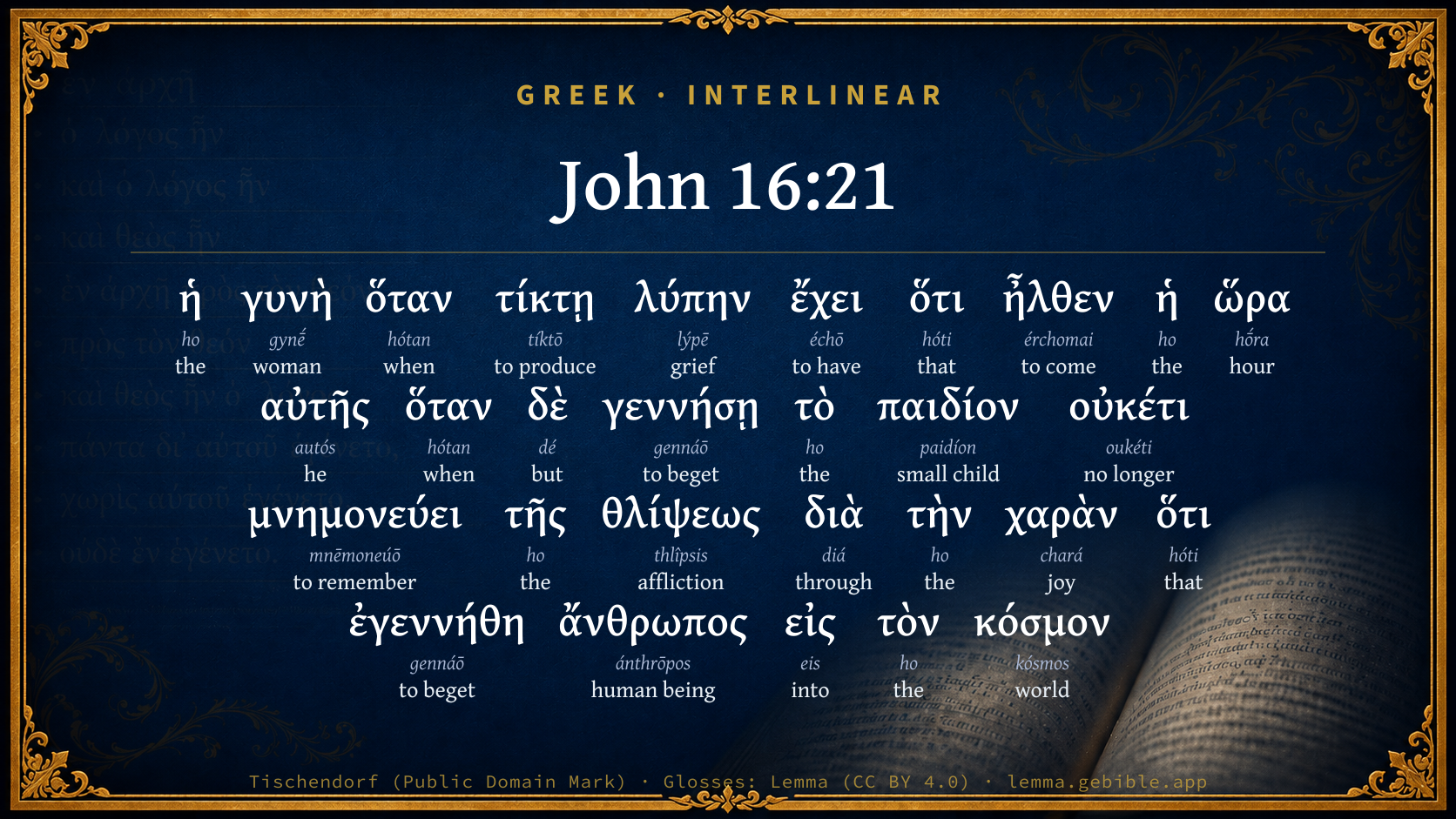
A woman, when she gives birth, has sorrow, because her time has come. But when she has delivered the child, she doesn't remember the anguish any more, for the joy that a human being is born into the world.
Download a study sheet
One document with this verse’s original text, its word-by-word gloss line, the meaning frame, cross-references with their text, attributed commentary, and full source and license credits — printable, and it pastes into notes with its structure intact.
This verse Autodidact and up
A passage Seminary Student
Up to 50 verses in one chapter. A passage sheet keeps up to 6 commentary sources and 12 cross-references per verse, in the order this page ranks them, and says so on the sheet whenever that leaves anything out. Ask for a single verse and you get the Autodidact verse sheet above.
Everything on this page stays free to read, with no account — the sheet is a download of what is already on screen, not access to it.
Compare translations 3
The same verse in 3 English versions, stacked beneath the original-language interlinear above. Click any original word for its lexicon entry.
Each is an independent rendering of the whole verse — the interlinear is not word-aligned to these translations.
Highlighted words mark where these versions differ — a whole-verse word diff, not a word-by-word alignment.
-
World English Bible Public Domain
A woman, when she gives birth, has sorrow, because her time has come. But when she has delivered the child, she doesn't remember the anguish any more, for the joy that a human being is born into the world.
-
King James Version Public Domain
A woman when she is in travail hath sorrow, because her hour is come: but as soon as she is delivered of the child, she remembereth no more the anguish, for joy that a man is born into the world.
-
unfoldingWord Literal Text CC BY-SA 4.0
When a woman gives birth, she has pain because her hour has come, but when she has given birth to the child, she no longer remembers her suffering, because of the joy that a man has been born into the world.
unfoldingWord Literal Text — © unfoldingWord, licensed CC BY-SA 4.0. Word-aligned USFM3 via Door43 (git.door43.org/unfoldingWord/en_ult).
Show all 19 translations
Every available English version of this verse, each an independent rendering of the whole verse.
-
World English Bible Public Domain
A woman, when she gives birth, has sorrow, because her time has come. But when she has delivered the child, she doesn't remember the anguish any more, for the joy that a human being is born into the world.
-
Berean Standard Bible Public Domain
A woman has pain in childbirth because her time has come; but when she brings forth her child, she forgets her anguish because of her joy that a child has been born into the world.
-
Majority Standard Bible Public Domain
A woman has pain in childbirth because her time has come; but when she brings forth her child, she forgets her anguish because of her joy that a child has been born into the world.
-
King James Version Public Domain
A woman when she is in travail hath sorrow, because her hour is come: but as soon as she is delivered of the child, she remembereth no more the anguish, for joy that a man is born into the world.
-
American Standard Version (1901) Public Domain
A woman when she is in travail hath sorrow, because her hour is come: but when she is delivered of the child, she remembereth no more the anguish, for the joy that a man is born into the world.
-
Revised Version (1885) Public Domain
A woman when she is in travail hath sorrow, because her hour is come: but when she is delivered of the child, she remembereth no more the anguish, for the joy that a man is born into the world.
-
Geneva Bible (1599) Public Domain
A woman when she traueileth, hath sorowe, because her houre is come: but assoone as she is deliuered of the childe, she remembreth no more the anguish, for ioy that a man is borne into the world.
-
Douay-Rheims (1899) Public Domain
A woman, when she is in labour, hath sorrow, because her hour is come; but when she hath brought forth the child, she remembereth no more the anguish, for joy that a man is born into the world.
-
Young's Literal Translation Public Domain
`The woman, when she may bear, hath sorrow, because her hour did come, and when she may bear the child, no more doth she remember the anguish, because of the joy that a man was born to the world.
-
Literal Standard Version CC BY-SA 4.0
The woman, when she may bear, has sorrow, because her hour came, and when she may bear the child, she no longer remembers the anguish, because of the joy that a man was born into the world.
-
Unlocked Literal Bible CC BY-SA 4.0
When a woman gives birth she has sadness because her hour has come, but when she has given birth to the child, she no longer remembers her pain because of her joy that a man has been born into the world.
-
unfoldingWord Literal Text CC BY-SA 4.0
When a woman gives birth, she has pain because her hour has come, but when she has given birth to the child, she no longer remembers her suffering, because of the joy that a man has been born into the world.
-
Darby Bible Public Domain
A woman, when she gives birth to a child, has grief because her hour has come; but when the child is born, she no longer remembers the trouble, on account of the joy that a man has been born into the world.
-
World Messianic Bible Public Domain
A woman, when she gives birth, has sorrow because her time has come. But when she has delivered the child, she doesn’t remember the anguish any more, for the joy that a human being is born into the world.
-
Webster's Bible Public Domain
A woman when she is in travail hath sorrow, because her hour is come: but as soon as she is delivered of the child, she remembereth no more the anguish, for joy that a man is born into the world.
-
Free Bible Version CC BY-SA 4.0
A woman in labor suffers pain because her time has come, but once the baby is born, she forgets the agony because of the joy that a child has been brought into the world.
-
Bible in Basic English Public Domain
When a woman is about to give birth she has sorrow, because her hour is come; but when she has given birth to the child, the pain is put out of her mind by the joy that a man has come into the world.
-
Text-Critical English NT CC BY 4.0
When a woman is giving birth, she has pain because her hour has come. But when her baby is born, she no longer remembers the anguish because of her joy that a child has been born into the world.
-
Tyndale New Testament (1534) Public Domain
A woman when she traveyleth hath sorowe because her houre is come: but assone as she is delivered of the chylde she remembreth no moare the anguysshe for ioye that a man is borne in to the worlde.
Literal Standard Version (2020), Covenant Press — licensed CC BY-SA 4.0. Text via the HelloAO Bible API (eBible.org). Unlocked Literal Bible (unfoldingWord) — licensed CC BY-SA 4.0. Text via the HelloAO Bible API (eBible.org). unfoldingWord Literal Text — © unfoldingWord, licensed CC BY-SA 4.0. Word-aligned USFM3 via Door43 (git.door43.org/unfoldingWord/en_ult). Free Bible Version, Dr. Jonathan Gallagher — licensed CC BY-SA 4.0. Text via the HelloAO Bible API (eBible.org).
Word by word
More ways to search: Search by grammar → Find every occurrence → Compare this word →
Practice this passage: Drill this verse → Learn its vocabulary →
- Appears 16× in the Greek New Testament
- First appears at Luke 22:45
- Part of Speech
- Noun
- Case
- Accusative
- Number
- Singular
- Gender
- Feminine
Full Thayer's Definition
- ἡ ho G3588 “the” Article, Nominative, Singular, Feminine
- γυνὴ gynḗ G1135 “woman” Noun, Nominative, Singular, Feminine
- ὅταν hótan G3752 “when” Conjunction
- τίκτῃ tíktō G5088 “to produce” Verb, Present, Active, Subjunctive, 3rd person, Singular
- λύπην lýpē G3077 “grief” Noun, Accusative, Singular, Feminine
- ἔχει échō G2192 “to have” Verb, Present, Active, Indicative, 3rd person, Singular
- ὅτι hóti G3754 “that” Conjunction
- ἦλθεν érchomai G2064 “to come” Verb, Aorist, Active, Indicative, 3rd person, Singular
- ἡ ho G3588 “the” Article, Nominative, Singular, Feminine
- ὥρα hṓra G5610 “hour” Noun, Nominative, Singular, Feminine
- αὐτῆς autós G846 “he” Personal pronoun, Genitive, Singular, Feminine
- ὅταν hótan G3752 “when” Conjunction
- δὲ dé G1161 “but” Conjunction
- γεννήσῃ gennáō G1080 “to beget” Verb, Aorist, Active, Subjunctive, 3rd person, Singular
- τὸ ho G3588 “the” Article, Accusative, Singular, Neuter
- παιδίον paidíon G3813 “small child” Noun, Accusative, Singular, Neuter
- οὐκέτι oukéti G3765 “no longer” Adverb, Negative
- μνημονεύει mnēmoneúō G3421 “to remember” Verb, Present, Active, Indicative, 3rd person, Singular
- τῆς ho G3588 “the” Article, Genitive, Singular, Feminine
- θλίψεως thlîpsis G2347 “affliction” Noun, Genitive, Singular, Feminine
- διὰ diá G1223 “through” Preposition
- τὴν ho G3588 “the” Article, Accusative, Singular, Feminine
- χαρὰν chará G5479 “joy” Noun, Accusative, Singular, Feminine
- ὅτι hóti G3754 “that” Conjunction
- ἐγεννήθη gennáō G1080 “to beget” Verb, Aorist, Passive, Indicative, 3rd person, Singular
- ἄνθρωπος ánthrōpos G444 “human being” Noun, Nominative, Singular, Masculine
- εἰς eis G1519 “into” Preposition
- τὸν ho G3588 “the” Article, Accusative, Singular, Masculine
- κόσμον kósmos G2889 “world” Noun, Accusative, Singular, Masculine
About this verse
These counts appear in no published source. They are computed here, from the morphology-tagged text and Lemma’s own curated glosses. What Lemma adds →
- 29
- words
- 21
- distinct lemmas
- Gospels
- section
Cross-references
14Topical passages linked to John 16:21 in the Treasury of Scripture Knowledge — connected by theme and wording, ordered by reader-vote popularity; previews shown in the World English Bible.
- Psalms 113:9 He settles the barren woman in her home, As a joyful mother of children. Praise Yah!
- Isaiah 13:8 and they shall be dismayed; pangs and sorrows shall take hold [of them]; they shall be in pain as a woman in travail: they shall look in amazement one at another; their faces [shall be] faces of flame.
- Jeremiah 30:6–7 Ask now, and see whether a man does travail with child: why do I see every man with his hands on his loins, as a woman in travail, and all faces are turned into paleness?
- 1 Thessalonians 5:3 For when they are saying, "Peace and safety," then sudden destruction will come on them, like birth pains on a pregnant woman; and they will in no way escape.
- Isaiah 26:16–18 Yahweh, in trouble have they visited you; they poured out a prayer [when] your chastening was on them.
- Hosea 13:13–14 The sorrows of a travailing woman will come on him. He is an unwise son; For when it is time, he doesn't come to the opening of the womb.
- Micah 4:10 Be in pain, and labor to bring forth, daughter of Zion, Like a woman in travail; For now you will go forth out of the city, And will dwell in the field, And will come even to Babylon. There you will be rescued. There Yahweh will redeem you from the hand of your enemies.
- Revelation 12:2–5 She was with child. She cried out in pain, laboring to give birth.
- Genesis 3:16 To the woman he said, "I will greatly multiply your pain in childbirth. In pain you will bring forth children. Your desire will be for your husband, and he will rule over you."
- Genesis 21:6–7 Sarah said, "God has made me laugh. Everyone who hears will laugh with me."
- Genesis 30:23–24 She conceived, bore a son, and said, "God has taken away my reproach."
- 1 Samuel 1:26–27 She said, Oh, my lord, as your soul lives, my lord, I am the woman who stood by you here, praying to Yahweh.
- Luke 1:57–58 Now the time that Elizabeth should give birth was fulfilled, and she brought forth a son.
- Galatians 4:27 For it is written, "Rejoice, you barren who don't bear. Break forth and shout, you that don't travail. For more are the children of the desolate than of her who has a husband."
Cross-references courtesy of OpenBible.info (CC BY 4.0).
Lesson kit
Teaching starters — assembled from the data on this page, not authored interpretation. Every prompt links to the verse data it draws on. Edit before teaching.
John, in the Gospels, opens this verse with 29 words (21 distinct Greek lemmas). Its most distinctive word is lýpē (“grief”). A historical commentator’s framing appears above. Read the whole chapter for the surrounding context.
Discussion questions
- How does “grief” (lýpē) shape what this verse is saying?
- How does Luke 22:45, which shares the word «grief», read alongside this verse?
- What does the repetition of “when” (2× in this one verse) do in this verse?
- These translations render this verse differently. What is at stake in choosing one wording over another?
- Compare how Tyndale Open Study Notes and Bengel's Gnomon read this verse. Where do they agree or differ?
Things to notice
- These translations choose different wording for 24 words in this verse.
- “when” occurs 2× in this single verse.
- 21 distinct Greek lemmas span 29 words in this verse.
Commentary
Notes on John 16:21 from classic Christian and Jewish commentators (each source and its license shown beneath its notes). The classic Christian expositions comment on the surrounding passage and are grouped to its opening verse, so a note may address several verses; the Jewish commentaries on the Tanakh (Rashi and others) are per-verse, so they appear only where the commentator wrote on this verse.
Lemma curates 59 commentaries, every one of them public domain or Creative Commons licensed, each selected and text-cleaned for this edition rather than reprinted as found. About our sources →
Tyndale Open Study Notes
Tyndale Open Resources
Tyndale Open Study Notes — © Tyndale Open Resources, licensed CC BY-SA 4.0. Text via the HelloAO Bible API.
Bengel's Gnomon
Johann Albrecht Bengel
Bengel's Gnomon of the New Testament — English translation (T&T Clark, Edinburgh, 1860) — public domain. Text from a community e-Sword module.
Expositor's Greek Testament
ed. W. Robertson Nicoll
The Expositor's Greek Testament, edited by W. Robertson Nicoll (1897–1910) — public domain. Text from a community e-Sword module.
Adam Clarke's Commentary
Adam Clarke's Commentary on the Bible (1810–1826) — public domain. Text from a community e-Sword/MySword module.
John Calvin's Commentaries
John Calvin's Commentaries (1540-1563) — public domain. Text from the Calvin Translation Society English edition (1840s-50s) via the Christian Classics Ethereal Library (ccel.org). Calvin's coverage is partial (roughly two-thirds of the Bible); uncommented books and verses are honest gaps, never fabricated. The 19th-century editor's footnotes and remarks are omitted so the notes are faithfully Calvin's own voice.
Ellicott's Commentary for English Readers
A Bible Commentary for English Readers, edited by Charles John Ellicott (1878–1897) — public domain. Text from a community e-Sword module.
The Cambridge Bible for Schools and Colleges
gen. ed. J. J. S. Perowne
The Cambridge Bible for Schools and Colleges (gen. ed. J. J. S. Perowne; Cambridge University Press, 1878–1918) — public domain. Text from a community e-Sword module.
John Gill's Exposition
John Gill's Exposition of the Whole Bible (1746–1763) — public domain (CC PDM 1.0). Text via the HelloAO Bible API.
Trapp's Complete Commentary
John Trapp
John Trapp, A Commentary or Exposition upon All the Books of the Old and New Testament (1647–1656) — public domain. Text from a community e-Sword module.
Matthew Poole's English Annotations
Matthew Poole's English Annotations on the Holy Bible (1683–1685) — public domain. Text from a community e-Sword/MySword module.
Whedon's Commentary on the Bible
Daniel D. Whedon
Daniel D. Whedon (gen. ed.), Commentary on the Old and New Testaments (1874–1909) — public domain. Text from a community e-Sword module.
The Pulpit Commentary
The Pulpit Commentary (1880–1919), ed. H.D.M. Spence-Jones & Joseph S. Exell — public domain. Text from a community e-Sword module.
Scofield Reference Notes
C. I. Scofield
The Scofield Reference Bible (1917 edition), notes by C. I. Scofield — public domain. Text from a community e-Sword module.
Cambridge Greek Testament for Schools and Colleges
Cambridge Greek Testament for Schools and Colleges (Cambridge University Press, 1896; 21 vols, various authors incl. Carr, Maclear, Plummer, Farrar, Lumby, Moule, M. R. James, Simcox) — public domain. Text from a community e-Sword module.
Alford’s Greek Testament
Henry Alford
Henry Alford, The Greek Testament (1849–1861) — public domain. Text from a community e-Sword module.
International Critical Commentary
International Critical Commentary — older volumes (1896–1929), various authors — public domain. Text from a community e-Sword module.
Vincent's Word Studies in the New Testament
Marvin R. Vincent
Marvin R. Vincent, Word Studies in the New Testament (1887–1900) — public domain. Text from a community e-Sword/MySword module.
Godet's Commentaries
Frédéric Louis Godet
Frédéric Louis Godet — Commentaries on Luke, John, Romans, and 1 Corinthians — English translation (T&T Clark, Edinburgh, 1870s–1890s) — public domain. Text from a community e-Sword module.