Acts 4:15

Greek (Tischendorf 8th ed.) Acts 4:15 appears in the Greek New Testament. The text above is from the Tischendorf 8th edition. Each word links to its Strong’s number and a concise gloss. Click any word for its full Thayer’s Greek Lexicon entry.
Download image
Cite this verse

Acts 4:15 (World English Bible). Public Domain. Lemma interlinear Bible study tool, https://lemma.gebible.app/v/acts/4/15.

Show BibTeX & RIS
BibTeX
RIS
English Translation
But when they had commanded them to go aside out of the council, they conferred among themselves,
World English Bible · Public Domain
Download a study sheet

One document with this verse’s original text, its word-by-word gloss line, the meaning frame, cross-references with their text, attributed commentary, and full source and license credits — printable, and it pastes into notes with its structure intact.

This verse Autodidact and up

Study sheet (.html) Plain text (.txt)

A passage Seminary Student

Up to 50 verses in one chapter. A passage sheet keeps up to 6 commentary sources and 12 cross-references per verse, in the order this page ranks them, and says so on the sheet whenever that leaves anything out. Ask for a single verse and you get the Autodidact verse sheet above.

Everything on this page stays free to read, with no account — the sheet is a download of what is already on screen, not access to it.

Want to remove ads? Support Godless Engineer
Compare translations 3

The same verse in 3 English versions, stacked beneath the original-language interlinear above. Click any original word for its lexicon entry.

Each is an independent rendering of the whole verse — the interlinear is not word-aligned to these translations.

Highlighted words mark where these versions differ — a whole-verse word diff, not a word-by-word alignment.

  • World English Bible Public Domain
    But when they had commanded them to go aside out of the council, they conferred among themselves,
  • King James Version Public Domain
    But when they had commanded them to go aside out of the council, they conferred among themselves,
  • unfoldingWord Literal Text CC BY-SA 4.0
    But having commanded them to go outside the Sanhedrin, they conferred among themselves,

unfoldingWord Literal Text — © unfoldingWord, licensed CC BY-SA 4.0. Word-aligned USFM3 via Door43 (git.door43.org/unfoldingWord/en_ult).

Versions to compare (up to 4)

3 of 4 selected

Show all 19 translations

Every available English version of this verse, each an independent rendering of the whole verse.

  • World English Bible Public Domain
    But when they had commanded them to go aside out of the council, they conferred among themselves,
  • Berean Standard Bible Public Domain
    So they ordered them to leave the Sanhedrin and then conferred together.
  • Majority Standard Bible Public Domain
    So they ordered them to leave the Sanhedrin and then conferred together.
  • King James Version Public Domain
    But when they had commanded them to go aside out of the council, they conferred among themselves,
  • American Standard Version (1901) Public Domain
    But when they had commanded them to go aside out of the council, they conferred among themselves,
  • Revised Version (1885) Public Domain
    But when they had commanded them to go aside out of the council, they conferred among themselves,
  • Geneva Bible (1599) Public Domain
    Then they commanded them to goe aside out of the Council, and conferred among themselues,
  • Douay-Rheims (1899) Public Domain
    But they commanded them to go aside out of the council; and they conferred among themselves,
  • Young's Literal Translation Public Domain
    and having commanded them to go away out of the sanhedrim, they took counsel with one another,
  • Literal Standard Version CC BY-SA 4.0
    and having commanded them to go away out of the Sanhedrin, they took counsel with one another,
  • Unlocked Literal Bible CC BY-SA 4.0
    But after they had commanded the apostles to leave the council meeting, they talked among themselves.
  • unfoldingWord Literal Text CC BY-SA 4.0
    But having commanded them to go outside the Sanhedrin, they conferred among themselves,
  • Darby Bible Public Domain
    but having commanded them to go out of the council they conferred with one another,
  • World Messianic Bible Public Domain
    But when they had commanded them to go aside out of the council, they conferred among themselves,
  • Webster's Bible Public Domain
    But when they had commanded them to withdraw from the council, they conferred among themselves,
  • Free Bible Version CC BY-SA 4.0
    So they instructed them to wait outside the council while they discussed the matter among themselves.
  • Bible in Basic English Public Domain
    But when they had given them orders to go out of the Sanhedrin, they had a discussion among themselves,
  • Text-Critical English NT CC BY 4.0
    So they ordered Peter and John to step out from the Sanhedrin while they conferred with one another,
  • Tyndale New Testament (1534) Public Domain
    But they commaunded them to go a syde out of the counsell and counceled amonge them selves

Literal Standard Version (2020), Covenant Press — licensed CC BY-SA 4.0. Text via the HelloAO Bible API (eBible.org). Unlocked Literal Bible (unfoldingWord) — licensed CC BY-SA 4.0. Text via the HelloAO Bible API (eBible.org). unfoldingWord Literal Text — © unfoldingWord, licensed CC BY-SA 4.0. Word-aligned USFM3 via Door43 (git.door43.org/unfoldingWord/en_ult). Free Bible Version, Dr. Jonathan Gallagher — licensed CC BY-SA 4.0. Text via the HelloAO Bible API (eBible.org).

Word by word

More ways to search: Search by grammar → Find every occurrence → Compare this word →

Practice this passage: Drill this verse → Learn its vocabulary →

συνέβαλλον
symbállō
G4820
“to fight with”
Verb, Imperfect, Active, Indicative, 3rd person, Plural
Part of Speech
Verb
Tense
Imperfect
Voice
Active
Mood
Indicative
Person
3rd person
Number
Plural
Full Thayer's Definition

Origin: from G4862 and G906

TDNT: None

1. to throw together, to bring together a. to converse b. to bring together in one's mind, confer with one's self c. to come together, meet 1. to encounter in a hostile sense 2. to fight with one 3. to bring together of one's property, to contribute, aid, help
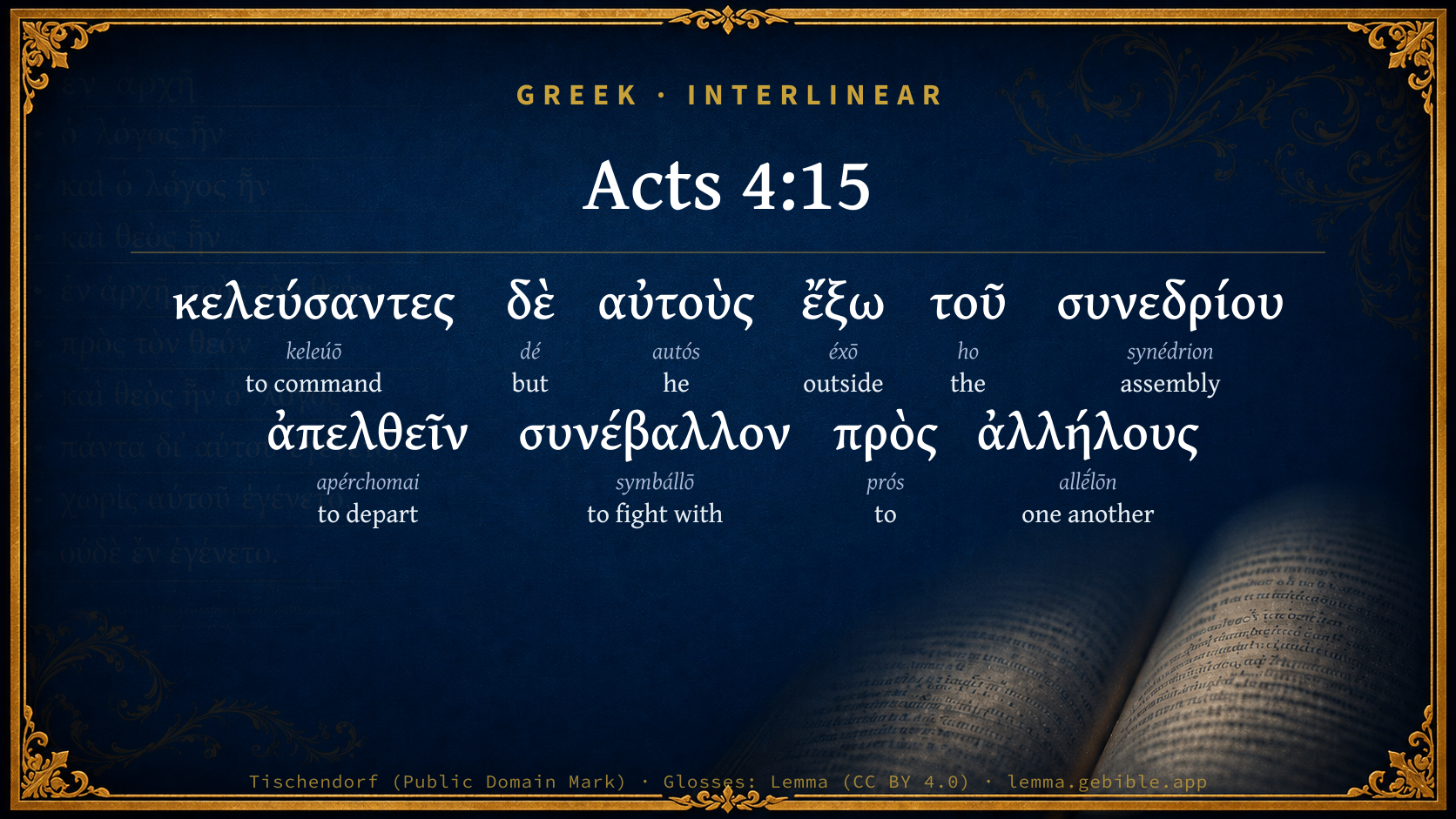
  1. κελεύσαντες keleúō G2753 “to command” Verb, Aorist, Active, Participle, Nominative, Plural, Masculine
  2. δὲ dé G1161 “but” Conjunction
  3. αὐτοὺς autós G846 “he” Personal pronoun, Accusative, Plural, Masculine
  4. ἔξω éxō G1854 “outside” Adverb
  5. τοῦ ho G3588 “the” Article, Genitive, Singular, Neuter
  6. συνεδρίου synédrion G4892 “assembly” Noun, Genitive, Singular, Neuter
  7. ἀπελθεῖν apérchomai G565 “to depart” Verb, Aorist, Active, Infinitive
  8. πρὸς prós G4314 “to” Preposition
  9. ἀλλήλους allḗlōn G240 “one another” Reciprocal pronoun, Accusative, Plural, Masculine

About this verse

These counts appear in no published source. They are computed here, from the morphology-tagged text and Lemma’s own curated glosses. What Lemma adds →

10
words
10
distinct lemmas
Acts
section

Notable vocabulary

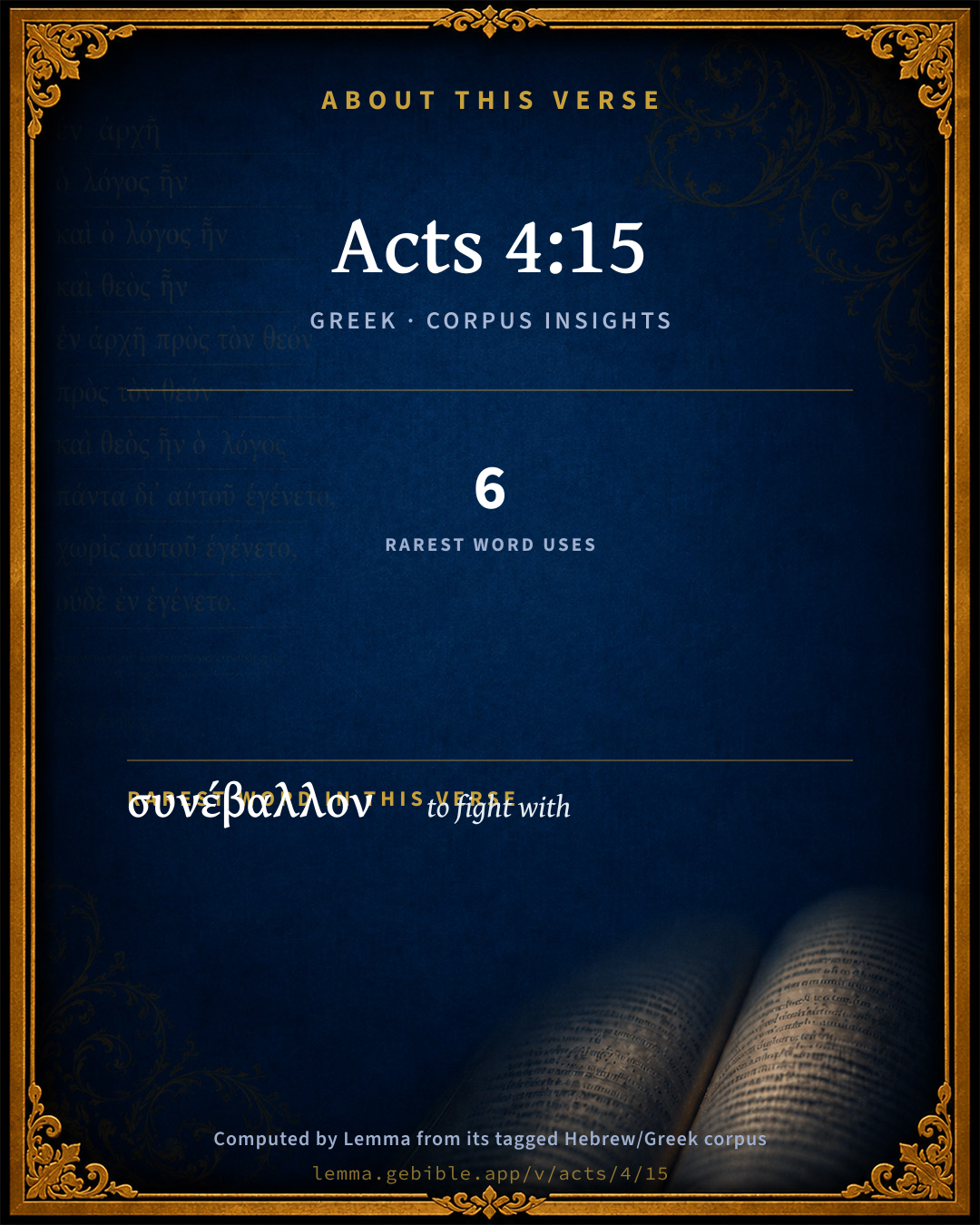
The rarest word here is συνέβαλλον to fight with G4820 — appearing just 6 times in the whole Greek New Testament.

Shared distinctive vocabulary

συνέβαλλον to fight with G4820 occurs in 6 verses of the Greek New Testament. Also found in:

Cross-references

3

Topical passages linked to Acts 4:15 in the Treasury of Scripture Knowledge — connected by theme and wording, ordered by reader-vote popularity; previews shown in the World English Bible.

  • Matthew 5:22 But I tell you, that everyone who is angry with his brother without a cause shall be in danger of the judgment; and whoever shall say to his brother, 'Raca!' shall be in danger of the council; and whoever shall say, 'You fool!' shall be in danger of the fire of Gehenna.
  • Acts 5:34–42 But one stood up in the council, a Pharisee named Gamaliel, a teacher of the law, honored by all the people, and commanded to put the apostles out for a little while.
  • Acts 26:30–32 The king rose up with the governor, and Bernice, and those who sat with them.

Cross-references courtesy of OpenBible.info (CC BY 4.0).

Commentary

Notes on Acts 4:15 from classic Christian and Jewish commentators (each source and its license shown beneath its notes). The classic Christian expositions comment on the surrounding passage and are grouped to its opening verse, so a note may address several verses; the Jewish commentaries on the Tanakh (Rashi and others) are per-verse, so they appear only where the commentator wrote on this verse.

Lemma curates 59 commentaries, every one of them public domain or Creative Commons licensed, each selected and text-cleaned for this edition rather than reprinted as found. About our sources →

Matthew Henry's Commentary

We have here the issue of the trial of Peter and John before the council. They came off now with flying colours, because they must be trained up to sufferings by degrees, and by less trials be prepared for greater. They now but run with the footmen; hereafter we shall have them contending with horses, Jer 12:5.

I. Here is the consultation and resolution of the court about this matter, and their proceeding thereupon.

1. The prisoners were ordered to withdraw (Act 4:15): They commanded them to go aside out of the council, willing enough to get clear of them (they spoke so home to their consciences), and not willing they should hear the acknowledgements that were extorted from them; but, though they might not hear from them, we have them here upon record. The designs of Christ's enemies are carried on in close cabals, and they dig deep, as if they would hide their counsels from the Lord.

2. A debate arose upon this matter: They conferred among themselves; every one is desired to speak his mind freely, and to give advice upon this important affair. Now the scripture was fulfilled that the rulers would take counsel together against the Lord, and against his anointed, Psa 2:2. The question proposed was, What shall we do to these men? Act 4:16. If they would have yielded to the convincing commanding power of truth, it had been easy to say what they should do to these men. They should have placed them at the head of their council, and received their doctrine, and been baptized by them in the name of the Lord Jesus, and joined in fellowship with them. But, when men will not be persuaded to do what they should do, it is no marvel that they are ever and anon at a loss what to do. The truths of Christ, if men would but entertain them as they should, would give them no manner of trouble or uneasiness; but, if they hold them or imprison them in unrighteousness (Rom 1:18), they will find them a burdensome stone that they will not know what to do with, Zac 12:3.

3. They came at last to a resolution, in two things: -

(1.) That it was not safe to punish the apostles for what they had done. Very willingly would they have done it, but they had not courage to do it, because the people espoused their cause, and cried up the miracle; and they stood now in as much awe of them as they had done formerly, when they durst not lay hands of Christ for fear of the people. By this it appears that the outcry of the mob against our Saviour was a forced or managed thing, the stream soon returned to its former channel. Now they could not find how they might punish Peter and John, what colour they might have for it, because of the people. They knew it would be an unrighteous thing to punish them, and therefore should have been restrained from it by the fear of God; but they considered it only as a dangerous thing, and therefore were held in from it only by the fear of the people. For, [1.] The people were convinced of the truth of the miracle; it was a notable miracle, gnōston sēmeion - a known miracle; it was known that they did it in Christ's name, and that Christ himself had often the like before. This was a known instance of the power of Christ, and a proof of his doctrine. That it was a great miracle, and wrought for the confirmation of the doctrine they preached (for it was a sign), was manifest to all that dwelt in Jerusalem: it was an opinion universally received, and, the miracle being wrought at the gate of the temple, universal notice was taken of it; and they themselves, with all the craftiness and all the effrontery they had, could not deny it to be a true miracle; every body would have hooted at them if they had. They could easily deny it to their own consciences, but not to the world. The proofs of the gospel were undeniable. [2.] They went further, and were not only convinced of the truth of the miracle, but all men glorified God for that which was done. Even those that were not persuaded by it to believe in Christ were yet so affected with it, as a mercy to a poor man and an honour to their country, that they could not but give praise to God for it; even natural religion taught them to do this. And, if the priests had punished Peter and John for that for which all men glorified God, they would have lost all their interest in the people, and been abandoned as enemies both to God and man. Thus therefore their wrath shall be made to praise God, and the remainder thereof shall be restrained.

(2.) That it was nevertheless necessary to silence them for the future, Act 4:17, Act 4:18. They could not prove that they had said or done any thing amiss, and yet they must no more say nor do what they have done. All their care is that the doctrine of Christ spread no further among the people; as if that healing institution were a plague begun, the contagion of which must be stopped. See how the malice of hell fights against the counsels of heaven; God will have the knowledge of Christ to spread all the world over, but the chief priests would have it spread no further, which he that sits in heaven laughs at. Now, to prevent the further spreading of this doctrine, [1.] They charge the apostles never to preach it any more. Be it enacted by their authority (which they think every Israelite is bound in conscience to submit to) that no man speak at all nor teach in the name of Jesus, Act 4:18. We do not find that they give them any reason why the doctrine of Christ must be suppressed; they cannot say it is false or dangerous, or of any ill tendency, and they are ashamed to own the true reason, that it testifies against their hypocrisy and wickedness, and shocks their tyranny. But, Stat pro ratione voluntas - They can assign no reason but their will. "We strictly charge and command you, not only that you do not preach this doctrine publicly, but that you speak henceforth to no man, not to any particular person privately, in this name," Act 4:17. There is not a greater service done to the devil's kingdom than the silencing of faithful ministers; and putting those under a bushel that are the lights of the world. [2.] They threaten them if they do, strictly threaten them: it is at their peril. This court will reckon itself highly affronted if they do, and they shall fall under its displeasure. Christ had not only charged them to preach the gospel to every creature, but had promised to bear them out in it, and reward them for it. Now these priests not only forbid the preaching of the gospel, but threaten to punish it as a heinous crime; but those who know how to put a just value upon the world's threatenings, though they be threatenings of slaughter that it breathes out, Act 9:1.

II. Here is the courageous resolution of the prisoners to go on in their work, notwithstanding the resolutions of this court, and their declaration of this resolution, Act 4:19, Act 4:20. Peter and John needed not confer together to know one another's minds (for they were both actuated by one and the same Spirit), but agree presently in the same sentiments, and jointly put in the answer: "Whether it be right in the sight of God, to whom both you and we are accountable, to hearken unto you more than unto God, we appeal to yourselves, judge you; for we cannot forbear speaking to every body the things which we have seen and heard, and are ourselves full of, and are charged to publish." The prudence of the serpent would have directed them to be silent, and, though they could not with a good conscience promise that they would not preach the gospel any more, yet they needed not tell the rulers that they would. But the boldness of the lion directed them thus to set both the authority and the malignity of their persecutors at defiance. They do, in effect, tell them that they are resolved to go on in preaching, and justify themselves in it with two things: - 1. The command of God: "You charge us not to preach the gospel; he has charged us to preach it, has committed it to us as a trust, requiring us upon our allegiance faithfully to dispense it; now whom must we obey, God or you?" Here they appeal to one of the communes notitiae - to a settled and acknowledged maxim in the law of nature, that if men's commands and God's interfere God's commands must take place. It is a rule in the common law of England that if any statute be made contrary to the law of God it is null and void. Nothing can be more absurd than to hearken unto weak and fallible men, that are fellow-creatures and fellow-subjects, more than unto a God that is infinitely wise and holy, our Creator and sovereign Lord, and the Judge to whom we are all accountable. The case is so plain, so uncontroverted and self-evident, that we will venture to leave it to yourselves to judge of it, though you are biassed and prejudiced. Can you think it right in the sight of God to break a divine command in obedience to a human injunction? That is right indeed which is right in the sight of God; for his judgment, we are sure, is according to truth, and therefore by that we ought to govern ourselves. 2. The convictions of their consciences. Even if they had not had such an express command from heaven to preach the doctrine of Christ, yet they could not but speak, and speak publicly, those things which they had seen and heard. Like Elihu, they were full of this matter, and the Spirit within them constrained them, they must speak, that they might be refreshed, Job 32:18, Job 32:20. (1.) They felt the influence of it upon themselves, what a blessed change it had wrought upon them, had brought them into a new world, and therefore they could not but speak of it: and those speak the doctrine of Christ best that have felt the power of it, and tasted the sweetness of it, and have themselves been deeply affected with it; it is as a fire in their bones, Jer 20:9. (2.) They knew the importance of it to others. They look with concern upon perishing souls, and know that they cannot escape eternal ruin but by Jesus Christ, and therefore will be faithful to them in giving them warning, and showing them the right way. They are things which we have seen and heard, and therefore will be faithful to them in giving them warning, and showing them the right way. They are things which we only have seen and heard, and therefore, if we do not publish them, who will? Who can? Knowing the favour, as well as the terror of the Lord, we persuade men; for the love of Christ and the love of souls constrain us, Co2 5:11, Co2 5:14.

III. Here is the discharge of the prisoners (Act 4:21): They further threatened them, and thought they frightened them, and then let them go. There were many whom they terrified into an obedience to their unrighteous decrees; they knew how to keep men in awe with their excommunication (Joh 9:22), and thought they could have the same influence upon the apostles that they had upon other men; but they were deceived, for they had been with Jesus. They threatened them, and that was all they did now: when they had done this they let them go, 1. Because they durst not contradict the people, who glorified God for that which was done, and would have been ready (at least they thought so) to pull them out of their seats, if they had punished the apostles for doing it. As rulers by the ordinance of God are made a terror and restraint to wicked people, so people are sometimes by the providence of God made a terror and restrain to wicked rulers. 2. Because they could not contradict the miracle: For (Act 4:22) the man was above forty years old on whom this miracle of healing was shown. And therefore, (1.) The miracle was so much the greater, he having been lame from his mother's womb, Act 3:2. The older he grew the more inveterate the disease was, and the more hardly cured. If those that are grown into years, and have been long accustomed to evil, are cured of their spiritual impotency to good, and thereby of their evil customs, the power of divine grace is therein so much the more magnified. (2.) The truth of it was so much the better attested; for the man being above forty years old, he was able, like the blind man whom Christ healed, when he was asked, to speak for himself, Joh 9:21.

Matthew Henry's Commentary on the Whole Bible (1708–1710) — public domain (CC PDM 1.0). Text via the HelloAO Bible API.

Joseph Benson's Commentary

Act 4:15-18. But when they had commanded them to go aside — To withdraw, not being willing they should hear the acknowledgments that were extorted from them; they conferred among themselves — Privately. Now the scripture was fulfilled which foretold that the rulers would take counsel together, against the Lord, and against his anointed, Psa 2:2; saying, What shall we do to these men? — If they would have yielded to the convincing, commanding power of truth, it would have been easy to say what they should do to them. They should have placed them at the head of their council, received their doctrine, been baptized by them, in the name of the Lord Jesus, and joined in fellowship with them. But, when men will not be persuaded to do what they ought to do, it is no marvel that they are continually at a loss what to do. The truths of Christ, if men would but entertain them as they should, would give them no manner of trouble and uneasiness; but if they hold, or imprison them in unrighteousness, (Rom 1:18,) they will find them a burdensome stone, that they will not know what to do with, Zec 12:4. For that a notable miracle, — Γνωστον, a signal and well-known miracle: it was known that they had done it in Christ’s name, and that Christ himself had often done similar miracles: this was a known instance of the power of Christ, and a proof of his doctrine. That it was a great miracle, and wrought for the confirmation of the doctrine they preached, being σημειον, a sign, was manifest to all that dwelt in Jerusalem — The miracle being wrought at the gate of the temple, universal notice was taken of it; and they themselves, with all the craft, and all the effrontery they had, could not deny it to be a true miracle. Hence they concluded that it would be neither reasonable nor safe to punish these men now. Nevertheless, on the other hand, they judged that both their credit and their interest required them to suppress the rumour of it as far as they could, and therefore, said they, that it spread no further among the people — And be a means of raising discontent, and, perhaps, of occasioning some dangerous insurrection among them; let us straitly threaten them — Απειλη απειλησωμεθα αυτοις, Let us threaten them with threatening: the expression is a Hebraism, being, it seems, St. Luke’s translation of the very words of the council into Greek; that they speak henceforth to no man — To no individual whatever; in this obnoxious name — They could not prove that they had said or done any thing amiss, any thing but what was proper, yea, necessary to be said and done; and yet they must no more say or do the like! All the care of these rulers, &c., is, that the doctrine of Christ should spread no further among the people; as if the healing and saving institutions of the gospel were a plague begun, the contagion of which must be stopped immediately. See how the malice of hell fights against the counsels of heaven! God will have the knowledge of Christ to spread all over the world; but the chief priests would have it spread no farther: at which He that sits in heaven laughs. And they called them — The whole council having agreed to this proposal, as the most proper they could now think of, they called in Peter and John, and, telling them how much they were offended at the liberty they took; commanded them — In a very strict and severe manner; not to speak at all, privately, nor teach, publicly, in the name o f Jesus — We do not find that they gave them any reason why the doctrine of Christ must be suppressed; they did not say it was either false or dangerous, or of any ill tendency; and they were ashamed to own the true reason, namely, that it testified against their hypocrisy and wickedness, and shook their tyranny.

Joseph Benson's Commentary on the Old and New Testaments (1811–1818) — public domain. Text from a community e-Sword module.

Expositor's Greek Testament

ed. W. Robertson Nicoll

Act 4:15 . συνέβαλον πρὸς ἀλλήλους , sc. , λόγους : only in St. Luke’s writings, in different significations; cf. for the construction here, Eurip., Iphig. Aul. , 830, and Plutarch, Mor. , p. 222, C. see on Act 17:18 .

The Expositor's Greek Testament, edited by W. Robertson Nicoll (1897–1910) — public domain. Text from a community e-Sword module.

Geneva Bible (1599)

Geneva Bible translators

Laid their heads together.

Geneva Bible (1599) marginal notes — public domain. Text via Bolls.life.

The Cambridge Bible for Schools and Colleges

gen. ed. J. J. S. Perowne

15. to go aside out of the council] To leave the council chamber, while the members of the council discussed what should be done.

The Cambridge Bible for Schools and Colleges (gen. ed. J. J. S. Perowne; Cambridge University Press, 1878–1918) — public domain. Text from a community e-Sword module.

John Gill's Exposition

But when they had commanded them,.... That is, when the sanhedrim had ordered the apostles; or "commanded that both", as the Arabic version reads, both Peter and John; and, it may be, the man that was healed too:

to go aside out of the council; or place where the council, or sanhedrim sat; which, whether it was in the chamber "Gazith", in the temple where they used to sit (g), or in the shops, or in the city, whither they removed, is not certain. We are told (h), that

"the sanhedrim removed from the chamber Gazith, to the shops, and from the shops to Jerusalem, and from Jerusalem to Jabneh;''

that is, after the destruction of the city. And the first remove was much about this time; for it is said (i), that

"forty years before the destruction of the temple, the sanhedrim removed, and sat in the shops.''

Not in the shops where things were sold for the use of the temple, but in a court adjoining to them, which took its name from them.

They conferred among themselves; what was proper to be done, the apostles being withdrawn.

(g) Misn. Sanhedrin, c. 10. sect. 2. & Middot. c. 5. sect. 3. (h) T. Bab. Roshhashana, fol. 31. 1. (i) T. Bab. Avoda Zara, fol. 8. 2.

John Gill's Exposition of the Whole Bible (1746–1763) — public domain (CC PDM 1.0). Text via the HelloAO Bible API.

Trapp's Complete Commentary

John Trapp

15 But when they had commanded them to go aside out of the council, they conferred among themselves,

Ver. 15. They conferred] Sic festucam quaerentes unde oculos sibi eruant, as Bernard hath it. They sought straws to put out their own eyes also.

John Trapp, A Commentary or Exposition upon All the Books of the Old and New Testament (1647–1656) — public domain. Text from a community e-Sword module.

Albert Barnes' Notes on the Bible

What shall we do to these men? - The object which they had in view was evidently to prevent their preaching. The miracle was performed, and it was believed by the people to have been made. This they could not expect to be able successfully to deny. Their only object, therefore, was to prevent the apostles from making the use which they saw they would to convince the people that Jesus was the Messiah. The question was, in what way they should prevent this; whether by putting them to death, by imprisoning them, or by scourging them; or whether by simply exerting theft authority and forbidding them. From the former they were deterred, doubtless, by fear of the multitude; and they therefore adopted the latter, and seemed to suppose that the mere exertion of their authority would be sufficient to deter them from this in future.

The council - Greek: The “Sanhedrin.” This body was composed of 71 or 72 persons, and was entrusted with the principal affairs of the nation. It was a body of vast influence and power, and hence they supposed that their command might be sufficient to restrain ignorant Galileans from speaking. Before this same body, and probably the same men, our Saviour was arraigned, and by them condemned before he was delivered to the Roman governor, Mat 26:59, etc. And before this same body, and in the presence of the same men, Peter had just before denied his Lord, Mat 26:70, etc. The fact that the disciples had fled on a former occasion, and that Peter had denied his Saviour, may hate operated to induce them to believe that they would be terrified by their threats, and deterred from preaching publicly in the name of Jesus.

A notable miracle - A known, undeniable miracle.

That it spread - That the knowledge of it may not spread among them any further.

Let us straitly threaten them - Greek: “Let us threaten them with a threat.” This is a “Hebraism” expressing intensity, certainty, etc. The threat was a command Act 4:18 not to teach, implying their displeasure if they did do it. This threat, however, was not effectual. On the next occasion, which occurred soon after Act 5:40, they added beating to their threats in order to deter them from preaching in the name of Jesus.

Albert Barnes' Notes on the Bible (1834–1885) — public domain. Text from a community e-Sword/MySword module.

Matthew Poole's English Annotations

To go aside out of the council; the place where the council met; for the apostles were not dismissed to go away at their liberty.

They conferred among themselves; it was their joint endeavour to stifle the gospel, and would now consult about the best expedient, but they would not let the apostles hear, lest they might discover the weakness of their proofs against them, and against the truth.

Matthew Poole's English Annotations on the Holy Bible (1683–1685) — public domain. Text from a community e-Sword/MySword module.

Whedon's Commentary on the Bible

Daniel D. Whedon

15. Commanded… out—The apostles were directed to withdraw while their judges should hold consultation. It is not an unimportant, though in some sense an unanswerable question, how Luke obtained his information of what was said in privy council. There were many ways in which he might have obtained it, and there was some way in which he certainly did obtain it, since he here reports its substance to us. There may have been secret believers like Nicodemus in the council. Caiaphas, as above noted, knew John personally, (Joh_18:15,) and so report may have reached John through intermediates, and the Christians thus have been informed.

Daniel D. Whedon (gen. ed.), Commentary on the Old and New Testaments (1874–1909) — public domain. Text from a community e-Sword module.

Godbey's Commentary on the New Testament

William B. Godbey

ECCLESIASTICAL USURPATION

15-22. Here we see the preachers in authority at Jerusalem determine to crush out the holiness movement started by Jesus of Nazareth and perpetuated by His Apostles. So they issue to Peter and John a positive prohibition to preach any more, augmenting that interdiction by terrible threats in case of persistence.

William B. Godbey, Commentary on the New Testament (1896–1900) — public domain. Text from a community e-Sword module.

McGarvey & Pendleton's Commentaries

J. W. McGarvey

15, 16. Finally, the silence was broken by a proposition that the prisoners be withdrawn. (15) " And having commanded them to go aside out of the Sanhedrim, they conferred among themselves, (16) saying, What shall we do to these men? For that, indeed, a noted miracle has been wrought by them, is manifest to all who dwell in Jerusalem, and we can not deny it. " This admission, in their secret deliberations, shows the utter heartlessness and hypocrisy of their proceedings, and it is astonishing that they could any longer give each other countenance in such a course.

J. W. McGarvey (with Philip Y. Pendleton), Commentaries on the New Testament (The Fourfold Gospel, 1914; Acts; and the epistles) — public domain. Text from a community e-Sword/MySword module.

The People's New Testament

B. W. Johnson

15. When they had commanded them to go aside. They sent them from their presence in order that they might confer freely together. The substance of their deliberations is condensed and reported. The conclusion they arrived at was, not to punish them for a miracle that all the people knew had taken place, but to stop their preaching by threats.

B. W. Johnson's The People's New Testament with Notes (1889–1891) — public domain. Electronic text from the Christian Classics Ethereal Library (CCEL) ThML edition.

unfoldingWord translationNotes

Door43 World Missions Community

the apostles

This refers to Peter and John.

What shall we do to these men?

The Jewish leaders ask this question out of frustration because they could not think of what to do with Peter and John. AT: "There is nothing that we can do with these men!" (See: Rhetorical Question)

For the fact that a remarkable miracle has been done through them is known to everyone who lives in Jerusalem

This can be stated in active form. AT: "For everyone who lives in Jerusalem knows that they have done a remarkable miracle" (See: Active or Passive)

everyone who lives in Jerusalem

This is a generalization. It may also be an exaggeration to show that the leaders think that this is a very big problem. AT: "many of the people who live in Jerusalem" or "people who live throughout Jerusalem" (See: Hyperbole and Generalization)

in order that it spreads no further

Here the word "it" refers to any miracles or teaching Peter and John might continue to do. AT: "in order that news of this miracle spreads no further" or "in order that no more people hear about this miracle" (See: Assumed Knowledge and Implicit Information)

not to speak anymore to anyone in this name

Here the word "name" refers to the person of Jesus. AT: "not to speak anymore to anyone about this person, Jesus" (See: Metonymy)

translationWords

command

apostle

council

miracle

Jerusalem

name

Jesus

unfoldingWord translationNotes — © Distant Shores Media and the Door43 World Missions Community, licensed CC BY-SA 4.0. Source: git.door43.org/Door43/en_tn.

Cambridge Greek Testament for Schools and Colleges

15. ἔξω τοῦ συνεδρίου, i.e. to retire from the council-chamber while the members of the council considered in conference what course should be taken. συνέβαλλον is the word used (Act 17:18) of the conference of the Stoic and Epicurean philosophers with St Paul at Athens.

Cambridge Greek Testament for Schools and Colleges (Cambridge University Press, 1896; 21 vols, various authors incl. Carr, Maclear, Plummer, Farrar, Lumby, Moule, M. R. James, Simcox) — public domain. Text from a community e-Sword module.

Vincent's Word Studies in the New Testament

Marvin R. Vincent

Conferred [συνεβαλον] . See on pondered, Luk 2:19.

Marvin R. Vincent, Word Studies in the New Testament (1887–1900) — public domain. Text from a community e-Sword/MySword module.

Lesson kit

Teaching starters — assembled from the data on this page, not authored interpretation. Every prompt links to the verse data it draws on. Edit before teaching.

Acts, in the Acts, opens this verse with 10 words (10 distinct Greek lemmas). Its most distinctive word is symbállō (“to fight with”). A historical commentator’s framing appears above. Read the whole chapter for the surrounding context.

Discussion questions

  1. What does “to fight with” (symbállō) contribute to the verse as a whole?
  2. How does Luke 2:19, which shares the word «to fight with», read alongside this verse?
  3. These translations render this verse differently; the difference is in the English rendering, not the original. What questions does that raise?
  4. Compare how Matthew Henry's Commentary and Joseph Benson's Commentary read this verse. Where do they agree or differ?

Things to notice

Reading settings

Reading text

Shown beneath each verse's original-language words.

Old Testament
Old Testament edition

Read the OT as the Masoretic Hebrew (MT) or the Greek Septuagint (LXX).

English shown for the Greek Septuagint (in the Hebrew ↔ Greek comparison).

Comparing translations? Open the Compare panel on any verse page to stack up to four side by side.