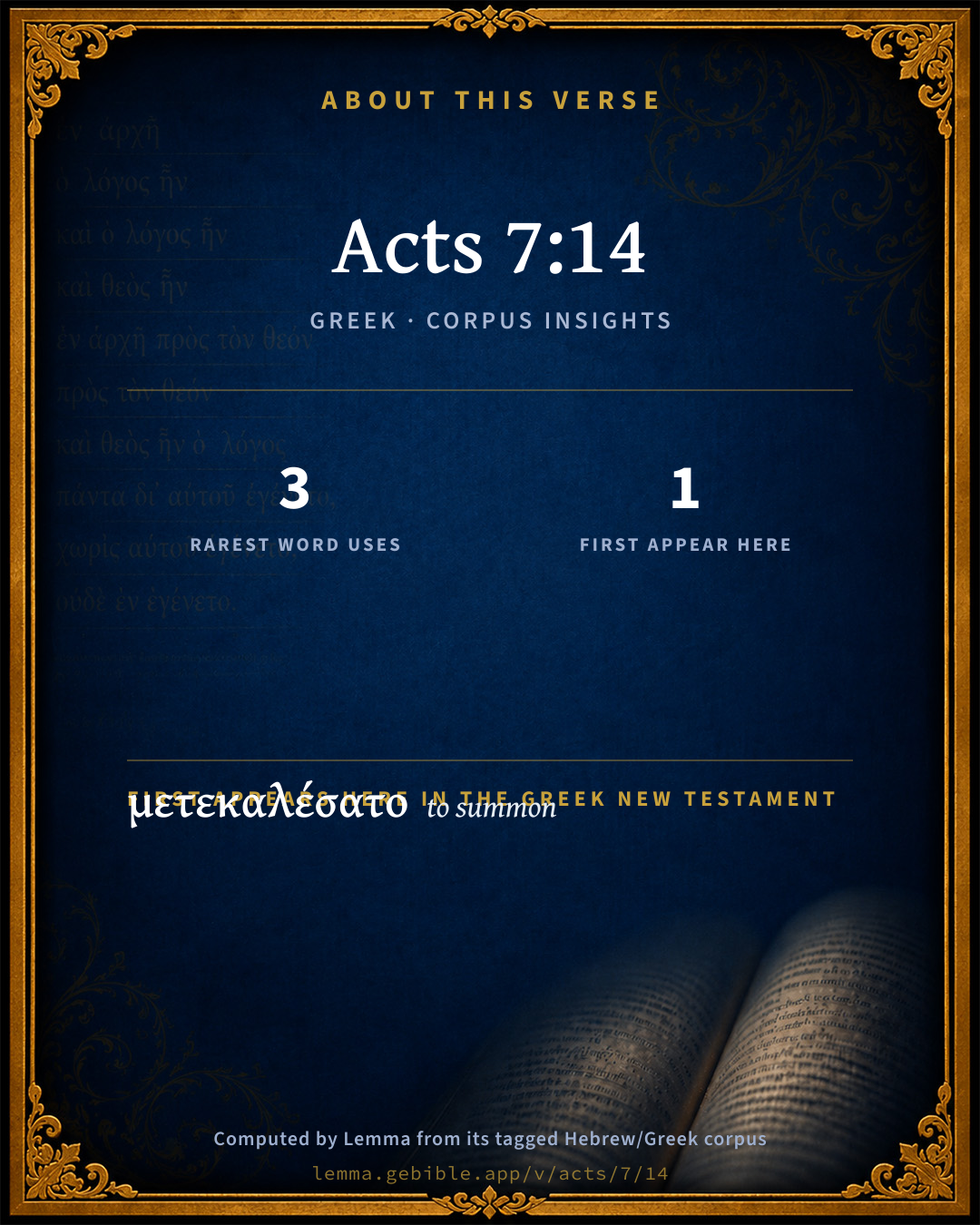
Acts 7:14

Greek (Tischendorf 8th ed.) Acts 7:14 appears in the Greek New Testament. The text above is from the Tischendorf 8th edition. Each word links to its Strong’s number and a concise gloss. Click any word for its full Thayer’s Greek Lexicon entry.
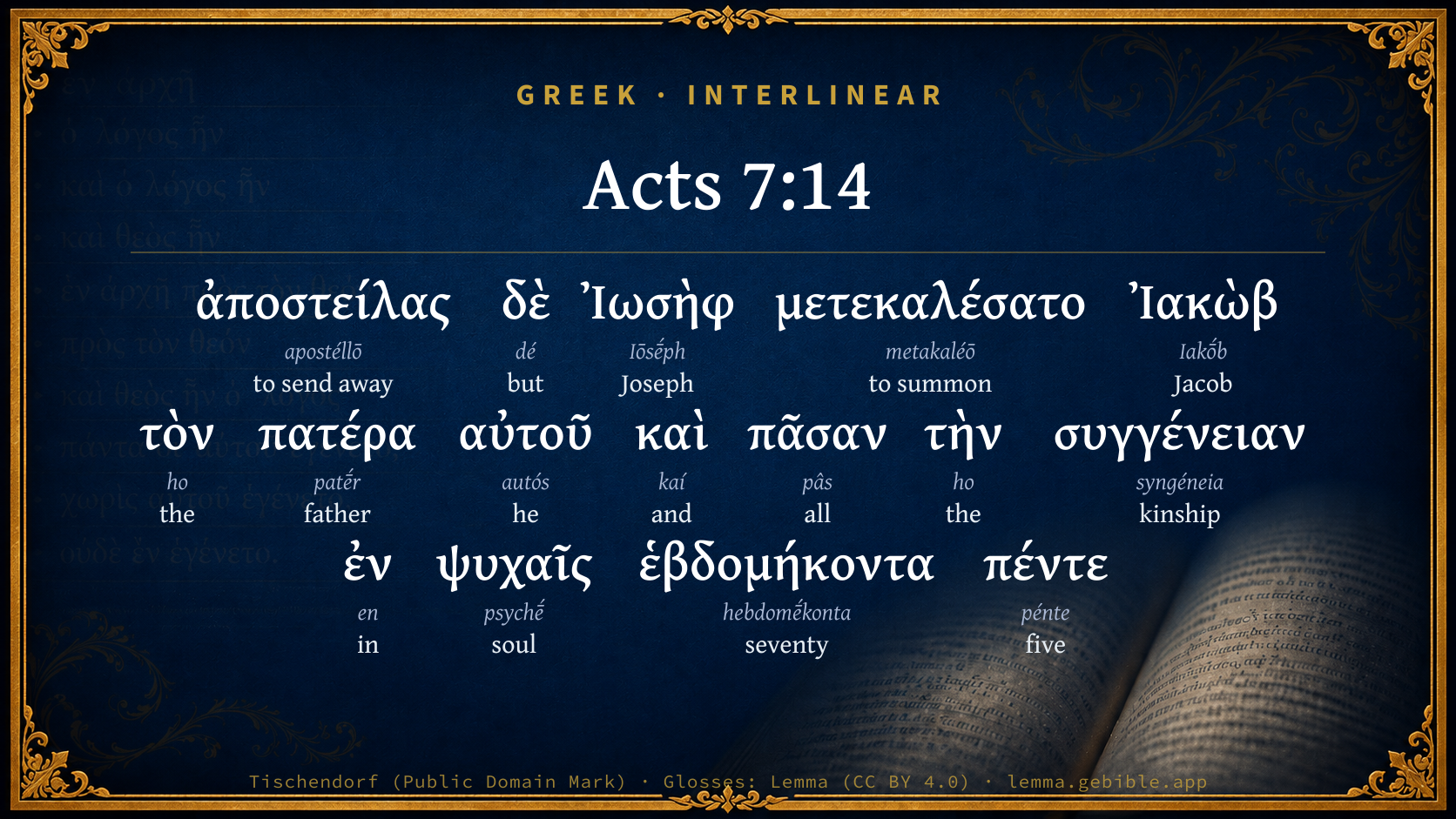
Download image
Cite this verse

Acts 7:14 (World English Bible). Public Domain. Lemma interlinear Bible study tool, https://lemma.gebible.app/v/acts/7/14.

Show BibTeX & RIS
BibTeX
RIS
English Translation
Joseph sent, and summoned Jacob, his father, and all his relatives, seventy-five souls.
World English Bible · Public Domain
Highlights
  • 1 first appearance in the Greek New Testament
Full analysis ↓
Download a study sheet

One document with this verse’s original text, its word-by-word gloss line, the meaning frame, cross-references with their text, attributed commentary, and full source and license credits — printable, and it pastes into notes with its structure intact.

This verse Autodidact and up

Study sheet (.html) Plain text (.txt)

A passage Seminary Student

Up to 50 verses in one chapter. A passage sheet keeps up to 6 commentary sources and 12 cross-references per verse, in the order this page ranks them, and says so on the sheet whenever that leaves anything out. Ask for a single verse and you get the Autodidact verse sheet above.

Everything on this page stays free to read, with no account — the sheet is a download of what is already on screen, not access to it.

Want to remove ads? Support Godless Engineer
Compare translations 3

The same verse in 3 English versions, stacked beneath the original-language interlinear above. Click any original word for its lexicon entry.

Each is an independent rendering of the whole verse — the interlinear is not word-aligned to these translations.

Highlighted words mark where these versions differ — a whole-verse word diff, not a word-by-word alignment.

  • World English Bible Public Domain
    Joseph sent, and summoned Jacob, his father, and all his relatives, seventy-five souls.
  • King James Version Public Domain
    Then sent Joseph, and called his father Jacob to him, and all his kindred, threescore and fifteen souls.
  • unfoldingWord Literal Text CC BY-SA 4.0
    Then, sending them back, Joseph summoned Jacob, his father, and all relatives, in souls 75.

unfoldingWord Literal Text — © unfoldingWord, licensed CC BY-SA 4.0. Word-aligned USFM3 via Door43 (git.door43.org/unfoldingWord/en_ult).

Versions to compare (up to 4)

3 of 4 selected

Show all 19 translations

Every available English version of this verse, each an independent rendering of the whole verse.

  • World English Bible Public Domain
    Joseph sent, and summoned Jacob, his father, and all his relatives, seventy-five souls.
  • Berean Standard Bible Public Domain
    Then Joseph sent for his father Jacob and all his relatives, seventy-five in all.
  • Majority Standard Bible Public Domain
    Then Joseph sent for his father Jacob and all his relatives, seventy-five in all.
  • King James Version Public Domain
    Then sent Joseph, and called his father Jacob to him, and all his kindred, threescore and fifteen souls.
  • American Standard Version (1901) Public Domain
    And Joseph sent, and called to him Jacob his father, and all his kindred, threescore and fifteen souls.
  • Revised Version (1885) Public Domain
    And Joseph sent, and called to him Jacob his father, and all his kindred, threescore and fifteen souls.
  • Geneva Bible (1599) Public Domain
    Then sent Ioseph and caused his father to be brought, and all his kindred, euen threescore and fifteene soules.
  • Douay-Rheims (1899) Public Domain
    And Joseph sending, called thither Jacob, his father, and all his kindred, seventy-five souls.
  • Young's Literal Translation Public Domain
    and Joseph having sent, did call for his father Jacob, and all his kindred -- with seventy and five souls --
  • Literal Standard Version CC BY-SA 4.0
    and Joseph having sent, called for his father Jacob, and all his relatives—with seventy-five souls—
  • Unlocked Literal Bible CC BY-SA 4.0
    Joseph sent his brothers back to tell Jacob his father to come to Egypt, along with all his relatives, seventy-five persons in all.
  • unfoldingWord Literal Text CC BY-SA 4.0
    Then, sending them back, Joseph summoned Jacob, his father, and all relatives, in souls 75.
  • Darby Bible Public Domain
    And Joseph sent and called down to him his father Jacob and all [his] kindred, seventy-five souls.
  • World Messianic Bible Public Domain
    Joseph sent and summoned Jacob his father and all his relatives, seventy-five souls.
  • Webster's Bible Public Domain
    Then Joseph sent, and called his father Jacob to him, and all his kindred, seventy five souls.
  • Free Bible Version CC BY-SA 4.0
    Joseph sent for his father and all his relatives—seventy-five in total.
  • Bible in Basic English Public Domain
    Then Joseph sent for Jacob his father and all his family, seventy-five persons.
  • Text-Critical English NT CC BY 4.0
    Then Joseph sent and called for his father Jacob and all his relatives, seventy-five people in all.
  • Tyndale New Testament (1534) Public Domain
    Then sent Ioseph and caused his father to be brought and all his kynne thre score and xv. soules.

Literal Standard Version (2020), Covenant Press — licensed CC BY-SA 4.0. Text via the HelloAO Bible API (eBible.org). Unlocked Literal Bible (unfoldingWord) — licensed CC BY-SA 4.0. Text via the HelloAO Bible API (eBible.org). unfoldingWord Literal Text — © unfoldingWord, licensed CC BY-SA 4.0. Word-aligned USFM3 via Door43 (git.door43.org/unfoldingWord/en_ult). Free Bible Version, Dr. Jonathan Gallagher — licensed CC BY-SA 4.0. Text via the HelloAO Bible API (eBible.org).

Word by word

More ways to search: Search by grammar → Find every occurrence → Compare this word →

Practice this passage: Drill this verse → Learn its vocabulary →

συγγένειαν
syngéneia
G4772
“kinship”
Noun, Accusative, Singular, Feminine
Part of Speech
Noun
Case
Accusative
Number
Singular
Gender
Feminine
Full Thayer's Definition

Origin: from G4773

TDNT: 19:16,1

1. a kinship, relationship 2. kindred, relations collectively, family
  1. ἀποστείλας apostéllō G649 “to send away” Verb, Aorist, Active, Participle, Nominative, Singular, Masculine
  2. δὲ dé G1161 “but” Conjunction
  3. Ἰωσὴφ Iōsḗph G2501 “Joseph” Noun, Proper, indeclinable
  4. μετεκαλέσατο metakaléō G3333 “to summon” Verb, Aorist, Middle, Indicative, 3rd person, Singular
  5. Ἰακὼβ Iakṓb G2384 “Jacob” Noun, Proper, indeclinable
  6. τὸν ho G3588 “the” Article, Accusative, Singular, Masculine
  7. πατέρα patḗr G3962 “father” Noun, Accusative, Singular, Masculine
  8. αὐτοῦ autós G846 “he” Personal pronoun, Genitive, Singular, Masculine
  9. καὶ kaí G2532 “and” Conjunction
  10. πᾶσαν pâs G3956 “all” Adjective, Accusative, Singular, Feminine
  11. τὴν ho G3588 “the” Article, Accusative, Singular, Feminine
  12. ἐν en G1722 “in” Preposition
  13. ψυχαῖς psychḗ G5590 “soul” Noun, Dative, Plural, Feminine
  14. ἑβδομήκοντα hebdomḗkonta G1440 “seventy” Adjective, Numeral (indeclinable)
  15. πέντε pénte G4002 “five” Adjective, Numeral (indeclinable)

About this verse

These counts appear in no published source. They are computed here, from the morphology-tagged text and Lemma’s own curated glosses. What Lemma adds →

16
words
15
distinct lemmas
Acts
section

Notable vocabulary

The rarest word here is συγγένειαν kinship G4772 — appearing just 3 times in the whole Greek New Testament.

First appearance in Scripture

This word makes its first canonical appearance in the Greek New Testament here:

  • μετεκαλέσατο to summon G3333

Shared distinctive vocabulary

συγγένειαν kinship G4772 occurs in 3 verses of the Greek New Testament. Also found in:

Repetition

A word recurs within this verse:

Cross-references

7

Topical passages linked to Acts 7:14 in the Treasury of Scripture Knowledge — connected by theme and wording, ordered by reader-vote popularity; previews shown in the World English Bible.

  • Genesis 46:26–27 All the souls who came with Jacob into Egypt, who were his direct descendants, besides Jacob's sons' wives, all the souls were sixty-six.
  • Deuteronomy 10:22 Your fathers went down into Egypt with seventy persons; and now Yahweh your God has made you as the stars of the sky for multitude.
  • Exodus 1:5 All the souls who came out of the Jacob's body were seventy souls, and Joseph was in Egypt already.
  • Genesis 45:9–11 Hurry, and go up to my father, and tell him, 'This is what your son Joseph says, "God has made me lord of all Egypt. Come down to me. Don't wait.
  • Genesis 46:12 The sons of Judah: Er, Onan, Shelah, Perez, and Zerah; but Er and Onan died in the land of Canaan. The sons of Perez were Hezron and Hamul.
  • 1 Chronicles 2:5–6 The sons of Perez: Hezron, and Hamul.
  • Psalms 105:23 Israel also came into Egypt. Jacob sojourned in the land of Ham.

Cross-references courtesy of OpenBible.info (CC BY 4.0).

Commentary

Notes on Acts 7:14 from classic Christian and Jewish commentators (each source and its license shown beneath its notes). The classic Christian expositions comment on the surrounding passage and are grouped to its opening verse, so a note may address several verses; the Jewish commentaries on the Tanakh (Rashi and others) are per-verse, so they appear only where the commentator wrote on this verse.

Lemma curates 59 commentaries, every one of them public domain or Creative Commons licensed, each selected and text-cleaned for this edition rather than reprinted as found. About our sources →

Albert Barnes' Notes on the Bible

All his kindred - His father and family, Gen 45:17-28; 46:1-26.

Threescore and fifteen souls - Seventy-five persons. There has been much perplexity felt in the explanation of this passage. In Gen 46:26, Exo 1:5, and Deu 10:22, it is expressly said that the number which went down to Egypt consisted of 70 persons. The question is, in what way these accounts can be reconciled? It is evident that Stephen has followed the account which is given by the Septuagint. In Gen 46:27, that version reads, “But the sons of Joseph who were with him in Egypt were nine souls; all the souls of the house of Jacob which came with Jacob into Egypt were seventy-five souls.” This number is made out by adding these nine souls to the 66 mentioned in Gen 46:26. The difference between the Septuagint and Moses is, that the former mentions five descendants of Joseph who are not recorded by the latter. The “names” of the sons of Ephraim and Manasseh are recorded in 1Ch 7:14-21. Their names were Ashriel, Machir, Zelophehad, Peresh, sons of Manasseh; and Shuthelah, son of Ephraim. Why the Septuagint inserted these, it may not be easy to see. But such was evidently the fact; and the fact accords accurately with the historic record, though Moses did not insert their names. The solution of difficulties in regard to chronology is always difficult; and what might be entirely apparent to a Jew in the time of Stephen, may be wholly inexplicable to us.

Albert Barnes' Notes on the Bible (1834–1885) — public domain. Text from a community e-Sword/MySword module.

Tyndale Open Study Notes

Tyndale Open Resources

7:14 Compare this figure with the seventy mentioned in the Hebrew text of Gen 46:27. The number seventy-five is probably taken from the Septuagint (the Greek translation of the Old Testament) for Gen 46:27. The Septuagint includes three descendants of Ephraim and two of Manasseh at Gen 46:20, making for a total of five more persons, whereas the Hebrew text does not include descendants for Joseph’s sons. The New Testament authors often quote from the Septuagint, which sometimes differs from the Hebrew Masoretic Text.

Tyndale Open Study Notes — © Tyndale Open Resources, licensed CC BY-SA 4.0. Text via the HelloAO Bible API.

Bengel's Gnomon

Johann Albrecht Bengel

Act 7:14. Ἑβδομήκοντα πέντε, seventy-five) Stephen, or Luke, follows the Septuagint translation, as being then the best known; which in Gen 46:27, or even in Deu 10:22, has given the number Seventy-five; whereas in the Hebrew and Samaritan Pentateuch, and in Josephus, the number is Seventy. So also Philo, adding one son and one grandson of Manasses, and the two sons of Ephraim and his one grandson: Gen. the ch. already quoted, Act 7:20.

Bengel's Gnomon of the New Testament — English translation (T&T Clark, Edinburgh, 1860) — public domain. Text from a community e-Sword module.

Meyer's Critical & Exegetical Commentary

Heinrich August Wilhelm Meyer

Act_7:14-15. Ἐν ψ. ἑβδομήκ. πέντε] in 75 souls (persons, Act_2:41, Act_27:37), he called his father and (in general) the whole family, i.e. he called them in a personal number of 75, which was the sum containing them. The expression is a Hebraism (בְּ), after the LXX. Deu_10:22. In the number Stephen, however, follows the LXX. Gen_46:27, Exo_1:5,[200] where likewise 75 souls are specified, whereas the original text (which Josephus follows, Antt. ii. 7. 4, vi. 5. 6) reckons only 70.[201]

ΑὐΤῸς Κ. ΟἹ ΠΑΤ. ἩΜῶΝ] he and our patriarchs (generally). A very common epanorthosis. See on Joh_2:12.

[200] At Deut. l.c. also Codex A has the reading 75, which is, however, evidently a mere alteration by a later hand in accordance with the two other passages. Already Philo (see Loesner, p. 185) mentions the two discrepant statements of number (75 according to Gen. l.c. and Ex. l.c., and 70 according to Deut. l.c.) and allegorizes upon them.

[201] According to the Hebrew, the number 70 is thus made up: all the descendants of Jacob who came down with him to Egypt are fixed at 66, Gen_46:26, and then, ver. 27, Joseph and his two sons and Jacob himself (that is, four persons more) are included. In the reckoning of the LXX., influenced by a discrepant tradition, there are added to those 66 persons (ver. 26) in ver. 27 (contrary to the original text), υἱοὶ δὲ Ἰωσὴφ οἱ γενόμενοι αὐτῇ ἐν γῇ Αἰγύπτῳ ψυχαὶ ἐννέα, so that 75 persons are made out. It is thus evidently contrary to this express mode of reckoning of the LXX., when it is commonly assumed (also by Wetstein, Michaelis, Rosenmüller, Kuinoel, Olshausen) that the LXX. had added to the 70 persons of the original text 5 grandchildren and great-grand-children of Joseph (who are named in the LXX Gen_46:20). But in the greatest contradiction to the above notice of the LXX. stands the view of Seb. Schmid, with whom Wolf agrees, that the LXX. had added to the 66 persons (ver. 26) the wives of the sons of Jacob, and from the sum of 78 thereby made up had again deducted 3 persons, namely, the wife of Judah who had died in Canaan, the wife of Joseph and Joseph himself, so that the number 75 is left. Entirely unhistorical is the hypothesis of Krebs and Loesner. Stephanum apud Luc. (et LXX.) de iis loqui, qui in Aegyptum invitati fuerint, Mosen de his, qui eo venerint, quorum non nisi 70 fuerunt. Beza conjectured, instead of πέντε in our passage: πάντες (!); and Massonius, instead of the numeral signs OE (75), the numeral signs C Ξ (66). For yet other views, see Wolf.

Meyer — Critical and Exegetical Commentary on the New Testament — English translation by Peter Christie, edited by Frederick Crombie (T&T Clark, 1880) — public domain. Text from a community e-Sword module.

Expositor's Greek Testament

ed. W. Robertson Nicoll

Act 7:14 . μετεκαλέσατο : four times in Acts, and nowhere else in N.T., cf. Act 10:32 , Act 20:17 , Act 24:25 , only once in LXX, H. and R., cf. Hos 11:2 , A; so εἰσκαλέομαι , only once in N.T., cf. Act 10:23 ; not in LXX or Apocrypha. Both compounds are peculiar to St. Luke in N.T., and are frequent in medical writers, to “send for” or to “call in” (although Polyb. in middle voice, Act 22:5 ; Act 22:2 , in same sense) a physician, Hobart, Medical Language , etc., p. 219. In Attic Greek we should have μεταπέμπεσθαι . ἐν ψυχαῖς ἑβδομήκοντα πέντε : ἐν = Hebrew בְּ , cf. Deu 10:22 , in (consisting in) so many souls, cf. Luk 16:31 . Here in Deut., LXX, as also in Hebrew, we have the number given as seventy (although in A, seventy-five, which seems to have been introduced to make the passage similar to the two others quoted below) who went down into Egypt. But in Gen 46:27 , and in Exo 1:5 , LXX, the number is given as seventy-five (the Hebrew in both passages however giving seventy as the number, although in Gen 46:26 giving sixty-six, making up the seventy by adding Jacob, Joseph, and his two sons). For the curious Rabbinical traditions current on the subject, see Lumby, Acts , p. 163. In Gen 46:27 the LXX make up the number to seventy-five by adding nine sons as born to Joseph while in Egypt, so that from this interpolation it seems that they did not obtain their number by simply adding the sons and grandsons, five in all, of Ephraim and Manasseh from Gen 46:20 (LXX) to the seventy mentioned in the Hebrew text, as Wetstein and others have maintained. But there is nothing strange in the fact that Stephen, as a Hellenist, should follow the tradition which he found in the LXX. Josephus in Ant. , ii., 7, 4; vi., 5, 6, follows the Hebrew seventy, and Philo gives the two numbers, and allegorises about them. See Meyer-Wendt, p. 174, note, Hackett, Lumby, in loco , and Wetstein. Nothing in the argument is touched by these variations in the numbers.

The Expositor's Greek Testament, edited by W. Robertson Nicoll (1897–1910) — public domain. Text from a community e-Sword module.

Jamieson, Fausset & Brown

Robert Jamieson, A. R. Fausset & David Brown

threescore and fifteen souls--according to the Septuagint version of Gen 46:27, which Stephen follows, including the five children and grandchildren of Joseph's two sons.

Jamieson, Fausset & Brown — Commentary Critical and Explanatory on the Whole Bible (1871) — public domain (CC PDM 1.0). Text via the HelloAO Bible API.

Adam Clarke's Commentary

Verse 14. Threescore and fifteen souls.] There are several difficulties here, which it is hoped the reader will find satisfactorily removed in the note on Ge 46:20. It is well known that in Ge 46:27, and in De 10:22, their number is said to be threescore and ten; but Stephen quotes from the Septuagint, which adds five persons to the account which are not in the Hebrew text, Machir, Gilead, Sutelaam, Taham, and Edem; but see the note referred to above.

Adam Clarke's Commentary on the Bible (1810–1826) — public domain. Text from a community e-Sword/MySword module.

John Calvin's Commentaries

14. Whereas he saith that Jacob came into Egypt with seventy-five souls, it agreeth not with the words of Moses; for Moses maketh mention of seventy only. Jerome thinketh that Luke setteth not down, word for word, those things which Stephen had spoken, or that he took this number out of the Greek translation of Moses, (Genesis 46:27,) either because he himself, being a proselyte, had not the knowledge of the Hebrew tongue, or because he would grant the Gentiles this, who used to read it thus. Furthermore, it is uncertain whether the Greek interpreters set down this number of set purpose, or whether it crop [crept] in afterward through negligence, [mistake;] which (I mean the latter) might well be, forasmuch as the Grecians used to set down their numbers in letters. Augustine, in his 26th book of City of God, [De Civitate Dei,] thinketh that Joseph’s nephews and kinsmen are comprehended in this number; and so he thinketh that the words went down doth signify all that time which Jacob lived. But that conjecture can by no means be received. For, in the mean space, the other patriarchs also had many children born to them. This seemeth to me a thing like to be true, that the Seventy Interpreters did translate that truly which was in Moses. And we cannot say that they were deceived; forasmuch as [in] Deuteronomy 10, where this number is repeated, they agree with Moses, at least as that place was read without all doubt in the time of Jerome; for those copies which are printed at this day have it otherwise. Therefore, I think that this difference came through the error of the writers which wrote out the books. And it was a matter of no such weight, for which Luke ought to have troubled the Gentiles which were accustomed with the Greek reading. And it may be that he himself did put down the true number; and that some man did correct the same amiss out of that place of Moses. For we know that those which had the New Testament in hand were ignorant of the Hebrew tongue, yet skillful in the Greek,

Therefore, to the end [that] the words of Stephen might agree with the place of Moses, it is to be thought that that false number which was found in the Greek translation of Genesis was by them put in also in this place; concerning which, if any man contend more stubbornly, let us suffer him to be wise without measure. Let us remember that it is not without cause that Paul doth forbid us to be too curious about genealogies. This, so small a number, is purposely expressed, to the end the power of God may the more plainly appear, in so great an enlarging of that kindred, which was of no long continuance. For such a small handful of men could not, by any human manner of engendering, grow to such an infinite multitude as is recorded in Exodus 12:37, within two hundred and fifty years. We ought rather to weigh the miracle which the Spirit commendeth unto us in this place, than to stand long about one letter, whereby the number is altered. There arise other questions (and those which are more hard to be answered) out of the rest of the text, [context.]

John Calvin's Commentaries (1540-1563) — public domain. Text from the Calvin Translation Society English edition (1840s-50s) via the Christian Classics Ethereal Library (ccel.org). Calvin's coverage is partial (roughly two-thirds of the Bible); uncommented books and verses are honest gaps, never fabricated. The 19th-century editor's footnotes and remarks are omitted so the notes are faithfully Calvin's own voice.

Ellicott's Commentary for English Readers

(14) Threescore and fifteen souls.—Seventy is given as the number, including Jacob, Joseph, and his sons, in Gen_46:27; Exo_1:5; Deu_10:22. Here, however, Stephen had the authority of the LXX. of Gen_46:27, which gives the number at seventy-five, and makes it up by inserting the son and grandson of Manasseh, two sons and a grandson of Ephraim. With them it was probably an editorial correction based upon Num_26:26-37. Stephen, as a Hellenistic Jew, naturally accepted, without caring to investigate, the number which he found in the Greek version.

A Bible Commentary for English Readers, edited by Charles John Ellicott (1878–1897) — public domain. Text from a community e-Sword module.

The Cambridge Bible for Schools and Colleges

gen. ed. J. J. S. Perowne

14. threescore and fifteen souls] This number is taken from the LXX. In the Hebrew (Gen_46:8-27) the number is but seventy including Jacob himself. The five additional names given in the LXX. are Machir the son and Galaad the grandson of Manasseh, and the two sons of Ephraim, Taam and Soutalaam, with Soutalaam’s son, Edom. So in Exo_1:5 the Hebrew has 70, and the LXX. 75. There were many traditions current on this subject, and the Rabbis notice too that 69 persons (they exclude Jacob) are reckoned for 70 in the account given Genesis 46. In the Midrash Shemuel, c. 32, there are various suggestions thrown out First it is said the one wanting was Jochebed, who became wife of Amram and mother of Moses, for it is mentioned (Num_26:59) that she was a daughter of Levi born in Egypt, and the tradition is that she was born “between the walls,” i.e. just as the people were entering Egypt, and so she is to be counted in the number. Another tradition is attached to Gen_46:23, “The sons of Dan, Hushim.” As the last word is a plural form, and sons are spoken of in the verse, therefore it is thought that there were two Hushim, an elder and a younger. Also (T. B. Baba Bathra 123 a ad fin.) there is mentioned the tradition that there was a twin with Dinah. We may thus see that there were traditions current which probably were well known to the translators of the LXX., and gave rise to their number. They however are not consistent, for in Deuteronomy (Act_10:22) they give 70 as the number which went down into Egypt. Stephen, as was to be expected from the other quotations in this book, and also because he was a Grecian Jew, follows the LXX.

The Cambridge Bible for Schools and Colleges (gen. ed. J. J. S. Perowne; Cambridge University Press, 1878–1918) — public domain. Text from a community e-Sword module.

John Gill's Exposition

Then sent Joseph,.... Gifts and presents to his father, and wagons, to fetch down him and his family into Egypt, Gen 45:21.

and called his father Jacob to him, and all his kindred, threescore and fifteen souls; which seems to disagree with the account of Moses, who says, that "all the souls of the house of Jacob, which came into Egypt, were threescore and ten", Gen 46:27. But there is no contradiction; Moses and Stephen are speaking of different things; Moses speaks of the seed of Jacob, which came out of his loins, who came into Egypt, and so excludes his sons' wives; Stephen speaks of Jacob and all his kindred, among whom his sons' wives must be reckoned, whom Joseph called to him: according to Moses's account, the persons that came with Jacob into Egypt, who came out of his loins, and so exclusive of his sons' wives, were threescore and six; to which if we add Jacob himself, and Joseph who was before in Egypt, and who might be truly said to come into it, and his two sons that were born there, who came thither in his loins, as others in the account may be said to do, who were not yet born, when Jacob went down, the total number is threescore and ten, Gen 46:26 out of which take the six following persons, Jacob, who was called by Joseph into Egypt, besides the threescore and fifteen souls, and Joseph and his two sons then in Egypt, who could not be said to be called by him, and Hezron and Hamul, the sons of Pharez not yet born, and this will reduce Moses's number to sixty four; to which sixty four, if you add the eleven wives of Jacob's sons, who were certainly part of the kindred called and invited into Egypt, Gen 45:10 it will make up completely threescore and fifteen persons: or the persons called by Joseph maybe reckoned thus; his eleven brethren and sister Dinah, fifty two brother's children, to which add his brethren's eleven wives, and the amount is threescore and fifteen: so that the Jew (w) has no reason to charge Stephen with an error, as he does; nor was there any need to alter and corrupt the Septuagint version of Gen 45:27 to make it agree with Stephen's account; or to add five names in it, in Act 7:20 as Machir, Galaad, Sutalaam, Taam, and Edom, to make up the number seventy five: and it may be observed, that the number is not altered in the version of Deu 10:22 which agrees with the Hebrew for seventy persons.

(w) R. Isaac Chizzuk Emuna, par. 2. c. 63. p. 450.

John Gill's Exposition of the Whole Bible (1746–1763) — public domain (CC PDM 1.0). Text via the HelloAO Bible API.

Matthew Poole's English Annotations

All his kindred; his affinity, and not consanguinity only, which may be the reason why, though in Gen 46:26 it is said, that all

the souls that came with Jacob into Egypt were threescore and six, ( it being then added, they were all such as came out of his loins), yet it is said they were seventy persons, Gen 46:27, Jacob, Joseph, and Joseph’s two sons (who were also of the promised seed) being added unto the number. In this account of St. Stephen, his sons’ wives might be added, which make up seventy-five. There are other accounts of this difference; but it is not of any consequence as to faith and holy living, which are only necessary unto salvation: the wonderful increase to so many hundred thousands of men, besides children, spoken of, Exo 12:37, notwithstanding the barbarous cruelty of the Egyptians, is to be admired.

Souls; the nobler and better part, by which they are numbered, and according unto which they are esteemed by God.

Matthew Poole's English Annotations on the Holy Bible (1683–1685) — public domain. Text from a community e-Sword/MySword module.

Whedon's Commentary on the Bible

Daniel D. Whedon

14. Threescore and fifteen souls—That is, seventy-five. But Exo_1:5, says there were but seventy souls. Herein Stephen follows the Septuagint, which reckons seventy-five by adding the five sons of Ephraim and Manasseh.

14. Apostles… Jerusalem… heard—The greatness of the event and the inferiority of the instrument alike surprised them. Cooperation, oversight, and control by them were evidently the demand of wisdom.

Sent… Peter—The apostolic body acted organically, so that they must have been still in secret organized and authoritative position. And as Samaria, the capital of the northern kingdom, was the most important post, after Jerusalem, in all Palestine, so they sent thither the senior apostle.

Daniel D. Whedon (gen. ed.), Commentary on the Old and New Testaments (1874–1909) — public domain. Text from a community e-Sword module.

The Pulpit Commentary

And Joseph sent for then sent Joseph, A.V.; called to him Jacob his father for c alled his father Jacob to him, A.V. Three score and fifteen souls in Gen_46:26, Gen_46:27, the statement is very precise that "all the souls of the house of Jacob, which came into Egypt, were three score and ten," including Joseph and his two sons. Moreover, the accuracy of the number is tested in two ways. First, the names of the sons and daughters of each patriarch are given, and they are found, on counting them, to amount to exactly seventy. And then the totals of the descendants of each of Jacob"s four wives is given separately, and again the total is exactly seventy (33 + 16 + 14 + 7 = 70). It is true that the computation in ver. 26 does not agree with the above, for it makes the number of Jacob"s descendants, exclusive of Joseph and his two sons, sixty-six instead of sixty-seven, which is the number according to the two above computations, and consequently the total number (when Joseph and his two sons are added) sixty-nine instead of seventy. But this is such a manifest contradiction that it seems almost a necessity to suppose a clerical error, vve for bv, caused perhaps by the preceding It is also a singular anomaly that, in the enumeration of Leah"s descendants, as well as in the general enumeration, Er and Onan are distinctly reckoned as well as mentioned. Jacob himself is nowhere reckoned in the Bible, though he is in the commentaries. But when we turn to the LXX, we find that in Gen_46:20 there are added to Manasseh and Ephraim Machir the son and Gilead the grandson of Manasseh; and Suthelah and Taam the sons, and Edom (meaning Eran, LXX Eden, (Num_26:36) the grandson, of Ephraim, making the descendants of Rachel eighteen (it should be nineteen if Huppim, (Gen_46:21, is added) instead of fourteen; the number sixty-six of ver. 26 is preserved; the number of Joseph"s descendants is given as nine (Huppim apparently being now reckoned), which, added to sixty-six, makes seventy-five; and accordingly in ver. 27 the LXX read yucainte ("seventy-five souls"), instead of "three score and ten. " But except in the addition of these five names of Joseph"s grand and great-grand-children, the LXX support the Hebrew text, even in the strange sixty-six of ver. 26. Stephen, as a Hellenist, naturally follows the LXX But the question arises How are we to understand the lists? Gen_46:8 says, "These are the names of the children of Israel, which came into Egypt;" and one naturally expects to find the names only of those who are described in vers. 5-7 as the migratory party from Canaan to Egypt. This expectation is somewhat disturbed by Er and Onan being included in the enumeration. This may, however, be accounted for by Pharez and Zerah being reckoned as their seed. But is it likely that Hezron and Hamul the sons of Pharez, and the other great-grandsons of Jacob, were born before the descent into Egypt? The answer to this is that, as Jacob was a hundred and thirty years old when he came down to Egypt, (Gen_47:28) there is no improbability in his having great-grandchildren allowing forty years for a generation); on the contrary, every likelihood that he should. But on the other hand, as Joseph could not have been above fifty when Jacob came down to Egypt (30 + 14 + X), Gen_41:46, Gen_41:29, Gen_41:30, it does not seem likely or possible that Joseph should have had grown-up grandsons and a great-grandson, as the LXX make him have. Indeed, to all appearance Manasseh and Ephraim were unmarried young men at the time that Jacob blessed them. (Gen_48:11, 16 50:23) Therefore we may conclude certainly that the additional numbers of the LXX are incorrect, if understood literally, of these who came down with Jacob from Canaan to Egypt. But there is nothing improbable in Benjamin having ton children. Judah, to whom grandchildren are attributed, was Jacob"s fourth son, and might be forty or fifty years older than Joseph and Benjamin. Asher, to whom also grandsons are attributed, was the eighth son, and might be twenty years older than Joseph and Benjamin. Still, considering that Er and Onan are reckoned among those who came down to Egypt, it would not be surprising to find that some of those mentioned in the list were born after Jacob"s arrival, but included on some principle which we do not understand. In other words, a literal interpretation of the statement of the Hebrew Bible involves no impossibilities, but a literal interpretation of the statement of the LXX does.

The Pulpit Commentary (1880–1919), ed. H.D.M. Spence-Jones & Joseph S. Exell — public domain. Text from a community e-Sword module.

John Wesley's Explanatory Notes

Seventy-five souls - So the seventy interpreters, (whom St. Stephen follows,) one son and a grandson of Manasseh, and three children of Ephraim, being added to the seventy persons mentioned Gen. xlvi, 27.

John Wesley, Explanatory Notes Upon the Whole Bible (1754–1765) — public domain. Text via the GEBible commentary corpus.

Scofield Reference Notes

C. I. Scofield

kindred

Cf. (See Scofield "Gen 46:26"). There is no real contradiction. The "house of Jacob" numbered seventy but the "kindred" would include the wives of Jacob’s sons.

The Scofield Reference Bible (1917 edition), notes by C. I. Scofield — public domain. Text from a community e-Sword module.

McGarvey & Pendleton's Commentaries

J. W. McGarvey

See notes on verse 9

J. W. McGarvey (with Philip Y. Pendleton), Commentaries on the New Testament (The Fourfold Gospel, 1914; Acts; and the epistles) — public domain. Text from a community e-Sword/MySword module.

The People's New Testament

B. W. Johnson

14. Then sent Joseph. The rejected Joseph becomes the prince and savior of all Israel. Threescore and fifteen souls. Gen. 46:27 says that sixty-six persons besides Jacob, Joseph and his two sons, seventy in all, were in Egypt. But the Septuagint Version, quoted almost invariably by Christ and the apostles, as well as by Stephen here, after giving the sixty-six, adds: “And the sons of Joseph born in Egypt were nine souls.” The nine, added to the sixty-six, make the seventy-five that Stephen gives. Why this clause was omitted from the Hebrew text, followed by the Common Version, is unknown. Stephen simply follows the text received by Christ, the apostles, and the Jews generally.

B. W. Johnson's The People's New Testament with Notes (1889–1891) — public domain. Electronic text from the Christian Classics Ethereal Library (CCEL) ThML edition.

unfoldingWord translationNotes

Door43 World Missions Community

sent his brothers back

"sent his brothers back to Canaan" or "sent his brothers back home"

he died

Make sure it does not sound as though he died as soon as he arrived in Egypt. AT: "eventually Jacob died"

he and our fathers

"Jacob and his sons who became our ancestors"

They were carried over ... and laid

This can be stated in active form. AT: "Jacob's descendants carried Jacob's body and his son's bodies over ... and buried them" (See: Active or Passive)

for a price in silver

"with money"

translationWords

Shechem

grave

Abraham

Hamor

unfoldingWord translationNotes — © Distant Shores Media and the Door43 World Missions Community, licensed CC BY-SA 4.0. Source: git.door43.org/Door43/en_tn.

Cambridge Greek Testament for Schools and Colleges

14. Ἰακὼβ τὸν πατέρα with אABCDE. Vulg. ‘Jacob patrem suum.’

Omit the second αὐτοῦ with אABCHP.

14. ἐν ψυχαῖς ἑβδομήκοντα πέντε, threescore and fifteen souls. The form of expression is a copy of LXX. (Deu 10:22) ἐν ἐβδομήκοντα ψυχαῖς κατέβησαν οἱ πατέρες σου, and the ἐν is simply a translation of the Hebrew בְּ, the idea being ‘they went down [consisting] in so many souls.’

The number, threescore and fifteen, is taken from the LXX. In the Hebrew (Gen 46:8-27) the number is but seventy, including Jacob himself. The five additional names given in the LXX. are Machir the son and Galaad the grandson of Manasseh, and the two sons of Ephraim, Taam and Soutalaam, with Soutalaam’s son, Edom. So in Exo 1:5 the Hebrew has 70, and the LXX. 75. There were many traditions current on this subject, and the Rabbis notice too that 69 persons (they exclude Jacob) are reckoned for 70 in the account given Genesis 46. In the Midrash Shemuel, c. 32, there are various suggestions thrown out. First it is said the one wanting was Jochebed, who became wife of Amram and mother of Moses, for it is mentioned (Num 26:59) that she was a daughter of Levi born in Egypt, and the tradition is that she was born ‘between the walls,’ i.e. just as the people were entering Egypt, and so she is to be counted in the number. Another tradition is attached to Gen 46:23, ‘The sons of Dan, Hushim.’ As the last word is a plural form, and sons are spoken of in the verse, therefore it is thought that there were two Hushim, an elder and a younger. Also (T. B. Baba Bathra 123 a ad fin.) there is mentioned the tradition that there was a twin with Dinah. We may thus see that there were traditions current which probably were well known to the translators of the LXX., and gave rise to their number. They however are not consistent, for in Deuteronomy (Act 10:22) they give 70 as the number which went down into Egypt. Stephen, as was to be expected from the other quotations in this book, and also because he was a Grecian Jew, follows the LXX.

Cambridge Greek Testament for Schools and Colleges (Cambridge University Press, 1896; 21 vols, various authors incl. Carr, Maclear, Plummer, Farrar, Lumby, Moule, M. R. James, Simcox) — public domain. Text from a community e-Sword module.

Alford’s Greek Testament

Henry Alford

14. ἐν ψυχαῖς ἑβδομηκονταπέντε] In the Hebrew text, Gen 46:27; Exo 1:5; Deu 10:22, seventy souls are reckoned, viz. sixty-six born of Jacob, Jacob himself, Joseph, and his two sons born in Egypt. So also Josephus, Antt. ii. 7. 4; vi. 5, 6. But the LXX, whom Stephen follows, insert in Gen 46:20 an account of the children and grandchildren of Manasseh and Ephraim, five in number: and in ver. 27 read υἱοὶ δὲ Ἰωσὴφ οἱ γενόμενοι αὐτῷ ἐν γῇ Αἰγ., ψυχαὶ ἐννέα. πᾶσαι ψυχαὶ οἴκου Ἰακὼβ αἱ εἰσελθοῦσαι μετὰ Ἰακὼβ (om μετὰ Ἰακώβ, and ψυχαί below, A, but obviously without any effect on the general statement) εἰς Αἴγυπτον, ψυχαὶ ἑβδομηκονταπέντε:—reckoning, as it appears, curiously enough, among the sons of Joseph, Joseph himself, and his wife Asenath; for these are required to make up the nine, according to their ver. 20. And similarly in Exo 1:5, and in Deu 10:22 A. (Wordsw., who is careful to note that A omits μετὰ Ἰακώβ in Gen 46:27, omits the fact that it reads πέντε here, by stating “seventy” as the LXX testimony.) With regard to the various attempts to solve the difficulty (66 + 12 wives, minus (Joseph and his wife, and Judah’s wife who died in Canaan) = 75, Seb. Schmid and Wolf:—that Stephen spoke of those who were invited,—Moses of those who went, Krebs and Loesner:—that πάντες should be read for πέντε, Beza:—&c.), see above on vv. 6, 7. The remarks of Jerome are curious:—he is arguing, on Gen. l. c., that the number really was seventy,—and adds, ‘Quod si e contrario nobis id opponitur, quomodo in Actibus Apostolorum in concione Stephani dicatur ad populum, septuaginta quinque animas ingressas esse Ægyptum, facilis excusatio est. Non enim debuit sanctus Lucas, qui ipsius (istius?) historiæ scriptor est, in gentes Actuum Apostolorum volumen emittens, contrarium aliquid scribere adversus eam scripturam, quæ jam fuerut gentibus divulgata.’ Philo, de Migr. Abr. § 36, vol. i. pp. 467 f., mentions both numbers (reading 75 in Gen. and 70 in Deut., see above), and gives allegorical reasons for both: and really Wordsworth’s solution, that Stephen includes those born of Jacob’s line in Egypt to shew that they “were equally children of the promise with those born in Canaan,” is hardly better. When we come to understand μετεκαλέσατο … πᾶσαν τὴν συγγένειαν ἐν ψυχαῖς ἑβδομηκονταπέντε, as represented by including, for a purpose, those already in Egypt, it seems to me that a stigma is cast on St. Stephen far more serious than that of mere numeral inaccuracy.

Henry Alford, The Greek Testament (1849–1861) — public domain. Text from a community e-Sword module.

Vincent's Word Studies in the New Testament

Marvin R. Vincent

Threescore and fifteen. Lit., "in [εν] threescore and fifteen;" the idiom expressing the sum in which all the individuals were included.

Marvin R. Vincent, Word Studies in the New Testament (1887–1900) — public domain. Text from a community e-Sword/MySword module.

Lesson kit

Teaching starters — assembled from the data on this page, not authored interpretation. Every prompt links to the verse data it draws on. Edit before teaching.

Acts, in the Acts, opens this verse with 16 words (15 distinct Greek lemmas). Its most distinctive word is syngéneia (“kinship”). A historical commentator’s framing appears above. Read the whole chapter for the surrounding context.

Discussion questions

  1. How does “kinship” (syngéneia) shape what this verse is saying?
  2. This is the first place “to summon” appears in Scripture (first appears here). What does its debut here establish?
  3. How does Luke 1:61, which shares the word «kinship», read alongside this verse?
  4. What does the repetition of “the” (2× in this one verse) do in this verse?
  5. These translations render this verse differently. What is at stake in choosing one wording over another?
  6. Compare how Albert Barnes' Notes on the Bible and Tyndale Open Study Notes read this verse. Where do they agree or differ?

Things to notice

  • 1 word makes its first canonical appearance in Scripture here.
  • These translations choose different wording for 12 words in this verse.
  • “the” occurs 2× in this single verse.
  • 15 distinct Greek lemmas span 16 words in this verse.

Reading settings

Reading text

Shown beneath each verse's original-language words.

Old Testament
Old Testament edition

Read the OT as the Masoretic Hebrew (MT) or the Greek Septuagint (LXX).

English shown for the Greek Septuagint (in the Hebrew ↔ Greek comparison).

Comparing translations? Open the Compare panel on any verse page to stack up to four side by side.