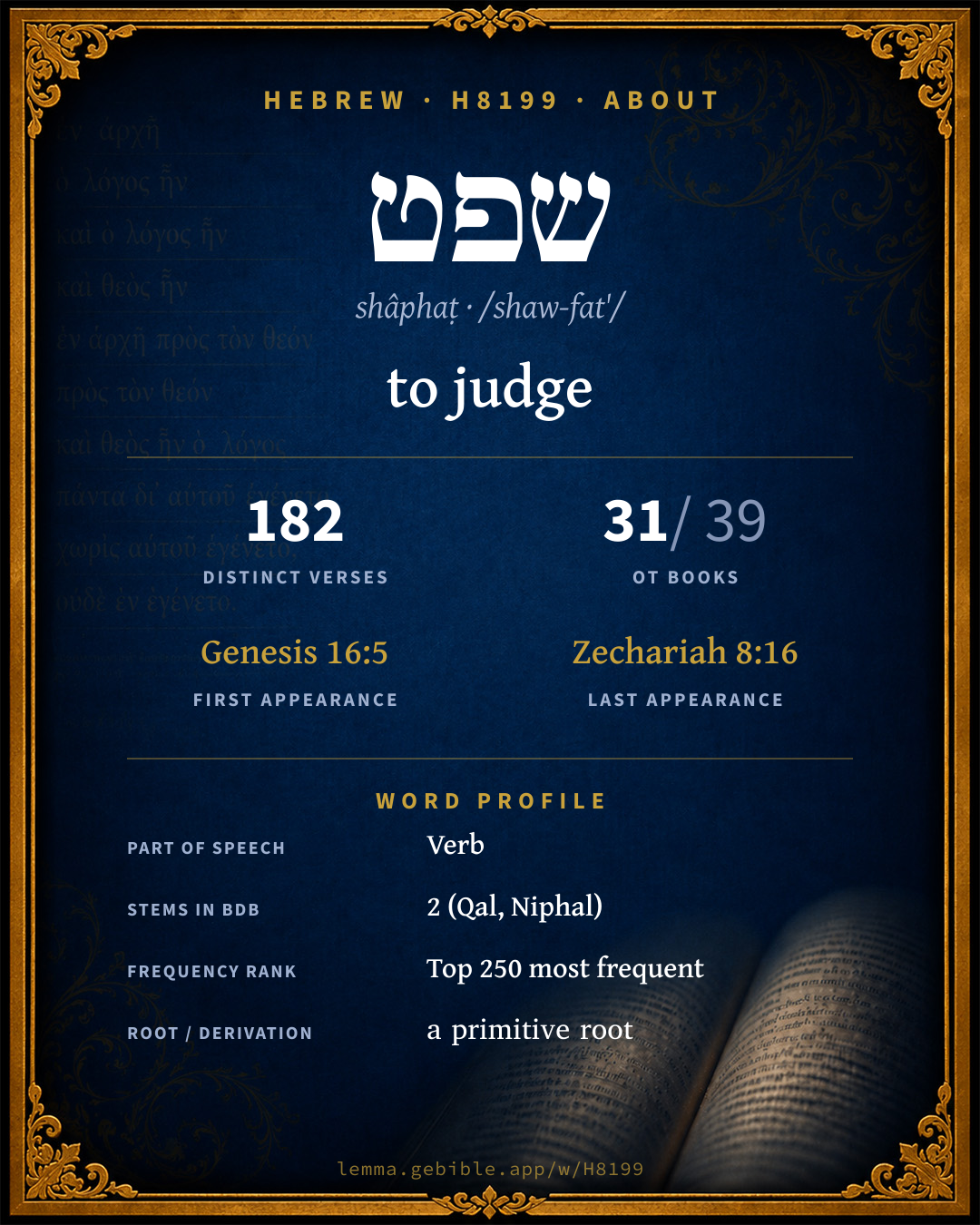
שָׁפַט
to judge
also: govern, vindicate, punish fuller range ↓
Full lexicon entry — Brown-Driver-Briggs (BDB)
From Brown-Driver-Briggs (BDB)
Where this word appears
See every Qal verb in the Hebrew Bible →
Grammar key — what these labels mean
Part of speech
- Verb
- An action or state-of-being word.
Stem
- Qal
- The basic, simple active stem — the plain form of the verb (“he wrote”). Here: ‘act as law-giver’
- Niphal
- Usually the simple passive or reflexive of the Qal (“he was written”). Here: ‘recipr.’
Form
- Sequential Imperfect
- An imperfect with prefixed waw — the standard past-narrative form (waw-consecutive imperfect).
- Imperfect
- An incomplete, ongoing, or future action (“he will / would write”).
- Participle Active
- A verbal adjective expressing ongoing or characteristic action (“writing / one who writes”).
- Infinitive Construct
- A bound verbal noun, frequently with prepositions (“to write / in writing”).
- Imperative
- A direct command (“write!”).
- Sequential Perfect
- A perfect with prefixed waw continuing a preceding imperfect or command (waw-consecutive perfect).
- Perfect
- A completed action or state — Hebrew marks aspect (completeness) more than strict tense (“he wrote”).
- Jussive
- A third- or second-person volitional form expressing wish or command (“let him write”).
- Cohortative
- A first-person volitional form expressing wish or resolve (“let me / let us write”).
- Infinitive Absolute
- An unbound verbal noun, often intensifying or standing in for a finite verb.
State
- Absolute
- The independent form of a noun, not bound to a following word.
- Construct
- A noun bound to a following noun in a possessive / “of” relationship (the construct chain).
Person
- 3rd Person
- The one spoken about (“he / she / it / they”).
- 1st Person
- The speaker (“I / we”).
- 2nd Person
- The one addressed (“you”).
Gender
- Masculine
- Grammatically masculine.
- Common
- Either gender — not distinguished for this form.
- Feminine
- Grammatically feminine.
Number
- Singular
- One.
- Plural
- More than one (in Hebrew, generally three or more).
Grammatical forms 33 distinct
- Verb, Qal, Participle Active, Masculine, Singular, Absolute 21 times (10%)
- Verb, Qal, Participle Active, Masculine, Plural, Construct 21 times (10%)
- Verb, Qal, Participle Active, Masculine, Plural, Absolute 18 times (9%)
- Verb, Qal, Sequential Imperfect, 3rd Person, Masculine, Singular 14 times (7%)
- Verb, Qal, Imperfect, 3rd Person, Masculine, Singular 14 times (7%)
- Verb, Qal, Infinitive Construct 14 times (7%)
- Verb, Qal, Imperfect, 2nd Person, Masculine, Singular 9 times (4%)
- Verb, Qal, Imperfect, 3rd Person, Masculine, Plural 8 times (4%)
+25 more forms (85 occurrences)
Parsed forms decoded from the imported morphology (morphhb / Westminster Leningrad Codex — WLC text public domain, morphhb tagging CC BY 4.0), counted across 204 parsed occurrences — not distinct verses.
Every verse where H8199 appears — 182 distinct verses across 31 books. Click any verse to open its interlinear word-by-word view. Verse text shown in the World English Bible for context — . Each verse’s Hebrew form is shown with its reference; the English is not keyword-highlighted, since the data carries no word-level English alignment. Use “Compare translations” on any verse to read it across multiple English versions. This concordance covers the Hebrew Bible; Septuagint (Greek Old Testament) occurrences are not indexed here.
Genesis 4 verses
- Genesis 16:5 יִשְׁפֹּ֥ט Qal juss 3ms Sarai said to Abram, "This wrong is your fault. I gave my handmaid into your bosom, and when she saw that she had conceived, I was despised in her eyes. Yahweh judge between me and you."
- Genesis 18:25 הֲ/שֹׁפֵט֙ ptcl inter + Qal ptcp.act ms cs Be it far from you to do things like that, to kill the righteous with the wicked, that so the righteous should be as the wicked. May that be far from you. Shouldn't the Judge of all the earth do right?"
- Genesis 19:9 וַ/יִּשְׁפֹּ֣ט שָׁפ֔וֹט conj + Qal wimpf 3ms Qal inf.abs They said, "Stand back!" They said, "This one fellow came in to live as a foreigner, and he appoints himself a judge. Now will we deal worse with you, than with them!" They pressed hard on the man, even Lot, and drew near to break the door.
- Genesis 31:53 יִשְׁפְּט֣וּ Qal impf 3mp The God of Abraham, and the God of Nahor, the God of their father, judge between us." Then Jacob swore by the fear of his father, Isaac.
Exodus 6 verses
- Exodus 2:14 וְ/שֹׁפֵט֙ conj + Qal ptcp.act ms He said, "Who made you a prince and a judge over us? Do you plan to kill me, as you killed the Egyptian?" Moses was afraid, and said, "Surely this thing is known."
- Exodus 5:21 וְ/יִשְׁפֹּ֑ט conj + Qal impf 3ms and they said to them, "May Yahweh look at you, and judge, because you have made us a stench to be abhorred in the eyes of Pharaoh, and in the eyes of his servants, to put a sword in their hand to kill us."
- Exodus 18:13 לִ/שְׁפֹּ֣ט prep + Qal inf.cs It happened on the next day, that Moses sat to judge the people, and the people stood around Moses from the morning to the evening.
- Exodus 18:16 וְ/שָׁ֣פַטְתִּ֔י conj + Qal wpf 1cs When they have a matter, they come to me, and I judge between a man and his neighbor, and I make them know the statutes of God, and his laws."
- Exodus 18:22 וְ/שָׁפְט֣וּ יִשְׁפְּטוּ conj + Qal wpf 3cp Qal impf 3mp Let them judge the people at all times. It shall be that every great matter they shall bring to you, but every small matter they shall judge themselves. So shall it be easier for you, and they shall share the load with you.
- Exodus 18:26 וְ/שָׁפְט֥וּ יִשְׁפּוּט֥וּ conj + Qal wpf 3cp Qal impf 3mp They judged the people at all times. They brought the hard causes to Moses, but every small matter they judged themselves.
Leviticus 1 verse
Numbers 2 verses
- Numbers 25:5 שֹׁפְטֵ֖י Qal ptcp.act mp cs Moses said to the judges of Israel, Kill you everyone his men who have joined themselves to Baal Peor.
- Numbers 35:24 וְ/שָֽׁפְטוּ֙ conj + Qal wpf 3cp then the congregation shall judge between the striker and the avenger of blood according to these ordinances;
Deuteronomy 9 verses
- Deuteronomy 1:16 שֹׁ֣פְטֵי/כֶ֔ם וּ/שְׁפַטְתֶּ֣ם Qal ptcp.act mp cs + sfx pers 2mp conj + Qal wpf 2mp I charged your judges at that time, saying, Hear [the causes] between your brothers, and judge righteously between a man and his brother, and the foreigner who is living with him.
- Deuteronomy 16:18 שֹׁפְטִ֣ים וְ/שָׁפְט֥וּ Qal ptcp.act mp conj + Qal wpf 3cp Judges and officers shall you make you in all your gates, which Yahweh your God gives you, according to your tribes; and they shall judge the people with righteous judgment.
- Deuteronomy 17:9 הַ/שֹּׁפֵ֔ט ptcl def.art + Qal ptcp.act ms and you shall come to the priests the Levites, and to the judge who shall be in those days: and you shall inquire; and they shall show you the sentence of judgment.
- Deuteronomy 17:12 הַ/שֹּׁפֵ֑ט ptcl def.art + Qal ptcp.act ms The man who does presumptuously, in not listening to the priest who stands to minister there before Yahweh your God, or to the judge, even that man shall die: and you shall put away the evil from Israel.
- Deuteronomy 19:17 וְ/הַ/שֹּׁ֣פְטִ֔ים conj + ptcl def.art + Qal ptcp.act mp then both the men, between whom the controversy is, shall stand before Yahweh, before the priests and the judges who shall be in those days;
- Deuteronomy 19:18 הַ/שֹּׁפְטִ֖ים ptcl def.art + Qal ptcp.act mp and the judges shall make diligent inquisition: and, behold, if the witness is a false witness, and has testified falsely against his brother;
- Deuteronomy 21:2 וְ/שֹׁפְטֶ֑י/ךָ conj + Qal ptcp.act mp cs + sfx pers 2ms then your elders and your judges shall come forth, and they shall measure to the cities which are round about him who is slain:
- Deuteronomy 25:1 וּ/שְׁפָט֑וּ/ם conj + Qal wpf 3cp + sfx pers 3mp If there be a controversy between men, and they come to judgment, and [the judges] judge them; then they shall justify the righteous, and condemn the wicked;
- Deuteronomy 25:2 הַ/שֹּׁפֵט֙ ptcl def.art + Qal ptcp.act ms and it shall be, if the wicked man be worthy to be beaten, that the judge shall cause him to lie down, and to be beaten before his face, according to his wickedness, by number.
Joshua 3 verses
- Joshua 8:33 וְ/שֹׁפְטָ֡י/ו conj + Qal ptcp.act mp cs + sfx pers 3ms All Israel, and their elders and officers, and their judges, stood on this side of the ark and on that side before the priests the Levites, who bore the ark of the covenant of Yahweh, as well the foreigner as the native; half of them in front of Mount Gerizim, and half of them in front of Mount Ebal; as Moses the servant of Yahweh had commanded at the first, that they should bless the people of Israel.
- Joshua 23:2 וּ/לְ/שֹׁפְטָ֖י/ו conj + prep + Qal ptcp.act mp cs + sfx pers 3ms that Joshua called for all Israel, for their elders and for their heads, and for their judges and for their officers, and said to them, I am old and well stricken in years:
- Joshua 24:1 וּ/לְ/שֹֽׁפְטָי/ו֙ conj + prep + Qal ptcp.act mp cs + sfx pers 3ms Joshua gathered all the tribes of Israel to Shechem, and called for the elders of Israel, and for their heads, and for their judges, and for their officers; and they presented themselves before God.
Judges 17 verses
- Judges 2:16 שֹֽׁפְטִ֑ים Qal ptcp.act mp Yahweh raised up judges, who saved them out of the hand of those who despoiled them.
- Judges 2:17 שֹֽׁפְטֵי/הֶם֙ Qal ptcp.act mp cs + sfx pers 3mp Yet they didn't listen to their judges; for they played the prostitute after other gods, and bowed themselves down to them: they turned aside quickly out of the way in which their fathers walked, obeying the commandments of Yahweh; [but] they didn't do so.
- Judges 2:18 שֹֽׁפְטִים֒ הַ/שֹּׁפֵ֔ט הַ/שּׁוֹפֵ֑ט Qal ptcp.act mp ptcl def.art + Qal ptcp.act ms ptcl def.art + Qal ptcp.act ms When Yahweh raised them up judges, then Yahweh was with the judge, and saved them out of the hand of their enemies all the days of the judge: for it repented Yahweh because of their groaning by reason of those who oppressed them and vexed them.
- Judges 2:19 הַ/שּׁוֹפֵ֗ט ptcl def.art + Qal ptcp.act ms But it happened, when the judge was dead, that they turned back, and dealt more corruptly than their fathers, in following other gods to serve them, and to bow down to them; they didn't cease from their doings, nor from their stubborn way.
- Judges 3:10 וַ/יִּשְׁפֹּ֣ט conj + Qal wimpf 3ms The Spirit of Yahweh came on him, and he judged Israel; and he went out to war, and Yahweh delivered Cushan Rishathaim king of Mesopotamia into his hand: and his hand prevailed against Cushan Rishathaim.
- Judges 4:4 שֹׁפְטָ֥ה Qal ptcp.act fs Now Deborah, a prophetess, the wife of Lappidoth, she judged Israel at that time.
- Judges 10:2 וַ/יִּשְׁפֹּט֙ conj + Qal wimpf 3ms He judged Israel twenty-three years, and died, and was buried in Shamir.
- Judges 10:3 וַ/יִּשְׁפֹּט֙ conj + Qal wimpf 3ms After him arose Jair, the Gileadite; and he judged Israel twenty-two years.
- Judges 11:27 יִשְׁפֹּ֨ט הַ/שֹּׁפֵט֙ Qal impf 3ms ptcl def.art + Qal ptcp.act ms I therefore have not sinned against you, but you do me wrong to war against me: Yahweh, the Judge, be judge this day between the children of Israel and the children of Ammon.
- Judges 12:7 וַ/יִּשְׁפֹּ֥ט conj + Qal wimpf 3ms Jephthah judged Israel six years. Then died Jephthah the Gileadite, and was buried in [one of] the cities of Gilead.
- Judges 12:8 וַ/יִּשְׁפֹּ֤ט conj + Qal wimpf 3ms After him Ibzan of Bethlehem judged Israel.
- Judges 12:9 וַ/יִּשְׁפֹּ֥ט conj + Qal wimpf 3ms He had thirty sons; and thirty daughters he sent abroad, and thirty daughters he brought in from abroad for his sons. He judged Israel seven years.
- Judges 12:11 וַ/יִּשְׁפֹּ֤ט וַ/יִּשְׁפֹּ֥ט conj + Qal wimpf 3ms conj + Qal wimpf 3ms After him Elon the Zebulunite judged Israel; and he judged Israel ten years.
- Judges 12:13 וַ/יִּשְׁפֹּ֥ט conj + Qal wimpf 3ms After him Abdon the son of Hillel the Pirathonite judged Israel.
- Judges 12:14 וַ/יִּשְׁפֹּ֥ט conj + Qal wimpf 3ms He had forty sons and thirty sons' sons, who rode on seventy donkey colts: and he judged Israel eight years.
- Judges 15:20 וַ/יִּשְׁפֹּ֧ט conj + Qal wimpf 3ms He judged Israel in the days of the Philistines twenty years.
- Judges 16:31 שָׁפַ֥ט Qal pf 3ms Then his brothers and all the house of his father came down, and took him, and brought him up, and buried him between Zorah and Eshtaol in the burying-place of Manoah his father. He judged Israel twenty years.
Ruth 1 verse
1 Samuel 14 verses
- 1 Samuel 3:13 שֹׁפֵ֥ט Qal ptcp.act ms For I have told him that I will judge his house forever, for the iniquity which he knew, because his sons did bring a curse on themselves, and he didn't restrain them.
- 1 Samuel 4:18 שָׁפַ֥ט Qal pf 3ms It happened, when he made mention of the ark of God, that [Eli] fell from off his seat backward by the side of the gate; and his neck broke, and he died: for he was an old man, and heavy. He had judged Israel forty years.
- 1 Samuel 7:6 וַ/יִּשְׁפֹּ֧ט conj + Qal wimpf 3ms They gathered together to Mizpah, and drew water, and poured it out before Yahweh, and fasted on that day, and said there, We have sinned against Yahweh. Samuel judged the children of Israel in Mizpah.
- 1 Samuel 7:15 וַ/יִּשְׁפֹּ֤ט conj + Qal wimpf 3ms Samuel judged Israel all the days of his life.
- 1 Samuel 7:16 וְ/שָׁפַט֙ conj + Qal pf 3ms He went from year to year in circuit to Bethel and Gilgal, and Mizpah; and he judged Israel in all those places.
- 1 Samuel 7:17 שָׁפָ֣ט Qal pf 3ms His return was to Ramah, for there was his house; and there he judged Israel: and he built there an altar to Yahweh.
- 1 Samuel 8:1 שֹׁפְטִ֖ים Qal ptcp.act mp It happened, when Samuel was old, that he made his sons judges over Israel.
- 1 Samuel 8:2 שֹׁפְטִ֖ים Qal ptcp.act mp Now the name of his firstborn was Joel; and the name of his second, Abijah: they were judges in Beersheba.
- 1 Samuel 8:5 לְ/שָׁפְטֵ֖/נוּ prep + Qal inf.cs + sfx pers 1cp and they said to him, Behold, you are old, and your sons don't walk in your ways: now make us a king to judge us like all the nations.
- 1 Samuel 8:6 לְ/שָׁפְטֵ֑/נוּ prep + Qal inf.cs + sfx pers 1cp But the thing displeased Samuel, when they said, Give us a king to judge us. Samuel prayed to Yahweh.
- 1 Samuel 8:20 וּ/שְׁפָטָ֤/נוּ conj + Qal wpf 3ms + sfx pers 1cp that we also may be like all the nations, and that our king may judge us, and go out before us, and fight our battles.
- 1 Samuel 12:7 וְ/אִשָּׁפְטָ֥ה conj + Niphal coh 1cs Now therefore stand still, that I may plead with you before Yahweh concerning all the righteous acts of Yahweh, which he did to you and to your fathers.
- 1 Samuel 24:12 יִשְׁפֹּ֤ט Qal juss 3ms Yahweh judge between me and you, and Yahweh avenge me of you; but my hand shall not be on you.
- 1 Samuel 24:15 וְ/שָׁפַ֖ט וְ/יִשְׁפְּטֵ֖/נִי conj + Qal wpf 3ms conj + Qal impf 3ms + sfx pers 1cs Yahweh therefore be judge, and give sentence between me and you, and see, and plead my cause, and deliver me out of your hand.
2 Samuel 4 verses
- 2 Samuel 7:11 שֹֽׁפְטִים֙ Qal ptcp.act mp and [as] from the day that I commanded judges to be over my people Israel; and I will cause you to rest from all your enemies. Moreover Yahweh tells you that Yahweh will make you a house.
- 2 Samuel 15:4 שֹׁפֵ֖ט Qal ptcp.act ms Absalom said moreover, Oh that I were made judge in the land, that every man who has any suit or cause might come to me, and I would do him justice!
- 2 Samuel 18:19 שְׁפָט֥/וֹ Qal pf 3ms + sfx pers 3ms Then said Ahimaaz the son of Zadok, Let me now run, and bear the king news, how that Yahweh has avenged him of his enemies.
- 2 Samuel 18:31 שְׁפָטְ/ךָ֤ Qal pf 3ms + sfx pers 2ms Behold, the Cushite came; and the Cushite said, News for my lord the king; for Yahweh has avenged you this day of all those who rose up against you.
1 Kings 4 verses
- 1 Kings 3:9 לִ/שְׁפֹּ֣ט לִ/שְׁפֹּ֔ט prep + Qal inf.cs prep + Qal inf.cs Give your servant therefore an understanding heart to judge your people, that I may discern between good and evil; for who is able to judge this your great people?
- 1 Kings 3:28 שָׁפַ֣ט Qal pf 3ms All Israel heard of the judgment which the king had judged; and they feared the king: for they saw that the wisdom of God was in him, to do justice.
- 1 Kings 7:7 יִשְׁפָּט Qal impf 3ms He made the porch of the throne where he was to judge, even the porch of judgment: and it was covered with cedar from floor to floor.
- 1 Kings 8:32 וְ/שָׁפַטְתָּ֣ conj + Qal wpf 2ms then hear you in heaven, and do, and judge your servants, condemning the wicked, to bring his way on his own head, and justifying the righteous, to give him according to his righteousness.
2 Kings 2 verses
- 2 Kings 15:5 שֹׁפֵ֖ט Qal ptcp.act ms Yahweh struck the king, so that he was a leper to the day of his death, and lived in a separate house. Jotham the king's son was over the household, judging the people of the land.
- 2 Kings 23:22 הַ/שֹּׁ֣פְטִ֔ים שָׁפְט֖וּ ptcl def.art + Qal ptcp.act mp Qal pf 3cp Surely there was not kept such a Passover from the days of the judges who judged Israel, nor in all the days of the kings of Israel, nor of the kings of Judah;
1 Chronicles 5 verses
- 1 Chronicles 16:33 לִ/שְׁפּ֥וֹט prep + Qal inf.cs Then shall the trees of the wood sing for joy before Yahweh; For he comes to judge the earth.
- 1 Chronicles 17:6 שֹׁפְטֵ֣י Qal ptcp.act mp cs In all places in which I have walked with all Israel, spoke I a word with any of the judges of Israel, whom I commanded to be shepherd of my people, saying, Why have you not built me a house of cedar?
- 1 Chronicles 17:10 שֹֽׁפְטִים֙ Qal ptcp.act mp and [as] from the day that I commanded judges to be over my people Israel; and I will subdue all your enemies. Moreover I tell you that Yahweh will build you a house.
- 1 Chronicles 23:4 וְ/שֹׁפְטִ֖ים conj + Qal ptcp.act mp Of these, twenty-four thousand were to oversee the work of the house of Yahweh; and six thousand were officers and judges;
- 1 Chronicles 26:29 וּ/לְ/שֹׁפְטִֽים conj + prep + Qal ptcp.act mp Of the Izharites, Chenaniah and his sons were for the outward business over Israel, for officers and judges.
2 Chronicles 9 verses
- 2 Chronicles 1:2 וְ/לַ/שֹּֽׁפְטִ֗ים conj + prep det + Qal ptcp.act mp Solomon spoke to all Israel, to the captains of thousands and of hundreds, and to the judges, and to every prince in all Israel, the heads of the fathers' [houses].
- 2 Chronicles 1:10 יִשְׁפֹּ֔ט Qal impf 3ms Give me now wisdom and knowledge, that I may go out and come in before this people; for who can judge this your people, that is so great?
- 2 Chronicles 1:11 תִּשְׁפּוֹט֙ Qal impf 2ms God said to Solomon, Because this was in your heart, and you have not asked riches, wealth, or honor, nor the life of those who hate you, neither yet have asked long life; but have asked wisdom and knowledge for yourself, that you may judge my people, over whom I have made you king:
- 2 Chronicles 6:23 וְ/שָׁפַטְתָּ֣ conj + Qal wpf 2ms then hear from heaven, and do, and judge your servants, requiting the wicked, to bring his way on his own head; and justifying the righteous, to give him according to his righteousness.
- 2 Chronicles 19:5 שֹֽׁפְטִ֜ים Qal ptcp.act mp He set judges in the land throughout all the fortified cities of Judah, city by city,
- 2 Chronicles 19:6 הַ/שֹּֽׁפְטִ֗ים תִּשְׁפְּט֖וּ ptcl def.art + Qal ptcp.act mp Qal impf 2mp and said to the judges, Consider what you do: for you don't judge for man, but for Yahweh; and [he is] with you in the judgment.
- 2 Chronicles 20:12 תִשְׁפָּט Qal impf 2ms Our God, will you not judge them? for we have no might against this great company that comes against us; neither know we what to do: but out eyes are on you.
- 2 Chronicles 22:8 כְּ/הִשָּׁפֵ֥ט prep + Niphal inf.cs It happened, when Jehu was executing judgment on the house of Ahab, that he found the princes of Judah, and the sons of the brothers of Ahaziah, ministering to Ahaziah, and killed them.
- 2 Chronicles 26:21 שׁוֹפֵ֖ט Qal ptcp.act ms Uzziah the king was a leper to the day of his death, and lived in a separate house, being a leper; for he was cut off from the house of Yahweh: and Jotham his son was over the king's house, judging the people of the land.
Ezra 1 verse
Job 6 verses
- Job 9:15 לִ֝/מְשֹׁפְטִ֗/י prep + Poel ptcp.act ms cs + sfx pers 1cs Whom, though I were righteous, yet would I not answer. I would make supplication to my judge.
- Job 9:24 שֹׁפְטֶ֥י/הָ Qal ptcp.act mp cs + sfx pers 3fs The earth is given into the hand of the wicked. He covers the faces of the judges of it. If not he, then who is it?
- Job 12:17 וְֽ/שֹׁפְטִ֥ים conj + Qal ptcp.act mp He leads counselors away stripped. He makes judges fools.
- Job 21:22 יִשְׁפּֽוֹט Qal impf 3ms "Shall any teach God knowledge, Seeing he judges those who are high?
- Job 22:13 יִשְׁפּֽוֹט Qal impf 3ms You say, 'What does God know? Can he judge through the thick darkness?
- Job 23:7 מִ/שֹּׁפְטִֽ/י prep + Qal ptcp.act ms cs + sfx pers 1cs There the upright might reason with him, So I should be delivered forever from my judge.
Psalms 30 verses
- Psalms 2:10 שֹׁ֣פְטֵי Qal ptcp.act mp cs Now therefore be wise, you kings. Be instructed, you judges of the earth.
- Psalms 7:8 שָׁפְטֵ֥/נִי Qal impv 2ms + sfx pers 1cs Yahweh administers judgment to the peoples. Judge me, Yahweh, according to my righteousness, And to my integrity that is in me.
- Psalms 7:11 שׁוֹפֵ֣ט Qal ptcp.act ms God is a righteous judge, Yes, a God who has indignation every day.
- Psalms 9:4 שׁוֹפֵ֥ט Qal ptcp.act ms cs For you have maintained my just cause. You sit on the throne judging righteously.
- Psalms 9:8 יִשְׁפֹּֽט Qal impf 3ms He will judge the world in righteousness. He will administer judgment to the peoples in uprightness.
- Psalms 9:19 יִשָּׁפְט֥וּ Niphal impf 3mp Arise, Yahweh! Don't let man prevail. Let the nations be judged in your sight.
- Psalms 10:18 לִ/שְׁפֹּ֥ט prep + Qal inf.cs To judge the fatherless and the oppressed, That man who is of the earth may terrify no more.
- Psalms 26:1 שָׁפְטֵ֤/נִי Qal impv 2ms + sfx pers 1cs Judge me, Yahweh, for I have walked in my integrity. I have trusted also in Yahweh without wavering.
- Psalms 35:24 שָׁפְטֵ֣/נִי Qal impv 2ms + sfx pers 1cs Vindicate me, Yahweh my God, according to your righteousness; Don't let them gloat over me.
- Psalms 37:33 בְּ/הִשָּׁפְטֽ/וֹ prep + Niphal inf.cs + sfx pers 3ms Yahweh will not leave him in his hand, Nor condemn him when he is judged.
- Psalms 43:1 שָׁפְטֵ֤/נִי Qal impv 2ms + sfx pers 1cs Vindicate me, God, and plead my cause against an ungodly nation. Oh, deliver me from deceitful and wicked men.
- Psalms 50:6 שֹׁפֵ֖ט Qal ptcp.act ms The heavens shall declare his righteousness, For God himself is judge. Selah.
- Psalms 51:4 בְ/שָׁפְטֶֽ/ךָ prep + Qal inf.cs + sfx pers 2ms Against you, and you only, have I sinned, And done that which is evil in your sight; That you may be proved right when you speak, And justified when you judge.
- Psalms 58:1 תִּ֝שְׁפְּט֗וּ Qal impf 2mp Do you indeed speak righteousness, silent ones? Do you judge blamelessly, you sons of men?
- Psalms 58:11 שֹׁפְטִ֥ים Qal ptcp.act mp So that men shall say, "Most assuredly there is a reward for the righteous. Most assuredly there is a God who judges the earth."
- Psalms 67:4 תִשְׁפֹּ֣ט Qal impf 2ms Oh let the nations be glad and sing for joy, For you will judge the peoples with equity, And govern the nations on earth. Selah.
- Psalms 72:4 יִשְׁפֹּ֤ט Qal impf 3ms He will judge the poor of the people. He will save the children of the needy, And will break the oppressor in pieces.
- Psalms 75:2 אֶשְׁפֹּֽט Qal impf 1cs When I choose the appointed time, I will judge blamelessly.
- Psalms 75:7 שֹׁפֵ֑ט Qal ptcp.act ms But God is the judge. He puts down one, and lifts up another.
- Psalms 82:1 יִשְׁפֹּֽט Qal impf 3ms God presides in the great assembly. He judges among the gods.
- Psalms 82:2 תִּשְׁפְּטוּ Qal impf 2mp "How long will you judge unjustly, And show partiality to the wicked?" Selah.
- Psalms 82:3 שִׁפְטוּ Qal impv 2mp "Defend the weak, the poor, and the fatherless. Maintain the rights of the poor and oppressed.
- Psalms 82:8 שָׁפְטָ֣/ה Qal impv 2ms + sfx h Arise, God, judge the earth, For you inherit all of the nations.
- Psalms 94:2 שֹׁפֵ֣ט Qal ptcp.act ms cs Rise up, you judge of the earth. Pay back the proud what they deserve.
- Psalms 96:13 לִ/שְׁפֹּ֪ט יִשְׁפֹּֽט prep + Qal inf.cs Qal impf 3ms Before Yahweh; for he comes, For he comes to judge the earth. He will judge the world with righteousness, The peoples with his truth.
- Psalms 98:9 לִ/שְׁפֹּ֪ט יִשְׁפֹּֽט prep + Qal inf.cs Qal impf 3ms Let them sing before Yahweh, For he comes to judge the earth. He will judge the world with righteousness, And the peoples with equity.
- Psalms 109:7 בְּ֭/הִשָּׁ֣פְט/וֹ prep + Niphal inf.cs + sfx pers 3ms When he is judged, let him come forth guilty. Let his prayer be turned into sin.
- Psalms 109:31 מִ/שֹּׁפְטֵ֥י prep + Qal ptcp.act mp cs For he will stand at the right hand of the needy, To save him from those who judge his soul.
- Psalms 141:6 שֹׁפְטֵי/הֶ֑ם Qal ptcp.act mp cs + sfx pers 3mp Their judges are thrown down by the sides of the rock. They will hear my words, for they are well spoken.
- Psalms 148:11 שֹׁ֥פְטֵי Qal ptcp.act mp cs Kings of the earth and all peoples; Princes and all judges of the earth;
Proverbs 4 verses
- Proverbs 8:16 שֹׁ֥פְטֵי Qal ptcp.act mp cs By me princes rule; Nobles, and all the righteous rulers of the earth.
- Proverbs 29:9 נִ֭שְׁפָּט Niphal ptcp.act ms If a wise man goes to court with a foolish man, The fool rages or scoffs, and there is no peace.
- Proverbs 29:14 שׁוֹפֵ֣ט Qal ptcp.act ms The king who fairly judges the poor, His throne shall be established forever.
- Proverbs 31:9 שְׁפָט Qal impv 2ms Open your mouth, judge righteously, And serve justice to the poor and needy."
Ecclesiastes 1 verse
Isaiah 15 verses
- Isaiah 1:17 שִׁפְט֣וּ Qal impv 2mp Learn to do well. Seek justice, Relieve the oppressed, Judge the fatherless, Plead for the widow."
- Isaiah 1:23 יִשְׁפֹּ֔טוּ Qal impf 3mp Your princes are rebellious, and companions of thieves. Everyone loves bribes, and follows after rewards. They don't judge the fatherless, Neither does the cause of the widow come to them.
- Isaiah 1:26 שֹׁפְטַ֨יִ/ךְ֙ Qal ptcp.act mp cs + sfx pers 2fs I will restore your judges as at the first, And your counselors as at the beginning. Afterward you shall be called 'The city of righteousness, A faithful town.'
- Isaiah 2:4 וְ/שָׁפַט֙ conj + Qal wpf 3ms He will judge between the nations, And will decide concerning many peoples; And they shall beat their swords into plowshares, And their spears into pruning-hooks. Nation shall not lift up sword against nation, Neither shall they learn war any more.
- Isaiah 3:2 שׁוֹפֵ֥ט Qal ptcp.act ms The mighty man, The man of war, The judge, The prophet, The diviner, The elder,
- Isaiah 5:3 שִׁפְטוּ Qal impv 2mp "Now, inhabitants of Jerusalem and men of Judah, Please judge between me and my vineyard.
- Isaiah 11:3 יִשְׁפּ֔וֹט Qal impf 3ms His delight shall be in the fear of Yahweh; and he shall not judge after the sight of his eyes, neither decide after the hearing of his ears;
- Isaiah 11:4 וְ/שָׁפַ֤ט conj + Qal wpf 3ms but with righteousness shall he judge the poor, and decide with equity for the humble of the earth; and he shall strike the earth with the rod of his mouth; and with the breath of his lips shall he kill the wicked.
- Isaiah 16:5 שֹׁפֵ֛ט Qal ptcp.act ms A throne shall be established in loving kindness; and one shall sit thereon in truth, in the tent of David, judging, and seeking justice, and swift to do righteousness.
- Isaiah 33:22 שֹׁפְטֵ֔/נוּ Qal ptcp.act ms cs + sfx pers 1cp For Yahweh is our judge, Yahweh is our lawgiver, Yahweh is our king; he will save us.
- Isaiah 40:23 שֹׁ֥פְטֵי Qal ptcp.act mp cs who brings princes to nothing; who makes the judges of the earth as vanity.
- Isaiah 43:26 נִשָּׁפְטָ֖ה Niphal coh 1cp Put me in remembrance; let us plead together: set you forth [your cause], that you may be justified.
- Isaiah 51:5 יִשְׁפֹּ֑טוּ Qal impf 3mp My righteousness is near, my salvation is gone forth, and my arms shall judge the peoples; the isles shall wait for me, and on my arm shall they trust.
- Isaiah 59:4 נִשְׁפָּ֖ט Niphal ptcp.act ms None sues in righteousness, and none pleads in truth: they trust in vanity, and speak lies; they conceive mischief, and bring forth iniquity.
- Isaiah 66:16 נִשְׁפָּ֔ט Niphal ptcp.act ms For by fire will Yahweh execute judgment, and by his sword, on all flesh; and the slain of Yahweh shall be many.
Jeremiah 4 verses
- Jeremiah 2:35 נִשְׁפָּ֣ט Niphal ptcp.act ms Yet you said, I am innocent; surely his anger is turned away from me. Behold, I will enter into judgment with you, because you say, I have not sinned.
- Jeremiah 5:28 שָׁפָֽטוּ Qal pf 3cp They are grew fat, they shine: yes, they overpass in deeds of wickedness; they don't plead the cause, the cause of the fatherless, that they may prosper; and the right of the needy they don't judge.
- Jeremiah 11:20 שֹׁפֵ֣ט Qal ptcp.act ms cs But, Yahweh of Hosts, who judge righteously, who try the heart and the mind, I shall see your vengeance on them; for to you have I revealed my cause.
- Jeremiah 25:31 נִשְׁפָּ֥ט Niphal ptcp.act ms A noise shall come even to the end of the earth; for Yahweh has a controversy with the nations; he will enter into judgment with all flesh: as for the wicked, he will give them to the sword, says Yahweh.
Lamentations 1 verse
Ezekiel 25 verses
- Ezekiel 7:3 וּ/שְׁפַטְתִּ֖י/ךְ conj + Qal wpf 1cs + sfx pers 2fs Now is the end on you, and I will send my anger on you, and will judge you according to your ways; and I will bring on you all your abominations.
- Ezekiel 7:8 וּ/שְׁפַטְתִּ֖י/ךְ conj + Qal wpf 1cs + sfx pers 2fs Now will I shortly pour out my wrath on you, and accomplish my anger against you, and will judge you according to your ways; and I will bring on you all your abominations.
- Ezekiel 7:27 אֶשְׁפְּטֵ֔/ם Qal impf 1cs + sfx pers 3mp The king shall mourn, and the prince shall be clothed with desolation, and the hands of the people of the land shall be troubled: I will do to them after their way, and according to their deserts will I judge them; and they shall know that I am Yahweh.
- Ezekiel 11:10 אֶשְׁפּ֣וֹט Qal impf 1cs You shall fall by the sword; I will judge you in the border of Israel; and you shall know that I am Yahweh.
- Ezekiel 11:11 אֶשְׁפֹּ֥ט Qal impf 1cs This [city] shall not be your caldron, neither shall you be the flesh in the midst of it; I will judge you in the border of Israel;
- Ezekiel 16:38 וּ/שְׁפַטְתִּי/ךְ֙ conj + Qal wpf 1cs + sfx pers 2fs I will judge you, as women who break wedlock and shed blood are judged; and I will bring on you the blood of wrath and jealousy.
- Ezekiel 17:20 וְ/נִשְׁפַּטְתִּ֤י conj + Niphal wpf 1cs I will spread my net on him, and he shall be taken in my snare, and I will bring him to Babylon, and will enter into judgment with him there for his trespass that he has trespassed against me.
- Ezekiel 18:30 אֶשְׁפֹּ֤ט Qal impf 1cs Therefore I will judge you, house of Israel, everyone according to his ways, says the Lord Yahweh. Return you, and turn yourselves from all your transgressions; so iniquity shall not be your ruin.
- Ezekiel 20:4 הֲ/תִשְׁפֹּ֣ט הֲ/תִשְׁפּ֖וֹט ptcl inter + Qal impf 2ms ptcl inter + Qal impf 2ms Will you judge them, son of man, will you judge them? Cause them to know the abominations of their fathers;
- Ezekiel 20:35 וְ/נִשְׁפַּטְתִּ֤י conj + Niphal wpf 1cs and I will bring you into the wilderness of the peoples, and there will I enter into judgment with you face to face.
- Ezekiel 20:36 נִשְׁפַּ֨טְתִּי֙ אִשָּׁפֵ֣ט Niphal pf 1cs Niphal impf 1cs Like as I entered into judgment with your fathers in the wilderness of the land of Egypt, so will I enter into judgment with you, says the Lord Yahweh.
- Ezekiel 21:30 אֶשְׁפֹּ֥ט Qal impf 1cs Cause it to return into its sheath. In the place where you were created, in the land of your birth, will I judge you.
- Ezekiel 22:2 הֲ/תִשְׁפֹּ֥ט הֲ/תִשְׁפֹּ֖ט ptcl inter + Qal impf 2ms ptcl inter + Qal impf 2ms You, son of man, will you judge, will you judge the bloody city? then cause her to know all her abominations.
- Ezekiel 23:24 וּ/שְׁפָט֖וּ/ךְ conj + Qal wpf 3cp + sfx pers 2fs They shall come against you with weapons, chariots, and wagons, and with a company of peoples; they shall set themselves against you with buckler and shield and helmet round about; and I will commit the judgment to them, and they shall judge you according to their judgments.
- Ezekiel 23:36 הֲ/תִשְׁפּ֥וֹט ptcl inter + Qal impf 2ms Yahweh said moreover to me: Son of man, will you judge Oholah and Oholibah? then declare to them their abominations.
- Ezekiel 23:45 יִשְׁפְּט֣וּ Qal impf 3mp Righteous men, they shall judge them with the judgment of adulteresses, and with the judgment of women who shed blood; because they are adulteresses, and blood is in their hands.
- Ezekiel 24:14 שְׁפָט֔וּ/ךְ Qal pf 3cp + sfx pers 2fs I, Yahweh, have spoken it: it shall happen, and I will do it: I will not go back, neither will I spare, neither will I repent; according to your ways, and according to your doings, shall they judge you, says the Lord Yahweh.
- Ezekiel 33:20 אֶשְׁפּ֥וֹט Qal impf 1cs Yet you say, The way of the Lord is not equal. House of Israel, I will judge you everyone after his ways.
- Ezekiel 34:17 שֹׁפֵט֙ Qal ptcp.act ms As for you, O my flock, thus says the Lord Yahweh: Behold, I judge between sheep and sheep, the rams and the male goats.
- Ezekiel 34:20 וְ/שָֽׁפַטְתִּי֙ conj + Qal wpf 1cs Therefore thus says the Lord Yahweh to them: Behold, I, even I, will judge between the fat sheep and the lean sheep.
- Ezekiel 34:22 וְ/שָׁ֣פַטְתִּ֔י conj + Qal wpf 1cs therefore will I save my flock, and they shall no more be a prey; and I will judge between sheep and sheep.
- Ezekiel 35:11 אֶשְׁפְּטֶֽ/ךָ Qal impf 1cs + sfx pers 2ms therefore, as I live, says the Lord Yahweh, I will do according to your anger, and according to your envy which you have shown out of your hatred against them; and I will make myself known among them, when I shall judge you.
- Ezekiel 36:19 שְׁפַטְתִּֽי/ם Qal pf 1cs + sfx pers 3mp and I scattered them among the nations, and they were dispersed through the countries: according to their way and according to their doings I judged them.
- Ezekiel 38:22 וְ/נִשְׁפַּטְתִּ֥י conj + Niphal wpf 1cs With pestilence and with blood will I enter into judgment with him; and I will rain on him, and on his hordes, and on the many peoples who are with him, an overflowing shower, and great hailstones, fire, and sulfur.
- Ezekiel 44:24 ל/שפט ו/שפט/הו יִשְׁפְּט֑וּ/הוּ prep + Qal inf.cs conj + Qal pf 3cp + sfx pers 3ms Qal impf 3mp + sfx pers 3ms In a controversy they shall stand to judge; according to my ordinances shall they judge it: and they shall keep my laws and my statutes in all my appointed feasts; and they shall make my Sabbaths holy.
Daniel 1 verse
Hosea 2 verses
- Hosea 7:7 שֹֽׁפְטֵי/הֶ֑ם Qal ptcp.act mp cs + sfx pers 3mp They are all hot as an oven, And devour their judges. All their kings have fallen. There is no one among them who calls to me.
- Hosea 13:10 וְ/שֹׁ֣פְטֶ֔י/ךָ conj + Qal ptcp.act mp cs + sfx pers 2ms Where is your king now, that he may save you in all your cities? And your judges, of whom you said, 'Give me a king and princes?'
Joel 2 verses
- Joel 3:2 וְ/נִשְׁפַּטְתִּ֨י conj + Niphal pf 1cs I will gather all nations, And will bring them down into the valley of Jehoshaphat; And I will execute judgment on them there for my people, And for my heritage, Israel, whom they have scattered among the nations. They have divided my land,
- Joel 3:12 לִ/שְׁפֹּ֥ט prep + Qal inf.cs "Let the nations arouse themselves, And come up to the valley of Jehoshaphat; For there will I sit to judge all the surrounding nations.
Amos 1 verse
Obadiah 1 verse
Micah 4 verses
- Micah 3:11 יִשְׁפֹּ֗טוּ Qal impf 3mp Her leaders judge for bribes, And her priests teach for a price, And her prophets of it tell forturnes for money: Yet they lean on Yahweh, and say, Isn't Yahweh in the midst of us? No disaster will come on us.
- Micah 4:3 וְ/שָׁפַ֗ט conj + Qal wpf 3ms And he will judge between many peoples, And will decide concerning strong nations afar off. They will beat their swords into plowshares, And their spears into pruning hooks. Nation will not lift up sword against nation, Neither will they learn war any more.
- Micah 5:1 שֹׁפֵ֥ט Qal ptcp.act ms cs Now you shall gather yourself in troops, Daughter of troops. He has laid siege against us; They will strike the judge of Israel with a rod on the cheek.
- Micah 7:3 וְ/הַ/שֹּׁפֵ֖ט conj + ptcl def.art + Qal ptcp.act ms Their hands are on that which is evil to do it diligently. The ruler and judge ask for a bribe; And the powerful man dictates the evil desire of his soul. Thus they conspire together.
Zephaniah 1 verse
Zechariah 2 verses
- Zechariah 7:9 שְׁפֹ֔טוּ Qal impv 2mp "Thus has Yahweh of Hosts spoken, saying, 'Execute true judgment, and show kindness and compassion every man to his brother.
- Zechariah 8:16 שִׁפְט֖וּ Qal impv 2mp These are the things that you shall do: speak every man the truth with his neighbor. Execute the judgment of truth and peace in your gates,
About this entry
At a glance — auto-summarized from this page’s data, not written by a person. Every figure links to its source below. This summary describes the numbers; it doesn’t interpret them.
שפט — transliterated shâphaṭ — is a Hebrew verb carrying the sense “to judge.” It first appears in Genesis 16:5. The Hebrew Bible uses it across 182 verses — common. Read the stem: it spans 2 stems, including Qal and Niphal. Related forms include משפט, שפוט and שפט. Each statement above links to its evidence; the full detail follows below.
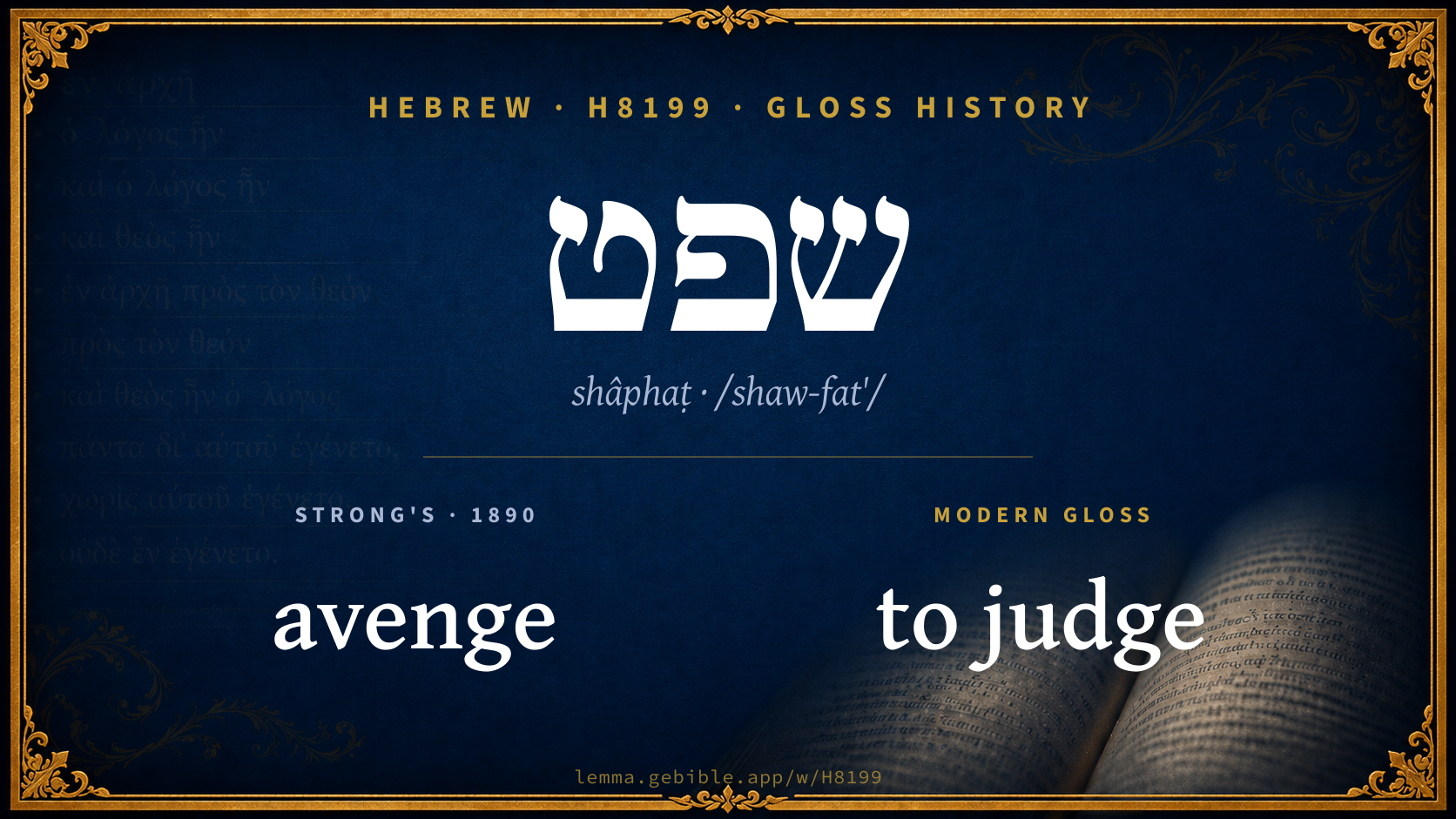
Gloss history
Strong's 1890 vs modern scholarship
About this word
Strong's H8199 catalogs a Hebrew word from the Hebrew Old Testament.
These counts are not copied from any lexicon or concordance. They are computed here, from the morphology-tagged Hebrew Old Testament. What Lemma adds →
- 182
- distinct verses
- The word appears in 182 distinct verses.
- 31 / 39
- OT books
- The word appears in 31 of 39 Old Testament books.
- #235
- by frequency
- Top 250 most frequent Hebrew words (rank 235 of 8,640 Hebrew words by occurrence).
View all 182 occurrences in the concordance →
By section of the Old Testament
By traditional corpus
Conventional, traditional groupings — biblical authorship is debated, so this is a traditional corpus grouping, not an authorship claim. Each share is this word’s portion of its verses in that division of the Hebrew canon. Each figure is a share of the word’s 182 distinct verses.
- Prophets (Nevi'im) 101 verses · 55%
- Writings (Ketuvim) 59 verses · 32%
- Torah (Pentateuch) 22 verses · 12%
How translations render this word
Counts come from each version’s own published word-to-Strong’s tagging or interlinear alignment — an approximate guide to how each version renders this word, not a word-level alignment the data otherwise carries. Because each total is that version’s own tagged count, the per-version totals vary from one another and need not match the appearance or distinct-verse counts above. These counts may also differ from a printed concordance because Lemma counts each distinctly tagged rendering and does not collapse phrase taggings into a single head-word total. This is a fixed set of word-tagged versions (KJV, ASV, BSB, ULT) and does not change with the reading translation you choose elsewhere. Each version’s license is shown beside its name below (and on Sources).
- King James Version: Judge 39×, Judges 30×, Judged 10×
- American Standard Version: Judge 37×, Judges 29×, He judged 9×
- Berean Standard Bible: Judge 36×, Judges 34×, I will judge 8×
- unfoldingWord Literal Text: Judge 41×, Judges 30×, And 9×
King James Version Public Domain
Renders H8199 across 203 tagged occurrences — most commonly:
Plus other, less common renderings. Plus 73 renderings that appear only once — usually multi-word phrases or single function words the recovered tagging swept in, not distinct renderings.
American Standard Version Public Domain
Renders H8199 across 202 tagged occurrences — most commonly:
Plus other, less common renderings. Plus 76 renderings that appear only once — usually multi-word phrases or single function words the recovered tagging swept in, not distinct renderings. Not rendered by a distinct English word in 1 further occurrence.
Berean Standard Bible Public Domain
Renders H8199 across 199 tagged occurrences — most commonly:
Plus other, less common renderings. Plus 57 renderings that appear only once — usually multi-word phrases or single function words the recovered tagging swept in, not distinct renderings. Not rendered by a distinct English word in 4 further occurrences.
unfoldingWord Literal Text CC BY-SA 4.0
Renders H8199 across 225 tagged occurrences — most commonly:
Plus other, less common renderings. Plus 62 renderings that appear only once — usually multi-word phrases or single function words the recovered tagging swept in, not distinct renderings.
15 senses and sub-senses in the full BDB
Hebrew verbs can shift meaning by stem (binyan): Qal is the basic action, Niphal is often passive or reflexive, Piel often intensifies or makes it factitive, and Hiphil is typically causative. The senses below are grouped under the stem BDB assigns to each.
What do BDB’s symbols mean?
BDB uses these scholarly abbreviations:
| Symbol | Meaning |
|---|---|
| 𝔊 | the Septuagint (the ancient Greek translation, LXX) |
| 𝔙 | the Vulgate (the Latin translation) |
| 𝔖 | the Syriac version (the Peshitta) |
| 𝔗 | the Targum (the Aramaic translation) |
| ψ | the Psalms |
| √ | root (the underlying root or stem) |
| ‖ | parallel passage (a synonymous or contrasted parallel) |
| † | the dagger: every passage where the word occurs is cited |
The 15 senses and sub-senses the full Brown-Driver-Briggs lexicon distinguishes for this word, in lexicon order (not ranked by frequency), with BDB’s own verbatim wording and sub-sense lettering. Shown in Hebrew script with BDB’s own scholarly abbreviations. The condensed entry is in the Lexicon Entry tab. See also the Forms in the corpus table below.
Qal
- Pf. 3 ms. שׁ׳ Ju 16:31 +, etc.; Impf. 3 ms. יִשְׁפֹּט Gn 16:5, יִשְׁפּוֹט Is 11:3; 3 mpl. יִשְׁפְּטוּ Gn 31:53 +, יִשְׁפּ֫וּטוּ Ex 18:26 (Ki יִשְׁפּוּט֫וּ; cf. Ges§ 47 g), etc.; Inf. abs. שָׁפוֹט Gn 19:9; cstr. שְׁפֹט Ru 1:1, לִשְׁפֹּט Ex 8:13 +, etc.; Imv. שְׁפָט־ Pr 31:9, שָׁפְטָה ψ 82:8; La 3:59, שִׁפְטוּ Is 1:17 +, שְׁפֹ֑טוּ Zc 7:9, etc.; Pt. שֹׁפֵט 1 S 3:13 +, etc.;— e.g. Judges 16:31
- 1. act as law-giver, judge, governor (giving law, deciding controversies and executing law, civil, religious, political, social; both early and late):
- a. of God only, שֹׁפֵט כל הארץ Gn 18:25 (J), ‖ מֶלֶךְ, מְחֹקֵק Is 33:22. e.g. Genesis 18:25
- b. of man, Gn 19:9(×2) (J), Moses deciding cases Ex 18:13 (E), making known statutes v 16 (E); so his assistants v 22(×2), 26(×2) (E), ‖ Dt 1:16; of שׁפטי ישׂראל Nu 25:5 (executioners); י׳ set שֹׁפְטִים over Isr. Ju 2:16, 18; 2 S 7:11 = 1 Ch 17:10, to deliver Isr., שׁפט ישׂראל Ju 3:10; 4:4; 10:2, 3 + 9 times Ju, 1 S 4:18; 7:15, 16, 17; 2 K 23:22, cf. 1 S 7:6; Pt. שֹׁפֵט as subst. also Ju 2:17, 18, 19; 1 S 8:1, 2; 2 K 23:22; שֹׁפְטֵי יִשׂ׳ 1 Ch 17:6 (‖ 2 S 7:7 שִׁבְטֵי), בִּימֵי שְׁפֹט הַשֹּׁפְטִים Ru 1:1(×2) (cf. מוֹשִׁיעִים Ob 21); שׁפט, ‖ מֶלֶךְ 1 S 8:5, 6, 20; Ho 7:7; 13:10; שֹׁפֶט ישׂראל Mi 4:14 (= king); king judges people 1 K 3:9(×2) = 2 Ch 1:10; 1 K 15:5 = 2 Ch 26:21; 2 Ch 1:11; abs. 1 K 7:7; Is 16:5; ‖ שׂרים Ex 2:14 (E) Am 2:3; Zp 3:3; ‖ יוֹעֵץ Is 1:26; Jb 12:17, cf. Is 3:2; שֹׁפְטֵי אָרֶץ Is 40:23 (‖ רוֹזְנִים), Pr 8:16 (‖ שׂרים), ψ 2:10; 148:11 (‖ מלכים); שׁפטינו אשׁר שׁפטונו Dn 9:12(×2). e.g. Genesis 19:9
- 2. specif. decide controversy, discriminate betw. persons, in civil, political, domestic and religious questions:
- a. of God ψ 82:1: שׁ׳ בֵּין … וּבֵין Gn 16:5 (J; domestic), Ju 11:27(×2); 1 S 24:13, 16 (all of war), Ez 34:20 (relig.); c. בֵּין … לְ Ez 34:17, 22 (relig.); c. בֵּינֵינוּ Gn 31:53 (E; domestic), Is 2:4 = Mi 4:3 (of war); c. בְּ 2 Ch 20:12 (war); c. acc. 1 K 8:32 = 2 Ch 6:23; Ec 3:17, condemning wicked and justifying righteous Jb 21:22 (‖ ידע), 23:7; abs. Ex 5:21 (J) Jb 22:13; שׁ׳ צֶדֶק Je 11:20 ψ 9:5; י׳ is שׁוֹפֵט צַדִּיק 7:12. e.g. Psalms 82:1
- b. of man, שׁ׳ בֵּין … וּבֵין Ex 18:16 (E) Nu 35:24 (P) Dt 1:16 (all civil), Is 5:3 (relig.); c. acc. Lv 19:15 (H) Dt 25:1 (all civil), Ez 20:4(×2); 22:2(×2); 23:36; שׁ׳ מִשְׁפָּט Dt 16:18; 1 K 3:28 (Sol.); במשׁפטים Ez 44:24, c. ל 2 Ch 19:6; abs. Ez 44:24; Is 11:3 (king); influenced by bribes Mi 3:11; 7:3; Jb 9:24; Absalom desires to decide cases as שֹׁפֵט 2 S 15:4 (implying lack of such in his time); according to 2 Ch 19:5, 6 Jehoshaphat set up שׁפטים, appar. for the first as judges in this specific sense; code of Dt recognizes them: הַשֹּׁפֵט declares דְּבַר הַמִּשְׁפָּט Dt 17:9, 12; 25:2; שׁפטים + שֹׁטְרִים 16:18; 1 Ch 23:4; 26:29; Jos 8:33 (+ זְקֵנִים), 23:2; 24:1 (D; both + זקנים, רָאשִׁים), + זקנים only Dt 21:2; Ezr 10:14, + כֹּהֲנִים; Dt 19:17, 18, שׂרים 2 Ch 1:2. e.g. Exodus 18:16
- 3. execute judgment:
- a. discriminating, of man only, משׁפט אמת Zc 7:9, מֵישָׁרִים שׁ׳ ψ 58:2 judge uprightly; משׁפט שׁלום Zc 8:16, צֶדֶק Pr 31:9, עָוֶל ψ 82:2. e.g. Zechariah 7:9
- b. vindicating, c. acc.: (1) subj. God, יתום ψ 10:18, acc. pers. 26:1; 43:1; 58:12 (read שֹׁפְטָם for שׁפטים), שׁ׳ משׁפט La 3:59; מִיַּד vindicate by delivering from hand of 1 S 24:16; 2 S 18:19, 31; שָׁפְטֵנִי י׳ כְּצִדְקִי ψ 7:9; שָׁפְטֵנִי כְּצִדְקְךָ 35:24. (2) subj. man, c. acc. יתום Is 1:17, 23; דל(ים) 11:4; Pr 29:14 ψ 82:3; עניי עם 72:4; משׁפט אביונים Je 5:28. e.g. Psalms 10:18
- c. condemning and punishing, (1) God כְּדַרְכֵי פ׳ acc. to ways of Ez 7:3, 8; 18:30; 24:14; 33:20; 36:19; במשׁפטים 7:27; 23:24; משׁפטי נאפות 16:38 (= 23:45 of human judges); c. acc. 1 S 3:13 ψ 51:6 Is 51:5; Ez 11:10, 11; 21:35; 35:11. (2) of man, only שֹׁפְטֵי נַפְשׁוֹ ψ 109:31 and Ez 23:45 supr., prob. also ψ 141:6 (corrupt). e.g. Ezekiel 7:3
- d. at theophanic advent for final judgment: God is שֹׁפֵט ψ 50:6; 75:8; שׁפט הארץ 94:2, c. acc. בא לשׁפט הארץ 96:13 = 1 Ch 16:33, ψ 98:9; שׁ׳ הארץ 82:8; כל הגוים Jo 4:12; עמים ψ 67:5; תבל 9:9; 96:13 = 98:9; שׁ׳ מישׁרים 75:3. e.g. Psalms 50:6
Niphal
- Pf. 1 s. נִשְׁפַּטְתִּי Ez 20:36 + 4 times; Impf. 1 s. אִשָּׁפֵט Ez 20:36; אִשָּֽׁפְטָה 1 S 12:7, etc.; Inf. cstr. הִשָּׁפֵט 2 Ch 22:8; sf. הִשָּֽׁפְטוֹ ψ 37:33; 109:7; Pt. נִשְׁפָּט Is 59:4 + 4 times;— e.g. Ezekiel 20:36
- 1. recipr., (Ges§ 51 d), enter into controversy, plead: c. אֵת with, of God Je 2:35; Ez 17:20 (+ acc. rei) 20:35, 36(×2); 38:22; of man 1 S 12:7 (+ וְאַגִּידָה לָכֶם 𝔊 We), Pr 29:9; c. עִם, of God Jo 4:2, of man 2 Ch 22:8; c. ל, of God Je 25:31; נשׁ׳ יחד Is 43:26 have controversy together; באשׁ by fire (of God) 66:16; באמונה 59:4. e.g. Jeremiah 2:35
- 2. pass. be judged, ψ 9:20; 37:33; 109:7. Pôʿel Pt. sf. מְשֹׁפְטִי (dub.; Hi Bu מִשְׁפָּטִי), = my opponent-at-law (Ges§ 55 b) Jb 9:15; + Zp 3:15 ψ 109:31 We al. e.g. Psalms 9:20
Senses from the full Brown-Driver-Briggs lexicon (Brown, Driver, Briggs; Oxford 1906 — public domain), digitized via Sefaria, supplemented by the OpenScriptures HebrewLexicon (CC BY 4.0). Full attribution on Sources.
Word origin
vb. judge, govern (NH in deriv.; Ph. שפט = שֹׁפֵט, also in n.pr.; Pun. sufet Lzb381; Biblical Aramaic שָֽׁפְטִין; Assyrian šapâtu (t = ת), syn. dânu (דִּין), judge DlWB 684, šipṭu (ט), prob. judgment [and šapiṭu, captain?] JenZA iv (1889), 278 f.; on poss. connexion with Arabic سفط v. NöZMG xi (1886), 724; on usage of vb. see FergusonJBL viii (1888), 130 ff.);—
— Brown-Driver-Briggs (Oxford 1906, public domain), digitized via Sefaria, supplemented by the OpenScriptures HebrewLexicon (CC BY 4.0). See Sources.
Origin: a primitive root
Jastrow Dictionary
A second Hebrew/Aramaic lexicon for comparison, covering Aramaic and post-biblical (Talmudic, Targumic, Midrashic) usage that the biblical-Hebrew BDB does not. Matched by lemma rather than by Strong’s number, so a lemma may carry more than one Jastrow headword (shown separately below), and the entries cover usage well beyond the Bible.
שָׁפַט
- v. פטט, s. v. פַּטָּטָא) [to divide; cmp. גזר,] to decree, decide, judge. Ruth R. to I, 1 אוי לדור שׁשָׁפְטוּ … צריכין להִשָּׁפט woe to the generation that judge (criticise) their judges, and woe to the generation whose judges need to be judged; B. Bath. 15ᵇ (ref. to Ruth l. c.) דור שׁשׁוֹפֵט וכ׳ it was a generation that judged its judges &c., v. קִיסָּם. Sot. 10ᵃ זכור לי … שׁשָׁפַטְתִּי וכ׳ remember unto me the twenty (-two) years that I judged Israel, and never did I say to them, carry a stick for me from one place to another; a. fr.—V. שׁוֹפֵט.
- to be judged, criticised. Ruth R. l. c., v. supra.
שֶׁפֶט
- , pl. שְׁפָטִים(b. h.; preced.) judgments, punishments. Mekh. B’shall., Shir., s. 8 נעשו ש׳ בע"ז judgment was executed on the idols; a. e.
A Dictionary of the Targumim, the Talmud Babli and Yerushalmi, and the Midrashic Literature (Marcus Jastrow; London, Luzac, 1903) — Public Domain. Digitized via Sefaria. Digitized via Sefaria. Full attribution on Sources.
Forms in the corpus
The 163 distinct written forms H8199 takes in the Hebrew Bible, most frequent first — each parse links to that stem’s occurrences in the concordance. Hebrew forms include their vowel points and cantillation, so a single lemma takes many written forms.
The 60 most common forms are shown; 103 rarer forms follow in the full concordance.
Same root — word family
Other BDB entries built from the same root as H8199, grouped by Strong’s listed origin. These share a root / origin per the lexicon — not necessarily a shared meaning. Each links to that word’s own entry.
Derived from this word
- משפט mishpâṭ H4941 judgment
- שפוט shᵉphôwṭ H8196 judgment
- שפט shᵉphaṭ H8200 to judge
- שפט shepheṭ H8201 judgment
- תפתי tiphtay H8614 magistrate
Proper names from this root
People and places named from this root — a name, not an additional meaning of the word.
Compare all same-root words → Showing 4 of 9 — not the complete family. 3 of the same-root words are proper names (people or places). They share a root, not necessarily a meaning.
Septuagint verse parallels
This word appears in 174 verses that also exist in the Greek Old Testament (Septuagint), out of the 182 Hebrew verses it occurs in. You can read those verses in Greek by switching the Old Testament edition to the Septuagint.
Read these verses in the Septuagint
- Genesis 16:5
- Exodus 2:14
- Leviticus 19:15
- Numbers 25:5
- Deuteronomy 1:16
- Joshua 23:2
- Judges 2:16
- Ruth 1:1
- 1 Samuel 3:13
- 2 Samuel 7:11
- 1 Kings 3:9
- 2 Kings 15:5
This is a verse-level parallel only — the same verses exist in both the Hebrew and Greek Old Testaments. No word-level Hebrew↔Greek correspondence is claimed: the data carries no such alignment, so no Greek word is shown as this Hebrew word’s translation. Coverage is not total — the Septuagint omits the deuterocanon and renumbers the Psalms, so some Hebrew verses have no direct Greek parallel.