
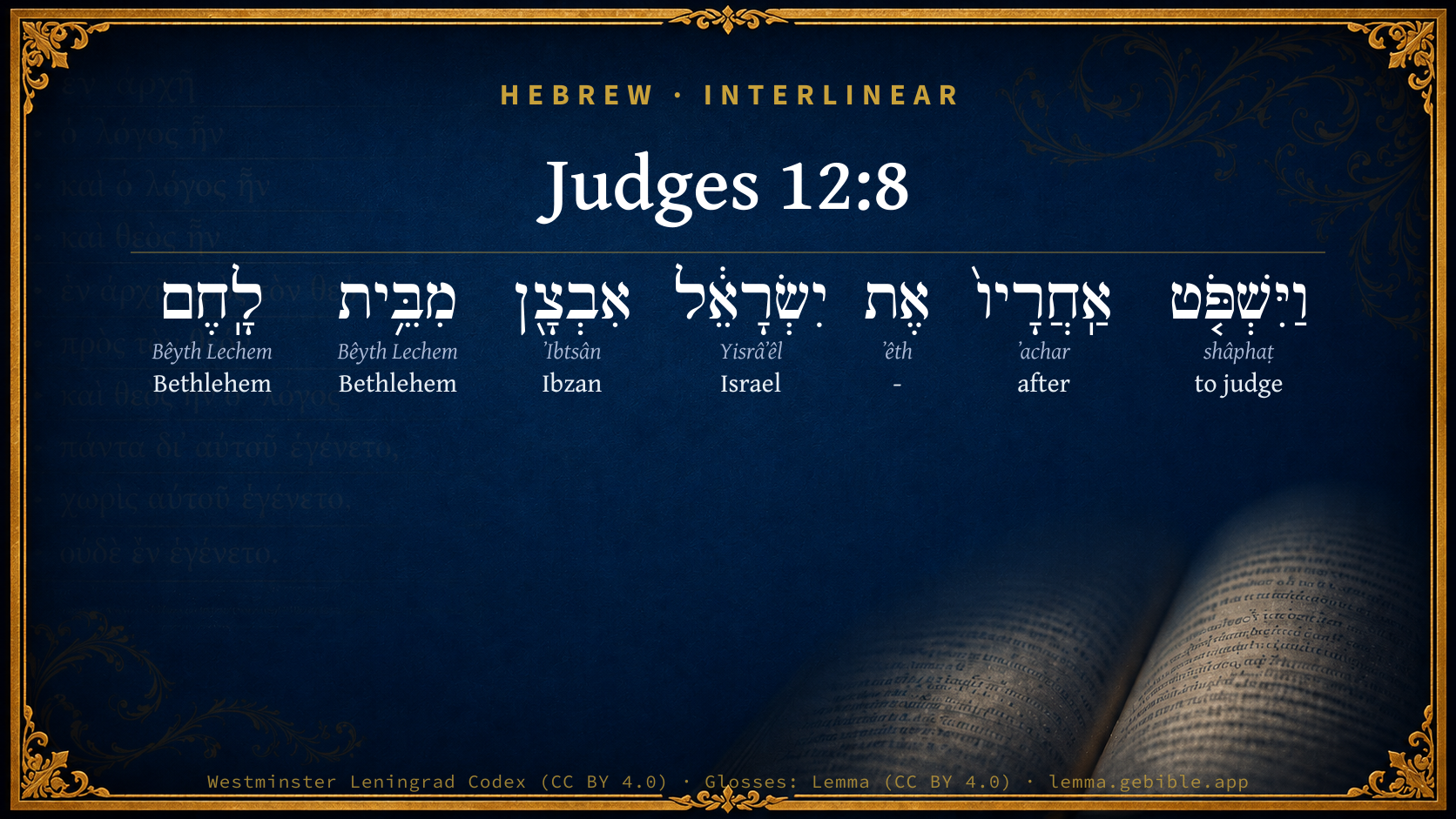
Judges 12:8

Hebrew (Westminster Leningrad Codex) Judges 12:8 appears in the Hebrew Old Testament. The text above is from the Westminster Leningrad Codex. Each word links to its Strong’s number, a concise gloss, and parsing drawn from the Open Scriptures Hebrew Bible morphology. Click any word for its full Brown-Driver-Briggs (BDB) entry.
Download image
Cite this verse

Judges 12:8 (World English Bible). Public Domain. Lemma interlinear Bible study tool, https://lemma.gebible.app/v/judges/12/8.

Show BibTeX & RIS
BibTeX
RIS
English Translation
After him Ibzan of Bethlehem judged Israel.
World English Bible · Public Domain
Highlights
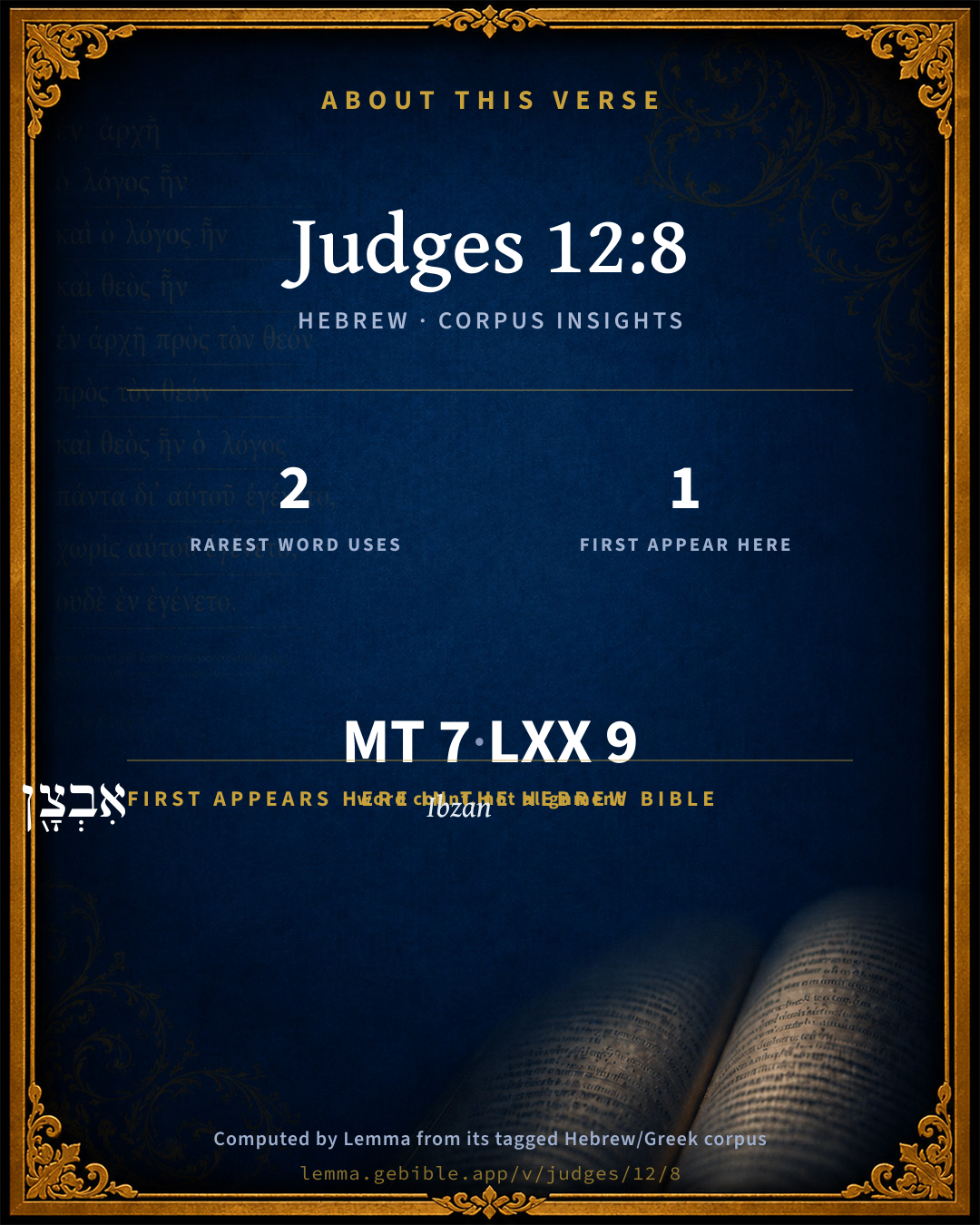
  • 1 first appearance in the Hebrew Bible
Full analysis ↓
Download a study sheet

One document with this verse’s original text, its word-by-word gloss line, the meaning frame, cross-references with their text, attributed commentary, and full source and license credits — printable, and it pastes into notes with its structure intact.

This verse Autodidact and up

Study sheet (.html) Plain text (.txt)

A passage Seminary Student

Up to 50 verses in one chapter. A passage sheet keeps up to 6 commentary sources and 12 cross-references per verse, in the order this page ranks them, and says so on the sheet whenever that leaves anything out. Ask for a single verse and you get the Autodidact verse sheet above.

Everything on this page stays free to read, with no account — the sheet is a download of what is already on screen, not access to it.

Want to remove ads? Support Godless Engineer
Compare translations 3

The same verse in 3 English versions, stacked beneath the original-language interlinear above. Click any original word for its lexicon entry.

Each is an independent rendering of the whole verse — the interlinear is not word-aligned to these translations.

Highlighted words mark where these versions differ — a whole-verse word diff, not a word-by-word alignment.

  • World English Bible Public Domain
    After him Ibzan of Bethlehem judged Israel.
  • King James Version Public Domain
    And after him Ibzan of Bethlehem judged Israel.
  • unfoldingWord Literal Text CC BY-SA 4.0
    And after him Ibzan from Bethlehem judged Israel.

unfoldingWord Literal Text — © unfoldingWord, licensed CC BY-SA 4.0. Word-aligned USFM3 via Door43 (git.door43.org/unfoldingWord/en_ult).

Versions to compare (up to 4)

3 of 4 selected

Show all 18 translations

Every available English version of this verse, each an independent rendering of the whole verse.

  • World English Bible Public Domain
    After him Ibzan of Bethlehem judged Israel.
  • Berean Standard Bible Public Domain
    After Jephthah, Ibzan of Bethlehem judged Israel.
  • Majority Standard Bible Public Domain
    After Jephthah, Ibzan of Bethlehem judged Israel.
  • King James Version Public Domain
    And after him Ibzan of Bethlehem judged Israel.
  • American Standard Version (1901) Public Domain
    And after him Ibzan of Beth-lehem judged Israel.
  • Revised Version (1885) Public Domain
    And after him Ibzan of Beth-lehem judged Israel.
  • Geneva Bible (1599) Public Domain
    After him Ibzan of Beth-lehem iudged Israel,
  • Douay-Rheims (1899) Public Domain
    After him Abesan of Bethlehem judged Israel:
  • Young's Literal Translation Public Domain
    And after him Ibzan of Beth-Lehem judgeth Israel,
  • Literal Standard Version CC BY-SA 4.0
    And after him Ibzan of Beth-Lehem judges Israel,
  • Unlocked Literal Bible CC BY-SA 4.0
    After him, Ibzan of Bethlehem served as a judge over Israel.
  • unfoldingWord Literal Text CC BY-SA 4.0
    And after him Ibzan from Bethlehem judged Israel.
  • Darby Bible Public Domain
    After him Ibzan of Bethlehem judged Israel.
  • World Messianic Bible Public Domain
    After him Ibzan of Bethlehem judged Israel.
  • Webster's Bible Public Domain
    And after him Ibzan of Beth-lehem judged Israel.
  • Free Bible Version CC BY-SA 4.0
    After Jephthah, Ibzan of Bethlehem led Israel as a judge.
  • Bible in Basic English Public Domain
    And after him, Ibzan of Beth-lehem was judge of Israel.
  • JPS Tanakh (1917) Public Domain
    And after him Ibzan of Beth-lehem judged Israel.

Literal Standard Version (2020), Covenant Press — licensed CC BY-SA 4.0. Text via the HelloAO Bible API (eBible.org). Unlocked Literal Bible (unfoldingWord) — licensed CC BY-SA 4.0. Text via the HelloAO Bible API (eBible.org). unfoldingWord Literal Text — © unfoldingWord, licensed CC BY-SA 4.0. Word-aligned USFM3 via Door43 (git.door43.org/unfoldingWord/en_ult). Free Bible Version, Dr. Jonathan Gallagher — licensed CC BY-SA 4.0. Text via the HelloAO Bible API (eBible.org).

Word by word

More ways to search: Search by grammar → Find every occurrence → Compare this word →

Practice this passage: Drill this verse → Learn its vocabulary →

About this verse

These counts appear in no published source. They are computed here, from the morphology-tagged text and Lemma’s own curated glosses. What Lemma adds →

7
words
6
distinct lemmas
Historical
section

Notable vocabulary

The rarest word here is אִבְצָ֖ן Ibzan H78 — appearing just 2 times in the whole Hebrew Bible.

First appearance in Scripture

This word makes its first canonical appearance in the Hebrew Bible here:

  • אִבְצָ֖ן Ibzan H78

Shared distinctive vocabulary

אִבְצָ֖ן Ibzan H78 occurs in 2 verses of the Hebrew Bible. Also found in:

Grammatical profile

  • 1 verb
  • 4 nouns
  • 1 preposition
  • 1 particle

Verb forms

  • וַיִּשְׁפֹּ֤ט Qal · Sequential Imperfect

Repetition

A word recurs within this verse — often emphatic in Hebrew:

  • מִבֵּ֥ית Bethlehem H1035 ×2

Hebrew & Septuagint length

In English translation the verse runs 7 words from the Hebrew and 8 from the Septuagint (LXX English) — closely comparable.

A rough comparison of the two English renderings, which tokenize alike — not a word-level alignment.

Word counts can differ between the Hebrew and the Greek without any difference in meaning — e.g. the Hebrew direct-object marker אֵת has no separate Greek word, and Greek often adds the article ὁ.

In the original languages it is 7 Hebrew tokens and 9 Greek tokens — but the two are counted differently (Hebrew bundles its prefixes and suffixes into one token; the Greek is in lemma form), so that isn’t a like-for-like length.

Cross-references

4

Topical passages linked to Judges 12:8 in the Treasury of Scripture Knowledge — connected by theme and wording, ordered by reader-vote popularity; previews shown in the World English Bible.

  • 1 Samuel 16:1 Yahweh said to Samuel, How long will you mourn for Saul, seeing I have rejected him from being king over Israel? fill your horn with oil, and go: I will send you to Jesse the Bethlehemite; for I have provided me a king among his sons.
  • Genesis 15:19 the Kenites, the Kenizzites, the Kadmonites,
  • Micah 5:2 But you, Bethlehem Ephrathah, Being small among the clans of Judah, Out of you one will come forth to me that is to be ruler in Israel; Whose goings forth are from of old, from everlasting.
  • Matthew 2:1 Now when Jesus was born in Bethlehem of Judea in the days of Herod the king, behold, wise men from the east came to Jerusalem, saying,

Cross-references courtesy of OpenBible.info (CC BY 4.0).

Hebrew and Greek witnesses Masoretic Hebrew ↔ Greek Septuagint

The same verse in the two great witnesses to the Old Testament, shown verse-for-verse.

These are two independent witnesses, not word-aligned to each other, and the Septuagint is shown in lemma (dictionary) form.

Hebrew Judges 12:8 Masoretic · Westminster Leningrad Codex

וַיִּשְׁפֹּ֤ט אַֽחֲרָיו֙ אֶת יִשְׂרָאֵ֔ל אִבְצָ֖ן מִבֵּ֥ית לָֽחֶם

After him Ibzan of Bethlehem judged Israel.

World English Bible · Public Domain

Greek LXX Judges 12:8 Septuagint · lemma form

καί κρίνω μετά αὐτός ὁ ἰσραήλ αβαισαν ἀπό βαιθλεεμ

And after him Abaissan of Bethleem judged Israel.

LXX2012 (modern English Septuagint) · Public Domain

Hebrew: Westminster Leningrad Codex (CC BY 4.0). Greek: Septuagint (public domain); English from LXX2012 (modern English Septuagint) (Public Domain). How the Septuagint differs from the Hebrew →

Targum (Aramaic paraphrase)

1

The Targum is the ancient Jewish Aramaic paraphrase of the Hebrew Scriptures — an interpretive translation, not the Hebrew text itself. Onkelos (literal) and Pseudo-Jonathan (expansive) render the Torah, and Jonathan the Prophets. Coverage is partial: where no permissively-licensed English translation exists for a verse, only the Aramaic is shown. This is verse-level text, not a word-by-word alignment to the Hebrew.

  1. Targum Jonathan Prophets (Joshua–Malachi)
    וְדָן בַּתְרוֹהִי יַת יִשְׂרָאֵל אִבְצָן דְמִבֵּית לֶחֶם:

    (no public-domain English translation for this verse)

    Targum Jonathan — Aramaic: “Mikraot Gedolot” (public domain). English: “Sefaria Community Translation” (CC0 1.0 (public-domain dedication)); “London "Chaldee Paraphrase," 1871” (public domain). Text via Sefaria.

Commentary

Notes on Judges 12:8 from classic Christian and Jewish commentators (each source and its license shown beneath its notes). The classic Christian expositions comment on the surrounding passage and are grouped to its opening verse, so a note may address several verses; the Jewish commentaries on the Tanakh (Rashi and others) are per-verse, so they appear only where the commentator wrote on this verse.

Lemma curates 59 commentaries, every one of them public domain or Creative Commons licensed, each selected and text-cleaned for this edition rather than reprinted as found. About our sources →

Trapp's Complete Commentary

John Trapp

Jdg 12:8 And after him Ibzan of Bethlehem judged Israel.

Ver. 8. Ibzan of Bethlehem.] Hic dicitur fuisse Boaz, saith Vatablus. This some will have to be Boaz, the husband of Ruth, the Moabitess, and great-grandfather of King David. But this is a conjecture only.

John Trapp, A Commentary or Exposition upon All the Books of the Old and New Testament (1647–1656) — public domain. Text from a community e-Sword module.

Whedon's Commentary on the Bible

Daniel D. Whedon

IBZAN, ELON, AND ABDON, Jdg_12:8-15.

8. Ibzan of Beth-lehem — Nothing is said by which we can certainly know whether the Beth-lehem of Judah or that of Zebulun (Jos_19:15) is meant. From the absence of the addition Judah, (compare Jdg_17:7,) and the fact that the next judge was also a Zebulonite, most commentators suppose that the Beth-lehem of Zebulun is meant. The notion that Ibzan was identical with Boaz, the second husband of Ruth and father of Obed, has nothing but a distant resemblance in the names to support it, and has very much against it.

Daniel D. Whedon (gen. ed.), Commentary on the Old and New Testaments (1874–1909) — public domain. Text from a community e-Sword module.

Keil & Delitzsch

C. F. Keil & F. Delitzsch

Of these three judges no particular deeds are related, just as in the case of Tola and Jair (see the remarks on Jdg 10:1). But it certainly follows from the expression אחריו ויּשׁפּט (Jdg 12:8, Jdg 12:11, Jdg 12:13) that they were one after another successors of Jephthah, and therefore that their office of judge also extended simply over the tribes on the east of the Jordan, and perhaps the northern tribes on this side.

Jdg 12:8-10

Ibzan sprang from Bethlehem,-hardly, however, the town of that name in the tribe of Judah, as Josephus affirms (Ant. v. 7, 13), for that is generally distinguished either as Bethlehem "of Judah" (Jdg 17:7, Jdg 17:9; Rut 1:2; Sa1 17:12), or Bethlehem Ephratah (Mic 5:1), but probably Bethlehem in the tribe of Zebulun (Jos 9:15). He had thirty sons and thirty daughters, the latter of whom he sent away החוּצה (out of his house), i.e., gave them in marriage, and brought home thirty women in their places from abroad as wives for his sons. He judged Israel seven years, and was buried in Bethlehem.

Jdg 12:11-12

His successor was Elon the Zebulunite, who died after filling the office of judge for ten years, and was buried at Aijalon, in the land of Zebulun. This Aijalon has probably been preserved in the ruins of Jaln, about four hours' journey to the east of Akka, and half an hour to the S.S.W. of Mejdel Kerun (see V. de Velde, Mem. p. 283).

Jdg 12:13-15

He was followed by the judge Abdon, the son of Hillel of Pirathon. This place, where Abdon died and was buried after holding the office of judge for eight years, was in the land of Ephraim, on the mountains of the Amalekites (Jdg 12:15). It is mentioned in Sa2 23:30 and Ch1 11:31 as the home of Benaiah the hero; it is the same as Φαραθώ (read Φαραθόν) in 1 Macc. 9:50, and Joseph. Ant. xiii. 1, 3, and has been preserved in the village of Ferta, about two hours and a half to the S.S.W. of Nabulus (see Rob. Bibl. Res. p. 134, and V. de Velde, Mem. p. 340). On the riding of his sons and daughters upon asses, see at Jdg 10:4.

Keil & Delitzsch — Biblical Commentary on the Old Testament (1861–1891) — public domain (CC PDM 1.0). Text via the HelloAO Bible API. (Old Testament only.)

Lange's Commentary on the Holy Scriptures

EIGHTH SECTION

three judges of uneventful lives in peaceful times: ibzan of bethlehem, elon the zebulonite, and abdon the pirathonite

__________________

Ibzan of Bethlehem, Elon the Zebulonite, and Abdon the Pirathonite

Jdg_12:8-15

8And after him Ibzan of Beth-lehem judged Israel. 9And he had thirty sons [,] and thirty daughters whom [omit: whom] he sent abroad [sent out, i. e. gave in marriage], and took in [brought home] thirty daughters from abroad for his sons: and he judged Israel seven years. 10Then died Ibzan [And Ibzan died], and was buried at Bethlehem. 11And after him Elon, a [the] Zebulonite, judged Israel, and he judged Israel ten years. 12And Elon the Zebulonite died, and was buried in Aijalon in the country of Zebulun. 13And after him Abdon the son of Hillel, a [the] Pirathonite, judged Israel. 14And he had forty sons and thirty nephews [grandsons], that rode on threescore and ten ass colts: and he judged Israel eight years. 15And Abdon the son of Hillel the Pirathonite died, and was buried in Pirathon in the land of Ephraim, in the mount of the Amalekites [Amalekite].

EXEGETICAL AND DOCTRINAL

The special value of the notices concerning these three Judges consists in the contrast which they offer to the fortunes of Jephthah. These three all have what Jephthah had not. They all have children in abundance, and are happy in them (Psa_127:3 ff.). Ibzan has thirty daughters, whom he gives in marriage, and thirty daughters-in-law. Abdon, likewise, has forty sons, and looks on thirty flourishing grandsons. The people is familiar with the places of their nativity, and knows where their sepulchres are. Indeed, some of these places, even with their old names, are not lost to this day. For even the native place of Ibzan, although it was not the celebrated Bethlehem, but another in Zebulun (Jos_19:15), has in our day been identified as Beit Lahm by Robinson (iii. 113). Keil’s remark that we are not to think here of the Bethlehem in Judah, must indeed be allowed, although the Jewish legend does think of it and identifies Ibzan with Boaz.3 But that this Bethlehem always appears with the addition “in Judah” (so also in Jdg_17:7), has its ground in the very fact that the other Bethlehem was not unknown. The definition “in Judah” could here be the less omitted because the next Judge also belonged to Zebulun.

Aijalon also, the place where Elon, the second mentioned Judge, is said to have died, and where he probably also resided, seems to be recognized in Jalûn, a place of ruins (cf. Van de Velde, referred to by Keil). Pirathon,4 the birthplace of the third Judge, whose name Hillel is a highly celebrated one among the Jews of later times, was already recognized by Esthor ha-Parchi in the modern Fer’ata (פרעתה), and has been rediscovered by Robinson and others (cf. Zunz, in Asher’s Benj. of Tudela, ii. 426; Robinson, iii. 134). They all enjoy in fact every blessing of life of which Jephthah was destitute; we hear of their children, their fathers, and their graves; but of their deeds we hear nothing. They have judged, but not delivered. They enjoyed distinction, because they were rich; but they never rose from the condition of exiled and hated men to the dignity of princes, urged thereto by the humble entreaties of their countrymen. Of them, we know nothing but their wealth; of Jephthah, nothing but his renown. They had herds, but made no sacrifices. Their daughters were married; but the unmarried daughter of Jephthah survives them all as an example of the obedience and faith of every noble maiden heart. They had full houses, and widely known monuments; and Jephthah went from an empty house to an unknown grave: but his name, consecrated by the Apostle’s benediction, shines forevermore as that of a hero of faith. Such contrasts the narrator wishes to rescue from concealment. The heathen Achilles, according to the legend of the Greeks, chose immortal fame in preference to length of life and pleasure. What would we choose, if choice were given us between lbzan or Hillel and Jephthah? Or rather, let us Christians choose the Cross of Him who lives forever!

HOMILETICAL AND PRACTICAL

After Gideon and Abimelech, two peaceful Judges are named, concerning whose official life nothing is reported. A similar relation subsists between Jephthah and his successors. The comparison may serve for instruction. The result of Gideon’s deeds was glory and greatness; of Abimelech’s tyranny, terrors and punishment. Both kinds of results were brought to view, for the instruction of the nations, in the career of Jephthah His victory was mighty against those without; his chastisement towards those within. The seed which he sowed in tears, sprang up in joy for others.

The three Judges have everything that Jephthah has not,—children, paternal home, and commemoration of their death. But they have no heroic victory like his, and his only daughter is an example for all time. Jephthah judged only a short time, and died bowed down with grief and loneliness. But neither can prosperity avail to lengthen years. These peaceful Judges judged only seven, ten, and eight years, respectively. How different is Jephthah’s life from theirs! But the kingdom of God does not move onward in tragedies alone, but also in meekness and quietude.

The teachings of God are calculated to serve truth, not to promote human glory. Worldly vanity strives for the immortality of time. It is a strange exhibition of human folly, when great deeds are performed for the sake of the monuments and statues with which they are rewarded. In the kingdom of God, other laws obtain. Jephthah is the great warrior hero; but neither the place of his birth nor that of his death is known. Monuments determine nothing in the history which God writes, but only Godlike deeds. The faithful who have died in God, are followed by their works.

Starke: It is better to bestow celebrity on one’s native land, by virtuous actions, than to derive celebrity from one’s native land.

Footnotes:

[3]The unhistorical character of the legend is the more evident, the more clear it is that chapter 12 treats only of northern heroes, whereas the narratives of southeastern aeroes and struggles begin at chapter 13, and continue ***own to Samuel and David.

[4]It lies on a Tell, which Jdg_12:15 calls the mountain of Amalek, perhaps from Joshua, the conqueror of Amalek, cf. Jdg_5:14.

Lange's Commentary on the Holy Scriptures (Critical, Doctrinal, and Homiletical), ed. John Peter Lange, English translation edited by Philip Schaff (1864–1880) — public domain. Text from a community e-Sword module.

Geneva Bible (1599)

Geneva Bible translators

Some think that this was Boaz the husband of Ruth.

Geneva Bible (1599) marginal notes — public domain. Text via Bolls.life.

Matthew Henry's Commentary

We have here a short account of the short reigns of three more of the judges of Israel, the first of whom governed but seven years, the second ten, and the third eight. For the transgression of a land, many are the princes thereof, many in a short time, successively (Pro 28:2), good men being removed in the beginning of their usefulness and by the time that they have applied themselves to their business.

I. Ibzan of Bethlehem, most probably Bethlehem of Judah, David's city, not that in Zebulun, which is only mentioned once, Jos 19:15. He ruled but seven years, but by the number of his children, and his disposing of them all in marriage himself, it appears that he lived long; and probably the great increase of his family, and the numerous alliances he made, added to his personal merits, made him the more fit to be either chosen by the people as Jephthah was, or called of God immediately, as Gideon was, to be Israel's judge, to keep up and carry on the work of God among them. That which is remarkable concerning him is, 1. That he had many children, sixty in all, a quiver full of these arrows. Thus was Bethlehem of old famous for increase, the very city where he was to be born whose spiritual seed should be as the stars of heaven. 2. That he had an equal number of each sex, thirty sons and thirty daughters, a thing which does not often happen in the same family, yet, in the great family of mankind, he that at first made two, male and female, by his wise providence preserves a succession of both in some sort of equality as far as is requisite to the keeping up of the generations of men upon earth. 3. That he took care to marry them all. His daughters he sent abroad, et maritis dedit, so the vulgar Latin adds - he provided husbands for them; and, as it were in exchange, and both ways, strengthening his interest, he took in thirty daughters from abroad for his sons. The Jews say, Every father owes three things to his son: to teach him to read the law, give him a trade, and get him a wife. What a difference was there between Ibzan's family and that of his immediate predecessor Jephthah! Ibzan has sixty children and all married, Jephthah but one, a daughter, that dies or lives unmarried. Some are increased, others are diminished: both are the Lord's doing.

II. Elon of Zebulun, in the north of Canaan, was next raised up to preside in public affairs, to administer justice, and to reform abuses. Ten years he continued a blessing to Israel, and then died, Jdg 12:11, Jdg 12:12. Dr. Lightfoot computes that in the beginning of his time the forty years' oppression by the Philistines began (spoken of Jdg 13:1), and about that time Samson was born. Probably, his residence being in the north, the Philistines who bordered upon the southern parts of Canaan took the opportunity of making incursions upon them.

III. Abdon, of the tribe of Ephraim, succeeded, and in him that illustrious tribe begins to recover its reputation, having not afforded any person of note since Joshua; for Abimelech the Shechemite was rather a scandal to it. This Abdon was famous for the multitude of his offspring (v. 14): he had forty sons and thirty grandsons, all of whom he lived to see grown up, and they rode on seventy ass-colts either as judges and officers or as gentlemen and persons of distinction. It was a satisfaction to him thus to see his children's children, but it is feared he did not see peace upon Israel, for by this time the Philistines had begun to break in upon them. Concerning this, and the rest of these judges that have ever so short an account given of them, yet notice is taken where they were buried (Jdg 12:7, Jdg 12:10, Jdg 12:12, Jdg 12:15), perhaps because the inscriptions upon their monuments (for such were anciently used, Kg2 23:17) would serve for the confirmation and enlargement of their story, and might be consulted by such as desired further information concerning them. Peter, having occasion to speak of David, says, His sepulchre is with us unto this day, Act 2:29. Or it is intended for the honour of the places where they laid their bones, but may be improved for the lessening of our esteem of all worldly glory, of which death and the grave will stain the pride. These judges, that were as gods to Israel, died like men, and all their honour was laid in the dust.

It is very strange that in the history of all these judges, some of whose actions are very particularly related, there is not so much as once mention made of the high priest, or any other priest or Levite, appearing either for counsel or action in any public affair, from Phinehas (Jdg 20:28) to Eli, which may well be computed 250 years; only the names of the high priests at that time are preserved, Ch1 6:4-7; and Ezr 7:3-5. How can this strange obscurity of that priesthood for so long a time, now in the beginning of its days, agree with that mighty splendour with which it was introduced and the figure which the institution of it makes in the law of Moses? Surely it intimates that the institution was chiefly intended to be typical, and that the great benefits that seemed to be promised by it were to be chiefly looked for in its antitype, the everlasting priesthood of our Lord Jesus, in comparison of the superior glory of which that priesthood had no glory, Co2 3:10.

Matthew Henry's Commentary on the Whole Bible (1708–1710) — public domain (CC PDM 1.0). Text via the HelloAO Bible API.

Adam Clarke's Commentary

Verse 8. And after him Ibzan] It appears that during the administration of Jephthah, six years - Ibzan, seven years - Elon, ten years - and Abdon, eight years, (in the whole thirty-one years,) the Israelites had peace in all their borders; and we shall find by the following chapter that in this time of rest they corrupted themselves, and were afterwards delivered into the power of the Philistines.

1. WE find that Ibzan had a numerous family, sixty children; and Abdon had forty sons and thirty grandsons; and that they lived splendidly, which is here expressed by their riding on seventy young asses; what we would express by they all kept their carriages; for the riding on fine asses in those days was not less dignified than riding in coaches in ours.

2. It does not appear that any thing particular took place in the civil state of the Israelites during the time of these latter judges; nothing is said concerning their administration, whether it was good or bad; nor is any thing mentioned of the state of religion. It is likely that they enjoyed peace without, and their judges were capable of preventing discord and sedition within. Yet, doubtless, God was at work among them, though there were none to record the operations either of his hand or his Spirit; but the people who feared him no doubt bore testimony to the word of his grace.

Adam Clarke's Commentary on the Bible (1810–1826) — public domain. Text from a community e-Sword/MySword module.

Ellicott's Commentary for English Readers

(8) Ibzan.—Nothing more is known of Ibzan than is detailed in these three verses. The notion that Ibhtsam (אבצו) is the same as Boaz (בֹּ֫עַז) has nothing to support it.

Of Beth-lehem.—Usually assumed, as by Josephus (Antt. v. 7, § 13), to be Bethlehem in Judah. There are, however, two reasons against the identification: (1) That Bethlehem is even in this book distinguished as Bethlehem Judah (Jdg_17:7; Jdg_17:9; Rth_1:2; 1Sa_17:12), or Bethlehem Ephratah (Mic_5:1); (2) Judah seems at this epoch to have stood entirely aloof from the general life of the nation. There was a Bethlehem in Zebulon (Jos_19:15), and as the next judge was a Zebulonite (Jdg_12:11), and that tribe had been recently powerful and prominent (Jdg_4:10; Jdg_5:18), it may be the town here intended.

A Bible Commentary for English Readers, edited by Charles John Ellicott (1878–1897) — public domain. Text from a community e-Sword module.

The Cambridge Bible for Schools and Colleges

gen. ed. J. J. S. Perowne

8. Ibzan] His tribe or family is not mentioned. His city was probably not the Beth-lehem in Judah, because the Bk of Judges is not concerned with Judah; but the Beth-lehem in Zebulun (Jos_19:15), now Bçt-laḥm, 7 m. N.W. of Nazareth.

8–15. The three last Minor Judges

See introduction to ch. 10

The Cambridge Bible for Schools and Colleges (gen. ed. J. J. S. Perowne; Cambridge University Press, 1878–1918) — public domain. Text from a community e-Sword module.

John Gill's Exposition

And after him Ibzan of Bethlehem judged Israel. There were two Bethlehems, one in the tribe of Zebulun, Jos 19:15 of which some think this man was; and another in the tribe of Judah, the city of Jesse and David, and of the Messiah; and Josephus says (x), Ibzan was of the tribe of Judah, of the city of Bethlehem; and because Boaz was of the same place, and lived in the times of the judges, the Jewish Rabbins (y) are of opinion that he is the same with Ibzan; so Jarchi and Ben Gersom.

(x) Antiqu. l. 5. c. 7. sect. 13. (y) T. Bab. Bava Bathra, fol. 91. 1.

John Gill's Exposition of the Whole Bible (1746–1763) — public domain (CC PDM 1.0). Text via the HelloAO Bible API.

Albert Barnes' Notes on the Bible

Ibzan of Bethlehem - Some have fancied him the same as Boaz Rth 2:1 of Bethlehem-Judah. Others, from the juxtaposition of Elon the Zebulonite Jdg 12:11, understand Bethlehem in the tribe of Zebulon Jos 19:15.

Albert Barnes' Notes on the Bible (1834–1885) — public domain. Text from a community e-Sword/MySword module.

Haydock's Catholic Bible Commentary

Bethlehem of Juda, where Booz also was born. (Calmet) --- The Rabbins make him the same person with Abesan. (Serarius, q. 5.) --- Maldonat (in Matthew ii. 1,) believes that this judge was of a city in Zabulon, Josue xix. 15. (Menochius) --- In the 6th year of Abesan, the Philistines compelled the Israelites to pay tribute, (chap. xiii. 1,) and Samson was born in the year of the world 2860. (Salien)

George Leo Haydock (1774–1849), Haydock's Catholic Family Bible and Commentary, 1859 edition — public domain. Excludes Psalms (Douay-Rheims chapter numbering differs from Protestant) and Deuterocanonical books (Catholic canon only).

Matthew Poole's English Annotations

Of Beth-lehem; either that in Judah, of which Mat 2:6; or that in Zebulun, Jos 19:15.

Matthew Poole's English Annotations on the Holy Bible (1683–1685) — public domain. Text from a community e-Sword/MySword module.

The Pulpit Commentary

Ibzan of Bethlehem. It is uncertain whether Bethlehem of Judah is meant, or Bethlehem in the tribe of Zebu-lun, mentioned in Jos_19:15. Josephus says that Ibzan was of the tribe of Judah, and of the city of Bethlehem, and some have supposed a connection between the names of Boaz and Ibzan. But as Bethlehem of the tribe of Judah is generally called Bethlehem of Judah, or Bethlehem-Ephratah, and as Elon and Abdon were judges in North-East Israel, it is perhaps more probable that Bethlehem of Zebulun is meant. Dr. Robinson has identified it with a village a "very miserable one called Beit Lahm, six miles west of Nazareth.

Vers. 8-15. The calm after the storm.

Jephthah"s day of life had been a stormy one indeed. The strife with his own brethren; the strife with the children of Ammon; the strife between nature and superstition, and the throbbings of a distracted heart; the strife with the tribe of Ephraim, and the strife with a premature death under which he sunk, marked him as a "man of strife" (Ver. 2 in the Hebrew, and Jer_15:10) all his days, both him and "his people." But now there came quiet, uneventful days both for Israel and his rulers. There is no mention of foreign foe or of domestic discord. Scenes of family life take the place of the martial muster and the bloody fight. There is nothing to record save how long the judges judged, when they died, and where they were buried. We infer, indeed, from the fact that there were judges the continual care of God for his people, and from the absence of invasion and servitude we infer that the people did not forsake God. But more than this we do not know, nor over how great a part of Israel these judgeships did extend. But the reflection cannot but arise that it is not good for a people to be in continual strife. Struggles for supremacy over enemies without, and conflict for the settlement of government at home, should have their term, and give way to enjoyment of prosperity and peace. The happiest times in a nation"s life are not always those that shine the brightest on the page of history. And so in the life of the individual. Though the surface of his life be not ruffled, nor its tenor varied by any startling changes, there may be a hidden work of God going on in the soul more momentous than the gain or loss of fortunes, or any vicissitudes of sickness and of health. Faith may be waxing stronger, and love may be burning brighter; patience may be perfecting her work, and the spirit of meekness may be steadily gaining ground over the spirit of wrath and intolerance; the knowledge of Jesus Christ may be filling the field of the soul"s vision, and the kingdom of heaven may be drawing nearer to the soul"s embrace, and yet the outward life may be monotonous and uneventful. Anyhow let us use the calm and untempestuous moments of our life to make undisturbed progress in the great business of our salvation; and in the assurance of God"s unwearied love let us pursue our own quiet round of meditation, and prayer, and praise. Great events and mighty deeds figure on the page of history, but the soul"s progress in holiness is worthy to be recorded by an angel"s pen.

Vers. 8-15. Cf. on Jud 10:1-5. M.

The Pulpit Commentary (1880–1919), ed. H.D.M. Spence-Jones & Joseph S. Exell — public domain. Text from a community e-Sword module.

Scofield Reference Notes

C. I. Scofield

Ibzan

He seems to have been only a civil judge in northeast Israel.

The Scofield Reference Bible (1917 edition), notes by C. I. Scofield — public domain. Text from a community e-Sword module.

Kretzmann's Popular Commentary

Paul E. Kretzmann

The Judgeships of Ibzan, Elon, and Abdon

v. 8. And after him (Jephthah) Ibzan of Bethlehem judged Israel. This Bethlehem was that in the tribe of Zebulun, and Ibzan’s jurisdiction seems to have extended over the northern tribes only.

v. 9. And he had thirty sons and thirty daughters, whom he sent abroad, saw them well provided for in marriage, and took in thirty daughters from abroad for his sons. And he judged Israel seven years, living in princely and happy state in the midst of the people.

v. 10. Then died Ibzan, and was buried at Bethlehem.

v. 11. And after him Elon, a Zebulonite, in the same part of Cavnaan, judged Israel; and he judged Israel ten years.

v. 12. And Elon, the Zebulonite. died, also after a peaceful and happy judgeship, and was buried in Aijalon, in the country of Zebulun.

v. 13. And after him Abdon, the son of Hillel, a Pirathonite, in the country of Ephraim, judged Israel.

v. 14. And he had forty sons and thirty nephews (grandsons), that rode on threescore and ten ass colts, in itself a mark of princely authority; and he judged Israel eight years, keeping the people in discipline and in obedience to God.

v. 15. And Abdon, the son of Hillel, the Pirathonite, died, and was buried in Pirathon in the land of Ephraim, in the mount of the Amalekites, that section of the mountains formerly occupied by this heathen tribe. If the teachers and rulers called by God will at all times follow the rule of God’s Word, they will be able to lead even the weak in knowledge the right way.

Paul E. Kretzmann, Popular Commentary of the Bible (1921–1924) — public domain. Text from a community e-Sword module.

unfoldingWord translationNotes

Door43 World Missions Community

Ibzan of Bethlehem

This is the name of a man from Bethlehem. (See: How to Translate Names)

He gave away thirty daughters in marriage

Here "give away ... in marriage" is an idiom which means that he allowed his daughters to get married. AT: "He had thirty daughters and arranged a marriage for each of them" (See: Idiom)

he brought in thirty daughters of other men for his sons, from the outside

The idiom "bring them in from the outside" means that he had women from other clans marry his sons. AT: "he arranged for thirty daughters of other men from outside of his clan to marry his sons" (See: Idiom)

translationWords

Bethlehem

judge, judges

Israel

unfoldingWord translationNotes — © Distant Shores Media and the Door43 World Missions Community, licensed CC BY-SA 4.0. Source: git.door43.org/Door43/en_tn.

Rashi

Rabbi Shlomo Yitzchaki (Rashi)

Ivtzan. Boaz.

Rashi on the Tanakh — English translations: “The Judaica Press complete Tanach with Rashi, translated by A. J. Rosenberg” (CC BY 4.0); “Pentateuch with Rashi's commentary by M. Rosenbaum and A.M. Silbermann, 1929-1934” (public domain); “The Metsudah Tanach series, Lakewood, N.J” (CC BY 4.0); and “The Book of Joshua, Metsudah Publications, 1997” (CC BY 4.0). Text via Sefaria.

Lesson kit

Teaching starters — assembled from the data on this page, not authored interpretation. Every prompt links to the verse data it draws on. Edit before teaching.

Judges, in the Historical, opens this verse with 7 words (6 distinct Hebrew lemmas). Its most distinctive word is ʼIbtsân (“Ibzan”). A historical commentator’s framing appears above. Read the whole chapter for the surrounding context.

Discussion questions

  1. The word ʼIbtsân carries the sense “Ibzan.” How does it shape the verse?
  2. This is the first place “Ibzan” appears in Scripture (first appears here). What does its debut here establish?
  3. How does Judges 12:10, which shares the word «Ibzan», read alongside this verse?
  4. What does the repetition of “Bethlehem” (2× in this one verse) do in this verse?
  5. «וַיִּשְׁפֹּ֤ט» is a Qal Sequential Imperfect verb. How does that grammatical form shape the action described?
  6. Compare how Trapp's Complete Commentary and Whedon's Commentary on the Bible read this verse. Where do they agree or differ?

Things to notice

Reading settings

Reading text

Shown beneath each verse's original-language words.

Old Testament
Old Testament edition

Read the OT as the Masoretic Hebrew (MT) or the Greek Septuagint (LXX).

English shown for the Greek Septuagint (in the Hebrew ↔ Greek comparison).

Comparing translations? Open the Compare panel on any verse page to stack up to four side by side.