1 Chronicles 23:4

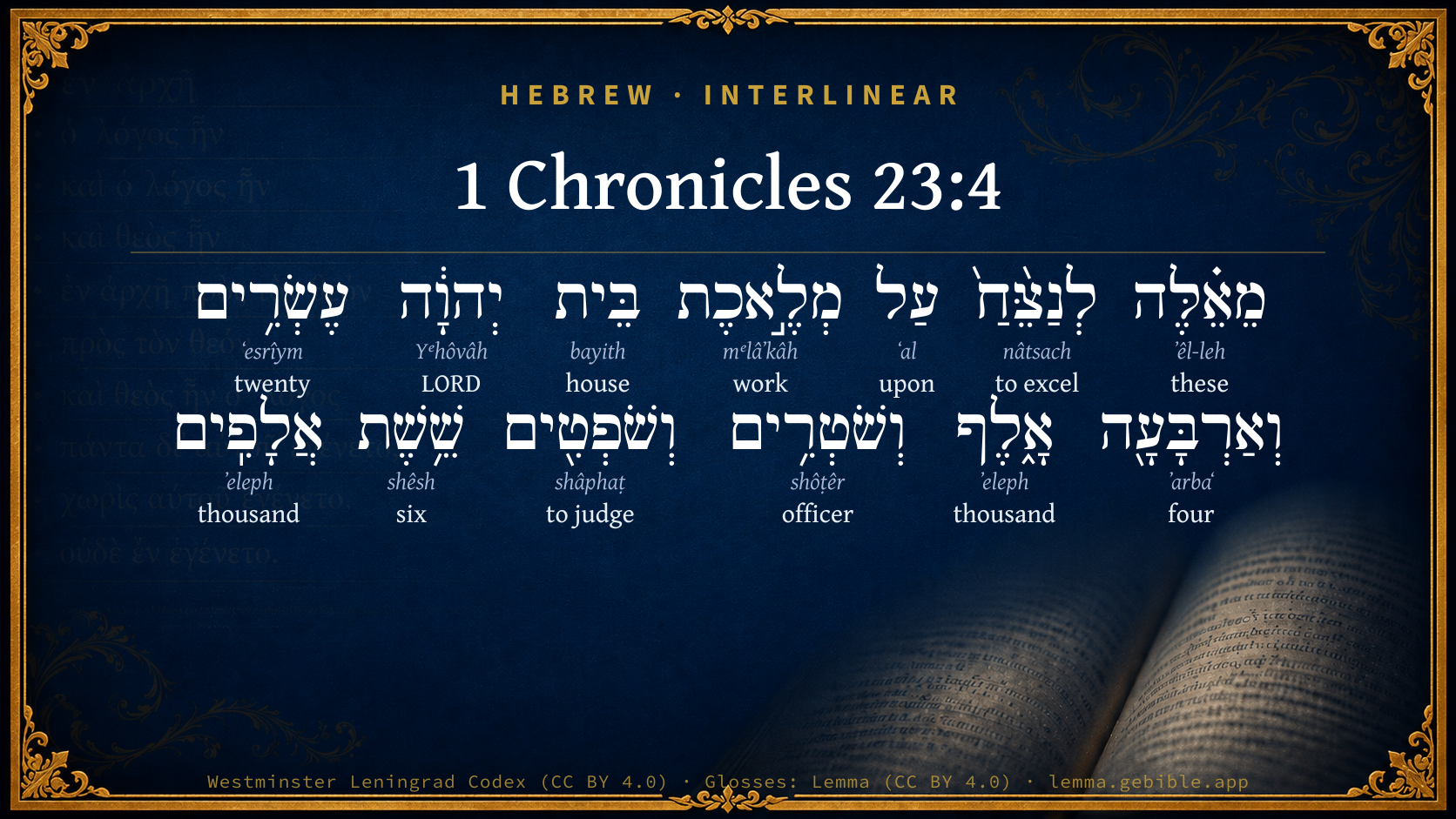
Hebrew (Westminster Leningrad Codex) 1 Chronicles 23:4 appears in the Hebrew Old Testament. The text above is from the Westminster Leningrad Codex. Each word links to its Strong’s number, a concise gloss, and parsing drawn from the Open Scriptures Hebrew Bible morphology. Click any word for its full Brown-Driver-Briggs (BDB) entry.
Download image
Cite this verse

1 Chronicles 23:4 (World English Bible). Public Domain. Lemma interlinear Bible study tool, https://lemma.gebible.app/v/1-chronicles/23/4.

Show BibTeX & RIS
BibTeX
RIS
English Translation
Of these, twenty-four thousand were to oversee the work of the house of Yahweh; and six thousand were officers and judges;
World English Bible · Public Domain
Download a study sheet

One document with this verse’s original text, its word-by-word gloss line, the meaning frame, cross-references with their text, attributed commentary, and full source and license credits — printable, and it pastes into notes with its structure intact.

This verse Autodidact and up

Study sheet (.html) Plain text (.txt)

A passage Seminary Student

Up to 50 verses in one chapter. A passage sheet keeps up to 6 commentary sources and 12 cross-references per verse, in the order this page ranks them, and says so on the sheet whenever that leaves anything out. Ask for a single verse and you get the Autodidact verse sheet above.

Everything on this page stays free to read, with no account — the sheet is a download of what is already on screen, not access to it.

Want to remove ads? Support Godless Engineer
Compare translations 3

The same verse in 3 English versions, stacked beneath the original-language interlinear above. Click any original word for its lexicon entry.

Each is an independent rendering of the whole verse — the interlinear is not word-aligned to these translations.

Highlighted words mark where these versions differ — a whole-verse word diff, not a word-by-word alignment.

  • World English Bible Public Domain
    Of these, twenty-four thousand were to oversee the work of the house of Yahweh; and six thousand were officers and judges;
  • King James Version Public Domain
    Of which, twenty and four thousand were to set forward the work of the house of the LORD; and six thousand were officers and judges:
  • unfoldingWord Literal Text CC BY-SA 4.0
    “From these, to lead over the work of the house of Yahweh, 24,000, and officers and judges, 6,000,

unfoldingWord Literal Text — © unfoldingWord, licensed CC BY-SA 4.0. Word-aligned USFM3 via Door43 (git.door43.org/unfoldingWord/en_ult).

Versions to compare (up to 4)

3 of 4 selected

Show all 18 translations

Every available English version of this verse, each an independent rendering of the whole verse.

  • World English Bible Public Domain
    Of these, twenty-four thousand were to oversee the work of the house of Yahweh; and six thousand were officers and judges;
  • Berean Standard Bible Public Domain
    “Of these,” said David, “24,000 are to oversee the work of the house of the LORD, 6,000 are to be officers and judges,
  • Majority Standard Bible Public Domain
    “Of these,” said David, “24,000 are to oversee the work of the house of the LORD, 6,000 are to be officers and judges,
  • King James Version Public Domain
    Of which, twenty and four thousand were to set forward the work of the house of the LORD; and six thousand were officers and judges:
  • American Standard Version (1901) Public Domain
    Of these, twenty and four thousand were to oversee the work of the house of Jehovah; and six thousand were officers and judges;
  • Revised Version (1885) Public Domain
    Of these, twenty and four thousand were to oversee the work of the house of the LORD; and six thousand were officers and judges:
  • Geneva Bible (1599) Public Domain
    Of these foure and twentie thousande were set to aduance the worke of the house of the Lord, and sixe thousand were ouerseers and iudges.
  • Douay-Rheims (1899) Public Domain
    Of these twenty-four thousand were chosen, and distributed unto the ministry of the house of the Lord: and six thousand were the overseers and judges.
  • Young's Literal Translation Public Domain
    Of these to preside over the work of the house of Jehovah `are' twenty and four thousand, and officers and judges six thousand,
  • Literal Standard Version CC BY-SA 4.0
    Of these, twenty-four thousand [are] to preside over the work of the house of YHWH, and six thousand officers and judges,
  • Unlocked Literal Bible CC BY-SA 4.0
    “Of these, twenty-four thousand were to oversee the work of Yahweh's house, and six thousand were officers and judges.
  • unfoldingWord Literal Text CC BY-SA 4.0
    “From these, to lead over the work of the house of Yahweh, 24,000, and officers and judges, 6,000,
  • Darby Bible Public Domain
    Of these, twenty-four thousand were to preside over the work of the house of Jehovah; and six thousand were officers and judges;
  • World Messianic Bible Public Domain
    David said, “Of these, twenty-four thousand were to oversee the work of the LORD’s house, six thousand were officers and judges,
  • Webster's Bible Public Domain
    Of which, twenty and four thousand were to oversee the work of the house of the LORD; and six thousand were officers and judges:
  • Free Bible Version CC BY-SA 4.0
    “Of these 24,000 will be in charge of the work of the house of the Lord, while 6,000 will be officers and judges,” David instructed.
  • Bible in Basic English Public Domain
    Of these, twenty-four thousand were to be overseers of the work of the house of the Lord, and six thousand were judges and men of authority;
  • JPS Tanakh (1917) Public Domain
    Of these, twenty and four thousand were to oversee the work of the house of the LORD; and six thousand were officers and judges;

Literal Standard Version (2020), Covenant Press — licensed CC BY-SA 4.0. Text via the HelloAO Bible API (eBible.org). Unlocked Literal Bible (unfoldingWord) — licensed CC BY-SA 4.0. Text via the HelloAO Bible API (eBible.org). unfoldingWord Literal Text — © unfoldingWord, licensed CC BY-SA 4.0. Word-aligned USFM3 via Door43 (git.door43.org/unfoldingWord/en_ult). Free Bible Version, Dr. Jonathan Gallagher — licensed CC BY-SA 4.0. Text via the HelloAO Bible API (eBible.org).

Word by word

More ways to search: Search by grammar → Find every occurrence → Compare this word →

Practice this passage: Drill this verse → Learn its vocabulary →

וְשֹׁטְרִ֥ים
shôṭêr
H7860
“and · officer”
Conjunction + Verb, Qal, Participle Active, Masculine, Plural, Absolute
Part of Speech
Conjunction + Verb
Stem
Qal
Form
Participle Active
Gender
Masculine
Number
Plural
State
Absolute
Full BDB Definition

Origin: act part of an otherwise unused root probably meaning to write

TWOT: TWOT - 2374a

(Qal) official, officer
  1. מֵאֵ֗לֶּה ʼêl-leh H428 “from · these” Preposition + Pronoun, Demonstrative, Common, Plural
  2. לְנַצֵּ֨חַ֙ nâtsach H5329 “to excel” Preposition + Verb, Piel, Infinitive Construct
  3. עַל ʻal H5921 “upon” Preposition
  4. מְלֶ֣אכֶת mᵉlâʼkâh H4399 “work of” Noun, Common, Feminine, Singular, Construct
  5. בֵּית bayith H1004 “house of” Noun, Common, Masculine, Singular, Construct
  6. יְהוָ֔ה Yᵉhôvâh H3068 “LORD” Noun, Proper
  7. עֶשְׂרִ֥ים ʻesrîym H6242 “twenty” Adjective, Cardinal number, Both, Plural, Absolute
  8. וְאַרְבָּעָ֖ה ʼarbaʻ H702 “and · four” Conjunction + Adjective, Cardinal number, Masculine, Singular, Absolute
  9. אָ֑לֶף ʼeleph H505 “thousand” Adjective, Cardinal number, Both, Singular, Absolute
  10. וְשֹׁפְטִ֖ים shâphaṭ H8199 “and · judging” Conjunction + Verb, Qal, Participle Active, Masculine, Plural, Absolute
  11. שֵׁ֥שֶׁת shêsh H8337 “six” Adjective, Cardinal number, Masculine, Singular, Construct
  12. אֲלָפִֽים ʼeleph H505 “thousand” Adjective, Cardinal number, Both, Plural, Absolute

About this verse

These counts appear in no published source. They are computed here, from the morphology-tagged text and Lemma’s own curated glosses. What Lemma adds →

13
words
12
distinct lemmas
Historical
section

Notable vocabulary

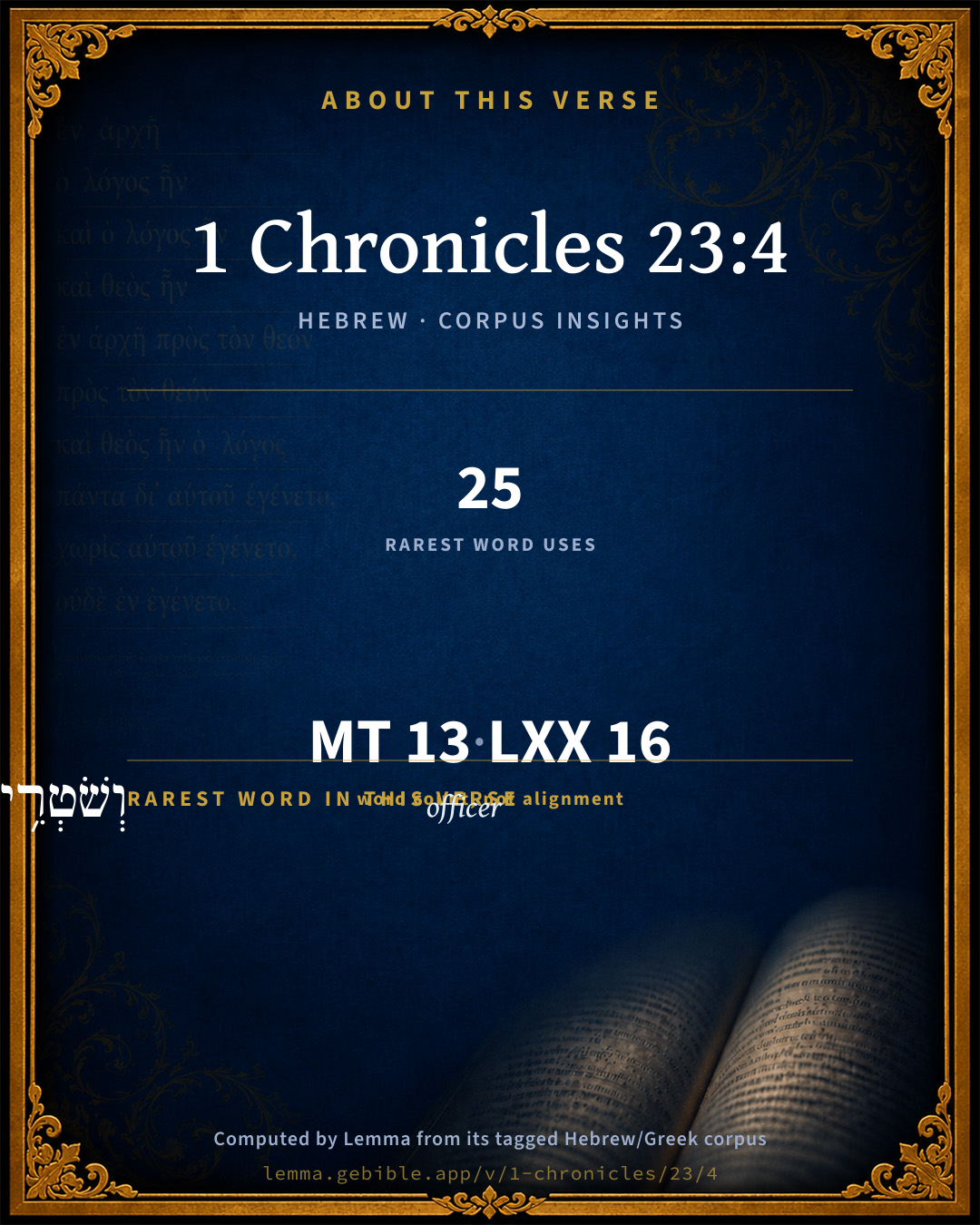
The rarest word here is וְשֹׁטְרִ֥ים officer H7860 — appearing just 25 times in the whole Hebrew Bible.

Shared distinctive vocabulary

וְשֹׁטְרִ֥ים officer H7860 occurs in 25 verses of the Hebrew Bible. Also found in:

Grammatical profile

  • 3 verbs
  • 3 nouns
  • 5 adjectives
  • 1 pronoun
  • 1 preposition

Verb forms

  • לְנַצֵּ֨חַ֙ Piel · Infinitive Construct
  • וְשֹׁטְרִ֥ים Qal · Participle Active
  • וְשֹׁפְטִ֖ים Qal · Participle Active

Repetition

A word recurs within this verse — often emphatic in Hebrew:

  • אָ֑לֶף thousand H505 ×2

Hebrew & Septuagint length

In English translation the verse runs 21 words from the Hebrew and 24 from the Septuagint (LXX English) — closely comparable.

A rough comparison of the two English renderings, which tokenize alike — not a word-level alignment.

Word counts can differ between the Hebrew and the Greek without any difference in meaning — e.g. the Hebrew direct-object marker אֵת has no separate Greek word, and Greek often adds the article ὁ.

In the original languages it is 13 Hebrew tokens and 16 Greek tokens — but the two are counted differently (Hebrew bundles its prefixes and suffixes into one token; the Greek is in lemma form), so that isn’t a like-for-like length.

Cross-references

13

Topical passages linked to 1 Chronicles 23:4 in the Treasury of Scripture Knowledge — connected by theme and wording, ordered by reader-vote popularity; previews shown in the World English Bible.

  • 2 Chronicles 19:8 Moreover in Jerusalem did Jehoshaphat set of the Levites and the priests, and of the heads of the fathers' [houses] of Israel, for the judgment of Yahweh, and for controversies. They returned to Jerusalem.
  • Deuteronomy 16:18 Judges and officers shall you make you in all your gates, which Yahweh your God gives you, according to your tribes; and they shall judge the people with righteous judgment.
  • Deuteronomy 17:8–10 If there arise a matter too hard for you in judgment, between blood and blood, between plea and plea, and between stroke and stroke, being matters of controversy within your gates; then shall you arise, and go up to the place which Yahweh your God shall choose;
  • 1 Chronicles 6:48 Their brothers the Levites were appointed for all the service of the tent of the house of God.
  • 1 Chronicles 9:28–32 Certain of them had charge of the vessels of service; for by count were these brought in and by count were these taken out.
  • 1 Chronicles 23:28–32 For their office was to wait on the sons of Aaron for the service of the house of Yahweh, in the courts, and in the chambers, and in the purifying of all holy things, even the work of the service of the house of God;
  • 1 Chronicles 26:20–27 Of the Levites, Ahijah was over the treasures of the house of God, and over the treasures of the dedicated things.
  • 1 Chronicles 26:29–31 Of the Izharites, Chenaniah and his sons were for the outward business over Israel, for officers and judges.
  • Ezra 3:8–9 Now in the second year of their coming to the house of God at Jerusalem, in the second month, began Zerubbabel the son of Shealtiel, and Jeshua the son of Jozadak, and the rest of their brothers the priests and the Levites, and all those who were come out of the captivity to Jerusalem, and appointed the Levites, from twenty years old and upward, to have the oversight of the work of the house of Yahweh.
  • Nehemiah 11:9 Joel the son of Zichri was their overseer; and Judah the son of Hassenuah was second over the city.
  • Nehemiah 11:22 The overseer also of the Levites at Jerusalem was Uzzi the son of Bani, the son of Hashabiah, the son of Mattaniah, the son of Mica, of the sons of Asaph, the singers, over the business of the house of God.
  • Malachi 2:7 For the priest's lips should keep knowledge, and they should seek the law at his mouth; for he is the messenger of Yahweh of Hosts.
  • Acts 20:28 Take heed, therefore, to yourselves, and to all the flock, in which the Holy Spirit has made you overseers, to shepherd the assembly of the Lord and God which he purchased with his own blood.

Cross-references courtesy of OpenBible.info (CC BY 4.0).

Hebrew and Greek witnesses Masoretic Hebrew ↔ Greek Septuagint

The same verse in the two great witnesses to the Old Testament, shown verse-for-verse.

These are two independent witnesses, not word-aligned to each other, and the Septuagint is shown in lemma (dictionary) form.

Hebrew 1 Chronicles 23:4 Masoretic · Westminster Leningrad Codex

מֵאֵ֗לֶּה לְנַצֵּ֨חַ֙ עַל מְלֶ֣אכֶת בֵּית יְהוָ֔ה עֶשְׂרִ֥ים וְאַרְבָּעָ֖ה אָ֑לֶף וְשֹׁטְרִ֥ים וְשֹׁפְטִ֖ים שֵׁ֥שֶׁת אֲלָפִֽים

Of these, twenty-four thousand were to oversee the work of the house of Yahweh; and six thousand were officers and judges;

World English Bible · Public Domain

Greek LXX 1 Chronicles 23:4 Septuagint · lemma form

ἀπό οὗτος ἐργοδιωκτής ἐπί ὁ ἔργον οἶκος κύριος εἴκοσι τέσσαρες χιλιάς καί γραμματεύς καί κριτής ἑξακισχίλιοι

Of the overseers over the works of the house of the Lord there were twenty-four thousand, and there were six thousand scribes and judges;

LXX2012 (modern English Septuagint) · Public Domain

On this verse, Haydock's Catholic Bible Commentary discusses the Septuagint’s reading. Read the note in Commentary ↓

Hebrew: Westminster Leningrad Codex (CC BY 4.0). Greek: Septuagint (public domain); English from LXX2012 (modern English Septuagint) (Public Domain). How the Septuagint differs from the Hebrew →

Commentary

Notes on 1 Chronicles 23:4 from classic Christian and Jewish commentators (each source and its license shown beneath its notes). The classic Christian expositions comment on the surrounding passage and are grouped to its opening verse, so a note may address several verses; the Jewish commentaries on the Tanakh (Rashi and others) are per-verse, so they appear only where the commentator wrote on this verse.

Lemma curates 59 commentaries, every one of them public domain or Creative Commons licensed, each selected and text-cleaned for this edition rather than reprinted as found. About our sources →

Trapp's Complete Commentary

John Trapp

1Ch 23:4 Of which, twenty and four thousand [were] to set forward the work of the house of the LORD; and six thousand [were] officers and judges:

Ver. 4. Of which, twenty and four thousand were, &c.] That is, They performed their different offices in their various courses, Hinc sequitur, Hence it followeth, saith an expositor, that each priest and Levite ministered in the temple not much oftener than twice a year; for there were of them twenty-four classes, each whereof served a week together, and no more. Gospel ministers have a far harder task.

John Trapp, A Commentary or Exposition upon All the Books of the Old and New Testament (1647–1656) — public domain. Text from a community e-Sword module.

Joseph Benson's Commentary

1Ch 23:4. To set forward the work of the house of the Lord — To take care that all the work of the temple, about sacrifices, should be punctually performed, either by themselves or others; which they were not to do all at once, but by courses, a thousand at a time. Six thousand were officers and judges — Not in the affairs of the temple, there the priests presided, but in several parts of the kingdom, where they assisted the princes and elders of every tribe, in the administration of justice.

Joseph Benson's Commentary on the Old and New Testaments (1811–1818) — public domain. Text from a community e-Sword module.

Geneva Bible (1599)

Geneva Bible translators

Or, to have care over.

Geneva Bible (1599) marginal notes — public domain. Text via Bolls.life.

Jamieson, Fausset & Brown

Robert Jamieson, A. R. Fausset & David Brown

twenty and four thousand were to set forward the work of the house of the Lord--They were not to preside over all the services of the temple. The Levites were subject to the priests, and they were superior to the Nethinim and other servants, who were not of the race of Levi. But they had certain departments of duty assigned, some of which are here specified.

Jamieson, Fausset & Brown — Commentary Critical and Explanatory on the Whole Bible (1871) — public domain (CC PDM 1.0). Text via the HelloAO Bible API.

Ellicott's Commentary for English Readers

(4) Of which, twenty and four thousand were to set forward.—It is clear from 1Ch_23:5 that David himself is supposed to utter both verses, thus personally assigning their commission to the Levites. The Hebrew here is peculiar. We may render: “Of these let there be for superintending the work of the house of Jehovah twenty-four thousand, and scribes and judges six thousand.”

To set forward.—An infinitive, as at 1Ch_22:12. The verb is that of which the participle often occurs in the titles of the Psalms. (Authorised “Version, “chief musician.”) It means “to lead,” or “superintend.” The Levites had a share in prisoners of war, according to Num_31:30. These they could employ in the more menial work of the sanctuary. The Gibeonites were spared on condition of becoming “hewers of wood and drawers of water,” i.e., Levitical bondsmen; and other whole cities may have received the same terms (Jos_9:23; Jos_9:27). We have details of the functions of these superintending Levites in 1Ch_23:28-32, below.

And six thousand were officers and judges.—See above. “Officers” (shôtĕrîm) are first mentioned in Exo_5:6 (see Note there; and comp. Deu_16:18). The word means writers (comp. Assyrian sadhâru, to write). The progress of the entire people in power and civilisation elevated the Levites also; and from a warlike troop of defenders of the sanctuary, they became peaceful guardians of the great Temple at Jerusalem and its treasures, musicians and artists in its service, instructors and judges scattered throughout the whole country (Ewald).

A Bible Commentary for English Readers, edited by Charles John Ellicott (1878–1897) — public domain. Text from a community e-Sword module.

The Cambridge Bible for Schools and Colleges

gen. ed. J. J. S. Perowne

4. twenty and four thousand] These were divided into courses (1Ch_23:6), serving by turn, apparently twenty-four in number, consisting each of a thousand men. The priests also were divided into a corresponding number of courses (1Ch_24:4; 1Ch_24:18).

to set forward the work] R.V. to oversee the work. This phrase assumes that the work itself was done by others, e.g. by Nethinim (see 1Ch_9:2, note). In 1Ch_23:24 (cp. 1Ch_23:28), however, the Levites are described as doing the work.

officers and judges] Cp. 2Ch_19:8; 2Ch_19:11. In Deu_17:9 (cp. ib. Deu_16:18) the harder causes are reserved for “the priests the Levites,” ordinary causes being decided by judges who were not Levites.

The Cambridge Bible for Schools and Colleges (gen. ed. J. J. S. Perowne; Cambridge University Press, 1878–1918) — public domain. Text from a community e-Sword module.

John Gill's Exposition

Of which twenty and four thousand were to set forward the work of the house of the Lord,.... To prepare for the work of the priests by slaying the sacrifices, flaying them, cutting them in pieces, and washing them, and bringing them to the altar; 1000 of these served weekly in their turns:

and six thousand were officers and judges: that acted as justices of the peace in the several parts of the country, heard causes and administered justice to the people, being trained up in and acquainted with the laws of God, civil as well as ecclesiastic; some were more properly judges, and others executioners of their sentence; see Deu 16:18.

John Gill's Exposition of the Whole Bible (1746–1763) — public domain (CC PDM 1.0). Text via the HelloAO Bible API.

Haydock's Catholic Bible Commentary

Overseers. Hebrew shoterim. Septuagint, "scribes." Others suppose "lictors and executioners," who attended the judges. (Grotius) --- These were functions from which the priests were exempted; (Calmet) so that the Levites alone are meant. (Menochius) --- Judges. They had to decide the causes of the people, 2 Paralipomenon xxix. (Du Hamel)

George Leo Haydock (1774–1849), Haydock's Catholic Family Bible and Commentary, 1859 edition — public domain. Excludes Psalms (Douay-Rheims chapter numbering differs from Protestant) and Deuterocanonical books (Catholic canon only).

Matthew Poole's English Annotations

To set forward the work of the house of the Lord, i.e. to take care that all the work of the temple about sacrifices and other parts or means of God’s service should be punctually and diligently performed, either by themselves or others; which they were not to do all at once, but by courses, a thousand at a time, as we shall shortly see.

Officers and judges; whose work it seems to have been to judge of and determine all difficult causes or differences which might arise, either among the inferior priests or Levites about their sacred administrations, or among the people, which being governed in all their concerns only by the laws of Moses, it was fit and necessary that the priests and Levites should be consulted and concerned in their matters.

Matthew Poole's English Annotations on the Holy Bible (1683–1685) — public domain. Text from a community e-Sword/MySword module.

Whedon's Commentary on the Bible

Daniel D. Whedon

4. To set forward the work of the house — Rather, to preside over the work; to attend to the various kinds of service specified in 1Ch_23:28-32.

Officers and judges — Hebrew, Shoterim and Shophetim. They served as local magistrates and judges throughout the various cities of the land. See notes on Jos_1:10, and comp. 1Ch_26:29, and 2Ch_19:8-10.

Daniel D. Whedon (gen. ed.), Commentary on the Old and New Testaments (1874–1909) — public domain. Text from a community e-Sword module.

The Pulpit Commentary

To set forward (Hebrew J"xen"l], Piel conjugation). The strict meaning of the word here is to superintend. The word has already occurred in the same sense invow 1Ch_15:21. Officers and judges (Hebrew The explanation of the nature of the work of these, as really outward work, for the "outward business of Israel," is distinctly stated in 1Ch_26:29; 2Ch_19:5-11. These officers are mentioned under the same Hebrew term in Exo_5:6, in a very different connection. It is plain that they were generally foremen, or overseers; while the judges took cognizance of matters which involved the interests of religion. This verse and the following give between them the four divisions of Levites, afterwards to be more fully described. The fuller account of the "twenty-four thousand" priests (including attendants) occupies ch. 24.; the "six thousand" officers and judges, 1Ch_26:20-32; the "four thousand" porters, 1Ch_26:1-19; and the "four thousand who praised the Lord with the instruments," ch. 25.

The Pulpit Commentary (1880–1919), ed. H.D.M. Spence-Jones & Joseph S. Exell — public domain. Text from a community e-Sword module.

John Wesley's Explanatory Notes

Officers - To take care that all the work of the temple about sacrifices should be punctually performed, either by themselves or others: which they were not to do all at once, but by courses, a thousand at a time. Judges - Not in the affairs of the temple; there the priests presided; but in several parts of the kingdom, where they assisted the princes and elders of every tribe, in the administration of justice.

John Wesley, Explanatory Notes Upon the Whole Bible (1754–1765) — public domain. Text via the GEBible commentary corpus.

Keil & Delitzsch

C. F. Keil & F. Delitzsch

Of which twenty and four thousand were to set forward the work of the house of the Lord,.... To prepare for the work of the priests by slaying the sacrifices, flaying them, cutting them in pieces, and washing them, and bringing them to the altar; 1000 of these served weekly in their turns:

and six thousand were officers and judges: that acted as justices of the peace in the several parts of the country, heard causes and administered justice to the people, being trained up in and acquainted with the laws of God, civil as well as ecclesiastic; some were more properly judges, and others executioners of their sentence; see Deu 16:18.

Keil & Delitzsch — Biblical Commentary on the Old Testament (1861–1891) — public domain (CC PDM 1.0). Text via the HelloAO Bible API. (Old Testament only.)

unfoldingWord translationNotes

Door43 World Missions Community

Of these, twenty-four thousand

"Of these Levities, 24,000" (See: Numbers)

six thousand

"6,000 Levites" (See: Numbers)

officers and judges

These Levites listened to legal arguments and administered justice according to the law of Moses.

four thousand

"4,000 Levites" (See: Numbers)

gatekeepers

These Levites guarded the temple entrance so no person who was ceremonially unclean entered.

that corresponded to

"based on" or "according to the descendants of"

Gershon, Kohath, and Merari

These are names of Levi's sons. (See: How to Translate Names)

translationWords

house of God

judge, judges

praise

Yahweh

praise

Levi

unfoldingWord translationNotes — © Distant Shores Media and the Door43 World Missions Community, licensed CC BY-SA 4.0. Source: git.door43.org/Door43/en_tn.

Lesson kit

Teaching starters — assembled from the data on this page, not authored interpretation. Every prompt links to the verse data it draws on. Edit before teaching.

1 Chronicles, in the Historical, opens this verse with 13 words (12 distinct Hebrew lemmas). Its most distinctive word is shôṭêr (“officer”). A historical commentator’s framing appears above. Read the whole chapter for the surrounding context.

Discussion questions

  1. The word shôṭêr carries the sense “officer.” How does it shape the verse?
  2. Exodus 5:6 shares the word «officer» with this verse. How do the two illuminate each other?
  3. “thousand” occurs 2× in this one verse. What is the effect of the repetition?
  4. These translations render this verse differently; the difference is in the English rendering, not the original. What questions does that raise?
  5. The verb «לְנַצֵּ֨חַ֙» is Piel Infinitive Construct. How does its form color the action?
  6. Reading how Trapp's Complete Commentary and Joseph Benson's Commentary read this verse, where do the two commentators agree and where do they part?

Things to notice

Reading settings

Reading text

Shown beneath each verse's original-language words.

Old Testament
Old Testament edition

Read the OT as the Masoretic Hebrew (MT) or the Greek Septuagint (LXX).

English shown for the Greek Septuagint (in the Hebrew ↔ Greek comparison).

Comparing translations? Open the Compare panel on any verse page to stack up to four side by side.