2 Chronicles 19:6

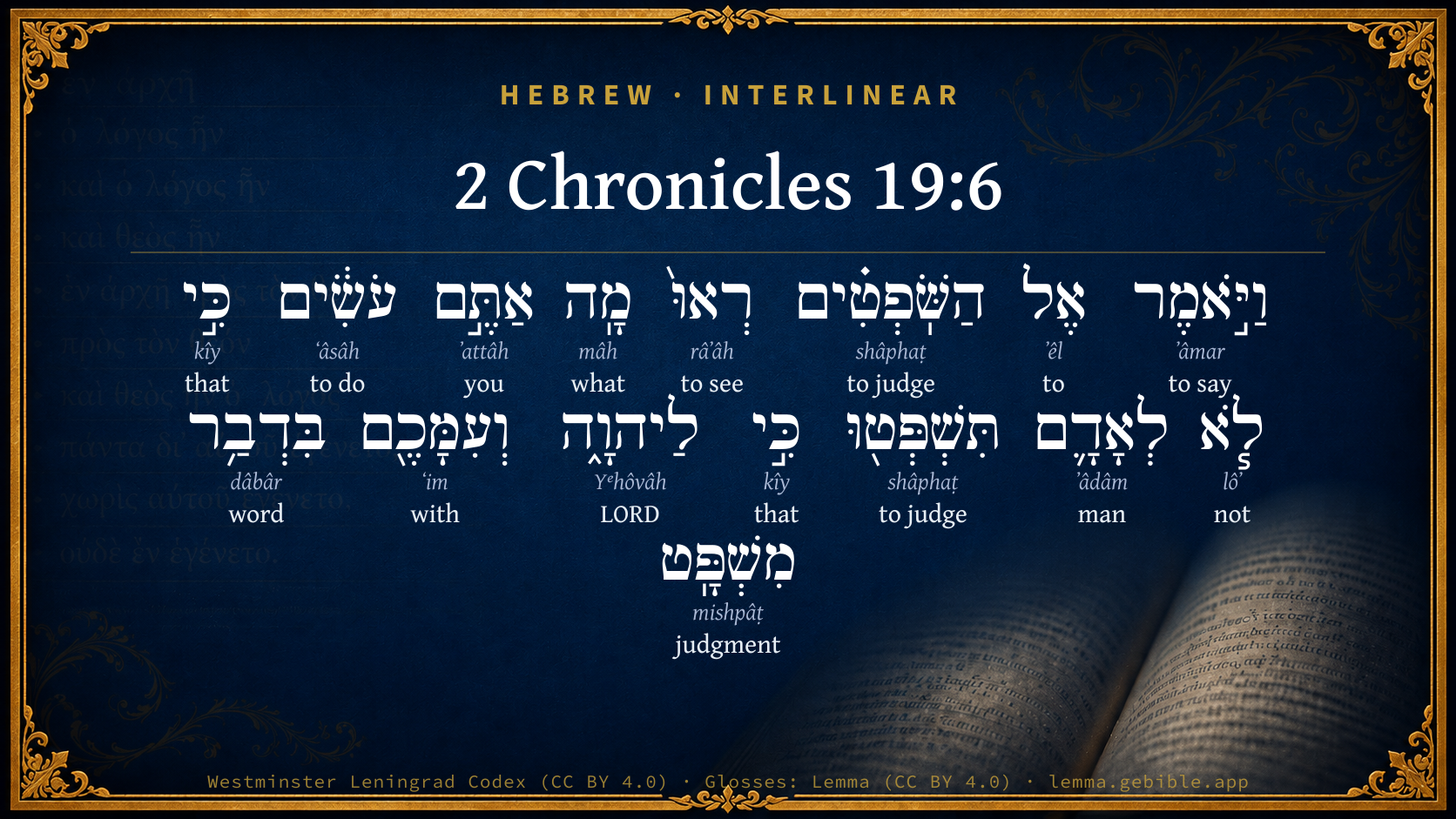
Hebrew (Westminster Leningrad Codex) 2 Chronicles 19:6 appears in the Hebrew Old Testament. The text above is from the Westminster Leningrad Codex. Each word links to its Strong’s number, a concise gloss, and parsing drawn from the Open Scriptures Hebrew Bible morphology. Click any word for its full Brown-Driver-Briggs (BDB) entry.
Download image
Cite this verse

2 Chronicles 19:6 (World English Bible). Public Domain. Lemma interlinear Bible study tool, https://lemma.gebible.app/v/2-chronicles/19/6.

Show BibTeX & RIS
BibTeX
RIS
English Translation
and said to the judges, Consider what you do: for you don't judge for man, but for Yahweh; and [he is] with you in the judgment.
World English Bible · Public Domain
Download a study sheet

One document with this verse’s original text, its word-by-word gloss line, the meaning frame, cross-references with their text, attributed commentary, and full source and license credits — printable, and it pastes into notes with its structure intact.

This verse Autodidact and up

Study sheet (.html) Plain text (.txt)

A passage Seminary Student

Up to 50 verses in one chapter. A passage sheet keeps up to 6 commentary sources and 12 cross-references per verse, in the order this page ranks them, and says so on the sheet whenever that leaves anything out. Ask for a single verse and you get the Autodidact verse sheet above.

Everything on this page stays free to read, with no account — the sheet is a download of what is already on screen, not access to it.

Want to remove ads? Support Godless Engineer
Compare translations 3

The same verse in 3 English versions, stacked beneath the original-language interlinear above. Click any original word for its lexicon entry.

Each is an independent rendering of the whole verse — the interlinear is not word-aligned to these translations.

Highlighted words mark where these versions differ — a whole-verse word diff, not a word-by-word alignment.

  • World English Bible Public Domain
    and said to the judges, Consider what you do: for you don't judge for man, but for Yahweh; and [he is] with you in the judgment.
  • King James Version Public Domain
    And said to the judges, Take heed what ye do: for ye judge not for man, but for the LORD, who is with you in the judgment.
  • unfoldingWord Literal Text CC BY-SA 4.0
    And he said to the judges, “See what you all are doing. For not for man do you all judge but for Yahweh; and with you all in the matter of judgment.

unfoldingWord Literal Text — © unfoldingWord, licensed CC BY-SA 4.0. Word-aligned USFM3 via Door43 (git.door43.org/unfoldingWord/en_ult).

Versions to compare (up to 4)

3 of 4 selected

Show all 18 translations

Every available English version of this verse, each an independent rendering of the whole verse.

  • World English Bible Public Domain
    and said to the judges, Consider what you do: for you don't judge for man, but for Yahweh; and [he is] with you in the judgment.
  • Berean Standard Bible Public Domain
    Then he said to the judges, “Consider carefully what you do, for you are not judging for man, but for the LORD, who is with you when you render judgment.
  • Majority Standard Bible Public Domain
    Then he said to the judges, “Consider carefully what you do, for you are not judging for man, but for the LORD, who is with you when you render judgment.
  • King James Version Public Domain
    And said to the judges, Take heed what ye do: for ye judge not for man, but for the LORD, who is with you in the judgment.
  • American Standard Version (1901) Public Domain
    and said to the judges, Consider what ye do: for ye judge not for man, but for Jehovah; and `he is' with you in the judgment.
  • Revised Version (1885) Public Domain
    and said to the judges, Consider what ye do: for ye judge not for man, but for the LORD; and he is with you in the judgment.
  • Geneva Bible (1599) Public Domain
    And said to the iudges, Take heede what ye doe: for yee execute not the iudgements of man, but of the Lord, and he will be with you in the cause and iudgement.
  • Douay-Rheims (1899) Public Domain
    And charging the judges, he said: Take heed what you do: for you exercise not the judgment of man, but of the Lord: and whatsoever you judge, it shall redound to you.
  • Young's Literal Translation Public Domain
    and saith unto the judges, `See what ye are doing -- for not for man do ye judge, but for Jehovah, who `is' with you in the matter of judgment;
  • Literal Standard Version CC BY-SA 4.0
    and says to the ones judging, “See what you are doing—for you do not judge for man, but for YHWH, who [is] with you in the matter of judgment;
  • Unlocked Literal Bible CC BY-SA 4.0
    He said to the judges, “Consider what you should do, because you are not judging for man, but for Yahweh; he is with you in the act of judging.
  • unfoldingWord Literal Text CC BY-SA 4.0
    And he said to the judges, “See what you all are doing. For not for man do you all judge but for Yahweh; and with you all in the matter of judgment.
  • Darby Bible Public Domain
    And he said to the judges, Take heed what ye do; for ye judge not for man, but for Jehovah, who will be with you in the matter of judgment.
  • World Messianic Bible Public Domain
    and said to the judges, “Consider what you do, for you don’t judge for man, but for the LORD; and he is with you in the judgment.
  • Webster's Bible Public Domain
    And said to the judges, Take heed what ye do: for ye judge not for man, but for the LORD, who is with you in the judgment.
  • Free Bible Version CC BY-SA 4.0
    He told the judges, “Be careful about what you're doing as judges, because you're not looking for the approval of people, but the approval of the Lord. He is the One with you when you give your verdict.
  • Bible in Basic English Public Domain
    And said to the judges, Take care what you do, for you are judging not for man but for the Lord, and he is with you in the decisions you give.
  • JPS Tanakh (1917) Public Domain
    and said to the judges: 'Consider what ye do; for ye judge not for man, but for the LORD; and He is with you in giving judgment.

Literal Standard Version (2020), Covenant Press — licensed CC BY-SA 4.0. Text via the HelloAO Bible API (eBible.org). Unlocked Literal Bible (unfoldingWord) — licensed CC BY-SA 4.0. Text via the HelloAO Bible API (eBible.org). unfoldingWord Literal Text — © unfoldingWord, licensed CC BY-SA 4.0. Word-aligned USFM3 via Door43 (git.door43.org/unfoldingWord/en_ult). Free Bible Version, Dr. Jonathan Gallagher — licensed CC BY-SA 4.0. Text via the HelloAO Bible API (eBible.org).

Word by word

More ways to search: Search by grammar → Find every occurrence → Compare this word →

Practice this passage: Drill this verse → Learn its vocabulary →

הַשֹּֽׁפְטִ֗ים
shâphaṭ
H8199
“the · judging”
Particle, Definite Article + Verb, Qal, Participle Active, Masculine, Plural, Absolute
Part of Speech
Particle + Verb
Stem
Qal
Form
Participle Active
Gender
Masculine
Number
Plural
State
Absolute
Full BDB Definition

Origin: a primitive root

TWOT: 2443

to judge, govern, vindicate, punish - (Qal) - to act as law-giver or judge or governor (of God, man) - to rule, govern, judge - to decide controversy (of God, man) - to execute judgment - discriminating (of man) - vindicating - condemning and punishing - at theophanic advent for final judgment - (Niphal) - to enter into controversy, plead, have controversy together - to be judged - (Poel) judge, opponent-at-law (participle)
  1. וַיֹּ֣אמֶר ʼâmar H559 “and · to say” Conjunction + Verb, Qal, Sequential Imperfect, 3rd Person, Masculine, Singular
  2. אֶל ʼêl H413 “to” Preposition
  3. רְאוּ֙ râʼâh H7200 “see” Verb, Qal, Imperative, 2nd Person, Masculine, Plural
  4. מָֽה mâh H4100 “what” Particle, Interrogative
  5. אַתֶּ֣ם ʼattâh H859 “you” Pronoun, Personal, 2nd Person, Masculine, Plural
  6. עֹשִׂ֔ים ʻâsâh H6213 “doing” Verb, Qal, Participle Active, Masculine, Plural, Absolute
  7. כִּ֣י kîy H3588 “that” Conjunction
  8. לֹ֧א lôʼ H3808 “not” Particle, Negative
  9. לְאָדָ֛ם ʼâdâm H120 “to/for · man” Preposition + Noun, Common, Masculine, Singular, Absolute
  10. תִּשְׁפְּט֖וּ shâphaṭ H8199 “to judge” Verb, Qal, Imperfect, 2nd Person, Masculine, Plural
  11. כִּ֣י kîy H3588 “that” Conjunction
  12. לַיהוָ֑ה Yᵉhôvâh H3068 “to/for · LORD” Preposition + Noun, Proper
  13. וְעִמָּכֶ֖ם ʻim H5973 “and · with · you” Conjunction + Preposition + Suffix, Personal, 2nd Person, Masculine, Plural
  14. בִּדְבַ֥ר dâbâr H1697 “in/at · word of” Preposition + Noun, Common, Masculine, Singular, Construct
  15. מִשְׁפָּֽט mishpâṭ H4941 “judgment” Noun, Common, Masculine, Singular, Absolute

About this verse

These counts appear in no published source. They are computed here, from the morphology-tagged text and Lemma’s own curated glosses. What Lemma adds →

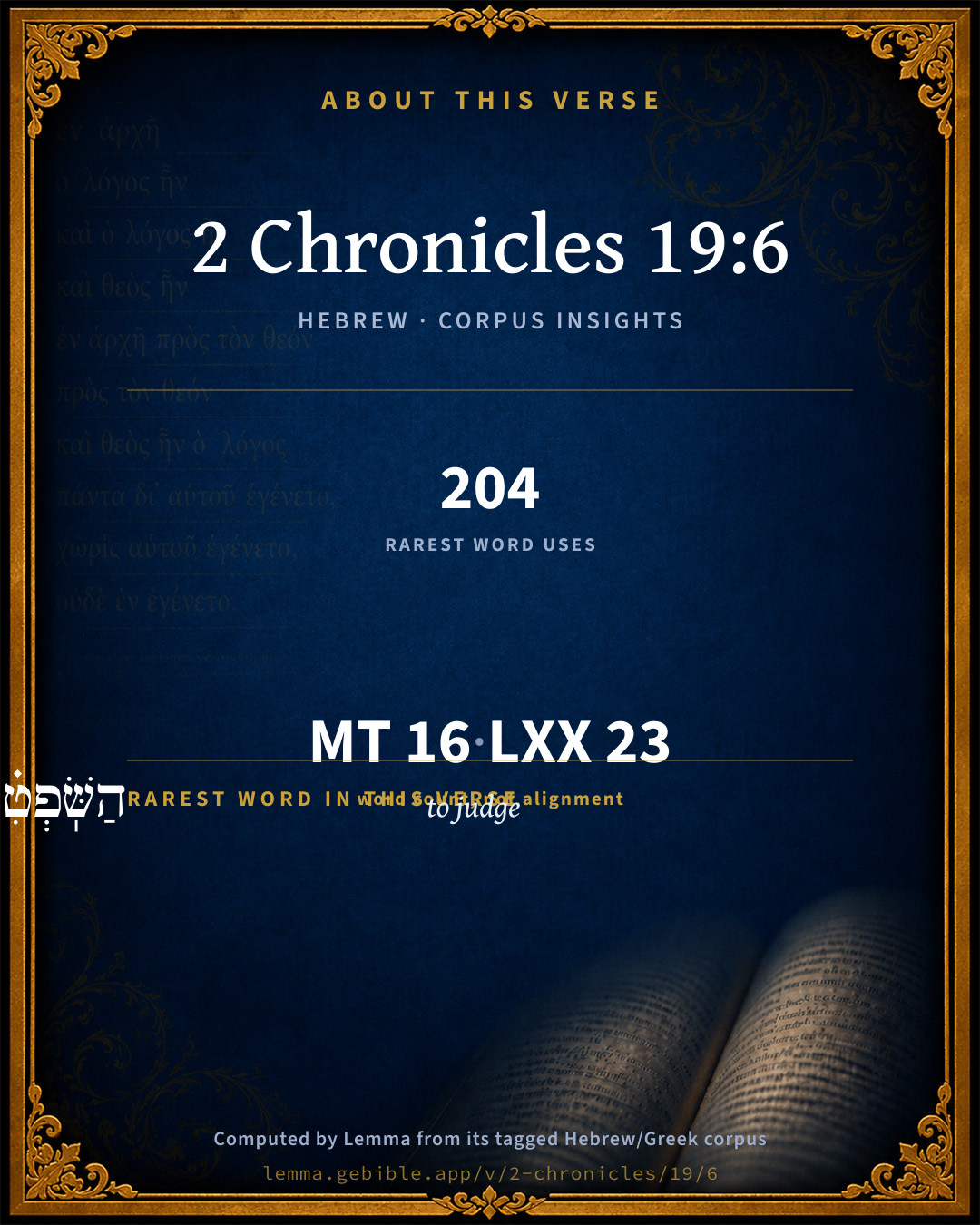
16
words
14
distinct lemmas
Historical
section

Grammatical profile

  • 5 verbs
  • 4 nouns
  • 1 pronoun
  • 2 prepositions
  • 2 conjunctions
  • 2 particles

Verb forms

  • וַיֹּ֣אמֶר Qal · Sequential Imperfect
  • הַשֹּֽׁפְטִ֗ים Qal · Participle Active
  • רְאוּ֙ Qal · Imperative
  • עֹשִׂ֔ים Qal · Participle Active
  • תִּשְׁפְּט֖וּ Qal · Imperfect

Repetition

Words recur within this verse — often emphatic in Hebrew:

  • הַשֹּֽׁפְטִ֗ים to judge H8199 ×2
  • כִּ֣י that H3588 ×2

Hebrew & Septuagint length

In English translation the verse runs 26 words from the Hebrew and 29 from the Septuagint (LXX English) — closely comparable.

A rough comparison of the two English renderings, which tokenize alike — not a word-level alignment.

Word counts can differ between the Hebrew and the Greek without any difference in meaning — e.g. the Hebrew direct-object marker אֵת has no separate Greek word, and Greek often adds the article ὁ.

In the original languages it is 16 Hebrew tokens and 23 Greek tokens — but the two are counted differently (Hebrew bundles its prefixes and suffixes into one token; the Greek is in lemma form), so that isn’t a like-for-like length.

Cross-references

10

Topical passages linked to 2 Chronicles 19:6 in the Treasury of Scripture Knowledge — connected by theme and wording, ordered by reader-vote popularity; previews shown in the World English Bible.

  • Deuteronomy 1:17 You shall not show partiality in judgment; you shall hear the small and the great alike; you shall not be afraid of the face of man; for the judgment is God's: and the cause that is too hard for you, you shall bring to me, and I will hear it.
  • Leviticus 19:15 "'You shall do no injustice in judgment: you shall not be partial to the poor, nor show favoritism to the great; but in righteousness shall you judge your neighbor.
  • Ecclesiastes 5:8 If you see the oppression of the poor, and the violent taking away of justice and righteousness in a district, don't marvel at the matter: for one official is eyed by a higher one; and there are officials over them.
  • Luke 12:15 He said to them, "Beware! Keep yourselves from covetousness, for a man's life doesn't consist of the abundance of the things which he possesses."
  • Joshua 22:5 Only take diligent heed to do the commandment and the law which Moses the servant of Yahweh commanded you, to love Yahweh your God, and to walk in all his ways, and to keep his commandments, and to cleave to him, and to serve him with all your heart and with all your soul.
  • 1 Chronicles 28:10 Take heed now; for Yahweh has chosen you to build a house for the sanctuary: be strong, and do it.
  • Psalms 82:1–6 God presides in the great assembly. He judges among the gods.
  • Luke 21:8 He said, "Watch out that you don't get led astray, for many will come in my name, saying, 'I AM,' and, 'The time is at hand.' Therefore don't follow them.
  • Acts 5:35 He said to them, "You men of Israel, be careful concerning these men, what you are about to do.
  • Acts 22:26 When the centurion heard it, he went to the commanding officer and told him, "Watch what you are about to do, for this man is a Roman!"

Cross-references courtesy of OpenBible.info (CC BY 4.0).

Hebrew and Greek witnesses Masoretic Hebrew ↔ Greek Septuagint

The same verse in the two great witnesses to the Old Testament, shown verse-for-verse.

These are two independent witnesses, not word-aligned to each other, and the Septuagint is shown in lemma (dictionary) form.

Hebrew 2 Chronicles 19:6 Masoretic · Westminster Leningrad Codex

וַיֹּ֣אמֶר אֶל הַשֹּֽׁפְטִ֗ים רְאוּ֙ מָֽה אַתֶּ֣ם עֹשִׂ֔ים כִּ֣י לֹ֧א לְאָדָ֛ם תִּשְׁפְּט֖וּ כִּ֣י לַיהוָ֑ה וְעִמָּכֶ֖ם בִּדְבַ֥ר מִשְׁפָּֽט

and said to the judges, Consider what you do: for you don't judge for man, but for Yahweh; and [he is] with you in the judgment.

World English Bible · Public Domain

Greek LXX 2 Chronicles 19:6 Septuagint · lemma form

καί εἶπον ὁ κριτής ὁράω τίς σύ ποιέω ὅτι οὐ ἄνθρωπος σύ κρίνω ἀλλά ἤ ὁ κύριος καί μετά σύ λόγος ὁ κρίσις

And he said to the judges, Take good heed what you⌃ do: for you⌃ judge not for man, but for the Lord, and with you are matters of judgment.

LXX2012 (modern English Septuagint) · Public Domain

On this verse, Ellicott's Commentary for English Readers discusses the Septuagint’s reading. Read the note in Commentary ↓

Hebrew: Westminster Leningrad Codex (CC BY 4.0). Greek: Septuagint (public domain); English from LXX2012 (modern English Septuagint) (Public Domain). How the Septuagint differs from the Hebrew →

Commentary

Notes on 2 Chronicles 19:6 from classic Christian and Jewish commentators (each source and its license shown beneath its notes). The classic Christian expositions comment on the surrounding passage and are grouped to its opening verse, so a note may address several verses; the Jewish commentaries on the Tanakh (Rashi and others) are per-verse, so they appear only where the commentator wrote on this verse.

Lemma curates 59 commentaries, every one of them public domain or Creative Commons licensed, each selected and text-cleaned for this edition rather than reprinted as found. About our sources →

Trapp's Complete Commentary

John Trapp

2Ch 19:6 And said to the judges, Take heed what ye do: for ye judge not for man, but for the LORD, who [is] with you in the judgment.

Ver. 6. And he said to the judges.] He left them their lesson: and it is such, surely, as deserveth not only to be written in letters of gold on all seats of judicature and in all houses of judges, but also to be engraven upon the tables of their hearts.

Take heed what ye do.] Carete vobis, cavete populo, do all deliberately, and on good advice: looking well about you.

For ye judge not for man, but for the Lord.] Non tam mei quam Dei estis vicarii: It is God whom you represent. See therefore that ye do it worthy of God: and that you express not him to the world as a corrupt and crooked judge.

Who is with you in the judgment.] As lord paramount. It is as if Jehoshaphat had said, I cannot ride circuit with you, but God both can and will. The Ethiopian judges always reserved the chief place on the tribunal empty for God; of whose presence they were persuaded, though they saw him not.

John Trapp, A Commentary or Exposition upon All the Books of the Old and New Testament (1647–1656) — public domain. Text from a community e-Sword module.

Geneva Bible (1599)

Geneva Bible translators

Both to preserve you, if you do justly, or to punish you, if you do the contrary.

Geneva Bible (1599) marginal notes — public domain. Text via Bolls.life.

Adam Clarke's Commentary

Verse 6. Take heed what ye do] A very solemn and very necessary caution; judges should feel themselves in the place of God, and judge as those who know they shall be judged for their judgments.

Adam Clarke's Commentary on the Bible (1810–1826) — public domain. Text from a community e-Sword/MySword module.

Ellicott's Commentary for English Readers

(6) Ye judge not for man, but for the Lord.—’Tis not for man that ye will judge, but for Jehovah, as His vicegerents, and ministers of His will. (Comp. Rom_13:1-4.)

Who is with you in the judgment.—This rightly gives the sense of the brief words: “and with you in word of doom.” i.e., Jehovah will be present with you at the time of your giving sentence. (See on 2Ch_20:17, and comp. Psa_82:1-4 : “God standeth in God’s Assembly; in the midst of gods (i.e., judges) He judgeth.”) The LXX. and Vulgate misunderstand the passage; but the Syriac renders: “Be strong, and judge true judgment, and the Lord will be with you for ever.” (Comp. also Deu_1:17 : “The decision belongeth to God”; and Exo_21:6.) The name “Jehoshaphat” denotes Jehovah judgeth.

A Bible Commentary for English Readers, edited by Charles John Ellicott (1878–1897) — public domain. Text from a community e-Sword module.

The Cambridge Bible for Schools and Colleges

gen. ed. J. J. S. Perowne

6. Take heed] R.V. Consider.

who is with you in the judgment] Render, and He is with you in giving judgment (cp. R.V. and mg.). The judges in deciding cases against the rich and powerful were to strengthen themselves with the thought “God is with us” (“Immanuel”).

The Cambridge Bible for Schools and Colleges (gen. ed. J. J. S. Perowne; Cambridge University Press, 1878–1918) — public domain. Text from a community e-Sword module.

John Gill's Exposition

Wherefore now let the fear of the Lord be upon you,.... And act as having that before your eyes, and on your hearts:

take heed and do it; do the commands enjoined them by him, and do judgment according to the law of God:

for there is no iniquity with the Lord our God; none in his nature, nor in his law; none commanded nor approved of by him, and therefore none should be done by his representatives in judgment:

nor respect of persons; whether high or low, rich or poor:

nor taking of gifts; he accepts not the faces of men, nor receives bribes, nor should his judges; this is forbidden by him, Deu 16:19.

John Gill's Exposition of the Whole Bible (1746–1763) — public domain (CC PDM 1.0). Text via the HelloAO Bible API.

Haydock's Catholic Bible Commentary

And whatsoever. Heb. "who is with you in the judgment." The Lord will confirm you just decisions, and punish your injustice. H. --- God stood in the synagogue of gods, or judges, Psalm lxxxi. 1. Judges ought not so much to regard man as God, when they pass sentence. C. --- How then will the Anabaptists deny that a man may sit in judgment? T.

George Leo Haydock (1774–1849), Haydock's Catholic Family Bible and Commentary, 1859 edition — public domain. Excludes Psalms (Douay-Rheims chapter numbering differs from Protestant) and Deuterocanonical books (Catholic canon only).

Matthew Poole's English Annotations

You represent God’s person, to whom judgement belongeth, and you have your commission and power from God, and not from man only; and your administration of justice is not only for man’s good, but also for God’s honour and service.

Who is with you; both to observe your carriage, and to defend you against all those enemies whom the impartial exercise of justice may provoke.

Matthew Poole's English Annotations on the Holy Bible (1683–1685) — public domain. Text from a community e-Sword/MySword module.

The Pulpit Commentary

Vers. 6, 7. The statement of the Divine principles laid down in these verses for the foundations of the "kingdom of heaven" on earth, and the doing of God"s "will on earth, even as it is in heaven," stretch from Moses and Job (Lev_19:15; Deu_1:17 Deu_10:17 Deu_16:19; Job_34:19) to SS. Paul and Peter (Act_10:34; Rom_2:11; 1Pe_1:17)

The Pulpit Commentary (1880–1919), ed. H.D.M. Spence-Jones & Joseph S. Exell — public domain. Text from a community e-Sword module.

John Wesley's Explanatory Notes

The Lord - You represent God's person to whom judgment belongeth, you have your commission from God, and not from man only; and your administration of justice is not only for man's good, but also for God's honour and service. With you - Both to observe your carriage, and to defend you against all those enemies whom the impartial exercise of justice may provoke.

John Wesley, Explanatory Notes Upon the Whole Bible (1754–1765) — public domain. Text via the GEBible commentary corpus.

unfoldingWord translationNotes

Door43 World Missions Community

He said to the judges

"Jehoshaphat said to the judges"

he is with you

Possible meanings are 1) Yahweh was aware of what the judges decided or 2) Yahweh would hold the judges accountable for their decisions or 3) Yahweh would help and guide them in their decisions. (See: Idiom)

let the fear of Yahweh be upon you

This can be expressed in active form. AT: "you should remember to fear Yahweh when you judge"

there is no iniquity with Yahweh our God, nor is there any favoritism or bribe taking

The abstract nouns "iniquity," "favoritism," and "bribe" can be translated using the verbs "sin," "favor," and "bribe." AT: "Yahweh our God will not sin or favor one person over another in judgment or be bribed" (See: Abstract Nouns)

translationWords

judge

fear

iniquity

favor

bribe

unfoldingWord translationNotes — © Distant Shores Media and the Door43 World Missions Community, licensed CC BY-SA 4.0. Source: git.door43.org/Door43/en_tn.

Rashi

Rabbi Shlomo Yitzchaki (Rashi)

for you do not judge for man The meaning is: Do not think in your heart: What difference does it make if we pervert the law to declare our friends innocent and pervert the rights of the poor and favor the rich? Is it not so that the judgment is not for the Lord? Therefore, it says, “for the Lord.” It is for Him. If you convict the innocent, it is as though you take from your Creator’s property and pervert the law of Heaven, by bestowing a distorted verdict. Therefore, “see what you are doing,” and may your heart be in every judgment, as if the Holy One, blessed be He, is standing before you in judgment, and this is the meaning of: “and [He] is with you in the matter of the judgment.” In Sanhedrin (6b) it is stated “What are you doing, for you do not judge for man but for the Lord.” This is explained [as follows]: Perhaps the judge will say, “How does this problem concern me?” Therefore, Scripture states: “and it is with you concerning the matter of the judgment,” i.e., it is incumbent upon you to rule justly. And the judge must deal only with that which he sees with his own eyes.

Rashi on the Tanakh — English translations: “The Judaica Press complete Tanach with Rashi, translated by A. J. Rosenberg” (CC BY 4.0); “Pentateuch with Rashi's commentary by M. Rosenbaum and A.M. Silbermann, 1929-1934” (public domain); “The Metsudah Tanach series, Lakewood, N.J” (CC BY 4.0); and “The Book of Joshua, Metsudah Publications, 1997” (CC BY 4.0). Text via Sefaria.

Lesson kit

Teaching starters — assembled from the data on this page, not authored interpretation. Every prompt links to the verse data it draws on. Edit before teaching.

2 Chronicles, in the Historical, opens this verse with 16 words (14 distinct Hebrew lemmas). Its most distinctive word is shâphaṭ (“to judge”). A historical commentator’s framing appears above. Read the whole chapter for the surrounding context.

Discussion questions

  1. How does “to judge” (shâphaṭ) shape what this verse is saying?
  2. Deuteronomy 1:17 shares this passage’s theme. How do the two illuminate each other?
  3. “to judge” occurs 2× in this one verse. What is the effect of the repetition?
  4. The translations on this page render this verse differently — a whole-verse word diff, not a word-by-word alignment. What might account for the different wordings?
  5. The verb «וַיֹּ֣אמֶר» is Qal Sequential Imperfect. How does its form color the action?
  6. Reading how Trapp's Complete Commentary and Geneva Bible (1599) read this verse, where do the two commentators agree and where do they part?

Things to notice

Reading settings

Reading text

Shown beneath each verse's original-language words.

Old Testament
Old Testament edition

Read the OT as the Masoretic Hebrew (MT) or the Greek Septuagint (LXX).

English shown for the Greek Septuagint (in the Hebrew ↔ Greek comparison).

Comparing translations? Open the Compare panel on any verse page to stack up to four side by side.