
Ezekiel 20:4

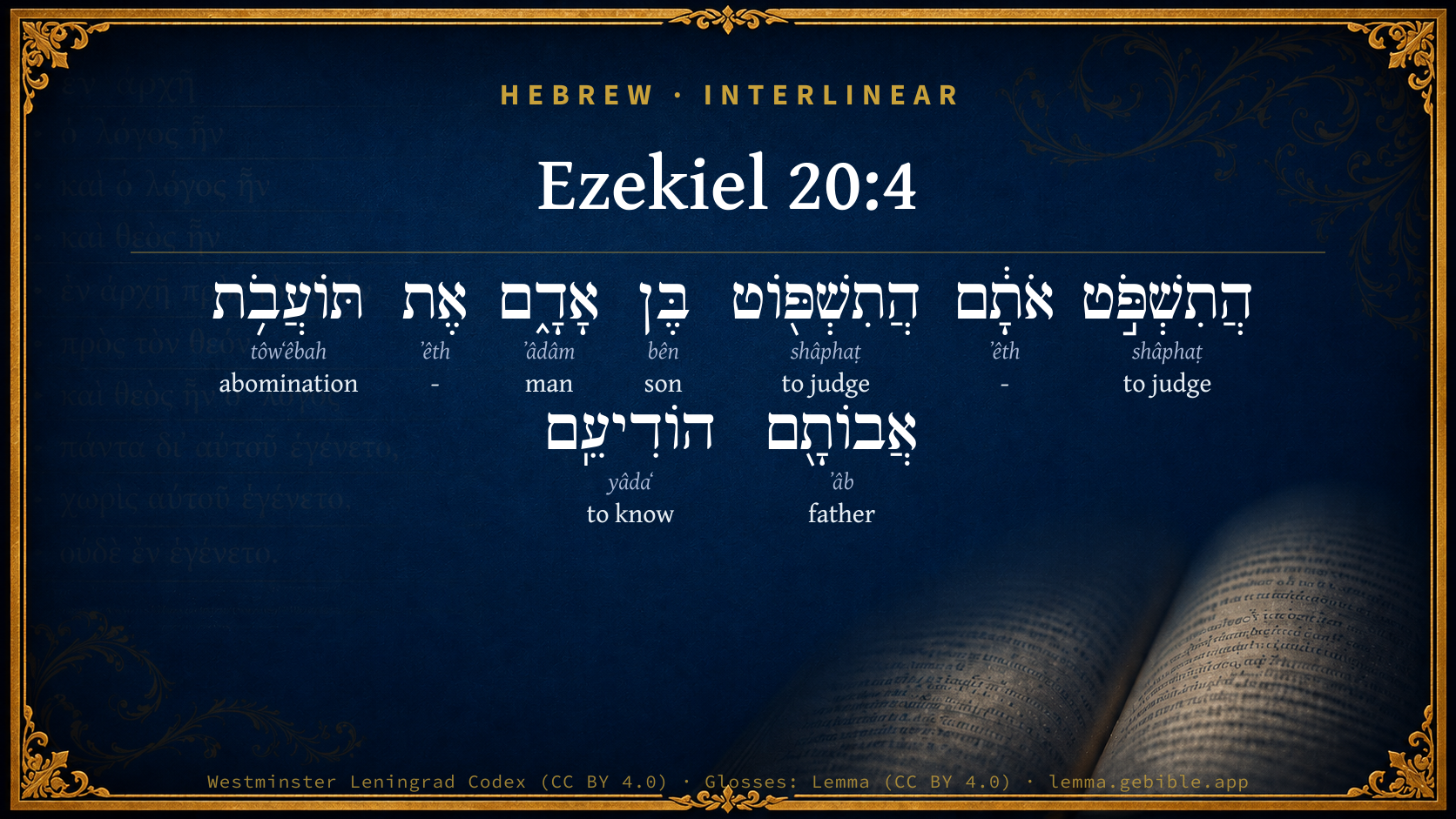
Hebrew (Westminster Leningrad Codex) Ezekiel 20:4 appears in the Hebrew Old Testament. The text above is from the Westminster Leningrad Codex. Each word links to its Strong’s number, a concise gloss, and parsing drawn from the Open Scriptures Hebrew Bible morphology. Click any word for its full Brown-Driver-Briggs (BDB) entry.
Download image
Cite this verse

Ezekiel 20:4 (World English Bible). Public Domain. Lemma interlinear Bible study tool, https://lemma.gebible.app/v/ezekiel/20/4.

Show BibTeX & RIS
BibTeX
RIS
English Translation
Will you judge them, son of man, will you judge them? Cause them to know the abominations of their fathers;
World English Bible · Public Domain
Download a study sheet

One document with this verse’s original text, its word-by-word gloss line, the meaning frame, cross-references with their text, attributed commentary, and full source and license credits — printable, and it pastes into notes with its structure intact.

This verse Autodidact and up

Study sheet (.html) Plain text (.txt)

A passage Seminary Student

Up to 50 verses in one chapter. A passage sheet keeps up to 6 commentary sources and 12 cross-references per verse, in the order this page ranks them, and says so on the sheet whenever that leaves anything out. Ask for a single verse and you get the Autodidact verse sheet above.

Everything on this page stays free to read, with no account — the sheet is a download of what is already on screen, not access to it.

Want to remove ads? Support Godless Engineer
Compare translations 3

The same verse in 3 English versions, stacked beneath the original-language interlinear above. Click any original word for its lexicon entry.

Each is an independent rendering of the whole verse — the interlinear is not word-aligned to these translations.

Highlighted words mark where these versions differ — a whole-verse word diff, not a word-by-word alignment.

  • World English Bible Public Domain
    Will you judge them, son of man, will you judge them? Cause them to know the abominations of their fathers;
  • King James Version Public Domain
    Wilt thou judge them, son of man, wilt thou judge them? cause them to know the abominations of their fathers:
  • unfoldingWord Literal Text CC BY-SA 4.0
    Will you judge them? Will you judge, son of man? Let them know about their fathers’ abominations.

unfoldingWord Literal Text — © unfoldingWord, licensed CC BY-SA 4.0. Word-aligned USFM3 via Door43 (git.door43.org/unfoldingWord/en_ult).

Versions to compare (up to 4)

3 of 4 selected

Show all 18 translations

Every available English version of this verse, each an independent rendering of the whole verse.

  • World English Bible Public Domain
    Will you judge them, son of man, will you judge them? Cause them to know the abominations of their fathers;
  • Berean Standard Bible Public Domain
    Will you judge them, will you judge them, son of man? Confront them with the abominations of their fathers
  • Majority Standard Bible Public Domain
    Will you judge them, will you judge them, son of man? Confront them with the abominations of their fathers
  • King James Version Public Domain
    Wilt thou judge them, son of man, wilt thou judge them? cause them to know the abominations of their fathers:
  • American Standard Version (1901) Public Domain
    Wilt thou judge them, son of man, wilt thou judge them? Cause them to know the abominations of their fathers;
  • Revised Version (1885) Public Domain
    Wilt thou judge them, son of man, wilt thou judge them? Cause them to know the abominations of their fathers;
  • Geneva Bible (1599) Public Domain
    Wilt thou iudge them, sonne of man? wilt thou iudge them? cause them to vnderstand the abominations of their fathers,
  • Douay-Rheims (1899) Public Domain
    If thou judgest them, if thou judgest, son of man, declare to them the abominations of their fathers.
  • Young's Literal Translation Public Domain
    Dost thou judge them? Dost thou judge, son of man? The abominations of their fathers cause them to know,
  • Literal Standard Version CC BY-SA 4.0
    Do you judge them? Do you judge, son of man? Cause them to know the abominations of their fathers,
  • Unlocked Literal Bible CC BY-SA 4.0
    Will you judge them? Will you judge, son of man? Let them know about their fathers' abominations.
  • unfoldingWord Literal Text CC BY-SA 4.0
    Will you judge them? Will you judge, son of man? Let them know about their fathers’ abominations.
  • Darby Bible Public Domain
    Wilt thou judge them, wilt thou judge, son of man? Cause them to know the abominations of their fathers,
  • World Messianic Bible Public Domain
    “Will you judge them, son of man? Will you judge them? Cause them to know the abominations of their fathers.
  • Webster's Bible Public Domain
    Wilt thou judge them, son of man, wilt thou judge them? cause them to know the abominations of their fathers:
  • Free Bible Version CC BY-SA 4.0
    Are you going to condemn them—will you do that, son of man? Remind them about the disgusting things their forefathers did,
  • Bible in Basic English Public Domain
    Will you be their judge, O son of man, will you be their judge? make clear to them the disgusting ways of their fathers,
  • JPS Tanakh (1917) Public Domain
    Wilt thou judge them, son of man, wilt thou judge them? cause them to know the abominations of their fathers;

Literal Standard Version (2020), Covenant Press — licensed CC BY-SA 4.0. Text via the HelloAO Bible API (eBible.org). Unlocked Literal Bible (unfoldingWord) — licensed CC BY-SA 4.0. Text via the HelloAO Bible API (eBible.org). unfoldingWord Literal Text — © unfoldingWord, licensed CC BY-SA 4.0. Word-aligned USFM3 via Door43 (git.door43.org/unfoldingWord/en_ult). Free Bible Version, Dr. Jonathan Gallagher — licensed CC BY-SA 4.0. Text via the HelloAO Bible API (eBible.org).

Word by word

More ways to search: Search by grammar → Find every occurrence → Compare this word →

Practice this passage: Drill this verse → Learn its vocabulary →

תּוֹעֲבֹ֥ת
tôwʻêbah
H8441
“abominations of”
Noun, Common, Feminine, Plural, Construct
Part of Speech
Noun
Type
Common
Gender
Feminine
Number
Plural
State
Construct
Full BDB Definition

Origin: act part of H8581

TWOT: 2530a

a disgusting thing, abomination, abominable - in ritual sense (of unclean food, idols, mixed marriages) - in ethical sense (of wickedness etc)
  1. הֲתִשְׁפֹּ֣ט shâphaṭ H8199 “to judge” Particle, Interrogative + Verb, Qal, Imperfect, 2nd Person, Masculine, Singular
  2. אֹתָ֔ם ʼêth H853 “- · them” Particle, Direct Object + Suffix, Personal, 3rd Person, Masculine, Plural
  3. הֲתִשְׁפּ֖וֹט shâphaṭ H8199 “to judge” Particle, Interrogative + Verb, Qal, Imperfect, 2nd Person, Masculine, Singular
  4. בֶּן bên H1121 “son of” Noun, Common, Masculine, Singular, Construct
  5. אָדָ֑ם ʼâdâm H120 “man” Noun, Common, Masculine, Singular, Absolute
  6. אֶת ʼêth H853 “-” Particle, Direct Object
  7. אֲבוֹתָ֖ם ʼâb H1 “fathers · their” Noun, Common, Masculine, Plural, Construct + Suffix, Personal, 3rd Person, Masculine, Plural
  8. הוֹדִיעֵֽם yâdaʻ H3045 “know · them” Verb, Hiphil, Imperative, 2nd Person, Masculine, Singular + Suffix, Personal, 3rd Person, Masculine, Plural

About this verse

These counts appear in no published source. They are computed here, from the morphology-tagged text and Lemma’s own curated glosses. What Lemma adds →

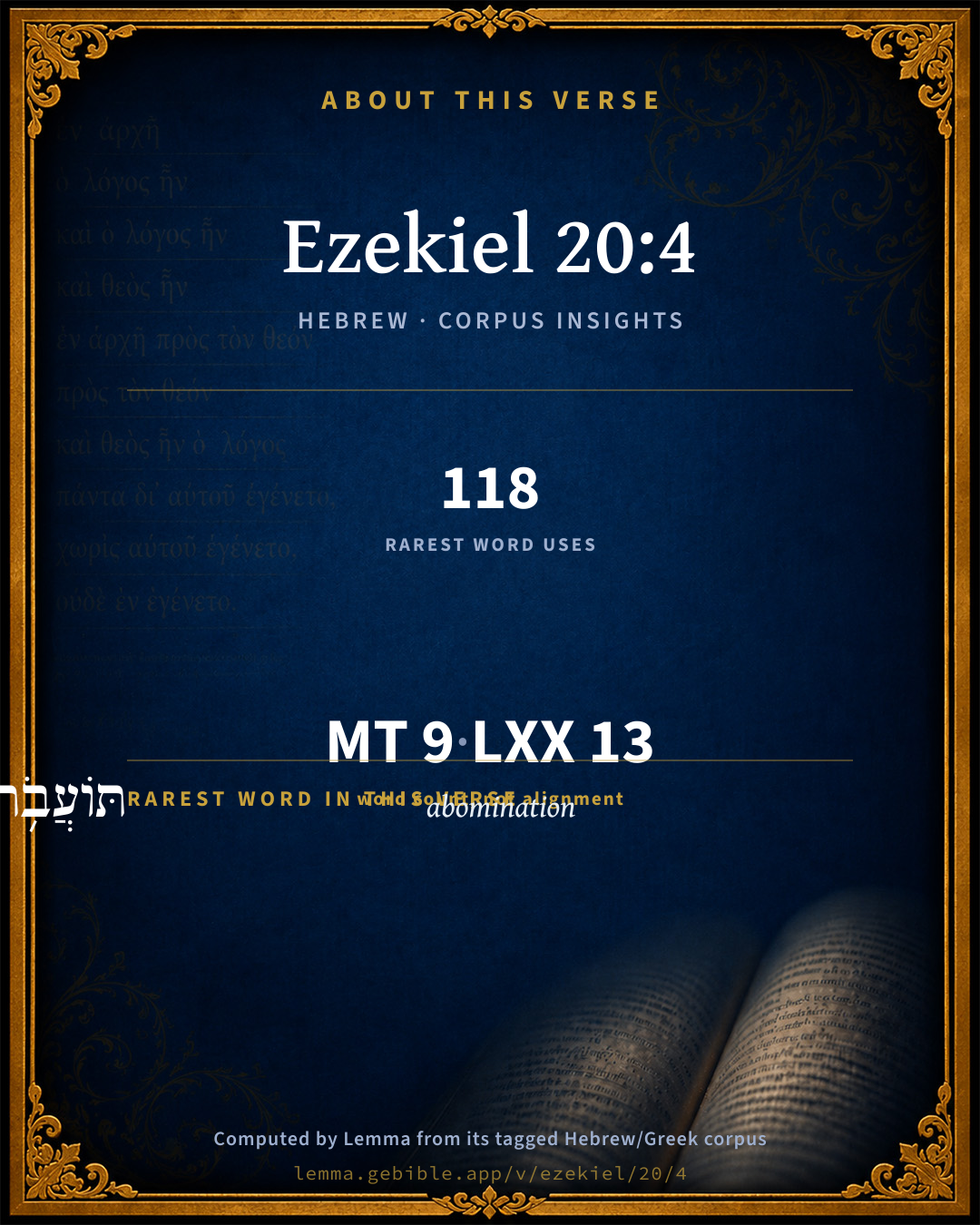
9
words
7
distinct lemmas
Prophets
section

Grammatical profile

  • 3 verbs
  • 4 nouns
  • 2 particles

Verb forms

  • הֲתִשְׁפֹּ֣ט Qal · Imperfect
  • הֲתִשְׁפּ֖וֹט Qal · Imperfect
  • הוֹדִיעֵֽם Hiphil · Imperative

Repetition

A word recurs within this verse — often emphatic in Hebrew:

  • הֲתִשְׁפֹּ֣ט to judge H8199 ×2

Hebrew & Septuagint length

In English translation the verse runs 20 words from the Hebrew and 19 from the Septuagint (LXX English) — closely comparable.

A rough comparison of the two English renderings, which tokenize alike — not a word-level alignment.

Word counts can differ between the Hebrew and the Greek without any difference in meaning — e.g. the Hebrew direct-object marker אֵת has no separate Greek word, and Greek often adds the article ὁ.

In the original languages it is 9 Hebrew tokens and 13 Greek tokens — but the two are counted differently (Hebrew bundles its prefixes and suffixes into one token; the Greek is in lemma form), so that isn’t a like-for-like length.

Cross-references

16

Topical passages linked to Ezekiel 20:4 in the Treasury of Scripture Knowledge — connected by theme and wording, ordered by reader-vote popularity; previews shown in the World English Bible.

  • Ezekiel 22:2 You, son of man, will you judge, will you judge the bloody city? then cause her to know all her abominations.
  • Ezekiel 23:36 Yahweh said moreover to me: Son of man, will you judge Oholah and Oholibah? then declare to them their abominations.
  • Isaiah 5:3 "Now, inhabitants of Jerusalem and men of Judah, Please judge between me and my vineyard.
  • Jeremiah 7:16 Therefore don't you pray for this people, neither lift up a cry nor prayer for them, neither make intercession to me; for I will not hear you.
  • Jeremiah 11:14 Therefore don't you pray for this people, neither lift up cry nor prayer for them; for I will not hear them in the time that they cry to me because of their trouble.
  • Jeremiah 14:11–14 Yahweh said to me, Don't pray for this people for [their] good.
  • Jeremiah 15:1 Then said Yahweh to me, Though Moses and Samuel stood before me, yet my mind would not be toward this people: cast them out of my sight, and let them go forth.
  • Ezekiel 14:14 though these three men, Noah, Daniel, and Job, were in it, they should deliver but their own souls by their righteousness, says the Lord Yahweh.
  • Ezekiel 14:20 though Noah, Daniel, and Job, were in it, as I live, says the Lord Yahweh, they should deliver neither son nor daughter; they should but deliver their own souls by their righteousness.
  • Ezekiel 16:2–3 Son of man, cause Jerusalem to know her abominations;
  • Ezekiel 23:45 Righteous men, they shall judge them with the judgment of adulteresses, and with the judgment of women who shed blood; because they are adulteresses, and blood is in their hands.
  • Matthew 23:29–37 "Woe to you, scribes and Pharisees, hypocrites! For you build the tombs of the prophets, and decorate the tombs of the righteous,
  • Luke 11:47–51 Woe to you! For you build the tombs of the prophets, and your fathers killed them.
  • Luke 13:33–35 Nevertheless I must go on my way today and tomorrow and the next day, for it can't be that a prophet perish outside of Jerusalem.'
  • Acts 7:51–52 "You stiff-necked and uncircumcised in heart and ears, you always resist the Holy Spirit! As your fathers did, so you do.
  • 1 Corinthians 6:2 Don't you know that the saints will judge the world? And if the world is judged by you, are you unworthy to judge the smallest matters?

Cross-references courtesy of OpenBible.info (CC BY 4.0).

Hebrew and Greek witnesses Masoretic Hebrew ↔ Greek Septuagint

The same verse in the two great witnesses to the Old Testament, shown verse-for-verse.

These are two independent witnesses, not word-aligned to each other, and the Septuagint is shown in lemma (dictionary) form.

Hebrew Ezekiel 20:4 Masoretic · Westminster Leningrad Codex

הֲתִשְׁפֹּ֣ט אֹתָ֔ם הֲתִשְׁפּ֖וֹט בֶּן אָדָ֑ם אֶת תּוֹעֲבֹ֥ת אֲבוֹתָ֖ם הוֹדִיעֵֽם

Will you judge them, son of man, will you judge them? Cause them to know the abominations of their fathers;

World English Bible · Public Domain

Greek LXX Ezekiel 20:4 Septuagint · lemma form

εἰ ἐκδικέω αὐτός ἐκδίκησις υἱός ἄνθρωπος ὁ ἀνομία ὁ πατήρ αὐτός διαμαρτύρομαι αὐτός

Shall I utterly take vengeance on them, son of man? testify to them of the iniquities of their fathers:

LXX2012 (modern English Septuagint) · Public Domain

Hebrew: Westminster Leningrad Codex (CC BY 4.0). Greek: Septuagint (public domain); English from LXX2012 (modern English Septuagint) (Public Domain). How the Septuagint differs from the Hebrew →

Targum (Aramaic paraphrase)

1

The Targum is the ancient Jewish Aramaic paraphrase of the Hebrew Scriptures — an interpretive translation, not the Hebrew text itself. Onkelos (literal) and Pseudo-Jonathan (expansive) render the Torah, and Jonathan the Prophets. Coverage is partial: where no permissively-licensed English translation exists for a verse, only the Aramaic is shown. This is verse-level text, not a word-by-word alignment to the Hebrew.

  1. Targum Jonathan Prophets (Joshua–Malachi)
    הֲתוֹכַח יַתְהוֹן הֲתוֹכַח בַּר אָדָם יַת תּוֹעֲבַת אֲבָהַתְהוֹן הוֹדָעִינוּן:

    (no public-domain English translation for this verse)

    Targum Jonathan — Aramaic: “Mikraot Gedolot” (public domain). English: “Sefaria Community Translation” (CC0 1.0 (public-domain dedication)); “London "Chaldee Paraphrase," 1871” (public domain). Text via Sefaria.

Commentary

Notes on Ezekiel 20:4 from classic Christian and Jewish commentators (each source and its license shown beneath its notes). The classic Christian expositions comment on the surrounding passage and are grouped to its opening verse, so a note may address several verses; the Jewish commentaries on the Tanakh (Rashi and others) are per-verse, so they appear only where the commentator wrote on this verse.

Lemma curates 59 commentaries, every one of them public domain or Creative Commons licensed, each selected and text-cleaned for this edition rather than reprinted as found. About our sources →

Trapp's Complete Commentary

John Trapp

Eze 20:4 Wilt thou judge them, son of man, wilt thou judge [them]? cause them to know the abominations of their fathers:

Ver. 4. Wilt thou judge them?] Or, Wilt thou excuse them? or, Wilt thou intercede for them? If thou hast never so good a mind to do so, yet do it not; rather reprove them for, and convince them of, their sins; spare thy charity, and exercise thine authority of "having in readiness to revenge their disobedience." {2Co 10:6} An causam ageres eorum? Abigendi sunt potius quam docendi. Ostendit Dominus ulcus profundum esse.

Cause them to know the abominations of their fathers.] By themselves avowed, abetted, augmented; their fathers’ iniquity they have drawn together with cart ropes of vanity.

John Trapp, A Commentary or Exposition upon All the Books of the Old and New Testament (1647–1656) — public domain. Text from a community e-Sword module.

Joseph Benson's Commentary

Eze 20:4. Wilt thou judge them — Or, rather, Wilt thou not judge them? Wilt thou not reprove, or condemn them? Wilt thou not denounce my judgments against them? Cause them to know the abominations of their fathers — The abominable crimes of which their fathers have been guilty, and which they themselves, and the present generation of Jews, have also committed with fresh aggravations: and hereby let them know what they have to expect. This whole chapter is a kind of decree, in which the prophet, after having set forth the crimes of the Jews, pronounces against them their reprobation, and foretels what blessings God would bestow on a faithful people who should serve him truly on his holy mountain.

Joseph Benson's Commentary on the Old and New Testaments (1811–1818) — public domain. Text from a community e-Sword module.

Tyndale Open Study Notes

Tyndale Open Resources

20:4-26 That the Lord would not answer their inquiry did not mean that he had nothing to say to them. Ezekiel would parade the detestable character of their ancestors before their eyes.

Tyndale Open Study Notes — © Tyndale Open Resources, licensed CC BY-SA 4.0. Text via the HelloAO Bible API.

Geneva Bible (1599)

Geneva Bible translators

This declareth the great lenity and patience of God, which calleth sinners to repentance before he condemns them.

Geneva Bible (1599) marginal notes — public domain. Text via Bolls.life.

Jamieson, Fausset & Brown

Robert Jamieson, A. R. Fausset & David Brown

Wilt thou judge? . . . judge--The emphatical repetition expresses, "Wilt thou not judge? yes, judge them. There is a loud call for immediate judgment." The Hebrew interrogative here is a command, not a prohibition [MAURER]. Instead of spending time in teaching them, tell them of the abomination of their fathers, of which their own are the complement and counterpart, and which call for judgment.

Jamieson, Fausset & Brown — Commentary Critical and Explanatory on the Whole Bible (1871) — public domain (CC PDM 1.0). Text via the HelloAO Bible API.

Adam Clarke's Commentary

Verse 4. Wilt thou judge them] If thou wilt enter into any discussion with them, show them the abomination of their fathers. The whole chapter is a consecutive history of the unfaithfulness ingratitude, rebellion, and idolatry of the Jews, from the earliest times to that day; and vindicates the sentence which God had pronounced against them, and which he was about to execute more fully in delivering them and the city into the hands of the Chaldeans.

Adam Clarke's Commentary on the Bible (1810–1826) — public domain. Text from a community e-Sword/MySword module.

John Calvin's Commentaries

The context flows very well if we embrace this sense, that God swears that the Israelites did not come to be subject to his Prophet, and to submit themselves modestly to his instructions. If this sense pleases, it is well added, shall you judge them? that is, shall you spend thy breath in arguing with them? He means that they are rather to be dismissed than instructed; as Christ says, You shall not cast pearls before swine. (Matthew 7:6.) And we know what God pronounces: My Spirit shall not always strive with man, because he is flesh. (Genesis 6:3.) He now means that there was no need of any dispute, since there was no means of carrying it on; so in this passage, since the Prophet was dealing with men utterly broken down, who never listened to wise counsels, nor obeyed any admonitions, nor were softened by any chastisement, he adds, therefore, shall you judge them? Some indeed coldly and insipidly explain this of taking away the part of a judge, since God rather wishes them to be called to repentance than to be condemned. But here judging embraces within itself all reproaches and threats. On the whole, since they acted deceitfully, and by no means proposed to submit themselves to God, hence he uses this bitterness, What! are they worthy of your judging them? that is, of your contending with them? for the Prophet’s duty is to argue with sinners, to threaten them, and to cite them to God’s tribunal. God, therefore, pronounces them unworthy of such disputing, because they are not only deaf, but, hardened by abandoned obstinacy. Now, therefore, we understand the sense of the words, wilt you judge them? will you judge them? The repetition is emphatic, that God may strongly express the obstinacy of that desperate people. He afterwards adds, If this be done, then show them the abominations of their fathers. God here mitigates the asperity which he had used, and by means of a correction descends to a reason for it, namely, that he may for once try whether or not they are curable. If then they are to be judged, that is, if he chooses to enter into any dispute, and to argue with them, he says that he ought to begin not with themselves, but with their fathers. God wishes them to be judged, not only on account of the wickedness of a few years, but because before they were born their fathers were obstinately attached to their abominations. In fine, God shows that the wound was deep, and could not be cured, unless the hidden poison was carefully examined, which otherwise would cause putrid matter, from which at length inflammation would arise. For many think that they have properly discharged their duty when they have but lightly probed their wounds: but sometimes it is necessary to penetrate to the inmost parts, as the people had not only provoked God lightly, and for a short time, but their impiety had been growing for ages, and their sins had become a kind of inheritance to them. Since, then, this hidden poison existed, which could not be cured either easily or by any slight remedy, hence God orders them to begin with their fathers. Show them, therefore, the abominations of their fathers. It follows —

John Calvin's Commentaries (1540-1563) — public domain. Text from the Calvin Translation Society English edition (1840s-50s) via the Christian Classics Ethereal Library (ccel.org). Calvin's coverage is partial (roughly two-thirds of the Bible); uncommented books and verses are honest gaps, never fabricated. The 19th-century editor's footnotes and remarks are omitted so the notes are faithfully Calvin's own voice.

Ellicott's Commentary for English Readers

(4) Wilt thou judge them?—The form of the repeated question is equivalent to an imperative—judge them. Instead of allowing their enquiry and entreaty for the averting of judgment, the prophet is directed to set before them their long series of apostasies and provocations. “Judge” is used in the sense of “bring to trial,” “prefer charges.”

A Bible Commentary for English Readers, edited by Charles John Ellicott (1878–1897) — public domain. Text from a community e-Sword module.

The Cambridge Bible for Schools and Colleges

gen. ed. J. J. S. Perowne

4. wilt thou judge] The interr. seems to have the sense of an impatient imperative, and the repetition gives stronger expression to the imperative, cf. ch. Eze_22:2, Eze_23:36. “Judge” is explained by “cause them to know the abominations of their fathers.” To rehearse the history of the fathers is to hold the mirror up to themselves.

The Cambridge Bible for Schools and Colleges (gen. ed. J. J. S. Perowne; Cambridge University Press, 1878–1918) — public domain. Text from a community e-Sword module.

John Gill's Exposition

Wilt thou judge them, son of man?.... Excuse them, patronise them, defend their cause, and plead for them? surely thou wilt not; or rather, wilt thou not reprove and correct them, judge and condemn them, for their sins and wickedness? this thou oughtest to do:

wilt thou judge them? this is repeated, to show the vehemency of the speaker, and the duty of the prophet:

cause them to know the abominations of their fathers: the sins they committed, which were abominable in themselves, and rendered them abominable unto God, and what came upon them for them; by which they would be led to see the abominable evils which they also had been guilty of, in which they had imitated their fathers, and what they had reason to expect in consequence of them.

John Gill's Exposition of the Whole Bible (1746–1763) — public domain (CC PDM 1.0). Text via the HelloAO Bible API.

Albert Barnes' Notes on the Bible

Wilt thou judge them? - We should rather say, Wilt thou not judge them? i. e., wilt thou not pronounce sentence upon them? Compare Eze 22:2.

Albert Barnes' Notes on the Bible (1834–1885) — public domain. Text from a community e-Sword/MySword module.

Haydock's Catholic Bible Commentary

Judgest them; or, if thou wilt enter into the cause, and plead against them. (Challoner) --- Lay before them the iniquities of their fathers, and their own, which bring on the reprobation of the greatest part. God will form his Church out of a few of them and of the Gentiles. The return of a small number from captivity is also insinuated.

George Leo Haydock (1774–1849), Haydock's Catholic Family Bible and Commentary, 1859 edition — public domain. Excludes Psalms (Douay-Rheims chapter numbering differs from Protestant) and Deuterocanonical books (Catholic canon only).

Matthew Poole's English Annotations

Wilt thou judge them? either, Wilt thou judge charitably, and, supposing they are upright and teachable, wilt thou plead with me for them? as Eze 14:3, or as Jer 14:9. Or else thus, Wilt thou argue with them, convince them, and reprove them? This is fittest to be done, and do this, handle them severely as they deserve. It is repeated, to whet the prophet, and quicken him to this work, and to intimate to us the great contumacy of the people.

Cause them to know the abominations of their fathers: tell them somewhat that they may go away wiser than they came. They expect to know what will be their fate, tell them what hath been their fathers’ carriage towards me, which they imitate, nay exceed. Their curiosity and perplexity would be informed what is to come, but their consciences need more to be informed: what their fathers have done they approved, and have outdone; by that let them know what to do, what to expect.

Matthew Poole's English Annotations on the Holy Bible (1683–1685) — public domain. Text from a community e-Sword/MySword module.

Whedon's Commentary on the Bible

Daniel D. Whedon

4. Wilt thou judge — “The interrogation seems to have the sense of an impatient imperative, and the repetition gives stronger impression to the imperative (compare Eze_22:2; Eze_23:36); ‘judge’ is explained by ‘cause them to know the abominations of their fathers.’ To rehearse the history of their fathers is to hold the mirror up to themselves.” — Davidson.

Daniel D. Whedon (gen. ed.), Commentary on the Old and New Testaments (1874–1909) — public domain. Text from a community e-Sword module.

The Pulpit Commentary

Wilt thou judge them, etc.? The doubled question has the force of a strong imperative. The prophet is directed, as it were, to assume the office of a judge, and as such to press home upon his hearers, and through them upon others, their own sins and those of their fathers. He is led, in doing so, to yet another survey of the nation"s history; not now, as in Eze 16, in figurative language, but directly.

The Pulpit Commentary (1880–1919), ed. H.D.M. Spence-Jones & Joseph S. Exell — public domain. Text from a community e-Sword module.

John Wesley's Explanatory Notes

Wilt thou - Wilt thou not convince and reprove them? And denounce my judgments against them? The abominations - What their fathers have done, they approve, and have outdone; by that let them know what to expect.

John Wesley, Explanatory Notes Upon the Whole Bible (1754–1765) — public domain. Text via the GEBible commentary corpus.

unfoldingWord translationNotes

Door43 World Missions Community

Will you judge them? Will you judge, son of man?

Yahweh asks Ezekiel the same question twice in order to secure Ezekiel's commitment to pronounce the judgement. AT: "Are you ready to pronounce judgment on them, son of man?" (See: Parallelism)

I ... raised my hand to swear an oath

Here "raised my hand" is a symbolic action that shows he will truly do what he has sworn to do. AT: "I ... solemnly swore an oath" (See: Symbolic Action)

the house of Jacob

The word "house" is a metonym for the family that lives in the house, in this case the descendants of Jacob over many years. Translate "the house of" as in Ezekiel 3:1. AT: "the descendants of Jacob" (See: Metonymy)

It was flowing with milk and honey

"It was a land where plenty of milk and honey flowed." Yahweh speaks of the land being good for animals and plants as if the milk and honey from those animals and plants were flowing through the land. AT: "It was land that was excellent for raising livestock and growing crops" (See: Metaphor and Metonymy)

the most beautiful ornament among all the lands

The lands in which people live are spoken of as if they are jewelry or other things that are pleasant to look at. AT: "the most beautiful of all lands" (See: Metaphor)

translationWords

judge

ancestor

abomination

oath

descend

house

Jacob

Egypt

Yahweh

honey

unfoldingWord translationNotes — © Distant Shores Media and the Door43 World Missions Community, licensed CC BY-SA 4.0. Source: git.door43.org/Door43/en_tn.

Rashi

Rabbi Shlomo Yitzchaki (Rashi)

Will you contend with them Heb. הֲתִישְׁפֹּט, an expression of contending.

Rashi on the Tanakh — English translations: “The Judaica Press complete Tanach with Rashi, translated by A. J. Rosenberg” (CC BY 4.0); “Pentateuch with Rashi's commentary by M. Rosenbaum and A.M. Silbermann, 1929-1934” (public domain); “The Metsudah Tanach series, Lakewood, N.J” (CC BY 4.0); and “The Book of Joshua, Metsudah Publications, 1997” (CC BY 4.0). Text via Sefaria.

Lesson kit

Teaching starters — assembled from the data on this page, not authored interpretation. Every prompt links to the verse data it draws on. Edit before teaching.

Ezekiel, in the Prophets, opens this verse with 9 words (7 distinct Hebrew lemmas). Its most distinctive word is tôwʻêbah (“abomination”). A historical commentator’s framing appears above. Read the whole chapter for the surrounding context.

Discussion questions

  1. The word tôwʻêbah carries the sense “abomination.” How does it shape the verse?
  2. How does Ezekiel 22:2, which shares this passage’s theme, read alongside this verse?
  3. What does the repetition of “to judge” (2× in this one verse) do in this verse?
  4. These translations render this verse differently. What is at stake in choosing one wording over another?
  5. «הֲתִשְׁפֹּ֣ט» is a Qal Imperfect verb. How does that grammatical form shape the action described?
  6. Compare how Trapp's Complete Commentary and Joseph Benson's Commentary read this verse. Where do they agree or differ?

Things to notice

Reading settings

Reading text

Shown beneath each verse's original-language words.

Old Testament
Old Testament edition

Read the OT as the Masoretic Hebrew (MT) or the Greek Septuagint (LXX).

English shown for the Greek Septuagint (in the Hebrew ↔ Greek comparison).

Comparing translations? Open the Compare panel on any verse page to stack up to four side by side.