Deuteronomy 19:18

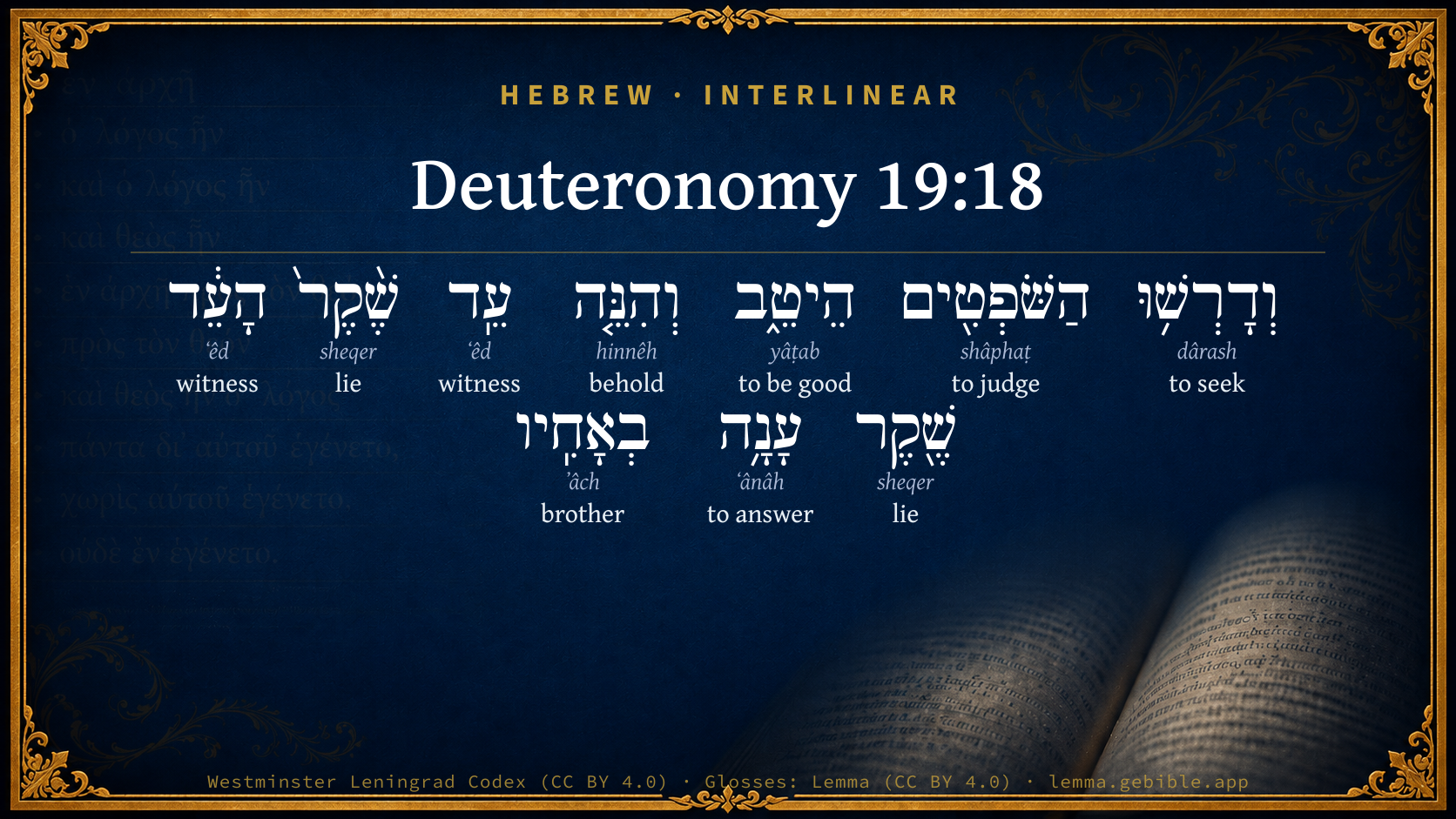
Hebrew (Westminster Leningrad Codex) Deuteronomy 19:18 appears in the Hebrew Old Testament. The text above is from the Westminster Leningrad Codex. Each word links to its Strong’s number, a concise gloss, and parsing drawn from the Open Scriptures Hebrew Bible morphology. Click any word for its full Brown-Driver-Briggs (BDB) entry.
Download image
Cite this verse

Deuteronomy 19:18 (World English Bible). Public Domain. Lemma interlinear Bible study tool, https://lemma.gebible.app/v/deuteronomy/19/18.

Show BibTeX & RIS
BibTeX
RIS
English Translation
and the judges shall make diligent inquisition: and, behold, if the witness is a false witness, and has testified falsely against his brother;
World English Bible · Public Domain
Download a study sheet

One document with this verse’s original text, its word-by-word gloss line, the meaning frame, cross-references with their text, attributed commentary, and full source and license credits — printable, and it pastes into notes with its structure intact.

This verse Autodidact and up

Study sheet (.html) Plain text (.txt)

A passage Seminary Student

Up to 50 verses in one chapter. A passage sheet keeps up to 6 commentary sources and 12 cross-references per verse, in the order this page ranks them, and says so on the sheet whenever that leaves anything out. Ask for a single verse and you get the Autodidact verse sheet above.

Everything on this page stays free to read, with no account — the sheet is a download of what is already on screen, not access to it.

Want to remove ads? Support Godless Engineer
Compare translations 3

The same verse in 3 English versions, stacked beneath the original-language interlinear above. Click any original word for its lexicon entry.

Each is an independent rendering of the whole verse — the interlinear is not word-aligned to these translations.

Highlighted words mark where these versions differ — a whole-verse word diff, not a word-by-word alignment.

  • World English Bible Public Domain
    and the judges shall make diligent inquisition: and, behold, if the witness is a false witness, and has testified falsely against his brother;
  • King James Version Public Domain
    And the judges shall make diligent inquisition: and, behold, if the witness be a false witness, and hath testified falsely against his brother;
  • unfoldingWord Literal Text CC BY-SA 4.0
    And the judges shall inquire thoroughly, and behold, witness false (the false witness testified against his brother),

unfoldingWord Literal Text — © unfoldingWord, licensed CC BY-SA 4.0. Word-aligned USFM3 via Door43 (git.door43.org/unfoldingWord/en_ult).

Versions to compare (up to 4)

3 of 4 selected

Show all 18 translations

Every available English version of this verse, each an independent rendering of the whole verse.

  • World English Bible Public Domain
    and the judges shall make diligent inquisition: and, behold, if the witness is a false witness, and has testified falsely against his brother;
  • Berean Standard Bible Public Domain
    The judges shall investigate thoroughly, and if the witness is proven to be a liar who has falsely accused his brother,
  • Majority Standard Bible Public Domain
    The judges shall investigate thoroughly, and if the witness is proven to be a liar who has falsely accused his brother,
  • King James Version Public Domain
    And the judges shall make diligent inquisition: and, behold, if the witness be a false witness, and hath testified falsely against his brother;
  • American Standard Version (1901) Public Domain
    and the judges shall make diligent inquisition: and, behold, if the witness be a false witness, and have testified falsely against his brother;
  • Revised Version (1885) Public Domain
    and the judges shall make diligent inquisition: and, behold, if the witness be a false witness, and hath testified falsely against his brother;
  • Geneva Bible (1599) Public Domain
    And the Iudges shall make diligent inquisition: and if the witnesse be found false, and hath giuen false witnes against his brother,
  • Douay-Rheims (1899) Public Domain
    And when after most diligent inquisition, they shall find that the false witness hath told a lie against his brother:
  • Young's Literal Translation Public Domain
    and the judges have searched diligently, and lo, the witness `is' a false witness, a falsehood he hath testified against his brother:
  • Literal Standard Version CC BY-SA 4.0
    and the judges have searched diligently, and behold, the witness [is] a false witness who has testified a falsehood against his brother,
  • Unlocked Literal Bible CC BY-SA 4.0
    The judges must make diligent inquiries; see, if the witness is a false witness and has testified falsely against his brother,
  • unfoldingWord Literal Text CC BY-SA 4.0
    And the judges shall inquire thoroughly, and behold, witness false (the false witness testified against his brother),
  • Darby Bible Public Domain
    and the judges shall make thorough inquiry; and if the witness be a false witness, and he have testified falsely against his brother,
  • World Messianic Bible Public Domain
    and the judges shall make diligent inquisition; and behold, if the witness is a false witness, and has testified falsely against his brother,
  • Webster's Bible Public Domain
    And the judges shall make diligent inquisition: and behold, if the witness is a false witness, and hath testified falsely against his brother;
  • Free Bible Version CC BY-SA 4.0
    The judges shall conduct a full investigation, and if the accuser proves to be a liar who has made false accusations
  • Bible in Basic English Public Domain
    And the judges will have the question looked into with care: and if the witness is seen to be false and to have made a false statement against his brother,
  • JPS Tanakh (1917) Public Domain
    And the judges shall inquire diligently; and, behold, if the witness be a false witness, and hath testified falsely against his brother;

Literal Standard Version (2020), Covenant Press — licensed CC BY-SA 4.0. Text via the HelloAO Bible API (eBible.org). Unlocked Literal Bible (unfoldingWord) — licensed CC BY-SA 4.0. Text via the HelloAO Bible API (eBible.org). unfoldingWord Literal Text — © unfoldingWord, licensed CC BY-SA 4.0. Word-aligned USFM3 via Door43 (git.door43.org/unfoldingWord/en_ult). Free Bible Version, Dr. Jonathan Gallagher — licensed CC BY-SA 4.0. Text via the HelloAO Bible API (eBible.org).

Word by word

More ways to search: Search by grammar → Find every occurrence → Compare this word →

Practice this passage: Drill this verse → Learn its vocabulary →

עֵֽד
ʻêd
H5707
“witness of”
Noun, Common, Masculine, Singular, Construct
Part of Speech
Noun
Type
Common
Gender
Masculine
Number
Singular
State
Construct
Full BDB Definition

Origin: contracted from H5749

TWOT: 1576b

witness - witness, testimony, evidence (of things) - witness (of people)
  1. וְדָרְשׁ֥וּ dârash H1875 “and · to seek” Conjunction + Verb, Qal, Sequential Perfect, 3rd Person, Common, Plural
  2. הַשֹּׁפְטִ֖ים shâphaṭ H8199 “the · judging” Particle, Definite Article + Verb, Qal, Participle Active, Masculine, Plural, Absolute
  3. הֵיטֵ֑ב yâṭab H3190 “to be good” Verb, Hiphil, Infinitive Absolute
  4. וְהִנֵּ֤ה hinnêh H2009 “and · behold” Conjunction + Particle, Demonstrative
  5. שֶׁ֨קֶר֙ sheqer H8267 “lie” Noun, Common, Masculine, Singular, Absolute
  6. הָעֵ֔ד ʻêd H5707 “the · witness” Particle, Definite Article + Noun, Common, Masculine, Singular, Absolute
  7. שֶׁ֖קֶר sheqer H8267 “lie” Noun, Common, Masculine, Singular, Absolute
  8. עָנָ֥ה ʻânâh H6030 “to answer” Verb, Qal, Perfect, 3rd Person, Masculine, Singular
  9. בְאָחִֽיו ʼâch H251 “in/at · brother · his” Preposition + Noun, Common, Masculine, Singular, Construct + Suffix, Personal, 3rd Person, Masculine, Singular

About this verse

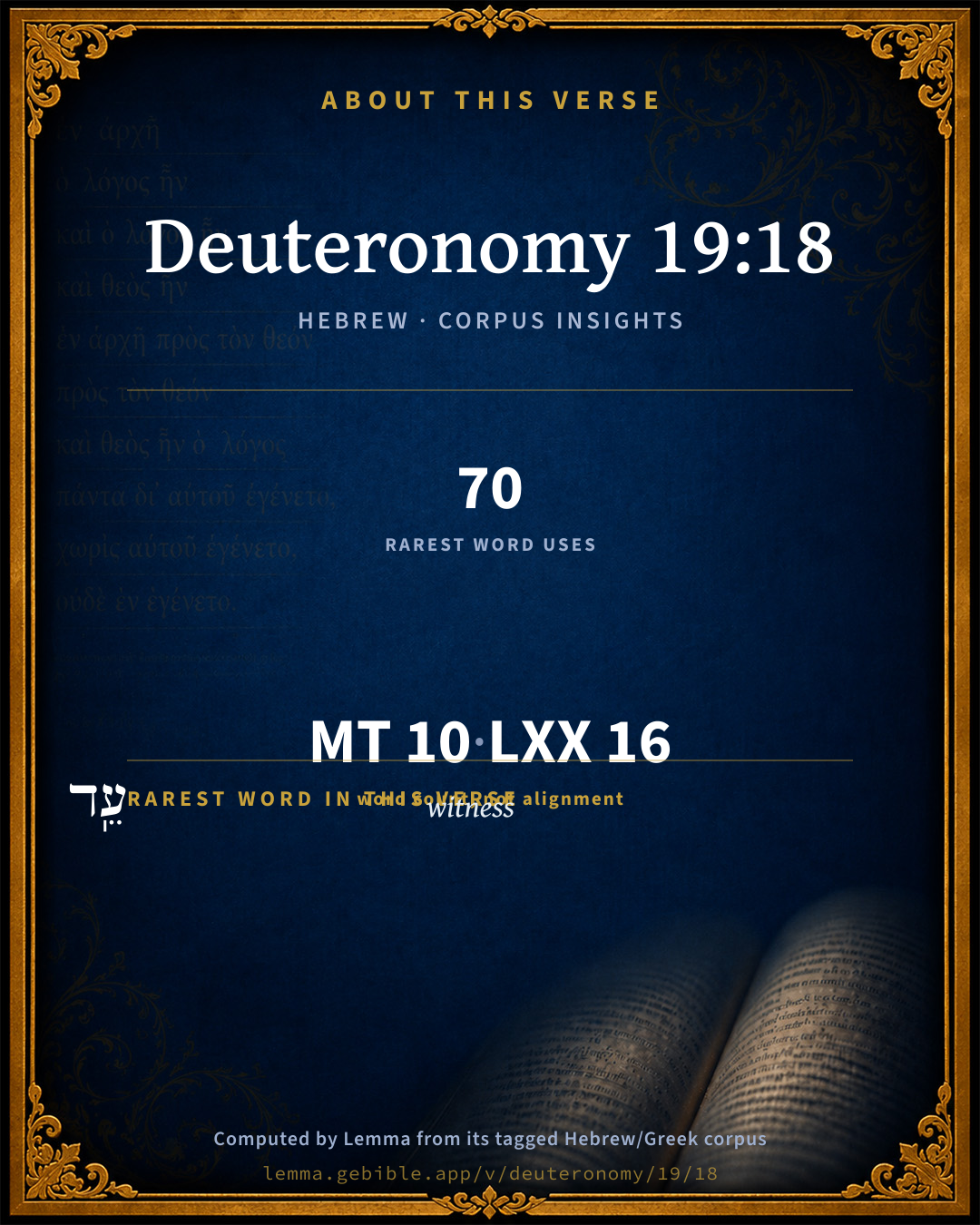
These counts appear in no published source. They are computed here, from the morphology-tagged text and Lemma’s own curated glosses. What Lemma adds →

10
words
8
distinct lemmas
Pentateuch
section

Grammatical profile

  • 4 verbs
  • 5 nouns
  • 1 particle

Verb forms

  • וְדָרְשׁ֥וּ Qal · Sequential Perfect
  • הַשֹּׁפְטִ֖ים Qal · Participle Active
  • הֵיטֵ֑ב Hiphil · Infinitive Absolute
  • עָנָ֥ה Qal · Perfect

Repetition

Words recur within this verse — often emphatic in Hebrew:

  • עֵֽד witness H5707 ×2
  • שֶׁ֨קֶר֙ lie H8267 ×2

Hebrew & Septuagint length

In English translation the verse runs 23 words from the Hebrew and 24 from the Septuagint (LXX English) — closely comparable.

A rough comparison of the two English renderings, which tokenize alike — not a word-level alignment.

Word counts can differ between the Hebrew and the Greek without any difference in meaning — e.g. the Hebrew direct-object marker אֵת has no separate Greek word, and Greek often adds the article ὁ.

In the original languages it is 10 Hebrew tokens and 16 Greek tokens — but the two are counted differently (Hebrew bundles its prefixes and suffixes into one token; the Greek is in lemma form), so that isn’t a like-for-like length.

Cross-references

4

Topical passages linked to Deuteronomy 19:18 in the Treasury of Scripture Knowledge — connected by theme and wording, ordered by reader-vote popularity; previews shown in the World English Bible.

  • Deuteronomy 13:14 then shall you inquire, and make search, and ask diligently; and, behold, if it be truth, and the thing certain, that such abomination is done in the midst of you,
  • Deuteronomy 17:4 and it be told you, and you have heard of it, then shall you inquire diligently; and, behold, if it be true, and the thing certain, that such abomination is done in Israel,
  • 2 Chronicles 19:6–7 and said to the judges, Consider what you do: for you don't judge for man, but for Yahweh; and [he is] with you in the judgment.
  • Job 19:16 I call to my servant, and he gives me no answer; I beg him with my mouth.

Cross-references courtesy of OpenBible.info (CC BY 4.0).

Hebrew and Greek witnesses Masoretic Hebrew ↔ Greek Septuagint

The same verse in the two great witnesses to the Old Testament, shown verse-for-verse.

These are two independent witnesses, not word-aligned to each other, and the Septuagint is shown in lemma (dictionary) form.

Hebrew Deuteronomy 19:18 Masoretic · Westminster Leningrad Codex

וְדָרְשׁ֥וּ הַשֹּׁפְטִ֖ים הֵיטֵ֑ב וְהִנֵּ֤ה עֵֽד שֶׁ֨קֶר֙ הָעֵ֔ד שֶׁ֖קֶר עָנָ֥ה בְאָחִֽיו

and the judges shall make diligent inquisition: and, behold, if the witness is a false witness, and has testified falsely against his brother;

World English Bible · Public Domain

Greek LXX Deuteronomy 19:18 Septuagint · lemma form

καί ἐκἐτάζω ὁ κριτής ἀκριβῶς καί ἰδού μάρτυς ἄδικος μαρτυρέω ἄδικος ἀντιἵστημι κατά ὁ ἀδελφός αὐτός

And the judges shall make diligent inquiry, and, behold, if an unjust witness has borne unjust testimony; and has stood up against his brother;

LXX2012 (modern English Septuagint) · Public Domain

Hebrew: Westminster Leningrad Codex (CC BY 4.0). Greek: Septuagint (public domain); English from LXX2012 (modern English Septuagint) (Public Domain). How the Septuagint differs from the Hebrew →

Targum (Aramaic paraphrase)

2

The Targum is the ancient Jewish Aramaic paraphrase of the Hebrew Scriptures — an interpretive translation, not the Hebrew text itself. Onkelos (literal) and Pseudo-Jonathan (expansive) render the Torah, and Jonathan the Prophets. Coverage is partial: where no permissively-licensed English translation exists for a verse, only the Aramaic is shown. This is verse-level text, not a word-by-word alignment to the Hebrew.

  1. Targum Onkelos Torah (Genesis–Deuteronomy)
    וְיִתְבְּעוּן דַיָנַיָא יָאוּת וְהָא סָהִיד שְׁקַר סָהֲדָא שִׁקְרָא אַסְהַד בַּאֲחוֹהִי

    (no public-domain English translation for this verse)

    Targum Onkelos — Aramaic: “Onkelos Genesis” (public domain); “Onkelos Exodus” (public domain); “Onkelos Leviticus” (public domain); “Onkelos Numbers” (public domain); “Onkelos Deuteronomy” (public domain). English: “Sefaria Community Translation” (CC0 1.0 (public-domain dedication)); “J.W. Etheridge. The Targums of Onkelos and Jonathan Ben Uzziel on the Pentateuch. London: Longmans, Green, 1862” (public domain). Text via Sefaria.

  2. Targum Pseudo-Jonathan Torah (Genesis–Deuteronomy)
    וְיִתְבְּעוּן דַּיָינַיָא לְסַהֲדִין דְּמַזְמִין יַתְהוֹן טָבְאוּת וְהָא סַהֲדוּ דִשְׁקַר בְּפוּם סַהֲדִין שִׁיקְרָא אַסְהִידוּ בַּאֲחוּהוֹן

    and the judges shall question the witnesses of their times fairly; and, behold, false testimony is in the mouth of the witnesses; they have borne false witness against their brother.

    Targum Pseudo-Jonathan — Aramaic: “Targum Jonathan on Genesis” (public domain); “Targum Jonathan on Exodus” (public domain); “Targum Jonathan on Leviticus” (public domain); “Targum Jonathan on Numbers” (public domain); “Targum Jonathan on Deuteronomy” (public domain). English: “The Targum of Jonathan ben Uzziel, trans. J. W. Etheridge, London, 1862” (public domain). Text via Sefaria.

Commentary

Notes on Deuteronomy 19:18 from classic Christian and Jewish commentators (each source and its license shown beneath its notes). The classic Christian expositions comment on the surrounding passage and are grouped to its opening verse, so a note may address several verses; the Jewish commentaries on the Tanakh (Rashi and others) are per-verse, so they appear only where the commentator wrote on this verse.

Lemma curates 59 commentaries, every one of them public domain or Creative Commons licensed, each selected and text-cleaned for this edition rather than reprinted as found. About our sources →

The Cambridge Bible for Schools and Colleges

gen. ed. J. J. S. Perowne

18. shall make diligent inquisition] See Deu_13:14 (15), Deu_17:4; Deu_17:9; Sg.

false, falsely] Heb. sheḳer: so in Exo_20:16, but Deu_5:20 has shav, vain.

brother] here and next v.: the usual term in Sg. passages for fellow-Israelite.

The Cambridge Bible for Schools and Colleges (gen. ed. J. J. S. Perowne; Cambridge University Press, 1878–1918) — public domain. Text from a community e-Sword module.

John Gill's Exposition

Then shall ye do unto him as he had thought to have done unto his brother,.... Inflict the same fine or punishment on him he thought to have brought his brother under by his false testimony of him; whether any pecuniary fine, or whipping and scourging, or the loss of a member, or the value of it, or death itself; whether stoning, strangling, burning, or killing with the sword: though, in the case of accusing a priest's daughter of adultery, as Jarchi observes, such were not to be burnt, as would have been her case if proved, but strangled:

so shalt thou put the evil away from among you; the evil man that bears a false testimony of his brother, or the guilt of sin which would be incurred by conniving at him.

John Gill's Exposition of the Whole Bible (1746–1763) — public domain (CC PDM 1.0). Text via the HelloAO Bible API.

Rashi

Rabbi Shlomo Yitzchaki (Rashi)

ודרשו השפטים היטב AND THE JUDGES SHALL DILIGENTLY ENQUIRE concerning the statement of those who assert them (the first witnesses) to be “plotting witnesses”, in that they investigate and crossexamine those who assert them to be “plotting witnesses” by diligent enquiry and scrutiny.

והנה עד שקר העד AND, BEHOLD, IF THE WITNESS BE A FALSE WITNESS — Wherever עד is written, [except if the numeral אחד, “one” is added (cf. Rashi on v. 15)], Scripture is speaking of two witnesses (Sanhedrin 30a).

Rashi on the Tanakh — English translations: “The Judaica Press complete Tanach with Rashi, translated by A. J. Rosenberg” (CC BY 4.0); “Pentateuch with Rashi's commentary by M. Rosenbaum and A.M. Silbermann, 1929-1934” (public domain); “The Metsudah Tanach series, Lakewood, N.J” (CC BY 4.0); and “The Book of Joshua, Metsudah Publications, 1997” (CC BY 4.0). Text via Sefaria.

Ramban (Nachmanides)

Rabbi Moshe ben Nachman (Ramban / Nachmanides)

AND THE JUDGES SHALL INQUIRE DILIGENTLY; AND, BEHOLD, IF THE WITNESS BE A FALSE WITNESS. Scripture has not explained how it became known that he is a false witness, for, since the testimony was presented by two witnesses, even if a hundred witnesses were to come and contradict them it would still not be established that they testified falsely [because the testimony of two witnesses carries the same weight as that of a hundred]. Nor can we say that the alleged murder-victim walked [into court], for, in that case Scripture would not say and the judges shall inquire diligently [for an investigation of testimony is incongruous when it is so demonstratively false]. Therefore, trustworthy tradition came and explained that the refutation, and thus nullified, and testimony that is merely contradicted. Ramban holds that if the second pair says, “How can you testify so, when at the same time you say Reuben killed Shimon you yourselves were with us in another place, far removed from that scene,” the first witnesses stand totally refuted and nullified. On the other hand, if the second pair merely contradicts the first pair by claiming that the alleged crime did not take place, we have a case of contradictory witnesses — two against two. If refutation is established and the person on trial has not yet been executed, then the plotting witnesses are subject to the same penalty they wanted to inflict upon their brother. If the verdict has already been executed, see Ramban further in Verse 19. But in the case of contradictory evidence, none of the witnesses is punished since we do not know which one is the false pair (Mishneh Torah, Hilchoth Eiduth 18:2). of witnesses takes place when they [the second pair of witnesses] say to the first “But you were with us on that day [and hour in such a place — away from the alleged scene of the crime].” The reason [that such testimony of the second pair of witnesses is accepted as conclusive] is because their testimony refers to the first witnesses themselves [rather than to their testimony, and the first pair, in order to defend itself, would therefore have to testify as to its own whereabouts at the time of the alleged crime]. Witnesses, however, are not given credence when testifying about themselves saying, “We have not done so,” and the second pair could say of the first pair that they killed someone or that they profaned the Sabbath.

Ramban (Nachmanides) on the Tanakh — English translation: “Commentary on the Torah by Ramban (Nachmanides). Translated and annotated by Charles B. Chavel. New York, Shilo Pub. House, 1971-1976” (CC BY 4.0). Text via Sefaria.

Lesson kit

Teaching starters — assembled from the data on this page, not authored interpretation. Every prompt links to the verse data it draws on. Edit before teaching.

Deuteronomy, in the Pentateuch, opens this verse with 10 words (8 distinct Hebrew lemmas). Its most distinctive word is ʻêd (“witness”). A historical commentator’s framing appears above. Read the whole chapter for the surrounding context.

Discussion questions

  1. The word ʻêd carries the sense “witness.” How does it shape the verse?
  2. Deuteronomy 13:14 shares this passage’s theme. How do the two illuminate each other?
  3. “witness” occurs 2× in this one verse. What is the effect of the repetition?
  4. These translations render this verse differently; the difference is in the English rendering, not the original. What questions does that raise?
  5. The verb «וְדָרְשׁ֥וּ» is Qal Sequential Perfect. How does its form color the action?
  6. Reading how The Cambridge Bible for Schools and Colleges and John Gill's Exposition read this verse, where do the two commentators agree and where do they part?

Things to notice

Reading settings

Reading text

Shown beneath each verse's original-language words.

Old Testament
Old Testament edition

Read the OT as the Masoretic Hebrew (MT) or the Greek Septuagint (LXX).

English shown for the Greek Septuagint (in the Hebrew ↔ Greek comparison).

Comparing translations? Open the Compare panel on any verse page to stack up to four side by side.