
2 Samuel 15:4

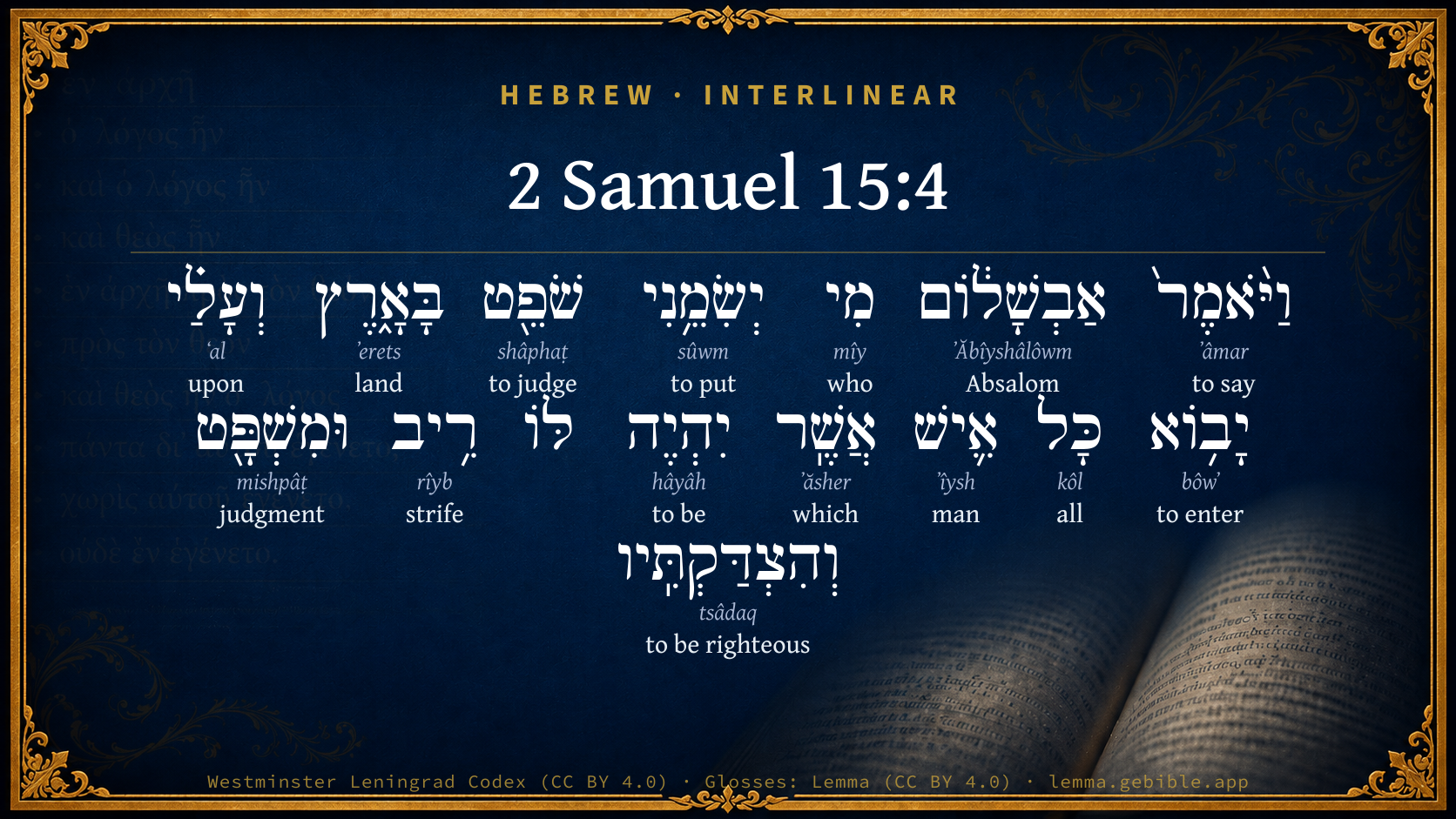
Hebrew (Westminster Leningrad Codex) 2 Samuel 15:4 appears in the Hebrew Old Testament. The text above is from the Westminster Leningrad Codex. Each word links to its Strong’s number, a concise gloss, and parsing drawn from the Open Scriptures Hebrew Bible morphology. Click any word for its full Brown-Driver-Briggs (BDB) entry.
Download image
Cite this verse

2 Samuel 15:4 (World English Bible). Public Domain. Lemma interlinear Bible study tool, https://lemma.gebible.app/v/2-samuel/15/4.

Show BibTeX & RIS
BibTeX
RIS
English Translation
Absalom said moreover, Oh that I were made judge in the land, that every man who has any suit or cause might come to me, and I would do him justice!
World English Bible · Public Domain
Download a study sheet

One document with this verse’s original text, its word-by-word gloss line, the meaning frame, cross-references with their text, attributed commentary, and full source and license credits — printable, and it pastes into notes with its structure intact.

This verse Autodidact and up

Study sheet (.html) Plain text (.txt)

A passage Seminary Student

Up to 50 verses in one chapter. A passage sheet keeps up to 6 commentary sources and 12 cross-references per verse, in the order this page ranks them, and says so on the sheet whenever that leaves anything out. Ask for a single verse and you get the Autodidact verse sheet above.

Everything on this page stays free to read, with no account — the sheet is a download of what is already on screen, not access to it.

Want to remove ads? Support Godless Engineer
Compare translations 3

The same verse in 3 English versions, stacked beneath the original-language interlinear above. Click any original word for its lexicon entry.

Each is an independent rendering of the whole verse — the interlinear is not word-aligned to these translations.

Highlighted words mark where these versions differ — a whole-verse word diff, not a word-by-word alignment.

  • World English Bible Public Domain
    Absalom said moreover, Oh that I were made judge in the land, that every man who has any suit or cause might come to me, and I would do him justice!
  • King James Version Public Domain
    Absalom said moreover, Oh that I were made judge in the land, that every man which hath any suit or cause might come unto me, and I would do him justice!
  • unfoldingWord Literal Text CC BY-SA 4.0
    And Absalom would say, “Who will appoint me a judge in the land, that every person to whom was a dispute and a judgment would come to me, and I would do him justice?”

unfoldingWord Literal Text — © unfoldingWord, licensed CC BY-SA 4.0. Word-aligned USFM3 via Door43 (git.door43.org/unfoldingWord/en_ult).

Versions to compare (up to 4)

3 of 4 selected

Show all 18 translations

Every available English version of this verse, each an independent rendering of the whole verse.

  • World English Bible Public Domain
    Absalom said moreover, Oh that I were made judge in the land, that every man who has any suit or cause might come to me, and I would do him justice!
  • Berean Standard Bible Public Domain
    And he would add, “If only someone would appoint me judge in the land, then everyone with a grievance or dispute could come to me, and I would give him justice.”
  • Majority Standard Bible Public Domain
    And he would add, “If only someone would appoint me judge in the land, then everyone with a grievance or dispute could come to me, and I would give him justice.”
  • King James Version Public Domain
    Absalom said moreover, Oh that I were made judge in the land, that every man which hath any suit or cause might come unto me, and I would do him justice!
  • American Standard Version (1901) Public Domain
    Absalom said moreover, Oh that I were made judge in the land, that every man who hath any suit or cause might come unto me, and I would do him justice!
  • Revised Version (1885) Public Domain
    Absalom said moreover, Oh that I were made judge in the land, that every man which hath any suit or cause might come unto me, and I would do him justice!
  • Geneva Bible (1599) Public Domain
    Absalom sayd moreouer, Oh that I were made Iudge in the lande, that euery man which hath any matter of controuersie, might come to me, that I might do him iustice.
  • Douay-Rheims (1899) Public Domain
    O that they would make me judge over the land, that all that have business might come to me, that I might do them justice.
  • Young's Literal Translation Public Domain
    And Absalom saith, `Who doth make me a judge in the land, that unto me doth come every man who hath a plea and judgment? -- then I have declared him righteous.'
  • Literal Standard Version CC BY-SA 4.0
    And Absalom says, “Who makes me judge in the land, that every man who has a plea and judgment comes to me? Then I have declared him righteous.”
  • Unlocked Literal Bible CC BY-SA 4.0
    Absalom added, “I wish that I were made judge in the land, so that every man who had any dispute or cause might come to me, and I would bring him justice!”
  • unfoldingWord Literal Text CC BY-SA 4.0
    And Absalom would say, “Who will appoint me a judge in the land, that every person to whom was a dispute and a judgment would come to me, and I would do him justice?”
  • Darby Bible Public Domain
    And Absalom said, Oh that I were made judge in the land, that every man who has any controversy and cause might come to me, and I would do him justice!
  • World Messianic Bible Public Domain
    Absalom said moreover, “Oh that I were made judge in the land, that every man who has any suit or cause might come to me, and I would do him justice!”
  • Webster's Bible Public Domain
    Absalom said moreover, Oh that I were made judge in the land, that every man who hath any suit or cause might come to me, and I would do him justice!
  • Free Bible Version CC BY-SA 4.0
    Then he would say, “If only there was someone to appoint me as judge for the country. Then everyone could come to me with their case or complaint, and I would give them justice.”
  • Bible in Basic English Public Domain
    And more than this, Absalom said, If only I was made judge in the land, so that every man who has any cause or question might come to me, and I would give a right decision for him!
  • JPS Tanakh (1917) Public Domain
    Absalom said moreover: 'Oh that I were made judge in the land, that every man who hath any suit or cause might come unto me, and I would do him justice!'

Literal Standard Version (2020), Covenant Press — licensed CC BY-SA 4.0. Text via the HelloAO Bible API (eBible.org). Unlocked Literal Bible (unfoldingWord) — licensed CC BY-SA 4.0. Text via the HelloAO Bible API (eBible.org). unfoldingWord Literal Text — © unfoldingWord, licensed CC BY-SA 4.0. Word-aligned USFM3 via Door43 (git.door43.org/unfoldingWord/en_ult). Free Bible Version, Dr. Jonathan Gallagher — licensed CC BY-SA 4.0. Text via the HelloAO Bible API (eBible.org).

Word by word

More ways to search: Search by grammar → Find every occurrence → Compare this word →

Practice this passage: Drill this verse → Learn its vocabulary →

וְהִצְדַּקְתִּֽיו
tsâdaq
H6663
“and · to be righteous · him”
Conjunction + Verb, Hiphil, Perfect, 1st Person, Common, Singular + Suffix, Personal, 3rd Person, Masculine, Singular
Part of Speech
Conjunction + Verb
Stem
Hiphil
Form
Perfect
Person
1st Person
Gender
Common
Number
Singular
Full BDB Definition

Origin: a primitive root

TWOT: 1879

to be just, be righteous - (Qal) - to have a just cause, be in the right - to be justified - to be just (of God) - to be just, be righteous (in conduct and character) - (Niphal) to be put or made right, be justified - (Piel) justify, make to appear righteous, make someone righteous - (Hiphil) - to do or bring justice (in administering law) - to declare righteous, justify - to justify, vindicate the cause of, save - to make righteous, turn to righteousness - (Hithpael) to justify oneself
  1. וַיֹּ֨אמֶר֙ ʼâmar H559 “and · to say” Conjunction + Verb, Qal, Sequential Imperfect, 3rd Person, Masculine, Singular
  2. אַבְשָׁל֔וֹם ʼĂbîyshâlôwm H53 “Absalom” Noun, Proper
  3. מִי mîy H4310 “who” Particle, Interrogative
  4. יְשִׂמֵ֥נִי sûwm H7760 “to put · me” Verb, Qal, Imperfect, 3rd Person, Masculine, Singular + Suffix, Personal, 1st Person, Common, Singular
  5. שֹׁפֵ֖ט shâphaṭ H8199 “judging” Verb, Qal, Participle Active, Masculine, Singular, Absolute
  6. בָּאָ֑רֶץ ʼerets H776 “in/at the · land” Preposition, Determined + Noun, Common, Both, Singular, Absolute
  7. וְעָלַ֗י ʻal H5921 “and · upon · me” Conjunction + Preposition + Suffix, Personal, 1st Person, Common, Singular
  8. יָב֥וֹא bôwʼ H935 “to enter” Verb, Qal, Imperfect, 3rd Person, Masculine, Singular
  9. כָּל kôl H3605 “all of” Noun, Common, Masculine, Singular, Construct
  10. אִ֛ישׁ ʼîysh H376 “man” Noun, Common, Masculine, Singular, Absolute
  11. אֲשֶֽׁר ʼăsher H834 “which” Particle, Relative
  12. יִהְיֶה hâyâh H1961 “to be” Verb, Qal, Imperfect, 3rd Person, Masculine, Singular
  13. רִ֥יב rîyb H7379 “strife” Noun, Common, Both, Singular, Absolute
  14. וּמִשְׁפָּ֖ט mishpâṭ H4941 “and · judgment” Conjunction + Noun, Common, Masculine, Singular, Absolute

About this verse

These counts appear in no published source. They are computed here, from the morphology-tagged text and Lemma’s own curated glosses. What Lemma adds →

16
words
15
distinct lemmas
Historical
section

Shared distinctive vocabulary

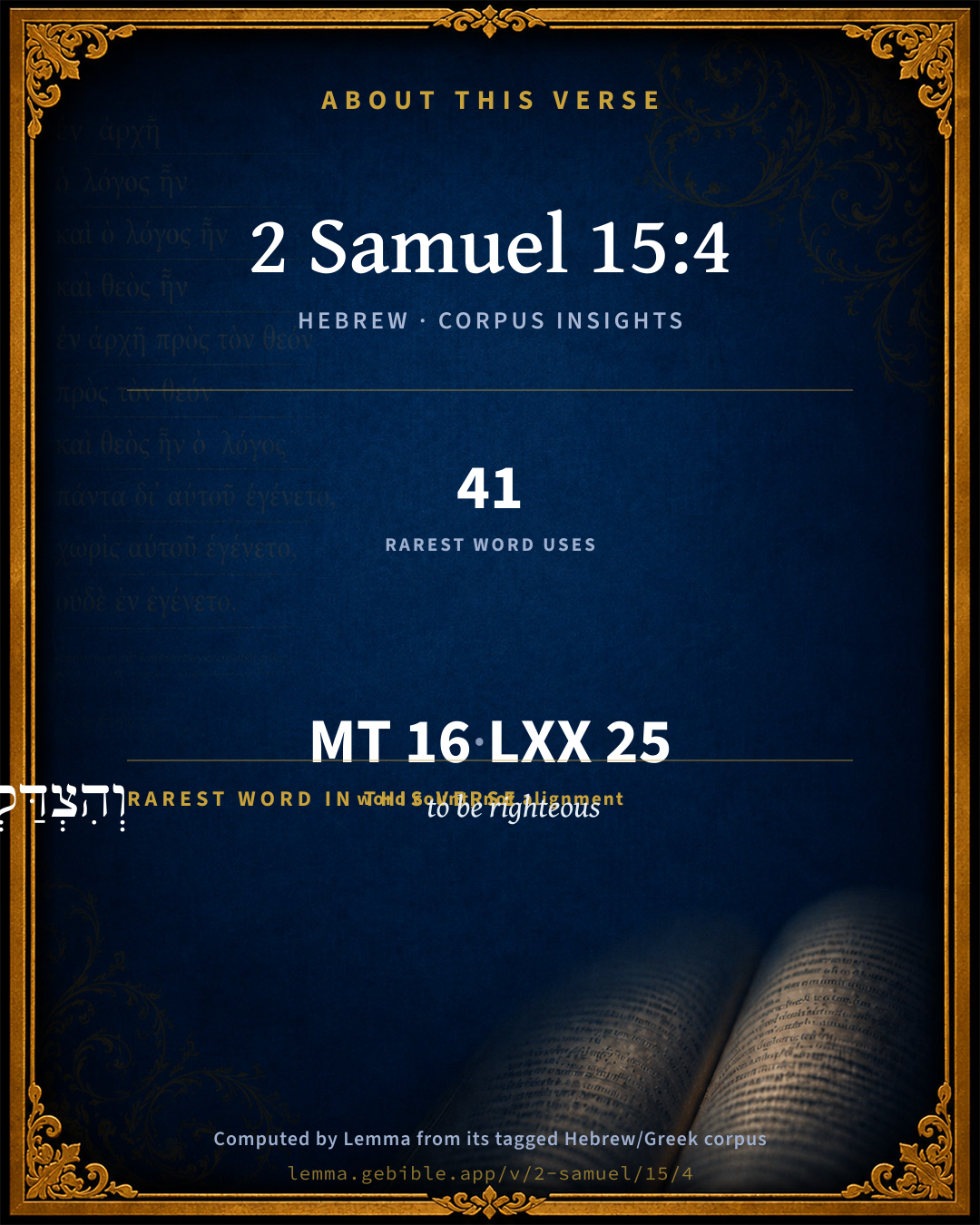
וְהִצְדַּקְתִּֽיו to be righteous H6663 occurs in 40 verses of the Hebrew Bible. Also found in:

Grammatical profile

  • 6 verbs
  • 6 nouns
  • 2 prepositions
  • 2 particles

Verb forms

  • וַיֹּ֨אמֶר֙ Qal · Sequential Imperfect
  • יְשִׂמֵ֥נִי Qal · Imperfect
  • שֹׁפֵ֖ט Qal · Participle Active
  • יָב֥וֹא Qal · Imperfect
  • יִהְיֶה Qal · Imperfect
  • וְהִצְדַּקְתִּֽיו Hiphil · Perfect

Hebrew & Septuagint length

In English translation the verse runs 31 words from the Hebrew and 33 from the Septuagint (LXX English) — closely comparable.

A rough comparison of the two English renderings, which tokenize alike — not a word-level alignment.

Word counts can differ between the Hebrew and the Greek without any difference in meaning — e.g. the Hebrew direct-object marker אֵת has no separate Greek word, and Greek often adds the article ὁ.

In the original languages it is 16 Hebrew tokens and 25 Greek tokens — but the two are counted differently (Hebrew bundles its prefixes and suffixes into one token; the Greek is in lemma form), so that isn’t a like-for-like length.

Cross-references

6

Topical passages linked to 2 Samuel 15:4 in the Treasury of Scripture Knowledge — connected by theme and wording, ordered by reader-vote popularity; previews shown in the World English Bible.

  • Judges 9:29 Would that this people were under my hand! then would I remove Abimelech. He said to Abimelech, Increase your army, and come out.
  • Judges 9:1–5 Abimelech the son of Jerubbaal went to Shechem to his mother's brothers, and spoke with them, and with all the family of the house of his mother's father, saying,
  • Proverbs 25:6 Don't exalt yourself in the presence of the king, Or claim a place among great men;
  • Proverbs 27:2 Let another man praise you, And not your own mouth; A stranger, and not your own lips.
  • Luke 14:8–11 "When you are invited by anyone to a marriage feast, don't sit in the best seat, since perhaps someone more honorable than you might be invited by him,
  • 2 Peter 2:19 promising them liberty, while they themselves are bondservants of corruption; for by whom a man is overcome, by the same is he also brought into bondage.

Cross-references courtesy of OpenBible.info (CC BY 4.0).

Hebrew and Greek witnesses Masoretic Hebrew ↔ Greek Septuagint

The same verse in the two great witnesses to the Old Testament, shown verse-for-verse.

These are two independent witnesses, not word-aligned to each other, and the Septuagint is shown in lemma (dictionary) form.

Hebrew 2 Samuel 15:4 Masoretic · Westminster Leningrad Codex

וַיֹּ֨אמֶר֙ אַבְשָׁל֔וֹם מִי יְשִׂמֵ֥נִי שֹׁפֵ֖ט בָּאָ֑רֶץ וְעָלַ֗י יָב֥וֹא כָּל אִ֛ישׁ אֲשֶֽׁר יִהְיֶה לּוֹ רִ֥יב וּמִשְׁפָּ֖ט וְהִצְדַּקְתִּֽיו

Absalom said moreover, Oh that I were made judge in the land, that every man who has any suit or cause might come to me, and I would do him justice!

World English Bible · Public Domain

Greek LXX 2 Samuel 15:4 Septuagint · lemma form

καί εἶπον αβεσσαλωμ τίς ἐγώ καταἵστημι κριτής ἐν ὁ γῆ καί ἐπί ἐγώ ἔρχομαι πᾶς ἀνήρ ὅς ἐάν εἰμί ἀντιλογία καί κρίσις καί δικαιόω αὐτός

And Abessalom said, O that one would make me a judge in the land; then every man who had a dispute or a cause would come to me, and I would judge him!

LXX2012 (modern English Septuagint) · Public Domain

Hebrew: Westminster Leningrad Codex (CC BY 4.0). Greek: Septuagint (public domain); English from LXX2012 (modern English Septuagint) (Public Domain). How the Septuagint differs from the Hebrew →

Targum (Aramaic paraphrase)

1

The Targum is the ancient Jewish Aramaic paraphrase of the Hebrew Scriptures — an interpretive translation, not the Hebrew text itself. Onkelos (literal) and Pseudo-Jonathan (expansive) render the Torah, and Jonathan the Prophets. Coverage is partial: where no permissively-licensed English translation exists for a verse, only the Aramaic is shown. This is verse-level text, not a word-by-word alignment to the Hebrew.

  1. Targum Jonathan Prophets (Joshua–Malachi)
    וַאֲמַר אַבְשָׁלוֹם מַן יְמַנַנִי דַיָנָא בְּאַרְעָא וְקָדָמַי יֵיתִי כָּל גְבַר דִיהֵי לֵיהּ דִין וּמַצוּ וְאַדִינַנֵיהּ בִקְשׁוֹט:

    (no public-domain English translation for this verse)

    Targum Jonathan — Aramaic: “Mikraot Gedolot” (public domain). English: “Sefaria Community Translation” (CC0 1.0 (public-domain dedication)); “London "Chaldee Paraphrase," 1871” (public domain). Text via Sefaria.

Commentary

Notes on 2 Samuel 15:4 from classic Christian and Jewish commentators (each source and its license shown beneath its notes). The classic Christian expositions comment on the surrounding passage and are grouped to its opening verse, so a note may address several verses; the Jewish commentaries on the Tanakh (Rashi and others) are per-verse, so they appear only where the commentator wrote on this verse.

Lemma curates 59 commentaries, every one of them public domain or Creative Commons licensed, each selected and text-cleaned for this edition rather than reprinted as found. About our sources →

Trapp's Complete Commentary

John Trapp

2Sa 15:4 Absalom said moreover, Oh that I were made judge in the land, that every man which hath any suit or cause might come unto me, and I would do him justice!

Ver. 4. Oh that I were made judge in the land.] It were pity else, you are so worthy a wight; let Pellican say for you. Absalom was an absolute villain, saith he, ungrateful, ambitious, arrogant, a hypocrite, a liar, a persecutor of his father, a subverter of the people, an example and monument of rebellious sons, and of all that persecute God’s servants. And was not this a fit man to make a supreme judge! Surely, such while they seek the greatest dignities, find the greatest shame; and like apes, when they be climbing, they do the more show their deformities.

John Trapp, A Commentary or Exposition upon All the Books of the Old and New Testament (1647–1656) — public domain. Text from a community e-Sword module.

Joseph Benson's Commentary

2Sa 15:4-6. Absalom said, O that I were made judge in the land! — Though he was admitted to come to court, and see the king, he had no office there, as, it seems, the rest of the king’s sons had. This he took ill, and endeavoured to bring the people to do so too, by persuading them that, if he were in authority, he would take speedy care to do them justice. When any man came nigh to do him obeisance — To fall prostrate before him as the king’s son. He put forth his hand and took him — That is, prevented him from prostrating himself, and condescended even to salute him with a kiss. In this manner did Absalom to all Israel — Robbed his father of the affections of the people, and possessed himself of them; some admiring his beauty and gallantry; others his courtesy and civility; and others being taken with his magnificent promises of the noble things he would do if he were their king.

Joseph Benson's Commentary on the Old and New Testaments (1811–1818) — public domain. Text from a community e-Sword module.

Geneva Bible (1599)

Geneva Bible translators

Thus by slander, flattery and fair promises the wicked seek preferment.

Geneva Bible (1599) marginal notes — public domain. Text via Bolls.life.

John Gill's Exposition

Absalom said, moreover,.... To the same persons, at the same time:

oh that I were made judge in the land; by which it appears that he had no office under the king; partly either because of his crime, and so not thought fit, and partly because he appeared to be an ambitious aspiring man, and so it was thought not safe to put him into any office:

that every man that hath any suit or cause might come unto me, and I would do him justice; at once, without any further trouble, or coming often, and in vain, and to no purpose.

John Gill's Exposition of the Whole Bible (1746–1763) — public domain (CC PDM 1.0). Text via the HelloAO Bible API.

Matthew Poole's English Annotations

Oh that I were made judge in the land! for the king had only restored Absalom to favour, but thought not fit to put him into any place of power and trust.

I would do him justice; I should refuse no man, and decline no pains to do any man good. So he pretends to a very public spirit.

Matthew Poole's English Annotations on the Holy Bible (1683–1685) — public domain. Text from a community e-Sword/MySword module.

Rashi

Rabbi Shlomo Yitzchaki (Rashi)

And I will judge him righteously. [Targum Yonosan translates:] "And I will judge him truthfully."

Rashi on the Tanakh — English translations: “The Judaica Press complete Tanach with Rashi, translated by A. J. Rosenberg” (CC BY 4.0); “Pentateuch with Rashi's commentary by M. Rosenbaum and A.M. Silbermann, 1929-1934” (public domain); “The Metsudah Tanach series, Lakewood, N.J” (CC BY 4.0); and “The Book of Joshua, Metsudah Publications, 1997” (CC BY 4.0). Text via Sefaria.

Lesson kit

Teaching starters — assembled from the data on this page, not authored interpretation. Every prompt links to the verse data it draws on. Edit before teaching.

2 Samuel, in the Historical, opens this verse with 16 words (15 distinct Hebrew lemmas). Its most distinctive word is tsâdaq (“to be righteous”). A historical commentator’s framing appears above. Read the whole chapter for the surrounding context.

Discussion questions

  1. How does “to be righteous” (tsâdaq) shape what this verse is saying?
  2. How does Genesis 38:26, which shares the word «to be righteous», read alongside this verse?
  3. These translations render this verse differently. What is at stake in choosing one wording over another?
  4. «וַיֹּ֨אמֶר֙» is a Qal Sequential Imperfect verb. How does that grammatical form shape the action described?
  5. Compare how Trapp's Complete Commentary and Joseph Benson's Commentary read this verse. Where do they agree or differ?

Things to notice

Reading settings

Reading text

Shown beneath each verse's original-language words.

Old Testament
Old Testament edition

Read the OT as the Masoretic Hebrew (MT) or the Greek Septuagint (LXX).

English shown for the Greek Septuagint (in the Hebrew ↔ Greek comparison).

Comparing translations? Open the Compare panel on any verse page to stack up to four side by side.