Psalms 7:8

Hebrew (Westminster Leningrad Codex) Psalms 7:8 appears in the Hebrew Old Testament. The text above is from the Westminster Leningrad Codex. Each word links to its Strong’s number, a concise gloss, and parsing drawn from the Open Scriptures Hebrew Bible morphology. Click any word for its full Brown-Driver-Briggs (BDB) entry.
Download image
Cite this verse

Psalms 7:8 (World English Bible). Public Domain. Lemma interlinear Bible study tool, https://lemma.gebible.app/v/psalms/7/8.

Show BibTeX & RIS
BibTeX
RIS
English Translation
Yahweh administers judgment to the peoples. Judge me, Yahweh, according to my righteousness, And to my integrity that is in me.
World English Bible · Public Domain
Download a study sheet

One document with this verse’s original text, its word-by-word gloss line, the meaning frame, cross-references with their text, attributed commentary, and full source and license credits — printable, and it pastes into notes with its structure intact.

This verse Autodidact and up

Study sheet (.html) Plain text (.txt)

A passage Seminary Student

Up to 50 verses in one chapter. A passage sheet keeps up to 6 commentary sources and 12 cross-references per verse, in the order this page ranks them, and says so on the sheet whenever that leaves anything out. Ask for a single verse and you get the Autodidact verse sheet above.

Everything on this page stays free to read, with no account — the sheet is a download of what is already on screen, not access to it.

Want to remove ads? Support Godless Engineer
Compare translations 3

The same verse in 3 English versions, stacked beneath the original-language interlinear above. Click any original word for its lexicon entry.

Each is an independent rendering of the whole verse — the interlinear is not word-aligned to these translations.

Highlighted words mark where these versions differ — a whole-verse word diff, not a word-by-word alignment.

  • World English Bible Public Domain
    Yahweh administers judgment to the peoples. Judge me, Yahweh, according to my righteousness, And to my integrity that is in me.
  • King James Version Public Domain
    The LORD shall judge the people: judge me, O LORD, according to my righteousness, and according to mine integrity that is in me.
  • unfoldingWord Literal Text CC BY-SA 4.0
    Yahweh, adjudicate the peoples! Judge me, Yahweh, according to my righteousness and according to my integrity, Most High!

unfoldingWord Literal Text — © unfoldingWord, licensed CC BY-SA 4.0. Word-aligned USFM3 via Door43 (git.door43.org/unfoldingWord/en_ult).

Versions to compare (up to 4)

3 of 4 selected

Show all 18 translations

Every available English version of this verse, each an independent rendering of the whole verse.

  • World English Bible Public Domain
    Yahweh administers judgment to the peoples. Judge me, Yahweh, according to my righteousness, And to my integrity that is in me.
  • Berean Standard Bible Public Domain
    The LORD judges the peoples; vindicate me, O LORD, according to my righteousness and integrity.
  • Majority Standard Bible Public Domain
    The LORD judges the peoples; vindicate me, O LORD, according to my righteousness and integrity.
  • King James Version Public Domain
    The LORD shall judge the people: judge me, O LORD, according to my righteousness, and according to mine integrity that is in me.
  • American Standard Version (1901) Public Domain
    Jehovah ministereth judgment to the peoples: Judge me, O Jehovah, according to my righteousness, and to mine integrity that is in me.
  • Revised Version (1885) Public Domain
    The LORD ministereth judgment to the peoples: judge me, O LORD, according to my righteousness, and to mine integrity that is in me.
  • Geneva Bible (1599) Public Domain
    The Lord shall iudge the people: Iudge thou me, O Lord, according to my righteousnesse, and according to mine innocencie, that is in mee.
  • Douay-Rheims (1899) Public Domain
    and a congregation of people shall surround thee. And for their sakes return thou on high.
  • Young's Literal Translation Public Domain
    Jehovah doth judge the peoples; Judge me, O Jehovah, According to my righteousness, And according to mine integrity on me,
  • Literal Standard Version CC BY-SA 4.0
    YHWH judges the peoples; Judge me, O YHWH, || According to my righteousness, || And according to my integrity [that is] on me.
  • Unlocked Literal Bible CC BY-SA 4.0
    Yahweh, judge the nations; vindicate me, Yahweh, because I am righteous and innocent, Most High.
  • unfoldingWord Literal Text CC BY-SA 4.0
    Yahweh, adjudicate the peoples! Judge me, Yahweh, according to my righteousness and according to my integrity, Most High!
  • Darby Bible Public Domain
    Jehovah shall minister judgment to the peoples. Judge me, Jehovah, according to my righteousness, and according to mine integrity which is in me.
  • World Messianic Bible Public Domain
    The LORD administers judgment to the peoples. Judge me, LORD, according to my righteousness, and to my integrity that is in me.
  • Webster's Bible Public Domain
    \\7:7\\So shall the congregation of the people encompass thee: for their sakes therefore return thou on high.
  • Free Bible Version CC BY-SA 4.0
    The Lord judges all people. Defend me, Lord, because I do what is right, because of my integrity.
  • Bible in Basic English Public Domain
    The Lord will be judge of the peoples; give a decision for me, O Lord, because of my righteousness, and let my virtue have its reward.
  • JPS Tanakh (1917) Public Domain
    (7-9) O LORD, who ministerest judgment to the peoples, judge me, O LORD, according to my righteousness, and according to mine integrity that is in me.

Literal Standard Version (2020), Covenant Press — licensed CC BY-SA 4.0. Text via the HelloAO Bible API (eBible.org). Unlocked Literal Bible (unfoldingWord) — licensed CC BY-SA 4.0. Text via the HelloAO Bible API (eBible.org). unfoldingWord Literal Text — © unfoldingWord, licensed CC BY-SA 4.0. Word-aligned USFM3 via Door43 (git.door43.org/unfoldingWord/en_ult). Free Bible Version, Dr. Jonathan Gallagher — licensed CC BY-SA 4.0. Text via the HelloAO Bible API (eBible.org).

Word by word

More ways to search: Search by grammar → Find every occurrence → Compare this word →

Practice this passage: Drill this verse → Learn its vocabulary →

יָדִ֪ין
dîyn
H1777
“to judge”
Verb, Qal, Imperfect, 3rd Person, Masculine, Singular
Part of Speech
Verb
Stem
Qal
Form
Imperfect
Person
3rd Person
Gender
Masculine
Number
Singular
Full BDB Definition

Origin: a primitive root [comp. H113 ]

TWOT: 426

to judge, contend, plead - (Qal) - to act as judge, minister judgment - to plead a cause - to execute judgment, requite, vindicate - to govern - to contend, strive - (Niphal) to be at strife, quarrel
  1. יְהוָה֮ Yᵉhôvâh H3068 “LORD” Noun, Proper
  2. עַ֫מִּ֥ים ʻam H5971 “peoples” Noun, Common, Masculine, Plural, Absolute
  3. שָׁפְטֵ֥נִי shâphaṭ H8199 “judge · me” Verb, Qal, Imperative, 2nd Person, Masculine, Singular + Suffix, Personal, 1st Person, Common, Singular
  4. יְהוָ֑ה Yᵉhôvâh H3068 “LORD” Noun, Proper
  5. כְּצִדְקִ֖י tsedeq H6664 “like/as · righteousness · my” Preposition + Noun, Common, Masculine, Singular, Construct + Suffix, Personal, 1st Person, Common, Singular
  6. וּכְתֻמִּ֣י tôm H8537 “and · like/as · integrity · my” Conjunction + Preposition + Noun, Common, Masculine, Singular, Construct + Suffix, Personal, 1st Person, Common, Singular
  7. עָלָֽי ʻal H5921 “upon · me” Preposition + Suffix, Personal, 1st Person, Common, Singular

About this verse

These counts appear in no published source. They are computed here, from the morphology-tagged text and Lemma’s own curated glosses. What Lemma adds →

8
words
7
distinct lemmas
Wisdom
section

Notable vocabulary

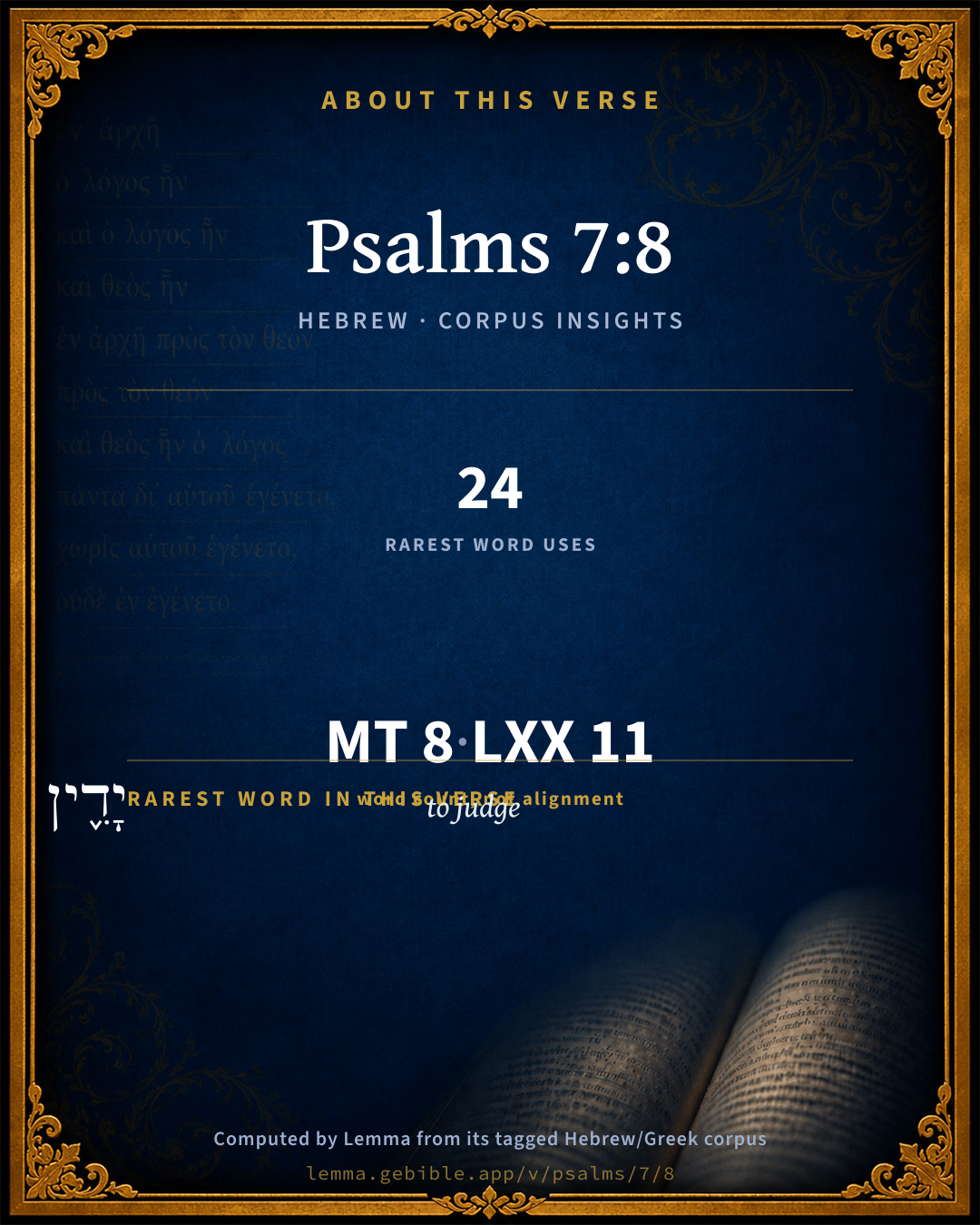
The rarest word here is יָדִ֪ין to judge H1777 — appearing just 24 times in the whole Hebrew Bible.

Shared distinctive vocabulary

יָדִ֪ין to judge H1777 occurs in 24 verses of the Hebrew Bible. Also found in:

Grammatical profile

  • 2 verbs
  • 5 nouns
  • 1 preposition

Verb forms

  • יָדִ֪ין Qal · Imperfect
  • שָׁפְטֵ֥נִי Qal · Imperative

Repetition

A word recurs within this verse — often emphatic in Hebrew:

  • יְהוָה֮ LORD H3068 ×2

Hebrew & Septuagint length

In English translation the verse runs 21 words from the Hebrew and 23 from the Septuagint (LXX English) — closely comparable.

A rough comparison of the two English renderings, which tokenize alike — not a word-level alignment.

Word counts can differ between the Hebrew and the Greek without any difference in meaning — e.g. the Hebrew direct-object marker אֵת has no separate Greek word, and Greek often adds the article ὁ.

In the original languages it is 8 Hebrew tokens and 11 Greek tokens — but the two are counted differently (Hebrew bundles its prefixes and suffixes into one token; the Greek is in lemma form), so that isn’t a like-for-like length.

Cross-references

23

Topical passages linked to Psalms 7:8 in the Treasury of Scripture Knowledge — connected by theme and wording, ordered by reader-vote popularity; previews shown in the World English Bible.

  • Psalms 96:13 Before Yahweh; for he comes, For he comes to judge the earth. He will judge the world with righteousness, The peoples with his truth.
  • Romans 14:10–12 But you, why do you judge your brother? Or you again, why do you despise your brother? For we will all stand before the judgment seat of Christ.
  • Psalms 43:1 Vindicate me, God, and plead my cause against an ungodly nation. Oh, deliver me from deceitful and wicked men.
  • 2 Corinthians 1:12 For our boasting is this: the testimony of our conscience, that in holiness and sincerity of God, not in fleshly wisdom but in the grace of God we behaved ourselves in the world, and more abundantly toward you.
  • Psalms 98:9 Let them sing before Yahweh, For he comes to judge the earth. He will judge the world with righteousness, And the peoples with equity.
  • 1 Thessalonians 2:10 You are witnesses with God, how holy, righteously, and blamelessly we behaved ourselves toward you who believe.
  • Psalms 26:1 Judge me, Yahweh, for I have walked in my integrity. I have trusted also in Yahweh without wavering.
  • Psalms 78:72 So he was their shepherd according to the integrity of his heart, And guided them by the skillfulness of his hands.
  • 1 Corinthians 4:4–5 For I know nothing against myself. Yet I am not justified by this, but he who judges me is the Lord.
  • Psalms 35:24–27 Vindicate me, Yahweh my God, according to your righteousness; Don't let them gloat over me.
  • Genesis 18:25 Be it far from you to do things like that, to kill the righteous with the wicked, that so the righteous should be as the wicked. May that be far from you. Shouldn't the Judge of all the earth do right?"
  • Genesis 31:53 The God of Abraham, and the God of Nahor, the God of their father, judge between us." Then Jacob swore by the fear of his father, Isaac.
  • 2 Chronicles 20:12 Our God, will you not judge them? for we have no might against this great company that comes against us; neither know we what to do: but out eyes are on you.
  • Psalms 9:8 He will judge the world in righteousness. He will administer judgment to the peoples in uprightness.
  • Psalms 11:4 Yahweh is in his holy temple. Yahweh is on his throne in heaven. His eyes observe. His eyes examine the children of men.
  • Psalms 17:2–3 Let my sentence come forth from your presence; Let your eyes look on equity.
  • Psalms 18:20–24 Yahweh has rewarded me according to my righteousness. According to the cleanness of my hands has he recompensed me.
  • Psalms 25:21 Let integrity and uprightness preserve me, For I wait for you.
  • Psalms 26:11 But as for me, I will walk in my integrity. Redeem me, and be merciful to me.
  • Psalms 41:12 As for me, you uphold me in my integrity, And set me in your presence forever.
  • Psalms 82:1 God presides in the great assembly. He judges among the gods.
  • Proverbs 19:1 Better is the poor who walks in his integrity Than he who is perverse in his lips and is a fool.
  • Acts 17:31 because he has appointed a day in which he will judge the world in righteousness by the man whom he has ordained; of which he has given assurance to all men, in that he has raised him from the dead."

Cross-references courtesy of OpenBible.info (CC BY 4.0).

Hebrew and Greek witnesses Masoretic Hebrew ↔ Greek Septuagint

The same verse in the two great witnesses to the Old Testament, shown verse-for-verse.

You’re reading Greek Psalm 7 (Hebrew Psalm 7). The Septuagint counts the superscription, so verse numbers can differ from the Hebrew — chapter-level alignment, not verse-by-verse. Numbering follows Rahlfs.

These are two independent witnesses, not word-aligned to each other, and the Septuagint is shown in lemma (dictionary) form.

Hebrew Psalms 7:8 Masoretic · Westminster Leningrad Codex

יְהוָה֮ יָדִ֪ין עַ֫מִּ֥ים שָׁפְטֵ֥נִי יְהוָ֑ה כְּצִדְקִ֖י וּכְתֻמִּ֣י עָלָֽי

Yahweh administers judgment to the peoples. Judge me, Yahweh, according to my righteousness, And to my integrity that is in me.

World English Bible · Public Domain

Greek LXX Greek Psalm 7:8 Septuagint · lemma form

καί συναγωγή λαός κυκλόω σύ καί ὑπέρ οὗτος εἰς ὕψος ἐπιστρέφω

The Lord shall judge the nations: judge me, O Lord, according to my righteousness, and according to my innocence that is in me.

LXX2012 (modern English Septuagint) · Public Domain

Hebrew: Westminster Leningrad Codex (CC BY 4.0). Greek: Septuagint (public domain); English from LXX2012 (modern English Septuagint) (Public Domain). How the Septuagint differs from the Hebrew →

Commentary

Notes on Psalms 7:8 from classic Christian and Jewish commentators (each source and its license shown beneath its notes). The classic Christian expositions comment on the surrounding passage and are grouped to its opening verse, so a note may address several verses; the Jewish commentaries on the Tanakh (Rashi and others) are per-verse, so they appear only where the commentator wrote on this verse.

Lemma curates 59 commentaries, every one of them public domain or Creative Commons licensed, each selected and text-cleaned for this edition rather than reprinted as found. About our sources →

Trapp's Complete Commentary

John Trapp

Psa 7:8 The LORD shall judge the people: judge me, O LORD, according to my righteousness, and according to mine integrity [that is] in me.

Ver. 8. The Lord shall judge the people] The Ethiopian judges leave the chief seat ever empty, thereby acknowledging that God is the chief judge.

Accordiny to my righteousness] viz. In this particular crime, whereof I am accused. Great is the confidence of a good conscience toward God. Such only can abide by the everlasting burnings.

John Trapp, A Commentary or Exposition upon All the Books of the Old and New Testament (1647–1656) — public domain. Text from a community e-Sword module.

The Biblical Illustrator

Joseph S. Exell

Psa_7:8

Judge me, O Lord, according to my righteousness, and according to mine integrity that is in me.

Integrity and peace

A truly noble confidence! and yet many of our time would call the language very dangerous, if it were spoken by any but one of the Scripture saints. Some, on the other hand, charge it as a fault in our doctrine of salvation by grace, that it lets down even the standards of our morality itself; because it is a part of our merit, under grace, to have no merit. Let us see if we can find the true place for integrity under the Christian salvation by noting--

I. How the Scriptures speak of integrity. The text cited does not stand alone. David says again, Judge me, O Lord; for I have walked in mine integrity. Good men are called upright, just, righteous, and right. It is even declared that they shall deliver their own souls by their righteousness. The Christian disciples of the New Testament dare to say that they have a conscience void of offence. They exhort others to walk so as they have them for examples. Making the strongest confessions of ill-desert, and resting their salvation on the justifying grace of God, they are still able to be free in professing their own conscious integrity in their discipleship. The explanation is not difficult if we consider--

II. What integrity means. As an integer is a whole, in distinction from a fraction, which is only a part, so a man of integrity is a man whose aim in the right is a whole aim, in distinction from one whose aim is divided, partial, or unstable. It does not mean that he has never been a sinner, or that he is not now, but simply that the intent of his soul is to do and be wholly right with God and man. Distinguish between commercial integrity and the higher integrity of religion. What does it signify that a man gives men their due, and will not give God His? God is a person as truly as men are, more closely related to us, a better friend, one who has claims of right more sacred. Does it entitle one to the name of a just man that he is honest with men of one colour and not with those of another? What, then, shall we think of mere commercial integrity taken, by itself? Real integrity, ready to do right to God as to men, to men as to God, must be the condition of Christian character itself. Let us inquire--

III. In what manner? If Christ saves men, not by their merit, or on terms of justice or reward, but by purely gratuitous favour, what place have we for insisting on the need of integrity at all? It seems to be the comfort of what some call their piety, that God is going to dispense with all merit in them, which they take to mean all sound reality of character,--all exactness of principle and conduct. Integrity is wholeness of aim or intent; but mere intent does not make a character. Yet it is just that by which all evil will be vanquished, under Christ and by grace, because it puts a man at the very gate of faith, where all Gods helps are waiting for Him. His new and better aim is his way of coming into the righteousness of God. The Scripture conditions all help on the integrity of the soul. Ye shall seek and find Me, if ye search for Me with all your heart. Let us note, in conclusion--

1. What it is that gives such peace and loftiness of bearing to the life of a truly righteous man. Storms of detraction and malignant conspiracies against his character may drive their clouds about Him, but he sits above with his God, and they all sail under. The work of righteousness shall be peace, and the effects of righteousness, quietness and assurance forever. Here, too--

2. Is the ground of all failures, and all highest successes in the Christian life. Only to be an honest man, in this genuinely Christian sense, signifies a great deal more than most of us ever conceive. Little do we realise how honest a man must be to pray, how heartily, simply, totally he must mean what he prays for. Perhaps he prays much, and has it for a continual wonder that God does not answer his prayers. Perhaps he has conceived a higher standing in religion, and has tried long to reach it, and finds it not. Strange as it may seem, here is the root of the difficulty--that his projected attainments are dear ahead of his integrity. Some traitor is hid in his souls chambers, that is kept there, and carefully fed. Success is the fixed destiny of any soul that has once reached the point of whole intent. I note--

3. A very important deduction, namely,--that every man who comes into a state of right intent will forthwith also be a Christian. Whoever is willing to be carried just where it will carry him, cost him what it may, in that man the spirit of all sin is broken, and his mind is in a state to lay hold of Christ and be laid hold of by Him. For the eyes of the Lord run to and fro throughout the whole earth, to show Himself strong in the behalf of them whose heart is perfect towards Him. God is on the look-out always for an honest man--him to help and with him, and for him, to be strong. And if there be one, God will not miss him; for His desiring, all-searching eyes are running the world through always to find him. (Horace Bushnell, D. D.)

Self-respect and self- righteousness

Is this speech self-righteous? If so it is a bad speech: for self-righteousness is a bad temper of mind; few are worse. But there is another temper of mind which looks like it at first, but is not so, and which is right in its way. I mean the temper of Job when his friends tried to make him out a bad man. He declared he would tell no lies about himself. Till I die I will not remove mine integrity from me. I have, on the whole, tried to be a good man, and I will not make myself out a bad one. St. John said, If we say that we have no sin we deceive ourselves, and the truth is not in us.

I. But we may misuse that doctrine. Many do.

1. Some people try to confess as many sins as possible. They do not go and commit them, but they fancy themselves guilty of them. This is all too common. It is ruinous oftentimes to the body; I have seen people kill their own bodies and die early by this folly. And they kill their souls too, and enter into strong delusions and believe lies. And yet one pities them more than we can be angry with them, and all the more because they are generally the most innocent, and who have least to confess. We should pray for them.

2. But there is a worse misuse of St. Johns doctrine than this. A man may be proud of calling himself a miserable sinner, and of confessing his sins. But if he really knew the misery of sin he would not talk so much about it. His talk is only another way of saying, I am a better man than you. I confess my sins, and you do not.

II. But what is the right use of the doctrine? If you refuse, like Job, to own yourself guilty of what you know you are not guilty of, such a man will tell you that you are ignorant of the first principles of the gospel. You are building integrity and morality. Now, he is partly right, and so are you. St. Paul will help us, for he said, I judge not mine own self; for I know nothing against myself, yet am I not hereby justified; but He that judgeth me is the Lord. Now, no man was ever less self-righteous than Paul, and yet he says, I know nothing against myself. Then, here is the rule. If you have done wrong, confess that; if you have done right, be not afraid to say you have. And to keep up self-respect, go on trying to do right. Wrong no man, least of all, a woman, But, mind, your right-doing will not justify you, for we all have sinned.

III. Remember the Lord will judge you. Be glad of this, as David was, for he knew that the Lord would bring him out of his sin. You must not think of God as hard, or you will fret and not fight. But if you believe Him good you will fight and not fret. And you will be able to leave yourself in His hands. (Charles Kingsley.)

The Biblical Illustrator, edited by Joseph S. Exell (c. 1880s–1900s) — public domain. Text from a community e-Sword module.

Joseph Benson's Commentary

Psa 7:8. The Lord shall judge the people — The Sovereign of the world will not fail to dispense equal justice unto all, according to their works. Assured of which, I say, Judge me, O Lord, according to my righteousness — For I desire no greater favour than to be disposed of according to my innocence in this matter. If I be guilty of those evil designs toward Saul wherewith Cush and others charge me, do thou give sentence against me; but, if I be just and innocent toward him, as thou knowest I am, and have been, do thou plead my right. Observe, reader, “legal or perfect righteousness and integrity are peculiar to the Redeemer; but evangelical righteousness and integrity all must have who would be saved.” — Horne.

Joseph Benson's Commentary on the Old and New Testaments (1811–1818) — public domain. Text from a community e-Sword module.

J. A. Alexander on Psalms

Joseph Addison Alexander

9. (Psa 7:8). The same thing is now expressed in a direct and formal manner. Jehovah will judge, is to judge, the nations. This is laid down as a certain general proposition, from which the Psalmist draws a special inference in the shape of a petition. Judge me, O Lord, Jehovah! If it be true that God will judge the world, redress all wrong, and punish all iniquity, let him begin with me. Let me share now in the justice which is to be universally administered. Judge me, O Lord, according to my right, and my completeness, or perfection, over me, i. e. according to my innocence which covers and protects me. All such expressions must be qualified and explained by the confession of unworthiness in Ps. vi. and elsewhere, which sufficiently demonstrates that the Psalmist here makes no claim to absolute perfection and innocence, nor to any whatever that is independent of God's sovereign mercy.

Joseph Addison Alexander, The Psalms Translated and Explained (1850) — public domain. Text from a community e-Sword module.

Tyndale Open Study Notes

Tyndale Open Resources

7:8 The judgment is against the defendants (the nations) and in favor of the righteous plaintiff (the psalmist; see 43:1). • Although not innocent of all sin, the psalmist is a person of authentic integrity (see 15:2; 25:21; 41:12; 78:72; cp. Job 1:1, 8; 9:20, 22).

Tyndale Open Study Notes — © Tyndale Open Resources, licensed CC BY-SA 4.0. Text via the HelloAO Bible API.

Geneva Bible (1599)

Geneva Bible translators

As touching my behavior toward Saul and mine enemies.

Geneva Bible (1599) marginal notes — public domain. Text via Bolls.life.

Jamieson, Fausset & Brown

Robert Jamieson, A. R. Fausset & David Brown

Though not claiming innocence in general, he can confidently do so in this case, and in demanding from the Judge of all the earth a judgment, he virtually asks acquittal.

Jamieson, Fausset & Brown — Commentary Critical and Explanatory on the Whole Bible (1871) — public domain (CC PDM 1.0). Text via the HelloAO Bible API.

Adam Clarke's Commentary

Verse 8. The Lord shall judge the people] He will execute justice and maintain truth among them. They shall not be as sheep without a shepherd.

Judge me, O Lord] Let my innocence be brought to the light, and my just dealing made clear as the noonday.

Adam Clarke's Commentary on the Bible (1810–1826) — public domain. Text from a community e-Sword/MySword module.

John Calvin's Commentaries

8 Jehovah shall judge the nations This sentence is closely connected with the preceding verse. David had prayed God to show himself as judge to the nations; and now he takes it for a certain and admitted truth, that it is the peculiar office of God to judge the nations: for the word put in the future tense, and rendered shall judge, denotes here a continued act; and this is the signification of the future tense in general sentences. Besides, he does not here speak of one nation only, but comprehends all nations. As he acknowledges God to be the judge of the whole world, he concludes a little after from this, that he will maintain his cause and right. And as often as we seem to be forsaken and oppressed, we should recall this truth to our remembrance, that as God is the governor of the world, it is as utterly impossible for him to abdicate his office as to deny himself. From this source there will flow a continual stream of comfort, although a long succession of calamities may press upon us: for from this truth we may assuredly conclude, that he will take care to defend our innocence. It would be contrary to every principle of just reasoning to supposes that he who governs many nations neglects even one man. What happens with respect to the judges of this world can never take place with respect to him; he cannot, as may be the case with them, be so occupied about great and public affairs as to neglect, because unable to attend to them, the concerns of individuals. He again brings into new his integrity that he may not seem, after the example of hypocrites to make the name of God a mere pretext for the better furthering of his own purposes. Since God is no respecter of persons, we cannot expect him to be on our side, and to favour us, if our cause is not good. But it is asked, how can David here boast of his own integrity before God, when in other places he deprecates God entering into judgment with him? The answer is easy, and it is this: The subject here treated of is not how he could answer if God should demand from him an account of his whole life; but, comparing himself with his enemies, he maintains and not without cause, that, in respect of them, he was righteous. But when each saint passes under the review of God’s judgment, and his own character is tried upon its own merits, the matter is very different, for then the only sanctuary to which he can betake himself for safety, is the mercy of God.

John Calvin's Commentaries (1540-1563) — public domain. Text from the Calvin Translation Society English edition (1840s-50s) via the Christian Classics Ethereal Library (ccel.org). Calvin's coverage is partial (roughly two-thirds of the Bible); uncommented books and verses are honest gaps, never fabricated. The 19th-century editor's footnotes and remarks are omitted so the notes are faithfully Calvin's own voice.

Ellicott's Commentary for English Readers

(8) The Lord shall.—Better, Jehovah judgeth the nations. Everything is complete, and the work of judgment begins. The poet prays that his sentence may be according to his own consciousness of righteousness and integrity. Of this plea of innocence Jerome says, “David could not say this; this properly belongs to the Saviour, who was sinless.” Others think it is the ideal Israel, which stands before Jehovah’s tribunal. But we may compare Job’s protestations of innocence, and his persistent demand for a trial. David (if he is the author) refers naturally to his innocence of the charge calumniously brought against him. As between Saul and himself, his conduct had been blameless.

A Bible Commentary for English Readers, edited by Charles John Ellicott (1878–1897) — public domain. Text from a community e-Sword module.

The Cambridge Bible for Schools and Colleges

gen. ed. J. J. S. Perowne

8. Render as R.V.:

The lord ministereth judgement to the peoples.

Jehovah has taken His seat and opened the assize (cp. the exactly similar sequence of ideas in Psa_9:7-8 : and see Isa_3:13-14, R.V.): and the Psalmist comes forward with a plea to have justice done him.

judge me] Here as elsewhere, of a judgement favourable to the petitioner (Psa_26:1, Psa_35:24, Psa_43:1, Psa_82:3): ‘do me justice.’ David challenges a decision according to his righteousness and his integrity; not that he would claim to be perfect and sinless, but he has “a conscience void of offence toward God and toward men,” and protests his innocence of the charges of treachery which have been brought against him. See Introduction, p. lxxxvii ff. Comp. 1Sa_26:23 (R.V.).

that is in me] The marg. alternative of R.V., be it unto me, is suggested to meet a difficulty in the usage of the preposition, which commonly means upon. But the rendering of the text can be defended as a well established idiom, of which examples will be found in Psa_42:6; Psa_42:11; or we may render upon me, and regard righteousness and integrity as a cloak which envelopes the Psalmist. Cp. Job_29:14.

The Cambridge Bible for Schools and Colleges (gen. ed. J. J. S. Perowne; Cambridge University Press, 1878–1918) — public domain. Text from a community e-Sword module.

John Gill's Exposition

The Lord shall judge the people,.... The inhabitants of the world in general; for God is the Judge of all the earth, and he judges the world in righteousness daily, and ministers judgment in uprightness, though it is not always manifest; or his own people in particular, whose cause he pleads, whose injuries and wrongs he avenges, whose persons he protects and defends; this the psalmist expresses with confidence, and therefore, suitable to his character as a Judge, he entreats him as follows:

judge me, O Lord, according to my righteousness; he speaks not of his justification before God, in whose sight he well knew no flesh living could be justified by their own righteousness, Psa 143:2; nor of the righteousness of his person, either imputed or inherent; but of the righteousness of his cause, Psa 35:27; not of his righteousness God-ward, for he knew that he was a sinner with respect to him; but of his righteousness towards Saul, against whom he had not sinned, but had acted towards him in the most righteous and faithful manner, Sa1 24:11; and therefore desired to be judged, and was content to stand or fall according to his conduct and behaviour towards him;

and according to mine integrity that is in me; who had always acted the sincere and upright part towards Saul, though he had pursued him with so much fury and violence; the psalmist's prayer was heard and answered, Psa 18:20.

John Gill's Exposition of the Whole Bible (1746–1763) — public domain (CC PDM 1.0). Text via the HelloAO Bible API.

Albert Barnes' Notes on the Bible

The Lord shall judge the people - Expressing his confident belief that God would interpose, and that his judgment would not much longer be delayed. The proposition is a general one - that God would see that justice would be done to all people; and on this ground the psalmist pleads that He would now interpose and defend him from his enemies.

Judge me, O Lord - That is, in my present circumstances. Interpose to do justice to my cause, and to vindicate me from these false accusations.

According to my righteousness - In this particular case, for to that the proper laws of interpretation require us to confine this. He does not say that he wished his own righteousness to be made the basis of judgment in determining his eternal welfare, or that he depended on his own righteousness for salvation - for that is not the point in question; but he felt that his was, in this case, a righteous cause; that he was not guilty of the charge alleged against him; that he was an injured, wronged, and calumniated man; and he prayed that God would “vindicate” him from these charges, and defend him from those who were unjustly persecuting him. With all our sense of personal unworthiness in the matter of salvation, it is not improper, when we are wronged, to pray that God would interpose and vindicate us in that particular case, according to our innocence of the charges alleged against us.

And according to mine integrity that is in me - Hebrew, “my perfection.” That is, his perfection in “this” case; his entire freedom from the charges brought against him; his absolute innocence in respect to the points under consideration. A man may be conscious of “perfect” innocence in respect to a particular matter, and yet have a deep sense of his “general” unworthiness, and of the fact that he is a sinner against God. That I am innocent of a particular act charged on me does not prove that I am guiltless altogether; that I should allege that, and insist on that, and pray to God to vindicate me in that, does not prove that I depend on that for the salvation of my soul, or that I claim absolute perfection before him.

Albert Barnes' Notes on the Bible (1834–1885) — public domain. Text from a community e-Sword/MySword module.

Matthew Poole's English Annotations

It belongs to thee to judge all persons and people, and to give sentence between them, especially when they appeal unto thee; which I now do. If I be guilty of those evil designs towards him, wherewith Cush and others charge me, do thou give sentence against me; but if I be just and innocent towards him, as thou knowest I am and have been. do thou plead my right.

Matthew Poole's English Annotations on the Holy Bible (1683–1685) — public domain. Text from a community e-Sword/MySword module.

The Treasury of David

Charles H. Spurgeon

Ver. 8. If I am not mistaken, David has now seen in the eye of his mind the Lord ascending to his judgment-seat, and beholding him seated there in royal state, he draws near to him to urge his suit anew. In the last two verses he besought Jehovah to arise, and now that he is arisen, he prepares to mingle with "the congregation of the people" who compass the Lord about. The royal heralds proclaim the opening of the court with the solemn words,

The Lord shall judge the people. Our petitioner rises at once, and cries with earnestness and humility,

Judge me, O Lord, according to my righteousness, and according to mine integrity that is in me. His hand is on an honest heart, and his cry is to a righteous Judge.

Ver. 8. Believers! let not the terror of that day dispirit you when you meditate upon it; let those who have slighted the Judge, and continue enemies to him and the way of holiness, droop and hang down their heads when they think of his coming; but lift ye up your heads with joy, for the last day will be your best day. The Judge is your Head and Husband, your Redeemer, and your Advocate. Ye must appear before the judgment-seat; but ye shall not come into condemnation. His coming will not be against you, but for you. It is otherwise with unbelievers, a neglected Saviour will be a severe Judge. Thomas Boston, 1676-1732.

Ver. 8. The character of the Judge before whom we all must stand.

Charles H. Spurgeon's The Treasury of David (1869–1885) — public domain. Psalms only. Text from a community e-Sword/MySword module.

Whedon's Commentary on the Bible

Daniel D. Whedon

8. The Lord shall judge the people—The peoples, or nations, as in Psa_7:7.

Judge me—Again David urges his special judgment in connexion with the universal and ultimate right. “The final judgment is only the finale of that judgment which is in constant execution in the world itself.”— Delitzsch.

Daniel D. Whedon (gen. ed.), Commentary on the Old and New Testaments (1874–1909) — public domain. Text from a community e-Sword module.

The Pulpit Commentary

The Lord shall judge the people. Hitherto judgment has been prayed for, now it is announced, "The Lord shall judge shall decide between David and his enemies shall judge them in his anger, and at the same time judge David, i.e. vindicate his cause. David has no desire to escape this judgment Judge me, he says, O Lord, according to my righteousness. Judge me, i.e. , and, if thou findest me righteous, acquit me and vindicate me. And according to mine integrity that is in me; literally, which is on me. (comp. Job_29:24, "I put on righteousness, and it clothed me; my judgment was as a robe and a diadem

The Pulpit Commentary (1880–1919), ed. H.D.M. Spence-Jones & Joseph S. Exell — public domain. Text from a community e-Sword module.

Kretzmann's Popular Commentary

Paul E. Kretzmann

David’s Confident Trust

v. 8. The Lord, the great Judge of all men, shall judge the people, David at that time confidently expecting a decision in his favor. Judge me, O Lord, according to my righteousness; for he was sure of being acquitted of deliberate wrong-doing if the record of his life were tested, and according to mine integrity that is in me, according to which David always led his life.

v. 9. Oh, let the wickedness of the wicked come to an end, putting a stop to their torturing of the believers; but establish the just, protecting them in their righteous cause; for the righteous God trieth the hearts and the reins, the affections and motives of man named after their supposed seat. With this certainty, David’s prayer gains in confidence.

v. 10. My defense is of God, He Himself having undertaken his protection and vindication, which saveth the upright in heart, those who are believers in truth, without a show of hypocrisy.

v. 11. God judgeth the righteous, being just in all His judgments, and God is angry with the wicked every day, always abhorring their evil ways and preparing for their punishment.

v. 12. If he, namely, the wicked person, turn not, He will whet His sword, for a just and severe retribution; He hath bent His bow and made it ready, for the sudden destruction of the ungodly.

v. 13. He hath also prepared for him the instruments of death; He ordaineth His arrows against the persecutors, the burning arrows and darts of His lightnings being tile messengers of His punishment.

v. 14. Behold, he, the wicked man, travaileth with iniquity, laboring and struggling, as in the throes of childbirth, in bringing forth transgression, and hath conceived mischief, and brought forth falsehood, his intention is to do harm to others, but in the end the deception will strike himself.

v. 15. He made a pit and digged it, with the intention of destroying the righteous, and is fallen into the ditch which he made.

v. 16. His mischief shall return upon his own head, slaying him with his own weapons, and his violent dealing shall come down upon his own pate, the wrath of God thereby being made manifest upon the oppressors.

v. 17. I will praise the Lord according to His righteousness, giving Him thanks even now because of tile certainty of deliverance from the present distress; and I will sing praise to the name of the Lord most high. Beginning in a tone almost of despair, the believer ends his prayer with a confident, a triumphant shout; for such is the effect of faith.

Paul E. Kretzmann, Popular Commentary of the Bible (1921–1924) — public domain. Text from a community e-Sword module.

unfoldingWord translationNotes

Door43 World Missions Community

vindicate me

"show them that I am not guilty"

establish the righteous people

"make the righteous people strong" or "make the righteous people prosper"

you who examine hearts and minds

The hearts and minds represent people's desires and thoughts. AT: "you who know our inner thoughts" (See: Metonymy)

translationWords

judge

nation

righteous

innocent

Most High

evil

works

heart

mind

unfoldingWord translationNotes — © Distant Shores Media and the Door43 World Missions Community, licensed CC BY-SA 4.0. Source: git.door43.org/Door43/en_tn.

Rashi

Rabbi Shlomo Yitzchaki (Rashi)

And [if] a congregation of kingdoms surrounds You If troops of nations follow You to save them, do not hearken to their voice. Distance Yourself from them and go back to sit in Your place on high; repoxa in Old French, repose. Another interpretation: Return on high to show them that You have the upper hand.

Rashi on the Tanakh — English translations: “The Judaica Press complete Tanach with Rashi, translated by A. J. Rosenberg” (CC BY 4.0); “Pentateuch with Rashi's commentary by M. Rosenbaum and A.M. Silbermann, 1929-1934” (public domain); “The Metsudah Tanach series, Lakewood, N.J” (CC BY 4.0); and “The Book of Joshua, Metsudah Publications, 1997” (CC BY 4.0). Text via Sefaria.

Radak

Rabbi David Kimhi (Radak)

And the congregation of the peoples let it compass Thee about: And over it return Thou on high. – He speaks of congregation (עדת) in a general, and of peoples (לאמים) in a specific, sense. The congregation is the congregation of Israel, which includes them all; the peoples (לאמים) are the twelve tribes of Israel. And they are called לאמים, i.e. peoples (עמים) and nations (גוים), as Isaac said to Jacob: “that thou mayest be a company of peoples (עֹמים קהל)” (Gen. 28:3). And so God says to Jacob (ibid. 35:11): “A nation and a company of nations (גוים קהל) shall be of thee.” So you see he calls them “peoples” (עמים) and “nations” (גוים) relative to the tribes; and he calls them a “company” (קהל) and a “congregation” (עדה), for the twelve tribes formed one company and one congregation. If he were using the word לאמים (“peoples”) of the nations of the world, he would not have made use of the expression congregation (ועדת), for a single congregation could not comprise them (all), because every single people (לאום) forms a congregation by itself in its own sight. Therefore the Nazarenes (Christians) have erred in interpreting the verse of Jesus, and explaining and the congregation of the peoples of the nations who have been converted to his faith, and who say that (the words) and over it return on high is an indication that he would come down (from heaven) to assume human flesh. Now say to them, in the first place, that the Psalm ex Psalm explains in its title about whom it was spoken; and then that the prayer would be in vain if he were God, while if his prayer had reference to the flesh (the Incarnation), it was unavailing. And if they say to you that such was his will that he should be hanged (reply) then, if so, it was foolish that he should pray for something he did not desire. And add that the greater part of the Psalm speaks of one enemy, while he had many enemies. And regarding the assumption of human flesh (the Incarnation), I have already written in the second Psalm how you should answer them. Now, according to our exposition, the interpretation of this verse will be as follows. It was known in Israel that David had been anointed to be king, and it was known likewise also that Samuel had anointed him at God's direction. And in the place where he had been anointed all recognised that Samuel had not done this of his own mind, for when Eliab, (David's) eldest brother, came he said, “Surely the Lord's anointed is before Him” (i Sam. 16:6), for he thought that he was to be the king until the Lord said to him: “Look not on his countenance nor on the height of his stature” (ibid. 5:7). And when the youngest came God said to him, “Arise, anoint him, for this is he” (ibid. 5:12). If so, he who pursued after David was as though he pursued after God, and he who surrounded him to capture him as one who surrounded God, who is blessed. And because of this he says, Let it compass thee about, after the manner of the prophet (Zech. 2:12), who says: “for he that toucheth you is as one who toucheth the apple of his eye.” And when he says, And over it return Thou on high, it is as he has (just before) said, Arise and lift up Thyself. And it is all figurative, for when God forgives man's transgression, it is as though He should descend from His place of power and His habitation of judgment. And when He visits man's iniquity and judges him, then it is as though He should rise and lift Himself up and return on high to the place of judgment. And so it is said of the vengeance on Pharaoh (Exod. 15:1), “for He is highly exalted.”

Radak on the Tanakh — English translations: “Sefaria Community Translation” (CC0 1.0 (public-domain dedication)); “Eliyahu Munk, HaChut Hameshulash” (CC BY 4.0); “Rabbi Mike Feuer, Jerusalem Anthology” (CC BY 4.0); and “R. David Kimhi on the first book of Psalms, Translated by R.G. Finch, London, 1919” (public domain). Text via Sefaria.

Lesson kit

Teaching starters — assembled from the data on this page, not authored interpretation. Every prompt links to the verse data it draws on. Edit before teaching.

Psalms, in the Wisdom, opens this verse with 8 words (7 distinct Hebrew lemmas). Its most distinctive word is dîyn (“to judge”). A historical commentator’s framing appears above. Read the whole chapter for the surrounding context.

Discussion questions

  1. The word dîyn carries the sense “to judge.” How does it shape the verse?
  2. How does Genesis 6:3, which shares the word «to judge», read alongside this verse?
  3. What does the repetition of “LORD” (2× in this one verse) do in this verse?
  4. The translations on this page render this verse differently — a whole-verse word diff, not a word-by-word alignment. What might account for the different wordings?
  5. «יָדִ֪ין» is a Qal Imperfect verb. How does that grammatical form shape the action described?
  6. Compare how Trapp's Complete Commentary and The Biblical Illustrator read this verse. Where do they agree or differ?

Things to notice

Reading settings

Reading text

Shown beneath each verse's original-language words.

Old Testament
Old Testament edition

Read the OT as the Masoretic Hebrew (MT) or the Greek Septuagint (LXX).

English shown for the Greek Septuagint (in the Hebrew ↔ Greek comparison).

Comparing translations? Open the Compare panel on any verse page to stack up to four side by side.