
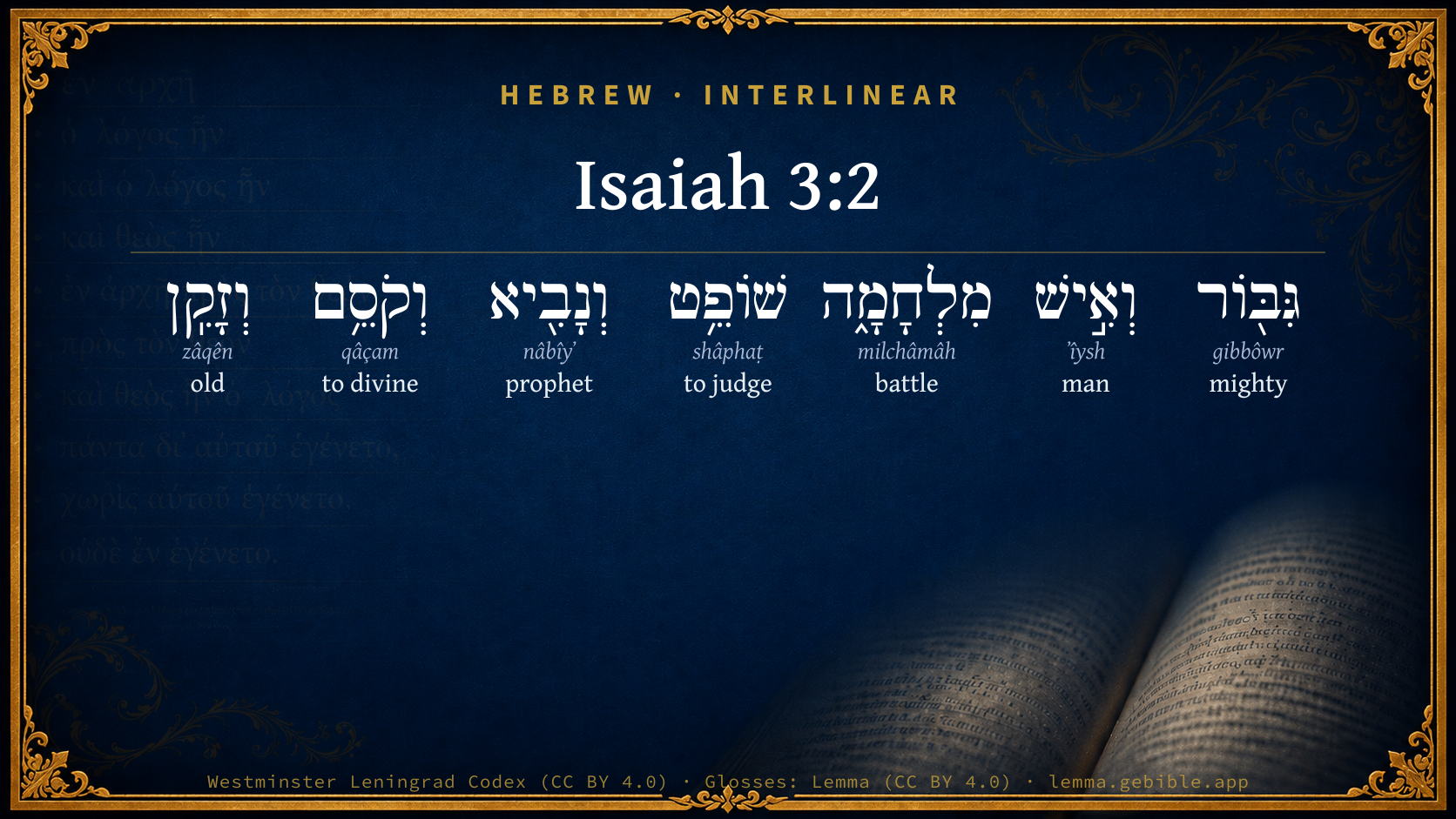
Isaiah 3:2

Hebrew (Westminster Leningrad Codex) Isaiah 3:2 appears in the Hebrew Old Testament. The text above is from the Westminster Leningrad Codex. Each word links to its Strong’s number, a concise gloss, and parsing drawn from the Open Scriptures Hebrew Bible morphology. Click any word for its full Brown-Driver-Briggs (BDB) entry.
Download image
Cite this verse

Isaiah 3:2 (World English Bible). Public Domain. Lemma interlinear Bible study tool, https://lemma.gebible.app/v/isaiah/3/2.

Show BibTeX & RIS
BibTeX
RIS
English Translation
The mighty man, The man of war, The judge, The prophet, The diviner, The elder,
World English Bible · Public Domain
Download a study sheet

One document with this verse’s original text, its word-by-word gloss line, the meaning frame, cross-references with their text, attributed commentary, and full source and license credits — printable, and it pastes into notes with its structure intact.

This verse Autodidact and up

Study sheet (.html) Plain text (.txt)

A passage Seminary Student

Up to 50 verses in one chapter. A passage sheet keeps up to 6 commentary sources and 12 cross-references per verse, in the order this page ranks them, and says so on the sheet whenever that leaves anything out. Ask for a single verse and you get the Autodidact verse sheet above.

Everything on this page stays free to read, with no account — the sheet is a download of what is already on screen, not access to it.

Want to remove ads? Support Godless Engineer
Compare translations 3

The same verse in 3 English versions, stacked beneath the original-language interlinear above. Click any original word for its lexicon entry.

Each is an independent rendering of the whole verse — the interlinear is not word-aligned to these translations.

Highlighted words mark where these versions differ — a whole-verse word diff, not a word-by-word alignment.

  • World English Bible Public Domain
    The mighty man, The man of war, The judge, The prophet, The diviner, The elder,
  • King James Version Public Domain
    The mighty man, and the man of war, the judge, and the prophet, and the prudent, and the ancient,
  • unfoldingWord Literal Text CC BY-SA 4.0
    warrior and man of war, judge and prophet and diviner and elder,

unfoldingWord Literal Text — © unfoldingWord, licensed CC BY-SA 4.0. Word-aligned USFM3 via Door43 (git.door43.org/unfoldingWord/en_ult).

Versions to compare (up to 4)

3 of 4 selected

Show all 18 translations

Every available English version of this verse, each an independent rendering of the whole verse.

  • World English Bible Public Domain
    The mighty man, The man of war, The judge, The prophet, The diviner, The elder,
  • Berean Standard Bible Public Domain
    the mighty man and the warrior, the judge and the prophet, the soothsayer and the elder,
  • Majority Standard Bible Public Domain
    the mighty man and the warrior, the judge and the prophet, the soothsayer and the elder,
  • King James Version Public Domain
    The mighty man, and the man of war, the judge, and the prophet, and the prudent, and the ancient,
  • American Standard Version (1901) Public Domain
    the mighty man, and the man of war; the judge, and the prophet, and the diviner, and the elder;
  • Revised Version (1885) Public Domain
    the mighty man, and the man of war; the judge, and the prophet, and the diviner, and the ancient;
  • Geneva Bible (1599) Public Domain
    The strong man, and the man of warre, the iudge and the prophet, the prudent and the aged,
  • Douay-Rheims (1899) Public Domain
    The strong man, and the man of war, the judge, and the prophet, and the cunning man, and the ancient.
  • Young's Literal Translation Public Domain
    Hero and man of war, judge and prophet, And diviner and elder,
  • Literal Standard Version CC BY-SA 4.0
    Mighty and man of war, judge and prophet, || And diviner and elderly,
  • Unlocked Literal Bible CC BY-SA 4.0
    the mighty man and the warrior, the judge and the prophet, the one who practices divination and the elder,
  • unfoldingWord Literal Text CC BY-SA 4.0
    warrior and man of war, judge and prophet and diviner and elder,
  • Darby Bible Public Domain
    the mighty man and the man of war, the judge and the prophet, and the diviner and the elder,
  • World Messianic Bible Public Domain
    the mighty man, the man of war, the judge, the prophet, the diviner, the elder,
  • Webster's Bible Public Domain
    The mighty man, and the man of war, the judge, and the prophet, and the prudent, and the ancient,
  • Free Bible Version CC BY-SA 4.0
    their strong fighters and soldiers, leaders and prophets, fortune-tellers and elders,
  • Bible in Basic English Public Domain
    The strong man and the man of war; the judge and the prophet; the man who has knowledge of secret arts, and the man who is wise because of his years;
  • JPS Tanakh (1917) Public Domain
    The mighty man, and the man of war; the judge, and the prophet, and the diviner, and the elder;

Literal Standard Version (2020), Covenant Press — licensed CC BY-SA 4.0. Text via the HelloAO Bible API (eBible.org). Unlocked Literal Bible (unfoldingWord) — licensed CC BY-SA 4.0. Text via the HelloAO Bible API (eBible.org). unfoldingWord Literal Text — © unfoldingWord, licensed CC BY-SA 4.0. Word-aligned USFM3 via Door43 (git.door43.org/unfoldingWord/en_ult). Free Bible Version, Dr. Jonathan Gallagher — licensed CC BY-SA 4.0. Text via the HelloAO Bible API (eBible.org).

Word by word

More ways to search: Search by grammar → Find every occurrence → Compare this word →

Practice this passage: Drill this verse → Learn its vocabulary →

About this verse

These counts appear in no published source. They are computed here, from the morphology-tagged text and Lemma’s own curated glosses. What Lemma adds →

7
words
7
distinct lemmas
Prophets
section

Notable vocabulary

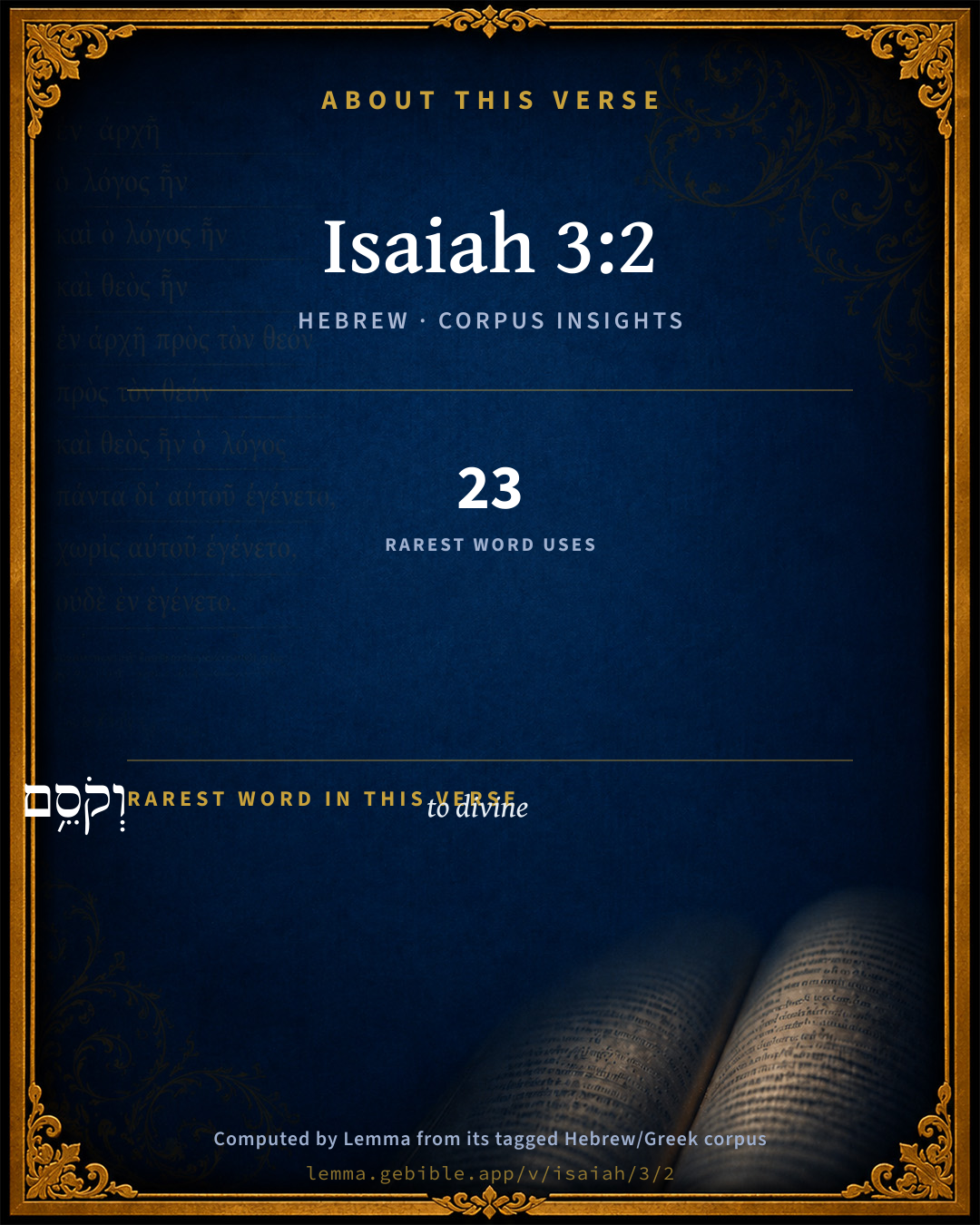
The rarest word here is וְקֹסֵ֥ם to divine H7080 — appearing just 23 times in the whole Hebrew Bible.

Shared distinctive vocabulary

וְקֹסֵ֥ם to divine H7080 occurs in 20 verses of the Hebrew Bible. Also found in:

Grammatical profile

  • 2 verbs
  • 3 nouns
  • 2 adjectives

Verb forms

  • שׁוֹפֵ֥ט Qal · Participle Active
  • וְקֹסֵ֥ם Qal · Participle Active

Hebrew & Septuagint length

In English translation the verse runs 15 words from the Hebrew and 19 from the Septuagint (LXX English) — closely comparable.

A rough comparison of the two English renderings, which tokenize alike — not a word-level alignment.

Word counts can differ between the Hebrew and the Greek without any difference in meaning — e.g. the Hebrew direct-object marker אֵת has no separate Greek word, and Greek often adds the article ὁ.

Cross-references

9

Topical passages linked to Isaiah 3:2 in the Treasury of Scripture Knowledge — connected by theme and wording, ordered by reader-vote popularity; previews shown in the World English Bible.

  • 2 Kings 24:14–16 He carried away all Jerusalem, and all the princes, and all the mighty men of valor, even ten thousand captives, and all the craftsmen and the smiths; none remained, save the poorest sort of the people of the land.
  • Isaiah 9:14–15 Therefore Yahweh will cut off from Israel head and tail, palm-branch and rush, in one day.
  • Psalms 74:9 We see no miraculous signs. There is no longer any prophet, Neither is there among us anyone who knows how long.
  • Isaiah 2:13–15 For all the cedars of Lebanon, that are high and lifted up, For all the oaks of Bashan,
  • Lamentations 5:12–14 Princes were hanged up by their hand: The faces of elders were not honored.
  • Ezekiel 8:12 Then said he to me, Son of man, have you seen what the elders of the house of Israel do in the dark, every man in his chambers of imagery? for they say, Yahweh doesn't see us; Yahweh has forsaken the land.
  • Ezekiel 9:5 To the others he said in my hearing, Go you through the city after him, and strike: don't let your eye spare, neither have you pity;
  • Ezekiel 17:13 and he took of the seed royal, and made a covenant with him; he also brought him under an oath, and took away the mighty of the land;
  • Amos 2:3 And I will cut off the judge from their midst, And will kill all its princes with him," says Yahweh.

Cross-references courtesy of OpenBible.info (CC BY 4.0).

Hebrew and Greek witnesses Masoretic Hebrew ↔ Greek Septuagint

The same verse in the two great witnesses to the Old Testament, shown verse-for-verse.

These are two independent witnesses, not word-aligned to each other, and the Septuagint is shown in lemma (dictionary) form.

Hebrew Isaiah 3:2 Masoretic · Westminster Leningrad Codex

גִּבּ֖וֹר וְאִ֣ישׁ מִלְחָמָ֑ה שׁוֹפֵ֥ט וְנָבִ֖יא וְקֹסֵ֥ם וְזָקֵֽן

The mighty man, The man of war, The judge, The prophet, The diviner, The elder,

World English Bible · Public Domain

Greek LXX Isaiah 3:2 Septuagint · lemma form

γίγας καί ἰσχύω καί ἄνθρωπος πολεμιστής καί δικαστής καί προφήτης καί στοχαστής καί πρεσβύτερος

the great and mighty man, the warrior and the judge, and the prophet, and the counsellor, and the elder,

LXX2012 (modern English Septuagint) · Public Domain

On this verse, Keil & Delitzsch discusses the Septuagint’s reading. Read the note in Commentary ↓

Hebrew: Westminster Leningrad Codex (CC BY 4.0). Greek: Septuagint (public domain); English from LXX2012 (modern English Septuagint) (Public Domain). How the Septuagint differs from the Hebrew →

Targum (Aramaic paraphrase)

1

The Targum is the ancient Jewish Aramaic paraphrase of the Hebrew Scriptures — an interpretive translation, not the Hebrew text itself. Onkelos (literal) and Pseudo-Jonathan (expansive) render the Torah, and Jonathan the Prophets. Coverage is partial: where no permissively-licensed English translation exists for a verse, only the Aramaic is shown. This is verse-level text, not a word-by-word alignment to the Hebrew.

  1. Targum Jonathan Prophets (Joshua–Malachi)
    גִבָּר וּגְבַר עֲבֵיד קְרָב דַיַין וְסָפַר וּמִשְׁתָּאֵל וְסָב:

    The mighty man, and the man that maketh war, the judge, and the prophet, and the scribe, and the diviner, and the ancient,

    Targum Jonathan — Aramaic: “Mikraot Gedolot” (public domain). English: “Sefaria Community Translation” (CC0 1.0 (public-domain dedication)); “London "Chaldee Paraphrase," 1871” (public domain). Text via Sefaria.

Commentary

Notes on Isaiah 3:2 from classic Christian and Jewish commentators (each source and its license shown beneath its notes). The classic Christian expositions comment on the surrounding passage and are grouped to its opening verse, so a note may address several verses; the Jewish commentaries on the Tanakh (Rashi and others) are per-verse, so they appear only where the commentator wrote on this verse.

Lemma curates 59 commentaries, every one of them public domain or Creative Commons licensed, each selected and text-cleaned for this edition rather than reprinted as found. About our sources →

The Cambridge Bible for Schools and Colleges

gen. ed. J. J. S. Perowne

2. The mighty man, and the man of war] Hero and man of war. The profession of arms naturally stands first, Judah being still a military power of some pretensions. In ancient times, moreover, civil and military leadership were hardly separate.

The prophet is the professional prophet, scarcely distinguishable from the diviner (wrongly rendered prudent in A.V.), with whom he is bracketed. The word for ancient is that usually translated elder.

2, 3. A list of the officials and prominent persons who form the “props” of society. No clear principle of arrangement can be traced, although the titles tend to fall into pairs, and those in Isa_3:3 are perhaps of less distinction than those in Isa_3:2. The art. is better omitted throughout as in Heb.

The Cambridge Bible for Schools and Colleges (gen. ed. J. J. S. Perowne; Cambridge University Press, 1878–1918) — public domain. Text from a community e-Sword module.

Trapp's Complete Commentary

John Trapp

Isa 3:2 The mighty man, and the man of war, the judge, and the prophet, and the prudent, and the ancient,

Ver. 2. The mighty man, and the man of war.] Such as were David’s mighties; Hannibal; Fabius Maximus, of whom the poet, Hic patria est, murique urbis stant pectore in uno; Scipio Africanus, of whose death when Metellus heard, he ran out into the public forum and cried out, Concurrite cives, urbis vestrae moenia corruerunt; Come forth and consult what is to be done, for your city is undone.

The judge and the prophet.] When God gathereth such by clusters as it were, some evil is at hand; as when men pull up their hedges and fences, it is open tide.

And the prudent.] Heb., The diviner: such as have their eyes in their head, {Ecc 2:14} their hearts at their right hands, {Ecc 10:2} that judiciously pondering things past, can prudently order things present, and providently foresee to prevent dangers likely to ensue.

And the ancient.] With whom is wisdom and counsel. {Job 32:4; Job 32:6-7}

John Trapp, A Commentary or Exposition upon All the Books of the Old and New Testament (1647–1656) — public domain. Text from a community e-Sword module.

Joseph Benson's Commentary

Isa 3:2-3. The mighty man, &c. — Strong and valiant men. The judge — The civil magistrates; and the prophet — Either strictly so called, the want of whom is matter of grief, (Psa 74:9,) or more largely taken, so as to include all skilful and faithful teachers; and the prudent — Whose wisdom and conduct were necessary to preserve them from ruin; and the ancient — Whose wisdom was increased by long experience. This likewise relates to the same times, particularly to Jehoiachin’s captivity, when all the men of note were carried away captive with him, 2Ki 24:14. The captain of fifty — There shall not be a man left able to command fifty soldiers, much less such as could command hundreds or thousands, who yet were necessary; and the honourable man — Men of high birth, place, power, and reputation; and the counsellor — Wise and learned statesmen; and the cunning artificer — Who could make either ornaments for times of peace, or instruments for war, whom therefore conquerors were wont to take away from those nations whom they subdued, 1Sa 13:19-20; 2Ki 24:14; and the eloquent orator — Hebrew, נבון לחשׁ, literally, the skilful of charm, or the skilful charmer, or enchanter; whereby he understands either, 1st, Charmers, whom he threatens God would take away, not as if such persons were blessings to a people, or the removing of them a curse, but only because they made great use of them, and trusted to them. And so he signifies that God would remove all the grounds of their confidence, both right and wrong, and make their case desperate. Thus, for the same reason, God threatens the Israelites, (Hos 3:4,) that they should be, as without a sacrifice, so without an image and teraphim. Or, he may mean, 2d, Such as could persuade powerfully, and, as it were, charm people, by their eloquence, and induce them to do those things which were necessary for their safety; for the expression may be taken in a good sense, as קסם, divination, is Pro 16:10. Accordingly, Bishop Lowth translates it, the powerful in persuasion.

Joseph Benson's Commentary on the Old and New Testaments (1811–1818) — public domain. Text from a community e-Sword module.

Tyndale Open Study Notes

Tyndale Open Resources

3:2-3 Regardless of their status, all military, civil, judicial, and religious leaders would be removed in the day of judgment (39:7; 2 Kgs 24:14-16). God would eventually give his people good leaders again (Isa 1:26) but not diviners and others who used pagan forms of revelation (47:9, 12-13; see Deut 18:10-12).

Tyndale Open Study Notes — © Tyndale Open Resources, licensed CC BY-SA 4.0. Text via the HelloAO Bible API.

Geneva Bible (1599)

Geneva Bible translators

The temporal governor and the minister.

Geneva Bible (1599) marginal notes — public domain. Text via Bolls.life.

Jamieson, Fausset & Brown

Robert Jamieson, A. R. Fausset & David Brown

Fulfilled (Kg2 24:14).

prudent--the Hebrew often means a "soothsayer" (Deu 18:10-14); thus it will mean, the diviners, on whom they rely, shall in that day fail. It is found in a good sense (Pro 16:10), from which passage the Jews interpret it a king; "without" whom Israel long has been (Hos 3:4).

ancient--old and experienced (Kg1 12:6-8).

Jamieson, Fausset & Brown — Commentary Critical and Explanatory on the Whole Bible (1871) — public domain (CC PDM 1.0). Text via the HelloAO Bible API.

Ellicott's Commentary for English Readers

(2) The mighty man, and the man of war.—The first word points to the aristocracy of landed proprietors, the latter to those who, whether of that class or not, had been prominent as leaders in the king’s armies.

The judge, and the prophet.—Each is named as the representative of a class. The latter was that to which Isaiah himself belonged, but in which he found, as Jeremiah did afterwards, his chief opponents.

The prudent, and the ancient.—The former word has the more definite meaning of “diviners,” those who had a real gift of wisdom, but who by their abuse of that gift had become as degenerate prophets. In the “ancient” we have the “elders” who were prominent in the municipal politics of the East, and formed at least the nucleus of the king’s council (Rth_4:4; 2Sa_19:11; 1Ki_20:7; 1Ki_21:8; and elsewhere).

A Bible Commentary for English Readers, edited by Charles John Ellicott (1878–1897) — public domain. Text from a community e-Sword module.

John Gill's Exposition

The mighty man, and man of war,.... The meaning is either that these should die in war, as thousands of them did; or that men fit to be generals of armies should be removed by death before this time, so that they should have none to go out with their armies, and meet the enemy:

the judge and the prophet; there should be none to sit upon the bench, and administer justice to the people in civil affairs, and to determine causes relating to life and death; and none to instruct them in religious matters, and deliver the mind and will of God to them; and before this time the Jews were under the Roman jurisdiction, and had a Roman governor over them, and had not power to judge in capital cases, in matters of life and death, as they suggest, Joh 18:31 and they say (z), that forty years before the destruction of the temple this power was taken from them; and at the time that Jerusalem was besieged, and taken by the Romans, and before that, they had no prophets among them; for though there were prophets in the Christian churches, yet none among them; this shows that this prophecy cannot be understood of the Babylonish captivity, because there were prophets then, as Jeremy, Ezekiel, and Daniel, but of Jerusalem's destruction by the Romans:

and the prudent and the ancient: with whom are wisdom, and who are fit to give advice and counsel in matters of difficulty; but these would be removed by famine or sword. The first of these words is used sometimes in an ill sense, for a diviner or soothsayer, Deu 18:10. The Jewish writers (a) interpret it of a king, according to Pro 16:10 and it is certain they were without one at this time, and have been ever since, Hos 3:4.

(z) T. Bab. Sabbat, fol. 15. 1. Sanhedrin, fol. 41. 1. and Beracot, fol. 58. 1. (a) T. Bab. Chagiga, fol. 14. 1. Jarchi in loc.

John Gill's Exposition of the Whole Bible (1746–1763) — public domain (CC PDM 1.0). Text via the HelloAO Bible API.

Albert Barnes' Notes on the Bible

The mighty man - The hero, The idea expressed is not simply that of personal strength and prowess, but the higher one of military eminence or heroism. “Prof. Alexander.” This was fully accomplished in the time of Nebuchadnezzar; 2Ki 24:14.

And the prudent - This word in the original - קסם qosēm - means properly “a diviner,” or a “soothsayer.” But it is sometimes used in a good sense; see Pro 16:10, “margin.” The Chaldee understands it of a man “who is consulted,” or whose opinion is asked, in times of perplexity or danger. The word was originally applied to false prophets, diviners, and soothsayers, who claimed the power of looking into futurity. It came, however, to denote also the man of sagacity, the statesman, the experienced counselor, who from the records of the past could judge of the future, and to whom, therefore, the nation could look in times of perplexity and danger. Vitringa supposes that it may refer here to the false prophets on whose advice the nation might be relying.

The ancient - The old man. Such men, especially among the Hebrews, were deemed particularly qualified to give advice. They had experience; they kept the traditions of their fathers; they had conversed with the wise of the preceding generation; and in a land where there were few books, and knowledge was to be gained mainly by conversation and experience, great respect was shown them; see Lev 19:32; 2Ch 31:17; 1Ki 12:6, 1Ki 12:8.

Albert Barnes' Notes on the Bible (1834–1885) — public domain. Text from a community e-Sword/MySword module.

Haydock's Catholic Bible Commentary

Prophet. Ezechiel was taken away under Jechonias. Other prophets were disregarded, and the cunning man, (ariolus, which may be understood in a good or bad sense. Calmet) every false prophet was silent, when danger threatened.

George Leo Haydock (1774–1849), Haydock's Catholic Family Bible and Commentary, 1859 edition — public domain. Excludes Psalms (Douay-Rheims chapter numbering differs from Protestant) and Deuterocanonical books (Catholic canon only).

Matthew Poole's English Annotations

The mighty man; strong and valiant men. The judge; the civil magistrates. The prophet; either strictly so called, the want of whom is matter of grief; see Psa 74:9; or largely, so as to include all skilful and faithful teachers.

The prudent; whose wisdom and conduct was necessary to preserve them from ruin. The ancient; whose wisdom was increased by long experience.

Matthew Poole's English Annotations on the Holy Bible (1683–1685) — public domain. Text from a community e-Sword/MySword module.

Whedon's Commentary on the Bible

Daniel D. Whedon

2. 3. Mighty man… man of war — Besides men, martial armaments are included. Uzziah had a widespread military organization. 2Ch_26:11-15.

Prudent — About the same as prophet. Men on secular principles occupied in divining future events.

Ancient — Elders, heads of families.

The captain of fifty — A title near in rank to that of the people.

The honourable — A favourite of the people; of dignified aspect.

Artificer — A maker of war weapons.

Eloquent orator — Not this in our modern sense, but rather, an enchanter; literally, whisperer. Chapter Isa_8:19. Akin to “prudent.”

Daniel D. Whedon (gen. ed.), Commentary on the Old and New Testaments (1874–1909) — public domain. Text from a community e-Sword module.

The Pulpit Commentary

The mighty man, and the man of war; or, hero and warrior. The first rank is given to those distinguished in war, as being held in the highest esteem, and perhaps as actually, under the coming circumstances, the men of most importance to the country. It is thus implied, as later (vers. 25, 26) it is expressly taught, that the impending visitation will be a terrible invasion. The judge, and the prophet; literally, judge and prophet. The judge holds his place as one of the highest officers of the state; (see Isa_1:26) the prophet holds a lower position than might have been expected, on account of the writer"s humility. The prudent; rather, the diviner , as the word is translated in Deu_18:14 1Sa_6:2 Isa_44:25 Jer_27:9 Jer_29:8; Ezekiel Mic_3:7 Zec_10:2; or soothsayer, as in Jos_13:22. Isaiah arranges the classes, not so much according to the order in which he values them, as to that in which they were valued by the people. The ancient; i.e. "the elder," as the word is translated commonly. The "elders" had an ascertained position in the state under the monarchy. (2Sa_5:3 2Sa_19:11 1Ki_8:1 1Ki_20:7 2Ki_6:32, etc.)

The Pulpit Commentary (1880–1919), ed. H.D.M. Spence-Jones & Joseph S. Exell — public domain. Text from a community e-Sword module.

John Wesley's Explanatory Notes

The judge - The civil magistrates. The ancient - Whose wisdom was increased by long experience.

John Wesley, Explanatory Notes Upon the Whole Bible (1754–1765) — public domain. Text via the GEBible commentary corpus.

Keil & Delitzsch

C. F. Keil & F. Delitzsch

"Hero and man of war, judge and prophet, and soothsayer and elder; captains of fifty, and the highly distinguished, and counsellors, and masters in art, and those skilled in muttering." As the state had grown into a military state under Uzziah-Jotham, the prophet commences in both vv. with military officers, viz., the gibbor, i.e., commanders whose bravery had been already tried; the "man of war" (ish imlchâmâh), i.e., private soldiers who had been equipped and well trained (see Eze 39:20); and the "captain of fifty" (sar Chamisshim), leaders of the smallest divisions of the army, consisting of only fifty men (pentekontarchos, Kg2 1:9, etc.). The prominent members of the state are all mixed up together; "the judge" (shophet), i.e., the officers appointed by the government to administer justice; "the elder" (zâkēn), i.e., the heads of families and the senators appointed by the town corporations; the "counsellor" (yōetz), those nearest to the king; the "highly distinguished" (nesu panim), lit., those whose personal appearance (panim) was accepted, i.e., welcome and regarded with honour (Saad.: wa'gı̄h, from wa'gh, the face of appearance), that is to say, persons of influence, not only on account of their office, but also on account of wealth, age, goodness, etc.; "masters in art" (Chacam Charâshim: lxx σοφὸς ἀρχιτέκτων ), or, as Jerome has very well rendered it, in artibus mechanicis exercitatus easque callide tractans (persons well versed in mechanical arts, and carrying them out with skill). In the Chaldean captivities skilled artisans are particularly mentioned as having been carried away (Kg2 24:14.; Jer 24:1; Jer 29:2); so that there can be no doubt whatever that Charâshim (from Cheresh) is to be understood as signifying mechanical and not magical arts, as Gesenius, Hitzig, and Meier suppose, and therefore that Chacam Charâshim does not mean "wizards," as Ewald renders it (Chărâshim is a different word from Chârâshim, fabri, from Chârâsh, although in Ch1 4:14, cf., Neh 11:35, the word is regularly pointed חרשׁים even in this personal sense). Moreover, the rendering "wizards" produces tautology, inasmuch as masters of the black art are cited as nebon lachash, "skilled in muttering." Lachash is the whispering or muttering of magical formulas; it is related both radically and in meaning to nachash, enchantment (Arabic nachs, misfortune); it is derived from lachash, sibilare, to hiss (a kindred word to nâchash; hence nâchâsh, a serpent). Beside this, the masters of the black art are also represented as kosem, which, in accordance with the radical idea of making fast, swearing, conjuring, denoted a soothsayer following heathen superstitions, as distinguished from the nabi, of false Jehovah prophet (we find this as early as Deu 18:10, Deu 18:14).

(Note: According to the primary meaning of the whole thema, which is one of hardness, rigidity, firmness, aksama (hi. of kâsam) signifies, strictly speaking, to make sure, i.e., to swear, either by swearing to the truth and certainty of a thing, or by making a person swear that he will do or not do a certain thing, by laying as it were a kasam upon him. The kal, on the other hand (kasama), gets its meaning to divide from the turn given to the radical idea in the substantive kism, which signifies, according to the original lexicographers, something fixed (= nası̄b), definite, i.e., a definite portion. There is just the same association of ideas in ‛azama as in aksama, namely, literally to be firm or make firm, i.e., to direct one's will firmly towards an object or place; also to direct one's will firmly towards a person, to adjure him to do a thing or not to do it; sometimes with a softer meaning, to urge or invite a person to anything, at other times to recite conjuring formulas (‛azâim.)

These came next to bread and water, and were in a higher grade the props of the state. They are mixed together in this manner without regular order, because the powerful and splendid state was really a quodlibet of things Jewish and heathen; and when the wrath of Jehovah broke out, the godless glory would soon become a mass of confusion.

Keil & Delitzsch — Biblical Commentary on the Old Testament (1861–1891) — public domain (CC PDM 1.0). Text via the HelloAO Bible API. (Old Testament only.)

J. A. Alexander on Isaiah

Joseph Addison Alexander

Next to the necessary means of subsistence, the Prophet enumerates the great men of the commonwealth, vs. 2, 3. The first clause has reference to military strength, the second to civil and religious dignities. In the second clause there is an inverse parallelism, the first and fourth terms denoting civil officers, the second and third religious ones. The omission of the article before the nouns, though not uncommon in poetry, adds much to the rapidity and life of the description. Hero and warrior, judge and prophet, and divine and elder. That the first is not a generic term including all that follow (the great men, viz. the warriors, etc) is clear from the parallelism, the terms being arranged in pairs as often elsewhere (Isa 11:2; Isa 19:3; Isa 19:6-9; Isa 22:12-13; Isa 42:19). The idea here expressed is not simply that of personal strength and prowess but the higher one of military eminence or heroism.

The literal version of the next phrase, man of war, has acquired a different sense in modern English. It may here denote either a warrior of high rank; as synonymous with mighty man, or one of ordinary rank, as distinguished from it. Judge may either be taken in its restricted modern sense or in the wider one of magistrate or ruler. The people are threatened with the loss of all their stays, good or bad, true or false. The last word in the verse is not to be taken in its primary and proper sense of old man, much less in the factitious one of sage, or wise man, since all the foregoing terms are titles denoting rank and office, but in its secondary sense of elder or hereditary chief, and as such a magistrate under the patriarchal system. It is here equivalent or parallel to judge, the one term denoting the functions of the office, the other the right by which it was held.

Joseph Addison Alexander, The Prophecies of Isaiah (1846–1847; New York: Scribner, 1870–1878) — public domain. Text from a community e-Sword module.

Rashi

Rabbi Shlomo Yitzchaki (Rashi)

soothsayer This denotes the king, as it is stated: (Prov. 16:10) “[Like] soothsaying on the lips of a king.”

Rashi on the Tanakh — English translations: “The Judaica Press complete Tanach with Rashi, translated by A. J. Rosenberg” (CC BY 4.0); “Pentateuch with Rashi's commentary by M. Rosenbaum and A.M. Silbermann, 1929-1934” (public domain); “The Metsudah Tanach series, Lakewood, N.J” (CC BY 4.0); and “The Book of Joshua, Metsudah Publications, 1997” (CC BY 4.0). Text via Sefaria.

Ibn Ezra

Rabbi Abraham ibn Ezra

The mighty man. He who has the strength required for a successful war.

The man of war. He who has the experience.

The judge, who is asked to show the right way according to the law. The prophet, who serves the same purpose; and also the astrologer, who foretells future events through the science of astrology.

The ancient, who has profited by the changes and trials of life.

Ibn Ezra on the Tanakh — English translations: “Sefaria Community Translation” (CC0 1.0 (public-domain dedication)); “Yalkut, Sifsei Chachomim Chumash, Metsudah Publications, 2009” (CC BY 4.0); and “Commentary of Ibn Ezra on Isaiah - trans. by M. Friedlander, 1873” (public domain). Text via Sefaria.

Lesson kit

Teaching starters — assembled from the data on this page, not authored interpretation. Every prompt links to the verse data it draws on. Edit before teaching.

Isaiah, in the Prophets, opens this verse with 7 words (7 distinct Hebrew lemmas). Its most distinctive word is qâçam (“to divine”). A historical commentator’s framing appears above. Read the whole chapter for the surrounding context.

Discussion questions

  1. The word qâçam carries the sense “to divine.” How does it shape the verse?
  2. Deuteronomy 18:10 shares the word «to divine» with this verse. How do the two illuminate each other?
  3. These translations render this verse differently. What is at stake in choosing one wording over another?
  4. The verb «שׁוֹפֵ֥ט» is Qal Participle Active. How does its form color the action?
  5. Reading how The Cambridge Bible for Schools and Colleges and Trapp's Complete Commentary read this verse, where do the two commentators agree and where do they part?

Things to notice

Reading settings

Reading text

Shown beneath each verse's original-language words.

Old Testament
Old Testament edition

Read the OT as the Masoretic Hebrew (MT) or the Greek Septuagint (LXX).

English shown for the Greek Septuagint (in the Hebrew ↔ Greek comparison).

Comparing translations? Open the Compare panel on any verse page to stack up to four side by side.