
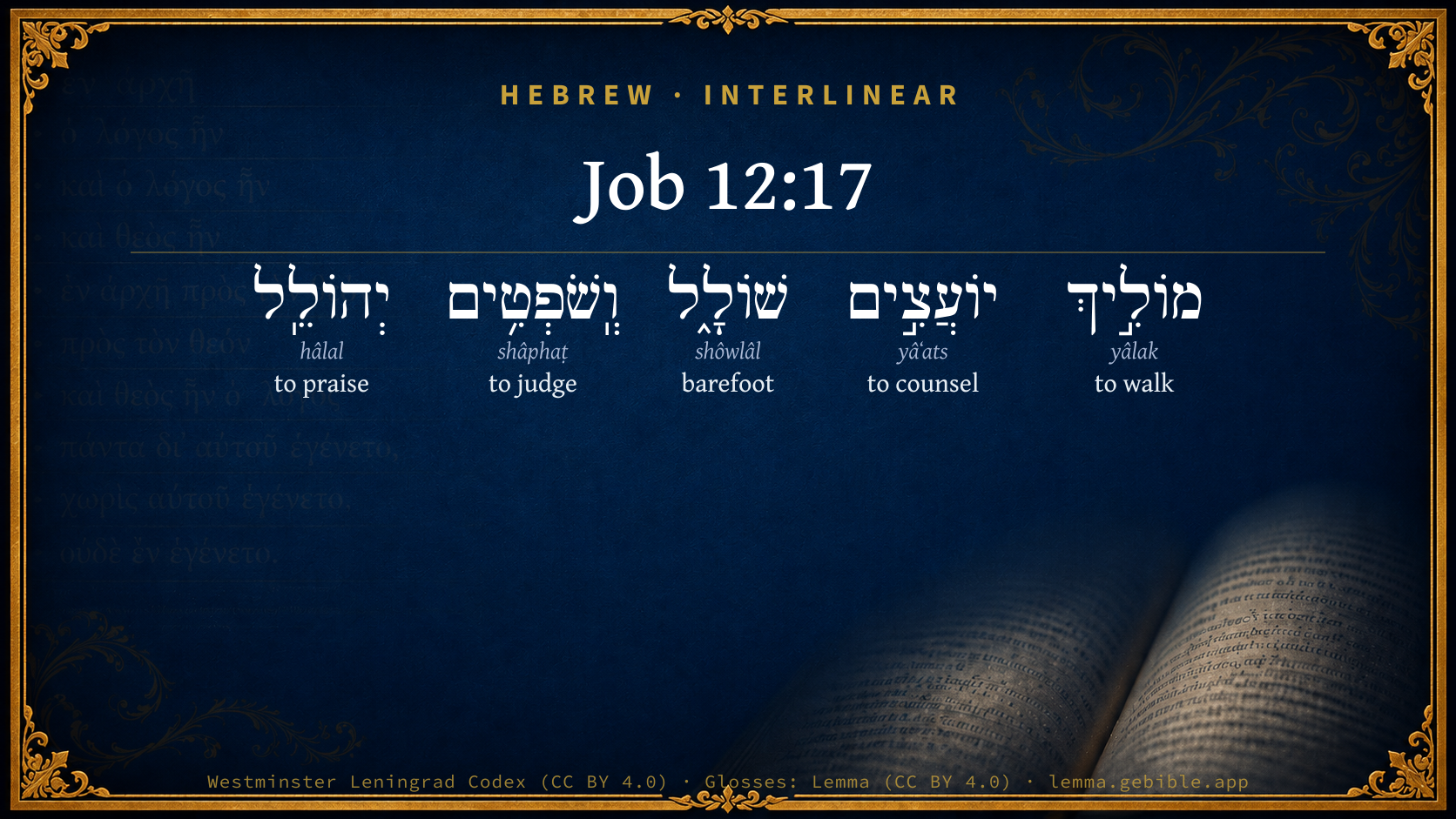
Job 12:17

Hebrew (Westminster Leningrad Codex) Job 12:17 appears in the Hebrew Old Testament. The text above is from the Westminster Leningrad Codex. Each word links to its Strong’s number, a concise gloss, and parsing drawn from the Open Scriptures Hebrew Bible morphology. Click any word for its full Brown-Driver-Briggs (BDB) entry.
Download image
Cite this verse

Job 12:17 (World English Bible). Public Domain. Lemma interlinear Bible study tool, https://lemma.gebible.app/v/job/12/17.

Show BibTeX & RIS
BibTeX
RIS
English Translation
He leads counselors away stripped. He makes judges fools.
World English Bible · Public Domain
Highlights
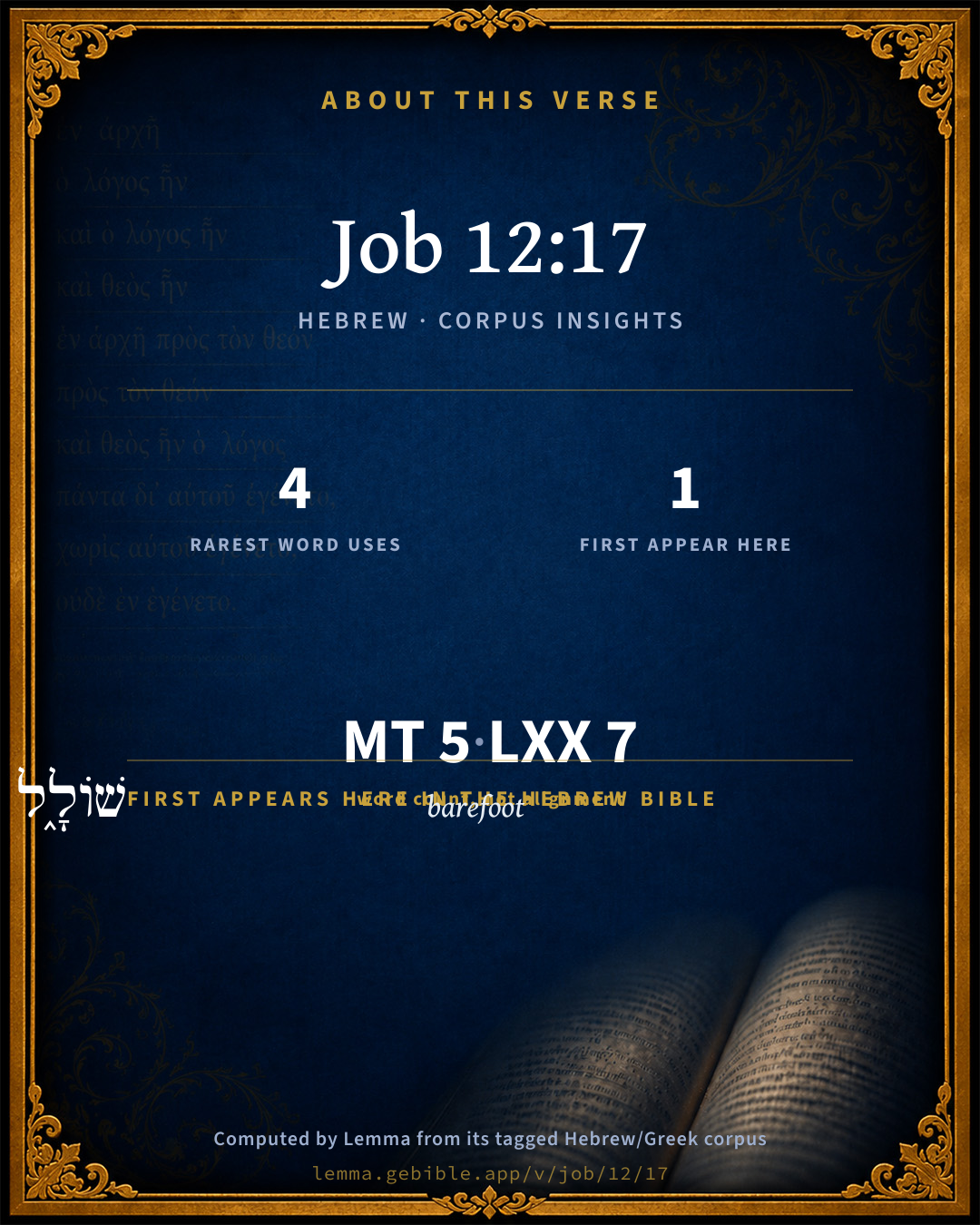
  • 1 first appearance in the Hebrew Bible
Full analysis ↓
Download a study sheet

One document with this verse’s original text, its word-by-word gloss line, the meaning frame, cross-references with their text, attributed commentary, and full source and license credits — printable, and it pastes into notes with its structure intact.

This verse Autodidact and up

Study sheet (.html) Plain text (.txt)

A passage Seminary Student

Up to 50 verses in one chapter. A passage sheet keeps up to 6 commentary sources and 12 cross-references per verse, in the order this page ranks them, and says so on the sheet whenever that leaves anything out. Ask for a single verse and you get the Autodidact verse sheet above.

Everything on this page stays free to read, with no account — the sheet is a download of what is already on screen, not access to it.

Want to remove ads? Support Godless Engineer
Compare translations 3

The same verse in 3 English versions, stacked beneath the original-language interlinear above. Click any original word for its lexicon entry.

Each is an independent rendering of the whole verse — the interlinear is not word-aligned to these translations.

Highlighted words mark where these versions differ — a whole-verse word diff, not a word-by-word alignment.

  • World English Bible Public Domain
    He leads counselors away stripped. He makes judges fools.
  • King James Version Public Domain
    He leadeth counsellors away spoiled, and maketh the judges fools.
  • unfoldingWord Literal Text CC BY-SA 4.0
    the one leading counselors away naked, and judges he makes foolish.

unfoldingWord Literal Text — © unfoldingWord, licensed CC BY-SA 4.0. Word-aligned USFM3 via Door43 (git.door43.org/unfoldingWord/en_ult).

Versions to compare (up to 4)

3 of 4 selected

Show all 18 translations

Every available English version of this verse, each an independent rendering of the whole verse.

  • World English Bible Public Domain
    He leads counselors away stripped. He makes judges fools.
  • Berean Standard Bible Public Domain
    He leads counselors away barefoot and makes fools of judges.
  • Majority Standard Bible Public Domain
    He leads counselors away barefoot and makes fools of judges.
  • King James Version Public Domain
    He leadeth counsellors away spoiled, and maketh the judges fools.
  • American Standard Version (1901) Public Domain
    He leadeth counsellors away stripped, And judges maketh he fools.
  • Revised Version (1885) Public Domain
    He leadeth counsellors away spoiled, and judges maketh he fools.
  • Geneva Bible (1599) Public Domain
    He causeth the counsellers to goe as spoyled, and maketh the iudges fooles.
  • Douay-Rheims (1899) Public Domain
    He bringeth counsellors to a foolish end, and judges to insensibility.
  • Young's Literal Translation Public Domain
    Causing counsellors to go away a spoil, And judges He maketh foolish.
  • Literal Standard Version CC BY-SA 4.0
    Causing counselors to go away [as] a spoil, || Indeed, He makes fools of judges.
  • Unlocked Literal Bible CC BY-SA 4.0
    He leads counselors away barefoot in sorrow; he turns judges into fools.
  • unfoldingWord Literal Text CC BY-SA 4.0
    the one leading counselors away naked, and judges he makes foolish.
  • Darby Bible Public Domain
    He leadeth counsellors away spoiled, and judges maketh he fools;
  • World Messianic Bible Public Domain
    He leads counselors away stripped. He makes judges fools.
  • Webster's Bible Public Domain
    He leadeth counselors away spoiled, and maketh the judges fools.
  • Free Bible Version CC BY-SA 4.0
    He leads counselors away stripped of their wisdom, he makes judges into fools.
  • Bible in Basic English Public Domain
    He takes away the wisdom of the wise guides, and makes judges foolish;
  • JPS Tanakh (1917) Public Domain
    He leadeth counsellors away stripped, and judges maketh He fools.

Literal Standard Version (2020), Covenant Press — licensed CC BY-SA 4.0. Text via the HelloAO Bible API (eBible.org). Unlocked Literal Bible (unfoldingWord) — licensed CC BY-SA 4.0. Text via the HelloAO Bible API (eBible.org). unfoldingWord Literal Text — © unfoldingWord, licensed CC BY-SA 4.0. Word-aligned USFM3 via Door43 (git.door43.org/unfoldingWord/en_ult). Free Bible Version, Dr. Jonathan Gallagher — licensed CC BY-SA 4.0. Text via the HelloAO Bible API (eBible.org).

Word by word

More ways to search: Search by grammar → Find every occurrence → Compare this word →

Practice this passage: Drill this verse → Learn its vocabulary →

About this verse

These counts appear in no published source. They are computed here, from the morphology-tagged text and Lemma’s own curated glosses. What Lemma adds →

5
words
5
distinct lemmas
Wisdom
section

Notable vocabulary

The rarest word here is שׁוֹלָ֑ל barefoot H7758 — appearing just 4 times in the whole Hebrew Bible.

First appearance in Scripture

This word makes its first canonical appearance in the Hebrew Bible here:

  • שׁוֹלָ֑ל barefoot H7758

Shared distinctive vocabulary

שׁוֹלָ֑ל barefoot H7758 occurs in 3 verses of the Hebrew Bible. Also found in:

Grammatical profile

  • 4 verbs
  • 1 adjective

Verb forms

  • מוֹלִ֣יךְ Hiphil · Participle Active
  • יוֹעֲצִ֣ים Qal · Participle Active
  • וְֽשֹׁפְטִ֥ים Qal · Participle Active
  • יְהוֹלֵֽל Piel · Imperfect

Hebrew & Septuagint length

In English translation the verse runs 9 words from the Hebrew and 12 from the Septuagint (LXX English) — closely comparable.

A rough comparison of the two English renderings, which tokenize alike — not a word-level alignment.

Word counts can differ between the Hebrew and the Greek without any difference in meaning — e.g. the Hebrew direct-object marker אֵת has no separate Greek word, and Greek often adds the article ὁ.

In the original languages it is 5 Hebrew tokens and 7 Greek tokens — but the two are counted differently (Hebrew bundles its prefixes and suffixes into one token; the Greek is in lemma form), so that isn’t a like-for-like length.

Cross-references

8

Topical passages linked to Job 12:17 in the Treasury of Scripture Knowledge — connected by theme and wording, ordered by reader-vote popularity; previews shown in the World English Bible.

  • Isaiah 29:14 therefore, behold, I will proceed to do a marvelous work among this people, even a marvelous work and a wonder; and the wisdom of their wise men shall perish, and the understanding of their prudent men shall be hid.
  • 1 Corinthians 1:19–20 For it is written, "I will destroy the wisdom of the wise, I will bring the discernment of the discerning to nothing."
  • 2 Samuel 17:23 When Ahithophel saw that his counsel was not followed, he saddled his donkey, and arose, and got him home, to his city, and set his house in order, and hanged himself; and he died, and was buried in the tomb of his father.
  • 2 Samuel 15:31 One told David, saying, Ahithophel is among the conspirators with Absalom. David said, Yahweh, please turn the counsel of Ahithophel into foolishness.
  • 2 Samuel 17:14 Absalom and all the men of Israel said, The counsel of Hushai the Archite is better than the counsel of Ahithophel. For Yahweh had ordained to defeat the good counsel of Ahithophel, to the intent that Yahweh might bring evil on Absalom.
  • Job 3:14 With kings and counselors of the earth, Who built up waste places for themselves;
  • Job 9:24 The earth is given into the hand of the wicked. He covers the faces of the judges of it. If not he, then who is it?
  • Isaiah 19:12–14 Where then are your wise men? and let them tell you now; and let them know what Yahweh of Hosts has purposed concerning Egypt.

Cross-references courtesy of OpenBible.info (CC BY 4.0).

Hebrew and Greek witnesses Masoretic Hebrew ↔ Greek Septuagint

The same verse in the two great witnesses to the Old Testament, shown verse-for-verse.

These are two independent witnesses, not word-aligned to each other, and the Septuagint is shown in lemma (dictionary) form.

Hebrew Job 12:17 Masoretic · Westminster Leningrad Codex

מוֹלִ֣יךְ יוֹעֲצִ֣ים שׁוֹלָ֑ל וְֽשֹׁפְטִ֥ים יְהוֹלֵֽל

He leads counselors away stripped. He makes judges fools.

World English Bible · Public Domain

Greek LXX Job 12:17 Septuagint · lemma form

διαἄγω βουλευτής αἰχμάλωτος κριτής δέ γῆ ἐκἵστημι

He leads counselors away captive, and maddens the judges of the earth.

LXX2012 (modern English Septuagint) · Public Domain

On this verse, Keil & Delitzsch discusses the Septuagint’s reading. Read the note in Commentary ↓

Hebrew: Westminster Leningrad Codex (CC BY 4.0). Greek: Septuagint (public domain); English from LXX2012 (modern English Septuagint) (Public Domain). How the Septuagint differs from the Hebrew →

Commentary

Notes on Job 12:17 from classic Christian and Jewish commentators (each source and its license shown beneath its notes). The classic Christian expositions comment on the surrounding passage and are grouped to its opening verse, so a note may address several verses; the Jewish commentaries on the Tanakh (Rashi and others) are per-verse, so they appear only where the commentator wrote on this verse.

Lemma curates 59 commentaries, every one of them public domain or Creative Commons licensed, each selected and text-cleaned for this edition rather than reprinted as found. About our sources →

Trapp's Complete Commentary

John Trapp

Job 12:17 He leadeth counsellors away spoiled, and maketh the judges fools.

Ver. 17. He leadeth counsellors away spoiled] viz. Of wit, wealth, and honour. This should be a warning to them, not to take ill causes in hand, not to call evil good and good evil, not to justify the wicked for a reward, and to take away the righteousness of the righteous from him; not to bolster out a bad cause, and to outface a good, lest if they improve their wits and parts to so evil an end, God make them as despicable as before they were honourable. They may see what the Lord did to Ahithophel, that oracle of his time; to Pharaoh’s counsellors, Isa 9:11-12; to Pharaoh himself, Exo 1:10 with Pro 28:15.

And he maketh the judges fools] Broughton rendereth the verse thus, He brings counsellors to badness, and judges to stark madness. He infatuateth them, not by infusing folly into them, anymore than the sun, when he shineth not in our horizon, causeth darkness in the air, which of itself and of its own nature is dark. But when God withholdeth that light of wisdom which he had imparted to a man, his inbred darkness must needs show itself. More than this, it sometimes cometh to pass, that when God delivereth a man up for his sins to a reprobate and injudicious mind, he is thenceforth deprived sometimes of natural wisdom and common sense, that the divine revenge may be the more apparent.

John Trapp, A Commentary or Exposition upon All the Books of the Old and New Testament (1647–1656) — public domain. Text from a community e-Sword module.

Joseph Benson's Commentary

Job 12:17. He leadeth counsellors away spoiled — The wise counsellors, or statesmen, by whom the affairs of kings and kingdoms are ordered, he leadeth away as captives in triumph, being spoiled either of that wisdom which they had, or seemed to have; or of that power and dignity which they had enjoyed. And maketh the judges fools — By discovering their folly, and by infatuating their minds, and turning their own counsels to their ruin.

Joseph Benson's Commentary on the Old and New Testaments (1811–1818) — public domain. Text from a community e-Sword module.

Keil & Delitzsch

C. F. Keil & F. Delitzsch

17 He leadeth away counsellors stripped of their robes,

And maketh judges fools.

18 The authority of kings He looseth,

And bindeth their loins with bands.

19 He leadeth away priests stripped of their robes,

And overthroweth those who are firmly established.

20 He removeth the speech of the eloquent,

And taketh away the judgment of the aged.

21 He poureth contempt upon princes,

And maketh loose the girdle of the mighty.

In Job 12:17, Job 12:19, שׁולל is added to מוליך as a conditional accusative; the old expositors vary in the rendering of this word; at any rate it does not mean: chained (Targ. on Job 12:17), from שׁלל (שׁרר), which is reduplicated in the word שׁלשׁלת, a chain, a word used in later Hebrew than the language of the Old Testament (שׁרשׁרה is the Old Testament word); nor is it: taken as booty, made captive (lxx αἰχμαλώτους; Targ. on Job 12:19, בּבזתא, in the quality of spoil) = משׁולל; but it is a neuter adjective closely allied to the idea of the verb, exutus, not however mente (deprived of sense), but vestibus; not merely barefooted (Hirz., Oehler, with lxx, Mic 1:8, ἀνυπόδετος), which is the meaning of יחף, but: stripped of their clothes with violence (vid., Isa 20:4), stripped in particular of the insignia of their power. He leads them half-naked into captivity, and takes away the judges as fools (יהולל, vid., Psychol. S. 292), by destroying not only their power, but the prestige of their position also. We find echoes of this utterance respecting God's paradoxical rule in the world in Isa 40:23; Isa 44:25; and Isaiah's oracle on Egypt, Job 19:11-15, furnishes an illustration in the reality.

It is but too natural to translate Job 12:18 : the bands of kings He looses (after Psa 116:16, למוסרי פתחת, Thou hast loosed my bands); but the relation of the two parts of the verse can then not be this: He unchains and chains kings (Hirz., Ew., Heiligst. Schlottm.), for the fut. consec. ויּאסר requires a contrast that is intimately connected with the context, and not of mere outward form: fetters in which kings have bound others (מלכים, gen. subjectivus) He looses, and binds them in fetters (Raschi), - an explanation which much commends itself, if מוּסר could only be justified as the construct of מוּסר by the remark that "the o sinks into u" (Ewald, 213, c). מוּסר does not once occur in the signification vinculum; but only the plur. מוסרים and מוסרות, vincula, accord with the usage of the language, so that even the pointing מוסר proposed by Hirzel is a venture. מוּסר, however, as constr. of מוּסר, correction, discipline, rule (i.e., as the domination of punishment, from יסר, castigare), is an equally suitable sense, and is probably connected by the poet with פּתּח (a word very familiar to him, Job 30:11; Job 39:5; Job 41:6) on account of its relation both in sound and sense to מוסרים (comp. Psa 105:22). The English translation is correct: He looseth the authority of kings. The antithesis is certainly lost, but the thoughts here moreover flow on in synonymous parallelism.

Job 12:19

It is unnecessary to understand כהנים, after Sa2 8:18, of high officers of state, perhaps privy councillors; such priest-princes as Melchizedek of Salem and Jethro of Midian are meant. איטנים, which denotes inexhaustible, perennis, when used of waters, is descriptive of nations as invincible in might, Jer 5:15, and of persons as firmly-rooted and stedfast. נאמנים, such as are tested, who are able to speak and counsel what is right at the fitting season, consequently the ready in speech and counsel. The derivation, proposed by Kimchi, from נאם, in the sense of diserti, would require the pointing נאמנים. טעם is taste, judgment, tact, which knows what is right and appropriate under the different circumstances of life, Sa1 25:33. יקּח is used exactly as in Hos 4:11. Job 12:21 is repeated verbatim, Psa 107:40; the trilogy, Ps 105-107, particularly Ps 107, is full of passages similar to the second part of Isaiah and the book of Job (vid., Psalter, ii. 117). אפיקים (only here and Job 41:7) are the strong, from אפק, to hold together, especially to concentrate strength on anything. מזיח (only here, instead of מזח, not from מזח, which is an imaginary root, but from זחח, according to Frst equivalent to זקק, to lace, bind) is the girdle with which the garments were fastened and girded up for any great exertion, especially for desperate conflict (Isa 5:27). To make him weak or relaxed, is the same as to deprive of the ability of vigorous, powerful action. Every word is here appropriately used. This tottering relaxed condition is the very opposite of the intensity and energy which belongs to "the strong." All temporal and spiritual power is subject to God: He gives or takes it away according to His supreme will and pleasure.

Keil & Delitzsch — Biblical Commentary on the Old Testament (1861–1891) — public domain (CC PDM 1.0). Text via the HelloAO Bible API. (Old Testament only.)

Tyndale Open Study Notes

Tyndale Open Resources

12:17 stripped of good judgment: The NLT adds “of good judgment” for clarity. In this image, God metaphorically strips leaders of their abilities. It could also refer to being stripped of the symbols of office or to becoming naked captives (12:18-19).

Tyndale Open Study Notes — © Tyndale Open Resources, licensed CC BY-SA 4.0. Text via the HelloAO Bible API.

Adam Clarke's Commentary

Verse 17. He leadeth counsellors away spoiled] The events of war are also in his hand. It is he who gives victory; through him even the counsellors - the great men and chief men, are often led into captivity, and found among the spoils.

And maketh the judges fools.] He infatuates the judges. Does this refer to the foolish conduct of some of the Israelitish judges, such as Samson?

Adam Clarke's Commentary on the Bible (1810–1826) — public domain. Text from a community e-Sword/MySword module.

The Cambridge Bible for Schools and Colleges

gen. ed. J. J. S. Perowne

17. away spoiled] The word is rendered “stripped” Mic_1:8, the meaning being, deprived of their outer garments, and clothed as slaves and captives. The word might perhaps mean “barefooted” (so Sept. Mic_1:8), also a condition of those in destitution and mourning, 2Sa_15:30.

On second clause “maketh judges fools,” turns them into fools, and shews them as fools, cf. Isa_44:25; Isa_19:11 seq.

The Cambridge Bible for Schools and Colleges (gen. ed. J. J. S. Perowne; Cambridge University Press, 1878–1918) — public domain. Text from a community e-Sword module.

John Gill's Exposition

He looseth the bonds of kings,.... Not with which they themselves may be bound, being taken prisoners, or being so before made kings, and brought from thence to reign, as in Ecc 4:14; but that which they bind on their subjects, a yoke of bondage, tyranny, and oppression; so that to loose their bond is to loose their subjects from it, and free them from their arbitrary and despotic power, and from the burdens they lay upon them: unless rather it should be understood of loosing their waistbands, as an emblem of their government, ungirding them, or unkinging them, stripping them of their royal power and authority, called a "loosing of their loins", Isa 45:1; and this power God has over such great personages, as to set up kings, and remove them at his pleasure, Dan 2:21; which shows that strength and power, as well as wisdom, are with him; this may respect Chedorlaomer casting off the yoke of Nimrod, and the kings of Canaan casting off the yoke of Chedorlaomer, and being loosed from it, Gen 14:1;

and girdeth their loins with a girdle; not with a royal waistband, as an ensign of government; see Isa 11:5; which he looses, and strips them of, but another instead of that; he girds them with the girdle of a servant or traveller; the allusion being to the custom in those eastern countries, where they wore long garments, for servants to gird them up, when they waited on their masters, or when men went long journeys, see Luk 17:7; and so may signify that kings sometimes become servants, or go into captivity, and there be used as such, as they sometimes are; the Vulgate Latin version is, "he girds their reins with a rope".

John Gill's Exposition of the Whole Bible (1746–1763) — public domain (CC PDM 1.0). Text via the HelloAO Bible API.

Albert Barnes' Notes on the Bible

He leadeth counsellors away spoiled - Plundered or captive. That is, the counsels of wise and great men do not avail against God. Statesmen who promised themselves victory as the result of their plans he disappoints, and leads away into captivity. The object of this is to show that God is superior over all, and also that people are not dealt with in exact accordance with their character and rank. God is a sovereign, and he shows his sovereignty when defeating the counsels and purposes of the wisest of men, and overturning the plans of the mighty.

And maketh the judges fools - He leaves them to distracted and foolish plans. He leaves them to the adoption of measures which result in their own ruin. He is a sovereign, having control over the minds of the great, and power to defeat all their counsels, and to render them infatuated. Nothing can be clearer than this. Nothing has been more frequently illustrated in the history of nations. In accordance with this belief is the well-known expression:

Quem Deus vult perdere prius dementat.

“Whom God purposes to destroy, he first infatuates.”

Albert Barnes' Notes on the Bible (1834–1885) — public domain. Text from a community e-Sword/MySword module.

Haydock's Catholic Bible Commentary

To a. Hebrew, "to be despoiled" of their wisdom and riches. (Calmet) --- Septuagint, "into captivity." (Haydock) --- Crafty plotters at last fall into such misconduct, as to be derided by men of the meanest capacity. (Worthington)

George Leo Haydock (1774–1849), Haydock's Catholic Family Bible and Commentary, 1859 edition — public domain. Excludes Psalms (Douay-Rheims chapter numbering differs from Protestant) and Deuterocanonical books (Catholic canon only).

Matthew Poole's English Annotations

The wise counsellors or statesmen, by whom the affairs of kings and kingdoms are ordered, he leadeth away as captives in triumph, being spoiled either of that wisdom which they had, or seemed or pretended to have; or of that power and dignity which they had enjoyed.

Maketh the judges fools; partly by discovering their folly, and partly by infatuating their minds, and turning their own counsels to their ruin; of which see 2Sa 15:31; 17:14,23; Isa 19:11; 1Co 1:19.

Matthew Poole's English Annotations on the Holy Bible (1683–1685) — public domain. Text from a community e-Sword/MySword module.

Whedon's Commentary on the Bible

Daniel D. Whedon

17. Spoiled — Barefoot. Captives were often stripped of their covering.

Isa_20:4. Fools — The counsels of Ahithophel, (brother of folly,) the counsellor of Absalom, were “turned into foolishness,” in answer to the prayer of David. 2Sa_15:31.

Daniel D. Whedon (gen. ed.), Commentary on the Old and New Testaments (1874–1909) — public domain. Text from a community e-Sword module.

The Pulpit Commentary

He leadeth counsellors away spoiled. The wise of the earth cannot resist or escape him; he frustrates their designs and overthrows them, and, as it were, leads them away captive. And maketh the judges fools; rather, and judges maketh he fools. There is no article, and no particular judges are referred to. (comp. Isa_44:25)

The Pulpit Commentary (1880–1919), ed. H.D.M. Spence-Jones & Joseph S. Exell — public domain. Text from a community e-Sword module.

John Wesley's Explanatory Notes

Spoiled - The wise counsellors or statesmen, by whom the affairs of kings and kingdoms are ordered, he leadeth away as captives in triumph, being spoiled either of that wisdom which they had, or seemed to have; or of that power and dignity which they had enjoyed. Fools - By discovering their folly, and by infatuating their minds, and turning their own counsels to their ruin.

John Wesley, Explanatory Notes Upon the Whole Bible (1754–1765) — public domain. Text via the GEBible commentary corpus.

Rashi

Rabbi Shlomo Yitzchaki (Rashi)

madness Heb. שולל. It is a noun, ‘madness.’ He leads them away with madness when He wishes to confuse and destroy their wisdom, as in (Isa. 59: 15), “and he who turns away from evil is considered mad (משתולל)”; (Ps. 76:6), “The stouthearted became mad אשתוללוּ.” The “tav” in משתולל and in אשתוללוּ [is inserted because] so is the structure of the Hebrew language: in a word that has a radical “shin” or “sammech,” and which is used in passive or reflexive conjugation, a “tav” is placed after the first radical, like (Ecc. 8:10), “and they will be forgotten (וישתכחו) in the city”; (Micah 6: 16), “For the statutes of Omri are kept (וישתמר)”; (Exod. 9:17), “You still exalt yourself very high (מסתולל) above My people”; (Ecc. 12:5), “and the grasshopper shall drag himself along (ויסתבל).”

Me makes...fools Heb. יהולל, He makes mad, an expression of folly and foolishness.

Rashi on the Tanakh — English translations: “The Judaica Press complete Tanach with Rashi, translated by A. J. Rosenberg” (CC BY 4.0); “Pentateuch with Rashi's commentary by M. Rosenbaum and A.M. Silbermann, 1929-1934” (public domain); “The Metsudah Tanach series, Lakewood, N.J” (CC BY 4.0); and “The Book of Joshua, Metsudah Publications, 1997” (CC BY 4.0). Text via Sefaria.

Lesson kit

Teaching starters — assembled from the data on this page, not authored interpretation. Every prompt links to the verse data it draws on. Edit before teaching.

Job, in the Wisdom, opens this verse with 5 words (5 distinct Hebrew lemmas). Its most distinctive word is shôwlâl (“barefoot”). A historical commentator’s framing appears above. Read the whole chapter for the surrounding context.

Discussion questions

  1. What does “barefoot” (shôwlâl) contribute to the verse as a whole?
  2. The word “barefoot” first appears here in Scripture. What is being introduced at this debut?
  3. Job 12:19 shares the word «barefoot» with this verse. How do the two illuminate each other?
  4. These translations render this verse differently. What is at stake in choosing one wording over another?
  5. The verb «מוֹלִ֣יךְ» is Hiphil Participle Active. How does its form color the action?
  6. Reading how Trapp's Complete Commentary and Joseph Benson's Commentary read this verse, where do the two commentators agree and where do they part?

Things to notice

Reading settings

Reading text

Shown beneath each verse's original-language words.

Old Testament
Old Testament edition

Read the OT as the Masoretic Hebrew (MT) or the Greek Septuagint (LXX).

English shown for the Greek Septuagint (in the Hebrew ↔ Greek comparison).

Comparing translations? Open the Compare panel on any verse page to stack up to four side by side.