
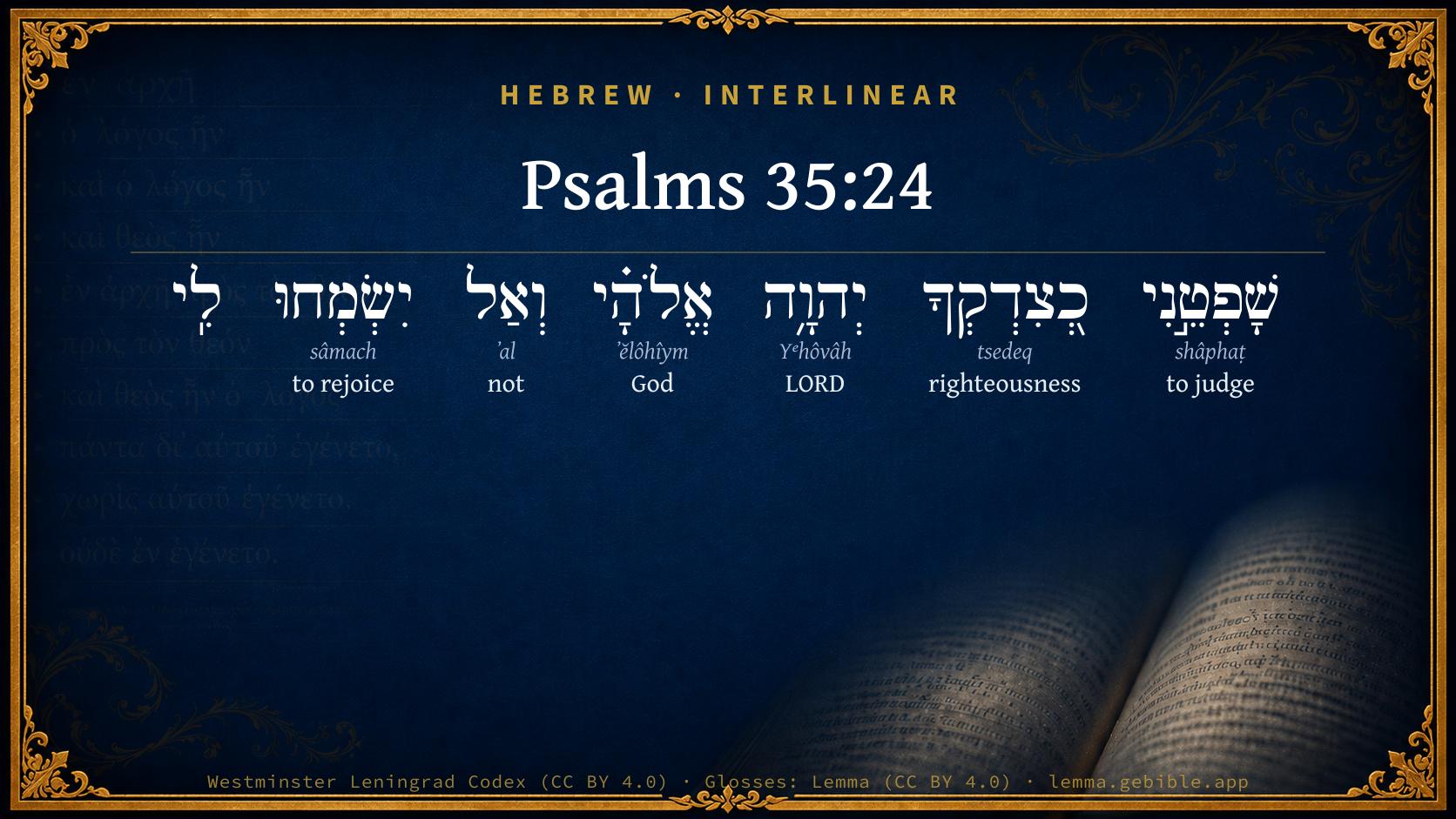
Psalms 35:24

Hebrew (Westminster Leningrad Codex) Psalms 35:24 appears in the Hebrew Old Testament. The text above is from the Westminster Leningrad Codex. Each word links to its Strong’s number, a concise gloss, and parsing drawn from the Open Scriptures Hebrew Bible morphology. Click any word for its full Brown-Driver-Briggs (BDB) entry.
Download image
Cite this verse

Psalms 35:24 (World English Bible). Public Domain. Lemma interlinear Bible study tool, https://lemma.gebible.app/v/psalms/35/24.

Show BibTeX & RIS
BibTeX
RIS
English Translation
Vindicate me, Yahweh my God, according to your righteousness; Don't let them gloat over me.
World English Bible · Public Domain
Download a study sheet

One document with this verse’s original text, its word-by-word gloss line, the meaning frame, cross-references with their text, attributed commentary, and full source and license credits — printable, and it pastes into notes with its structure intact.

This verse Autodidact and up

Study sheet (.html) Plain text (.txt)

A passage Seminary Student

Up to 50 verses in one chapter. A passage sheet keeps up to 6 commentary sources and 12 cross-references per verse, in the order this page ranks them, and says so on the sheet whenever that leaves anything out. Ask for a single verse and you get the Autodidact verse sheet above.

Everything on this page stays free to read, with no account — the sheet is a download of what is already on screen, not access to it.

Want to remove ads? Support Godless Engineer
Compare translations 3

The same verse in 3 English versions, stacked beneath the original-language interlinear above. Click any original word for its lexicon entry.

Each is an independent rendering of the whole verse — the interlinear is not word-aligned to these translations.

Highlighted words mark where these versions differ — a whole-verse word diff, not a word-by-word alignment.

  • World English Bible Public Domain
    Vindicate me, Yahweh my God, according to your righteousness; Don't let them gloat over me.
  • King James Version Public Domain
    Judge me, O LORD my God, according to thy righteousness; and let them not rejoice over me.
  • unfoldingWord Literal Text CC BY-SA 4.0
    Judge me according to your righteousness, Yahweh my God, and do not let them rejoice over me.

unfoldingWord Literal Text — © unfoldingWord, licensed CC BY-SA 4.0. Word-aligned USFM3 via Door43 (git.door43.org/unfoldingWord/en_ult).

Versions to compare (up to 4)

3 of 4 selected

Show all 18 translations

Every available English version of this verse, each an independent rendering of the whole verse.

  • World English Bible Public Domain
    Vindicate me, Yahweh my God, according to your righteousness; Don't let them gloat over me.
  • Berean Standard Bible Public Domain
    Vindicate me by Your righteousness, O LORD my God, and do not let them gloat over me.
  • Majority Standard Bible Public Domain
    Vindicate me by Your righteousness, O LORD my God, and do not let them gloat over me.
  • King James Version Public Domain
    Judge me, O LORD my God, according to thy righteousness; and let them not rejoice over me.
  • American Standard Version (1901) Public Domain
    Judge me, O Jehovah my God, according to thy righteousness; And let them not rejoice over me.
  • Revised Version (1885) Public Domain
    Judge me, O LORD my God, according to thy righteousness; and let them not rejoice over me.
  • Geneva Bible (1599) Public Domain
    Iudge me, O Lord my God, according to thy righteousnesse, and let them not reioyce ouer mee.
  • Douay-Rheims (1899) Public Domain
    Judge me, O Lord my God according to thy justice, and let them not rejoice over me.
  • Young's Literal Translation Public Domain
    Judge me according to Thy righteousness, O Jehovah my God, And they do not rejoice over me.
  • Literal Standard Version CC BY-SA 4.0
    Judge me according to Your righteousness, O YHWH my God, || And they do not rejoice over me.
  • Unlocked Literal Bible CC BY-SA 4.0
    Defend me, Yahweh my God, because of your righteousness; do not let them rejoice over me.
  • unfoldingWord Literal Text CC BY-SA 4.0
    Judge me according to your righteousness, Yahweh my God, and do not let them rejoice over me.
  • Darby Bible Public Domain
    Judge me, Jehovah my God, according to thy righteousness, and let them not rejoice over me.
  • World Messianic Bible Public Domain
    Vindicate me, LORD my God, according to your righteousness. Don’t let them gloat over me.
  • Webster's Bible Public Domain
    Judge me, O LORD my God, according to thy righteousness; and let them not rejoice over me.
  • Free Bible Version CC BY-SA 4.0
    Vindicate me, my Lord and my God, because you are just and right. Don't let them gloat over me.
  • Bible in Basic English Public Domain
    Be my judge, O Lord my God, in your righteousness; do not let them be glad over me.
  • JPS Tanakh (1917) Public Domain
    Judge me, O LORD my God, according to Thy righteousness; and let them not rejoice over me.

Literal Standard Version (2020), Covenant Press — licensed CC BY-SA 4.0. Text via the HelloAO Bible API (eBible.org). Unlocked Literal Bible (unfoldingWord) — licensed CC BY-SA 4.0. Text via the HelloAO Bible API (eBible.org). unfoldingWord Literal Text — © unfoldingWord, licensed CC BY-SA 4.0. Word-aligned USFM3 via Door43 (git.door43.org/unfoldingWord/en_ult). Free Bible Version, Dr. Jonathan Gallagher — licensed CC BY-SA 4.0. Text via the HelloAO Bible API (eBible.org).

Word by word

More ways to search: Search by grammar → Find every occurrence → Compare this word →

Practice this passage: Drill this verse → Learn its vocabulary →

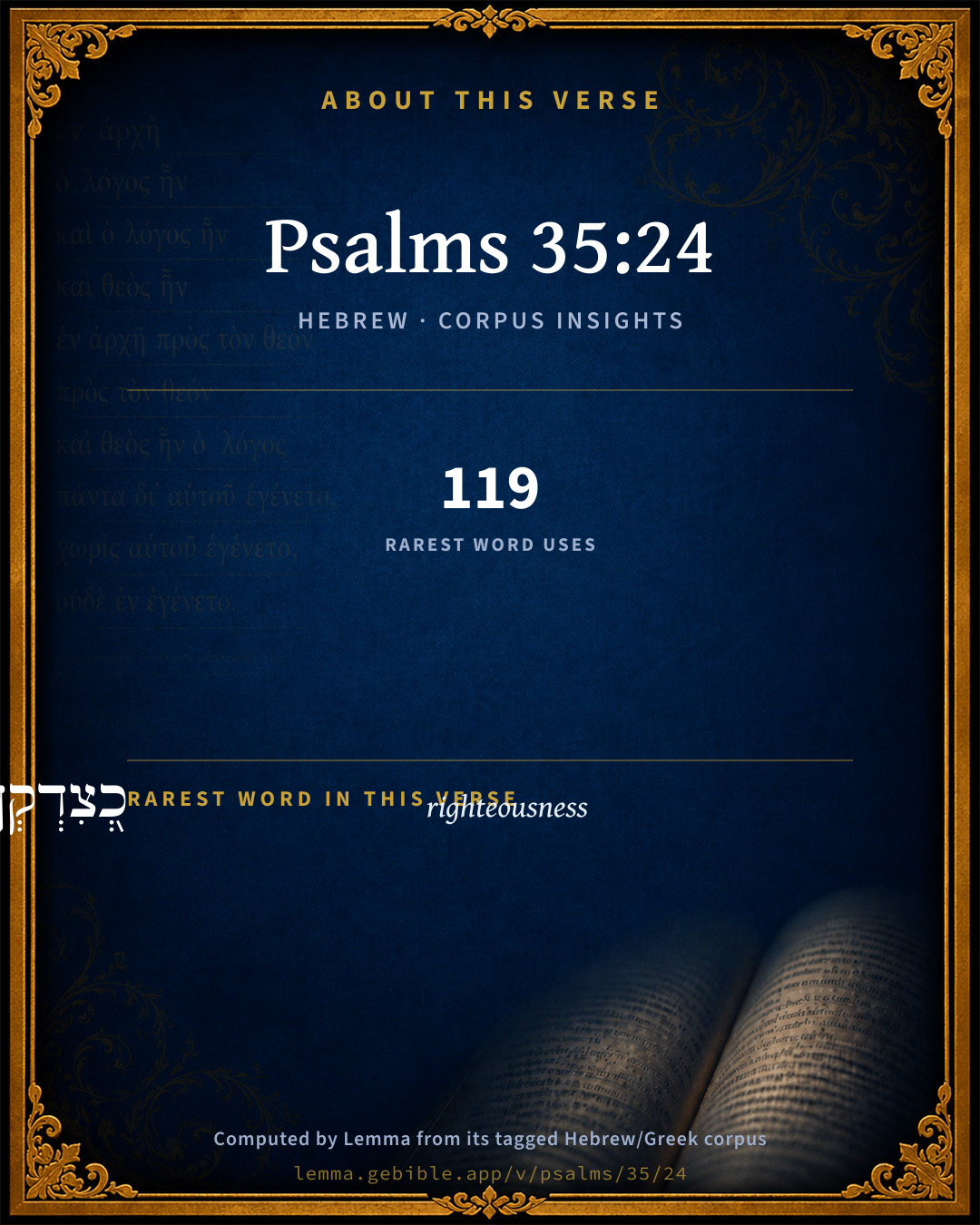
כְ֭צִדְקְךָ
tsedeq
H6664
“like/as · righteousness · your”
Preposition + Noun, Common, Masculine, Singular, Construct + Suffix, Personal, 2nd Person, Masculine, Singular
Part of Speech
Preposition + Noun
Type
Common
Gender
Masculine
Number
Singular
State
Construct
Full BDB Definition

Origin: from H6663

TWOT: 1879a

justice, rightness, righteousness - what is right or just or normal, rightness, justness (of weights and measures) - righteousness (in government) - of judges, rulers, kings - of law - of Davidic king, Messiah - of Jerusalem as seat of just government - of God's attribute - righteousness, justice (in case or cause) - rightness (in speech) - righteousness (as ethically right) - righteousness (as vindicated), justification (in controversy), deliverance, victory, prosperity - of God as covenant-keeping in redemption - in name of Messianic king - of people enjoying salvation - of Cyrus
  1. שָׁפְטֵ֣נִי shâphaṭ H8199 “judge · me” Verb, Qal, Imperative, 2nd Person, Masculine, Singular + Suffix, Personal, 1st Person, Common, Singular
  2. יְהוָ֥ה Yᵉhôvâh H3068 “LORD” Noun, Proper
  3. אֱלֹהָ֗י ʼĕlôhîym H430 “God(s) · my” Noun, Common, Masculine, Plural, Construct + Suffix, Personal, 1st Person, Common, Singular
  4. וְאַל ʼal H408 “and · not” Conjunction + Particle, Negative
  5. יִשְׂמְחוּ sâmach H8055 “to rejoice” Verb, Qal, Jussive, 3rd Person, Masculine, Plural

About this verse

These counts appear in no published source. They are computed here, from the morphology-tagged text and Lemma’s own curated glosses. What Lemma adds →

7
words
6
distinct lemmas
Wisdom
section

Grammatical profile

  • 2 verbs
  • 3 nouns
  • 1 preposition
  • 1 particle

Verb forms

  • שָׁפְטֵ֣נִי Qal · Imperative
  • יִשְׂמְחוּ Qal · Jussive

Hebrew & Septuagint length

In English translation the verse runs 15 words from the Hebrew and 19 from the Septuagint (LXX English) — closely comparable.

A rough comparison of the two English renderings, which tokenize alike — not a word-level alignment.

Word counts can differ between the Hebrew and the Greek without any difference in meaning — e.g. the Hebrew direct-object marker אֵת has no separate Greek word, and Greek often adds the article ὁ.

Cross-references

8

Topical passages linked to Psalms 35:24 in the Treasury of Scripture Knowledge — connected by theme and wording, ordered by reader-vote popularity; previews shown in the World English Bible.

  • Psalms 43:1 Vindicate me, God, and plead my cause against an ungodly nation. Oh, deliver me from deceitful and wicked men.
  • Psalms 26:1 Judge me, Yahweh, for I have walked in my integrity. I have trusted also in Yahweh without wavering.
  • Psalms 7:8 Yahweh administers judgment to the peoples. Judge me, Yahweh, according to my righteousness, And to my integrity that is in me.
  • Psalms 35:19 Don't let those who are my enemies wrongfully rejoice over me; Neither let them wink with the eye who hate me without a cause.
  • 2 Thessalonians 1:6 Since it is a righteous thing with God to repay affliction to those who afflict you,
  • Job 20:5 That the triumphing of the wicked is short, The joy of the godless but for a moment?
  • Psalms 18:20–24 Yahweh has rewarded me according to my righteousness. According to the cleanness of my hands has he recompensed me.
  • 1 Peter 2:22 who did not sin, "neither was deceit found in his mouth."

Cross-references courtesy of OpenBible.info (CC BY 4.0).

Hebrew and Greek witnesses Masoretic Hebrew ↔ Greek Septuagint

The same verse in the two great witnesses to the Old Testament, shown verse-for-verse.

You’re reading Greek Psalm 34 (Hebrew Psalm 35). The Septuagint counts the superscription, so verse numbers can differ from the Hebrew — chapter-level alignment, not verse-by-verse. Numbering follows Rahlfs.

These are two independent witnesses, not word-aligned to each other, and the Septuagint is shown in lemma (dictionary) form.

Hebrew Psalms 35:24 Masoretic · Westminster Leningrad Codex

שָׁפְטֵ֣נִי כְ֭צִדְקְךָ יְהוָ֥ה אֱלֹהָ֗י וְאַל יִשְׂמְחוּ לִֽי

Vindicate me, Yahweh my God, according to your righteousness; Don't let them gloat over me.

World English Bible · Public Domain

Greek LXX Greek Psalm 34:24 Septuagint · lemma form

κρίνω ἐγώ κατά ὁ δικαιοσύνη σύ κύριος ὁ θεός ἐγώ καί μή ἐπιχαίρω ἐγώ

Judge me, O Lord, according to your righteousness, O Lord my God; and let them not rejoice against me.

LXX2012 (modern English Septuagint) · Public Domain

Hebrew: Westminster Leningrad Codex (CC BY 4.0). Greek: Septuagint (public domain); English from LXX2012 (modern English Septuagint) (Public Domain). How the Septuagint differs from the Hebrew →

Commentary

Notes on Psalms 35:24 from classic Christian and Jewish commentators (each source and its license shown beneath its notes). The classic Christian expositions comment on the surrounding passage and are grouped to its opening verse, so a note may address several verses; the Jewish commentaries on the Tanakh (Rashi and others) are per-verse, so they appear only where the commentator wrote on this verse.

Lemma curates 59 commentaries, every one of them public domain or Creative Commons licensed, each selected and text-cleaned for this edition rather than reprinted as found. About our sources →

Trapp's Complete Commentary

John Trapp

Psa 35:24 Judge me, O LORD my God, according to thy righteousness; and let them not rejoice over me.

Ver. 24. According to thy righteousness] i.e. For the honour of thy justice, wherein else thou art likely to suffer.

And let them not rejoice over me] For I quarter arms, as I may so say, with thee, Lord; and my disgrace will reflect upon thee.

John Trapp, A Commentary or Exposition upon All the Books of the Old and New Testament (1647–1656) — public domain. Text from a community e-Sword module.

J. A. Alexander on Psalms

Joseph Addison Alexander

24. (Psa 35:24) Judge me according to thy righteousness, Jehovah, my God, and let them not rejoice respecting me. "Do me justice, clear me from aspersion, grant an attestation of my innocence, in the exercise and exhibition of thine own essential rectitude, and in accordance with that covenant relation which exists between us; and thus, in the most effectual manner, take away from my malignant enemies all pretext and occasion for exulting in my overthrow, or otherwise triumphing at my expense." With the last clause compare Psa 30:2 (1) above, where he thanks God for the very favour which he here asks. The verb in this clause may be referred to men in general, or with still greater probability to the enemies described in the preceding context.

Joseph Addison Alexander, The Psalms Translated and Explained (1850) — public domain. Text from a community e-Sword module.

Geneva Bible (1599)

Geneva Bible translators

It is the justice of God to give to the oppressors affliction and torment, and to the oppressed aid and relief, 2 Thess. 1:6.

Geneva Bible (1599) marginal notes — public domain. Text via Bolls.life.

Adam Clarke's Commentary

Verse 24. Judge me, O Lord my God] The manner of his appeal shows the strong confidence he had in his own innocence.

Adam Clarke's Commentary on the Bible (1810–1826) — public domain. Text from a community e-Sword/MySword module.

John Calvin's Commentaries

24. Judge me, O Jehovah my God! David here confirms the prayer of the preceding verse that God would be his defender, and would maintain his righteous cause. Having been for a time subjected to suffering as one who had been forsaken and forgotten, he sets before himself the righteousness of God, which forbids that he should altogether abandon the upright and the just. It is, therefore, not simply a prayer, but a solemn appeal to God, that as he is righteous, he would manifest his righteousness in defending his servant in a good cause. And certainly, when we seem to be forsaken and deprived of all help, there is no remedy which we can employ, more effectual to overcome temptation than this consideration, that the righteousness of God, on which our deliverance depends, can never fail. Accordingly, the Apostle Paul, in exhorting the faithful to patience, says in 2 Thessalonians 1:6,

“It is a righteous thing with God to recompense tribulation to them that trouble you.”

Now David again appeals to God in this place, and entreats him to manifest his righteousness in restraining the insolence of his enemies: for the more proudly they assail us, God is so much the more ready to help us. Besides, by again introducing them as speaking, he portrays in a graphic style the cruelty of their desires; and by this he means to show, that if things should happen according to their wishes, they would set no limit to their frowardness. But as the more they vaunt themselves, the more they provoke the wrath of God against them, David with good reason uses this as an argument to encourage his hope, and employs it for his support and confirmation in prayer.

John Calvin's Commentaries (1540-1563) — public domain. Text from the Calvin Translation Society English edition (1840s-50s) via the Christian Classics Ethereal Library (ccel.org). Calvin's coverage is partial (roughly two-thirds of the Bible); uncommented books and verses are honest gaps, never fabricated. The 19th-century editor's footnotes and remarks are omitted so the notes are faithfully Calvin's own voice.

The Cambridge Bible for Schools and Colleges

gen. ed. J. J. S. Perowne

24. Judge me] Do me justice. Cp. Psa_7:8; and for the plea, according to thy righteousness, see Psa_7:17; Psa_31:1.

The Cambridge Bible for Schools and Colleges (gen. ed. J. J. S. Perowne; Cambridge University Press, 1878–1918) — public domain. Text from a community e-Sword module.

John Gill's Exposition

Judge me, O Lord my God, according to thy righteousness,.... Either that righteousness of his, by which he justifies his people, which Christ has wrought out, God has accepted of, and imputes; and which, though revealed in the Gospel, was witnessed to by the law and prophets, and was known to the saints under the Old Testament, and particularly to David; see Rom 4:6; or the perfection of his justice, his essential righteousness displayed in all his works and actions, and in the government of the world; according to this the psalmist desired to be judged; not with respect to his person before God, but with respect to his cause before men, by delivering him from his enemies, and taking vengeance on them: thus Christ also was judged according to the strict justice or righteousness of God; for as sin was righteously condemned in his flesh, being imputed to him, and found upon him; so he was, according to the justice of God, acquitted, discharged, and justified in the Spirit, when he arose from the dead; and afterwards righteous judgment was executed on his enemies the Jews, when wrath came upon them to the uttermost: and his people are also dealt with according to the righteousness of God; who acts as a righteous God, as just and faithful in forgiving their sins, on account of the blood of Christ being shed for it; and in justifying their persons by his righteousness, and by giving them the crown of righteousness laid up for them; and at last by rendering tribulation to them that have troubled them;

and let them not rejoice over me; meaning his enemies, as in Psa 35:15; that is, let them not go on to rejoice; let them have no occasion for it, but deliver me out of their hands.

John Gill's Exposition of the Whole Bible (1746–1763) — public domain (CC PDM 1.0). Text via the HelloAO Bible API.

Albert Barnes' Notes on the Bible

Judge me, O Lord my God - Pronounce judgment, or judge between me and my enemies. Compare the notes at Psa 26:1.

According to thy righteousness - That is, “rightly.” Let there be a righteous judgment. The character of God, or the righteousness of God, is the highest standard of equity and justice, and the psalmist asks that he would manifest his real character as judge in interposing in behalf of an injured and oppressed man, and doing justice to him. When we are right in our own cause we may ask a just God to interpose and determine between us and our enemies according to his own nature. As between ourselves and our fellow-men we may bring our cause with this plea before a righteous God; as between ourselves and God, we can make no appeal to his “justice,” but our only hope is in his “mercy.”

And let them not rejoice over me - Let them not carry out their purposes; let them not be successful, so that they can appeal to the result as if they were right, and thus obtain a triumph over me. Compare Psa 35:19.

Albert Barnes' Notes on the Bible (1834–1885) — public domain. Text from a community e-Sword/MySword module.

Matthew Poole's English Annotations

Thy righteousness; whereby thou usest and lovest to defend the innocent, and to punish their oppressors.

Matthew Poole's English Annotations on the Holy Bible (1683–1685) — public domain. Text from a community e-Sword/MySword module.

The Treasury of David

Charles H. Spurgeon

Verse 24. The appeal is here repeated; the plaintiff feels that the joy of his accusers will be shortlived as soon as impartial justice rules. The oppressors' wrong, the proud man's contumely, the fool's grimace all, all will cease when the righteous Lord sits down upon the judgment seat.

[Verse] 24. ["O Lord my God."] O Jehovah my God; here is another precious word. He takes Jehovah to be his God, in opposition to those who make idols, or riches, or their own lusts their God. He claims a full possession of all that is in the great I AM. Even though he views him as a judge he lays the hand of faith upon his God, and flinches not even before the blaze of his righteousness. It is a noble word, a grand utterance of faith; he who can pronounce that word "my" from his inmost soul in such a connection may well laugh to scorn all his enemies. [C. H. S.]

None.

Charles H. Spurgeon's The Treasury of David (1869–1885) — public domain. Psalms only. Text from a community e-Sword/MySword module.

Whedon's Commentary on the Bible

Daniel D. Whedon

24. According to thy righteousness—An appeal to God’s knowledge of the right as to the points at issue with his enemies. Justice, not private victory, is his plea with God.

Daniel D. Whedon (gen. ed.), Commentary on the Old and New Testaments (1874–1909) — public domain. Text from a community e-Sword module.

The Pulpit Commentary

Judge me, O Lord my God, according to thy righteousness, Let thy law of righteousness be the rule by which I am judged, and my enemies also. Then the victory will remain with me; thou wilt not let them rejoice over me.

The Pulpit Commentary (1880–1919), ed. H.D.M. Spence-Jones & Joseph S. Exell — public domain. Text from a community e-Sword module.

unfoldingWord translationNotes

Door43 World Missions Community

do not let them rejoice over me

"do not let them be glad because I am suffering"

say in their heart

This is an idiom that means to say to oneself. AT: "say to themselves" (See: Idiom)

Aha

This is an exclamation that is used when something is suddenly seen or understood. It emphasizes what follows. AT: "Yes" (See: Exclamations)

we have what we wanted

It is implied that the writer's enemies wanted him to be declared guilty. AT: "he has been declared guilty just as we desired" (See: Assumed Knowledge and Implicit Information)

We have devoured him

The writer's enemies speak of his destruction as if they were wild animals who had eaten him. AT: "We have swallowed him up" or "We have destroyed him" (See: Metaphor)

May they be put to shame and may they be confounded who rejoice at my distress

"May those who rejoice at my distress be put to shame and confounded"

May they be put to shame

"May they feel shame"

may they be confounded

"may they be confused" or "may they be humiliated"

May those who exalt themselves over me be clothed with shame and dishonor

This can be stated in active form. AT: "May you clothe with shame and dishonor those who exalt themselves over me" (See: Active or Passive)

exalt themselves over me

"consider themselves better than I am" or "think they have the right to treat me badly"

clothed with shame and dishonor

Here shame and dishonor are spoken of as if they were shameful clothes that the writer could wear. These abstract nouns can be stated as verbs. AT: "shamed and dishonored" (See: Abstract Nouns and Metaphor)

shame and dishonor

These terms mean about the same thing and are used to emphasize how degraded they will be. (See: Doublet)

translationWords

God

righteous

joy

heart

devour

shame

dishonor

unfoldingWord translationNotes — © Distant Shores Media and the Door43 World Missions Community, licensed CC BY-SA 4.0. Source: git.door43.org/Door43/en_tn.

Lesson kit

Teaching starters — assembled from the data on this page, not authored interpretation. Every prompt links to the verse data it draws on. Edit before teaching.

Psalms, in the Wisdom, opens this verse with 7 words (6 distinct Hebrew lemmas). Its most distinctive word is tsedeq (“righteousness”). A historical commentator’s framing appears above. Read the whole chapter for the surrounding context.

Discussion questions

  1. How does “righteousness” (tsedeq) shape what this verse is saying?
  2. Psalms 43:1 shares this passage’s theme. How do the two illuminate each other?
  3. The translations on this page render this verse differently — a whole-verse word diff, not a word-by-word alignment. What might account for the different wordings?
  4. The verb «שָׁפְטֵ֣נִי» is Qal Imperative. How does its form color the action?
  5. Reading how Trapp's Complete Commentary and J. A. Alexander on Psalms read this verse, where do the two commentators agree and where do they part?

Things to notice

Reading settings

Reading text

Shown beneath each verse's original-language words.

Old Testament
Old Testament edition

Read the OT as the Masoretic Hebrew (MT) or the Greek Septuagint (LXX).

English shown for the Greek Septuagint (in the Hebrew ↔ Greek comparison).

Comparing translations? Open the Compare panel on any verse page to stack up to four side by side.