
Deuteronomy 17:12

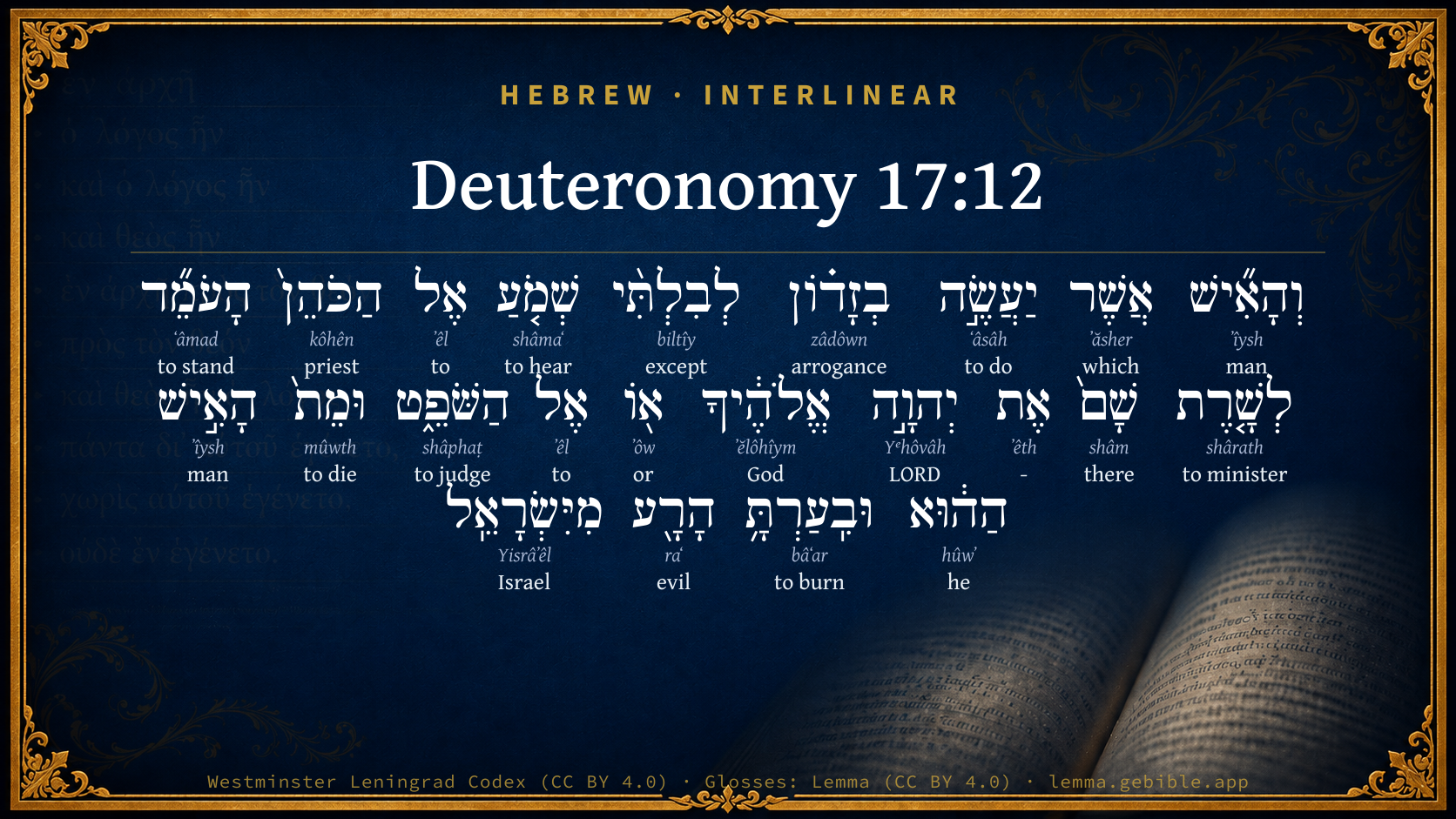
Hebrew (Westminster Leningrad Codex) Deuteronomy 17:12 appears in the Hebrew Old Testament. The text above is from the Westminster Leningrad Codex. Each word links to its Strong’s number, a concise gloss, and parsing drawn from the Open Scriptures Hebrew Bible morphology. Click any word for its full Brown-Driver-Briggs (BDB) entry.
Download image
Cite this verse

Deuteronomy 17:12 (World English Bible). Public Domain. Lemma interlinear Bible study tool, https://lemma.gebible.app/v/deuteronomy/17/12.

Show BibTeX & RIS
BibTeX
RIS
English Translation
The man who does presumptuously, in not listening to the priest who stands to minister there before Yahweh your God, or to the judge, even that man shall die: and you shall put away the evil from Israel.
World English Bible · Public Domain
Highlights
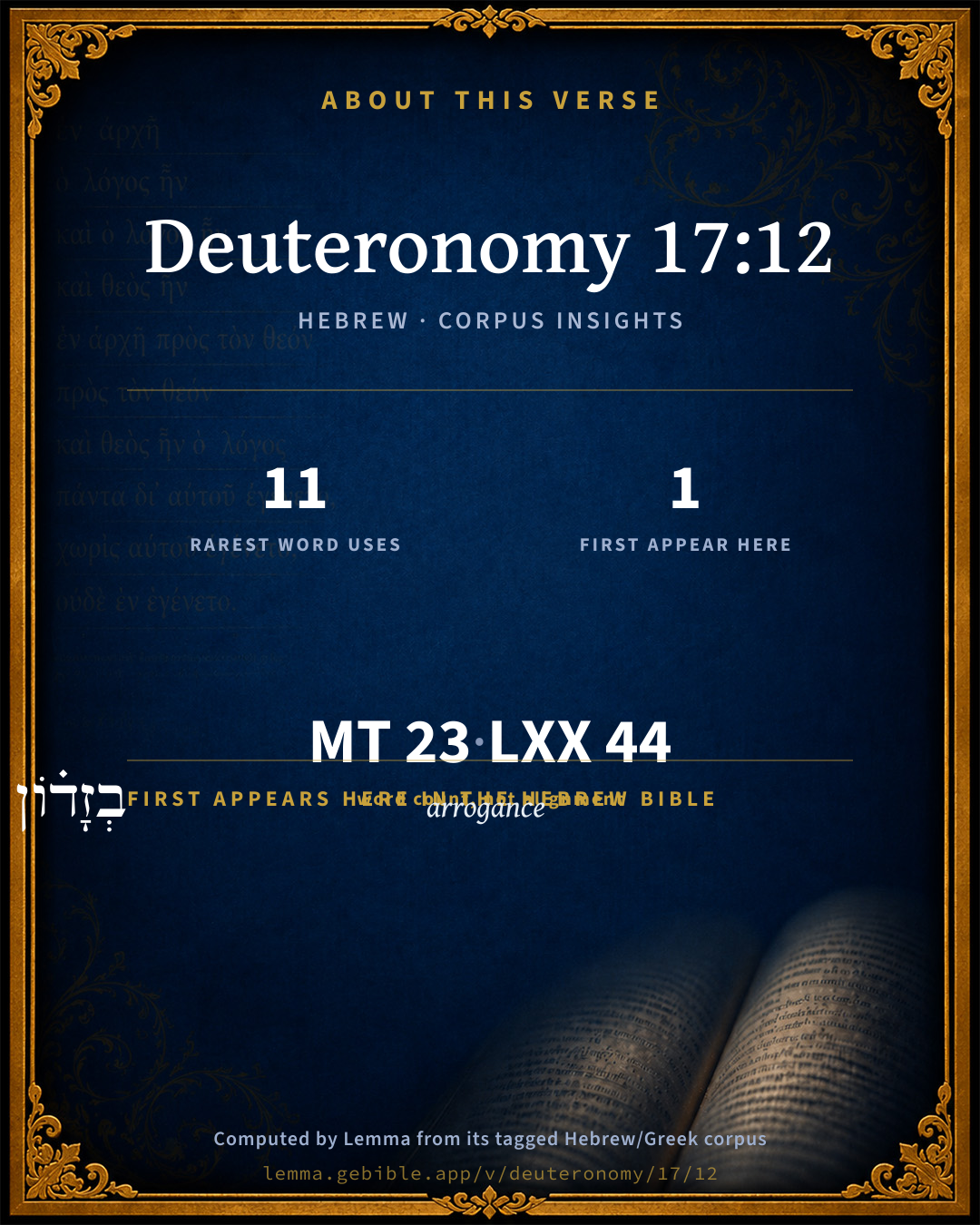
  • 1 first appearance in the Hebrew Bible
Full analysis ↓
Download a study sheet

One document with this verse’s original text, its word-by-word gloss line, the meaning frame, cross-references with their text, attributed commentary, and full source and license credits — printable, and it pastes into notes with its structure intact.

This verse Autodidact and up

Study sheet (.html) Plain text (.txt)

A passage Seminary Student

Up to 50 verses in one chapter. A passage sheet keeps up to 6 commentary sources and 12 cross-references per verse, in the order this page ranks them, and says so on the sheet whenever that leaves anything out. Ask for a single verse and you get the Autodidact verse sheet above.

Everything on this page stays free to read, with no account — the sheet is a download of what is already on screen, not access to it.

Want to remove ads? Support Godless Engineer
Compare translations 3

The same verse in 3 English versions, stacked beneath the original-language interlinear above. Click any original word for its lexicon entry.

Each is an independent rendering of the whole verse — the interlinear is not word-aligned to these translations.

Highlighted words mark where these versions differ — a whole-verse word diff, not a word-by-word alignment.

  • World English Bible Public Domain
    The man who does presumptuously, in not listening to the priest who stands to minister there before Yahweh your God, or to the judge, even that man shall die: and you shall put away the evil from Israel.
  • King James Version Public Domain
    And the man that will do presumptuously, and will not hearken unto the priest that standeth to minister there before the LORD thy God, or unto the judge, even that man shall die: and thou shalt put away the evil from Israel.
  • unfoldingWord Literal Text CC BY-SA 4.0
    And the man who does arrogantly, not listening to the priest who is standing there to serve Yahweh your God, or to the judge, then that man shall die, and you shall remove the evil from Israel.

unfoldingWord Literal Text — © unfoldingWord, licensed CC BY-SA 4.0. Word-aligned USFM3 via Door43 (git.door43.org/unfoldingWord/en_ult).

Versions to compare (up to 4)

3 of 4 selected

Show all 18 translations

Every available English version of this verse, each an independent rendering of the whole verse.

  • World English Bible Public Domain
    The man who does presumptuously, in not listening to the priest who stands to minister there before Yahweh your God, or to the judge, even that man shall die: and you shall put away the evil from Israel.
  • Berean Standard Bible Public Domain
    But the man who acts presumptuously, refusing to listen either to the priest who stands there to serve the LORD your God, or to the judge, must be put to death. You must purge the evil from Israel.
  • Majority Standard Bible Public Domain
    But the man who acts presumptuously, refusing to listen either to the priest who stands there to serve the LORD your God, or to the judge, must be put to death. You must purge the evil from Israel.
  • King James Version Public Domain
    And the man that will do presumptuously, and will not hearken unto the priest that standeth to minister there before the LORD thy God, or unto the judge, even that man shall die: and thou shalt put away the evil from Israel.
  • American Standard Version (1901) Public Domain
    And the man that doeth presumptuously, in not hearkening unto the priest that standeth to minister there before Jehovah thy God, or unto the judge, even that man shall die: and thou shalt put away the evil from Israel.
  • Revised Version (1885) Public Domain
    And the man that doeth presumptuously, in not hearkening unto the priest that standeth to minister there before the LORD thy God, or unto the judge, even that man shall die: and thou shalt put away the evil from Israel.
  • Geneva Bible (1599) Public Domain
    And that man that wil doe presumptuously, not hearkening vnto the Priest (that standeth before the Lord thy God to minister there) or vnto the iudge, that man shall die, and thou shalt take away euill from Israel.
  • Douay-Rheims (1899) Public Domain
    But he that will be proud, and refuse to obey the commandment of the priest, who ministereth at that time to the Lord thy God, and the decree of the judge, that man shall die, and thou shalt take away the evil from Israel:
  • Young's Literal Translation Public Domain
    And the man who acteth with presumption, so as not to hearken unto the priest (who is standing to serve there Jehovah thy God), or unto the judge, even that man hath died, and thou hast put away the evil thing from Israel,
  • Literal Standard Version CC BY-SA 4.0
    And the man who acts with presumption, so as not to listen to the priest (who is standing to serve your God YHWH there), or to the judge, even that man has died, and you have put away evil from Israel,
  • Unlocked Literal Bible CC BY-SA 4.0
    Anyone who acts arrogantly, in not listening to the priest who is standing to serve before Yahweh your God, or in not listening to the judge—that man will die; you will put away the evil from Israel.
  • unfoldingWord Literal Text CC BY-SA 4.0
    And the man who does arrogantly, not listening to the priest who is standing there to serve Yahweh your God, or to the judge, then that man shall die, and you shall remove the evil from Israel.
  • Darby Bible Public Domain
    And the man that shall act presumptuously, and not hearken unto the priest that standeth to serve there before Jehovah thy God, or unto the judge, that man shall die; and thou shalt put away evil from Israel.
  • World Messianic Bible Public Domain
    The man who does presumptuously in not listening to the priest who stands to minister there before the LORD your God, or to the judge, even that man shall die. You shall put away the evil from Israel.
  • Webster's Bible Public Domain
    And the man that will do presumptuously, and will not hearken to the priest that standeth to minister there before the LORD thy God, or to the judge, even that man shall die: and thou shalt remove the evil from Israel.
  • Free Bible Version CC BY-SA 4.0
    Anyone who treats with contempt either the priest (who ministers before the Lord your God) or the judge, must be executed. You must eliminate this evil from Israel.
  • Bible in Basic English Public Domain
    And any man who, in his pride, will not give ear to the priest whose place is there before the Lord your God, or to the judge, is to be put to death: you are to put away the evil from Israel.
  • JPS Tanakh (1917) Public Domain
    And the man that doeth presumptuously, in not hearkening unto the priest that standeth to minister there before the LORD thy God, or unto the judge, even that man shall die; and thou shalt exterminate the evil from Israel.

Literal Standard Version (2020), Covenant Press — licensed CC BY-SA 4.0. Text via the HelloAO Bible API (eBible.org). Unlocked Literal Bible (unfoldingWord) — licensed CC BY-SA 4.0. Text via the HelloAO Bible API (eBible.org). unfoldingWord Literal Text — © unfoldingWord, licensed CC BY-SA 4.0. Word-aligned USFM3 via Door43 (git.door43.org/unfoldingWord/en_ult). Free Bible Version, Dr. Jonathan Gallagher — licensed CC BY-SA 4.0. Text via the HelloAO Bible API (eBible.org).

Word by word

More ways to search: Search by grammar → Find every occurrence → Compare this word →

Practice this passage: Drill this verse → Learn its vocabulary →

בְזָד֗וֹן
zâdôwn
H2087
“in/at · arrogance”
Preposition + Noun, Common, Masculine, Singular, Absolute
Part of Speech
Preposition + Noun
Type
Common
Gender
Masculine
Number
Singular
State
Absolute
Full BDB Definition

Origin: from H2102

TWOT: 547b

pride, insolence, presumptuousness, arrogance
  1. וְהָאִ֞ישׁ ʼîysh H376 “and · the · man” Conjunction + Particle, Definite Article + Noun, Common, Masculine, Singular, Absolute
  2. אֲשֶׁר ʼăsher H834 “which” Particle, Relative
  3. יַעֲשֶׂ֣ה ʻâsâh H6213 “to do” Verb, Qal, Imperfect, 3rd Person, Masculine, Singular
  4. לְבִלְתִּ֨י biltîy H1115 “to/for · except” Preposition + Conjunction
  5. שְׁמֹ֤עַ shâmaʻ H8085 “to hear” Verb, Qal, Infinitive Construct
  6. אֶל ʼêl H413 “to” Preposition
  7. הַכֹּהֵן֙ kôhên H3548 “the · priest” Particle, Definite Article + Noun, Common, Masculine, Singular, Absolute
  8. הָעֹמֵ֞ד ʻâmad H5975 “the · standing” Particle, Definite Article + Verb, Qal, Participle Active, Masculine, Singular, Absolute
  9. לְשָׁ֤רֶת shârath H8334 “to minister” Preposition + Verb, Piel, Infinitive Construct
  10. שָׁם֙ shâm H8033 “there” Adverb
  11. אֶת ʼêth H853 “-” Particle, Direct Object
  12. יְהוָ֣ה Yᵉhôvâh H3068 “LORD” Noun, Proper
  13. אֱלֹהֶ֔יךָ ʼĕlôhîym H430 “God(s) · your” Noun, Common, Masculine, Plural, Construct + Suffix, Personal, 2nd Person, Masculine, Singular
  14. א֖וֹ ʼôw H176 “or” Conjunction
  15. אֶל ʼêl H413 “to” Preposition
  16. הַשֹּׁפֵ֑ט shâphaṭ H8199 “the · judging” Particle, Definite Article + Verb, Qal, Participle Active, Masculine, Singular, Absolute
  17. וּמֵת֙ mûwth H4191 “and · to die” Conjunction + Verb, Qal, Sequential Perfect, 3rd Person, Masculine, Singular
  18. הָאִ֣ישׁ ʼîysh H376 “the · man” Particle, Definite Article + Noun, Common, Masculine, Singular, Absolute
  19. הַה֔וּא hûwʼ H1931 “the · he” Particle, Definite Article + Pronoun, Personal, 3rd Person, Masculine, Singular
  20. וּבִֽעַרְתָּ֥ bâʻar H1197 “and · to burn” Conjunction + Verb, Piel, Sequential Perfect, 2nd Person, Masculine, Singular
  21. הָרָ֖ע raʻ H7451 “the · evil” Particle, Definite Article + Adjective, Adjective, Masculine, Singular, Absolute
  22. מִיִּשְׂרָאֵֽל Yisrâʼêl H3478 “from · Israel” Preposition + Noun, Proper

About this verse

These counts appear in no published source. They are computed here, from the morphology-tagged text and Lemma’s own curated glosses. What Lemma adds →

23
words
21
distinct lemmas
Pentateuch
section

Notable vocabulary

The rarest word here is בְזָד֗וֹן arrogance H2087 — appearing just 11 times in the whole Hebrew Bible.

First appearance in Scripture

This word makes its first canonical appearance in the Hebrew Bible here:

  • בְזָד֗וֹן arrogance H2087

Shared distinctive vocabulary

בְזָד֗וֹן arrogance H2087 occurs in 11 verses of the Hebrew Bible. Also found in:

Grammatical profile

  • 7 verbs
  • 7 nouns
  • 1 adjective
  • 1 pronoun
  • 2 prepositions
  • 2 conjunctions
  • 1 adverb
  • 2 particles

Verb forms

  • יַעֲשֶׂ֣ה Qal · Imperfect
  • שְׁמֹ֤עַ Qal · Infinitive Construct
  • הָעֹמֵ֞ד Qal · Participle Active
  • לְשָׁ֤רֶת Piel · Infinitive Construct
  • הַשֹּׁפֵ֑ט Qal · Participle Active
  • וּמֵת֙ Qal · Sequential Perfect
  • וּבִֽעַרְתָּ֥ Piel · Sequential Perfect

Repetition

Words recur within this verse — often emphatic in Hebrew:

  • וְהָאִ֞ישׁ man H376 ×2
  • אֶל to H413 ×2

Hebrew & Septuagint length

In English translation the verse runs 38 words from the Hebrew and 51 from the Septuagint (LXX English) — closely comparable.

A rough comparison of the two English renderings, which tokenize alike — not a word-level alignment.

Word counts can differ between the Hebrew and the Greek without any difference in meaning — e.g. the Hebrew direct-object marker אֵת has no separate Greek word, and Greek often adds the article ὁ.

In the original languages it is 23 Hebrew tokens and 44 Greek tokens — but the two are counted differently (Hebrew bundles its prefixes and suffixes into one token; the Greek is in lemma form), so that isn’t a like-for-like length.

Cross-references

21

Topical passages linked to Deuteronomy 17:12 in the Treasury of Scripture Knowledge — connected by theme and wording, ordered by reader-vote popularity; previews shown in the World English Bible.

  • Numbers 15:30 But the soul who does anything with a high hand, whether he is home-born or a foreigner, the same blasphemes Yahweh; and that soul shall be cut off from among his people.
  • Deuteronomy 13:5 That prophet, or that dreamer of dreams, shall be put to death, because he has spoken rebellion against Yahweh your God, who brought you out of the land of Egypt, and redeemed you out of the house of bondage, to draw you aside out of the way which Yahweh your God commanded you to walk in. So shall you put away the evil from the midst of you.
  • Deuteronomy 10:8 At that time Yahweh set apart the tribe of Levi, to bear the ark of the covenant of Yahweh, to stand before Yahweh to minister to him, and to bless in his name, to this day.
  • Deuteronomy 17:7 The hand of the witnesses shall be first on him to put him to death, and afterward the hand of all the people. So you shall put away the evil from the midst of you.
  • Deuteronomy 18:5 For Yahweh your God has chosen him out of all your tribes, to stand to minister in the name of Yahweh, him and his sons for ever.
  • Deuteronomy 18:7 then he shall minister in the name of Yahweh his God, as all his brothers the Levites do, who stand there before Yahweh.
  • Ezra 10:8 and that whoever didn't come within three days, according to the counsel of the princes and the elders, all his substance should be forfeited, and himself separated from the assembly of the captivity.
  • Hosea 4:4 "Yet let no man bring a charge, neither let any man accuse; For your people are like those who bring charges against a priest.
  • 1 Thessalonians 4:8 Therefore he who rejects doesn't reject man, but God, who has also given his Holy Spirit to you.
  • 1 Timothy 5:20 Those who sin, reprove in the sight of all, that the rest also may be in fear.
  • Hebrews 10:26–29 For if we sin willfully after we have received the knowledge of the truth, there remains no more a sacrifice for sins,
  • Deuteronomy 13:11 All Israel shall hear, and fear, and shall not do any more such wickedness as this is in the midst of you.
  • Deuteronomy 18:20 But the prophet, who shall speak a word presumptuously in my name, which I have not commanded him to speak, or who shall speak in the name of other gods, that same prophet shall die.
  • Psalms 19:13 Keep back your servant also from presumptuous sins. Let them not have dominion over me. Then I will be upright, I will be blameless and innocent of great transgression.
  • Proverbs 21:11 When the mocker is punished, the simple gains wisdom; When the wise is instructed, he receives knowledge.
  • Jeremiah 25:3–14 From the thirteenth year of Josiah the son of Amon, king of Judah, even to this day, these twenty-three years, the word of Yahweh has come to me, and I have spoken to you, rising up early and speaking; but you have not listened.
  • Matthew 10:14 Whoever doesn't receive you, nor hear your words, as you go out of that house or that city, shake off the dust from your feet.
  • Luke 10:16 Whoever listens to you listens to me, and whoever rejects you rejects me. Whoever rejects me rejects him who sent me."
  • John 12:48 He who rejects me, and doesn't receive my sayings, has one who judges him. The word that I spoke, the same will judge him in the last day.
  • John 20:23 Whoever's sins you forgive, they are forgiven them. Whoever's sins you retain, they have been retained."
  • 1 Thessalonians 4:2 For you know what charge we gave you through the Lord Jesus.

Cross-references courtesy of OpenBible.info (CC BY 4.0).

Hebrew and Greek witnesses Masoretic Hebrew ↔ Greek Septuagint

The same verse in the two great witnesses to the Old Testament, shown verse-for-verse.

These are two independent witnesses, not word-aligned to each other, and the Septuagint is shown in lemma (dictionary) form.

Hebrew Deuteronomy 17:12 Masoretic · Westminster Leningrad Codex

וְהָאִ֞ישׁ אֲשֶׁר יַעֲשֶׂ֣ה בְזָד֗וֹן לְבִלְתִּ֨י שְׁמֹ֤עַ אֶל הַכֹּהֵן֙ הָעֹמֵ֞ד לְשָׁ֤רֶת שָׁם֙ אֶת יְהוָ֣ה אֱלֹהֶ֔יךָ א֖וֹ אֶל הַשֹּׁפֵ֑ט וּמֵת֙ הָאִ֣ישׁ הַה֔וּא וּבִֽעַרְתָּ֥ הָרָ֖ע מִיִּשְׂרָאֵֽל

The man who does presumptuously, in not listening to the priest who stands to minister there before Yahweh your God, or to the judge, even that man shall die: and you shall put away the evil from Israel.

World English Bible · Public Domain

Greek LXX Deuteronomy 17:12 Septuagint · lemma form

καί ὁ ἄνθρωπος ὅς ἄν ποιέω ἐν ὑπερηφανία ὁ μή ὑποἀκούω ὁ ἱερεύς ὁ παραἵστημι λειτουργέω ἐπί ὁ ὄνομα κύριος ὁ θεός σύ ἤ ὁ κριτής ὅς ἄν εἰμί ἐν ὁ ἡμέρα ἐκεῖνος καί ἀποθνήσκω ὁ ἄνθρωπος ἐκεῖνος καί ἐκαἴρω ὁ πονηρός ἐκ ἰσραήλ

And the man whoever shall act in haughtiness, so as not to listen to the priest who stands to minister in the name of the Lord your God, or the judge who shall preside in those days, that man shall die, and you shall remove the evil one out of Israel.

LXX2012 (modern English Septuagint) · Public Domain

Hebrew: Westminster Leningrad Codex (CC BY 4.0). Greek: Septuagint (public domain); English from LXX2012 (modern English Septuagint) (Public Domain). How the Septuagint differs from the Hebrew →

Targum (Aramaic paraphrase)

2

The Targum is the ancient Jewish Aramaic paraphrase of the Hebrew Scriptures — an interpretive translation, not the Hebrew text itself. Onkelos (literal) and Pseudo-Jonathan (expansive) render the Torah, and Jonathan the Prophets. Coverage is partial: where no permissively-licensed English translation exists for a verse, only the Aramaic is shown. This is verse-level text, not a word-by-word alignment to the Hebrew.

  1. Targum Onkelos Torah (Genesis–Deuteronomy)
    וּגְבַר דִי יַעְבֵּד בִּרְשַׁע בְּדִיל דְלָא לְקַבָּלָא מִן כַּהֲנָא דְקָאֵם לְשַׁמָשָׁא תַמָן קֳדָם יְיָ אֱלָהָךְ אוֹ מִן דַיָנָא וְיִתְקְטֵל גַבְרָא הַהוּא וּתְפַלֵי עָבֵד דְבִישׁ מִיִשְׂרָאֵל

    (no public-domain English translation for this verse)

    Targum Onkelos — Aramaic: “Onkelos Genesis” (public domain); “Onkelos Exodus” (public domain); “Onkelos Leviticus” (public domain); “Onkelos Numbers” (public domain); “Onkelos Deuteronomy” (public domain). English: “Sefaria Community Translation” (CC0 1.0 (public-domain dedication)); “J.W. Etheridge. The Targums of Onkelos and Jonathan Ben Uzziel on the Pentateuch. London: Longmans, Green, 1862” (public domain). Text via Sefaria.

  2. Targum Pseudo-Jonathan Torah (Genesis–Deuteronomy)
    וְגַבְרָא דְיַעֲבֵיד בְּזָדְנוּתָא בְּדִיל דְּלָא לְמֵיצַת מִן כַּהֲנָא דְקָאִים לְשַׁמָּשָׁא תַּמָּן קֳדָם יְיָ אֱלָהָכוֹן אוֹ מִן דַּיָינָא וְיִתְקְטֵיל גַּבְרָא הַהוּא וּתְפַלּוּן עֲבִיד דְּבִישׁ מִיִּשְרָאֵל

    And the man who will act with presumption, and not obey the judge or the priest who standeth there to minister before the Lord your God, that man shall be put to death; so shalt you put down the doer of evil from Israel,

    Targum Pseudo-Jonathan — Aramaic: “Targum Jonathan on Genesis” (public domain); “Targum Jonathan on Exodus” (public domain); “Targum Jonathan on Leviticus” (public domain); “Targum Jonathan on Numbers” (public domain); “Targum Jonathan on Deuteronomy” (public domain). English: “The Targum of Jonathan ben Uzziel, trans. J. W. Etheridge, London, 1862” (public domain). Text via Sefaria.

Commentary

Notes on Deuteronomy 17:12 from classic Christian and Jewish commentators (each source and its license shown beneath its notes). The classic Christian expositions comment on the surrounding passage and are grouped to its opening verse, so a note may address several verses; the Jewish commentaries on the Tanakh (Rashi and others) are per-verse, so they appear only where the commentator wrote on this verse.

Lemma curates 59 commentaries, every one of them public domain or Creative Commons licensed, each selected and text-cleaned for this edition rather than reprinted as found. About our sources →

Tyndale Open Study Notes

Tyndale Open Resources

17:12 purge the evil: The effects of evil should not be allowed to fester in the community. Like a cancer, they must be completely eradicated.

Tyndale Open Study Notes — © Tyndale Open Resources, licensed CC BY-SA 4.0. Text via the HelloAO Bible API.

Geneva Bible (1599)

Geneva Bible translators

So long as he is the true minister of God, and pronounceth according to his word.

Geneva Bible (1599) marginal notes — public domain. Text via Bolls.life.

Adam Clarke's Commentary

Verse 12. The man that will do presumptuously] The man who refused to abide by this final determination forfeited his life, as being then in a state of rebellion against the highest authority, and consequently the public could have no pledge for his conduct.

Adam Clarke's Commentary on the Bible (1810–1826) — public domain. Text from a community e-Sword/MySword module.

The Cambridge Bible for Schools and Colleges

gen. ed. J. J. S. Perowne

12. presumptuously] See on Deu_1:43 and cp. Deu_18:20.

unto the priest … or unto the judge] Again no information is given as to how the cases are to be divided between the two. D’s sole interest is to accommodate the procedure of law to the fact of the One Altar.

that standeth to minister, etc.] See on Deu_10:8.

put away the evil] See on Deu_13:5 (6).

The Cambridge Bible for Schools and Colleges (gen. ed. J. J. S. Perowne; Cambridge University Press, 1878–1918) — public domain. Text from a community e-Sword module.

John Gill's Exposition

The judge of the country court that makes his application to that at Jerusalem for information and direction; if, after all, he is conceited in his own opinion, and rejects theirs, and is obstinate, and will not be guided and directed, but will take his own way, and pursue his own sense of things, and act according to that:

and will not hearken to the priest that standeth to minister there before the Lord thy God; the priests of the tribe of Levi, of whom the court generally consisted, Deu 17:9, priest for priests; though some think the high priest is meant, to whom the character very well agrees; but he was not always at the head of the sanhedrim, nor indeed a member of it, unless he had the proper qualifications; see Deu 18:18.

or unto the judge; or judges; See Gill on Deu 17:9. L'Empereur (g) thinks, that the supreme senate, or grand sanhedrim, was twofold, according to the diversity of ecclesiastic and political matters; since where it treats of the supreme senators, or chief persons in the court, the priest is manifestly distinguished from the judge (i.e. priests or judges); now the man that has asked advice of them, and will not be directed by it, but takes his own way, this being so great a contempt of, and insult upon, the great senate of the nation:

even that man shall die; and this was by strangling, for so the rebellious older, as such an one is called, was to die according to the Misnah (h); and it is said (i), that the death spoken of in the law absolutely (without specifying what kind of death) is strangling:

and thou shall put away the evil from Israel; the evil man that is rebellious against the supreme legislature of the nation, and the evil of contumacy he is guilty of, deterring others from it by his death.

(g) In Misn. Middoth, c. 5. sect. 3. (h) Sanhedrin, c. 10. sect. 2. (i) Maimon. Issure Biah, c. 1. sect. 6.

John Gill's Exposition of the Whole Bible (1746–1763) — public domain (CC PDM 1.0). Text via the HelloAO Bible API.

Haydock's Catholic Bible Commentary

And the decree. Some copies read with Sixtus V ex decreto, by &c., "decree," (Haydock) as if a lay-judge stood ready to put the sentence in execution. (Calmet) --- But there was no necessity of any farther judgment after the high priest had spoken, who is here declared the sovereign judge. (St. Cyprian, ep. 55.) Hebrew, "or to the judge." Amama ridicules his friend, Ant. a Dominis, for saying that the Hebrew and Vulgate have et decreto. (Haydock) --- The Rabbins inform us, that if any judge refused to acquiesce in the decision, and endeavoured to draw others into his opinion, in matters of consequence, (as those are where the guilty is ordered to be cut off,) he was to be strangled, on a festival day, at Jerusalem, that all the people hearing it might fear, ver. 13. (Selden, Syned. iii. 3.) (Calmet)

George Leo Haydock (1774–1849), Haydock's Catholic Family Bible and Commentary, 1859 edition — public domain. Excludes Psalms (Douay-Rheims chapter numbering differs from Protestant) and Deuterocanonical books (Catholic canon only).

Matthew Poole's English Annotations

That will do presumptuously, i.e. that will proudly and obstinately oppose the sentence given against him. This is opposite to ignorance and error, Exo 21:13,14.

The evil; either,

1. The evil thing, that scandal, that pernicious example. Or,

2. That evil, refractory, pernicious person, whose practice herein tends to the dissolution of all government, and the ruin of the common-wealth of Israel.

Matthew Poole's English Annotations on the Holy Bible (1683–1685) — public domain. Text from a community e-Sword/MySword module.

Whedon's Commentary on the Bible

Daniel D. Whedon

12. The man that will do presumptuously — Apparently defying the judge and the law.

And will not hearken unto the priest — The Jews understood this to apply to such elders or judges as had, in accordance with the preceding requirement, referred an important matter to the highest authority, and then refused to abide by its decision.

Even that man shall die — Such resistance was to be considered as rebellion against constituted authority. It was defiance of God’s law — it was at that time to be looked upon as treason against the state.

Daniel D. Whedon (gen. ed.), Commentary on the Old and New Testaments (1874–1909) — public domain. Text from a community e-Sword module.

John Wesley's Explanatory Notes

Do presumptuously - That will proudly and obstinately oppose the sentence given against him. The evil - The evil thing, that scandal, that pernicious example.

John Wesley, Explanatory Notes Upon the Whole Bible (1754–1765) — public domain. Text via the GEBible commentary corpus.

unfoldingWord translationNotes

Door43 World Missions Community

in not listening to the priest ... or in not listening to the judge

"and does not obey the priest ... or does not obey the judge"

you will put away the evil from Israel

The nominal adjective "the evil" can be translated as an adjective. AT: "you must remove from among the Israelites the person who does this evil thing" or "you must execute this evil person" (See: Nominal Adjectives)

All the people must hear and fear, and act arrogantly no more

It is implied that when the people hear about the person who was executed for acting arrogantly, they will be afraid and not act arrogantly themselves. (See: Assumed Knowledge and Implicit Information)

translationWords

arrogant

servant

fear

unfoldingWord translationNotes — © Distant Shores Media and the Door43 World Missions Community, licensed CC BY-SA 4.0. Source: git.door43.org/Door43/en_tn.

Lesson kit

Teaching starters — assembled from the data on this page, not authored interpretation. Every prompt links to the verse data it draws on. Edit before teaching.

Deuteronomy, in the Pentateuch, opens this verse with 23 words (21 distinct Hebrew lemmas). Its most distinctive word is zâdôwn (“arrogance”). A historical commentator’s framing appears above. Read the whole chapter for the surrounding context.

Discussion questions

  1. What does “arrogance” (zâdôwn) contribute to the verse as a whole?
  2. The word “arrogance” first appears here in Scripture. What is being introduced at this debut?
  3. Deuteronomy 18:22 shares the word «arrogance» with this verse. How do the two illuminate each other?
  4. “man” occurs 2× in this one verse. What is the effect of the repetition?
  5. The translations on this page render this verse differently — a whole-verse word diff, not a word-by-word alignment. What might account for the different wordings?
  6. The verb «יַעֲשֶׂ֣ה» is Qal Imperfect. How does its form color the action?
  7. Reading how Tyndale Open Study Notes and Geneva Bible (1599) read this verse, where do the two commentators agree and where do they part?

Things to notice

Reading settings

Reading text

Shown beneath each verse's original-language words.

Old Testament
Old Testament edition

Read the OT as the Masoretic Hebrew (MT) or the Greek Septuagint (LXX).

English shown for the Greek Septuagint (in the Hebrew ↔ Greek comparison).

Comparing translations? Open the Compare panel on any verse page to stack up to four side by side.