

Job 23:7

Hebrew (Westminster Leningrad Codex) Job 23:7 appears in the Hebrew Old Testament. The text above is from the Westminster Leningrad Codex. Each word links to its Strong’s number, a concise gloss, and parsing drawn from the Open Scriptures Hebrew Bible morphology. Click any word for its full Brown-Driver-Briggs (BDB) entry.
Download image
Cite this verse

Job 23:7 (World English Bible). Public Domain. Lemma interlinear Bible study tool, https://lemma.gebible.app/v/job/23/7.

Show BibTeX & RIS
BibTeX
RIS
English Translation
There the upright might reason with him, So I should be delivered forever from my judge.
World English Bible · Public Domain
Download a study sheet

One document with this verse’s original text, its word-by-word gloss line, the meaning frame, cross-references with their text, attributed commentary, and full source and license credits — printable, and it pastes into notes with its structure intact.

This verse Autodidact and up

Study sheet (.html) Plain text (.txt)

A passage Seminary Student

Up to 50 verses in one chapter. A passage sheet keeps up to 6 commentary sources and 12 cross-references per verse, in the order this page ranks them, and says so on the sheet whenever that leaves anything out. Ask for a single verse and you get the Autodidact verse sheet above.

Everything on this page stays free to read, with no account — the sheet is a download of what is already on screen, not access to it.

Want to remove ads? Support Godless Engineer
Compare translations 3

The same verse in 3 English versions, stacked beneath the original-language interlinear above. Click any original word for its lexicon entry.

Each is an independent rendering of the whole verse — the interlinear is not word-aligned to these translations.

Highlighted words mark where these versions differ — a whole-verse word diff, not a word-by-word alignment.

  • World English Bible Public Domain
    There the upright might reason with him, So I should be delivered forever from my judge.
  • King James Version Public Domain
    There the righteous might dispute with him; so should I be delivered for ever from my judge.
  • unfoldingWord Literal Text CC BY-SA 4.0
    There the upright is arguing with him, and I would escape forever the one judging me.

unfoldingWord Literal Text — © unfoldingWord, licensed CC BY-SA 4.0. Word-aligned USFM3 via Door43 (git.door43.org/unfoldingWord/en_ult).

Versions to compare (up to 4)

3 of 4 selected

Show all 18 translations

Every available English version of this verse, each an independent rendering of the whole verse.

  • World English Bible Public Domain
    There the upright might reason with him, So I should be delivered forever from my judge.
  • Berean Standard Bible Public Domain
    Then an upright man could reason with Him, and I would be delivered forever from my Judge.
  • Majority Standard Bible Public Domain
    Then an upright man could reason with Him, and I would be delivered forever from my Judge.
  • King James Version Public Domain
    There the righteous might dispute with him; so should I be delivered for ever from my judge.
  • American Standard Version (1901) Public Domain
    There the upright might reason with him; So should I be delivered for ever from my judge.
  • Revised Version (1885) Public Domain
    There the upright might reason with him; so should I be delivered for ever from my judge.
  • Geneva Bible (1599) Public Domain
    There the righteous might reason with him, so I shoulde be deliuered for euer from my Iudge.
  • Douay-Rheims (1899) Public Domain
    Let him propose equity against me, and let my judgment come to victory.
  • Young's Literal Translation Public Domain
    There the upright doth reason with Him, And I escape for ever from my judge.
  • Literal Standard Version CC BY-SA 4.0
    There the upright reason with Him, || And I escape from mine who is judging—forever.
  • Unlocked Literal Bible CC BY-SA 4.0
    There the upright person might argue with him. In this way I would be acquitted forever by my judge.
  • unfoldingWord Literal Text CC BY-SA 4.0
    There the upright is arguing with him, and I would escape forever the one judging me.
  • Darby Bible Public Domain
    There would an upright man reason with him; and I should be delivered for ever from my judge.
  • World Messianic Bible Public Domain
    There the upright might reason with him, so I should be delivered forever from my judge.
  • Webster's Bible Public Domain
    There the righteous might dispute with him; so should I be delivered for ever from my judge.
  • Free Bible Version CC BY-SA 4.0
    There a good person could reason with him, and I would be acquitted forever by my judge.
  • Bible in Basic English Public Domain
    There an upright man might put his cause before him; and I would be free for ever from my judge.
  • JPS Tanakh (1917) Public Domain
    There the upright might reason with Him; so should I be delivered for ever from my Judge.

Literal Standard Version (2020), Covenant Press — licensed CC BY-SA 4.0. Text via the HelloAO Bible API (eBible.org). Unlocked Literal Bible (unfoldingWord) — licensed CC BY-SA 4.0. Text via the HelloAO Bible API (eBible.org). unfoldingWord Literal Text — © unfoldingWord, licensed CC BY-SA 4.0. Word-aligned USFM3 via Door43 (git.door43.org/unfoldingWord/en_ult). Free Bible Version, Dr. Jonathan Gallagher — licensed CC BY-SA 4.0. Text via the HelloAO Bible API (eBible.org).

Word by word

More ways to search: Search by grammar → Find every occurrence → Compare this word →

Practice this passage: Drill this verse → Learn its vocabulary →

וַאֲפַלְּטָ֥ה
pâlaṭ
H6403
“and · to escape”
Conjunction + Verb, Piel, Cohortative, 1st Person, Common, Singular
Part of Speech
Conjunction + Verb
Stem
Piel
Form
Cohortative
Person
1st Person
Gender
Common
Number
Singular
Full BDB Definition

Origin: a primitive root

TWOT: 1774

to escape, save, deliver, slip away - (Qal) to escape - (Piel) - to bring into security, deliver - to cause to escape, cast forth - to be delivered - to slip away - (Hiphil) to bring into security, bring to safety
  1. שָׁ֗ם shâm H8033 “there” Adverb
  2. יָ֭שָׁר yâshâr H3477 “upright” Adjective, Adjective, Masculine, Singular, Absolute
  3. נוֹכָ֣ח yâkach H3198 “reproving” Verb, Niphal, Participle Active, Masculine, Singular, Absolute
  4. עִמּ֑וֹ ʻim H5973 “with · him” Preposition + Suffix, Personal, 3rd Person, Masculine, Singular
  5. לָ֝נֶ֗צַח netsach H5331 “to/for · perpetuity” Preposition + Noun, Common, Masculine, Singular, Absolute
  6. מִשֹּׁפְטִֽי shâphaṭ H8199 “from · judging · me” Preposition + Verb, Qal, Participle Active, Masculine, Singular, Construct + Suffix, Personal, 1st Person, Common, Singular

About this verse

These counts appear in no published source. They are computed here, from the morphology-tagged text and Lemma’s own curated glosses. What Lemma adds →

7
words
7
distinct lemmas
Wisdom
section

Notable vocabulary

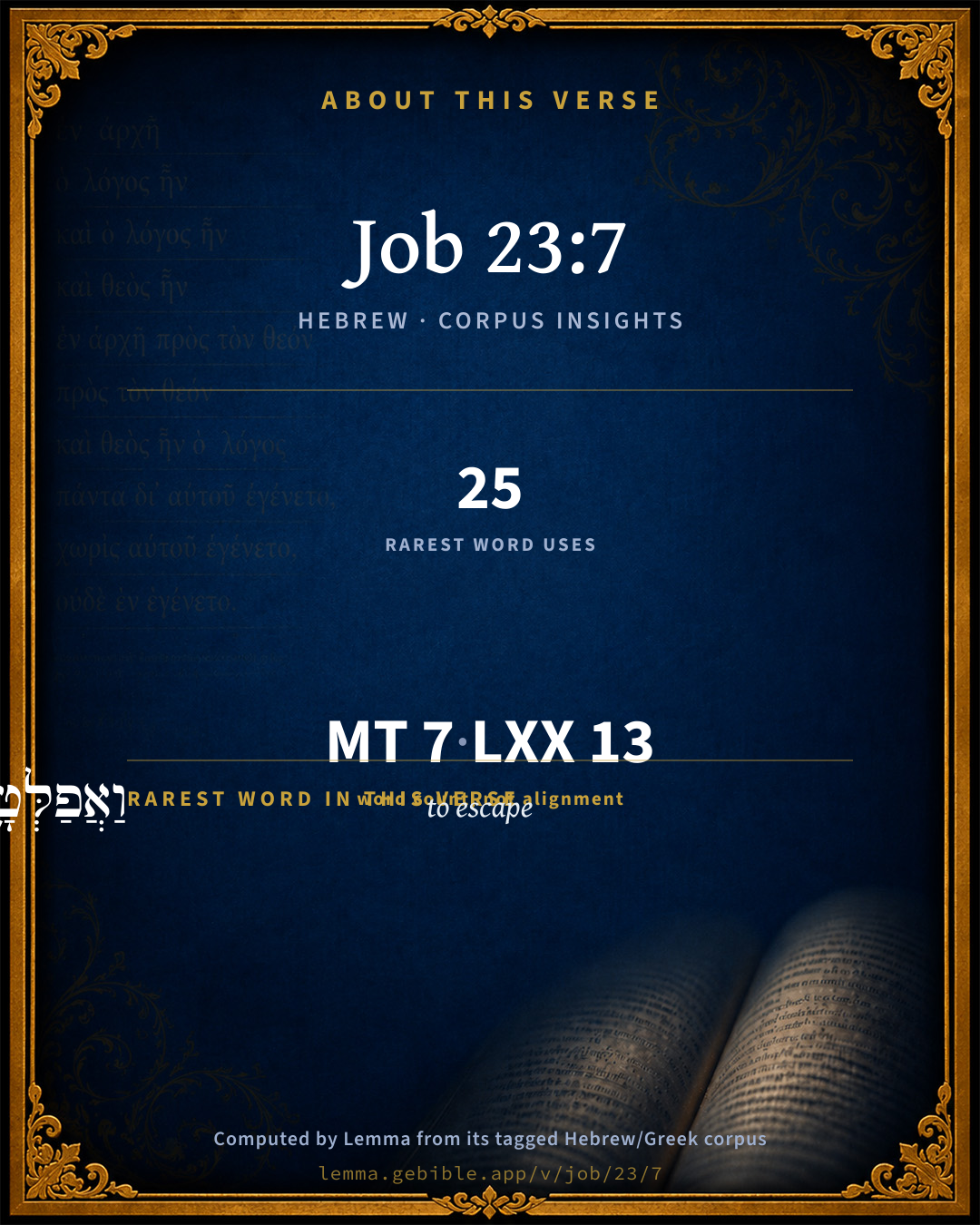
The rarest word here is וַאֲפַלְּטָ֥ה to escape H6403 — appearing just 25 times in the whole Hebrew Bible.

Shared distinctive vocabulary

וַאֲפַלְּטָ֥ה to escape H6403 occurs in 23 verses of the Hebrew Bible. Also found in:

Grammatical profile

  • 3 verbs
  • 1 noun
  • 1 adjective
  • 1 preposition
  • 1 adverb

Verb forms

  • נוֹכָ֣ח Niphal · Participle Active
  • וַאֲפַלְּטָ֥ה Piel · Cohortative
  • מִשֹּׁפְטִֽי Qal · Participle Active

Hebrew & Septuagint length

In English translation the verse runs 16 words from the Hebrew and 17 from the Septuagint (LXX English) — closely comparable.

A rough comparison of the two English renderings, which tokenize alike — not a word-level alignment.

Word counts can differ between the Hebrew and the Greek without any difference in meaning — e.g. the Hebrew direct-object marker אֵת has no separate Greek word, and Greek often adds the article ὁ.

In the original languages it is 7 Hebrew tokens and 13 Greek tokens — but the two are counted differently (Hebrew bundles its prefixes and suffixes into one token; the Greek is in lemma form), so that isn’t a like-for-like length.

Cross-references

8

Topical passages linked to Job 23:7 in the Treasury of Scripture Knowledge — connected by theme and wording, ordered by reader-vote popularity; previews shown in the World English Bible.

  • Job 13:3 "Surely I would speak to the Almighty. I desire to reason with God.
  • Isaiah 1:18 "Come now, and let us reason together," says Yahweh: "Though your sins be as scarlet, they shall be as white as snow. Though they be red like crimson, they shall be as wool.
  • Romans 8:1 There is therefore now no condemnation to those who are in Christ Jesus, who don't walk according to the flesh, but according to the Spirit.
  • Job 9:15 Whom, though I were righteous, yet would I not answer. I would make supplication to my judge.
  • Jeremiah 3:5 Will he retain [his anger] forever? will he keep it to the end? Behold, you have spoken and have done evil things, and have had your way.
  • Jeremiah 12:1 Righteous are you, Yahweh, when I contend with you; yet would I reason the cause with you: why does the way of the wicked prosper? why are all they at ease who deal very treacherously?
  • Romans 3:19–22 Now we know that whatever things the law says, it speaks to those who are under the law, that every mouth may be closed, and all the world may be brought under the judgment of God.
  • Romans 8:33–34 Who could bring a charge against God's chosen ones? It is God who justifies.

Cross-references courtesy of OpenBible.info (CC BY 4.0).

Hebrew and Greek witnesses Masoretic Hebrew ↔ Greek Septuagint

The same verse in the two great witnesses to the Old Testament, shown verse-for-verse.

These are two independent witnesses, not word-aligned to each other, and the Septuagint is shown in lemma (dictionary) form.

Hebrew Job 23:7 Masoretic · Westminster Leningrad Codex

שָׁ֗ם יָ֭שָׁר נוֹכָ֣ח עִמּ֑וֹ וַאֲפַלְּטָ֥ה לָ֝נֶ֗צַח מִשֹּׁפְטִֽי

There the upright might reason with him, So I should be delivered forever from my judge.

World English Bible · Public Domain

Greek LXX Job 23:7 Septuagint · lemma form

ἀλήθεια γάρ καί ἔλεγχος παρά αὐτός ἐκἄγω δέ εἰς τέλος ὁ κρίμα ἐγώ

for truth and reproof are from him; and he would bring forth my judgment to an end.

LXX2012 (modern English Septuagint) · Public Domain

On this verse, Haydock's Catholic Bible Commentary discusses the Septuagint’s reading. Read the note in Commentary ↓

Hebrew: Westminster Leningrad Codex (CC BY 4.0). Greek: Septuagint (public domain); English from LXX2012 (modern English Septuagint) (Public Domain). How the Septuagint differs from the Hebrew →

Commentary

Notes on Job 23:7 from classic Christian and Jewish commentators (each source and its license shown beneath its notes). The classic Christian expositions comment on the surrounding passage and are grouped to its opening verse, so a note may address several verses; the Jewish commentaries on the Tanakh (Rashi and others) are per-verse, so they appear only where the commentator wrote on this verse.

Lemma curates 59 commentaries, every one of them public domain or Creative Commons licensed, each selected and text-cleaned for this edition rather than reprinted as found. About our sources →

Trapp's Complete Commentary

John Trapp

Job 23:7 There the righteous might dispute with him; so should I be delivered for ever from my judge.

Ver. 7. There the righteous might dispute with him] There for then; sc. when God shall put strength into him; the upright or honest man (who draweth near with a true heart, in full assurance of faith, having his heart sprinkled from an evil conscience by the blood of Jesus Christ, Heb 10:22) might dispute with God, but not unless he have that advocate with the Father, Jesus Christ the just one, to appear in the presence of God for him, Heb 9:24, as the lawyer appeareth for his client, to put by and non suit all accusations, to plead his cause, and to justify him by the only merit of his righteousness and obedience. All St Paul’s care was to be found in Christ when sought for by the justice of God; not having his own righteousness, which is of the law, but that which is through the faith of Christ, Php 3:9; for sordet in conspectu iudicis, quod fulget in conspectu operantis (Aug.), "that which is highly esteemed among men, is abomination in the sight of God," Luk 16:15. They only may dispute with God, that is, in a humble and laudable manner plead with him, as did Jacob, Gen 32:24, and Jeremiah, Jer 12:1, who partake of Christ’s righteousness imputed and imparted; opposing to the appearances of God’s wrath the firm persuasion of his grace, by the seal of his Spirit, Et O quam hoc non est omnium! This is few men’s happiness.

So should I be delivered for ever from my judge] Who would quit me by proclamation; and then I should the less care to be condemned by you, my fellow prisoners. I care not for man’s day, since he that judgeth me is the Lord, 1Co 4:3-4; where note what boldness and confidence the upright have in God; neither shall they be herein deceived, as Job was not.

John Trapp, A Commentary or Exposition upon All the Books of the Old and New Testament (1647–1656) — public domain. Text from a community e-Sword module.

Joseph Benson's Commentary

Job 23:7. There — At that throne of grace, where God lays aside his majesty and power, and judges according to his wonted grace and clemency; the righteous — Such as I trust I am in sincerity and truth; might dispute with him — Humbly and modestly propound the grounds of their confidence and the evidences of their righteousness. So — Upon such a fair and equal hearing; should I be delivered from my judge — From the severe censures of all corrupt and partial judges, such as my friends are, or rather, from the condemnatory sentence of God; for he is supposed to be pleading, not only before God, but with him. This and some such expressions of Job cannot be excused from irreverence toward God, and too great confidence in himself; for which, therefore, God afterward reproves him, and Job abhors himself.

Joseph Benson's Commentary on the Old and New Testaments (1811–1818) — public domain. Text from a community e-Sword module.

Geneva Bible (1599)

Geneva Bible translators

When he of his mercy hath given strength to maintain their cause.

Geneva Bible (1599) marginal notes — public domain. Text via Bolls.life.

Jamieson, Fausset & Brown

Robert Jamieson, A. R. Fausset & David Brown

There--rather, "Then": if God would "attend" to me (Job 23:6).

righteous--that is, the result of my dispute would be, He would acknowledge me as righteous.

delivered--from suspicion of guilt on the part of my Judge.

Jamieson, Fausset & Brown — Commentary Critical and Explanatory on the Whole Bible (1871) — public domain (CC PDM 1.0). Text via the HelloAO Bible API.

Adam Clarke's Commentary

Verse 7. There the righteous might dispute with him] נוכח nochach, might argue or plead. To dispute with God sounds very harsh.

So should I be delivered for ever] Mr. Good translates: "And triumphantly should I escape from my condemnation." The Hebrew word לנצח lanetsach may as well be translated to victory as for ever: and in this sense the Vulgate understood the words: Proponat aequitatem contra me; et perveniat ad victoriam judicium meum. "He would set up equity against me; and would lead on my cause to victory." Coverdale renders thus: - But let hym give me like power to go to lawe, then am I sure to wynne my matter. Nothing less than the fullest conviction of his own innocence could have led Job to express himself thus to the Judge of quick and dead!

Adam Clarke's Commentary on the Bible (1810–1826) — public domain. Text from a community e-Sword/MySword module.

Ellicott's Commentary for English Readers

(7) There the righteous might dispute.—He has learnt this marvellous truth, which the Gospel has so effectually brought to light, that it is God the Saviour who is Himself the refuge from God the Judge (Joh_12:47); and then, in the solemn conviction of His presence, he makes use of the most sublime language expressive of it, being assured, though He may hide Himself with the express purpose of not interfering in his cause, yet that all things work together for good to them that love Him (Rom_8:28), and that when his time of trial is over, he himself will come forth like gold. Job’s case teaches us that if an innocent man is falsely accused, God’s honour is vindicated and maintained by his holding fast his conviction of innocence rather than by his yielding to the pressure of adversity and owning to sins he has not committed, or relaxing his hold on innocence by yielding to irritability.

A Bible Commentary for English Readers, edited by Charles John Ellicott (1878–1897) — public domain. Text from a community e-Sword module.

The Cambridge Bible for Schools and Colleges

gen. ed. J. J. S. Perowne

7. This verse, as rendered in the A.V., seems to mean that in such circumstances (Job_23:3-6) a righteous man might plead his cause before God. Rather the words run literally, then a righteous man would be pleading with him, i. e. then it would appear that the man who pleads with Him (i. e. Job) is righteous. This sense fits into the parallelism of the second clause.

The Cambridge Bible for Schools and Colleges (gen. ed. J. J. S. Perowne; Cambridge University Press, 1878–1918) — public domain. Text from a community e-Sword module.

John Gill's Exposition

Behold, I go forward, but he is not there,.... Job here returns to what he had said before, Job 23:3; as Jarchi observes, where he expresses his earnest desire after God, that he might know where he was, and come up to his seat; here he relates the various ways he took to find him, and his fruitless search of him. Cocceius thinks, by these phrases "forward" and "backward", are meant times future and past; and that the sense is, that Job looked into the future times of the Messiah, and the grace promised him, his living Redeemer, that should stand on the earth in the latter day; and that he looked back to the ages before him, and to the first promise made to Adam; but could not understand by either the reason why good men were afflicted; and by the "right" hand and "left", the different dispensations of God to men, granting protection with his right hand, and distributing the blessings of his goodness by it; and with his left hand laying afflictions and evils upon them; and yet, neither from the one nor the other could he learn the mind and will of God concerning men, since love and hatred are not to be known by these things: but rather, with the Jewish commentators in general, we are to understand places by these various expressions; even each of the parts of the world, east, west, north, and south; which Job went through, and surveyed in his mind, to find God in, but to no purpose; for, when a man stands with his face to the rising sun, the east is before him, and, if he goes forward, he goes eastward; and behind him is the west, and, if he goes that way, he goes backward; so the eastern sea is called the former sea, and the western, or Mediterranean sea, the hinder sea, Zac 14:8; and a man, in this position, will have the north on his left hand, and the south on his right; see Gen 13:9; now Job says that he went "forward", that is, eastward; but, says he of God, "he is not there", or "is not" (g); meaning not that he was not in being, did not exist; for he most firmly believed the existence of God, or that he was, but, as we rightly supply, he was not there, that is, eastward; and yet the greatest, the most glorious, and most gracious appearances of him were in the east; man was made in the east; the garden of Eden was planted eastward; here God appeared to Adam, both before and after his fall; and it was in the east, Christ, the second Adam, was born; his star appeared in it, and his Gospel was first preached in the eastern parts; in the east Job now lived, and had been the greatest man in it; but now God did not appear to him, as the Vulgate Latin version, not in a kind and gracious manner; nor could he find him at his throne of justice here, as he wished for; he was there, though Job saw him not; for he is everywhere; indeed he is not confined or limited to any place; for, as the heaven of heavens cannot contain him, so much less any part or corner of the earth:

and backward, but I cannot perceive him; or understand where he is, or get intelligence of him, and of the reason of his dispensations, especially concerning himself.

(g) "et non ipse", Montanus, Drusius, Bolducius.

John Gill's Exposition of the Whole Bible (1746–1763) — public domain (CC PDM 1.0). Text via the HelloAO Bible API.

Albert Barnes' Notes on the Bible

There the righteous might dispute with him - One who is conscious of his integrity might carry his cause there, with the assurance that he would be heard, and that justice would be done him. There can be no doubt that Job here refers to himself, though. he speaks in the third person, and advances this as a general proposition.

So shall I be delivered forever from my judge - From him who would judge or condemn me (משׁפטי mı̂shâphaṭı̂y). He does not here refer to “God,” as if he would be delivered from him, but to anyone who would attempt to judge and condemn him, as his friends had done. The meaning is, that having, as he confidently expected he would, obtained the verdict of God in his favor, he would be ever after free from condemnation. The decision would be final. There was no higher tribunal, and no one would dare to condemn him afterward. This shows his consciousness of integrity. It may be applied to ourselves - to all. If we can obtain, at the last day, when our cause shall be brought before God, the divine verdict in our favor, it will settle the matter forever. No one, after that, will condemn us; never again shall our character or conduct be put on trial. The divine decision of that day will settle the question to all eternity. How momentous, then, is it that we should so live as to be acquitted in that day, and to have “an eternal sentence” in our favour!

Albert Barnes' Notes on the Bible (1834–1885) — public domain. Text from a community e-Sword/MySword module.

Haydock's Catholic Bible Commentary

Victory. Before such a judge I should hope to be acquitted. Job must have been well convinced of his innocence. For woe to man, if God treat him according to the rigour of his justice! (Calmet) --- Septuagint, "For truth and reproof are with him. But, oh! that he would bring my judgment to an end." (Haydock)

George Leo Haydock (1774–1849), Haydock's Catholic Family Bible and Commentary, 1859 edition — public domain. Excludes Psalms (Douay-Rheims chapter numbering differs from Protestant) and Deuterocanonical books (Catholic canon only).

Matthew Poole's English Annotations

There; at that throne of grace, as it is called, Heb 4:16, where God lays aside his majesty and power, and judgeth according to his wonted grace and clemency.

The righteous; such as I do and dare avow myself to be, to wit, in sincerity, though not in perfection. Might dispute with him; humbly and modestly propounding the grounds of their confidence, and the evidences of their righteousness. So; upon such a fair and equal hearing.

From my judge; either,

1. From the severe censures of all corrupt and partial judges, such as you my friends are. Or rather,

2. From the damnatory sentence of God; for he is not only pleading before him, but also with him. He would give sentence for me, and against himself. This and some such expressions of Job cannot be excused from reverence towards God, and too great a confidence in himself; for which therefore God sharply reproves him hereafter, and Job abhorreth himself.

Matthew Poole's English Annotations on the Holy Bible (1683–1685) — public domain. Text from a community e-Sword/MySword module.

Whedon's Commentary on the Bible

Daniel D. Whedon

7. Might dispute — נוכח, pleads, the Niphal form of the verb. With the same preposition, עם, the Hiphil form is also rendered plead in Job_16:21, which see. The passage before us reads, literally, A righteous one there pleads with Him, which, to say the least, “suggests the thought of the Great Intercessor. It is, too, not altogether foreign to the book.” — T. Lewis. See Excursus 4. Delivered… from — So should I be forever acquitted by my judge. God’s judgment would prove final; his words of absolution would be without repeal. When God did appear, his self-confidence, now so conspicuous, merged itself in the profoundest self-abasement. Job_40:4.

Daniel D. Whedon (gen. ed.), Commentary on the Old and New Testaments (1874–1909) — public domain. Text from a community e-Sword module.

The Pulpit Commentary

There the righteous might dispute with him. There, before his high tribunal (ver. 3), the upright man (rvy) might argue or reason with him, appealing from his justice to his mercy from God the Judge to God the Saviour (Loathes), vindicating his integrity, acknowledging his transgressions, and pleading that they were sins of infirmity-and at last obtaining from God the acquittal anticipated in the second clause of the verse. In the absence of any revelation of an Advocate who will plead our cause before God for us, Job would seem to have been justified in expecting such a liberty of pleading his own cause as he here sets forth. So should I be delivered for ever from my Judge. The "Judge of all the earth" will certainly and necessarily "do right." Job"s conscience testifies to his substantial integrity and uprightness. (comp. 1Jn_3:21) He is, therefore, confident that, if he can once bring his cause to God"s cognizance, he will obtain acquittal and deliverance.

The Pulpit Commentary (1880–1919), ed. H.D.M. Spence-Jones & Joseph S. Exell — public domain. Text from a community e-Sword module.

John Wesley's Explanatory Notes

There - At that throne of grace, where God lays aside his majesty, and Judges according to his wonted clemency. Dispute - Humbly propounding the grounds of their confidence. So - Upon such a fair and equal hearing. Delivered - From the damnatory sentence of God. This and some such expressions of Job cannot be excused from irreverence towards God, for which God afterwards reproves him, and Job abhorreth himself.

John Wesley, Explanatory Notes Upon the Whole Bible (1754–1765) — public domain. Text via the GEBible commentary corpus.

Rashi

Rabbi Shlomo Yitzchaki (Rashi)

There in the place of our contest.

integrity The propriety of my deeds will be proven, revealed, and it will appear with Him, i.e., before Him.

proven and there I will extricate [myself] forever because He will find no iniquity in me.

Rashi on the Tanakh — English translations: “The Judaica Press complete Tanach with Rashi, translated by A. J. Rosenberg” (CC BY 4.0); “Pentateuch with Rashi's commentary by M. Rosenbaum and A.M. Silbermann, 1929-1934” (public domain); “The Metsudah Tanach series, Lakewood, N.J” (CC BY 4.0); and “The Book of Joshua, Metsudah Publications, 1997” (CC BY 4.0). Text via Sefaria.

Lesson kit

Teaching starters — assembled from the data on this page, not authored interpretation. Every prompt links to the verse data it draws on. Edit before teaching.

Job, in the Wisdom, opens this verse with 7 words (7 distinct Hebrew lemmas). Its most distinctive word is pâlaṭ (“to escape”). A historical commentator’s framing appears above. Read the whole chapter for the surrounding context.

Discussion questions

  1. How does “to escape” (pâlaṭ) shape what this verse is saying?
  2. How does 2 Samuel 22:2, which shares the word «to escape», read alongside this verse?
  3. These translations render this verse differently; the difference is in the English rendering, not the original. What questions does that raise?
  4. «נוֹכָ֣ח» is a Niphal Participle Active verb. How does that grammatical form shape the action described?
  5. Compare how Trapp's Complete Commentary and Joseph Benson's Commentary read this verse. Where do they agree or differ?

Things to notice

Reading settings

Reading text

Shown beneath each verse's original-language words.

Old Testament
Old Testament edition

Read the OT as the Masoretic Hebrew (MT) or the Greek Septuagint (LXX).

English shown for the Greek Septuagint (in the Hebrew ↔ Greek comparison).

Comparing translations? Open the Compare panel on any verse page to stack up to four side by side.