1 Samuel 7:16

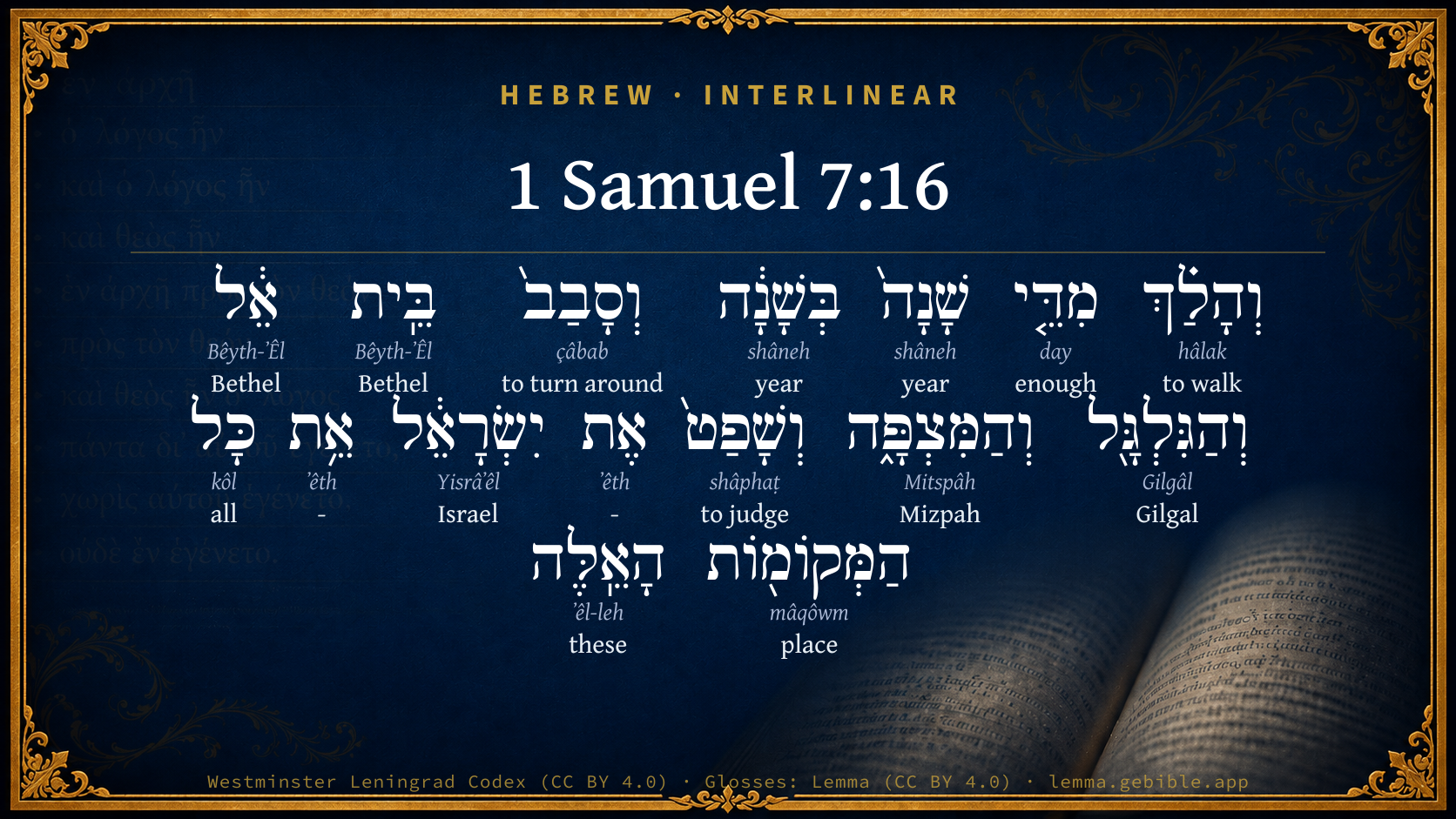
Hebrew (Westminster Leningrad Codex) 1 Samuel 7:16 appears in the Hebrew Old Testament. The text above is from the Westminster Leningrad Codex. Each word links to its Strong’s number, a concise gloss, and parsing drawn from the Open Scriptures Hebrew Bible morphology. Click any word for its full Brown-Driver-Briggs (BDB) entry.
Download image
Cite this verse

1 Samuel 7:16 (World English Bible). Public Domain. Lemma interlinear Bible study tool, https://lemma.gebible.app/v/1-samuel/7/16.

Show BibTeX & RIS
BibTeX
RIS
English Translation
He went from year to year in circuit to Bethel and Gilgal, and Mizpah; and he judged Israel in all those places.
World English Bible · Public Domain
Download a study sheet

One document with this verse’s original text, its word-by-word gloss line, the meaning frame, cross-references with their text, attributed commentary, and full source and license credits — printable, and it pastes into notes with its structure intact.

This verse Autodidact and up

Study sheet (.html) Plain text (.txt)

A passage Seminary Student

Up to 50 verses in one chapter. A passage sheet keeps up to 6 commentary sources and 12 cross-references per verse, in the order this page ranks them, and says so on the sheet whenever that leaves anything out. Ask for a single verse and you get the Autodidact verse sheet above.

Everything on this page stays free to read, with no account — the sheet is a download of what is already on screen, not access to it.

Want to remove ads? Support Godless Engineer
Compare translations 3

The same verse in 3 English versions, stacked beneath the original-language interlinear above. Click any original word for its lexicon entry.

Each is an independent rendering of the whole verse — the interlinear is not word-aligned to these translations.

Highlighted words mark where these versions differ — a whole-verse word diff, not a word-by-word alignment.

  • World English Bible Public Domain
    He went from year to year in circuit to Bethel and Gilgal, and Mizpah; and he judged Israel in all those places.
  • King James Version Public Domain
    And he went from year to year in circuit to Bethel, and Gilgal, and Mizpeh, and judged Israel in all those places.
  • unfoldingWord Literal Text CC BY-SA 4.0
    And he went according to year by year and went around Bethel and Gilgal and Mizpah, and he judged Israel all of those places.

unfoldingWord Literal Text — © unfoldingWord, licensed CC BY-SA 4.0. Word-aligned USFM3 via Door43 (git.door43.org/unfoldingWord/en_ult).

Versions to compare (up to 4)

3 of 4 selected

Show all 18 translations

Every available English version of this verse, each an independent rendering of the whole verse.

  • World English Bible Public Domain
    He went from year to year in circuit to Bethel and Gilgal, and Mizpah; and he judged Israel in all those places.
  • Berean Standard Bible Public Domain
    Every year he would go on a circuit from Bethel to Gilgal to Mizpah, judging Israel in all these places.
  • Majority Standard Bible Public Domain
    Every year he would go on a circuit from Bethel to Gilgal to Mizpah, judging Israel in all these places.
  • King James Version Public Domain
    And he went from year to year in circuit to Bethel, and Gilgal, and Mizpeh, and judged Israel in all those places.
  • American Standard Version (1901) Public Domain
    And he went from year to year in circuit to Beth-el and Gilgal, and Mizpah; and he judged Israel in all those places.
  • Revised Version (1885) Public Domain
    And he went from year to year in circuit to Beth-el, and Gilgal, and Mizpah; and he judged Israel in all those places.
  • Geneva Bible (1599) Public Domain
    And went about yeere by yere to Beth-el, and Gilgal, and Mizpeh, and iudged Israel in all those places.
  • Douay-Rheims (1899) Public Domain
    And he went every year about to Bethel and to Galgal and to Masphath, and he judged Israel in the aforesaid places.
  • Young's Literal Translation Public Domain
    and he hath gone from year to year, and gone round Beth-El, and Gilgal, and Mizpeh, and judged Israel `in' all these places;
  • Literal Standard Version CC BY-SA 4.0
    and he has gone from year to year, and gone around Beth-El, and Gilgal, and Mizpeh, and judged Israel [in] all these places;
  • Unlocked Literal Bible CC BY-SA 4.0
    Each year he went on a circuit to Bethel, to Gilgal, and to Mizpah. He decided disputes for Israel in all these places.
  • unfoldingWord Literal Text CC BY-SA 4.0
    And he went according to year by year and went around Bethel and Gilgal and Mizpah, and he judged Israel all of those places.
  • Darby Bible Public Domain
    And he went from year to year in circuit to Bethel, and Gilgal, and Mizpah, and judged Israel in all those places.
  • World Messianic Bible Public Domain
    He went from year to year in a circuit to Bethel, Gilgal, and Mizpah; and he judged Israel in all those places.
  • Webster's Bible Public Domain
    And he went from year to year in circuit to Beth-el, and Gilgal, and Mizpeh, and judged Israel in all those places.
  • Free Bible Version CC BY-SA 4.0
    Every year he went around, going to Bethel, Gilgal, and Mizpah. At all these places he ruled Israel.
  • Bible in Basic English Public Domain
    From year to year he went in turn to Beth-el and Gilgal and Mizpah, judging Israel in all those places.
  • JPS Tanakh (1917) Public Domain
    And he went from year to year in circuit to Beth-el, and Gilgal, and Mizpah; and he judged Israel in all those places.

Literal Standard Version (2020), Covenant Press — licensed CC BY-SA 4.0. Text via the HelloAO Bible API (eBible.org). Unlocked Literal Bible (unfoldingWord) — licensed CC BY-SA 4.0. Text via the HelloAO Bible API (eBible.org). unfoldingWord Literal Text — © unfoldingWord, licensed CC BY-SA 4.0. Word-aligned USFM3 via Door43 (git.door43.org/unfoldingWord/en_ult). Free Bible Version, Dr. Jonathan Gallagher — licensed CC BY-SA 4.0. Text via the HelloAO Bible API (eBible.org).

Word by word

More ways to search: Search by grammar → Find every occurrence → Compare this word →

Practice this passage: Drill this verse → Learn its vocabulary →

וְהַמִּצְפָּ֑ה
Mitspâh
H4709
“and · the · Mizpah”
Conjunction + Particle, Definite Article + Noun, Proper
Part of Speech
Conjunction + Particle + Noun
Type
Proper
Full BDB Definition

Origin: from H4708

TWOT: None

Mizpah = "watchtower" - a place in Gilead north of Jabbok and location of Laban's cairn - a place in Gilead south of Jabbok; site unknown - a place near Mount Hermon - an old sacred place in Benjamin
  1. וְהָלַ֗ךְ hâlak H1980 “and · to walk” Conjunction + Verb, Qal, Perfect, 3rd Person, Masculine, Singular
  2. מִדֵּ֤י day H1767 “from · enough of” Preposition + Noun, Common, Masculine, Singular, Construct
  3. שָׁנָה֙ shâneh H8141 “year” Noun, Common, Feminine, Singular, Absolute
  4. בְּשָׁנָ֔ה shâneh H8141 “in/at · year” Preposition + Noun, Common, Feminine, Singular, Absolute
  5. וְסָבַב֙ çâbab H5437 “and · to turn around” Conjunction + Verb, Qal, Perfect, 3rd Person, Masculine, Singular
  6. בֵּֽית Bêyth-ʼÊl H1008 “Bethel” Noun, Proper
  7. אֵ֔ל Bêyth-ʼÊl H1008 “Bethel” Noun, Proper
  8. וְהַגִּלְגָּ֖ל Gilgâl H1537 “and · the · Gilgal” Conjunction + Particle, Definite Article + Noun, Proper
  9. וְשָׁפַט֙ shâphaṭ H8199 “and · to judge” Conjunction + Verb, Qal, Perfect, 3rd Person, Masculine, Singular
  10. אֶת ʼêth H853 “-” Particle, Direct Object
  11. יִשְׂרָאֵ֔ל Yisrâʼêl H3478 “Israel” Noun, Proper
  12. אֵ֥ת ʼêth H853 “-” Particle, Direct Object
  13. כָּל kôl H3605 “all of” Noun, Common, Masculine, Singular, Construct
  14. הַמְּקוֹמ֖וֹת mâqôwm H4725 “the · places” Particle, Definite Article + Noun, Common, Masculine, Plural, Absolute
  15. הָאֵֽלֶּה ʼêl-leh H428 “the · these” Particle, Definite Article + Pronoun, Demonstrative, Common, Plural

About this verse

These counts appear in no published source. They are computed here, from the morphology-tagged text and Lemma’s own curated glosses. What Lemma adds →

16
words
13
distinct lemmas
Historical
section

Shared distinctive vocabulary

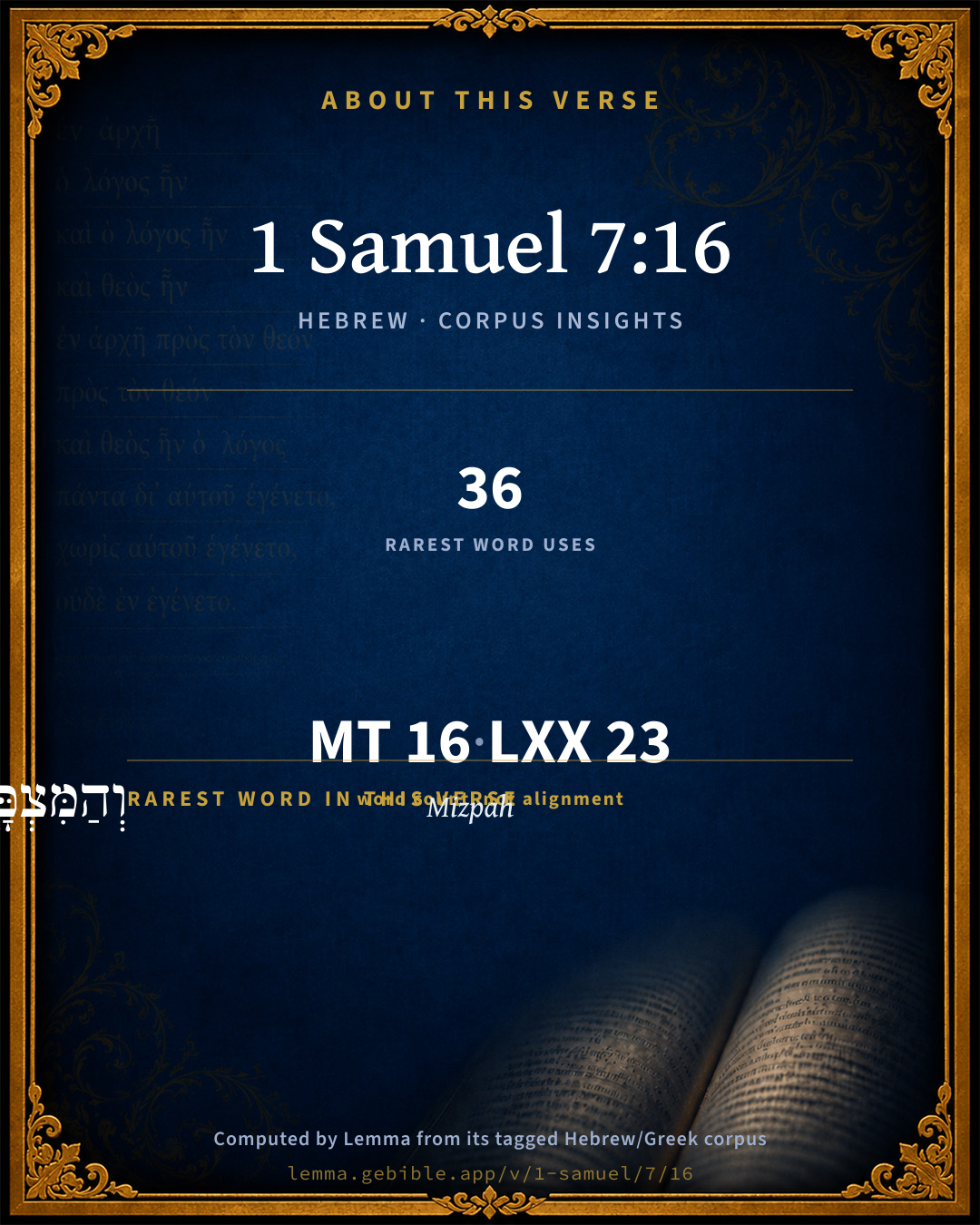
וְהַמִּצְפָּ֑ה Mizpah H4709 occurs in 33 verses of the Hebrew Bible. Also found in:

Grammatical profile

  • 3 verbs
  • 10 nouns
  • 1 pronoun
  • 2 particles

Verb forms

  • וְהָלַ֗ךְ Qal · Perfect
  • וְסָבַב֙ Qal · Perfect
  • וְשָׁפַט֙ Qal · Perfect

Repetition

Words recur within this verse — often emphatic in Hebrew:

  • שָׁנָה֙ year H8141 ×2
  • בֵּֽית Bethel H1008 ×2

Hebrew & Septuagint length

In English translation the verse runs 22 words from the Hebrew and 23 from the Septuagint (LXX English) — closely comparable.

A rough comparison of the two English renderings, which tokenize alike — not a word-level alignment.

Word counts can differ between the Hebrew and the Greek without any difference in meaning — e.g. the Hebrew direct-object marker אֵת has no separate Greek word, and Greek often adds the article ὁ.

In the original languages it is 16 Hebrew tokens and 23 Greek tokens — but the two are counted differently (Hebrew bundles its prefixes and suffixes into one token; the Greek is in lemma form), so that isn’t a like-for-like length.

Cross-references

5

Topical passages linked to 1 Samuel 7:16 in the Treasury of Scripture Knowledge — connected by theme and wording, ordered by reader-vote popularity; previews shown in the World English Bible.

  • Judges 5:10 Tell [of it], you who ride on white donkeys, You who sit on rich carpets, You who walk by the way.
  • Judges 10:4 He had thirty sons who rode on thirty donkey colts, and they had thirty cities, which are called Havvoth Jair to this day, which are in the land of Gilead.
  • Judges 12:14 He had forty sons and thirty sons' sons, who rode on seventy donkey colts: and he judged Israel eight years.
  • Psalms 75:2 When I choose the appointed time, I will judge blamelessly.
  • Psalms 82:3–4 "Defend the weak, the poor, and the fatherless. Maintain the rights of the poor and oppressed.

Cross-references courtesy of OpenBible.info (CC BY 4.0).

Hebrew and Greek witnesses Masoretic Hebrew ↔ Greek Septuagint

The same verse in the two great witnesses to the Old Testament, shown verse-for-verse.

These are two independent witnesses, not word-aligned to each other, and the Septuagint is shown in lemma (dictionary) form.

Hebrew 1 Samuel 7:16 Masoretic · Westminster Leningrad Codex

וְהָלַ֗ךְ מִדֵּ֤י שָׁנָה֙ בְּשָׁנָ֔ה וְסָבַב֙ בֵּֽית אֵ֔ל וְהַגִּלְגָּ֖ל וְהַמִּצְפָּ֑ה וְשָׁפַט֙ אֶת יִשְׂרָאֵ֔ל אֵ֥ת כָּל הַמְּקוֹמ֖וֹת הָאֵֽלֶּה

He went from year to year in circuit to Bethel and Gilgal, and Mizpah; and he judged Israel in all those places.

World English Bible · Public Domain

Greek LXX 1 Samuel 7:16 Septuagint · lemma form

καί πορεύομαι κατά ἐνιαυτός ἐνιαυτός καί κύκλος βαιθηλ καί ὁ γάλγαλα καί ὁ μασσηφαθ καί δικάζω ὁ ἰσραήλ ἐν πᾶς ὁ ἁγιάζω οὗτος

And he went year by year, and went round Baethel, and Galgala, and Massephath; and he judged Israel in all these consecrated places.

LXX2012 (modern English Septuagint) · Public Domain

On this verse, Haydock's Catholic Bible Commentary discusses the Septuagint’s reading. Read the note in Commentary ↓

Hebrew: Westminster Leningrad Codex (CC BY 4.0). Greek: Septuagint (public domain); English from LXX2012 (modern English Septuagint) (Public Domain). How the Septuagint differs from the Hebrew →

Targum (Aramaic paraphrase)

1

The Targum is the ancient Jewish Aramaic paraphrase of the Hebrew Scriptures — an interpretive translation, not the Hebrew text itself. Onkelos (literal) and Pseudo-Jonathan (expansive) render the Torah, and Jonathan the Prophets. Coverage is partial: where no permissively-licensed English translation exists for a verse, only the Aramaic is shown. This is verse-level text, not a word-by-word alignment to the Hebrew.

  1. Targum Jonathan Prophets (Joshua–Malachi)
    וַאֲזַל בִּזְמַן שְׁנָא בִּשְׁנָא וּמִסְתְּחַר לְבֵית אֵל וּלְגִלְגָלָא וּלְמִצְפַּיָא וְדָאִין יַת יִשְׂרָאֵל יַת כָּל אַתְרַיָא הָאִלֵין:

    (no public-domain English translation for this verse)

    Targum Jonathan — Aramaic: “Mikraot Gedolot” (public domain). English: “Sefaria Community Translation” (CC0 1.0 (public-domain dedication)); “London "Chaldee Paraphrase," 1871” (public domain). Text via Sefaria.

Commentary

Notes on 1 Samuel 7:16 from classic Christian and Jewish commentators (each source and its license shown beneath its notes). The classic Christian expositions comment on the surrounding passage and are grouped to its opening verse, so a note may address several verses; the Jewish commentaries on the Tanakh (Rashi and others) are per-verse, so they appear only where the commentator wrote on this verse.

Lemma curates 59 commentaries, every one of them public domain or Creative Commons licensed, each selected and text-cleaned for this edition rather than reprinted as found. About our sources →

Trapp's Complete Commentary

John Trapp

1Sa 7:16 And he went from year to year in circuit to Bethel, and Gilgal, and Mizpeh, and judged Israel in all those places.

Ver. 16. And he went from year to year in circuit.] For the people’s ease and conveniency; which the magistrate ought to provide for, as Jethro adviseth. {Exo 18:17-23}

John Trapp, A Commentary or Exposition upon All the Books of the Old and New Testament (1647–1656) — public domain. Text from a community e-Sword module.

Joseph Benson's Commentary

1Sa 7:16. Judged Israel in all those places — He went to those several places, in compliance with the people’s desire, whose convenience he was willing to purchase with his own trouble, as an itinerant judge and preacher; and by his presence in several parts, he could the better observe and rectify all sorts of miscarriages and abuses.

Joseph Benson's Commentary on the Old and New Testaments (1811–1818) — public domain. Text from a community e-Sword module.

Tyndale Open Study Notes

Tyndale Open Resources

7:16 Bethel and Mizpah were places of national assembly in the judges era (Judg 20:1, 18, 26; 21:1-2). Bethel’s significance went back to the days of Abraham (Gen 12:8; 13:3-4; 28:10-22; 35:1-15). • Gilgal, located near Jericho, had been a sacred place since Joshua’s day (Josh 4:19-24; 5:2-10). From this circuit, Samuel influenced “all the people of Israel” (1 Sam 10:17).

Tyndale Open Study Notes — © Tyndale Open Resources, licensed CC BY-SA 4.0. Text via the HelloAO Bible API.

Adam Clarke's Commentary

Verse 16. He went from year to year in circuit] When he was at BETH-EL, the tribe of Ephraim, and all the northern parts of the country, could attend him; when at GILGAL, the tribe of Benjamin, and those beyond Jordan, might have easy access to him; and when at MIZPEH, he was within reach of Judah, Simeon, and Gad; but Ramah was the place of his ordinary abode; and there he held his court, for there he judged Israel; and, as it is probable that Shiloh was destroyed, it is said, 1Sa 7:17, that there (viz., at Ramah) he built an altar unto the Lord. This altar, being duly consecrated, the worship performed at it was strictly legal.

Ramah, which is said to be about six miles from Jerusalem, was the seat of prophecy during the life of Samuel; and there it is probable all Israel came to consult him on matters of a spiritual nature, as there was the only altar of God in the land of Israel.

Adam Clarke's Commentary on the Bible (1810–1826) — public domain. Text from a community e-Sword/MySword module.

Ellicott's Commentary for English Readers

(16) To Beth-el, and Gilgal, and Mizpeh, and judged Israel.—These centres, it is observable, were all situated in the southern part of the land, in the tribe of Benjamin. This leads us to the conclusion that the power of Samuel, if not exclusively, was chiefly exercised among the southern tribes. The whole subsequent story of the chosen people seems to tell us that the religion of the Eternal at an early date became corrupted m the north of the Promised Land, and that the restoration of faith and purification of life—the result of the great work of Samuel—was so much less marked in the northern than in the southern tribes, that when the strong hand of Solomon was removed, a formal secession from the southern league at once took place. This was followed by a rapid deterioration both in faith and practice in the northern kingdom of Israel.

The places mentioned as the centres where Samuel “judged” were all holy sites, and at different periods of the year, no doubt, were crowded with pilgrims from distant parts of the land.

A Bible Commentary for English Readers, edited by Charles John Ellicott (1878–1897) — public domain. Text from a community e-Sword module.

The Cambridge Bible for Schools and Colleges

gen. ed. J. J. S. Perowne

16. to Beth-el] About 8 miles N. of Jerusalem the ruins of Beitîn mark the site of the ancient city of Beth-el, formerly the royal Canaanite city Luz (Gen_28:19), at the head of the pass of Michmash and Ai. (a) Near it Abraham built an altar (Gen_12:8). (b) There Jacob saw the Vision of the Ladder set up to heaven (Gen_28:11 ff.), and received the confirmation of his new name Israel (Gen_35:10), and from these revelations called the place Beth-el or “The House of God.” (c) There in the days of the Judges the Ark rested for a time and an altar was set up (Jdg_20:18; Jdg_20:26-28, where “the house of God” in the E. V. should be “Beth-el:” cp. 1Sa_10:3). (d) There after the Disruption of the Kingdoms Jeroboam set up his idolatrous parody of the worship of Jehovah (1Ki_12:32-33), and Beth-el “the house of God” became in the language of the prophet Beth-aven “the house of naught,” i.e. of idols (Hos_4:15; Hos_10:5).

The name Beth-el appears to have been applied originally to the sanctuary in the neighbourhood of Luz, and not to have been given to the city till after its conquest by the tribe of Ephraim.

For a graphic description of Beth-el see Stanley’s Sinai and Palestine, pp. 217–333.

and Gilgal] Gilgal (= “the Rolling,” Jos_5:9) was the first station of the Israelites after the passage of the Jordan, where (a) the men born in the wilderness were circumcised (Jos_5:2); (b) the First Passover was celebrated (Jos_5:10); (c) in all probability the Ark rested during the conquest of the land. Now it appears as the chief religious and political centre of the nation, where (1) sacrifices are offered (ch. 1Sa_10:8); (2) assizes held; (3) the national assembly convened (1Sa_11:14-15); (4) the army mustered (1Sa_13:4; 1Sa_13:7). It was probably selected for these purposes on account of its historical associations and its remoteness from the Philistines, whose invasions had pushed the centre of gravity of the kingdom back to the banks of the Jordan.

Lieut. Conder has fixed the site of Gilgal by the discovery of the name Jiljûlieh a mile and a half E. of the village of Erîha, between the ancient Jericho and the Jordan. Tent Work, 11. p. 7.

and Mizpeh] See note on 1Sa_7:5.

in all places] The Sept. has “in all these sanctuaries.” This reading whether original or not expresses the fact that all these places were, like Ramah, places for sacrifice and worship. Even before the captivity of the Ark, Shiloh was not the sole religious centre; for instance there was a sanctuary at Shechem in Joshua’s time (Jos_24:6); and now that the Ark and Tabernacle had disappeared from view, no effort seems to have been made to preserve the religious unity of the nation.

The Cambridge Bible for Schools and Colleges (gen. ed. J. J. S. Perowne; Cambridge University Press, 1878–1918) — public domain. Text from a community e-Sword module.

John Gill's Exposition

And he went from year to year in circuit,.... As judges do; or "from the year in the year" (r) from the time of the year in the year, as the Targum, from the middle of it, that is, every half year; and so Josephus says (s), that he went twice a year in circuit: and the places he went to, and where he held his courts of judicature, were

Bethel, and Gilgal, and Mizpeh; by Bethel is not meant Shiloh, as Abarbinel, for that was now destroyed; nor Kirjathjearim, where the ark was, for it would have been called by its name; but the same Bethel that was near to Ai, and not far from Shiloh, and was in the tribe of Benjamin, as all those places were. Gilgal was where the tabernacle, ark, and camp of Israel were first pitched, when they came over Jordan, and Mizpeh where the people used to be assembled on occasion, see Sa1 7:5,

and judged Israel in all those places; who came from all parts hither with their causes, and for advice and counsel in all cases, at the returning periods.

(r) "ex anno in anno". (s) Antiqu. l. 6. c. 3. sect. 1.

John Gill's Exposition of the Whole Bible (1746–1763) — public domain (CC PDM 1.0). Text via the HelloAO Bible API.

Albert Barnes' Notes on the Bible

Gilgal - It is uncertain whether Gilgal in the valley of the Jordan, or the modern Jiljulieh, the Gilgal of 2Ki 2:1; 2Ki 4:38, be meant; but far more probably the former (see 1Sa 11:14 and note).

Albert Barnes' Notes on the Bible (1834–1885) — public domain. Text from a community e-Sword/MySword module.

Haydock's Catholic Bible Commentary

Places. Septuagint, "in all these holy places." Some take Bethel to mean the city, where the ark was, (Calmet) or the holy of holies, in the tabernacle, at Silo, &c. (Haydock) --- The northern tribes might meet him at Bethel; those on the east of the Jordan, at Galgala, of Benjamin; and the tribes of Juda, Simeon, and Dan, might have an opportunity of hearing the holy prophet, and decide their controversies, at Masphath. (Calmet) --- Thus Samuel gave an excellent instruction to pastors and governors, to watch over their people. (Haydock)

George Leo Haydock (1774–1849), Haydock's Catholic Family Bible and Commentary, 1859 edition — public domain. Excludes Psalms (Douay-Rheims chapter numbering differs from Protestant) and Deuterocanonical books (Catholic canon only).

Matthew Poole's English Annotations

Beth-el; either a place known by that name, or the house of God, to wit, Kirjath-jearim, where the ark was. Gilgal; in the eastern border.

Mizpeh; towards the west.

Judged Israel in all those places; he went to those several places, partly in compliance with the people, whose convenience and benefit he was willing to purchase with his own trouble, making himself an itinerant judge and preacher for their sakes; and partly that by his presence in several parts, he might the better observe and rectify all sorts of miscarriages against God or men.

Matthew Poole's English Annotations on the Holy Bible (1683–1685) — public domain. Text from a community e-Sword/MySword module.

Whedon's Commentary on the Bible

Daniel D. Whedon

16. Beth-el… Gilgal… Mizpeh — These places, with Ramah, he seems to have designated as places where he might be found at certain stated seasons of each year, and where the people from the neighbouring districts might resort unto him for counsel or judgment. On Beth-el, see Gen_28:19, and Jos_7:2. There were three places that bore the name of Gilgal: one, in the western part of Central Palestine, was a royal city of the Canaanites, whose king had been overthrown by Joshua, (Jos_12:23;) another was at the site of the modern Jiljilia, about halfway between Jerusalem and Shechem; and the third was in the plains of Jericho. This last is the Gilgal mentioned in this verse, and was the most celebrated of the three. Here the Israelites first pitched their camp when they entered the Land of Promise, and here the tabernacle probably remained during the wars of the Conquest, and until it was set up at Shiloh. It was ever regarded by Israel as a sacred place. See on Jos_4:19; Jos_9:6. So Samuel, leaving his house at Ramah, would pass northwards to Beth-el, thence southeasterly to Gilgal, and thence westwards to Mizpeh, from which place it would be an easy return to Ramah. On Mizpeh, see 1Sa_7:5.

Daniel D. Whedon (gen. ed.), Commentary on the Old and New Testaments (1874–1909) — public domain. Text from a community e-Sword module.

John Wesley's Explanatory Notes

In all places - He went to those several places, in compliance with the people, whose convenience he was willing to purchase with his own trouble, as an itinerant judge and preacher; and by his presence in several parts, he could the better observe, and rectify all sorts of miscarriages.

John Wesley, Explanatory Notes Upon the Whole Bible (1754–1765) — public domain. Text via the GEBible commentary corpus.

Lesson kit

Teaching starters — assembled from the data on this page, not authored interpretation. Every prompt links to the verse data it draws on. Edit before teaching.

1 Samuel, in the Historical, opens this verse with 16 words (13 distinct Hebrew lemmas). Its most distinctive word is Mitspâh (“Mizpah”). A historical commentator’s framing appears above. Read the whole chapter for the surrounding context.

Discussion questions

  1. How does “Mizpah” (Mitspâh) shape what this verse is saying?
  2. Genesis 31:49 shares the word «Mizpah» with this verse. How do the two illuminate each other?
  3. “year” occurs 2× in this one verse. What is the effect of the repetition?
  4. The translations on this page render this verse differently — a whole-verse word diff, not a word-by-word alignment. What might account for the different wordings?
  5. The verb «וְהָלַ֗ךְ» is Qal Perfect. How does its form color the action?
  6. Reading how Trapp's Complete Commentary and Joseph Benson's Commentary read this verse, where do the two commentators agree and where do they part?

Things to notice

Reading settings

Reading text

Shown beneath each verse's original-language words.

Old Testament
Old Testament edition

Read the OT as the Masoretic Hebrew (MT) or the Greek Septuagint (LXX).

English shown for the Greek Septuagint (in the Hebrew ↔ Greek comparison).

Comparing translations? Open the Compare panel on any verse page to stack up to four side by side.