
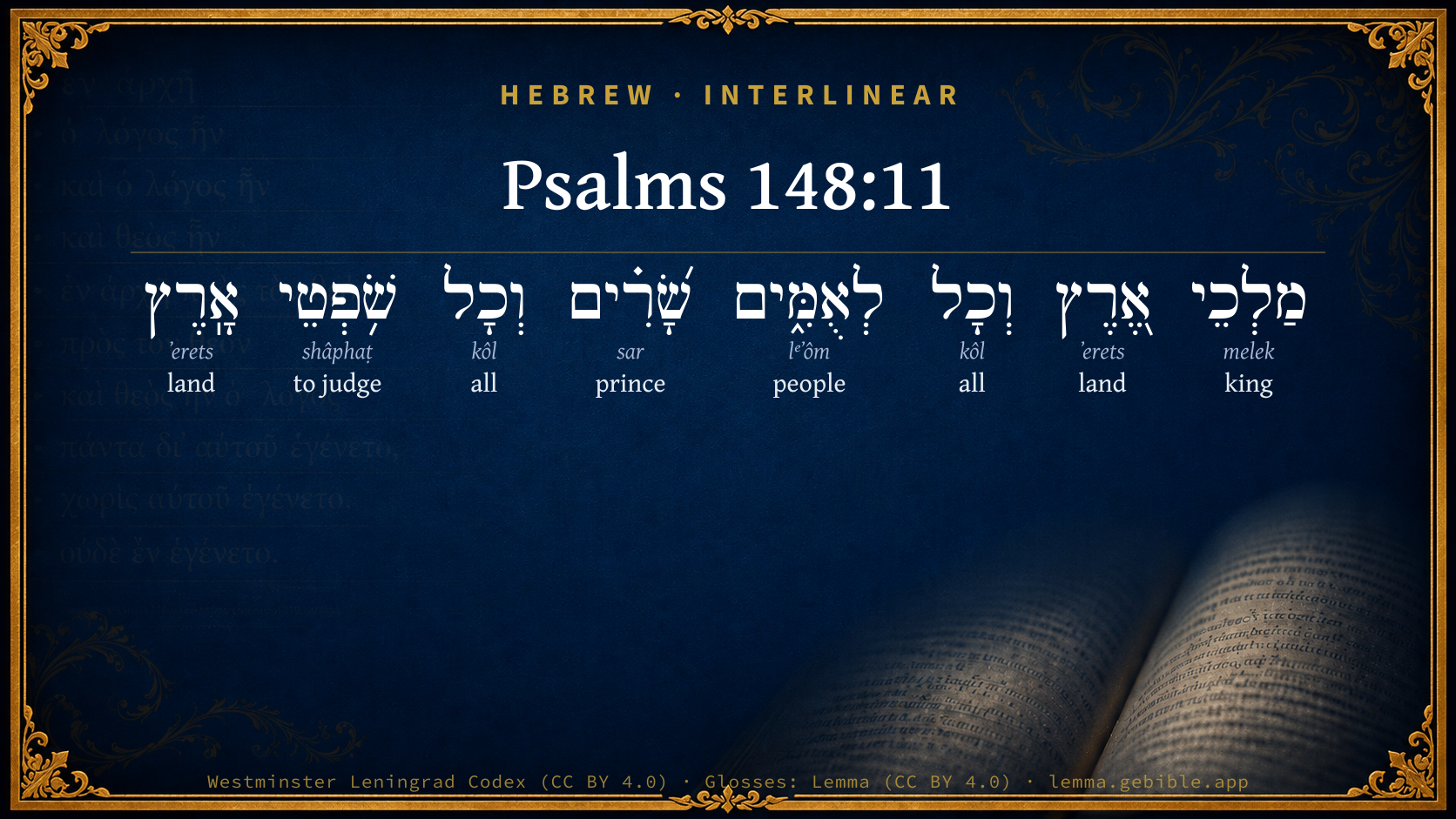
Psalms 148:11

Hebrew (Westminster Leningrad Codex) Psalms 148:11 appears in the Hebrew Old Testament. The text above is from the Westminster Leningrad Codex. Each word links to its Strong’s number, a concise gloss, and parsing drawn from the Open Scriptures Hebrew Bible morphology. Click any word for its full Brown-Driver-Briggs (BDB) entry.
Download image
Cite this verse

Psalms 148:11 (World English Bible). Public Domain. Lemma interlinear Bible study tool, https://lemma.gebible.app/v/psalms/148/11.

Show BibTeX & RIS
BibTeX
RIS
English Translation
Kings of the earth and all peoples; Princes and all judges of the earth;
World English Bible · Public Domain
Download a study sheet

One document with this verse’s original text, its word-by-word gloss line, the meaning frame, cross-references with their text, attributed commentary, and full source and license credits — printable, and it pastes into notes with its structure intact.

This verse Autodidact and up

Study sheet (.html) Plain text (.txt)

A passage Seminary Student

Up to 50 verses in one chapter. A passage sheet keeps up to 6 commentary sources and 12 cross-references per verse, in the order this page ranks them, and says so on the sheet whenever that leaves anything out. Ask for a single verse and you get the Autodidact verse sheet above.

Everything on this page stays free to read, with no account — the sheet is a download of what is already on screen, not access to it.

Want to remove ads? Support Godless Engineer
Compare translations 3

The same verse in 3 English versions, stacked beneath the original-language interlinear above. Click any original word for its lexicon entry.

Each is an independent rendering of the whole verse — the interlinear is not word-aligned to these translations.

Highlighted words mark where these versions differ — a whole-verse word diff, not a word-by-word alignment.

  • World English Bible Public Domain
    Kings of the earth and all peoples; Princes and all judges of the earth;
  • King James Version Public Domain
    Kings of the earth, and all people; princes, and all judges of the earth:
  • unfoldingWord Literal Text CC BY-SA 4.0
    kings of the earth and all peoples, princes and all judges of the earth,

unfoldingWord Literal Text — © unfoldingWord, licensed CC BY-SA 4.0. Word-aligned USFM3 via Door43 (git.door43.org/unfoldingWord/en_ult).

Versions to compare (up to 4)

3 of 4 selected

Show all 18 translations

Every available English version of this verse, each an independent rendering of the whole verse.

  • World English Bible Public Domain
    Kings of the earth and all peoples; Princes and all judges of the earth;
  • Berean Standard Bible Public Domain
    kings of the earth and all peoples, princes and all rulers of the earth,
  • Majority Standard Bible Public Domain
    kings of the earth and all peoples, princes and all rulers of the earth,
  • King James Version Public Domain
    Kings of the earth, and all people; princes, and all judges of the earth:
  • American Standard Version (1901) Public Domain
    Kings of the earth and all peoples; Princes and all judges of the earth;
  • Revised Version (1885) Public Domain
    Kings of the earth and all peoples; princes and all judges of the earth:
  • Geneva Bible (1599) Public Domain
    Kings of the earth and all people, princes and all iudges of the worlde:
  • Douay-Rheims (1899) Public Domain
    The Lord taketh pleasure in them that fear him: and in them that hope in his mercy.
  • Young's Literal Translation Public Domain
    Kings of earth, and all peoples, Chiefs, and all judges of earth,
  • Literal Standard Version CC BY-SA 4.0
    Kings of earth, and all peoples, || Chiefs, and all judges of earth,
  • Unlocked Literal Bible CC BY-SA 4.0
    Praise Yahweh, kings of the earth and all nations, princes and all who govern on the earth,
  • unfoldingWord Literal Text CC BY-SA 4.0
    kings of the earth and all peoples, princes and all judges of the earth,
  • Darby Bible Public Domain
    Kings of the earth and all peoples, princes and all judges of the earth;
  • World Messianic Bible Public Domain
    kings of the earth and all peoples, princes and all judges of the earth,
  • Webster's Bible Public Domain
    Kings of the earth, and all people; princes, and all judges of the earth:
  • Free Bible Version CC BY-SA 4.0
    earthly kings and all peoples, leaders and rulers of the world,
  • Bible in Basic English Public Domain
    Kings of the earth, and all peoples; rulers and all judges of the earth:
  • JPS Tanakh (1917) Public Domain
    Kings of the earth and all peoples, princes and all judges of the earth;

Literal Standard Version (2020), Covenant Press — licensed CC BY-SA 4.0. Text via the HelloAO Bible API (eBible.org). Unlocked Literal Bible (unfoldingWord) — licensed CC BY-SA 4.0. Text via the HelloAO Bible API (eBible.org). unfoldingWord Literal Text — © unfoldingWord, licensed CC BY-SA 4.0. Word-aligned USFM3 via Door43 (git.door43.org/unfoldingWord/en_ult). Free Bible Version, Dr. Jonathan Gallagher — licensed CC BY-SA 4.0. Text via the HelloAO Bible API (eBible.org).

Word by word

More ways to search: Search by grammar → Find every occurrence → Compare this word →

Practice this passage: Drill this verse → Learn its vocabulary →

About this verse

These counts appear in no published source. They are computed here, from the morphology-tagged text and Lemma’s own curated glosses. What Lemma adds →

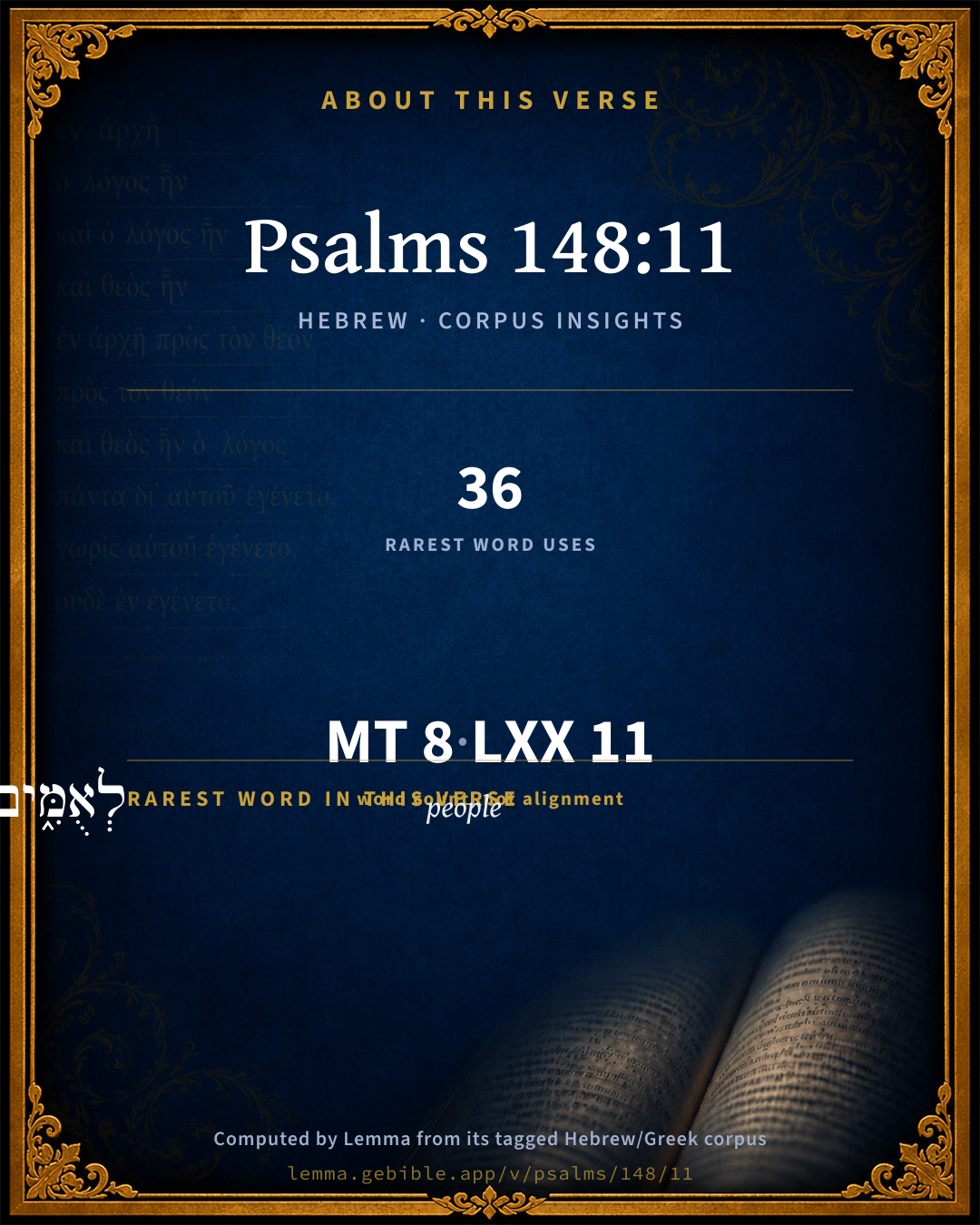
8
words
6
distinct lemmas
Wisdom
section

Shared distinctive vocabulary

לְאֻמִּ֑ים people H3816 occurs in 31 verses of the Hebrew Bible. Also found in:

Grammatical profile

  • 1 verb
  • 7 nouns

Verb forms

  • שֹׁ֥פְטֵי Qal · Participle Active

Repetition

Words recur within this verse — often emphatic in Hebrew:

  • אֶ֭רֶץ land H776 ×2
  • וְכָל all H3605 ×2

Hebrew & Septuagint length

In English translation the verse runs 14 words from the Hebrew and 14 from the Septuagint (LXX English) — the same length.

A rough comparison of the two English renderings, which tokenize alike — not a word-level alignment.

Word counts can differ between the Hebrew and the Greek without any difference in meaning — e.g. the Hebrew direct-object marker אֵת has no separate Greek word, and Greek often adds the article ὁ.

In the original languages it is 8 Hebrew tokens and 11 Greek tokens — but the two are counted differently (Hebrew bundles its prefixes and suffixes into one token; the Greek is in lemma form), so that isn’t a like-for-like length.

Cross-references

12

Topical passages linked to Psalms 148:11 in the Treasury of Scripture Knowledge — connected by theme and wording, ordered by reader-vote popularity; previews shown in the World English Bible.

  • Psalms 102:15 So the nations will fear the name of Yahweh; All the kings of the earth your glory.
  • Isaiah 60:3 Nations shall come to your light, and kings to the brightness of your rising.
  • Psalms 2:10–12 Now therefore be wise, you kings. Be instructed, you judges of the earth.
  • Psalms 22:27–29 All the ends of the earth shall remember and turn to Yahweh. All the relatives of the nations shall worship before you.
  • Psalms 66:1–4 Make a joyful shout to God, all the earth!
  • Psalms 68:31–32 Princes shall come out of Egypt. Ethiopia shall hurry to stretch out her hands to God.
  • Psalms 72:10–11 The kings of Tarshish and of the isles will bring tribute. The kings of Sheba and Seba shall offer gifts.
  • Psalms 86:9 All nations you have made will come and worship before you, Lord. They shall glorify your name.
  • Psalms 138:4–5 All the kings of the earth will give you thanks, Yahweh, For they have heard the words of your mouth.
  • Proverbs 8:15–16 By me kings reign, And princes decree justice.
  • Isaiah 49:23 Kings shall be your nursing fathers, and their queens your nursing mothers: they shall bow down to you with their faces to the earth, and lick the dust of your feet; and you shall know that I am Yahweh; and those who wait for me shall not be disappointed.
  • Revelation 21:24 The nations will walk in its light. The kings of the earth bring the glory and honor of the nations into it.

Cross-references courtesy of OpenBible.info (CC BY 4.0).

Hebrew and Greek witnesses Masoretic Hebrew ↔ Greek Septuagint

The same verse in the two great witnesses to the Old Testament, shown verse-for-verse.

You’re reading Greek Psalm 148 (Hebrew Psalm 148). The Septuagint counts the superscription, so verse numbers can differ from the Hebrew — chapter-level alignment, not verse-by-verse. Numbering follows Rahlfs.

These are two independent witnesses, not word-aligned to each other, and the Septuagint is shown in lemma (dictionary) form.

Hebrew Psalms 148:11 Masoretic · Westminster Leningrad Codex

מַלְכֵי אֶ֭רֶץ וְכָל לְאֻמִּ֑ים שָׂ֝רִ֗ים וְכָל שֹׁ֥פְטֵי אָֽרֶץ

Kings of the earth and all peoples; Princes and all judges of the earth;

World English Bible · Public Domain

Greek LXX Greek Psalm 148:11 Septuagint · lemma form

βασιλεύς ὁ γῆ καί πᾶς λαός ἄρχων καί πᾶς κριτής γῆ

kings of the earth, and all peoples; princes, and all judges of the earth:

LXX2012 (modern English Septuagint) · Public Domain

Hebrew: Westminster Leningrad Codex (CC BY 4.0). Greek: Septuagint (public domain); English from LXX2012 (modern English Septuagint) (Public Domain). How the Septuagint differs from the Hebrew →

Commentary

Notes on Psalms 148:11 from classic Christian and Jewish commentators (each source and its license shown beneath its notes). The classic Christian expositions comment on the surrounding passage and are grouped to its opening verse, so a note may address several verses; the Jewish commentaries on the Tanakh (Rashi and others) are per-verse, so they appear only where the commentator wrote on this verse.

Lemma curates 59 commentaries, every one of them public domain or Creative Commons licensed, each selected and text-cleaned for this edition rather than reprinted as found. About our sources →

Trapp's Complete Commentary

John Trapp

Psa 148:11 Kings of the earth, and all people; princes, and all judges of the earth:

Ver. 11. Kings of the earth] These are doublybound to God (as Queen Elizabeth wrote to the French king); first, as they are men; and next, as they are so great men; but this is little considered. Tamerlane, having overcome Bajazet, asked him whether ever he had given God thanks for making him so great an emperor? who confessed ingenuously he never thought of it.

Princes, and all judges of the earth] These are thrice called upon, because hardly persuaded to pay God his rent, as holding themselves too high to do him homage.

John Trapp, A Commentary or Exposition upon All the Books of the Old and New Testament (1647–1656) — public domain. Text from a community e-Sword module.

Joseph Benson's Commentary

Psa 148:11-12. Kings of the earth, and all people — “After the whole creation hath been called upon to praise Jehovah, man, for whom the whole was made; man, the last and most perfect work of God; man, that hath been since redeemed by the blood of the Son of God incarnate, is exhorted to join and fill up the universal chorus of heaven and earth, as being connected with both worlds, that which now is, and that which is to come. Persons of every degree, of each sex, and of every age; kings, whose power God hath made an image of his own, and who are the suns of their respective systems; judges, and magistrates of all kinds, who derive their power, as the moon and planets do their light, from its original source; young men and maidens, in the flower of health, strength, and beauty; old men, who have accomplished their warfare, and are going out of life; children, who are just come into it, and see every thing new before them; all these have their several reasons for praising the Lord.” — Horne.

Joseph Benson's Commentary on the Old and New Testaments (1811–1818) — public domain. Text from a community e-Sword module.

J. A. Alexander on Psalms

Joseph Addison Alexander

11. (Psa 148:11) Kings of the earth and all nations, chiefs and all judges of the earth. He here passes from the lower animals to man. Kings and the nations whom they represent. Princes is not an exact translation of the Hebrew, which is especially, though not exclusively, applied to military leaders of various rank, and may therefore be represented by the English chiefs or chieftains.

Joseph Addison Alexander, The Psalms Translated and Explained (1850) — public domain. Text from a community e-Sword module.

Tyndale Open Study Notes

Tyndale Open Resources

148:11-12 The psalmist calls all humans to offer praise to God, regardless of status, age, or gender.

Tyndale Open Study Notes — © Tyndale Open Resources, licensed CC BY-SA 4.0. Text via the HelloAO Bible API.

Geneva Bible (1599)

Geneva Bible translators

For the greater gifts that any hath received, and the more high that one is preferred, the more bound is he to praise God for the same: but neither high nor low condition or degree can be exempted from this duty.

Geneva Bible (1599) marginal notes — public domain. Text via Bolls.life.

Jamieson, Fausset & Brown

Robert Jamieson, A. R. Fausset & David Brown

Next all rational beings, from the highest in rank to little children.

princes--or, military leaders.

Jamieson, Fausset & Brown — Commentary Critical and Explanatory on the Whole Bible (1871) — public domain (CC PDM 1.0). Text via the HelloAO Bible API.

Adam Clarke's Commentary

Verse 11. Kings of the earth] As being representatives of the Most High; and all people-the nations governed by them. Princes, as governors of provinces, and all judges executing those laws that bind man to man, and regulate and preserve civil society; praise God, from whom ye have derived your power and influence: for by him kings reign. And let the people magnify God for civil and social institutions, and for the laws by which, under him, their lives and properties are preserved.

Adam Clarke's Commentary on the Bible (1810–1826) — public domain. Text from a community e-Sword/MySword module.

John Calvin's Commentaries

11. Kings of the earth, etc. He now turns his address to men, with a respect to whom it was that he called for a declaration of God’s praises from creatures, both above and from beneath. As kings and princes are blinded by the dazzling influence of their station, so as to think the world was made for them, and to despise God in the pride of their hearts, he particularly calls them to this duty; and, by mentioning them first, he reproves their ingratitude in withholding their tribute of praise when they are under greater obligations than others. As all men originally stand upon a level as to condition, the higher persons have risen, and the nearer they have been brought to God, the more sacredly are they bound to proclaim his goodness. The more intolerable is the wickedness of kings and princes who claim exemption from the common rule, when they ought rather to inculcate it upon others and lead the way. He could have addressed his exhortation at once summarily to all men, as indeed he mentions peoples in general terms; but by thrice specifying princes he suggests that they are slow to discharge the duty, and need to be urged do it. Then follows a division according to age and sex, to show that all without exception are created for this end, and should unitedly devote their energies to it. As to old men, the more God has lengthened out their lives the more should they be exercised in singing his praises; but he joins young men with them, for though they have less experience from continued habit, it will be inexcusable if they do not acknowledge the great mercy of God in the vigor of their lives. In speaking of girls or virgins, the particle גם, gam, also, is not merely expletive, but added to make the words more emphatical, conveying the truth that even the young women who are not so liberally educated as the male sex, being considered as born for domestic offices, will omit their duty if they do not join with the rest of the Church in praising God. It follows that all from the least to the greatest are bound by this common rule.

John Calvin's Commentaries (1540-1563) — public domain. Text from the Calvin Translation Society English edition (1840s-50s) via the Christian Classics Ethereal Library (ccel.org). Calvin's coverage is partial (roughly two-thirds of the Bible); uncommented books and verses are honest gaps, never fabricated. The 19th-century editor's footnotes and remarks are omitted so the notes are faithfully Calvin's own voice.

Ellicott's Commentary for English Readers

(11) All people.—And now the whole animate and inanimate universe having been summoned, man takes his place as leader of the choir; and here the poet’s language is couched so as to include all, all ranks and nations, of every age, and each sex.

A Bible Commentary for English Readers, edited by Charles John Ellicott (1878–1897) — public domain. Text from a community e-Sword module.

The Cambridge Bible for Schools and Colleges

gen. ed. J. J. S. Perowne

11, 12. Last of all man, as the crown of creation (Gen_1:26), is summoned to join the chorus, without distinction of rank or age or sex.

all people] Peoples, naturally coupled with kings.

The Cambridge Bible for Schools and Colleges (gen. ed. J. J. S. Perowne; Cambridge University Press, 1878–1918) — public domain. Text from a community e-Sword module.

John Gill's Exposition

Kings of the earth, and all people,.... The order of the creation is pretty much observed throughout the whole of this account; and as man was made last of all, so here he is called upon last to praise the Lord; and the chief among men are begun with, "the kings of the earth", of the several nations of the earth divided into kingdoms, over which some are set as supreme: and these have reason to praise the Lord, who has raised them to such dignity, for promotion comes not by chance, but by the Lord, who sets up kings and puts them down at his pleasure; and also for those gifts bestowed upon them, qualifying them for government, for it is by him kings reign and princes decree justice; and likewise for the preservation of them, for it is he that gives salvation to kings, and continues them for usefulness, notwithstanding all plots and conspiracies against them, Psa 144:9; see Psa 75:6; "and all people"; their subjects, as they should submit unto them and pray for them, so should praise the Lord on their account, when they rule well, protect and defend them in their persons, property, and liberties, Pro 29:2;

princes, and all judges of the earth: the sons of kings, princes of the blood, heirs of the crown; or nobles, ministers of state, counsellors, and, all subordinate magistrates, who are in high places of honour, profit, and trust, and so should praise the Lord, by whom they are brought to such honour; and when they fill up their places, and discharge their trust aright, the people have reason to be thankful for them; and especially for the "judges of the earth", when they are men fearing God and hating covetousness, and impartially minister justice and judgment; see Psa 2:10.

John Gill's Exposition of the Whole Bible (1746–1763) — public domain (CC PDM 1.0). Text via the HelloAO Bible API.

Albert Barnes' Notes on the Bible

Kings of the earth, and all people - This would embrace all, as all are included in the idea of the rulers and the ruled.

Princes, and all judges of the earth - Those of exalted rank; those high in authority. This is proper in itself considered, as they are people like other people; and proper as an example to the rest. None of any rank are exempt from the obligation to praise God; none are cut off from the privilege.

Albert Barnes' Notes on the Bible (1834–1885) — public domain. Text from a community e-Sword/MySword module.

Matthew Poole's English Annotations

Kings of the earth; who, though you are called gods, and adored like gods by your subjects, yet are but men, and the creatures and subjects of this sovereign Lord, to whom you owe both your being, and all your power and dignity.

Matthew Poole's English Annotations on the Holy Bible (1683–1685) — public domain. Text from a community e-Sword/MySword module.

The Treasury of David

Charles H. Spurgeon

Ver. 11. Kings of the earth, and all people: princes, and all judges of the earth. Now the poet has reached our own race, and very justly he would have rulers and subjects, chieftains and magistrates, unite in worshipping the sovereign Lord of all. Monarchs must not disdain to sing, nor must their people refrain from uniting with them. Those who lead in battle and those who decide in courts must neither of them allow their vocations to keep them from reverently adoring the Chief and Judge of all. All people, and all judges, must praise the Lord of all. What a happy day it will be when it is universally acknowledged that through our Lord Jesus, the incarnate Wisdom, "kings reign and princes decree justice"! Alas, it is not so as yet! kings have been patrons of vice, and princes ringleaders in folly. Let us pray that the song of the Psalmist may be realized in fact.

Ver. 11. Kings of the earth, and all people; princes. As kings and princes are blinded by the dazzling influence of their station, so as to think the world was made for them, and to despise God in the pride of their hearts, he particularly calls them to this duty; and, by mentioning them first, he reproves their ingratitude in withholding their tribute of praise when they are under greater obligations than others. As all men originally stand upon a level as to condition, the higher persons have risen, and the nearer they have been brought to God, the more sacredly are they bound to proclaim his goodness. The more intolerable is the wickedness of kings and princes who claim exemption from the common rule, when they ought rather to inculcate it upon others, and lead the way. He could have addressed his exhortation at once summarily to all men, as indeed he mentions people in general terms; but by thrice specifying princes he suggests that they are slow to discharge the duty, and need to be urged to it. John Calvin.

Ver. 11. "Kings of the earth"; "judges of the earth"; these are not proud but humiliating titles; for earthly kings and earthly judges will not be kings and judges long.

Ver. 11-18.

1. The universal King. Alone in excelling. Supreme in glory.

2. The universal summons. Of all nations, ranks, classes and ages. Foreshadowing the Judgment.

3. The universal duty: praise, constant, emphatic, growing. W.B.H.

Psalms 148:12*

Charles H. Spurgeon's The Treasury of David (1869–1885) — public domain. Psalms only. Text from a community e-Sword/MySword module.

Whedon's Commentary on the Bible

Daniel D. Whedon

11, 12. The human family is here called upon, as such, to praise God. They alone of all the creatures inhabiting the earth are endued with intelligence to trace all existence to its primal cause and ultimate ends. Man, as the high priest of nature, is to offer the incense of praise for all the inferior creatures of God. The earth, with all its irrational tribes, was made in anticipation of man, through whose appreciative reason alone the fullest praise of the visible earth and heavens ascends.

Kings… people… princes… judges— In looking upon universal human society, governments, nationalities, first strike the view. Officers of government represent God in their functions. It is fit they should lead the people in praise.

Young men… maidens; old men… children—Families, with their varied grades of youth, age, and childhood appear next.

Daniel D. Whedon (gen. ed.), Commentary on the Old and New Testaments (1874–1909) — public domain. Text from a community e-Sword module.

The Pulpit Commentary

Kings of the earth, and all people; rather, all peoples; or, all nations. Princes, and all judges of the earth. "Kings," "princes," and "judges" represent the upper classes of society; "peoples," or "nations," all the remainder. Together, they include the whole race of mankind.

Vers. 11-13. The leaders of the nature-choir.

The Church appears as the choir-leader of the universe. "Both sexes and all ages are summoned to the blessed service of song. Those who usually make merry together are to be devoutly joyful together; those who make up the ends of families, that is to say, the elders and the juveniles, should make the Lord their one and only End. Old men should, by their experience, teach the children to praise; and children, by their cheerfulness, should excite old men to sing. There is room for every voice at this concert; fruitful trees and maidens, cedars and young men, angels and children, old men and judges, all may unite in this oratorio. None, indeed, can be dispensed with: for perfect psalmody we must have the whole universe aroused to worship, and all parts of creation must take their parts in devotion" (C.H.S.).

I MAN BELONGS TO NATURE. That wondrous inbreathing through which man became a "living soul" did not separate man, or make him a distinct being from nature. This mistaken conception is too often encouraged. Man belongs to nature. His senses bear relation to this nature-sphere. He is subject to all the nature-conditions of the creatures around him. Shares pleasure and pain with them. Needs food as they do. Has the passions they have. He can lead the nature-choir as one of the choir.

II MAN LEADS NATURE. It is in the line of modern evolution teachings to point out that man bodily is the crown of creation; and that man, when his possibilities are all fully developed, will be the crown of creation in the highest and most sublime sense. In praise-power man is supreme. In every choir there are leading voices; in every orchestra leading instruments. This place man occupies. As the chorus of creation rises to God, he hears the thrilling tones of those who were made in his image and redeemed by his grace.

III MAN FINDS VOICE FOR NATURE. And so puts intelligence, character, tone, heart, into it. As some exquisite solo that seems to carry to our souls all the body of orchestral sound, so man redeemed man finds voice for God, voice in which is pathos, praise, devotion, love, which translates for God the whole mass of praise that rises from all creation. R.T.

The Pulpit Commentary (1880–1919), ed. H.D.M. Spence-Jones & Joseph S. Exell — public domain. Text from a community e-Sword module.

unfoldingWord translationNotes

Door43 World Missions Community

Connecting Statement:

The writer commands all people to praise Yahweh.

all nations

The word "nations" represents the people who live in those nations. AT: "people of every nation" (See: Metonymy)

young men and young women, elderly and children

The writer uses two merisms, one related to gender and one related to age, to represent every person. (See: Merism)

translationWords

king

nation

prince

govern

unfoldingWord translationNotes — © Distant Shores Media and the Door43 World Missions Community, licensed CC BY-SA 4.0. Source: git.door43.org/Door43/en_tn.

Lesson kit

Teaching starters — assembled from the data on this page, not authored interpretation. Every prompt links to the verse data it draws on. Edit before teaching.

Psalms, in the Wisdom, opens this verse with 8 words (6 distinct Hebrew lemmas). Its most distinctive word is lᵉʼôm (“people”). A historical commentator’s framing appears above. Read the whole chapter for the surrounding context.

Discussion questions

  1. The word lᵉʼôm carries the sense “people.” How does it shape the verse?
  2. How does Genesis 25:23, which shares the word «people», read alongside this verse?
  3. What does the repetition of “land” (2× in this one verse) do in this verse?
  4. These translations render this verse differently. What is at stake in choosing one wording over another?
  5. «שֹׁ֥פְטֵי» is a Qal Participle Active verb. How does that grammatical form shape the action described?
  6. Compare how Trapp's Complete Commentary and Joseph Benson's Commentary read this verse. Where do they agree or differ?

Things to notice

Reading settings

Reading text

Shown beneath each verse's original-language words.

Old Testament
Old Testament edition

Read the OT as the Masoretic Hebrew (MT) or the Greek Septuagint (LXX).

English shown for the Greek Septuagint (in the Hebrew ↔ Greek comparison).

Comparing translations? Open the Compare panel on any verse page to stack up to four side by side.