
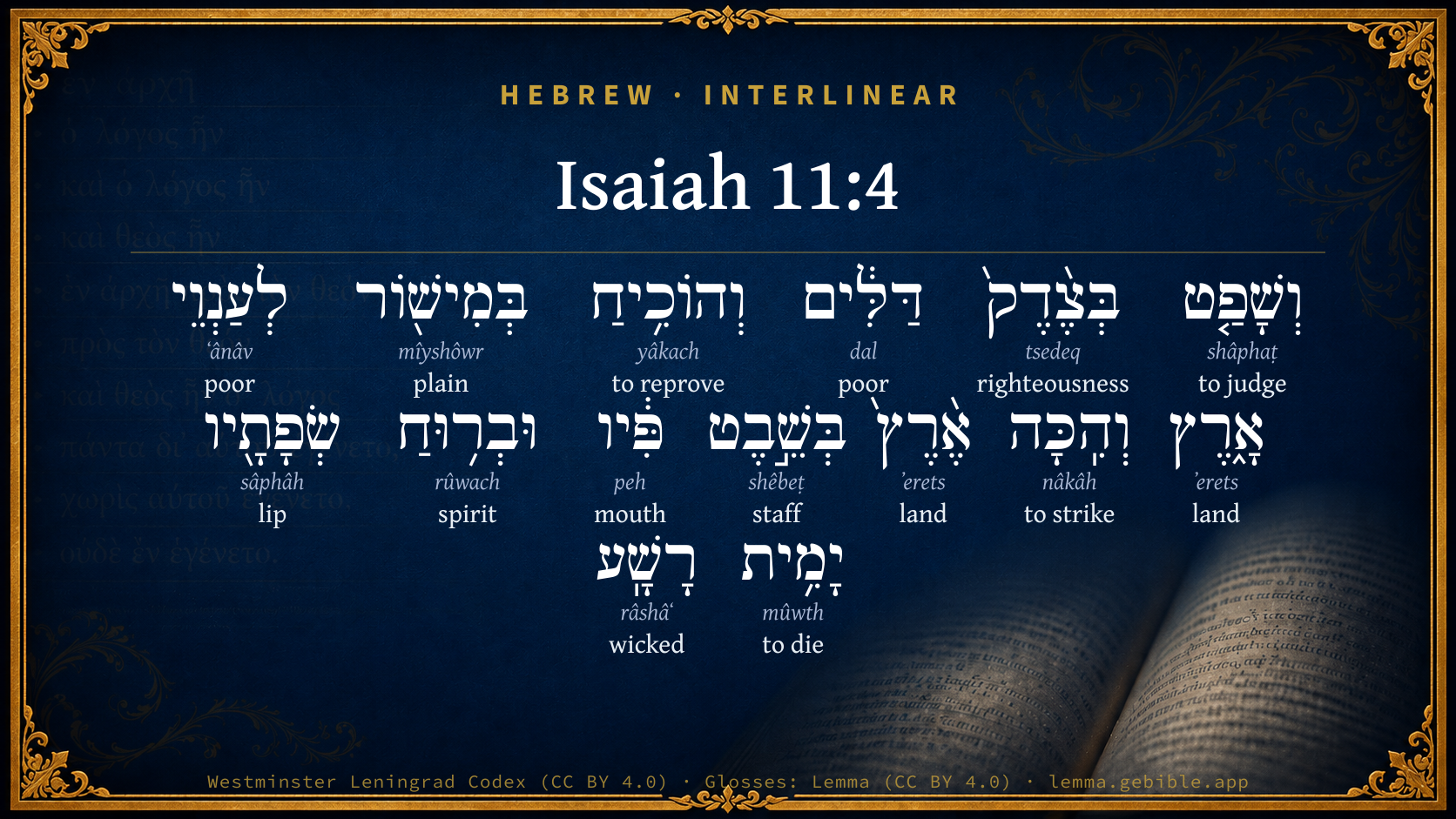
Isaiah 11:4

Hebrew (Westminster Leningrad Codex) Isaiah 11:4 appears in the Hebrew Old Testament. The text above is from the Westminster Leningrad Codex. Each word links to its Strong’s number, a concise gloss, and parsing drawn from the Open Scriptures Hebrew Bible morphology. Click any word for its full Brown-Driver-Briggs (BDB) entry.
Download image
Cite this verse

Isaiah 11:4 (World English Bible). Public Domain. Lemma interlinear Bible study tool, https://lemma.gebible.app/v/isaiah/11/4.

Show BibTeX & RIS
BibTeX
RIS
English Translation
but with righteousness shall he judge the poor, and decide with equity for the humble of the earth; and he shall strike the earth with the rod of his mouth; and with the breath of his lips shall he kill the wicked.
World English Bible · Public Domain
Download a study sheet

One document with this verse’s original text, its word-by-word gloss line, the meaning frame, cross-references with their text, attributed commentary, and full source and license credits — printable, and it pastes into notes with its structure intact.

This verse Autodidact and up

Study sheet (.html) Plain text (.txt)

A passage Seminary Student

Up to 50 verses in one chapter. A passage sheet keeps up to 6 commentary sources and 12 cross-references per verse, in the order this page ranks them, and says so on the sheet whenever that leaves anything out. Ask for a single verse and you get the Autodidact verse sheet above.

Everything on this page stays free to read, with no account — the sheet is a download of what is already on screen, not access to it.

Want to remove ads? Support Godless Engineer
Compare translations 3

The same verse in 3 English versions, stacked beneath the original-language interlinear above. Click any original word for its lexicon entry.

Each is an independent rendering of the whole verse — the interlinear is not word-aligned to these translations.

Highlighted words mark where these versions differ — a whole-verse word diff, not a word-by-word alignment.

  • World English Bible Public Domain
    but with righteousness shall he judge the poor, and decide with equity for the humble of the earth; and he shall strike the earth with the rod of his mouth; and with the breath of his lips shall he kill the wicked.
  • King James Version Public Domain
    But with righteousness shall he judge the poor, and reprove with equity for the meek of the earth: and he shall smite the earth: with the rod of his mouth, and with the breath of his lips shall he slay the wicked.
  • unfoldingWord Literal Text CC BY-SA 4.0
    but he will judge the needy with righteousness, and he will decide with uprightness for the poor of the earth. And he will strike the earth with the rod of his mouth, and with the breath of his lips he will kill the wicked.

unfoldingWord Literal Text — © unfoldingWord, licensed CC BY-SA 4.0. Word-aligned USFM3 via Door43 (git.door43.org/unfoldingWord/en_ult).

Versions to compare (up to 4)

3 of 4 selected

Show all 18 translations

Every available English version of this verse, each an independent rendering of the whole verse.

  • World English Bible Public Domain
    but with righteousness shall he judge the poor, and decide with equity for the humble of the earth; and he shall strike the earth with the rod of his mouth; and with the breath of his lips shall he kill the wicked.
  • Berean Standard Bible Public Domain
    but with righteousness He will judge the poor, and with equity He will decide for the lowly of the earth. He will strike the earth with the rod of His mouth and slay the wicked with the breath of His lips.
  • Majority Standard Bible Public Domain
    but with righteousness He will judge the poor, and with equity He will decide for the lowly of the earth. He will strike the earth with the rod of His mouth and slay the wicked with the breath of His lips.
  • King James Version Public Domain
    But with righteousness shall he judge the poor, and reprove with equity for the meek of the earth: and he shall smite the earth: with the rod of his mouth, and with the breath of his lips shall he slay the wicked.
  • American Standard Version (1901) Public Domain
    but with righteousness shall he judge the poor, and decide with equity for the meek of the earth; and he shall smite the earth with the rod of his mouth; and with the breath of his lips shall he slay the wicked.
  • Revised Version (1885) Public Domain
    but with righteousness shall he judge the poor, and reprove with equity for the meek of the earth: and he shall smite the earth with the rod of his mouth, and with the breath of his lips shall he slay the wicked.
  • Geneva Bible (1599) Public Domain
    But with righteousnesse shall he iudge the poore, and with equitie shall he reprooue for the meeke of the earth: and he shall smite the earth with the rod of his mouth, and with the breath of his lippes shall he slay the wicked.
  • Douay-Rheims (1899) Public Domain
    But he shall judge the poor with justice, and shall reprove with equity for the meek of the earth: land he shall strike the earth with the rod of his mouth, and with the breath of his lips he shall slay the wicked.
  • Young's Literal Translation Public Domain
    And he hath judged in righteousness the poor, And decided in uprightness for the humble of earth, And hath smitten earth with the rod of his mouth, And with the breath of his lips he putteth the wicked to death.
  • Literal Standard Version CC BY-SA 4.0
    And He has judged the poor in righteousness, || And decided for the humble of earth in uprightness, || And has struck earth with the rod of His mouth, || And He puts the wicked to death with the breath of His lips.
  • Unlocked Literal Bible CC BY-SA 4.0
    Instead, he will judge the poor with righteousness and decide fairly for the humble of the earth. He will strike the earth with the rod of his mouth, and with the breath of his lips he will slay the wicked.
  • unfoldingWord Literal Text CC BY-SA 4.0
    but he will judge the needy with righteousness, and he will decide with uprightness for the poor of the earth. And he will strike the earth with the rod of his mouth, and with the breath of his lips he will kill the wicked.
  • Darby Bible Public Domain
    but with righteousness shall he judge the poor, and reprove with equity the meek of the earth: and he shall smite the earth with the rod of his mouth, and with the breath of his lips shall he slay the wicked.
  • World Messianic Bible Public Domain
    but he will judge the poor with righteousness, and decide with equity for the humble of the earth. He will strike the earth with the rod of his mouth; and with the breath of his lips he will kill the wicked.
  • Webster's Bible Public Domain
    But with righteousness will he judge the poor, and reprove with equity for the meek of the earth: and he will smite the earth with the rod of his mouth, and with the breath of his lips will he slay the wicked.
  • Free Bible Version CC BY-SA 4.0
    Instead, he will judge the poor justly, and make decisions fairly on behalf of the destitute people of the earth. He will strike the earth when he pronounces judgment, and he will execute the wicked with just a word from his lips.
  • Bible in Basic English Public Domain
    But he will do right in the cause of the poor, and give wise decisions for those in the land who are in need; and the rod of his mouth will come down on the cruel, and with the breath of his lips he will put an end to the evil-doer.
  • JPS Tanakh (1917) Public Domain
    But with righteousness shall he judge the poor, and decide with equity for the meek of the land; and he shall smite the land with the rod of his mouth, and with the breath of his lips shall he slay the wicked.

Literal Standard Version (2020), Covenant Press — licensed CC BY-SA 4.0. Text via the HelloAO Bible API (eBible.org). Unlocked Literal Bible (unfoldingWord) — licensed CC BY-SA 4.0. Text via the HelloAO Bible API (eBible.org). unfoldingWord Literal Text — © unfoldingWord, licensed CC BY-SA 4.0. Word-aligned USFM3 via Door43 (git.door43.org/unfoldingWord/en_ult). Free Bible Version, Dr. Jonathan Gallagher — licensed CC BY-SA 4.0. Text via the HelloAO Bible API (eBible.org).

Word by word

More ways to search: Search by grammar → Find every occurrence → Compare this word →

Practice this passage: Drill this verse → Learn its vocabulary →

בְּמִישׁ֖וֹר
mîyshôwr
H4334
“in/at · plain”
Preposition + Noun, Common, Masculine, Singular, Absolute
Part of Speech
Preposition + Noun
Type
Common
Gender
Masculine
Number
Singular
State
Absolute
Full BDB Definition

Origin: from H3474

TWOT: 930f

level place, uprightness - level country, table-land, plain - level place - uprightness
  1. וְשָׁפַ֤ט shâphaṭ H8199 “and · to judge” Conjunction + Verb, Qal, Sequential Perfect, 3rd Person, Masculine, Singular
  2. בְּצֶ֨דֶק֙ tsedeq H6664 “in/at · righteousness” Preposition + Noun, Common, Masculine, Singular, Absolute
  3. דַּלִּ֔ים dal H1800 “poor” Adjective, Adjective, Masculine, Plural, Absolute
  4. וְהוֹכִ֥יחַ yâkach H3198 “and · to reprove” Conjunction + Verb, Hiphil, Sequential Perfect, 3rd Person, Masculine, Singular
  5. לְעַנְוֵי ʻânâv H6035 “to/for · poor of” Preposition + Adjective, Adjective, Masculine, Plural, Construct
  6. אָ֑רֶץ ʼerets H776 “land” Noun, Common, Both, Singular, Absolute
  7. וְהִֽכָּה nâkâh H5221 “and · to strike” Conjunction + Verb, Hiphil, Sequential Perfect, 3rd Person, Masculine, Singular
  8. אֶ֨רֶץ֙ ʼerets H776 “land” Noun, Common, Both, Singular, Absolute
  9. בְּשֵׁ֣בֶט shêbeṭ H7626 “in/at · staff of” Preposition + Noun, Common, Masculine, Singular, Construct
  10. פִּ֔יו peh H6310 “mouth · his” Noun, Common, Masculine, Singular, Construct + Suffix, Personal, 3rd Person, Masculine, Singular
  11. וּבְר֥וּחַ rûwach H7307 “and · in/at · spirit of” Conjunction + Preposition + Noun, Common, Both, Singular, Construct
  12. שְׂפָתָ֖יו sâphâh H8193 “lips · his” Noun, Common, Feminine, Dual, Construct + Suffix, Personal, 3rd Person, Masculine, Singular
  13. יָמִ֥ית mûwth H4191 “to die” Verb, Hiphil, Imperfect, 3rd Person, Masculine, Singular
  14. רָשָֽׁע râshâʻ H7563 “wicked” Adjective, Adjective, Masculine, Singular, Absolute

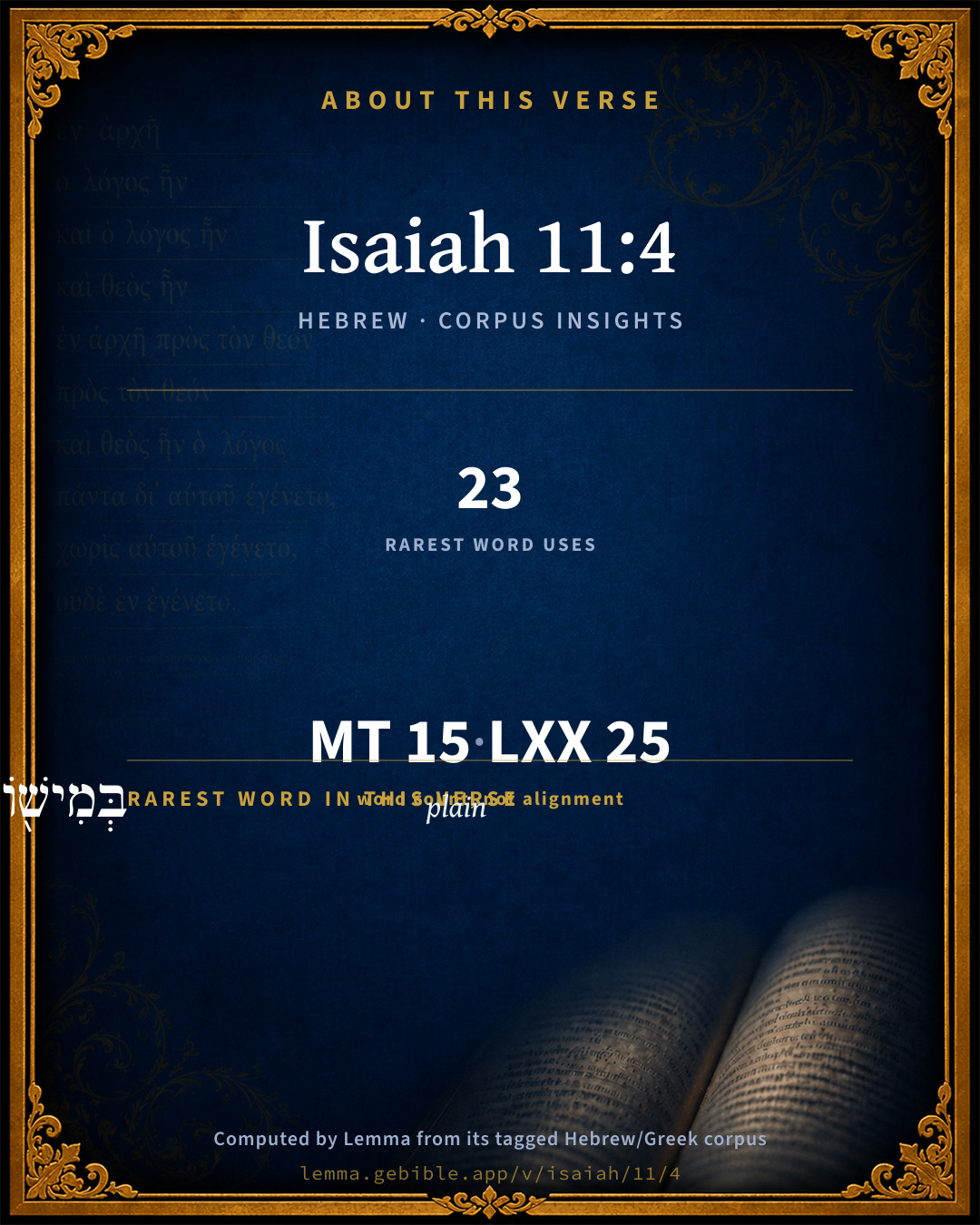
About this verse

These counts appear in no published source. They are computed here, from the morphology-tagged text and Lemma’s own curated glosses. What Lemma adds →

15
words
14
distinct lemmas
Prophets
section

Notable vocabulary

The rarest word here is בְּמִישׁ֖וֹר plain H4334 — appearing just 23 times in the whole Hebrew Bible.

Shared distinctive vocabulary

בְּמִישׁ֖וֹר plain H4334 occurs in 23 verses of the Hebrew Bible. Also found in:

Grammatical profile

  • 4 verbs
  • 8 nouns
  • 3 adjectives

Verb forms

  • וְשָׁפַ֤ט Qal · Sequential Perfect
  • וְהוֹכִ֥יחַ Hiphil · Sequential Perfect
  • וְהִֽכָּה Hiphil · Sequential Perfect
  • יָמִ֥ית Hiphil · Imperfect

Repetition

A word recurs within this verse — often emphatic in Hebrew:

  • אָ֑רֶץ land H776 ×2

Hebrew & Septuagint length

In English translation the verse runs 42 words from the Hebrew and 42 from the Septuagint (LXX English) — the same length.

A rough comparison of the two English renderings, which tokenize alike — not a word-level alignment.

Word counts can differ between the Hebrew and the Greek without any difference in meaning — e.g. the Hebrew direct-object marker אֵת has no separate Greek word, and Greek often adds the article ὁ.

In the original languages it is 15 Hebrew tokens and 25 Greek tokens — but the two are counted differently (Hebrew bundles its prefixes and suffixes into one token; the Greek is in lemma form), so that isn’t a like-for-like length.

Cross-references

37

Topical passages linked to Isaiah 11:4 in the Treasury of Scripture Knowledge — connected by theme and wording, ordered by reader-vote popularity; previews shown in the World English Bible.

  • 2 Thessalonians 2:8 Then the lawless one will be revealed, whom the Lord will kill with the breath of his mouth, and bring to nothing by the brightness of his coming;
  • Revelation 19:15 Out of his mouth proceeds a sharp, double-edged sword, that with it he should strike the nations. He will rule them with a rod of iron. He treads the winepress of the fierceness of the wrath of God, the Almighty.
  • Job 4:9 By the breath of God they perish, By the blast of his anger are they consumed.
  • Proverbs 31:8–9 Open your mouth for the mute, In the cause of all who are left desolate.
  • Malachi 4:6 He will turn the hearts of the fathers to the children, and the hearts of the children to their fathers, lest I come and strike the earth with a curse."
  • Psalms 72:12–14 For he will deliver the needy when he cries; The poor, who has no helper.
  • Isaiah 61:1 The Spirit of the Lord Yahweh is on me; because Yahweh has anointed me to preach good news to the humble; he has sent me to bind up the broken-hearted, to proclaim liberty to the captives, and the opening [of the prison] to those who are bound;
  • Matthew 5:5 Blessed are the gentle, For they shall inherit the earth.
  • Galatians 5:23 gentleness, and self-control. Against such things there is no law.
  • James 3:13 Who is wise and understanding among you? Let him show by his good conduct that his deeds are done in gentleness of wisdom.
  • Psalms 2:9 You shall break them with a rod of iron. You shall dash them in pieces like a potter's vessel."
  • Psalms 72:1–4 God, give the king your justice; Your righteousness to the royal son.
  • Isaiah 9:7 Of the increase of his government and of peace there shall be no end, on the throne of David, and on his kingdom, to establish it, and to uphold it with justice and with righteousness from henceforth even forever. The zeal of Yahweh of Hosts will perform this.
  • Isaiah 30:33 For a Topheth is prepared of old; yes, for the king it is made ready; he has made it deep and large; the pile of it is fire and much wood; the breath of Yahweh, like a stream of sulfur, does kindle it.
  • Jeremiah 33:15 In those days, and at that time, will I cause a Branch of righteousness to grow up to David; and he shall execute justice and righteousness in the land.
  • Revelation 1:16 He had seven stars in his right hand. Out of his mouth proceeded a sharp two-edged sword. His face was like the sun shining at its brightest.
  • Revelation 2:16 Repent therefore, or else I am coming to you quickly, and I will make war against them with the sword of my mouth.
  • Psalms 45:6–7 Your throne, God, is forever and ever. A scepter of equity is the scepter of your kingdom.
  • Isaiah 16:5 A throne shall be established in loving kindness; and one shall sit thereon in truth, in the tent of David, judging, and seeking justice, and swift to do righteousness.
  • Isaiah 29:19 The humble also shall increase their joy in Yahweh, and the poor among men shall rejoice in the Holy One of Israel.
  • Isaiah 32:1 Behold, a king shall reign in righteousness, and princes shall rule in justice.
  • Jeremiah 23:5–6 Behold, the days come, says Yahweh, that I will raise to David a righteous Branch, and he shall reign as king and deal wisely, and shall execute justice and righteousness in the land.
  • Titus 3:2 to speak evil of no one, not to be contentious, to be gentle, showing all humility toward all men.
  • 2 Samuel 23:2–4 The Spirit of Yahweh spoke by me, His word was on my tongue.
  • 1 Kings 10:8–9 Happy are your men, happy are these your servants, who stand continually before you, [and] who hear your wisdom.
  • Psalms 18:8 Smoke went out of his nostrils. Consuming fire came out of his mouth. Coals were kindled by it.
  • Psalms 82:2–4 "How long will you judge unjustly, And show partiality to the wicked?" Selah.
  • Psalms 110:2 Yahweh will send forth the rod of your strength out of Zion. Rule in the midst of your enemies.
  • Isaiah 1:17 Learn to do well. Seek justice, Relieve the oppressed, Judge the fatherless, Plead for the widow."
  • Isaiah 3:14 Yahweh will enter into judgment with the elders of his people, And their leaders: "It is you who have eaten up the vineyard. The spoil of the poor is in your houses.
  • Jeremiah 5:28 They are grew fat, they shine: yes, they overpass in deeds of wickedness; they don't plead the cause, the cause of the fatherless, that they may prosper; and the right of the needy they don't judge.
  • Zephaniah 2:3 Seek Yahweh, all you humble of the land, who have kept his ordinances. Seek righteousness. Seek humility. It may be that you will be hidden in the day of Yahweh's anger.
  • Matthew 11:5 the blind receive their sight, the lame walk, the lepers are cleansed, the deaf hear, the dead are raised up, and the poor have good news preached to them.
  • Acts 9:1 But Saul, still breathing threats and slaughter against the disciples of the Lord, went to the high priest,
  • 2 Corinthians 10:1 Now I Paul, myself, entreat you by the humility and gentleness of Christ; I who in your presence am lowly among you, but being absent am of good courage toward you.
  • Revelation 19:11 I saw the heaven opened, and behold, a white horse, and he who sat on it is called Faithful and True. In righteousness he judges and makes war.
  • 2 Samuel 8:15 David reigned over all Israel; and David executed justice and righteousness to all his people.

Cross-references courtesy of OpenBible.info (CC BY 4.0).

Hebrew and Greek witnesses Masoretic Hebrew ↔ Greek Septuagint

The same verse in the two great witnesses to the Old Testament, shown verse-for-verse.

These are two independent witnesses, not word-aligned to each other, and the Septuagint is shown in lemma (dictionary) form.

Hebrew Isaiah 11:4 Masoretic · Westminster Leningrad Codex

וְשָׁפַ֤ט בְּצֶ֨דֶק֙ דַּלִּ֔ים וְהוֹכִ֥יחַ בְּמִישׁ֖וֹר לְעַנְוֵי אָ֑רֶץ וְהִֽכָּה אֶ֨רֶץ֙ בְּשֵׁ֣בֶט פִּ֔יו וּבְר֥וּחַ שְׂפָתָ֖יו יָמִ֥ית רָשָֽׁע

but with righteousness shall he judge the poor, and decide with equity for the humble of the earth; and he shall strike the earth with the rod of his mouth; and with the breath of his lips shall he kill the wicked.

World English Bible · Public Domain

Greek LXX Isaiah 11:4 Septuagint · lemma form

ἀλλά κρίνω ταπεινός κρίσις καί ἐλέγχω ὁ ταπεινός ὁ γῆ καί πατάσσω γῆ ὁ λόγος ὁ στόμα αὐτός καί ἐν πνεῦμα διά χεῖλος ἀνααἱρέω ἀσεβής

but he shall judge the cause of the lowly, and shall reprove the lowly of the earth: and he shall strike the earth with the word of his mouth, and with the breath of his lips shall he destroy the ungodly one.

LXX2012 (modern English Septuagint) · Public Domain

On this verse, Keil & Delitzsch discusses the Septuagint’s reading. Read the note in Commentary ↓

Hebrew: Westminster Leningrad Codex (CC BY 4.0). Greek: Septuagint (public domain); English from LXX2012 (modern English Septuagint) (Public Domain). How the Septuagint differs from the Hebrew →

Targum (Aramaic paraphrase)

1

The Targum is the ancient Jewish Aramaic paraphrase of the Hebrew Scriptures — an interpretive translation, not the Hebrew text itself. Onkelos (literal) and Pseudo-Jonathan (expansive) render the Torah, and Jonathan the Prophets. Coverage is partial: where no permissively-licensed English translation exists for a verse, only the Aramaic is shown. This is verse-level text, not a word-by-word alignment to the Hebrew.

  1. Targum Jonathan Prophets (Joshua–Malachi)
    וְיָדִין בְּקוּשְׁטָא מִסְכֵּינִין וְיוֹכַח בְּהֵימְנוּתָא מַחֲשִׁיכֵי עַמָא דְאַרְעָא וְיַמְחֵי חַיָבֵי אַרְעָא בְּמֵימַר פּוּמֵיהּ וּבְמַמְלֵיל סִפְוָתֵיהּ יְהֵי מֵמִית אַרְמִילוֹס רַשִׁיעָא:

    But with righteousness shall he judge the poor, and reprove with faithfulness the needy of the earth; and he shall smite the sinners of the earth with the word of his mouth, and with the speech of His lips he shall slay Armillus the wicked.

    Targum Jonathan — Aramaic: “Mikraot Gedolot” (public domain). English: “Sefaria Community Translation” (CC0 1.0 (public-domain dedication)); “London "Chaldee Paraphrase," 1871” (public domain). Text via Sefaria.

Commentary

Notes on Isaiah 11:4 from classic Christian and Jewish commentators (each source and its license shown beneath its notes). The classic Christian expositions comment on the surrounding passage and are grouped to its opening verse, so a note may address several verses; the Jewish commentaries on the Tanakh (Rashi and others) are per-verse, so they appear only where the commentator wrote on this verse.

Lemma curates 59 commentaries, every one of them public domain or Creative Commons licensed, each selected and text-cleaned for this edition rather than reprinted as found. About our sources →

Trapp's Complete Commentary

John Trapp

Isa 11:4 But with righteousness shall he judge the poor, and reprove with equity for the meek of the earth: and he shall smite the earth with the rod of his mouth, and with the breath of his lips shall he slay the wicked.

Ver. 4. But with righteousness judge the poor,] i.e., The poor in spirit, those meek ones of the earth. So the Anabaptists of Germany called themselves, and said that now the promise must be fulfilled, "The meek shall inherit the earth"; whenas they by blood, rapine, cruel wars, seized on the possessions of others. And have we not now {a} among us many loaves of the same leaven, brats of the same breed, bloody in their positions and dispositions - the fifth monarchy men they call themselves. Christ Jesus (as he hath lately to his great praise, so still) preserve and bless us out of their bloody fingers, and from their prodigious principles and practices. He hath promised it here, and much more: thou shalt "give thy judgment to the king" (Christ), "and he shall deliver the poor" {Psa 72:2} - viz., from all foes and persecutors.

And he shall smite the earth,] i.e., Earthly minded men, who are "of the earth, speak of the earth, and the earth heareth them." {Joh 3:31} As the earth is cold and dry, so are they. As the earth is heavy, and beareth downward, so do they. As the earth keepeth down hot exhalations that naturally would ascend, so is it with such. And lastly, as the earth standeth still in the midst of heaven, and taketh no notice of the whole circumference that is carried around it, so are earthly men stupid and insensible, &c. Howbeit "by the rod of his mouth," that is, by the preaching of the gospel, Christ doth again secretly "smite the earth," that is, the consciences of carnal people, glued to the earth, making them sound heavily as a shawm. {b}

And with the breath of his lips shall he slay the wicked.] The devil and his deputies, Antichrist especially, {2Th 2:8} and that with little ado, even with a blast of his lips only; as with his bare word he laid on their backs those soldiers that came to apprehend him.

{a} This was written May 1, 1657.

{b} A mediaeval musical instrument of the oboe class, having a double reed enclosed in a globular mouthpiece.

John Trapp, A Commentary or Exposition upon All the Books of the Old and New Testament (1647–1656) — public domain. Text from a community e-Sword module.

The Biblical Illustrator

Joseph S. Exell

Isa_11:4

But with righteousness shall He judge the poor

The righteousness of Christs kingdom

As it may in many ways be shown that the Church of Christ though one Church with the Jewish, differs from it as being a kingdom, so now let me dwell on this point: that though a kingdom like empires of the earth, it differs from them in being a Church, i.., a kingdom of truth and righteousness. That Scripture speaks of the kingdom of Christ as not an earthly kingdom, not supported by strength of arm or force of mind or any other faculty or gift of the natural man, is plain. But consider some objections to which the circumstances of its actual history and condition give rise.

I. IT MAY BE SAID THAT THE EVENT HAS NOT FULFILLED THE PROPHECIES; that the kingdom has indeed been large and powerful, but it has not ruled according to justice and truth; that at times it has had very wicked men among its rulers, and that great corruptions, religious and moral, have been found in it; and that worse crimes have been perpetrated under colour of religion than in any other way. But this may be granted in the argument; yet the Scripture account of the Church remains uncompromised. It is a kingdom of righteousness, because it is a kingdom founded in righteousness.

II. IN THE GOSPEL, CHRISTS FOLLOWERS ARE REPRESENTED AS POOR, DESPISED, WEAK, AND HELPLESS. Such preeminently were the apostles. But in the prophets, especially in Isaiah, the kingdom is represented as rich and flourishing and honoured, powerful and happy. If the Church of Christ were to seek power, wealth, and honour, this were to fall from grace; but it is not less true that she will have them, though she seeks them not--or rather, if she seeks them not. Such is the law of Christs kingdom, such the paradox which is seen in its history. It belongs to the poor in spirit; it belongs to the persecuted; it is possessed by the meek; it Is sustained by the patient. It conquers by suffering; it advances by retiring; it is made wise through foolishness.

III. TEMPORAL POWER AND WEALTH, THOUGH NOT ESSENTIAL TO THE CHURCH, ARE ALMOST NECESSARY ATTENDANTS ON IT. (J. H.Newman, D. D.)

The Biblical Illustrator, edited by Joseph S. Exell (c. 1880s–1900s) — public domain. Text from a community e-Sword module.

Joseph Benson's Commentary

Isa 11:4. With righteousness — With justice and impartiality; shall he judge the poor — Whom human judges commonly neglect and oppress, but whom he shall defend and deliver; and reprove with equity for the meek of the earth — Shall condemn their malicious enemies, and give sentence for them. He calls them meek, whom before he called poor, partly to show his justice in defending them when they are most exposed to the contempt and injuries of men; and partly to signify that his subjects should be poor in spirit, as well as poor in the world, and not poor and proud, as many worldly persons are. And he shall smite the earth — That is, the men of the earth, intending chiefly the carnal and wicked, as it is in the next branch of the verse; with the rod of his mouth — With his word, which is his sceptre, and the rod of his power, (Psa 110:2,) which is sharper than a sword, (Heb 4:12,) by the preaching whereof he subdues the world to himself, and will destroy his enemies, 2Th 2:8. This he adds farther, to declare the nature of Christ’s kingdom, that it is not of this world, and that his sceptre and arms are not carnal, but spiritual, as it is said 2Co 10:4. And with the breath of his lips — With his word, breathed out of his lips; whereby he explains what was meant by the foregoing expression, rod; shall he slay the wicked — The impenitent and unbelieving, the obstinate and irreclaimable, who will not obey the truth, but persist to obey unrighteousness. These he will slay or destroy, by the terrible judgments which he will execute upon them. This latter part of the verse will be eminently fulfilled in the destruction of antichrist, to whom St. Paul applies it 2Th 2:3-8, (compare Rev 19:21,) who is, by way of eminence, called the Wicked one, the man of sin, and ο αντικειμενος, the adversary to God’s truth and people.

Joseph Benson's Commentary on the Old and New Testaments (1811–1818) — public domain. Text from a community e-Sword module.

Keil & Delitzsch

C. F. Keil & F. Delitzsch

This is the standard according to which He will judge when saving, and judge when punishing. "And judges the poor with righteousness, and passes sentence with equity for the humble in the land; and smites the earth with the rod of His mouth, and with the breath of His lips He slays the wicked. And righteousness is the girdle of His loins, and faithfulness the girdle of His hips." The main feature in Isa 11:4 is to be seen in the objective ideas. He will do justice to the dallim, the weak and helpless, by adopting an incorruptibly righteous course towards their oppressors, and decide with straightforwardness for the humble or meek of the land: ‛ânâv, like ‛ânı̄, from ‛ânâh, to bend, the latter denoting a person bowed down by misfortune, the former a person inwardly bowed down, i.e., from all self-conceit (hōcı̄ach l', as in Job 16:21). The poor and humble, or meek, are the peculiar objects of His royal care; just as it was really to them that the first beatitudes of the Sermon on the Mount applied. But "the earth" and "the wicked" (the latter is not to be understood collectively, but, as in several passages in the Old Testament, viz., Psa 68:22; Psa 110:6; Hab 3:13-14, as pointing forward prophetically to an eschatological person, in whom hostility towards Jehovah and His Anointed culminates most satanically) will experience the full force of His penal righteousness. The very word of His mouth is a rod which shatters in pieces (Psa 2:9; Rev 1:16); and the breath of His lips is sufficient to destroy, without standing in need of any further means (Th2 2:8). As the girdle upon the hips (mothnaim, lxx την̀ ὀσφύν), and in front upon the loins (chălâzaim, lxx τὰς πλευράς), fastens the clothes together, so all the qualities and active powers of His person have for their band tzedâkâh, which follows the inviolable norm of the divine will, and hâ'emūnâh, which holds immovably to the course divinely appointed, according to promise (Isa 25:1). Special prominence is given by the article to 'emūnâh; He is the faithful and true witness (Rev 1:5; Rev 3:14). Consequently with Him there commences a new epoch, in which the Son of David and His righteousness acquire a world-subduing force, and find their home in a humanity that has sprung, like Himself, out of deep humiliation.

Keil & Delitzsch — Biblical Commentary on the Old Testament (1861–1891) — public domain (CC PDM 1.0). Text via the HelloAO Bible API. (Old Testament only.)

Tyndale Open Study Notes

Tyndale Open Resources

11:4 The poor and . . . the exploited would receive the justice due to them, which the wicked leaders of Judah had previously withheld. • the force of his word: Literally the scepter of his mouth (see Ps 2:9; Rev 19:15).

Tyndale Open Study Notes — © Tyndale Open Resources, licensed CC BY-SA 4.0. Text via the HelloAO Bible API.

Geneva Bible (1599)

Geneva Bible translators

All these properties can agree to none, but only unto Christ: for it is he that toucheth the hearts of the faithful, and mortifieth their concupiscences: and to the wicked he is the savor of death, and to them that shall perish: so that all the world shall be smitten with his rod, which is his word.

Geneva Bible (1599) marginal notes — public domain. Text via Bolls.life.

Jamieson, Fausset & Brown

Robert Jamieson, A. R. Fausset & David Brown

judge--see that impartial justice is done them. "Judge" may mean here "rule," as in Psa 67:4.

reprove--or, "argue"; "decide." But LOWTH, "work conviction in."

earth--Compare with Mat 5:5, and Rev 11:15.

earth--its ungodly inhabitants, answering to "the wicked" in the parallel, and in antithesis to the "poor" and "meek," namely, in spirit, the humble pious (Mat 5:3). It is at the same time implied that "the earth" will be extraordinarily wicked when He shall come to judge and reign. His reign shall therefore be ushered in with judgments on the apostates (Psa 2:9-12; Luk 18:8; Rev 2:27).

rod of . . . mouth--condemning sentences which proceed from His mouth against the wicked (Rev 1:16; Rev 2:16; Rev 19:15, Rev 19:21).

breath of . . . lips--his judicial decisions (Isa 30:28; Job 15:30; Rev 19:20; Rev 20:9-12). He as the Word of God (Rev 19:13-15) comes to strike that blow which shall decide His claim to the kingdom, previously usurped by Satan, and "the beast" to whom Satan delegates his power. It will be a day of judgment to the Gentile dispensation, as the first coming was to the Jews. Compare a type of the "rod" (Num 17:2-10).

Jamieson, Fausset & Brown — Commentary Critical and Explanatory on the Whole Bible (1871) — public domain (CC PDM 1.0). Text via the HelloAO Bible API.

Adam Clarke's Commentary

Verse 4. With the rod of his mouth - "By the blast of his mouth"] For בשבט beshebet, by the rod, Houbigant reads beshebeth, by the blast of his mouth, from נשב nashab, to blow. The conjecture is ingenious and probable; and seems to be confirmed by the Septuagint and Chaldee, who render it by the word of his mouth, which answers much better to the correction than to the present reading. Add to this, that the blast of his mouth is perfectly parallel to the breath of his lips in the next line.

Adam Clarke's Commentary on the Bible (1810–1826) — public domain. Text from a community e-Sword/MySword module.

Ellicott's Commentary for English Readers

(4) With righteousness shall he judge the poor . . .—The picture which Isaiah had drawn of the corrupt judges of his time gives point to the contrast (Isa_1:23; Isa_2:14-15; Isa_10:1-2). The poor whom they trampled on should be the special objects of the care of the true King (Mat_11:5).

He shall smite the earth . . .—The “earth” stands here, if we accept the reading, for the rulers who are for the time supreme in it. A slight alteration of the Hebrew gives shall smite the tyrant, which forms a better parallelism with the “ungodly” of the next clause. The phrase “the sceptre of his mouth” is significant. The word which the Messiah-King speaks shall be as the sceptre which is the symbol of authority. So in Rev_1:16, “a sharp two-edged sword” comes forth from the mouth of the Christ of St. John’s vision. The latter clause, “with the breath of his lips shall he slay . . . ,”has a parallel in Hos_6:5.

A Bible Commentary for English Readers, edited by Charles John Ellicott (1878–1897) — public domain. Text from a community e-Sword module.

The Cambridge Bible for Schools and Colleges

gen. ed. J. J. S. Perowne

4. The special objects of his care are the defenceless and down-trodden classes (cf. ch. Isa_1:23, Isa_10:2). Observe that the sporadic outbreak of injustice and violence does not appear to be excluded from Isaiah’s conception of the Messianic age; only, the transgressors are at once discovered and destroyed.

the meek of the earth] Possibly “the oppressed in the land.” Two words (‘ânî and ‘ânâv) are often confounded in the Hebr. Text; the former means simply to be in abject circumstances, the latter includes the religious virtue of resignation to an adverse lot (Rahlfs, ‘Anî und ‘Anaw in den Psalmen).

he shall smite the earth] The word for “earth” (’ereç) is probably written wrongly for ‘ârîç “oppressor.” It is not permissible, with Del. &c., to explain “earth” in the N.T. sense of “the (ungodly) world,” or “Wicked,” in the next clause, of the Antichrist (cf. 2Th_2:8).

with the rod of his mouth … with the breath of his lips] Cf. Rev_1:6. The Messiah’s sentence has a self-fulfilling energy (cf. Hos_6:5; Act_5:1-10). This reveals the operation of the “spirit of might,” as Isa_11:3 represents the effect of the “spirit of wisdom.”

The Cambridge Bible for Schools and Colleges (gen. ed. J. J. S. Perowne; Cambridge University Press, 1878–1918) — public domain. Text from a community e-Sword module.

John Gill's Exposition

But with righteousness shall he judge the poor,.... The poor sinner, that is sensible of his spiritual poverty, and comes and acknowledges his sins and transgressions, and prays for pardoning grace and mercy, and hungers and thirsts after righteousness; such Christ justifies with his own righteousness, acquits and discharges them from all sin and condemnation, as also protects and defends them against all their enemies and oppressors:

and reprove with equity for the meek of the earth; that is, shall take the part of the meek, the lowly, and the humble, who are under a sense of their sins and unworthiness, apply to him for grace, righteousness, pardon, and eternal life; and for their sakes reprove wicked men that would distress and crush them; and in a just and equitable manner, in a way of righteous retaliation, render tribulation to them that trouble them:

and he shall smite the earth with the rod of his mouth: that is, either he shall smite the consciences of earthly and unregenerate men, by the ministration of his word, the rod of his strength, so that they shall be convinced of sin, and humbled for it, and be brought to repentance towards God, and faith in himself; or he shall smite the nations of the earth, the antichristian states, and destroy them, Rev 19:15.

and with the breath of his lips shall he slay the wicked; either by the words of his mouth, as before; see Hos 6:5 so that they become dead men in their own apprehensions, have no hope of life and salvation by their own works, see themselves dead in law, and liable to eternal death and damnation; or this is to be understood of the destruction of the wicked at the last day, by a sentence of condemnation pronounced upon them by Christ; and particularly of antichrist, the wicked and lawless one, the man of sin and son of perdition, whom the Lord shall consume with the spirit of his mouth, and destroy with the brightness of his coming, Th2 2:4 in which place the apostle seems to have respect to this; nor is the Targum foreign from the sense given, which is

"he shall smite the sinners of the earth with the word of his mouth, and with the speech of his lips he shall slay the wicked Armillus.''

Armillus seems to be a name hammered out of Romulus, and designs the Romish antichrist; for elsewhere the Jews expressly say, that Armillus is he whom the nations call antichrist (z); by whom they suppose that Messiah, the son of Joseph shall be slain, and afterwards he himself shall be slain by Messiah the son of David; or it is the same with a destroyer of the people, a name that well agrees with antichrist; see Rev 11:18. This whole, verse is applied to the Messiah, both by ancient and modern Jews (a).

(z) Abkath Rocel, p. 52. Ed. Huls. Vid. Buxtorf. Lex. Talmud, p. 221, 222, 223, 224. (a) Shirhashirim. Rabba, fol. 22. 3. Midrash Ruth, fol. 33. 2. Pesikta apud Yalkut Simeoni, par. 2. fol. 66. 4. Nachman. Disputat. cum Fratre Paulo, p, 41.

John Gill's Exposition of the Whole Bible (1746–1763) — public domain (CC PDM 1.0). Text via the HelloAO Bible API.

Albert Barnes' Notes on the Bible

Shall he judge the poor - That is, he shall see that impartial justice is done them; he shall not take part with the rich against the poor, but shall show that he is the friend of justice. This is the quality of a just and upright magistrate, and this character the Lord Jesus everywhere evinced. He chose his disciples from among the poor; he condescended to be their companion and friend; he provided for their needs; and he pronounced their condition blessed; Mat 5:3. There may be a reference here to the poor in spirit - the humble, the penitent; but the main idea is, that he would not be influenced by any undue regard for the higher ranks of life, but would be the friend and patron of the poor.

And reprove - הוכיח hô̂kiyach. And judge, decide, or argue for; that is, he shall be their friend and their impartial judge; Isa 11:3.

With equity - With uprightness, or uncorrupted integrity.

For the meek of the earth - ענוי־ארץ ‛anevēy 'ārets. For the humble, the lower class; referring to those who were usually passed by, or oppressed by those in power.

And he shall smite the earth - By the “earth” here, or the land, is meant evidently “the wicked,” as the following member of the parallelism shows. Perhaps it is intended to be implied, that the earth, when he should come, would be eminently depraved; which was the fact. The characteristic here is that of an upright judge or prince, who would punish the wicked. To “smite” the earth, or the wicked, is expressive of punishment; and this characteristic is elsewhere attributed to the Messiah; see Psa 2:9-12; Rev 2:27. The trait is that of a just, upright, impartial exercise of power - such as would be manifested in the defense of the poor and the innocent, and in the punishment of the proud and the guilty.

With the rod of his mouth - The word שׁבט shêbet rendered here ‘rod,’ denotes properly a stick, or staff; a rod for chastisement or correction Pro 10:13; Pro 13:24; Job 9:34; Job 21:9; the staff, or scepter of a ruler - as an emblem of office; a measuring rod; a spear, etc.; Note, Isa 10:5. It is not elsewhere applied to the mouth, though it is often used in other connections. It means that which goes out of the mouth - a word command threatening decision; and it is implied that it would go forth to pronounce sentence of condemnation, and to punish. His word would be so just, impartial, and authoritative, that the effect would be to overwhelm the wicked. In a sense similar to this, Christ is said to have been seen by John, when ‘out of his mouth went a sharp two-edged sword’ Rev 1:16; that is, his commands and decisions were so authoritative, and so certain in their execution, as to be like a sharp sword; compare Heb 4:12; Isa 49:2 : ‘And he hath made my mouth like a sharp sword.’ The discriminating preaching, the pungent discourses, the authoritative commands of the Lord Jesus, when on earth, showed, and his judicial decisions in the day of judment will show, the manner of the fulfillment of the prediction.

And with the breath of his lips - This is synonymous with the previous member of the parallelism. ‘The breath of his lips’ means that which goes forth from his lips - his doctrines, his commands, his decisions.

Shall he slay the wicked - That is, he shall condemn the wicked; or, he shall sentence them to punishment. This is descriptive of a prince or ruler, who by his commands and decisions effectually subdues and punishes the wicked; that is, he does justice to all. Grotius interprets this, ‘by his prayers,’ referring it to Hezekiah, and to the influence of his prayers in destroying the Assyrians. The Chaldee Paraphrast translates it, ‘And by the word of his lips he shall slay the impious Armillus.’ By “Armillus,” the Jews mean the last great enemy of their nation, who would come after Gog and Magog and wage furious wars, and who would slay the Messiah Ben Ephraim, whom the Jews expect, but who would be himself slain by the rod of the Messiah Ben David, or the son of David. - “Castell.”

Albert Barnes' Notes on the Bible (1834–1885) — public domain. Text from a community e-Sword/MySword module.

Haydock's Catholic Bible Commentary

Wicked. Antichrist, (2 Thessalonians ii. 8.) and all impiety, by means of the apostles.

George Leo Haydock (1774–1849), Haydock's Catholic Family Bible and Commentary, 1859 edition — public domain. Excludes Psalms (Douay-Rheims chapter numbering differs from Protestant) and Deuterocanonical books (Catholic canon only).

Matthew Poole's English Annotations

Judge the poor; defend and deliver them, as judging is oft used, as Deu 32:36; Jer 5:28; 22:16, &c. Or,

judge for the poor; the prefix lamed being understood out of the next clause, as is usual in the Hebrew language. He mentions the poor, partly to signify the justice of this Judge, because human judges commonly neglect and oppress the poor; and partly to declare the nature of Christ’s kingdom, and the quality of his subjects, who should, for the generality of them, be the poor and contemptible sort of men, Mat 11:5; Jam 2:5. Reprove; or, as this word seems to be taken, Isa 11:3, condemn, to wit, their malicious and furious enemies.

For the meek; on their behalf, or giving sentence for them. He calls them meek, whom before he called poor, partly to show his justice in defending them who are most exposed to the contempt and injuries of men and partly to signify that his subjects should be poor in spirit as well as in the world, and not poor and proud, as many worldly men are.

Smite, i.e. slay, as this word is used, Isa 37:36, and very commonly, and as it is expounded in the next clause.

The earth; the men of the earth, the wicked, as it is in the next branch of the verse; fitly called earth, either because of their earthly minds and conversations, as they are called

the men of this world that have their portion here upon the earth, Psa 17:14, or because the far greatest part of the inhabitants of the earth is wicked; the whole world lies in wickedness, 1Jo 5:1,9; for which reason they are oft called the world, as Joh 16:20; 17:9,25, &c.

With the rod of his mouth; with his word, which is his sceptre, and the rod of his power, Psa 110:2, which is sharper than a sword, Heb 4:12; by the preaching whereof he subdued the world to himself, and will destroy his enemies, 2Th 2:8. This he adds, further to declare the nature of Christ’s kingdom, that it is not of this world, and that his sceptre and arms are not carnal, but spiritual, as it is said, 2Co 10:4.

With the breath of his lips; with his word breathed out of his lips, whereby he explains what he meant by the foregoing rod.

Shall he slay the wicked; either spiritually, by inflicting deadly plagues upon their souls; or properly, which he doth very frequently by his terrible judgments executed upon many of them, and will certainly do, and that fully and universally, at his coming to judgment.

Matthew Poole's English Annotations on the Holy Bible (1683–1685) — public domain. Text from a community e-Sword/MySword module.

Whedon's Commentary on the Bible

Daniel D. Whedon

4. With righteousness shall he judge the poor — Shall see that their cause is not repressed, but dealt with exactly right: “the poor” who cannot commend their case to the eye.

The meek — Who use no adroit nor eloquent words to win the ear.

The rod of his mouth — The words of his mouth are the rod which shatters. Psa_2:9; Rev_1:16. He needs no visible sceptre: his is a fearful presence to the guilty conscience.

Daniel D. Whedon (gen. ed.), Commentary on the Old and New Testaments (1874–1909) — public domain. Text from a community e-Sword module.

The Pulpit Commentary

With righteousness shall he judge the poor. (comp. Isa_32:1, "A king shall reign in righteousness It would be characteristic of the Messiah"s rule that the poor should be eared for, that oppression should cease, and judgment be no more perverted in favor of the rich. There is an intended contrast between the Messiah"s rule in this respect, and that of the princes of Judah. (Isa_1:23 Isa_3:15 Isa_10:1, Isa_10:2) Christian countries still, for the most part, follow their Lord"s example in this particular, if in no other, having judges that are incorruptible, and tribunals that are free from any leaning against the poor. Reprove; or, plead. (as in Job_16:21) The meek of the earth; rather, the humble, or afflicted. Low condition, not meekness of spirit, is what the word used expresses. He shall smite the earth. A slight alteration of the text produces the meaning, be shall smite the terrible one, (comp. Isa_29:20) which improves the parallelism of the clauses. But there is no need of any alteration, parallelism in Isaiah being often incomplete. The Messiah at his coming will "smite the earth" generally, (see Mal_4:6, and comp. Mat_10:34, "I came not to send peace on the earth, but a sword and will also especially chastise "the wicked." The rod of his mouth... the breath of his lips. "The Word of God is quick, and powerful, and sharper than any two-edged sword, piercing even to the dividing asunder of soul and spirit, and of the joints and marrow, and is a discerner of the thoughts and intents of the heart". (Heb_4:12) The sayings of Christ pierce the conscience and penetrate the soul as no other words that ever came from a human mouth. In the last day words from his mouth will consign to everlasting life or to everlasting destruction.

The Pulpit Commentary (1880–1919), ed. H.D.M. Spence-Jones & Joseph S. Exell — public domain. Text from a community e-Sword module.

John Wesley's Explanatory Notes

Judge - Defend and deliver them. Reprove - Or condemn their malicious enemies. Thy rod - With his word, which is his scepter, and the rod of his power, Psalm cx, 2, which is sharper than a sword, Heb. iv, 12, by the preaching whereof he subdued the world to himself, and will destroy his enemies, 2Thes ii, 8. This he adds farther, to declare the nature of Christ's kingdom, that it is not of this world.

John Wesley, Explanatory Notes Upon the Whole Bible (1754–1765) — public domain. Text via the GEBible commentary corpus.

J. A. Alexander on Isaiah

Joseph Addison Alexander

The Messiah, as a righteous judge, is now exhibited in contrast with the unjust magistrates of Judah, as described in Isa 1:23; Isa 10:2; Isa 5:23. “And He shall judge in righteousness the weak (or poor) and do justice with equity (or impartiality) to the meek of the earth, and shall smite the earth with the rod of His mouth, and with the breath of His lips shall slay the wicked.” By the earth to be smitten, some understand the inhabitants of the earth. But the expression seems at least to include the smiting of the earth itself, which is elsewhere represented as the object of God’s wrath, and is here described as cursed on man’s account. By a breath of His lips, we are to understand a mere word, or a mere breath; as something even less than a word, and yet sufficient to effect His purpose. Paul, in 2Th 2:8, applies these words, with little change, to the destruction of Antichrist at the coming of Christ. It does not follow, however, that this is a specific and exclusive prophecy of that event, but only that it comprehends it, as it evidently does. If one of the Messiah’s works is to destroy His enemies, it cannot be fulfilled without the destruction of the last and greatest of those enemies to whom the Scriptures make allusion. If the promise in the first clause is of general import, the threatening in the last must be coextensive with it.

Joseph Addison Alexander, The Prophecies of Isaiah (1846–1847; New York: Scribner, 1870–1878) — public domain. Text from a community e-Sword module.

Rashi

Rabbi Shlomo Yitzchaki (Rashi)

with equity This is an expression of mildness and tenderness.

and he shall smite the earth with the rod of his mouth As the Targum states: And he shall smite the sinful of the earth.

and with the breath of his lips Jonathan [renders:] And with the speech of his lips.

Rashi on the Tanakh — English translations: “The Judaica Press complete Tanach with Rashi, translated by A. J. Rosenberg” (CC BY 4.0); “Pentateuch with Rashi's commentary by M. Rosenbaum and A.M. Silbermann, 1929-1934” (public domain); “The Metsudah Tanach series, Lakewood, N.J” (CC BY 4.0); and “The Book of Joshua, Metsudah Publications, 1997” (CC BY 4.0). Text via Sefaria.

Ibn Ezra

Rabbi Abraham ibn Ezra

And he will judge the poor with justice. According to the rule, Neither shalt thou countenance the poor in his cause (Exod. 33:3).

ביושר ═ במישור With equity. לענוי ארץ The meek of the earth. The good.

With the rod of his mouth. With his mouth, which is, as it were, a rod for the wicked.

Ibn Ezra on the Tanakh — English translations: “Sefaria Community Translation” (CC0 1.0 (public-domain dedication)); “Yalkut, Sifsei Chachomim Chumash, Metsudah Publications, 2009” (CC BY 4.0); and “Commentary of Ibn Ezra on Isaiah - trans. by M. Friedlander, 1873” (public domain). Text via Sefaria.

Lesson kit

Teaching starters — assembled from the data on this page, not authored interpretation. Every prompt links to the verse data it draws on. Edit before teaching.

Isaiah, in the Prophets, opens this verse with 15 words (14 distinct Hebrew lemmas). Its most distinctive word is mîyshôwr (“plain”). A historical commentator’s framing appears above. Read the whole chapter for the surrounding context.

Discussion questions

  1. The word mîyshôwr carries the sense “plain.” How does it shape the verse?
  2. How does Deuteronomy 3:10, which shares the word «plain», read alongside this verse?
  3. What does the repetition of “land” (2× in this one verse) do in this verse?
  4. These translations render this verse differently. What is at stake in choosing one wording over another?
  5. «וְשָׁפַ֤ט» is a Qal Sequential Perfect verb. How does that grammatical form shape the action described?
  6. Compare how Trapp's Complete Commentary and The Biblical Illustrator read this verse. Where do they agree or differ?

Things to notice

Reading settings

Reading text

Shown beneath each verse's original-language words.

Old Testament
Old Testament edition

Read the OT as the Masoretic Hebrew (MT) or the Greek Septuagint (LXX).

English shown for the Greek Septuagint (in the Hebrew ↔ Greek comparison).

Comparing translations? Open the Compare panel on any verse page to stack up to four side by side.