
Ezekiel 17:20

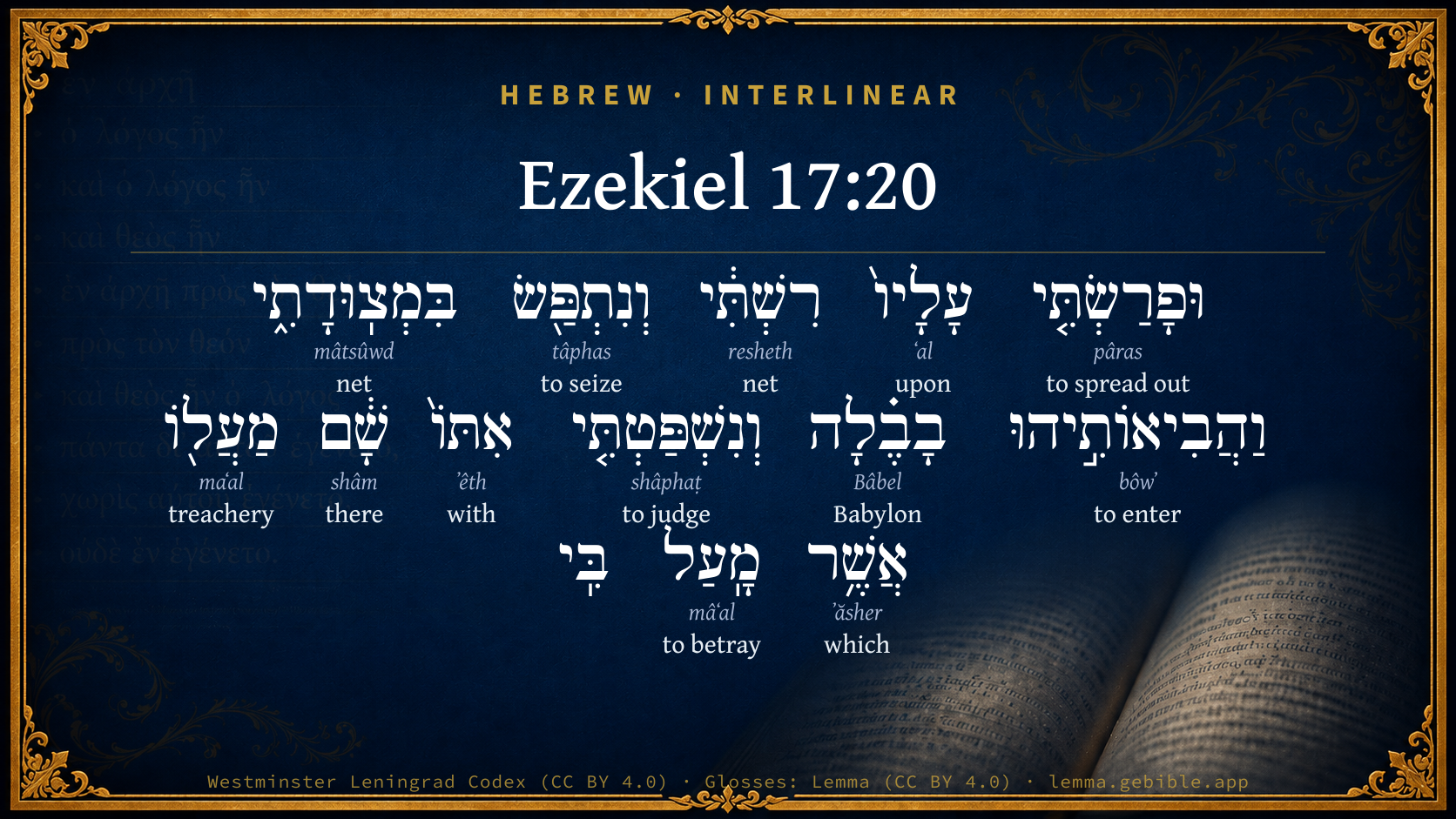
Hebrew (Westminster Leningrad Codex) Ezekiel 17:20 appears in the Hebrew Old Testament. The text above is from the Westminster Leningrad Codex. Each word links to its Strong’s number, a concise gloss, and parsing drawn from the Open Scriptures Hebrew Bible morphology. Click any word for its full Brown-Driver-Briggs (BDB) entry.
Download image
Cite this verse

Ezekiel 17:20 (World English Bible). Public Domain. Lemma interlinear Bible study tool, https://lemma.gebible.app/v/ezekiel/17/20.

Show BibTeX & RIS
BibTeX
RIS
English Translation
I will spread my net on him, and he shall be taken in my snare, and I will bring him to Babylon, and will enter into judgment with him there for his trespass that he has trespassed against me.
World English Bible · Public Domain
Download a study sheet

One document with this verse’s original text, its word-by-word gloss line, the meaning frame, cross-references with their text, attributed commentary, and full source and license credits — printable, and it pastes into notes with its structure intact.

This verse Autodidact and up

Study sheet (.html) Plain text (.txt)

A passage Seminary Student

Up to 50 verses in one chapter. A passage sheet keeps up to 6 commentary sources and 12 cross-references per verse, in the order this page ranks them, and says so on the sheet whenever that leaves anything out. Ask for a single verse and you get the Autodidact verse sheet above.

Everything on this page stays free to read, with no account — the sheet is a download of what is already on screen, not access to it.

Want to remove ads? Support Godless Engineer
Compare translations 3

The same verse in 3 English versions, stacked beneath the original-language interlinear above. Click any original word for its lexicon entry.

Each is an independent rendering of the whole verse — the interlinear is not word-aligned to these translations.

Highlighted words mark where these versions differ — a whole-verse word diff, not a word-by-word alignment.

  • World English Bible Public Domain
    I will spread my net on him, and he shall be taken in my snare, and I will bring him to Babylon, and will enter into judgment with him there for his trespass that he has trespassed against me.
  • King James Version Public Domain
    And I will spread my net upon him, and he shall be taken in my snare, and I will bring him to Babylon, and will plead with him there for his trespass that he hath trespassed against me.
  • unfoldingWord Literal Text CC BY-SA 4.0
    I will spread my net out over him, and he will be caught in my hunting net. Then I will bring him to Babylon and execute judgment on him there for his treason that he committed when he betrayed me!

unfoldingWord Literal Text — © unfoldingWord, licensed CC BY-SA 4.0. Word-aligned USFM3 via Door43 (git.door43.org/unfoldingWord/en_ult).

Versions to compare (up to 4)

3 of 4 selected

Show all 18 translations

Every available English version of this verse, each an independent rendering of the whole verse.

  • World English Bible Public Domain
    I will spread my net on him, and he shall be taken in my snare, and I will bring him to Babylon, and will enter into judgment with him there for his trespass that he has trespassed against me.
  • Berean Standard Bible Public Domain
    I will spread My net over him and catch him in My snare. I will bring him to Babylon and execute judgment upon him there for the treason he committed against Me.
  • Majority Standard Bible Public Domain
    I will spread My net over him and catch him in My snare. I will bring him to Babylon and execute judgment upon him there for the treason he committed against Me.
  • King James Version Public Domain
    And I will spread my net upon him, and he shall be taken in my snare, and I will bring him to Babylon, and will plead with him there for his trespass that he hath trespassed against me.
  • American Standard Version (1901) Public Domain
    And I will spread my net upon him, and he shall be taken in my snare, and I will bring him to Babylon, and will enter into judgment with him there for his trespass that he hath trespassed against me.
  • Revised Version (1885) Public Domain
    And I will spread my net upon him, and he shall be taken in my snare, and I will bring him to Babylon, and will plead with him there for his trespass that he hath trespassed against me.
  • Geneva Bible (1599) Public Domain
    And I wil spread my net vpon him, and he shalbe taken in my net, and I wil bring him to Babel, and will enter into iudgement with him there for his trespas that he hath committed against me.
  • Douay-Rheims (1899) Public Domain
    And I will spread my net over him, and he shall be taken in my net: and I will bring him into Babylon, and will judge him there for the transgression by which he hath despised me.
  • Young's Literal Translation Public Domain
    And I have spread out for him My snare, And he hath been caught in My net, And I have brought him in to Babylon, And pleaded with him there his trespass, That he hath trespassed against Me.
  • Literal Standard Version CC BY-SA 4.0
    And I have spread out My snare for him, || And he has been caught in My net, || And I have brought him to Babylon, || And judged him there [for the] trespass || That he has trespassed against Me.
  • Unlocked Literal Bible CC BY-SA 4.0
    I will spread my net out over him, and he will be caught in my hunting net. Then I will bring him to Babylon and execute judgment on him there for his treason that he committed when he betrayed me!
  • unfoldingWord Literal Text CC BY-SA 4.0
    I will spread my net out over him, and he will be caught in my hunting net. Then I will bring him to Babylon and execute judgment on him there for his treason that he committed when he betrayed me!
  • Darby Bible Public Domain
    And I will spread my net upon him, and he shall be taken in my snare; and I will bring him to Babylon, and will enter into judgment with him there for his unfaithfulness in which he hath been unfaithful against me.
  • World Messianic Bible Public Domain
    I will spread my net on him, and he will be taken in my snare. I will bring him to Babylon, and will enter into judgment with him there for his trespass that he has trespassed against me.
  • Webster's Bible Public Domain
    And I will spread my net upon him, and he shall be taken in my snare, and I will bring him to Babylon, and will plead with him there for his trespass that he hath trespassed against me.
  • Free Bible Version CC BY-SA 4.0
    I will throw my net over him and catch him; I will trap him in my snare. I will take him to Babylon and sentence him to punishment there for his treason towards me.
  • Bible in Basic English Public Domain
    My net will be stretched out over him, and he will be taken in my cords, and I will send him to Babylon, and there I will be his judge for the wrong which he has done against me.
  • JPS Tanakh (1917) Public Domain
    And I will spread My net upon him, and he shall be taken in My snare, and I will bring him to Babylon, and will plead with him there for his treachery that he hath committed against Me.

Literal Standard Version (2020), Covenant Press — licensed CC BY-SA 4.0. Text via the HelloAO Bible API (eBible.org). Unlocked Literal Bible (unfoldingWord) — licensed CC BY-SA 4.0. Text via the HelloAO Bible API (eBible.org). unfoldingWord Literal Text — © unfoldingWord, licensed CC BY-SA 4.0. Word-aligned USFM3 via Door43 (git.door43.org/unfoldingWord/en_ult). Free Bible Version, Dr. Jonathan Gallagher — licensed CC BY-SA 4.0. Text via the HelloAO Bible API (eBible.org).

Word by word

More ways to search: Search by grammar → Find every occurrence → Compare this word →

Practice this passage: Drill this verse → Learn its vocabulary →

רִשְׁתִּ֔י
resheth
H7568
“net · my”
Noun, Common, Feminine, Singular, Construct + Suffix, Personal, 1st Person, Common, Singular
Part of Speech
Noun
Type
Common
Gender
Feminine
Number
Singular
State
Construct
Full BDB Definition

Origin: from H3423

TWOT: 920c

net - net - for catching - of judgment (figuratively) - of leaders leading people to sin - as a trap for man - network (brazen - for altar of tabernacle)
  1. וּפָרַשְׂתִּ֤י pâras H6566 “and · to spread out” Conjunction + Verb, Qal, Sequential Perfect, 1st Person, Common, Singular
  2. עָלָיו֙ ʻal H5921 “upon · him” Preposition + Suffix, Personal, 3rd Person, Masculine, Singular
  3. וְנִתְפַּ֖שׂ tâphas H8610 “and · to seize” Conjunction + Verb, Niphal, Sequential Perfect, 3rd Person, Masculine, Singular
  4. בִּמְצֽוּדָתִ֑י mâtsûwd H4686 “in/at · net · my” Preposition + Noun, Common, Feminine, Singular, Construct + Suffix, Personal, 1st Person, Common, Singular
  5. וַהֲבִיאוֹתִ֣יהוּ bôwʼ H935 “and · to enter · him” Conjunction + Verb, Hiphil, Sequential Perfect, 1st Person, Common, Singular + Suffix, Personal, 3rd Person, Masculine, Singular
  6. בָבֶ֗לָה Bâbel H894 “Babylon · toward” Noun, Proper + Suffix, Demonstrative
  7. וְנִשְׁפַּטְתִּ֤י shâphaṭ H8199 “and · to judge” Conjunction + Verb, Niphal, Sequential Perfect, 1st Person, Common, Singular
  8. אִתּוֹ֙ ʼêth H854 “with · him” Preposition + Suffix, Personal, 3rd Person, Masculine, Singular
  9. שָׁ֔ם shâm H8033 “there” Adverb
  10. מַעֲל֖וֹ maʻal H4604 “treachery · his” Noun, Common, Masculine, Singular, Construct + Suffix, Personal, 3rd Person, Masculine, Singular
  11. אֲשֶׁ֥ר ʼăsher H834 “which” Particle, Relative
  12. מָֽעַל mâʻal H4603 “to betray” Verb, Qal, Perfect, 3rd Person, Masculine, Singular

About this verse

These counts appear in no published source. They are computed here, from the morphology-tagged text and Lemma’s own curated glosses. What Lemma adds →

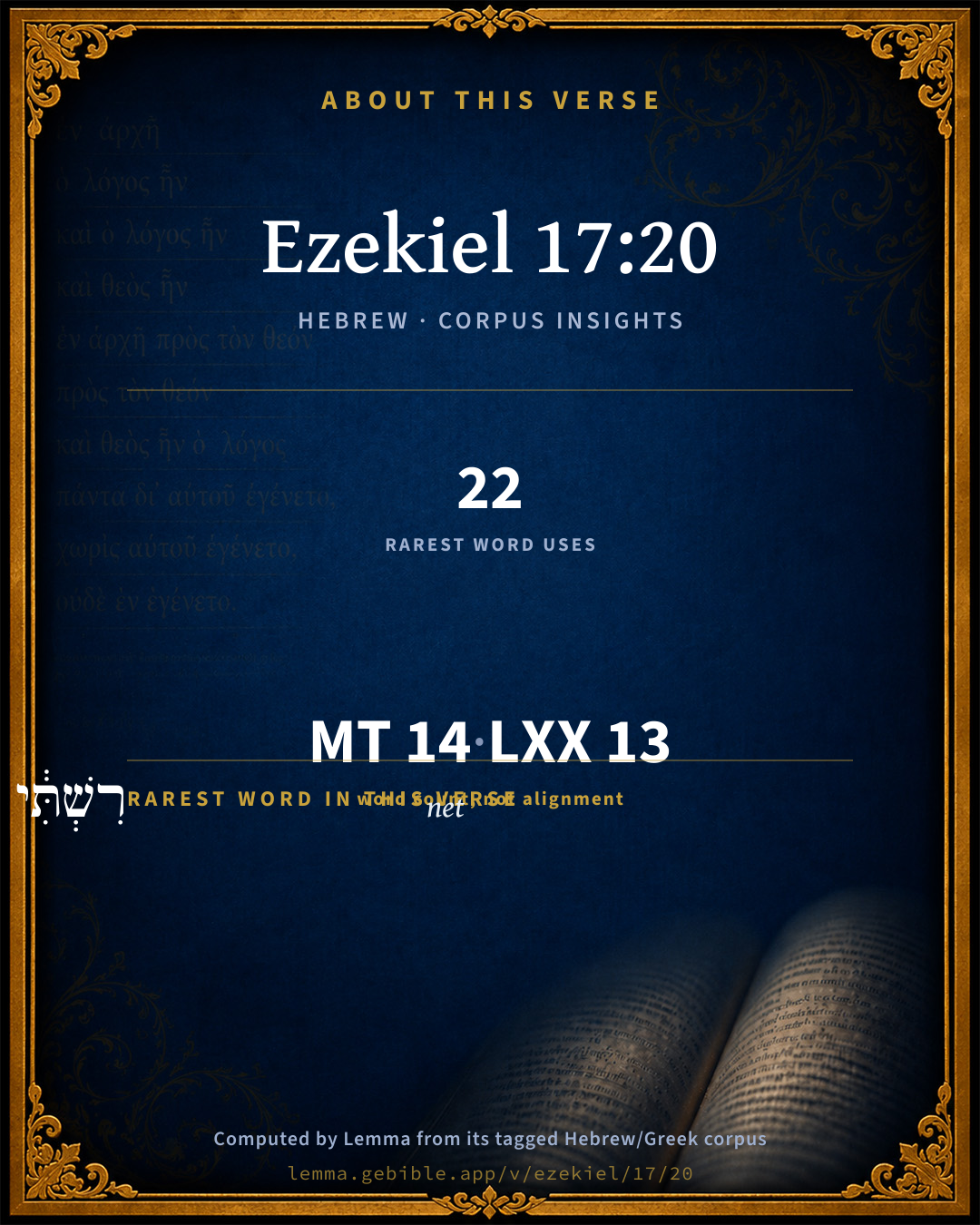
14
words
13
distinct lemmas
Prophets
section

Notable vocabulary

The rarest word here is רִשְׁתִּ֔י net H7568 — appearing just 22 times in the whole Hebrew Bible.

Shared distinctive vocabulary

רִשְׁתִּ֔י net H7568 occurs in 21 verses of the Hebrew Bible. Also found in:

Grammatical profile

  • 5 verbs
  • 4 nouns
  • 3 prepositions
  • 1 adverb
  • 1 particle

Verb forms

  • וּפָרַשְׂתִּ֤י Qal · Sequential Perfect
  • וְנִתְפַּ֖שׂ Niphal · Sequential Perfect
  • וַהֲבִיאוֹתִ֣יהוּ Hiphil · Sequential Perfect
  • וְנִשְׁפַּטְתִּ֤י Niphal · Sequential Perfect
  • מָֽעַל Qal · Perfect

Hebrew & Septuagint length

In English translation the verse runs 39 words from the Hebrew and 16 from the Septuagint (LXX English) — the Septuagint runs noticeably shorter here. See the side-by-side →

A rough comparison of the two English renderings, which tokenize alike — not a word-level alignment.

Word counts can differ between the Hebrew and the Greek without any difference in meaning — e.g. the Hebrew direct-object marker אֵת has no separate Greek word, and Greek often adds the article ὁ.

In the original languages it is 14 Hebrew tokens and 13 Greek tokens — but the two are counted differently (Hebrew bundles its prefixes and suffixes into one token; the Greek is in lemma form), so that isn’t a like-for-like length.

Cross-references

19

Topical passages linked to Ezekiel 17:20 in the Treasury of Scripture Knowledge — connected by theme and wording, ordered by reader-vote popularity; previews shown in the World English Bible.

  • Ezekiel 12:13 My net also will I spread on him, and he shall be taken in my snare; and I will bring him to Babylon to the land of the Chaldeans; yet shall he not see it, though he shall die there.
  • Jeremiah 2:35 Yet you said, I am innocent; surely his anger is turned away from me. Behold, I will enter into judgment with you, because you say, I have not sinned.
  • Ezekiel 20:35–36 and I will bring you into the wilderness of the peoples, and there will I enter into judgment with you face to face.
  • Ezekiel 32:3 Thus says the Lord Yahweh: I will spread out my net on you with a company of many peoples; and they shall bring you up in my net.
  • Jeremiah 39:5–7 But the army of the Chaldeans pursued after them, and overtook Zedekiah in the plains of Jericho: and when they had taken him, they brought him up to Nebuchadrezzar king of Babylon to Riblah in the land of Hamath; and he gave judgment on him.
  • Ezekiel 38:22 With pestilence and with blood will I enter into judgment with him; and I will rain on him, and on his hordes, and on the many peoples who are with him, an overflowing shower, and great hailstones, fire, and sulfur.
  • Joshua 10:16–18 These five kings fled, and hid themselves in the cave at Makkedah.
  • 2 Samuel 18:9 Absalom happened to meet the servants of David. Absalom was riding on his mule, and the mule went under the thick boughs of a great oak, and his head caught hold of the oak, and he was taken up between the sky and earth; and the mule that was under him went on.
  • 2 Chronicles 33:11 Therefore Yahweh brought on them the captains of the host of the king of Assyria, who took Manasseh in chains, and bound him with fetters, and carried him to Babylon.
  • Job 10:16 If my head is held high, you hunt me like a lion. Again you show yourself powerful to me.
  • Ecclesiastes 9:12 For man also doesn't know his time. As the fish that are taken in an evil net, and as the birds that are caught in the snare, even so are the sons of men snared in an evil time, when it falls suddenly on them.
  • Jeremiah 2:9 Therefore I will yet contend with you, says Yahweh, and with your children's children will I contend.
  • Jeremiah 50:44 Behold, [the enemy] shall come up like a lion from the pride of the Jordan against the strong habitation: for I will suddenly make them run away from it; and whoever is chosen, him will I appoint over it: for who is like me? and who will appoint me a time? and who is the shepherd who can stand before me?
  • Lamentations 1:13 From on high has he sent fire into my bones, and it prevails against them; He has spread a net for my feet, he has turned me back: He has made me desolate and faint all the day.
  • Lamentations 4:20 The breath of our nostrils, the anointed of Yahweh, was taken in their pits; Of whom we said, Under his shadow we shall live among the nations.
  • Hosea 2:2 Contend with your mother! Contend, for she is not my wife, Neither am I her husband; And let her put away her prostitution from her face, And her adulteries from between her breasts;
  • Hosea 7:12 When they go, I will spread my net on them. I will bring them down like the birds of the sky. I will chastise them, as their congregation has heard.
  • Micah 6:2 Hear, you mountains, Yahweh's controversy, And you enduring foundations of the earth; For Yahweh has a controversy with his people, And he will contend with Israel.
  • Luke 21:35 For it will come like a snare on all those who dwell on the surface of all the earth.

Cross-references courtesy of OpenBible.info (CC BY 4.0).

Hebrew and Greek witnesses Masoretic Hebrew ↔ Greek Septuagint

The same verse in the two great witnesses to the Old Testament, shown verse-for-verse.

Here the Septuagint runs noticeably shorter than the Hebrew — LXX2012 (modern English Septuagint) 16 words vs World English Bible 39. A rough length comparison of the two English translations, not a word-level alignment — read both below.

These are two independent witnesses, not word-aligned to each other, and the Septuagint is shown in lemma (dictionary) form.

Hebrew Ezekiel 17:20 Masoretic · Westminster Leningrad Codex

וּפָרַשְׂתִּ֤י עָלָיו֙ רִשְׁתִּ֔י וְנִתְפַּ֖שׂ בִּמְצֽוּדָתִ֑י וַהֲבִיאוֹתִ֣יהוּ בָבֶ֗לָה וְנִשְׁפַּטְתִּ֤י אִתּוֹ֙ שָׁ֔ם מַעֲל֖וֹ אֲשֶׁ֥ר מָֽעַל בִּֽי

I will spread my net on him, and he shall be taken in my snare, and I will bring him to Babylon, and will enter into judgment with him there for his trespass that he has trespassed against me.

World English Bible · Public Domain

Greek LXX Ezekiel 17:20 Septuagint · lemma form

καί ἐκπεταννύω ἐπί αὐτός ὁ δίκτυον ἐγώ καί ἁλίσκω ἐν ὁ περιοχή αὐτός

And I will spread a net upon him, and he shall be caught in its snare.

LXX2012 (modern English Septuagint) · Public Domain

Hebrew: Westminster Leningrad Codex (CC BY 4.0). Greek: Septuagint (public domain); English from LXX2012 (modern English Septuagint) (Public Domain). How the Septuagint differs from the Hebrew →

Targum (Aramaic paraphrase)

1

The Targum is the ancient Jewish Aramaic paraphrase of the Hebrew Scriptures — an interpretive translation, not the Hebrew text itself. Onkelos (literal) and Pseudo-Jonathan (expansive) render the Torah, and Jonathan the Prophets. Coverage is partial: where no permissively-licensed English translation exists for a verse, only the Aramaic is shown. This is verse-level text, not a word-by-word alignment to the Hebrew.

  1. Targum Jonathan Prophets (Joshua–Malachi)
    וְאֶפְרוֹס עֲלוֹהִי מְצֻדָתִי וְיִתְאַחַד בִּסְרִגְתִּי וְאַגְלִינֵהּ לְבָבֶל וְאִתְפְּרַע מִנֵיהּ תַּמָן שִׁקְרַהּ דִשְׁקַר קֳדָמַי:

    (no public-domain English translation for this verse)

    Targum Jonathan — Aramaic: “Mikraot Gedolot” (public domain). English: “Sefaria Community Translation” (CC0 1.0 (public-domain dedication)); “London "Chaldee Paraphrase," 1871” (public domain). Text via Sefaria.

Commentary

Notes on Ezekiel 17:20 from classic Christian and Jewish commentators (each source and its license shown beneath its notes). The classic Christian expositions comment on the surrounding passage and are grouped to its opening verse, so a note may address several verses; the Jewish commentaries on the Tanakh (Rashi and others) are per-verse, so they appear only where the commentator wrote on this verse.

Lemma curates 59 commentaries, every one of them public domain or Creative Commons licensed, each selected and text-cleaned for this edition rather than reprinted as found. About our sources →

Trapp's Complete Commentary

John Trapp

Eze 17:20 And I will spread my net upon him, and he shall be taken in my snare, and I will bring him to Babylon, and will plead with him there for his trespass that he hath trespassed against me.

Ver. 20. And I will spread my net upon him.] See on Eze 12:13. The history telleth us that when Zedekiah, with his nobles, were gotten into the plains of Jericho, and thought themselves out of danger, those great hunters the Babylonians caught him, and carried him to their king.

John Trapp, A Commentary or Exposition upon All the Books of the Old and New Testament (1647–1656) — public domain. Text from a community e-Sword module.

Jamieson, Fausset & Brown

Robert Jamieson, A. R. Fausset & David Brown

my net-- (Eze 12:13; Eze 32:3). God entraps him as he had tried to entrap others (Psa 7:15). This was spoken at least upwards of three years before the fall of Jerusalem (compare Eze 8:1, with Eze 20:1).

Jamieson, Fausset & Brown — Commentary Critical and Explanatory on the Whole Bible (1871) — public domain (CC PDM 1.0). Text via the HelloAO Bible API.

Adam Clarke's Commentary

Verse 20. I will spread my net upon him] See Clarke on Eze 12:13.

Adam Clarke's Commentary on the Bible (1810–1826) — public domain. Text from a community e-Sword/MySword module.

John Calvin's Commentaries

Here he points out the kind of punishment which he was about to inflict on King Zedekiah. He had said generally that his perfidy should fall upon his own head, but he now proceeds further, namely, that Zedekiah should be a captive. For God might chastise him by other means, but the prophecy was thereby confirmed, since the Prophet had clearly threatened Zedekiah as we see. But he speaks in the person of God that his language may have more weight. I will spread my net, says God, and he shall be taken in my snares. The passage is metaphorical, but it best explains what often occurs in Scripture, namely, that while the impious take first one course and then another, they are agents of God who governs them by his own secret virtue, and directs them wherever he wishes. As, therefore, men false up all things confusedly, and are, as we see, driven about hither and thither by their lusts, and disturb heaven and earth; yet God moderates their attacks by his secret providence. We gather this from the Prophet’s words when he calls the army of the king of Babylon, and his plans, and the apparatus of war, God’s net and snares. Although Nebuchadnezzar was impelled by his own ambition and avarice, and did not suppose himself under the divine sway, yet we see what the Spirit pronounces. And we must diligently observe this doctrine, because, if we repose on the paternal solicitude of God, although armies surround us on all sides, yet we may confide securely, and await the end with quiet and tranquil minds, since men can do nothing without God. But when we provoke God’s wrath against us, we must bear in mind, that while men have their reasons for being hostile to us, yet God governs them, or that they are his nets or snares, as the Prophet here says.

I will bring him, says he, to Babylon, and there will I dispute with him in judgment, according to the prevarication by which he has prevaricated. Not only did God dispute with Zedekiah there, but he inflicted a heavy and formidable judgment upon him in Riblah, when he saw his own sons put to death first, and then his own eyes were put out, and then he was bound by chains. But he almost pined away in his captivity, and was treated shamefully even unto death; for this reason God says that he would judge him at Babylon: and yet there will be nothing out of place if we comprehend Riblah also. For although Zedekiah had been partially punished before he entered Babylon, yet God there inflicted his own sentence, after he was dragged from his country and led into exile. He was buried indeed not without honor, as we saw in Jeremiah, (Jeremiah 34:5,) for they bewailed him at his burial — Alas, my brother! alas, O master! as the Prophet says: yet till his death he was like the vilest prisoner, for he pined away in his chains, and was meanly clothed, when the king treated Coniah nobly and splendidly: hence Zedekiah’s captivity was the seal of this prophecy for Ezekiel could not have pronounced this sentence, unless he had been the organ of the Holy Spirit. It follows —

John Calvin's Commentaries (1540-1563) — public domain. Text from the Calvin Translation Society English edition (1840s-50s) via the Christian Classics Ethereal Library (ccel.org). Calvin's coverage is partial (roughly two-thirds of the Bible); uncommented books and verses are honest gaps, never fabricated. The 19th-century editor's footnotes and remarks are omitted so the notes are faithfully Calvin's own voice.

The Cambridge Bible for Schools and Colleges

gen. ed. J. J. S. Perowne

20. spread my net] Cf. ch. Eze_12:13; Hos_7:12.

plead with him] i.e. there subject him to the consequences of his treachery, bringing it thereby to his knowledge that he is suffering the penalty of it, cf. Eze_20:35-36, Eze_38:22; Jer_2:35.

The Cambridge Bible for Schools and Colleges (gen. ed. J. J. S. Perowne; Cambridge University Press, 1878–1918) — public domain. Text from a community e-Sword module.

John Gill's Exposition

Thus saith the Lord God,.... Lest it should be thought, by the above prophecies, that the tribe of Judah should be utterly lost, and the family of David extinct, and the promise to him void, that he should have one of his seed to sit upon his, throne for evermore, Psa 132:11; it is here in a figurative manner signified, that of his seed the Messiah should be raised up, by whom the church and kingdom of God would be brought into a flourishing state and condition:

I will also take of the highest branch of the high cedar; Nebuchadnezzar had took one of the family of David, and set, him upon the throne, signified by taking of the seed of the land, and planting it, Eze 17:5; but without success; wherefore the Lord here promises that he will "also", take one and plant it, which should thrive and prosper: by the "high cedar" is meant the Jewish nation, which the Lord chose and set on high above all nations of the earth distinguishing it with peculiar blessings and favours; for which reason it may be compared to the high and spreading cedar; see Num 24:5; and by "the highest branch" of it the tribe of Judah, who prevailed above his brethren, because from him came the chief ruler, Ch1 5:2; and from whence the Messiah was to come, and did, Gen 49:10, Rev 5:5;

and set it; namely, the slip taken from the highest branch of the high cedar; or one that should descend from the Jewish nation, and particularly from the tribe of Judah, more fully described in the next clause:

I will crop off from the top of his young twigs a tender one; and by the "top" and "young twigs" of the highest branch of the cedar, or of the chief tribe in Israel, are meant the house and family of David, the royal family, and the descendants of it, the chief of the tribe of Judah; and by the "tender one" is designed the Messiah; and so Jarchi interprets it; and which interpretation is mentioned by Kimchi, though he would have Zerubbabel intended; and owns it to be the sense of the Targum, which is this,

"I will bring one of the kingdom of the house of David, which is like to a high cedar, and I will raise him up an infant from his children's children;''

and so Abendana observes, that from Shealtiel, the son of Jeconiah, comes forth the King Messiah, who shall rule over all the world, and under whom every bird of wing shall dwell. The Messiah is often called a "branch" in prophecy, Isa 4:2; and here a "tender twig" or branch, as in Isa 53:2; a "tender plant"; which is expressive of the meanness of his descent, David's family being very low at the time of his birth, and of the contemptible appearance he made in the form of a servant; having also all the sinless infirmities of the human nature on him, as well as was attended with poverty, griefs, and sorrows of various kinds; and so made a very unpromising appearance of being the great Prophet, Priest, and King in Israel: and now by the "cropping off" of this tender twig seems to be designed not the incarnation of the Messiah, but his sufferings and death; whereby he was cut off, not for himself, but for the sins of his people, and in which his divine Father had a considerable hand, Isa 53:8; and to which is owing the great fruitfulness of his kingdom and interest, Joh 12:24; moreover, this may respect not only the person of the Messiah, and his mean appearance in the world; but also his church and interest, which were at first like a little stone cut out of the mountain, and like a grain of mustard seed, the least of all seeds, Dan 2:34; the Gospel, which was the instrument of raising the church of God, was very contemptible, because of its subject, a crucified Christ; and the first preachers of it were mean and illiterate persons; those that received it were the poor of this world, and those but a few, and they the offscouring of all things;

and will plant it on a high mountain and eminent; which may be expressive not of the incarnation of Christ, but rather of his ascension to heaven after his death, and resurrection from the dead; and the constitution of him upon that as Lord and Christ, or the setting of him up as King over God's holy hill of Zion, the church of God: and no doubt but there is an allusion to Mount Zion, and to Jerusalem, from whence the Gospel first went forth, and where the first Gospel church was planted; and being said to be on a mountain high and eminent, may note both the visibility and stability of the church of Christ.

John Gill's Exposition of the Whole Bible (1746–1763) — public domain (CC PDM 1.0). Text via the HelloAO Bible API.

Haydock's Catholic Bible Commentary

Net. Chap. xii. 13. (Calmet) --- Judge, punish. (Haydock) --- His sentence was pronounced at Reblatha, 4 Kings xxv. 7. (Calmet)

George Leo Haydock (1774–1849), Haydock's Catholic Family Bible and Commentary, 1859 edition — public domain. Excludes Psalms (Douay-Rheims chapter numbering differs from Protestant) and Deuterocanonical books (Catholic canon only).

Matthew Poole's English Annotations

See Eze 12:13, where the former part of this verse is word for word. Plead with him; or, be judged with him, i.e. the heathen shall both see what I do against this man, they shall consider why I do so, and be judge whether I do more than this perjured king deserves; or, I will punish him with continued punishments from my own hand, or by the hand of Nebuchadnezzar, suitable to the greatness of his trespass against me.

Against me: falsehoods to men in breaking oaths and covenants are in a high degree trespasses against God.

Matthew Poole's English Annotations on the Holy Bible (1683–1685) — public domain. Text from a community e-Sword/MySword module.

Whedon's Commentary on the Bible

Daniel D. Whedon

20. I will spread my net upon him — Compare Eze_12:13.

I… will plead with him — “Subject him to the consequences of his treachery, bringing it thereby to his knowledge that he is suffering the penalty of it” (Eze_20:35-36; Eze_38:22; Jer_2:35). — Davidson.

His trespass, etc. — Rather, his unfaithfulness that he has committed against me.

Daniel D. Whedon (gen. ed.), Commentary on the Old and New Testaments (1874–1909) — public domain. Text from a community e-Sword module.

The Pulpit Commentary

The words receive a special significance as being identical with those which Ezekiel had uttered in Eze_12:13, with the addition that the sin against Nebuchadnezzar as the vicegerent of Jehovah, was a sin against Jehovah himself as the God of faithfulness and truth. There, in Babylon, the real character of his sin should be brought home to the conscience of the blind and captive king. What follows in ver. 21, in like manner, reproduces Eze_12:14, Eze_12:15.

The Pulpit Commentary (1880–1919), ed. H.D.M. Spence-Jones & Joseph S. Exell — public domain. Text from a community e-Sword module.

John Wesley's Explanatory Notes

Plead - I will punish him.

John Wesley, Explanatory Notes Upon the Whole Bible (1754–1765) — public domain. Text via the GEBible commentary corpus.

Rashi

Rabbi Shlomo Yitzchaki (Rashi)

And I will spread My net over him as I explained above at the beginning of the Book (12:13): that He set up a deer to walk on the roof of the cave.

and contend And I will debate with him.

Rashi on the Tanakh — English translations: “The Judaica Press complete Tanach with Rashi, translated by A. J. Rosenberg” (CC BY 4.0); “Pentateuch with Rashi's commentary by M. Rosenbaum and A.M. Silbermann, 1929-1934” (public domain); “The Metsudah Tanach series, Lakewood, N.J” (CC BY 4.0); and “The Book of Joshua, Metsudah Publications, 1997” (CC BY 4.0). Text via Sefaria.

Lesson kit

Teaching starters — assembled from the data on this page, not authored interpretation. Every prompt links to the verse data it draws on. Edit before teaching.

Ezekiel, in the Prophets, opens this verse with 14 words (13 distinct Hebrew lemmas). Its most distinctive word is resheth (“net”). The Greek Septuagint runs shorter here. A historical commentator’s framing appears above. Read the whole chapter for the surrounding context.

Discussion questions

  1. What does “net” (resheth) contribute to the verse as a whole?
  2. How does Exodus 27:4, which shares the word «net», read alongside this verse?
  3. The Septuagint runs shorter here than the Hebrew. What might account for the difference?
  4. These translations render this verse differently. What is at stake in choosing one wording over another?
  5. «וּפָרַשְׂתִּ֤י» is a Qal Sequential Perfect verb. How does that grammatical form shape the action described?
  6. Compare how Trapp's Complete Commentary and Jamieson, Fausset & Brown read this verse. Where do they agree or differ?

Things to notice

Reading settings

Reading text

Shown beneath each verse's original-language words.

Old Testament
Old Testament edition

Read the OT as the Masoretic Hebrew (MT) or the Greek Septuagint (LXX).

English shown for the Greek Septuagint (in the Hebrew ↔ Greek comparison).

Comparing translations? Open the Compare panel on any verse page to stack up to four side by side.