Ezekiel 22:2

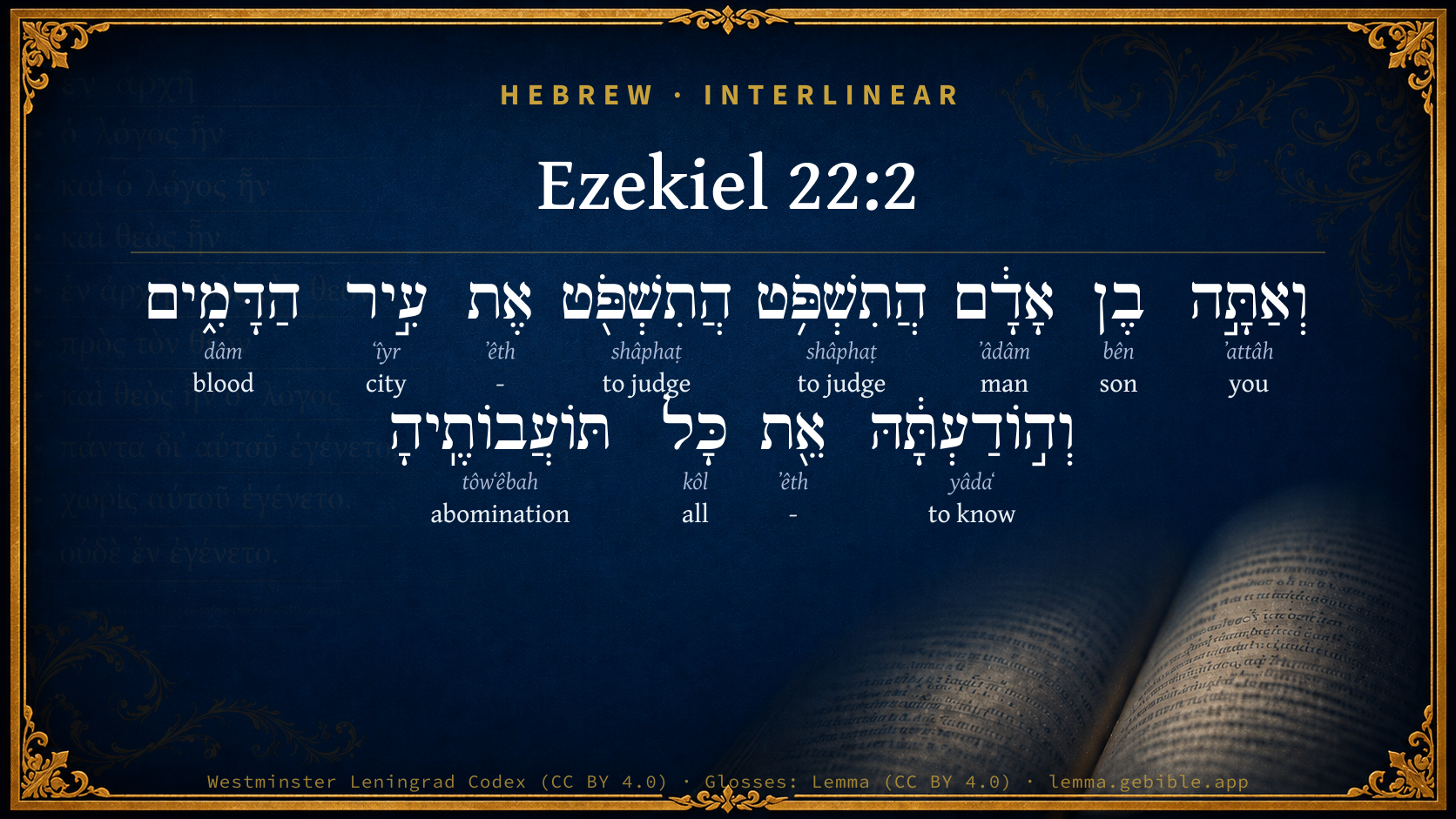
Hebrew (Westminster Leningrad Codex) Ezekiel 22:2 appears in the Hebrew Old Testament. The text above is from the Westminster Leningrad Codex. Each word links to its Strong’s number, a concise gloss, and parsing drawn from the Open Scriptures Hebrew Bible morphology. Click any word for its full Brown-Driver-Briggs (BDB) entry.
Download image
Cite this verse

Ezekiel 22:2 (World English Bible). Public Domain. Lemma interlinear Bible study tool, https://lemma.gebible.app/v/ezekiel/22/2.

Show BibTeX & RIS
BibTeX
RIS
English Translation
You, son of man, will you judge, will you judge the bloody city? then cause her to know all her abominations.
World English Bible · Public Domain
Download a study sheet

One document with this verse’s original text, its word-by-word gloss line, the meaning frame, cross-references with their text, attributed commentary, and full source and license credits — printable, and it pastes into notes with its structure intact.

This verse Autodidact and up

Study sheet (.html) Plain text (.txt)

A passage Seminary Student

Up to 50 verses in one chapter. A passage sheet keeps up to 6 commentary sources and 12 cross-references per verse, in the order this page ranks them, and says so on the sheet whenever that leaves anything out. Ask for a single verse and you get the Autodidact verse sheet above.

Everything on this page stays free to read, with no account — the sheet is a download of what is already on screen, not access to it.

Want to remove ads? Support Godless Engineer
Compare translations 3

The same verse in 3 English versions, stacked beneath the original-language interlinear above. Click any original word for its lexicon entry.

Each is an independent rendering of the whole verse — the interlinear is not word-aligned to these translations.

Highlighted words mark where these versions differ — a whole-verse word diff, not a word-by-word alignment.

  • World English Bible Public Domain
    You, son of man, will you judge, will you judge the bloody city? then cause her to know all her abominations.
  • King James Version Public Domain
    Now, thou son of man, wilt thou judge, wilt thou judge the bloody city? yea, thou shalt shew her all her abominations.
  • unfoldingWord Literal Text CC BY-SA 4.0
    “Now you, son of man, will you judge? Will you judge the city of blood? Make her know all her abominations.

unfoldingWord Literal Text — © unfoldingWord, licensed CC BY-SA 4.0. Word-aligned USFM3 via Door43 (git.door43.org/unfoldingWord/en_ult).

Versions to compare (up to 4)

3 of 4 selected

Show all 18 translations

Every available English version of this verse, each an independent rendering of the whole verse.

  • World English Bible Public Domain
    You, son of man, will you judge, will you judge the bloody city? then cause her to know all her abominations.
  • Berean Standard Bible Public Domain
    “As for you, son of man, will you judge her? Will you pass judgment on the city of bloodshed? Then confront her with all her abominations
  • Majority Standard Bible Public Domain
    “As for you, son of man, will you judge her? Will you pass judgment on the city of bloodshed? Then confront her with all her abominations
  • King James Version Public Domain
    Now, thou son of man, wilt thou judge, wilt thou judge the bloody city? yea, thou shalt shew her all her abominations.
  • American Standard Version (1901) Public Domain
    And thou, son of man, wilt thou judge, wilt thou judge the bloody city? then cause her to know all her abominations.
  • Revised Version (1885) Public Domain
    And thou, son of man, wilt thou judge, wilt thou judge the bloody city? then cause her to know all her abominations.
  • Geneva Bible (1599) Public Domain
    Now thou sonne of man, wilt thou iudge, wilt thou iudge this bloody citie? wilt thou shew her all her abominations?
  • Douay-Rheims (1899) Public Domain
    And thou son of man, dost thou not judge, dost thou not judge the city of blood?
  • Young's Literal Translation Public Domain
    `And thou, son of man, dost thou judge? dost thou judge the city of blood? then thou hast caused it to know all its abominations,
  • Literal Standard Version CC BY-SA 4.0
    “And you, son of man, do you judge? Do you judge the city of blood? Then you have caused it to know all its abominations,
  • Unlocked Literal Bible CC BY-SA 4.0
    “Now you, son of man, will you judge? Will you judge the city of blood? Make her know all her abominations.
  • unfoldingWord Literal Text CC BY-SA 4.0
    “Now you, son of man, will you judge? Will you judge the city of blood? Make her know all her abominations.
  • Darby Bible Public Domain
    And thou, son of man, wilt thou judge, wilt thou judge the bloody city? Yea, cause her to know all her abominations,
  • World Messianic Bible Public Domain
    “You, son of man, will you judge? Will you judge the bloody city? Then cause her to know all her abominations.
  • Webster's Bible Public Domain
    Now, thou son of man, wilt thou judge, wilt thou judge the bloody city? yes, thou shalt show her all her abominations.
  • Free Bible Version CC BY-SA 4.0
    “So, son of man, are you ready to judge them? Are you ready to judge the people of this city that have caused so much bloodshed? Make them face all the disgusting things they've done,
  • Bible in Basic English Public Domain
    And you, son of man, will you be a judge, will you be a judge of the town of blood? then make clear to her all her disgusting ways.
  • JPS Tanakh (1917) Public Domain
    'Now, thou, son of man, wilt thou judge, wilt thou judge the bloody city? then cause her to know all her abominations.

Literal Standard Version (2020), Covenant Press — licensed CC BY-SA 4.0. Text via the HelloAO Bible API (eBible.org). Unlocked Literal Bible (unfoldingWord) — licensed CC BY-SA 4.0. Text via the HelloAO Bible API (eBible.org). unfoldingWord Literal Text — © unfoldingWord, licensed CC BY-SA 4.0. Word-aligned USFM3 via Door43 (git.door43.org/unfoldingWord/en_ult). Free Bible Version, Dr. Jonathan Gallagher — licensed CC BY-SA 4.0. Text via the HelloAO Bible API (eBible.org).

Word by word

More ways to search: Search by grammar → Find every occurrence → Compare this word →

Practice this passage: Drill this verse → Learn its vocabulary →

תּוֹעֲבוֹתֶֽיהָ
tôwʻêbah
H8441
“abominations · her”
Noun, Common, Feminine, Plural, Construct + Suffix, Personal, 3rd Person, Feminine, Singular
Part of Speech
Noun
Type
Common
Gender
Feminine
Number
Plural
State
Construct
Full BDB Definition

Origin: act part of H8581

TWOT: 2530a

a disgusting thing, abomination, abominable - in ritual sense (of unclean food, idols, mixed marriages) - in ethical sense (of wickedness etc)
  1. וְאַתָּ֣ה ʼattâh H859 “and · you” Conjunction + Pronoun, Personal, 2nd Person, Masculine, Singular
  2. בֶן bên H1121 “son of” Noun, Common, Masculine, Singular, Construct
  3. אָדָ֔ם ʼâdâm H120 “man” Noun, Common, Masculine, Singular, Absolute
  4. הֲתִשְׁפֹּ֥ט shâphaṭ H8199 “to judge” Particle, Interrogative + Verb, Qal, Imperfect, 2nd Person, Masculine, Singular
  5. הֲתִשְׁפֹּ֖ט shâphaṭ H8199 “to judge” Particle, Interrogative + Verb, Qal, Imperfect, 2nd Person, Masculine, Singular
  6. אֶת ʼêth H853 “-” Particle, Direct Object
  7. עִ֣יר ʻîyr H5892 “city of” Noun, Common, Feminine, Singular, Construct
  8. הַדָּמִ֑ים dâm H1818 “the · blood” Particle, Definite Article + Noun, Common, Masculine, Plural, Absolute
  9. וְה֣וֹדַעְתָּ֔הּ yâdaʻ H3045 “and · to know · her” Conjunction + Verb, Hiphil, Sequential Perfect, 2nd Person, Masculine, Singular + Suffix, Personal, 3rd Person, Feminine, Singular
  10. אֵ֖ת ʼêth H853 “-” Particle, Direct Object
  11. כָּל kôl H3605 “all of” Noun, Common, Masculine, Singular, Construct

About this verse

These counts appear in no published source. They are computed here, from the morphology-tagged text and Lemma’s own curated glosses. What Lemma adds →

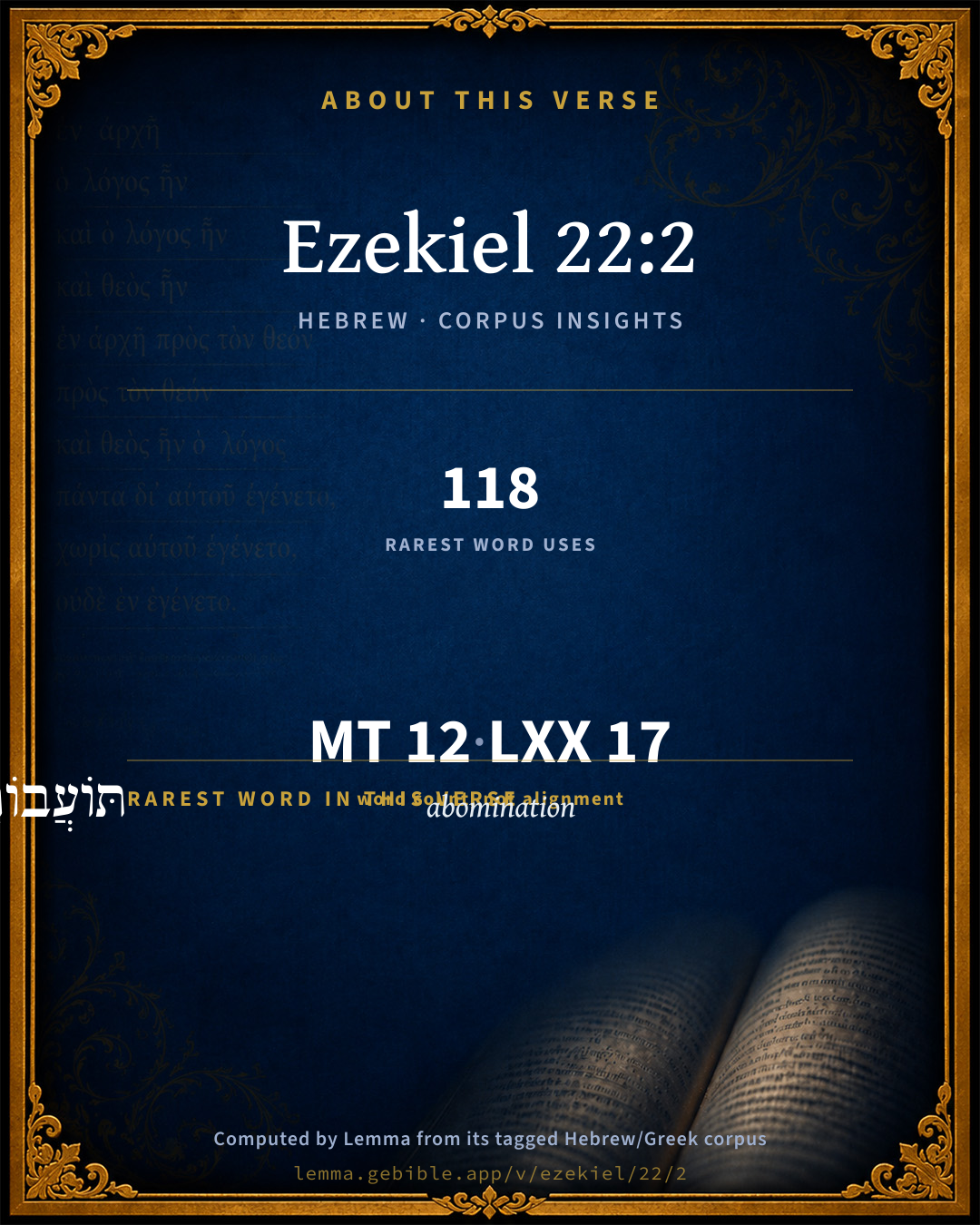
12
words
10
distinct lemmas
Prophets
section

Grammatical profile

  • 3 verbs
  • 6 nouns
  • 1 pronoun
  • 2 particles

Verb forms

  • הֲתִשְׁפֹּ֥ט Qal · Imperfect
  • הֲתִשְׁפֹּ֖ט Qal · Imperfect
  • וְה֣וֹדַעְתָּ֔הּ Hiphil · Sequential Perfect

Repetition

A word recurs within this verse — often emphatic in Hebrew:

  • הֲתִשְׁפֹּ֥ט to judge H8199 ×2

Hebrew & Septuagint length

In English translation the verse runs 21 words from the Hebrew and 19 from the Septuagint (LXX English) — closely comparable.

A rough comparison of the two English renderings, which tokenize alike — not a word-level alignment.

Word counts can differ between the Hebrew and the Greek without any difference in meaning — e.g. the Hebrew direct-object marker אֵת has no separate Greek word, and Greek often adds the article ὁ.

In the original languages it is 12 Hebrew tokens and 17 Greek tokens — but the two are counted differently (Hebrew bundles its prefixes and suffixes into one token; the Greek is in lemma form), so that isn’t a like-for-like length.

Cross-references

18

Topical passages linked to Ezekiel 22:2 in the Treasury of Scripture Knowledge — connected by theme and wording, ordered by reader-vote popularity; previews shown in the World English Bible.

  • Isaiah 58:1 Cry aloud, don't spare, lift up your voice like a trumpet, and declare to my people their disobedience, and to the house of Jacob their sins.
  • Ezekiel 20:4 Will you judge them, son of man, will you judge them? Cause them to know the abominations of their fathers;
  • Ezekiel 24:6 Therefore thus says the Lord Yahweh: Woe to the bloody city, to the caldron whose rust is therein, and whose rust is not gone out of it! take out of it piece after piece; No lot is fallen on it.
  • Ezekiel 24:9 Therefore thus says the Lord Yahweh: Woe to the bloody city! I also will make the pile great.
  • 2 Kings 21:16 Moreover Manasseh shed innocent blood very much, until he had filled Jerusalem from one end to another; besides his sin with which he made Judah to sin, in doing that which was evil in the sight of Yahweh.
  • Hosea 4:2 There is cursing, lying, murder, stealing, and committing adultery; They break boundaries, and bloodshed causes bloodshed.
  • Nahum 3:1 Woe to the bloody city! It is all full of lies and robbery. The prey doesn't depart.
  • Matthew 27:25 All the people answered, "May his blood be on us, and on our children!"
  • Acts 7:52 Which of the prophets didn't your fathers persecute? They killed those who foretold the coming of the Righteous One, of whom you have now become betrayers and murderers.
  • 1 Timothy 5:20 Those who sin, reprove in the sight of all, that the rest also may be in fear.
  • 2 Kings 24:3–4 Surely at the commandment of Yahweh came this on Judah, to remove them out of his sight, for the sins of Manasseh, according to all that he did,
  • Jeremiah 2:30 In vain have I struck your children; they received no correction: your own sword has devoured your prophets, like a destroying lion.
  • Jeremiah 2:34 Also in your skirts is found the blood of the souls of the innocent poor: you did not find them breaking in; but it is because of all these things.
  • Ezekiel 8:9–17 He said to me, Go in, and see the wicked abominations that they do here.
  • Ezekiel 16:1–63 Again the word of Yahweh came to me, saying,
  • Ezekiel 23:1–49 The word of Yahweh came again to me, saying,
  • Matthew 23:35 that on you may come all the righteous blood shed on the earth, from the blood of righteous Abel to the blood of Zachariah son of Barachiah, whom you killed between the sanctuary and the altar.
  • Luke 11:50 that the blood of all the prophets, which was shed from the foundation of the world, may be required of this generation;

Cross-references courtesy of OpenBible.info (CC BY 4.0).

Hebrew and Greek witnesses Masoretic Hebrew ↔ Greek Septuagint

The same verse in the two great witnesses to the Old Testament, shown verse-for-verse.

These are two independent witnesses, not word-aligned to each other, and the Septuagint is shown in lemma (dictionary) form.

Hebrew Ezekiel 22:2 Masoretic · Westminster Leningrad Codex

וְאַתָּ֣ה בֶן אָדָ֔ם הֲתִשְׁפֹּ֥ט הֲתִשְׁפֹּ֖ט אֶת עִ֣יר הַדָּמִ֑ים וְה֣וֹדַעְתָּ֔הּ אֵ֖ת כָּל תּוֹעֲבוֹתֶֽיהָ

You, son of man, will you judge, will you judge the bloody city? then cause her to know all her abominations.

World English Bible · Public Domain

Greek LXX Ezekiel 22:2 Septuagint · lemma form

καί σύ υἱός ἄνθρωπος εἰ κρίνω ὁ πόλις ὁ αἷμα καί παραδεικνύω αὐτός πᾶς ὁ ἀνομία αὐτός

And you, son of man, will you judge the bloody city? yes, declare you to her all her iniquities.

LXX2012 (modern English Septuagint) · Public Domain

Hebrew: Westminster Leningrad Codex (CC BY 4.0). Greek: Septuagint (public domain); English from LXX2012 (modern English Septuagint) (Public Domain). How the Septuagint differs from the Hebrew →

Targum (Aramaic paraphrase)

1

The Targum is the ancient Jewish Aramaic paraphrase of the Hebrew Scriptures — an interpretive translation, not the Hebrew text itself. Onkelos (literal) and Pseudo-Jonathan (expansive) render the Torah, and Jonathan the Prophets. Coverage is partial: where no permissively-licensed English translation exists for a verse, only the Aramaic is shown. This is verse-level text, not a word-by-word alignment to the Hebrew.

  1. Targum Jonathan Prophets (Joshua–Malachi)
    וְאַתְּ בַּר אָדָם הֲתוֹכַח הֲתוֹכַח יַת קַרְתָּא דְאִשְׁדֵי דַם זַכַּאי בְּגַוָהּ וְחַוֵי לָהּ יַת כָּל תּוֹעֲבָתָהָא:

    (no public-domain English translation for this verse)

    Targum Jonathan — Aramaic: “Mikraot Gedolot” (public domain). English: “Sefaria Community Translation” (CC0 1.0 (public-domain dedication)); “London "Chaldee Paraphrase," 1871” (public domain). Text via Sefaria.

Commentary

Notes on Ezekiel 22:2 from classic Christian and Jewish commentators (each source and its license shown beneath its notes). The classic Christian expositions comment on the surrounding passage and are grouped to its opening verse, so a note may address several verses; the Jewish commentaries on the Tanakh (Rashi and others) are per-verse, so they appear only where the commentator wrote on this verse.

Lemma curates 59 commentaries, every one of them public domain or Creative Commons licensed, each selected and text-cleaned for this edition rather than reprinted as found. About our sources →

Ellicott's Commentary for English Readers

(2) Wilt thou judge.—The same expression as in Eze_20:4. (See Note there.) The sense of the margin, “plead for,” is not appropriate here.

Bloody city.—In Eze_22:2-6 crimes of bloodshed and idolatry are dwelt upon, between which there seems always to have been a close connection. The same words are used in Eze_24:6; Eze_24:9, and in Nah_3:1.

A Bible Commentary for English Readers, edited by Charles John Ellicott (1878–1897) — public domain. Text from a community e-Sword module.

Trapp's Complete Commentary

John Trapp

Eze 22:2 Now, thou son of man, wilt thou judge, wilt thou judge the bloody city? yea, thou shalt shew her all her abominations.

Ver. 2. Wilt thou judge?] Or, Plead for, or excuse? See Eze 20:4.

The bloody city.] The saints’ slaughter house.

John Trapp, A Commentary or Exposition upon All the Books of the Old and New Testament (1647–1656) — public domain. Text from a community e-Sword module.

Joseph Benson's Commentary

Eze 22:2-5. Wilt thou judge, wilt thou judge the bloody city? — Wilt thou plead for it? Or rather, Wilt thou not judge? see note on Eze 20:4. The expression is doubled to awaken the prophet more fully, and to quicken him to his work. Jerusalem is termed the bloody city, Hebrew, עיר הדמים, the city of bloods, because of the blood of innocent persons, of children sacrificed to Moloch, and of prophets and righteous men shed in her, and that by courts of justice under colour of law. Yea, thou shalt show her — Make her know; all her abominations — That I may be justified in all the desolations which I have brought, and shall still more fully bring upon her. The city sheddeth blood in the midst of it — Openly and impudently; that her time may come — The time of her destruction, as the consequence of her having filled up the measure of her iniquities; and maketh idols against herself — To her own ruin. Thou hast caused thy days to draw near — The days of thy sorrows and sufferings; and art come even to thy years — To the end of thy years of trial, so that thou shalt be borne with no longer. Therefore have I made thee a reproach unto the heathen — Have exposed thee to their contempt and scorn; and a mocking to all countries — A proverb, and a by-word, and cause of astonishment to all people, according to the prediction of Moses, (Deu 28:37,) and the solemn warning given by the Lord to Solomon, when he appeared to him after the dedication of the temple, 1Ki 9:7. Those that are near — And are eye-witnesses of thy apostacy and degeneracy, as the Edomites, Ammonites, Moabites, and Philistines; and those that be far from thee — The Medes, Persians, Hyrcanians, &c., to whom thou shalt be carried captive; shall mock thee, which art infamous — Of a most infamous name; and much vexed — Afflicted, empoverished, and ruined: or rather, who art full of tumult and trouble, as רבת המהומה more properly signifies: that is, in which there are continually confusion and disorder, by the commission of acts of violence.

Joseph Benson's Commentary on the Old and New Testaments (1811–1818) — public domain. Text from a community e-Sword module.

Geneva Bible (1599)

Geneva Bible translators

Art thou ready to execute thy charge, which I commit unto thee against Jerusalem, that murdereth the Prophets and them that are godly?

Geneva Bible (1599) marginal notes — public domain. Text via Bolls.life.

Adam Clarke's Commentary

Verse 2. Wilt thou judge the bloody city] Pronounce the sentence of death against the murderers.

Show her all her abominations.] And a most revolting and dreadful catalogue of these is in consequence exhibited.

Adam Clarke's Commentary on the Bible (1810–1826) — public domain. Text from a community e-Sword/MySword module.

The Cambridge Bible for Schools and Colleges

gen. ed. J. J. S. Perowne

2. wilt thou judge] See on ch. Eze_20:4, cf. Eze_23:36.

yea, thou shalt shew] Rather: then thou shalt cause her to know … Eze_22:3 and thou shalt say.

The Cambridge Bible for Schools and Colleges (gen. ed. J. J. S. Perowne; Cambridge University Press, 1878–1918) — public domain. Text from a community e-Sword module.

John Gill's Exposition

Now, thou son of man, wilt thou judge, wilt thou judge the bloody city?.... Or, "city of bloods" (y)? the city of Jerusalem, in which was shed the blood of the prophets sent unto her; the doubling of the word denotes the vehemency with which it was expressed: wilt thou plead for and excuse such a city as this? surely no; so some: or wilt thou do thy work and office as a prophet? hast thou courage enough to do it? will thou rebuke and reprove? as the Targum; wilt thou examine her case, judge truly, and condemn her, as thou oughtest to do? hast thou an inclination to take this affair in hand? then be directed to it, as follows:

yea, thou shalt show her all her abominations; lay them before her; convict her of them; show her the evil of them, and the punishment they deserve; every kind of sin she was guilty of; for, as for particular acts, it was impossible to reckon them; those sins that were the most flagrant, and most frequently committed, and which were abominable to the Lord, and rendered her so in his sight, are intended.

(y) "civitatem sanguinum", V. L. Munster, Montanus.

John Gill's Exposition of the Whole Bible (1746–1763) — public domain (CC PDM 1.0). Text via the HelloAO Bible API.

Haydock's Catholic Bible Commentary

Blood. Why dost thou cease to admonish and rebuke the people? (Worthington) --- Pronounce sentence on Jerusalem, (Haydock) for her cruelties. (Calmet)

George Leo Haydock (1774–1849), Haydock's Catholic Family Bible and Commentary, 1859 edition — public domain. Excludes Psalms (Douay-Rheims chapter numbering differs from Protestant) and Deuterocanonical books (Catholic canon only).

Matthew Poole's English Annotations

Some would have the prophet here to be questioned, whether he would, and why he would, plead for such a city. Others, that God doth forbid him to plead for it, or be solicitous about it. I rather think God doth awake: him to more vigorous reproving of this sinful people, and threatening them for sin. The question is doubled to awaken the prophet more fully, and to quicken him to his work.

The bloody city; Jerusalem, which is guilty of the murders of innocent ones, of prophets and holy men.

Show her; make her know, at least tell her by writing; for the prophet was at Babylon now, and could not speak to then at Jerusalem, but he might and must send word to then what their abominations were.

All her abominations; all the kinds, not all individual acts of them.

Matthew Poole's English Annotations on the Holy Bible (1683–1685) — public domain. Text from a community e-Sword/MySword module.

Whedon's Commentary on the Bible

Daniel D. Whedon

DESCRIPTION OF THE GROSS SINS OF THE INHABITANTS OF JERUSALEM, INCLUDING EVEN THE PROPHETS AND PRIESTS OF JEHOVAH.

2. Wilt thou judge [see Eze_20:4] the bloody city — What a name for the holy sanctuary, now filled with child sacrifices (Eze_20:26) and murders (Eze_22:6; Eze_22:9; Eze_9:10; Eze_16:38; Eze_23:37; Eze_23:45).

Yea, thou shalt show — Literally, then cause her to know.

Daniel D. Whedon (gen. ed.), Commentary on the Old and New Testaments (1874–1909) — public domain. Text from a community e-Sword module.

John Wesley's Explanatory Notes

Judge - The question is doubled, to awaken the prophet more fully, and to quicken him to his work.

John Wesley, Explanatory Notes Upon the Whole Bible (1754–1765) — public domain. Text via the GEBible commentary corpus.

Rashi

Rabbi Shlomo Yitzchaki (Rashi)

will you judge the city of bloodshed Jerusalem.

and let her know The “heh” in והודעתה is pointed, so that the meaning is, “and let her know.”

Rashi on the Tanakh — English translations: “The Judaica Press complete Tanach with Rashi, translated by A. J. Rosenberg” (CC BY 4.0); “Pentateuch with Rashi's commentary by M. Rosenbaum and A.M. Silbermann, 1929-1934” (public domain); “The Metsudah Tanach series, Lakewood, N.J” (CC BY 4.0); and “The Book of Joshua, Metsudah Publications, 1997” (CC BY 4.0). Text via Sefaria.

Lesson kit

Teaching starters — assembled from the data on this page, not authored interpretation. Every prompt links to the verse data it draws on. Edit before teaching.

Ezekiel, in the Prophets, opens this verse with 12 words (10 distinct Hebrew lemmas). Its most distinctive word is tôwʻêbah (“abomination”). A historical commentator’s framing appears above. Read the whole chapter for the surrounding context.

Discussion questions

  1. What does “abomination” (tôwʻêbah) contribute to the verse as a whole?
  2. How does Isaiah 58:1, which shares this passage’s theme, read alongside this verse?
  3. What does the repetition of “to judge” (2× in this one verse) do in this verse?
  4. These translations render this verse differently; the difference is in the English rendering, not the original. What questions does that raise?
  5. «הֲתִשְׁפֹּ֥ט» is a Qal Imperfect verb. How does that grammatical form shape the action described?
  6. Compare how Ellicott's Commentary for English Readers and Trapp's Complete Commentary read this verse. Where do they agree or differ?

Things to notice

Reading settings

Reading text

Shown beneath each verse's original-language words.

Old Testament
Old Testament edition

Read the OT as the Masoretic Hebrew (MT) or the Greek Septuagint (LXX).

English shown for the Greek Septuagint (in the Hebrew ↔ Greek comparison).

Comparing translations? Open the Compare panel on any verse page to stack up to four side by side.