1 Samuel 8:2

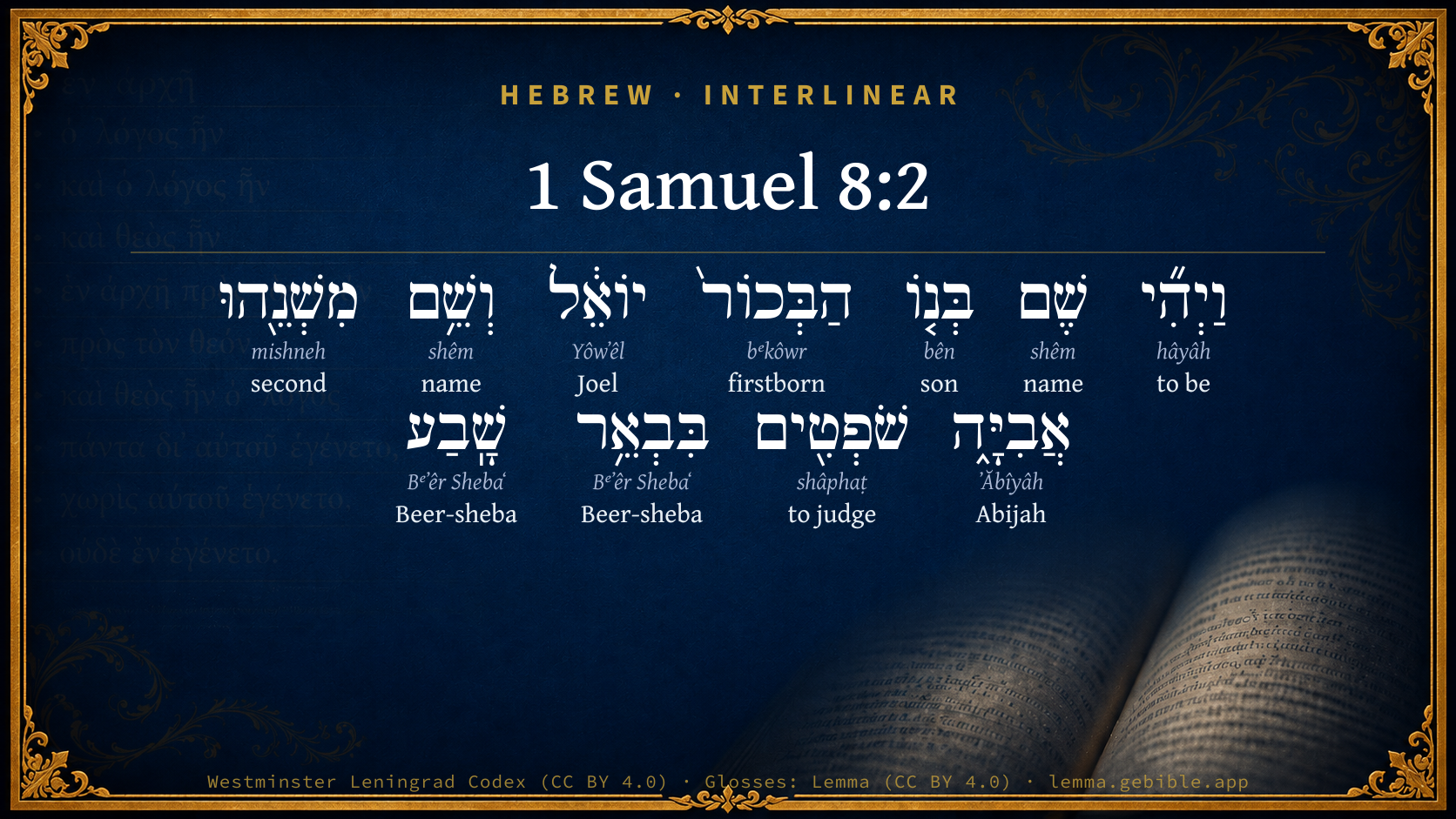
Hebrew (Westminster Leningrad Codex) 1 Samuel 8:2 appears in the Hebrew Old Testament. The text above is from the Westminster Leningrad Codex. Each word links to its Strong’s number, a concise gloss, and parsing drawn from the Open Scriptures Hebrew Bible morphology. Click any word for its full Brown-Driver-Briggs (BDB) entry.
Download image
Cite this verse

1 Samuel 8:2 (World English Bible). Public Domain. Lemma interlinear Bible study tool, https://lemma.gebible.app/v/1-samuel/8/2.

Show BibTeX & RIS
BibTeX
RIS
English Translation
Now the name of his firstborn was Joel; and the name of his second, Abijah: they were judges in Beersheba.
World English Bible · Public Domain
Highlights
  • 2 first appearances in the Hebrew Bible
Full analysis ↓
Download a study sheet

One document with this verse’s original text, its word-by-word gloss line, the meaning frame, cross-references with their text, attributed commentary, and full source and license credits — printable, and it pastes into notes with its structure intact.

This verse Autodidact and up

Study sheet (.html) Plain text (.txt)

A passage Seminary Student

Up to 50 verses in one chapter. A passage sheet keeps up to 6 commentary sources and 12 cross-references per verse, in the order this page ranks them, and says so on the sheet whenever that leaves anything out. Ask for a single verse and you get the Autodidact verse sheet above.

Everything on this page stays free to read, with no account — the sheet is a download of what is already on screen, not access to it.

Want to remove ads? Support Godless Engineer
Compare translations 3

The same verse in 3 English versions, stacked beneath the original-language interlinear above. Click any original word for its lexicon entry.

Each is an independent rendering of the whole verse — the interlinear is not word-aligned to these translations.

Highlighted words mark where these versions differ — a whole-verse word diff, not a word-by-word alignment.

  • World English Bible Public Domain
    Now the name of his firstborn was Joel; and the name of his second, Abijah: they were judges in Beersheba.
  • King James Version Public Domain
    Now the name of his firstborn was Joel; and the name of his second, Abiah: they were judges in Beersheba.
  • unfoldingWord Literal Text CC BY-SA 4.0
    And the name of his firstborn son was Joel, and the name of his second, Abijah, judges in Beersheba.

unfoldingWord Literal Text — © unfoldingWord, licensed CC BY-SA 4.0. Word-aligned USFM3 via Door43 (git.door43.org/unfoldingWord/en_ult).

Versions to compare (up to 4)

3 of 4 selected

Show all 18 translations

Every available English version of this verse, each an independent rendering of the whole verse.

  • World English Bible Public Domain
    Now the name of his firstborn was Joel; and the name of his second, Abijah: they were judges in Beersheba.
  • Berean Standard Bible Public Domain
    The name of his firstborn son was Joel, and the name of his second was Abijah. They were judges in Beersheba.
  • Majority Standard Bible Public Domain
    The name of his firstborn son was Joel, and the name of his second was Abijah. They were judges in Beersheba.
  • King James Version Public Domain
    Now the name of his firstborn was Joel; and the name of his second, Abiah: they were judges in Beersheba.
  • American Standard Version (1901) Public Domain
    Now the name of his first-born was Joel; and the name of his second, Abijah: they were judges in Beer-sheba.
  • Revised Version (1885) Public Domain
    Now the name of his firstborn was Joel; and the name of his second, Abijah: they were judges in Beer-sheba.
  • Geneva Bible (1599) Public Domain
    (And the name of his eldest sonne was Ioel, and the name of the second Abiah) euen Iudges in Beer-sheba.
  • Douay-Rheims (1899) Public Domain
    Now the name of his firstborn son was Joel: and the name of the second was Abia, judges in Bersabee.
  • Young's Literal Translation Public Domain
    And the name of his first-born son is Joel, and the name of his second Abiah, judges in Beer-Sheba:
  • Literal Standard Version CC BY-SA 4.0
    And the name of his firstborn son is Joel, and the name of his second Abiah, judges in Beer-Sheba:
  • Unlocked Literal Bible CC BY-SA 4.0
    The name of his firstborn was Joel, and the name of his second son was Abijah. They were judges in Beersheba.
  • unfoldingWord Literal Text CC BY-SA 4.0
    And the name of his firstborn son was Joel, and the name of his second, Abijah, judges in Beersheba.
  • Darby Bible Public Domain
    And the name of his firstborn was Joel; and the name of his second, Abijah; they judged in Beer-sheba.
  • World Messianic Bible Public Domain
    Now the name of his firstborn was Joel, and the name of his second, Abijah. They were judges in Beersheba.
  • Webster's Bible Public Domain
    Now the name of his first-born was Joel; and the name of his second, Abiah: they were judges in Beer-sheba.
  • Free Bible Version CC BY-SA 4.0
    His first son was named Joel, and his second son was named Abijah. They were rulers in Beersheba.
  • Bible in Basic English Public Domain
    The name of his first son was Joel and the name of his second Abijah: they were judges in Beer-sheba.
  • JPS Tanakh (1917) Public Domain
    Now the name of his first-born was Joel; and the name of his second, Abijah; they were judges in Beer-sheba.

Literal Standard Version (2020), Covenant Press — licensed CC BY-SA 4.0. Text via the HelloAO Bible API (eBible.org). Unlocked Literal Bible (unfoldingWord) — licensed CC BY-SA 4.0. Text via the HelloAO Bible API (eBible.org). unfoldingWord Literal Text — © unfoldingWord, licensed CC BY-SA 4.0. Word-aligned USFM3 via Door43 (git.door43.org/unfoldingWord/en_ult). Free Bible Version, Dr. Jonathan Gallagher — licensed CC BY-SA 4.0. Text via the HelloAO Bible API (eBible.org).

Word by word

More ways to search: Search by grammar → Find every occurrence → Compare this word →

Practice this passage: Drill this verse → Learn its vocabulary →

יוֹאֵ֔ל
Yôwʼêl
H3100
“Joel”
Noun, Proper
Part of Speech
Noun
Type
Proper
Full BDB Definition

Origin: from H3068 and H410

TWOT: None

Joel = "Jehovah is God" - son of Pethuel and the 2nd of the 12 minor prophets with a book by his name; probably prophesied in the time of king Uzziah of Judah - eldest son of Samuel the prophet and father of Heman the singer - a Simeonite chief - a Reubenite - a chief of Gad - son of Izrahiah and a chief of Issachar - brother of Nathan of Zobah and one of David's mighty warriors - son of Pedaiah and a chief of the half tribe of Manasseh west of the Jordan in the time of David - a son of Nebo who returned with Ezra and had a foreign wife - a Benjamite, son of Zichri - a Levite - a Kohathite Levite in the reign of Hezekiah - a Gershonite Levite chief in the time of David - a Gershonite Levite, son of Jehiel and a descendant of Laadan
  1. וַיְהִ֞י hâyâh H1961 “and · to be” Conjunction + Verb, Qal, Sequential Imperfect, 3rd Person, Masculine, Singular
  2. שֶׁם shêm H8034 “name of” Noun, Common, Masculine, Singular, Construct
  3. בְּנ֤וֹ bên H1121 “son · his” Noun, Common, Masculine, Singular, Construct + Suffix, Personal, 3rd Person, Masculine, Singular
  4. הַבְּכוֹר֙ bᵉkôwr H1060 “the · firstborn” Particle, Definite Article + Noun, Common, Masculine, Singular, Absolute
  5. וְשֵׁ֥ם shêm H8034 “and · name of” Conjunction + Noun, Common, Masculine, Singular, Construct
  6. מִשְׁנֵ֖הוּ mishneh H4932 “second · his” Noun, Common, Masculine, Singular, Construct + Suffix, Personal, 3rd Person, Masculine, Singular
  7. אֲבִיָּ֑ה ʼĂbîyâh H29 “Abijah” Noun, Proper
  8. שֹׁפְטִ֖ים shâphaṭ H8199 “judging” Verb, Qal, Participle Active, Masculine, Plural, Absolute
  9. בִּבְאֵ֥ר Bᵉʼêr Shebaʻ H884 “in/at · Beer-sheba” Preposition + Noun, Proper
  10. שָֽׁבַע Bᵉʼêr Shebaʻ H884 “Beer-sheba” Noun, Proper

About this verse

These counts appear in no published source. They are computed here, from the morphology-tagged text and Lemma’s own curated glosses. What Lemma adds →

11
words
9
distinct lemmas
Historical
section

Notable vocabulary

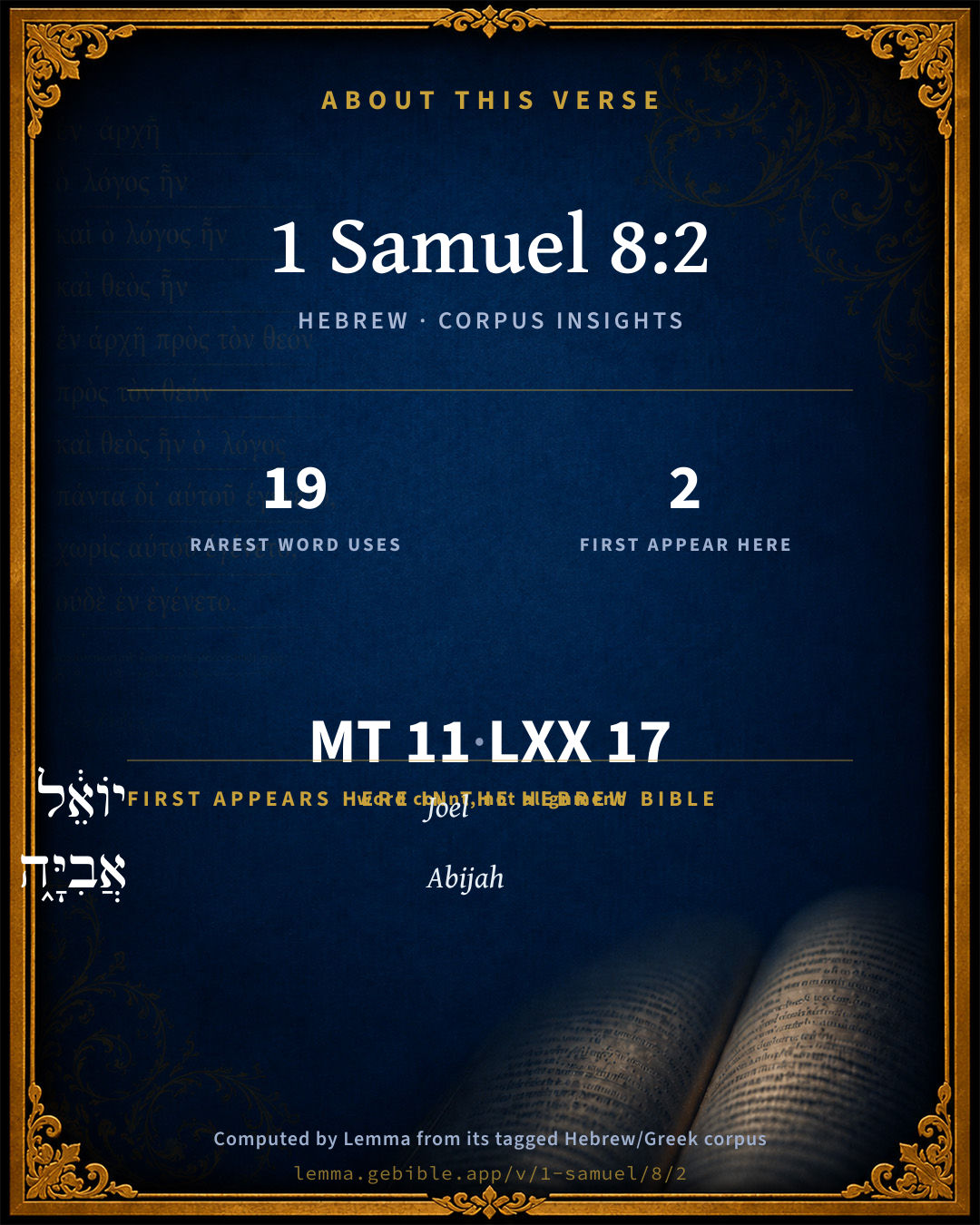
The rarest word here is יוֹאֵ֔ל Joel H3100 — appearing just 19 times in the whole Hebrew Bible.

First appearance in Scripture

These words make their first canonical appearance in the Hebrew Bible here:

  • יוֹאֵ֔ל Joel H3100
  • אֲבִיָּ֑ה Abijah H29

Shared distinctive vocabulary

יוֹאֵ֔ל Joel H3100 occurs in 19 verses of the Hebrew Bible. Also found in:

Grammatical profile

  • 2 verbs
  • 9 nouns

Verb forms

  • וַיְהִ֞י Qal · Sequential Imperfect
  • שֹׁפְטִ֖ים Qal · Participle Active

Repetition

Words recur within this verse — often emphatic in Hebrew:

  • שֶׁם name H8034 ×2
  • בִּבְאֵ֥ר Beer-sheba H884 ×2

Hebrew & Septuagint length

In English translation the verse runs 20 words from the Hebrew and 21 from the Septuagint (LXX English) — closely comparable.

A rough comparison of the two English renderings, which tokenize alike — not a word-level alignment.

Word counts can differ between the Hebrew and the Greek without any difference in meaning — e.g. the Hebrew direct-object marker אֵת has no separate Greek word, and Greek often adds the article ὁ.

In the original languages it is 11 Hebrew tokens and 17 Greek tokens — but the two are counted differently (Hebrew bundles its prefixes and suffixes into one token; the Greek is in lemma form), so that isn’t a like-for-like length.

Cross-references

5

Topical passages linked to 1 Samuel 8:2 in the Treasury of Scripture Knowledge — connected by theme and wording, ordered by reader-vote popularity; previews shown in the World English Bible.

  • Genesis 22:19 So Abraham returned to his young men, and they rose up and went together to Beersheba. Abraham lived at Beersheba.
  • 1 Kings 19:3 When he saw that, he arose, and went for his life, and came to Beersheba, which belongs to Judah, and left his servant there.
  • 1 Chronicles 6:28 The sons of Samuel: the firstborn [Joel], and the second Abijah.
  • 1 Chronicles 6:38 the son of Izhar, the son of Kohath, the son of Levi, the son of Israel.
  • Amos 5:5 But don't seek Bethel, Nor enter into Gilgal, And don't pass to Beersheba: For Gilgal shall surely go into captivity, And Bethel shall come to nothing.

Cross-references courtesy of OpenBible.info (CC BY 4.0).

Hebrew and Greek witnesses Masoretic Hebrew ↔ Greek Septuagint

The same verse in the two great witnesses to the Old Testament, shown verse-for-verse.

These are two independent witnesses, not word-aligned to each other, and the Septuagint is shown in lemma (dictionary) form.

Hebrew 1 Samuel 8:2 Masoretic · Westminster Leningrad Codex

וַיְהִ֞י שֶׁם בְּנ֤וֹ הַבְּכוֹר֙ יוֹאֵ֔ל וְשֵׁ֥ם מִשְׁנֵ֖הוּ אֲבִיָּ֑ה שֹׁפְטִ֖ים בִּבְאֵ֥ר שָֽׁבַע

Now the name of his firstborn was Joel; and the name of his second, Abijah: they were judges in Beersheba.

World English Bible · Public Domain

Greek LXX 1 Samuel 8:2 Septuagint · lemma form

καί οὗτος ὁ ὄνομα ὁ υἱός αὐτός πρωτότοκος ιωηλ καί ὄνομα ὁ δεύτερος αβια δικαστής ἐν βηρσαβεε

And these are the names of his sons; Joel the firstborn, and the name of the second Abia, judges in Bersabee.

LXX2012 (modern English Septuagint) · Public Domain

Hebrew: Westminster Leningrad Codex (CC BY 4.0). Greek: Septuagint (public domain); English from LXX2012 (modern English Septuagint) (Public Domain). How the Septuagint differs from the Hebrew →

Targum (Aramaic paraphrase)

1

The Targum is the ancient Jewish Aramaic paraphrase of the Hebrew Scriptures — an interpretive translation, not the Hebrew text itself. Onkelos (literal) and Pseudo-Jonathan (expansive) render the Torah, and Jonathan the Prophets. Coverage is partial: where no permissively-licensed English translation exists for a verse, only the Aramaic is shown. This is verse-level text, not a word-by-word alignment to the Hebrew.

  1. Targum Jonathan Prophets (Joshua–Malachi)
    וַהֲוָה שׁוּם בְּרֵיהּ בּוּכְרֵיהּ יוֹאֵל וְשׁוּם תִּנְיָנֵיהּ אֲבִיהָ דַיָנִין בִּבְאֵר שָׁבַע:

    (no public-domain English translation for this verse)

    Targum Jonathan — Aramaic: “Mikraot Gedolot” (public domain). English: “Sefaria Community Translation” (CC0 1.0 (public-domain dedication)); “London "Chaldee Paraphrase," 1871” (public domain). Text via Sefaria.

Commentary

Notes on 1 Samuel 8:2 from classic Christian and Jewish commentators (each source and its license shown beneath its notes). The classic Christian expositions comment on the surrounding passage and are grouped to its opening verse, so a note may address several verses; the Jewish commentaries on the Tanakh (Rashi and others) are per-verse, so they appear only where the commentator wrote on this verse.

Lemma curates 59 commentaries, every one of them public domain or Creative Commons licensed, each selected and text-cleaned for this edition rather than reprinted as found. About our sources →

Trapp's Complete Commentary

John Trapp

1Sa 8:2 Now the name of his firstborn was Joel; and the name of his second, Abiah: [they were] judges in Beersheba.

Ver. 2. Now the name of his firstborn was Joel.] Which some {a} will have to be Joel the prophet, the son of Pethuel, that is, of Samuel, say they, {Joe 1:1} as this Joel is called Vashni. {1Ch 6:28; 1Ch 6:33} He might afterwards repent of his government without righteousness, which is but robbery by authority, and be a prophet as was his father. Howsoever, he had a good son - viz., Heman the music master and a prophet. {1Ki 4:31 1Ch 6:33; 1Ch 25:1 Psa 88:1}

They were judges in Beersheba,] i.e., From Dan to Beersheba, saith Junius: the one in Dan, the other in Beersheba, saith Josephus. Pellican thinketh they dwelt both at Beersheba, purposely to vex the people with long journeys for judgment: or at least out of a neglect toward them. Others hold that their father set them there to exercise that authority by him delegated unto them in the southern parts of the land, because they were so far remote from Ramah, and that he knew not of their bribery, &c.

{a} Alsted.

John Trapp, A Commentary or Exposition upon All the Books of the Old and New Testament (1647–1656) — public domain. Text from a community e-Sword module.

Joseph Benson's Commentary

1Sa 8:2. They were judges in Beer-sheba — In the southern borders of the land of Canaan, which were very remote from his house at Ramah; where, and in the neighbouring places, Samuel himself still executed the office of judge.

Joseph Benson's Commentary on the Old and New Testaments (1811–1818) — public domain. Text from a community e-Sword module.

Tyndale Open Study Notes

Tyndale Open Resources

8:2 Samuel’s two oldest sons functioned as judges in Beersheba, fifty miles south of their father’s home.

Tyndale Open Study Notes — © Tyndale Open Resources, licensed CC BY-SA 4.0. Text via the HelloAO Bible API.

Geneva Bible (1599)

Geneva Bible translators

Who was also called Vasheni, 1 Chron. 6:28.

Geneva Bible (1599) marginal notes — public domain. Text via Bolls.life.

The Cambridge Bible for Schools and Colleges

gen. ed. J. J. S. Perowne

2. Now the name, &c.] Joel = “Jehovah is God:” Abiah = “Jah is my father:” names significant of a protest against the prevalent idolatry. The text of 1Ch_6:28, where the names are given as “the firstborn Vashni and Abiah,” is corrupt. “Joel” has dropped out after “the firstborn,” and “Vashni” is an obvious corruption of the Heb. word meaning “and the second.”

judges in Beer-sheba] See note on ch. 1Sa_3:20. Beer-sheba was the most convenient centre for the southern district, which Samuel assigned to his sons, retaining the northern himself. Josephus says that “resigning his office to his sons he divided the people between them, and placed them in Bethel and Beer-sheba,” a statement which is probably his own conjecture, and does not agree with ch. 1Sa_7:15.

The Cambridge Bible for Schools and Colleges (gen. ed. J. J. S. Perowne; Cambridge University Press, 1878–1918) — public domain. Text from a community e-Sword module.

John Gill's Exposition

Now the name of his firstborn was Joel,.... In Ch1 6:28 he is called Vashni; See Gill on Ch1 6:28. This was not Joel the prophet, as some have thought, neither his parentage, nor his office, nor his times, will agree with this:

and the name of his second Abiah: which two sons seem to be all he had:

they were judges in Beersheba; in the utmost border of the land, to the south, as Ramah, where Samuel dwelt and judged, was more to the north; where they were placed by their father, for the greater convenience of the people of Israel that lived southward, to bring their causes to them, as those lived more northward might bring them to him: according to Josephus (w), they were placed by their father, the one in Bethel, one of the places Samuel used to go to in his circuit and judge, and the other at Beersheba. But some, as Junius and others, think it should be rendered, "unto Beersheba"; and so takes in its opposite, Dan, which lay at the utmost border of the land northward; hence the phrase, "from Dan to Beersheba"; and that the one was settled at Dan for the sake of the northern part of the land, and the other at Beersheba, for the sake of the southern: or rather these sons of Samuel placed themselves at Beersheba; which was an ill judged thing, to be both in one place, and which must give the people of Israel a great deal of trouble, and put them to a large expense to come from all quarters thither, to have their causes tried; but that is not the worst.

(w) Ut supra, (Antiqu. l. 6. c. 3.) sect. 2.

John Gill's Exposition of the Whole Bible (1746–1763) — public domain (CC PDM 1.0). Text via the HelloAO Bible API.

Albert Barnes' Notes on the Bible

The mention of Beer-sheba, on the extreme southern frontier of Judah, as the place where Samuel’s sons judged Israel is remarkable. It was probably due to the recovery of territory from the usurpation of the Philistines 1Sa 7:14.

Albert Barnes' Notes on the Bible (1834–1885) — public domain. Text from a community e-Sword/MySword module.

Haydock's Catholic Bible Commentary

In, or "as far as" Bersabee, from Dan, that is, throughout Palestine. (Calmet)

George Leo Haydock (1774–1849), Haydock's Catholic Family Bible and Commentary, 1859 edition — public domain. Excludes Psalms (Douay-Rheims chapter numbering differs from Protestant) and Deuterocanonical books (Catholic canon only).

Matthew Poole's English Annotations

In the southern border of the land of Canaan, where he placed his sons, because these parts were very remote from his house at Ramah; where, and in the neighbouring places, Samuel himself still executed the office of the judge; sending his sons to reside and judge in distant places, for the ease and convenience of the people.

Matthew Poole's English Annotations on the Holy Bible (1683–1685) — public domain. Text from a community e-Sword/MySword module.

Whedon's Commentary on the Bible

Daniel D. Whedon

2. In Beer-sheba — Their chief seat was there, as Samuel’s was at Ramah. Probably the recovery under Samuel of many cities from the Philistines (1Sa_7:14) made it expedient to have some kind of magistrates appointed in the southern part of the country.

Daniel D. Whedon (gen. ed.), Commentary on the Old and New Testaments (1874–1909) — public domain. Text from a community e-Sword module.

The Pulpit Commentary

The name of his firstborn was Joel. The names of Samuel"s sons are pledges of his faith Joel meaning Jehovah is God, and Abiah Jab is Father. The name given in 1Ch_6:28, Vashni, is a mistake. It means, "and the second," the name of Joel the firstborn having somehow been omitted. The names of Saul"s sons, and even of Jonathan"s, unlike those in Samuel"s family, bear witness to their religion having been of a curiously mixed character. In Beer-sheba. Not, therefore, in any of the places to which Samuel went in person, and which were all near Ramah, his home. Beer-sheba was in the extreme south of the tribe of Judah, (see on Gen_21:31) on the Philistine border, and his being able to place his sons there in authority proves, not merely that his rule was acknowledged throughout the whole country, but also that the Philistines did not interfere much with the internal arrangements of the Israelites.

Josephus ("Antiq.," 6:3, 2) represents only one son as placed at Beer-sheba, and says that the other was judge at Dan, but it may be doubted whether the northern tribes were sufficiently under control to submit to be governed by a southern judge.

The Pulpit Commentary (1880–1919), ed. H.D.M. Spence-Jones & Joseph S. Exell — public domain. Text from a community e-Sword module.

John Wesley's Explanatory Notes

Beer-sheba - In the southern border of the land of Canaan, which were very remote from his house at Ramah; where, and in the neighbouring places Samuel himself still executing the office of judge.

John Wesley, Explanatory Notes Upon the Whole Bible (1754–1765) — public domain. Text via the GEBible commentary corpus.

Lesson kit

Teaching starters — assembled from the data on this page, not authored interpretation. Every prompt links to the verse data it draws on. Edit before teaching.

1 Samuel, in the Historical, opens this verse with 11 words (9 distinct Hebrew lemmas). Its most distinctive word is Yôwʼêl (“Joel”). A historical commentator’s framing appears above. Read the whole chapter for the surrounding context.

Discussion questions

  1. What does “Joel” (Yôwʼêl) contribute to the verse as a whole?
  2. 2 words here appear for the first time in Scripture. What is being introduced at this debut?
  3. 1 Chronicles 4:35 shares the word «Joel» with this verse. How do the two illuminate each other?
  4. “name” occurs 2× in this one verse. What is the effect of the repetition?
  5. These translations render this verse differently. What is at stake in choosing one wording over another?
  6. The verb «וַיְהִ֞י» is Qal Sequential Imperfect. How does its form color the action?
  7. Reading how Trapp's Complete Commentary and Joseph Benson's Commentary read this verse, where do the two commentators agree and where do they part?

Things to notice

Reading settings

Reading text

Shown beneath each verse's original-language words.

Old Testament
Old Testament edition

Read the OT as the Masoretic Hebrew (MT) or the Greek Septuagint (LXX).

English shown for the Greek Septuagint (in the Hebrew ↔ Greek comparison).

Comparing translations? Open the Compare panel on any verse page to stack up to four side by side.