
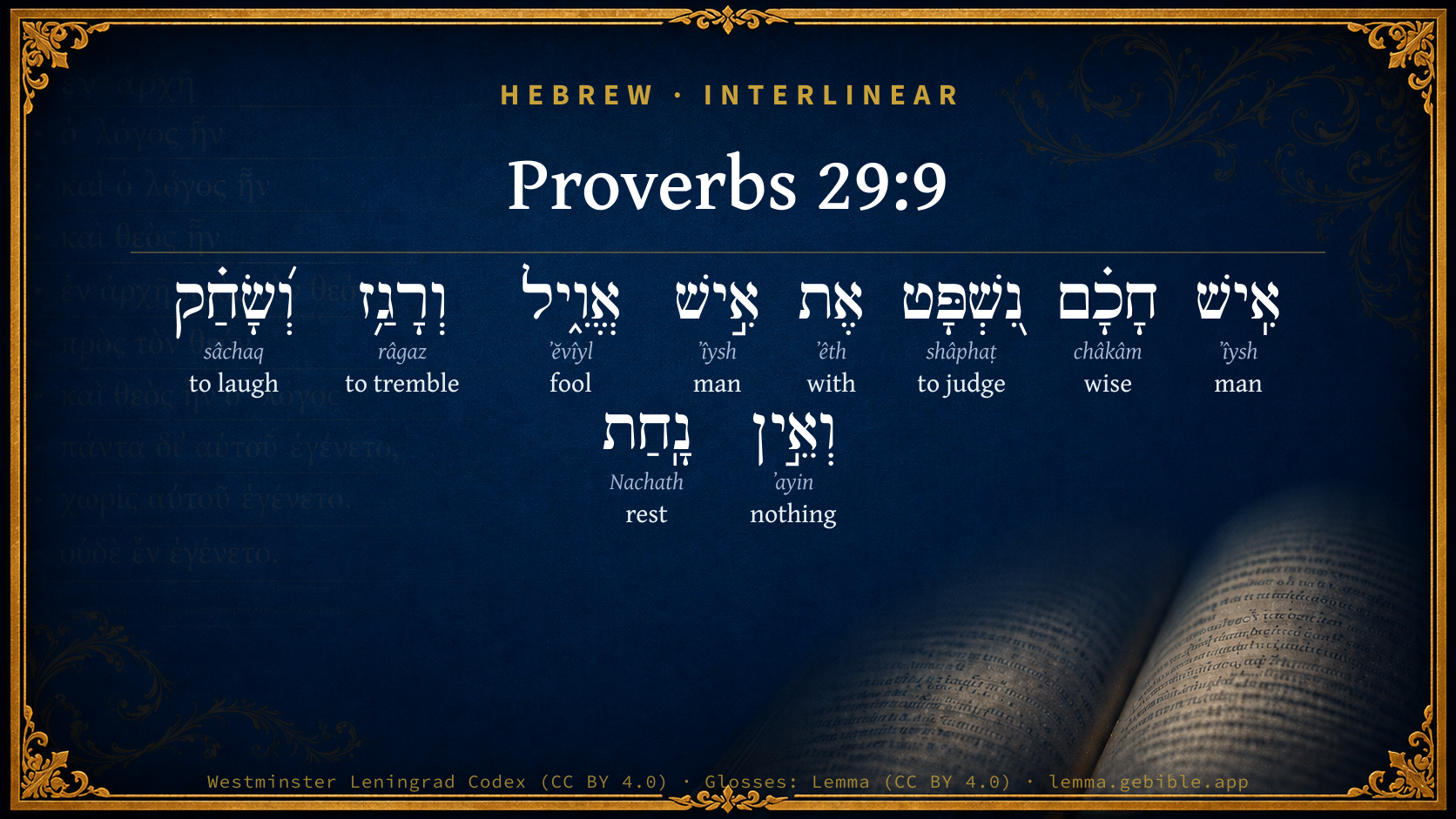
Proverbs 29:9

Hebrew (Westminster Leningrad Codex) Proverbs 29:9 appears in the Hebrew Old Testament. The text above is from the Westminster Leningrad Codex. Each word links to its Strong’s number, a concise gloss, and parsing drawn from the Open Scriptures Hebrew Bible morphology. Click any word for its full Brown-Driver-Briggs (BDB) entry.
Download image
Cite this verse

Proverbs 29:9 (World English Bible). Public Domain. Lemma interlinear Bible study tool, https://lemma.gebible.app/v/proverbs/29/9.

Show BibTeX & RIS
BibTeX
RIS
English Translation
If a wise man goes to court with a foolish man, The fool rages or scoffs, and there is no peace.
World English Bible · Public Domain
Download a study sheet

One document with this verse’s original text, its word-by-word gloss line, the meaning frame, cross-references with their text, attributed commentary, and full source and license credits — printable, and it pastes into notes with its structure intact.

This verse Autodidact and up

Study sheet (.html) Plain text (.txt)

A passage Seminary Student

Up to 50 verses in one chapter. A passage sheet keeps up to 6 commentary sources and 12 cross-references per verse, in the order this page ranks them, and says so on the sheet whenever that leaves anything out. Ask for a single verse and you get the Autodidact verse sheet above.

Everything on this page stays free to read, with no account — the sheet is a download of what is already on screen, not access to it.

Want to remove ads? Support Godless Engineer
Compare translations 3

The same verse in 3 English versions, stacked beneath the original-language interlinear above. Click any original word for its lexicon entry.

Each is an independent rendering of the whole verse — the interlinear is not word-aligned to these translations.

Highlighted words mark where these versions differ — a whole-verse word diff, not a word-by-word alignment.

  • World English Bible Public Domain
    If a wise man goes to court with a foolish man, The fool rages or scoffs, and there is no peace.
  • King James Version Public Domain
    If a wise man contendeth with a foolish man, whether he rage or laugh, there is no rest.
  • unfoldingWord Literal Text CC BY-SA 4.0
    A wise man goes to judgment with a foolish man, but he rages and he laughs, and there is no rest.

unfoldingWord Literal Text — © unfoldingWord, licensed CC BY-SA 4.0. Word-aligned USFM3 via Door43 (git.door43.org/unfoldingWord/en_ult).

Versions to compare (up to 4)

3 of 4 selected

Show all 18 translations

Every available English version of this verse, each an independent rendering of the whole verse.

  • World English Bible Public Domain
    If a wise man goes to court with a foolish man, The fool rages or scoffs, and there is no peace.
  • Berean Standard Bible Public Domain
    If a wise man goes to court with a fool, there will be raving and laughing with no resolution.
  • Majority Standard Bible Public Domain
    If a wise man goes to court with a fool, there will be raving and laughing with no resolution.
  • King James Version Public Domain
    If a wise man contendeth with a foolish man, whether he rage or laugh, there is no rest.
  • American Standard Version (1901) Public Domain
    If a wise man hath a controversy with a foolish man, Whether he be angry or laugh, there will be no rest.
  • Revised Version (1885) Public Domain
    If a wise man hath a controversy with a foolish man, whether he be angry or laugh, there will be no rest.
  • Geneva Bible (1599) Public Domain
    If a wise man contend with a foolish man, whether he be angry or laugh, there is no rest.
  • Douay-Rheims (1899) Public Domain
    If a wise man contend with a fool, whether he be angry or laugh, he shall find no rest.
  • Young's Literal Translation Public Domain
    A wise man is judged by the foolish man, And he hath been angry, And he hath laughed, and there is no rest.
  • Literal Standard Version CC BY-SA 4.0
    A wise man is judged by the foolish man, || And he has been angry, || And he has laughed, and there is no rest.
  • Unlocked Literal Bible CC BY-SA 4.0
    When a wise person has an argument with a fool, he rages and laughs, and there will be no rest.
  • unfoldingWord Literal Text CC BY-SA 4.0
    A wise man goes to judgment with a foolish man, but he rages and he laughs, and there is no rest.
  • Darby Bible Public Domain
    If a wise man contendeth with a fool, whether he rage or laugh, [he] hath no rest.
  • World Messianic Bible Public Domain
    If a wise man goes to court with a foolish man, the fool rages or scoffs, and there is no peace.
  • Webster's Bible Public Domain
    If a wise man contendeth with a foolish man, whether he rageth or laugheth, there is no rest.
  • Free Bible Version CC BY-SA 4.0
    When a wise man takes a stupid man to court, there's raging and ridicule, but nothing is settled.
  • Bible in Basic English Public Domain
    If a wise man goes to law with a foolish man, he may be angry or laughing, but there will be no rest.
  • JPS Tanakh (1917) Public Domain
    If a wise man contendeth with a foolish man, whether he be angry or laugh, there will be no rest.

Literal Standard Version (2020), Covenant Press — licensed CC BY-SA 4.0. Text via the HelloAO Bible API (eBible.org). Unlocked Literal Bible (unfoldingWord) — licensed CC BY-SA 4.0. Text via the HelloAO Bible API (eBible.org). unfoldingWord Literal Text — © unfoldingWord, licensed CC BY-SA 4.0. Word-aligned USFM3 via Door43 (git.door43.org/unfoldingWord/en_ult). Free Bible Version, Dr. Jonathan Gallagher — licensed CC BY-SA 4.0. Text via the HelloAO Bible API (eBible.org).

Word by word

More ways to search: Search by grammar → Find every occurrence → Compare this word →

Practice this passage: Drill this verse → Learn its vocabulary →

About this verse

These counts appear in no published source. They are computed here, from the morphology-tagged text and Lemma’s own curated glosses. What Lemma adds →

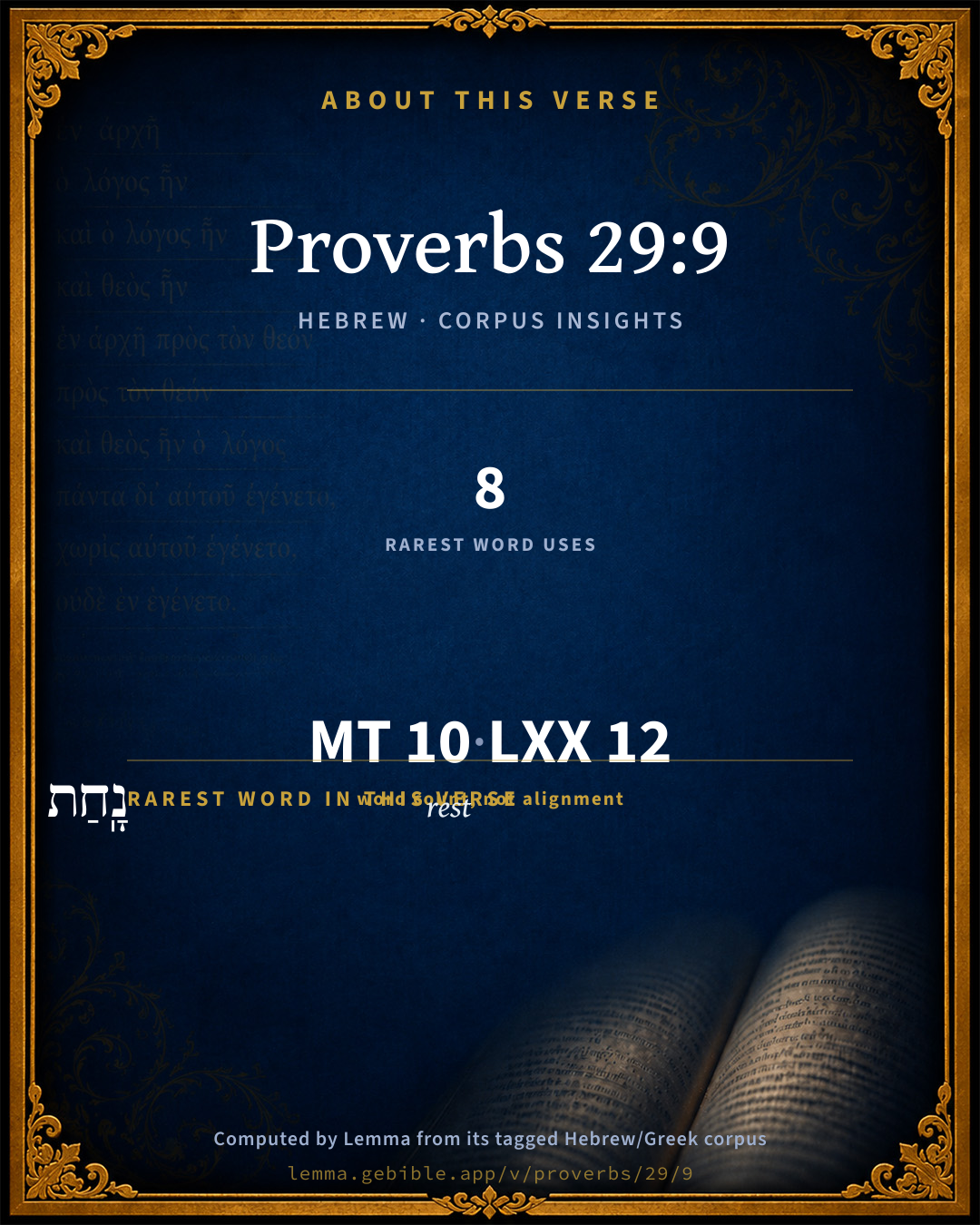
10
words
9
distinct lemmas
Wisdom
section

Notable vocabulary

The rarest word here is נָֽחַת rest H5183 — appearing just 8 times in the whole Hebrew Bible.

Shared distinctive vocabulary

נָֽחַת rest H5183 occurs in 8 verses of the Hebrew Bible. Also found in:

Grammatical profile

  • 3 verbs
  • 3 nouns
  • 2 adjectives
  • 1 preposition
  • 1 particle

Verb forms

  • נִ֭שְׁפָּט Niphal · Participle Active
  • וְרָגַ֥ז Qal · Sequential Perfect
  • וְ֝שָׂחַ֗ק Qal · Sequential Perfect

Repetition

A word recurs within this verse — often emphatic in Hebrew:

  • אִֽישׁ man H376 ×2

Hebrew & Septuagint length

In English translation the verse runs 21 words from the Hebrew and 16 from the Septuagint (LXX English) — closely comparable.

A rough comparison of the two English renderings, which tokenize alike — not a word-level alignment.

Word counts can differ between the Hebrew and the Greek without any difference in meaning — e.g. the Hebrew direct-object marker אֵת has no separate Greek word, and Greek often adds the article ὁ.

In the original languages it is 10 Hebrew tokens and 12 Greek tokens — but the two are counted differently (Hebrew bundles its prefixes and suffixes into one token; the Greek is in lemma form), so that isn’t a like-for-like length.

Cross-references

4

Topical passages linked to Proverbs 29:9 in the Treasury of Scripture Knowledge — connected by theme and wording, ordered by reader-vote popularity; previews shown in the World English Bible.

  • Proverbs 26:4 Don't answer a fool according to his folly, Lest you also be like him.
  • Ecclesiastes 10:13 The beginning of the words of his mouth is foolishness; and the end of his talk is mischievous madness.
  • Matthew 7:6 "Don't give that which is holy to the dogs, neither throw your pearls before the pigs, lest perhaps they trample them under their feet, and turn and tear you to pieces.
  • Matthew 11:17–19 and say, 'We played the flute for you, and you didn't dance. We mourned for you, and you didn't lament.'

Cross-references courtesy of OpenBible.info (CC BY 4.0).

Hebrew and Greek witnesses Masoretic Hebrew ↔ Greek Septuagint

The same verse in the two great witnesses to the Old Testament, shown verse-for-verse.

These are two independent witnesses, not word-aligned to each other, and the Septuagint is shown in lemma (dictionary) form.

Hebrew Proverbs 29:9 Masoretic · Westminster Leningrad Codex

אִֽישׁ חָכָ֗ם נִ֭שְׁפָּט אֶת אִ֣ישׁ אֱוִ֑יל וְרָגַ֥ז וְ֝שָׂחַ֗ק וְאֵ֣ין נָֽחַת

If a wise man goes to court with a foolish man, The fool rages or scoffs, and there is no peace.

World English Bible · Public Domain

Greek LXX Proverbs 29:9 Septuagint · lemma form

ἀνήρ σοφός κρίνω ἔθνος ἀνήρ δέ φαῦλος ὀργίζω καταγελάω καί οὐ καταπτήσσω

A wise man shall judge nations: but a worthless man being angry laughs and fears not.

LXX2012 (modern English Septuagint) · Public Domain

On this verse, Haydock's Catholic Bible Commentary discusses the Septuagint’s reading. Read the note in Commentary ↓

Hebrew: Westminster Leningrad Codex (CC BY 4.0). Greek: Septuagint (public domain); English from LXX2012 (modern English Septuagint) (Public Domain). How the Septuagint differs from the Hebrew →

Commentary

Notes on Proverbs 29:9 from classic Christian and Jewish commentators (each source and its license shown beneath its notes). The classic Christian expositions comment on the surrounding passage and are grouped to its opening verse, so a note may address several verses; the Jewish commentaries on the Tanakh (Rashi and others) are per-verse, so they appear only where the commentator wrote on this verse.

Lemma curates 59 commentaries, every one of them public domain or Creative Commons licensed, each selected and text-cleaned for this edition rather than reprinted as found. About our sources →

Trapp's Complete Commentary

John Trapp

Pro 29:9 [If] a wise man contendeth with a foolish man, whether he rage or laugh, [there is] no rest.

Ver. 9. If a wise man contendeth with a foolish man.] Such fools were the Pharisees, though for their worldly wisdom called princes of this world. {1Co 2:8} Christ piped to them, John mourned to them, neither wrought upon them. {Mat 11:16-17} Such was their peevishness and pertinace in evil, that they "rejected the counsel of God against themselves," {Luk 7:30} being ingrati gratiae Dei, as Ambrose hath it; receiving the grace of God in vain, as Paul; turning good nourishment into vicious humours, as foul stomachs use to do. And as wine, a strong remedy against hemlock, yet mingled with it, doubles the force of the poison; so was it with the most powerful means of grace, mingled with their obstinace and unbelief. Tigers are enraged with perfumes, and vultures killed with oil of roses, as Aristotle writes.

John Trapp, A Commentary or Exposition upon All the Books of the Old and New Testament (1647–1656) — public domain. Text from a community e-Sword module.

Joseph Benson's Commentary

Pro 29:9. If a wise man contendeth with a foolish man — Debating any matter with him, or endeavouring to convince him of any error; whether he — The wise man, rage (is angry) or laugh — That is, whether he deal sharply and severely with him: rebuking him for his folly, or mildly and pleasantly, smiling at it; there is no rest — No end or fruit of the debate; the fool will not be satisfied nor convinced. Thus Bishop Patrick: “Let a man be never so wise, it is to no purpose for him to dispute, or to enter into any contest with an obstinate fool; for which way soever he deal with him, whether roughly or gently, whether angrily or pleasantly, there will be no end of the controversy; but the fool will still have the last word; nay, it is well if he do not either restlessly rage, or laugh one to scorn.” Houbigant takes this verse in a somewhat different sense, reading, A wise man contending in judgment with a foolish man, whether he is provoked or derided, remains unmoved; a translation which the Hebrew will very well bear.

Joseph Benson's Commentary on the Old and New Testaments (1811–1818) — public domain. Text from a community e-Sword module.

Geneva Bible (1599)

Geneva Bible translators

He can hear no admonition in what sort soever it is spoken.

Geneva Bible (1599) marginal notes — public domain. Text via Bolls.life.

Matthew Henry's Commentary

A wise man is here advised not to set his wit to a fool's, not to dispute with him, or by contending with him to think either of fastening reason upon him or gaining right from him: If a wise man contend with a wise man, he may hope to be understood, and, as far as he has reason and equity on his side, to carry his point, at least to bring the controversy to a head and make it issue amicably; but, if he contend with a foolish man, there is no rest; he will see no end of it, nor will he have any satisfaction in it, but must expect to be always uneasy. 1. Whether the foolish man he contends with rage or laugh, whether he take angrily or scornfully what is said to him, whether he rail at it or mock at it, one of the two he will do, and so there will be no rest. However it is given, it will be ill-taken, and the wisest man must expect to be either scolded or ridiculed if he contend with a fool. He that fights with a dunghill, whether he be conqueror or conquered, is sure to be defiled. 2. Whether the wise man himself rage or laugh, whether he take the serious or the jocular way of dealing with the fool, whether he be severe or pleasant with him, whether he come with a rod or with the spirit of meekness (Co1 4:21), it is all alike, no good is done. We have piped unto you, and you have not danced, mourned unto you, and you have not lamented.

Matthew Henry's Commentary on the Whole Bible (1708–1710) — public domain (CC PDM 1.0). Text via the HelloAO Bible API.

Jamieson, Fausset & Brown

Robert Jamieson, A. R. Fausset & David Brown

contendeth--that is, in law.

whether . . . laugh--The fool, whether angry or good-humored, is unsettled; or referring the words to the wise man, the sense is, that all his efforts, severe or gentle, are unavailing to pacify the fool.

Jamieson, Fausset & Brown — Commentary Critical and Explanatory on the Whole Bible (1871) — public domain (CC PDM 1.0). Text via the HelloAO Bible API.

Adam Clarke's Commentary

Verse 9. Whether he rage or laugh] Coverdale translates, "Yf a wyse man go to lawe with a foole, whether he deale with him frendly or roughly he geteth no rest."

Adam Clarke's Commentary on the Bible (1810–1826) — public domain. Text from a community e-Sword/MySword module.

Ellicott's Commentary for English Readers

(9) Whether he rage or laugh—i.e., whether the wise man treat him with sternness or good temper, yet “there is no rest,” the fool will not cease from his folly; or, the sense may be, “the fool rages and laughs;” he will not listen quietly to argument, by which he might be brought to wisdom, but is either violent or supercilious.

A Bible Commentary for English Readers, edited by Charles John Ellicott (1878–1897) — public domain. Text from a community e-Sword module.

The Cambridge Bible for Schools and Colleges

gen. ed. J. J. S. Perowne

9. whether he rage &c.] This makes the fool the subject, as is more clearly brought out in R.V. marg., He rageth and laugheth and there is no rest. In R.V. text, however, the wise man is made the subject, whether he be angry or laugh, whether he seeks to bring the controversy to an end by severity or by banter, he will fail. There is no coming to terms with a fool, either by threats or by persuasion.

The Cambridge Bible for Schools and Colleges (gen. ed. J. J. S. Perowne; Cambridge University Press, 1878–1918) — public domain. Text from a community e-Sword module.

John Gill's Exposition

If a wise man contendeth with a foolish man,.... Enters into a controversy with him, either by word or writing, in order to convince him of his folly and wickedness, of his errors and mistakes;

whether he rage or laugh, there is no rest; that is, either whether the fool is angry with the wise man, and rages at him and abuses him, and calls him names, or laughs at him, and scoffs at all his arguments, reasons, and advice; yet the wise man does not cease from proceeding in the contest with him; or he is not dejected and cast down, and discouraged; or, as the Targum is,

"he is not broken;''

but patiently bears his wrath fury, his scoffs and jeers: or else whether the wise man deals roughly or gently with the feel, in a morose or in a mere jocose way: it has no upon him; he is never the better for it; he does not acquiesce or rest in what he says like the Pharisees in Christ's time, who are compared to surly children: who, when "piped to, danced not"; and, when "mourned to, lamented not"; see Gill on Mat 11:16, and See Gill on Mat 11:17. The design of the proverb is to show, that all labour to reclaim a fool from his folly is lost, let a man take what methods he will, Pro 27:22.

John Gill's Exposition of the Whole Bible (1746–1763) — public domain (CC PDM 1.0). Text via the HelloAO Bible API.

Albert Barnes' Notes on the Bible

All modes of teaching - the stern rebuke or the smiling speech - are alike useless with the “foolish” man; there is “no rest.” The ceaseless cavilling goes on still.

Albert Barnes' Notes on the Bible (1834–1885) — public domain. Text from a community e-Sword/MySword module.

Haydock's Catholic Bible Commentary

Rest; or bring him to hear reason. (Calmet) --- Septuagint, "a wise man shall rule nations; but the wicked being angry, is laughed at, and does not frighten."

George Leo Haydock (1774–1849), Haydock's Catholic Family Bible and Commentary, 1859 edition — public domain. Excludes Psalms (Douay-Rheims chapter numbering differs from Protestant) and Deuterocanonical books (Catholic canon only).

Matthew Poole's English Annotations

If a wise man contendeth with a foolish man; either judicially or otherwise debating any matter with him, endeavouring to convince him of any error;

whether he, the wise man, rageth (or is angry) or laugheth, i.e. whether he deal sharply and severely with him, rebuking him for his folly, or mildly and pleasantly smiling at it,

there is no rest, no end or fruit of the debate, the fool will not be satisfied nor convinced. Or, as it is in the Hebrew, he (to wit, the fool last named, to whom the following carriages may seem more fitly to agree) both rageth and laugheth, (he will not yield nor be convinced, but persists in his folly, which he discovers sometimes by his furious and unbridled passions, and sometimes by foolish laughter and scorning,) and there

is no rest; he will never be quieted.

Matthew Poole's English Annotations on the Holy Bible (1683–1685) — public domain. Text from a community e-Sword/MySword module.

Whedon's Commentary on the Bible

Daniel D. Whedon

9. Contendeth — נשׁפשׂ, (nishpat,) litigates; goes to law before a judge.

Whether he rage or laugh — It is uncertain whether this is predicated of the wise man or the fool. Some suppose one, some the other, and many are in doubt. It probably refers to the fool, and imports that whether he is cast in the suit, in which case he rages and is abusive, or whether he is the gainer, in which case he laughs, jeers, taunts, and boasts, there is no rest, no ceasing, no real settlement of the matter. He will harp on it continually, either in anger or in triumph. Compare Pro_29:11; Pro_12:16.

Daniel D. Whedon (gen. ed.), Commentary on the Old and New Testaments (1874–1909) — public domain. Text from a community e-Sword module.

The Pulpit Commentary

If a wise man contendeth with a foolish man if a wise man has a controversy, either legal or social, with a wicked foolwhether he rage (is angry) or laugh, there is no rest. It is a question whether the wise man or the fool is the subject of this clause. St. Jerome makes the former the subject, Vir sapiens, si cum stulto contenderit, sive irascatur, sive rideat, non inveniet requiem. It matters not how the wise man treats the fool; he may be stern and angry, he may be gentle and good tempered, yet the fool will be none the better, will not be reformed, will not cease from his folly, will carry on his cavilling contention. Hitzig, Delitzsch, and others, deeming that the rage and the laughter are not becoming to the character of the wise man, take the fool as the subject; so that the sense is, that after all has been said, the fool only falls into a passion or laughs at the matter, argument is wasted upon him, and the controversy is never settled. This seems to be the best interpretation, and is somewhat supported by the Septuagint, "A wise man shall judge the nations, but a worthless man, being angry, laughs and fears not katagelatai kai ou katapthssei , which may also mean, "is derided and terrifies no one." Wordsworth notes that the irreligious fool is won neither by the austere preaching of John the Baptist nor by the mild teaching of Christ, but rejects both. (Mat_11:16-19)

The Pulpit Commentary (1880–1919), ed. H.D.M. Spence-Jones & Joseph S. Exell — public domain. Text from a community e-Sword module.

John Wesley's Explanatory Notes

Whether - Whether he, the wise man, deal sharply with him, or mildly, there is no rest, no end or fruit of the debate.

John Wesley, Explanatory Notes Upon the Whole Bible (1754–1765) — public domain. Text via the GEBible commentary corpus.

Keil & Delitzsch

C. F. Keil & F. Delitzsch

9 If a wise man has to contend with a fool,

He the fool rageth and laugheth, and hath no rest.

Among the old translators, Jerome and Luther take the "wise man" as subject even of the second line, and that in all its three members: vir sapiens si cum stulto contenderit, sive irascatur sive reideat, non inveniet requiem. Thus Schultens, C. B. Michaelis, Umbreit, Ewald, Elster, and also Fleischer: "The doubled Vav is correlative, as at Exo 21:16; Lev 5:3, and expresses the perfect sameness in respect of the effect, here of the want of effect. If the wise man, when he disputes with a fool, becomes angry, or jests, he will have no rest, i.e., he will never bring it to pass that the fool shall cease to reply; he yields the right to him, and thus makes it possible for him to end the strife." But the angry passion, and the bursts of laughter alternating therewith, are not appropriate to the wise man affirming his right; and since, after Ecc 9:17, the words of the wise are heard בּנחח, the ואין נחת [and there is no rest] will cause us to think of the fool as the logical subject. So far correctly, but in other respects inappropriately, the lxx ἀνὴρ σοφὸς κρινεῖ ἔθνη (after the expression עם, i.e., עם, instead of את), ἀνὴρ δὲ φαῦλος (which אישׁ אויל does not mean) ὀργιζόμενος καταγελᾶται καὶ οὐ καταπτήσσει (as if the words were ולא יחת).

(Note: According to this the Targum ולא מתתּבר (he remains obstinate), according to which the ולא מתתפיר (he does not lose his wits) of the Peshito is perhaps to be corrected. The distribution of the subjects is obscure.)

The syntactical relation would be simpler if נשׁפּט in 9a were vocalized as a hypothetical perfect. But we read for it the past נשׁפּט. Ewald designates 9a as a conditional clause, and Hitzig remarks that the Lat. viro sapiente disceptante cum stulto corresponds therewith. It marks, like Sa1 2:13; Job 1:16, the situation from which there is a departure then with perf. consec.: if a wise man in the right is in contact with a fool, he starts up, and laughs, and keeps not quiet (supply לּו as at Pro 28:27), or (without לו): there is no keeping quiet, there is no rest. The figure is in accordance with experience. If a wise man has any controversy with a fool, which is to be decided by reasonable and moral arguments, then he becomes boisterous and laughs, and shows himself incapable of quietly listening to his opponent, and of appreciating his arguments.

Keil & Delitzsch — Biblical Commentary on the Old Testament (1861–1891) — public domain (CC PDM 1.0). Text via the HelloAO Bible API. (Old Testament only.)

Bridges on Proverbs

Charles Bridges

It would generally be far better not to meddle with such a fool as is here described. We can only deal with him on very disadvantageous terms, and with little prospect of good.†1 If a wise man contend with the wise, he can make himself understood, and there is some hope of bringing the debate to a good issue. But to contend with a fool, there is no rest, no peace or quiet. It will go on without end. He will neither listen to reason, nor yield to argument. So intractable is he, that he will either rage or laugh; either vent upon us the fury of an ungoverned temper, or laugh us to scorn. This contention was a point of poignant trial to our Divine Master. What could be more revolting than sometimes their murderous rage,†2 sometimes their scornful laugh,†3 both "rejecting his counsel against themselves"? (Mat 11:16-17 .) And what if a contention with such fools should be appointed for me? Let me remember my days of perversity and folly. And while this vivid impression brings me back to their level; can I return their unreasonable provocation, save with tenderness and compassion? (Tit 3:2-3 .) Yea — when, as the most effectual means for their benefit, I would commend them to the Almighty and Sovereign grace of God; can I forget, that if this grace has healed my deep-rooted stubbornness, it is not less rich, not less free, not less sufficient, for them?

Footnotes:

†1 Pro 17:12; Pro 26:4 . Ecc 10:13 . Mat 7:6 .

†2 Luk 4:29. Joh 7:1 ; Joh 8:59 ; Joh 11:53 .

†3 Luk 16:14.

Charles Bridges, An Exposition of the Book of Proverbs (1846) — public domain. Text from a community e-Sword module.

unfoldingWord translationNotes

Door43 World Missions Community

has an argument with

Another possible meaning is "goes to court against."

he rages and laughs

The fool becomes very angry and tries to keep the wise person from speaking or the court judge from judging.

rages

This means to be loud and excited and to move with powerful movements like a strong storm. This is a negative word.

there will be no rest

"they will not be able to settle the problem"

seek the life of

This idiom means to "want to kill." (See: Idiom)

translationWords

wise

fool

rest

blameless

life

righteous

unfoldingWord translationNotes — © Distant Shores Media and the Door43 World Missions Community, licensed CC BY-SA 4.0. Source: git.door43.org/Door43/en_tn.

Rashi

Rabbi Shlomo Yitzchaki (Rashi)

a wise man contends Heb. נשפט, debates with the fool.

he will have no contentment Whether he shows him an angry countenance or he shows him a laughing countenance, there is no contentment either in this or in that. He finds no satisfaction. We find in the case of Amaziah that the Holy One, blessed be He, showed him a laughing countenance and delivered Edom into his hands, and when he returned from defeating them, (11 Chron 25:14) “he brought their (sic) gods, etc. and prostrated himself before them.” To Ahaz, the Holy One, blessed be He, showed an angry countenance and delivered him into the hands of the kings of Aram (ibid. 28:23): “And he sacrificed to the gods of Damascus, etc. for he said, ‘The gods of Aram are helping them.’”

Rashi on the Tanakh — English translations: “The Judaica Press complete Tanach with Rashi, translated by A. J. Rosenberg” (CC BY 4.0); “Pentateuch with Rashi's commentary by M. Rosenbaum and A.M. Silbermann, 1929-1934” (public domain); “The Metsudah Tanach series, Lakewood, N.J” (CC BY 4.0); and “The Book of Joshua, Metsudah Publications, 1997” (CC BY 4.0). Text via Sefaria.

Lesson kit

Teaching starters — assembled from the data on this page, not authored interpretation. Every prompt links to the verse data it draws on. Edit before teaching.

Proverbs, in the Wisdom, opens this verse with 10 words (9 distinct Hebrew lemmas). Its most distinctive word is Nachath (“rest”). A historical commentator’s framing appears above. Read the whole chapter for the surrounding context.

Discussion questions

  1. The word Nachath carries the sense “rest.” How does it shape the verse?
  2. How does Job 17:16, which shares the word «rest», read alongside this verse?
  3. What does the repetition of “man” (2× in this one verse) do in this verse?
  4. These translations render this verse differently. What is at stake in choosing one wording over another?
  5. «נִ֭שְׁפָּט» is a Niphal Participle Active verb. How does that grammatical form shape the action described?
  6. Compare how Trapp's Complete Commentary and Joseph Benson's Commentary read this verse. Where do they agree or differ?

Things to notice

Reading settings

Reading text

Shown beneath each verse's original-language words.

Old Testament
Old Testament edition

Read the OT as the Masoretic Hebrew (MT) or the Greek Septuagint (LXX).

English shown for the Greek Septuagint (in the Hebrew ↔ Greek comparison).

Comparing translations? Open the Compare panel on any verse page to stack up to four side by side.