
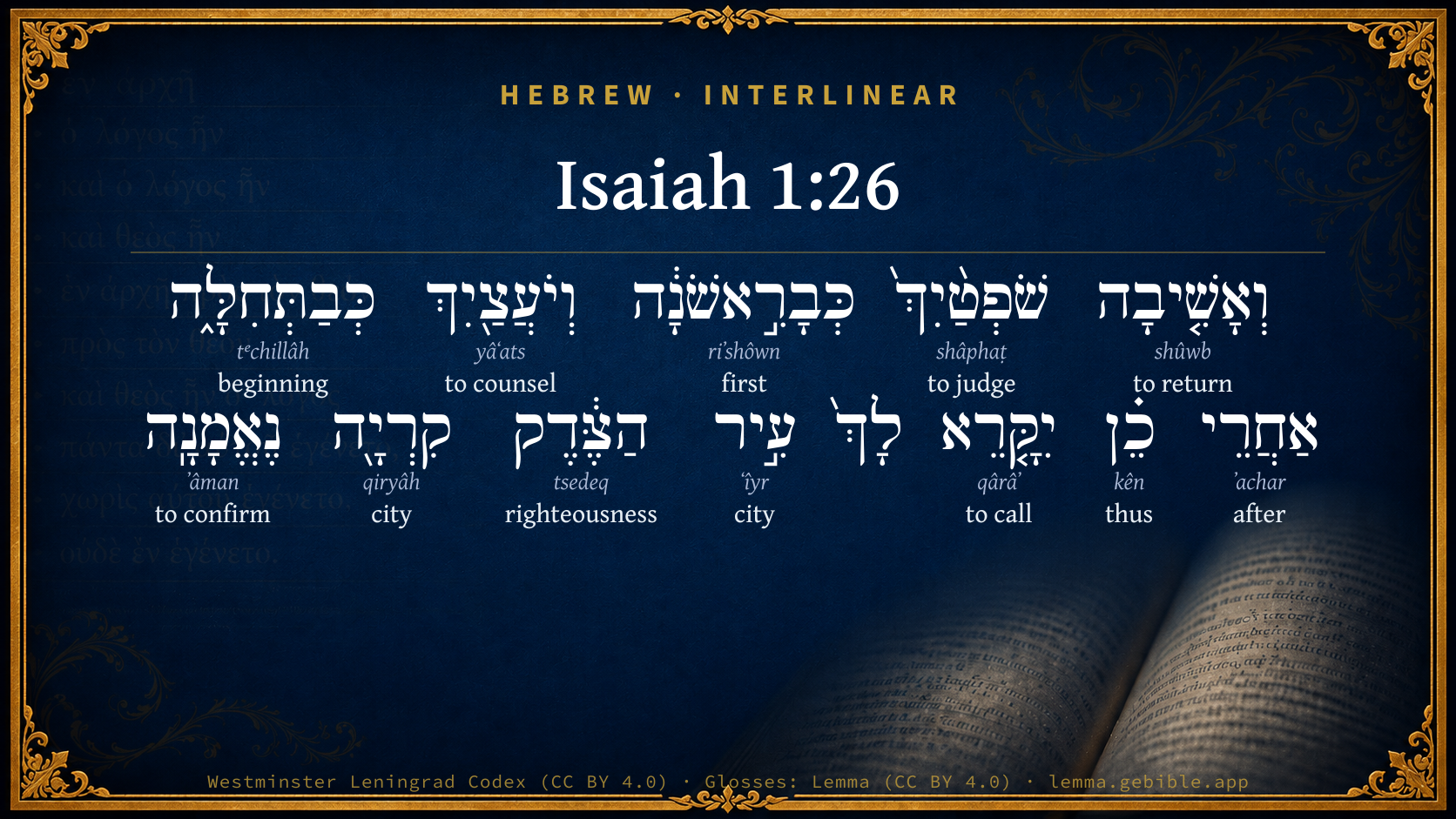
Isaiah 1:26

Hebrew (Westminster Leningrad Codex) Isaiah 1:26 appears in the Hebrew Old Testament. The text above is from the Westminster Leningrad Codex. Each word links to its Strong’s number, a concise gloss, and parsing drawn from the Open Scriptures Hebrew Bible morphology. Click any word for its full Brown-Driver-Briggs (BDB) entry.
Download image
Cite this verse

Isaiah 1:26 (World English Bible). Public Domain. Lemma interlinear Bible study tool, https://lemma.gebible.app/v/isaiah/1/26.

Show BibTeX & RIS
BibTeX
RIS
English Translation
I will restore your judges as at the first, And your counselors as at the beginning. Afterward you shall be called 'The city of righteousness, A faithful town.'
World English Bible · Public Domain
Download a study sheet

One document with this verse’s original text, its word-by-word gloss line, the meaning frame, cross-references with their text, attributed commentary, and full source and license credits — printable, and it pastes into notes with its structure intact.

This verse Autodidact and up

Study sheet (.html) Plain text (.txt)

A passage Seminary Student

Up to 50 verses in one chapter. A passage sheet keeps up to 6 commentary sources and 12 cross-references per verse, in the order this page ranks them, and says so on the sheet whenever that leaves anything out. Ask for a single verse and you get the Autodidact verse sheet above.

Everything on this page stays free to read, with no account — the sheet is a download of what is already on screen, not access to it.

Want to remove ads? Support Godless Engineer
Compare translations 3

The same verse in 3 English versions, stacked beneath the original-language interlinear above. Click any original word for its lexicon entry.

Each is an independent rendering of the whole verse — the interlinear is not word-aligned to these translations.

Highlighted words mark where these versions differ — a whole-verse word diff, not a word-by-word alignment.

  • World English Bible Public Domain
    I will restore your judges as at the first, And your counselors as at the beginning. Afterward you shall be called 'The city of righteousness, A faithful town.'
  • King James Version Public Domain
    And I will restore thy judges as at the first, and thy counsellors as at the beginning: afterward thou shalt be called, The city of righteousness, the faithful city.
  • unfoldingWord Literal Text CC BY-SA 4.0
    And I will restore your judges as at the first, and your counselors, as at the beginning. After this, it will be called to you ‘City of Righteousness, Attested Settlement.’”

unfoldingWord Literal Text — © unfoldingWord, licensed CC BY-SA 4.0. Word-aligned USFM3 via Door43 (git.door43.org/unfoldingWord/en_ult).

Versions to compare (up to 4)

3 of 4 selected

Show all 18 translations

Every available English version of this verse, each an independent rendering of the whole verse.

  • World English Bible Public Domain
    I will restore your judges as at the first, And your counselors as at the beginning. Afterward you shall be called 'The city of righteousness, A faithful town.'
  • Berean Standard Bible Public Domain
    I will restore your judges as at first, and your counselors as at the beginning. After that you will be called the City of Righteousness, the Faithful City.”
  • Majority Standard Bible Public Domain
    I will restore your judges as at first, and your counselors as at the beginning. After that you will be called the City of Righteousness, the Faithful City.”
  • King James Version Public Domain
    And I will restore thy judges as at the first, and thy counsellors as at the beginning: afterward thou shalt be called, The city of righteousness, the faithful city.
  • American Standard Version (1901) Public Domain
    and I will restore thy judges as at the first, and thy counsellors as at the beginning: afterward thou shalt be called The city of righteousness, a faithful town.
  • Revised Version (1885) Public Domain
    and I will restore thy judges as at the first, and thy counsellors as at the beginning: afterward thou shalt be called The city of righteousness, the faithful city.
  • Geneva Bible (1599) Public Domain
    And I will restore thy iudges as at the first, and thy counsellers as at the beginning: afterward shalt thou be called a citie of righteousnes, and a faithfull citie.
  • Douay-Rheims (1899) Public Domain
    And I will restore thy judges se they were before, and thy counsellors as of old. After this thou shalt be called the city of the just, a faithful city.
  • Young's Literal Translation Public Domain
    And I give back thy judges as at the first, And thy counsellors as in the beginning, After this thou art called, `A city of righteousness -- a faithful city.'
  • Literal Standard Version CC BY-SA 4.0
    And I give back your judges as at the first, || And your counselors as in the beginning, || After this you are called, A city of righteousness—a faithful city.”
  • Unlocked Literal Bible CC BY-SA 4.0
    I will restore your judges as at the first, and your counselors as at the beginning; after that you will be called the city of righteousness, a faithful town.”
  • unfoldingWord Literal Text CC BY-SA 4.0
    And I will restore your judges as at the first, and your counselors, as at the beginning. After this, it will be called to you ‘City of Righteousness, Attested Settlement.’”
  • Darby Bible Public Domain
    and I will restore thy judges as at the first, and thy counsellors as at the beginning. Afterwards thou shalt be called, Town of righteousness, Faithful city.
  • World Messianic Bible Public Domain
    I will restore your judges as at the first, and your counselors as at the beginning. Afterward you shall be called ‘The city of righteousness, a faithful town.’
  • Webster's Bible Public Domain
    And I will restore thy judges as at the first, and thy counselors as at the beginning: afterward thou shalt be called, The city of righteousness, the faithful city.
  • Free Bible Version CC BY-SA 4.0
    I will give you good leaders as you used to have before, wise counselors as you had in the beginning. After that you will once again be called the City of Integrity, the Faithful City.
  • Bible in Basic English Public Domain
    And I will give you judges again as at the first, and wise guides as in the past; then you will be named, The Town of Righteousness, the true town.
  • JPS Tanakh (1917) Public Domain
    And I will restore thy judges as at the first, and thy counsellors as at the beginning; afterward thou shalt be called The city of righteousness, the faithful city.

Literal Standard Version (2020), Covenant Press — licensed CC BY-SA 4.0. Text via the HelloAO Bible API (eBible.org). Unlocked Literal Bible (unfoldingWord) — licensed CC BY-SA 4.0. Text via the HelloAO Bible API (eBible.org). unfoldingWord Literal Text — © unfoldingWord, licensed CC BY-SA 4.0. Word-aligned USFM3 via Door43 (git.door43.org/unfoldingWord/en_ult). Free Bible Version, Dr. Jonathan Gallagher — licensed CC BY-SA 4.0. Text via the HelloAO Bible API (eBible.org).

Word by word

More ways to search: Search by grammar → Find every occurrence → Compare this word →

Practice this passage: Drill this verse → Learn its vocabulary →

כְּבַתְּחִלָּ֑ה
tᵉchillâh
H8462
“like/as · in/at the · beginning”
Preposition + Preposition, Determined + Noun, Common, Feminine, Singular, Absolute
Part of Speech
Preposition + Preposition + Noun
Type
Common
Gender
Feminine
Number
Singular
State
Absolute
Full BDB Definition

Origin: from H2490 in the sense of opening

TWOT: 661d

beginning, first - the first time - from the beginning, in the beginning (with preposition)
  1. וְאָשִׁ֤יבָה shûwb H7725 “and · to return” Conjunction + Verb, Hiphil, Cohortative, 1st Person, Common, Singular
  2. שֹׁפְטַ֨יִךְ֙ shâphaṭ H8199 “judging · you” Verb, Qal, Participle Active, Masculine, Plural, Construct + Suffix, Personal, 2nd Person, Feminine, Singular
  3. כְּבָרִ֣אשֹׁנָ֔ה riʼshôwn H7223 “like/as · in/at the · first” Preposition + Preposition, Determined + Adjective, Adjective, Feminine, Singular, Absolute
  4. וְיֹעֲצַ֖יִךְ yâʻats H3289 “and · counseling · you” Conjunction + Verb, Qal, Participle Active, Masculine, Plural, Construct + Suffix, Personal, 2nd Person, Feminine, Singular
  5. אַחֲרֵי ʼachar H310 “after” Preposition
  6. כֵ֗ן kên H3651 “thus” Adverb
  7. יִקָּ֤רֵא qârâʼ H7121 “to call” Verb, Niphal, Imperfect, 3rd Person, Masculine, Singular
  8. עִ֣יר ʻîyr H5892 “city of” Noun, Common, Feminine, Singular, Construct
  9. הַצֶּ֔דֶק tsedeq H6664 “the · righteousness” Particle, Definite Article + Noun, Common, Masculine, Singular, Absolute
  10. קִרְיָ֖ה qiryâh H7151 “city” Noun, Common, Feminine, Singular, Absolute
  11. נֶאֱמָנָֽה ʼâman H539 “confirming” Verb, Niphal, Participle Active, Feminine, Singular, Absolute

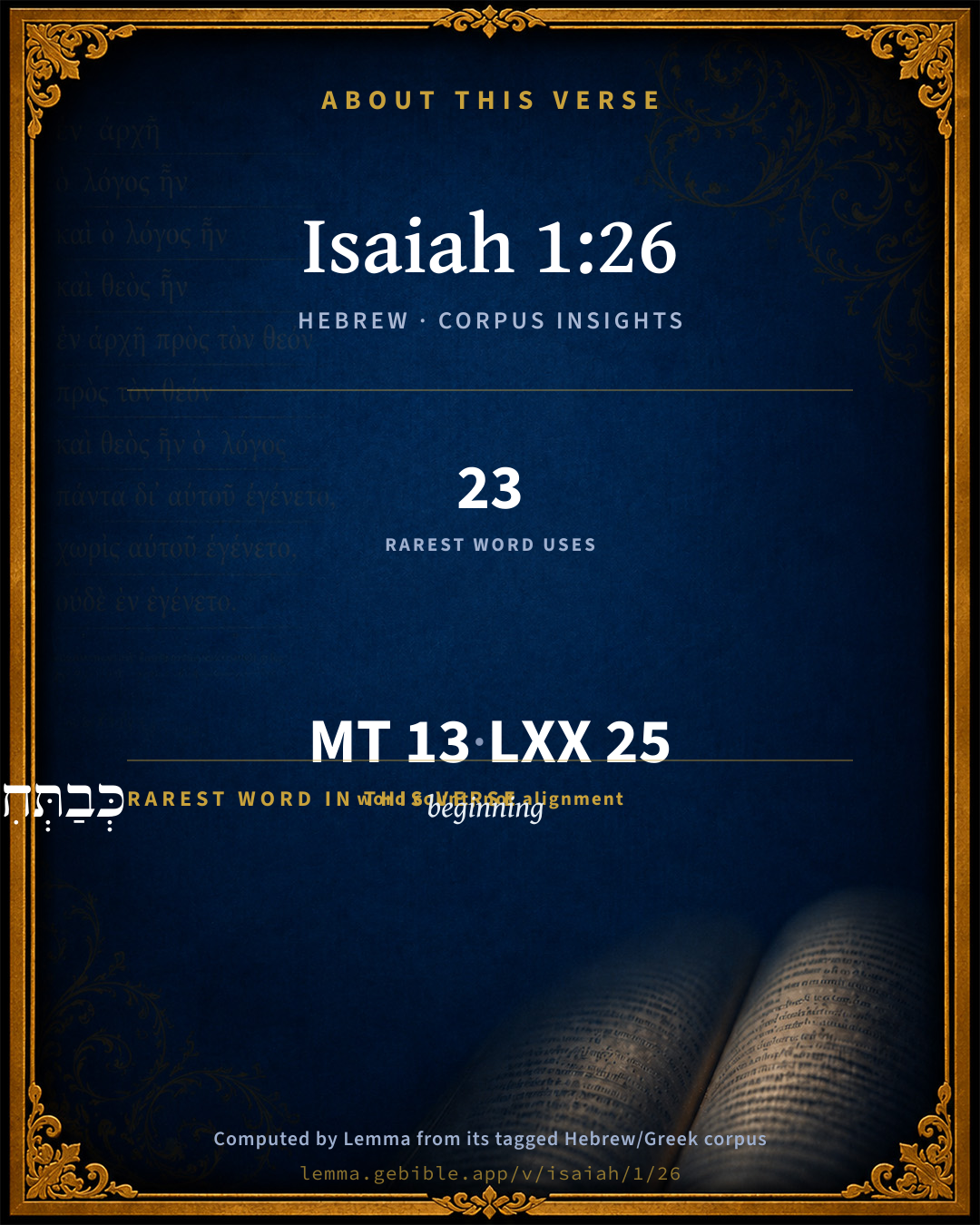
About this verse

These counts appear in no published source. They are computed here, from the morphology-tagged text and Lemma’s own curated glosses. What Lemma adds →

13
words
12
distinct lemmas
Prophets
section

Notable vocabulary

The rarest word here is כְּבַתְּחִלָּ֑ה beginning H8462 — appearing just 23 times in the whole Hebrew Bible.

Shared distinctive vocabulary

כְּבַתְּחִלָּ֑ה beginning H8462 occurs in 21 verses of the Hebrew Bible. Also found in:

Grammatical profile

  • 5 verbs
  • 4 nouns
  • 1 adjective
  • 2 prepositions
  • 1 adverb

Verb forms

  • וְאָשִׁ֤יבָה Hiphil · Cohortative
  • שֹׁפְטַ֨יִךְ֙ Qal · Participle Active
  • וְיֹעֲצַ֖יִךְ Qal · Participle Active
  • יִקָּ֤רֵא Niphal · Imperfect
  • נֶאֱמָנָֽה Niphal · Participle Active

Hebrew & Septuagint length

In English translation the verse runs 28 words from the Hebrew and 30 from the Septuagint (LXX English) — closely comparable.

A rough comparison of the two English renderings, which tokenize alike — not a word-level alignment.

Word counts can differ between the Hebrew and the Greek without any difference in meaning — e.g. the Hebrew direct-object marker אֵת has no separate Greek word, and Greek often adds the article ὁ.

In the original languages it is 13 Hebrew tokens and 25 Greek tokens — but the two are counted differently (Hebrew bundles its prefixes and suffixes into one token; the Greek is in lemma form), so that isn’t a like-for-like length.

Cross-references

22

Topical passages linked to Isaiah 1:26 in the Treasury of Scripture Knowledge — connected by theme and wording, ordered by reader-vote popularity; previews shown in the World English Bible.

  • Jeremiah 33:7 I will cause the captivity of Judah and the captivity of Israel to return, and will build them, as at the first.
  • Zechariah 8:3 Thus says Yahweh: "I have returned to Zion, and will dwell in the midst of Jerusalem. Jerusalem shall be called 'The City of Truth;' and the mountain of Yahweh of Hosts, 'The Holy Mountain.'"
  • Isaiah 62:1–2 For Zion's sake will I not hold my peace, and for Jerusalem's sake I will not rest, until her righteousness go forth as brightness, and her salvation as a lamp that burns.
  • Numbers 12:3 Now the man Moses was very humble, above all the men who were on the surface of the earth.
  • Isaiah 1:21 How the faithful city has become a prostitute! She was full of justice; righteousness lodged in her, But now murderers.
  • Isaiah 32:1–2 Behold, a king shall reign in righteousness, and princes shall rule in justice.
  • Isaiah 33:5 Yahweh is exalted; for he dwells on high: he has filled Zion with justice and righteousness.
  • Isaiah 60:14 The sons of those who afflicted you shall come bending to you; and all those who despised you shall bow themselves down at the soles of your feet; and they shall call you The city of Yahweh, The Zion of the Holy One of Israel.
  • Isaiah 60:17–18 For brass I will bring gold, and for iron I will bring silver, and for wood brass, and for stones iron. I will also make your officers peace, and righteousness your ruler.
  • Isaiah 60:21 Your people also shall be all righteous; they shall inherit the land forever, the branch of my planting, the work of my hands, that I may be glorified.
  • Jeremiah 31:23 Thus says Yahweh of Hosts, the God of Israel, Yet again shall they use this speech in the land of Judah and in the cities of it, when I shall bring again their captivity: Yahweh bless you, habitation of righteousness, mountain of holiness.
  • Jeremiah 33:11 the voice of joy and the voice of gladness, the voice of the bridegroom and the voice of the bride, the voice of those who say, Give thanks to Yahweh of Hosts, for Yahweh is good, for his loving kindness endures forever; [and of them] who bring [sacrifices of] thanksgiving into the house of Yahweh. For I will cause the captivity of the land to return as at the first, says Yahweh.
  • Jeremiah 33:15–17 In those days, and at that time, will I cause a Branch of righteousness to grow up to David; and he shall execute justice and righteousness in the land.
  • Ezekiel 34:23–24 I will set up one shepherd over them, and he shall feed them, even my servant David; he shall feed them, and he shall be their shepherd.
  • Ezekiel 37:24–25 My servant David shall be king over them; and they all shall have one shepherd: they shall also walk in my ordinances, and observe my statutes, and do them.
  • Ezekiel 45:8 In the land it shall be to him for a possession in Israel: and my princes shall no more oppress my people; but they shall give the land to the house of Israel according to their tribes.
  • Zephaniah 3:13 The remnant of Israel will not do iniquity, nor speak lies, neither will a deceitful tongue be found in their mouth, for they will feed and lie down, and no one will make them afraid."
  • Zechariah 8:8 and I will bring them, and they will dwell in the midst of Jerusalem; and they will be my people, and I will be their God, in truth and in righteousness."
  • Numbers 16:15 Moses was very angry, and said to Yahweh, "Don't respect their offering: I have not taken one donkey from them, neither have I hurt one of them."
  • 1 Samuel 12:2–5 Now, behold, the king walks before you; and I am old and gray-headed; and, behold, my sons are with you: and I have walked before you from my youth to this day.
  • Zephaniah 3:9 For then I will purify the lips of the peoples, that they may all call on the name of Yahweh, to serve him shoulder to shoulder.
  • Revelation 21:27 There will in no way enter into it anything profane, or one who causes an abomination or a lie, but only those who are written in the Lamb's book of life.

Cross-references courtesy of OpenBible.info (CC BY 4.0).

Hebrew and Greek witnesses Masoretic Hebrew ↔ Greek Septuagint

The same verse in the two great witnesses to the Old Testament, shown verse-for-verse.

These are two independent witnesses, not word-aligned to each other, and the Septuagint is shown in lemma (dictionary) form.

Hebrew Isaiah 1:26 Masoretic · Westminster Leningrad Codex

וְאָשִׁ֤יבָה שֹׁפְטַ֨יִךְ֙ כְּבָרִ֣אשֹׁנָ֔ה וְיֹעֲצַ֖יִךְ כְּבַתְּחִלָּ֑ה אַחֲרֵי כֵ֗ן יִקָּ֤רֵא לָךְ֙ עִ֣יר הַצֶּ֔דֶק קִרְיָ֖ה נֶאֱמָנָֽה

I will restore your judges as at the first, And your counselors as at the beginning. Afterward you shall be called 'The city of righteousness, A faithful town.'

World English Bible · Public Domain

Greek LXX Isaiah 1:26 Septuagint · lemma form

καί ἐπιἵστημι ὁ κριτής σύ ὡς ὁ πρότερος καί ὁ σύμβουλος σύ ὡς ὁ ἀπό ἀρχή καί μετά οὗτος καλέω πόλις δικαιοσύνη μητρόπολις πιστός σιων

And I will establish your judges as before, and your counselors as at the beginning: and afterward you shall be called the city of righteousness, the faithful mother-city of Sion.

LXX2012 (modern English Septuagint) · Public Domain

On this verse, Adam Clarke's Commentary discusses the Septuagint’s reading. Read the note in Commentary ↓

Hebrew: Westminster Leningrad Codex (CC BY 4.0). Greek: Septuagint (public domain); English from LXX2012 (modern English Septuagint) (Public Domain). How the Septuagint differs from the Hebrew →

Targum (Aramaic paraphrase)

1

The Targum is the ancient Jewish Aramaic paraphrase of the Hebrew Scriptures — an interpretive translation, not the Hebrew text itself. Onkelos (literal) and Pseudo-Jonathan (expansive) render the Torah, and Jonathan the Prophets. Coverage is partial: where no permissively-licensed English translation exists for a verse, only the Aramaic is shown. This is verse-level text, not a word-by-word alignment to the Hebrew.

  1. Targum Jonathan Prophets (Joshua–Malachi)
    וַאֲמַנֵי בִיךְ דַיָנֵי קוּשְׁטָא תַקְנִין כִּבְקַדְמֵיתָא וּמָלְכֵי מִלְכָךְ כַּד מִן אַוְלָא וּבָתַר כֵּן יִתְקְרֵי לָךְ קַרְתָּא דְקוּשְׁטָא קַרְתָּא מְהֵימַנְתָּא:

    And I will appoint in thee judges of truth, upright ones, as at the first, and thy counsellors, as at the beginning: afterward thou shalt be called the holy city, the faithful city.

    Targum Jonathan — Aramaic: “Mikraot Gedolot” (public domain). English: “Sefaria Community Translation” (CC0 1.0 (public-domain dedication)); “London "Chaldee Paraphrase," 1871” (public domain). Text via Sefaria.

Commentary

Notes on Isaiah 1:26 from classic Christian and Jewish commentators (each source and its license shown beneath its notes). The classic Christian expositions comment on the surrounding passage and are grouped to its opening verse, so a note may address several verses; the Jewish commentaries on the Tanakh (Rashi and others) are per-verse, so they appear only where the commentator wrote on this verse.

Lemma curates 59 commentaries, every one of them public domain or Creative Commons licensed, each selected and text-cleaned for this edition rather than reprinted as found. About our sources →

Trapp's Complete Commentary

John Trapp

Isa 1:26 And I will restore thy judges as at the first, and thy counsellors as at the beginning: afterward thou shalt be called, The city of righteousness, the faithful city.

Ver. 26. And I will restore.] By new minting the commonwealth, Velut adulterinum nummum {as Jer 9:7 Mal 3:3} This I will do for thee after thy captivity, but especially after the coming of Christ in the flesh.

Thou shalt be called.] Thou shalt have the name and the note, the comfort and the credit of such a one.

The city of righteousness.] Wherein dwelleth righteousness; or the city of the righteous - of Jesus Christ, the righteous One {1Jn 2:2} and of his people, which shall be all righteous. {Isa 60:21} Thou shalt be a very Jehovahshammah. {Eze 48:35}

The faithful city.] As once thou wast. {Isa 1:21}

John Trapp, A Commentary or Exposition upon All the Books of the Old and New Testament (1647–1656) — public domain. Text from a community e-Sword module.

The Biblical Illustrator

Joseph S. Exell

Isa_1:26

And I will restore thy Judges as at the first

A grand ideal

Two things are noteworthy in this passage.

1. The ideal is political. The salvation of Israel is secured when all public offices are filled with good men. Judges and counsellors.

2. The ideal will be realised by a restoration of the best days of the past. (Prof. J. Skinner, D. D.)

Social regeneration

I. ALL THE ARRANGEMENTS OF SOCIETY ARE ABSOLUTELY IN GODS HANDS. I will restore, etc. No man can overturn, or build up, but by His permission.

II. ALL INTERRUPTIONS OF SOCIAL ORDER ARE UNDER THE CONTROL OF GOD.

III. NO SOCIAL STATE CAN BE PURIFIED BUT BY RELIGIOUS PROCESSES. There are many philanthropic and political projects which have for their aim national regeneration, but they are all foredoomed to come to nought, because they lack the religious element.

IV. THE GREAT NAME WILL FOLLOW THE TRUE REGENERATION. Afterward thou shalt be called, etc. Not first the exalted title, but the illustrative character; not first the splendid renown, but the glorious achievement! (J. Parker, D. D.)

National revivification

The imperishable kernel that remains becomes the centre to which all demerits of excellence are attracted. (F. Delitzsch.)

The city of righteousness

With Isaiah, the giving of a name is the perception and recognition of the real existence of what has come into outward manifestation. (J. Parker, D. D.)

The Biblical Illustrator, edited by Joseph S. Exell (c. 1880s–1900s) — public domain. Text from a community e-Sword module.

The Preacher's Complete Homiletical Commentary

Joseph S. Exell (gen. ed.)

THE DIVINE IDEA OF REDEMPTION

Isa_1:25-26. And I will turn my hand upon thee, and purely purge away thy dross, and take away all thy tin: and I will restore thy judges as at the first, and thy counsellors as at the beginning: afterward thou shalt be called, The city of righteousness, The faithful city.

We have here the promise of a redemption which God would accomplish for Jerusalem, and from the terms of the promise, especially taken in connection with the preceding statements (Isa_1:21-23), we may learn what God’s idea of redemption is: it is to purge away all that debases and to restore all that is lost. In other words, redemption consists in restoration to the Divine ideal. Such was the redemption which God promised to accomplish for Jerusalem: such is the redemption which He offers to accomplish for us. Here we have—

I. A correction of a common error. Most men, when they hear of redemption, think of it merely as salvation from suffering, rescue from the peril of hell. This is a consequence of redemption, but redemption consists in the cleansing of our nature from all defilement, and in our restoration to the Divine ideal of humanity (Col_3:10; Eph_4:24; Eph_4:13). God is going to do something grander for us than save us from hell. He is going to make us “meet” for heaven (1Jn_3:2). It would be truer to say that God’s idea of redemption is “salvation by suffering,” than to say that it is “salvation from suffering.” The figure used in the text is expressive of the keenest suffering—“I will purely purge away thy dross.” But dross is purged away by fire! Suffering is one of the instruments which God most frequently uses to save men from sin.

II. A model for preachers. Guided by a Divine inspiration, the prophet does not speak of happiness, but of purity and righteousness; he names these as the great favours which God was about to bestow upon His people. So should preachers to-day strive to make men understand that these are the greatest blessings which God can confer upon man. All other blessings spring from them; as all social blessings are secured to a community when its “judges” are righteous and its “counsellors” fear God. Let preachers do their utmost to make it plain to the men of this generation, that just as if we have the sun we shall have light and heat, so if they have purity, they shall have peace; if they attain to holiness, they shall attain to a nobler and completer happiness than those who long for happiness merely ever dream of.

III. An ennobling ideal to be striven after by all men. Happy is the man who has a great purpose in life. And what is the purpose with which a study of our text should inspire us? Not merely to “flee from the wrath to come,” but to become “partakers of the Divine nature,” and so to attain to God’s ideal of humanity. God is striving to restore us to His own likeness: let us do all that in us lies to help on this restoration (Php_2:12-13). The “salvation” we are to “work out” is not salvation from guilt (that is Christ’s work, accomplished by Him once for all on the cross), but from the indwelling corruption which is to us what dross is to the precious metals. Nor are we merely to seek to put away that which is evil [457] we are to strive to set up in us all noblenesses which are to character what “judges” and “counsellors” are to a city (2Pe_1:5-7; Php_4:8). Blessed is the man who has this ideal in life.

[457] Christianity ends not in negatives. No man clears his garden of weeds but in order to the planting of flowers or useful herbs in their room. God calls upon us to dispossess our corruptions, but it is for the reception of new inhabitants. A room may be clean, and yet empty; but it is not enough that our hearts be swept, unless they be also garnished, or that we lay aside our pride, our luxury, our covetousness, unless humility, temperance, and liberality rise up and thrive in their places. The design of religion would be very poor and short should it look no further than only to keep men from being swine, goals, and tigers, without improving the principles of humanity into positive and higher perfections. The soul may be cleansed from all blots, and yet still be left but a blank. But Christianity is of a thriving and aspiring nature, and requires us to proceed from grace to grace (2Pe_1:5-7), ascending by degrees, till at length the top of the ladder reaches heaven, and conveys the soul so qualified into the mansions of glory.—South, 1633–1716.

I. He is saved from fear, the haunting dread of failure which oppresses those whose supreme desire is merely to be saved from hell.

II. He has a sustaining hope, based upon the sure promises of God’s Word (1Pe_1:10-11).

III. He has a present and growing joy, such as can come only from self-conquest and moral progress. The joy of “the just,” that is, of the men whose steadfast aim is righteousness, is like “the path of the just” (Pro_4:18).

SOCIAL REGENERATION

Isa_1:26. And I will restore thy judges as at the first, and thy counsellors as at the beginning: afterward thou shalt be called, The city of righteousness, The faithful city.

We have in the contest a picture of a dismantled city, a disorganised community; and here God tells us that He will undertake the work of its reconstruction.

I. All the arrangements of society are absolutely in God’s hands. “I will restore,” &c. No man can overturn, or build up, but by His permission. On Him all projects of national, social, or ecclesiastical reconstruction depend for their success. That on which He smiles flourishes; that on which He frowns withers away. Let reformers and reconstructors of society remember and recognise this great fact, that God rules on earth as in heaven.

II. All interruptions of social order are under the control of God. Revolutions occur not by chance, not by the will of man, but by the will of God. They occur only when, and continue only as long as He pleases. By Him judges and counsellors are swept away, and by Him they are restored. No nation is so broken that it cannot be uplifted by Him to power and glory, “as at the first.”

III. No social state can be purified but by religious processes. There are many philanthropic and political projects which have for their aim national regeneration, but they are all foredoomed to come to nought, because they lack the religious element. Moral reformation must go before social advancement: a return to righteousness is the first step to national exaltation [460]

[460] Think not that any change in the form of government would cure that which is caused by the people’s sin, or the common depravity of human nature. Some think they can contrive such forms of government as that the rulers shall be able to do no hurt; but either they will disable them to do good, or else their engine is but glass, and will fail or break when it comes to execution. Men that are themselves so bad and unhumbled as not to know how bad they are, and how bad mankind is, are still laying the blame upon the form of government when anything is amiss, and think by a change to find a cure. As if when an army is infected with the plague, or composed of cowards, the change of the general or form of government would prove a cure. But if a monarch be faulty, in an aristocracy you will have but many faulty governors for one, and in a democracy a multitude of tyrants.—Baxter, 1615–1691.

IV. The great name will follow the true regeneration. “Afterward thou shalt be called, The city of righteousness, the faithful city.” Not first the exalted title, but the illustrative character; not first the splendid renown but the glorious achievement!—Joseph Parker, D.D.

The Preacher's Complete Homiletical Commentary (gen. ed. Joseph S. Exell; Funk & Wagnalls, c. 1892) — public domain (pre-1929). A full-Bible homiletical/sermon-outline anthology covering 65 of 66 books (2 John is absent from the source module). Text from a community e-Sword module.

Keil & Delitzsch

C. F. Keil & F. Delitzsch

As the threat couched in the previous figure does not point to the destruction, but simply to the smelting of Jerusalem, there is nothing strange in the fact that in Isa 1:26 it should pass over into a pure promise; the meltingly soft and yearningly mournful termination of the clauses with ayich, the keynote of the later songs of Zion, being still continued. "And I will bring back thy judges as in the olden time, and thy counsellors as in the beginning; afterwards thou wilt be called city of righteousness, faithful citadel." The threat itself was, indeed, relatively a promise, inasmuch as whatever could stand the fire would survive the judgment; and the distinct object of this was to bring back Jerusalem to the purer metal of its own true nature. But when that had been accomplished, still more would follow. The indestructible kernel that remained would be crystallized, since Jerusalem would receive back from Jehovah the judges and counsellors which it had had in the olden flourishing times of the monarchy, ever since it had become the city of David and of the temple; not, indeed, the very same persons, but persons quite equal to them in excellence. Under such God-given leaders Jerusalem would become what it had once been, and what it ought to be. The names applied to the city indicate the impression produced by the manifestation of its true nature. The second name is written without the article, as in fact the word kiryah (city), with its massive, definite sound, always is in Isaiah. Thus did Jehovah announce the way which it had been irrevocably determined that He would take with Israel, as the only way to salvation. Moreover, this was the fundamental principle of the government of God, the law of Israel's history.

Keil & Delitzsch — Biblical Commentary on the Old Testament (1861–1891) — public domain (CC PDM 1.0). Text via the HelloAO Bible API. (Old Testament only.)

Tyndale Open Study Notes

Tyndale Open Resources

1:26 The restoration of the community would be marked by new leaders who uphold justice rather than perverting it (see 1:23). Jerusalem would again be pure silver (see 1:22), the Home of Justice and the Faithful City.

Tyndale Open Study Notes — © Tyndale Open Resources, licensed CC BY-SA 4.0. Text via the HelloAO Bible API.

Geneva Bible (1599)

Geneva Bible translators

It is only the work of God to purify the heart of man, which thing he doeth because of his promise, made concerning the salvation of his Church.

Geneva Bible (1599) marginal notes — public domain. Text via Bolls.life.

Jamieson, Fausset & Brown

Robert Jamieson, A. R. Fausset & David Brown

As the degeneracy had shown itself most in the magistrates (Isa 1:17-23), so, at the "restoration," these shall be such as the theocracy "at the first" had contemplated, namely, after the Babylonish restoration in part and typically, but fully and antitypically under Messiah (Isa 32:1; Isa 52:8; Jer 33:7; Mat 19:28).

faithful--no longer "an harlot."

Jamieson, Fausset & Brown — Commentary Critical and Explanatory on the Whole Bible (1871) — public domain (CC PDM 1.0). Text via the HelloAO Bible API.

Adam Clarke's Commentary

Verse 26. I will restore] "This," says Kimchi, "shall be in the days of the Messiah, in which all the wicked shall cease, and the remnant of Israel shall neither do iniquity, nor speak lies." What a change must this be among Jews!

Afterward - "And after this"] The Septuagint, Syriac, Chaldee, and eighteen MSS., and one of my own, very ancient, add the conjunction ו vau, AND.

Adam Clarke's Commentary on the Bible (1810–1826) — public domain. Text from a community e-Sword/MySword module.

Ellicott's Commentary for English Readers

(26) I will restore thy judges as at the first.—The prophet looks back to the good old days, the time probably of David, or the early years of Solomon (1Ki_10:9)—as Englishmen look back to those of Elizabeth—when judges were faithful, and princes upright, and the people happy—to such an ideal polity as that of Psalms 15, 24.

The city of righteousness, the faithful city.—The two nouns are not the same, and the second has rather the meaning of “citadel,” the acropolis of Jerusalem. There is possibly an allusive reference to the idea embodied in the names of Melchizedek (Gen_14:18; Heb_7:2) and Adonizedec (Jos_10:3), as connected with Jerusalem. So in Jer_33:16 the ideal city, no less than the ideal king, is to be called Jehovah Tsidkenu (“the Lord our righteousness”).

A Bible Commentary for English Readers, edited by Charles John Ellicott (1878–1897) — public domain. Text from a community e-Sword module.

The Cambridge Bible for Schools and Colleges

gen. ed. J. J. S. Perowne

26. The result will be the establishment of a pure administration in Jerusalem, as in the olden time, Zion once more worthy of her ancient name, citadel of righteousness (Cheyne), faithful city. The last expression, carrying us back to Isa_1:21, marks the close of the elegy.

Two things are noteworthy in this passage. (1) The ideal is political. The salvation of Israel is secured when all public offices are filled with good men (“judges” and “counsellers”). (2) The ideal will be realised by a restoration of the best days of the past. In later prophecies Isaiah looks forward to a state of things far transcending anything that had been achieved in Israel’s previous history. Such an anticipation as this is most naturally assigned to an early period of his career, before his eschatological conceptions had assumed a definite form.

27 describes the salutary and 28 the judicial aspect of the chastisement in more abstract terms than those hitherto employed. her converts] lit. “those in her who turn”; cf. “Remnant-shall-turn” in ch. Isa_7:3.

redeemed] A very rare word with Isaiah (only again in Isa_29:22). It is doubtful whether the meaning is that she shall be redeemed from her own sins, or from the troubles they shall have brought upon her. So it is uncertain whether judgment and righteousness (cf. Isa_1:21) are the virtues of the redeemed people, or the attributes of God manifested in the redemption. The former idea is most in accordance with Isaiah’s use of the words, but the latter, which is common in the later parts of the book, undoubtedly gives the best sense in this connexion.

The Cambridge Bible for Schools and Colleges (gen. ed. J. J. S. Perowne; Cambridge University Press, 1878–1918) — public domain. Text from a community e-Sword module.

John Gill's Exposition

And I will restore thy judges as at the first,.... This refers not to the times after the Babylonish, captivity, when the Jews had judges and rulers, such as Zerubbabel and Nehemiah, as they had in the times of Moses, Joshua, and the judges, or as in the times of David and Solomon; but it refers, as Kimchi observes, to the times of the Messiah; and is true of the apostles of Christ, who were set on twelve thrones, had power and authority from Christ to preach his Gospel, and to judge the twelve tribes of Israel in a doctrinal way, Mat 19:28 for which they were abundantly qualified, having the spirit of counsel and of judgment resting upon them, as the prophets of old; and will be again verified in the ministers of the Gospel, at the time of the Jews' conversion, when the watchmen shall see eye to eye, have a clear discerning and judgment of things as at the first, Isa 52:8.

and thy counsellors as at the beginning; which is to be understood of the same persons; the apostles at Jerusalem gave advice and counsel in matters of difficulty, and were consulted on special occasions, of which there is an instance in Act 15:1 and ordinary ministers of the word are qualified, and especially will be in the latter day, to give advice both to sensible sinners, inquiring the way of salvation, and to saints when under desertion, and have lost their beloved, or have any matters of difficulty upon them, whether with respect to faith or practice.

Afterward thou shall be called the city of righteousness: when many shall be converted through the hand of the Lord turned upon them, and become incorporated into a church state, and having the apostles and other ministers of the Gospel among them, with proper officers over them, as the first Christian church at Jerusalem had; and the members of it were righteous persons, such as were justified by the righteousness of Christ, and lived righteously, walking in the ordinances of the Lord, and as became the Gospel of Christ, and will be the case of the churches of Christ in the latter day:

the faithful city; to Christ, his Gospel, ordinances, and one another, as the first Christians at Jerusalem were; see Act 2:12. A true church of Christ is a congregation of faithful men, who keep the ordinances as they were delivered; stand first in the faith of the Gospel; take care that the laws of Christ's house are put in execution; and do not suffer sin upon one another, nor bear them that are evil, whether in doctrine or practice; and which in the latter day will be the case of the churches of Christ in a remarkable manner, when they will justly bear this character.

John Gill's Exposition of the Whole Bible (1746–1763) — public domain (CC PDM 1.0). Text via the HelloAO Bible API.

Albert Barnes' Notes on the Bible

And I will restore ... - That is, I will give you such judges as the nation had in former days - in the times of Moses, Joshua, etc. Most of the charges in this chapter are against the magistrates. The calamities of the nation are traced to their unfaithfulness and corruption, Isa 1:17-23. God now says that he will remove this cause of their calamity, and give them pure magistrates.

Thy counselors - Thy advisers; that is, those occupying places of trust and responsibility. When this should be, the prophet does not say. The Jewish commentators suppose that he refers to the time after the return from captivity, and to such men as Zerubbabel, Ezra, and Nehemiah; and to the times of Hyrcanus and Herod, Jerome supposes that the times of the Messiah are referred to. It is impossible to determine which is the correct opinion; though, as the Babylonian captivity was the punishment of those national sins which the prophet was denouncing, it is more probable that he refers to the time immediately succeeding that punishment, when the nation would be restored. I am inclined, therefore, to the opinion, that the prophet had reference solely to the prosperity of the Jewish nation, under a succession of comparatively virtuous princes, after the Babylonian captivity.

Thou shalt be called ... - The principal cause of your wickedness and calamity, that is, your unfaithful rulers being removed and punished, you shall afterward be distinguished as a city of righteousness.

The faithful city - That is, faithful to Yahweh - faithful in keeping his laws, and maintaining the rites of his religion as formerly; compare Isa 1:21.

Albert Barnes' Notes on the Bible (1834–1885) — public domain. Text from a community e-Sword/MySword module.

Haydock's Catholic Bible Commentary

Judges. The Jews explain this of the judges, and priests, who governed after the captivity; though it refer rather to the apostles, &c. (St. Jerome) (Worthington)

George Leo Haydock (1774–1849), Haydock's Catholic Family Bible and Commentary, 1859 edition — public domain. Excludes Psalms (Douay-Rheims chapter numbering differs from Protestant) and Deuterocanonical books (Catholic canon only).

Matthew Poole's English Annotations

I will restore thy judges, I will give thee such princes and magistrates,

as at the first, Heb. as thou hadst in the beginning; either,

1. Of thy commonwealth, such as Moses and Joshua; or,

2. Of thy kingdom, such as David.

Thy counsellors; thy princes shall have and hearken to wise and faithful counsellors, which is a singular blessing to a prince and people.

Thou shalt be called, to wit, justly and truly; thou shalt be such; for to be called is oft put for to be, as Isa 4:3; 61:6; Mat 5:9.

Matthew Poole's English Annotations on the Holy Bible (1683–1685) — public domain. Text from a community e-Sword/MySword module.

Whedon's Commentary on the Bible

Daniel D. Whedon

26, 27. I will restore thy judges — Corrupt judges and counsellors shall be removed, and such magistrates as in early times — as in David’s time — were enjoyed, shall take their places.

City of righteousness — The prophet catches a glimpse of what he is yet to describe in Isa_60:14.

Faithful city — A city steadfast in character, also of unquestionably good reputation. Isa_7:9; Isa_33:5-6.

Zion — By metonomy, the purified city itself.

With judgment — In just visitation for sin, yet with merciful intent. Although obliged to punish this rebellious people because of their perversity, God’s infliction should lead to repentance, when he would remove his stroke and again gather them to their own land.

Her converts — Margin, They that return of her. Possibly the reference is to the return from captivity in Babylon: more likely, the expression is general, and means those who return to the Lord.

Daniel D. Whedon (gen. ed.), Commentary on the Old and New Testaments (1874–1909) — public domain. Text from a community e-Sword module.

The Pulpit Commentary

I will restore thy judges as at the first. (see Ex 19) In the early times there was no bribery, no perversion of justice. (Jer_2:2, Jer_2:3) God will bring back a time when the nation will renew its first love, and be as it was in the days of Moses and Joshua. Thy counselors. (comp. 2Sa_15:12 1Ch_26:14 1Ch_27:32, 1Ch_27:33, etc.) The city of righteousness; or, of justice. The prophecy may have been fulfilled in part by the earthly Jerusalem under Zerubhabel, Ezra, and the Maccabees. but is mainly fulfilled in the heavenly Jerusalem the Church of God, the true Israel. The faithful city (comp. ver. 21). Certainly the post-Captivity Church was "faithful" to Jehovah, in the way of acknowledging him, and him only, to be God, to a very remarkable degree, and in strong contrast to its inclination during pro-Captivity times.

The Pulpit Commentary (1880–1919), ed. H.D.M. Spence-Jones & Joseph S. Exell — public domain. Text from a community e-Sword module.

John Wesley's Explanatory Notes

Thy counsellors - Thy princes shall hearken to wise and faithful counsellors. Called faithful - Thou shalt be such.

John Wesley, Explanatory Notes Upon the Whole Bible (1754–1765) — public domain. Text via the GEBible commentary corpus.

J. A. Alexander on Isaiah

Joseph Addison Alexander

Here again the figurative promise is succeeded by a literal one of restoration to a former state of purity, to be effected not by the conversion of the wicked rulers but by filling their places with better men. “And I will restore,” bring back, cause to return, “thy judges”, rulers, “as at first,” in the earliest and best days of the commonwealth, “and thy counsellors”, ministers of state, “as in the beginning, after which it shall be called to thee”, a Hebrew idiom for thou shalt be called, (i.e., deservedly, with truth), “City of Righteousness, a Faithful State.” There is here a twofold allusion to v. 21. She who from being a faithful wife had become an adulteress or harlot, should again be what she was; and justice which once dwelt in her should return to its old home.

Joseph Addison Alexander, The Prophecies of Isaiah (1846–1847; New York: Scribner, 1870–1878) — public domain. Text from a community e-Sword module.

Scofield Reference Notes

C. I. Scofield

thy judges

Under the kingdom the ancient method of administering the theocratic government over Israel is to be restored. Cf. Jdg 2:18; Mat 19:28.

The Scofield Reference Bible (1917 edition), notes by C. I. Scofield — public domain. Text from a community e-Sword module.

unfoldingWord translationNotes

Door43 World Missions Community

General Information:

Isaiah speaks to the people of Judah in the form of a poem. (See: Parallelism)

at the first ... at the beginning

These are two ways of speaking of the first part or beginning of Israel's history, when Israel first became a nation.

you will be called

This can be stated in active form. AT: "people will call you" (See: Active or Passive)

the city of righteousness, a faithful town

Here "city" and "town" refer to the people living in Jerusalem. AT: "the city where the people are righteous and loyal to God" (See: Metonymy)

translationWords

judge

advice

righteous

faithful

unfoldingWord translationNotes — © Distant Shores Media and the Door43 World Missions Community, licensed CC BY-SA 4.0. Source: git.door43.org/Door43/en_tn.

Rashi

Rabbi Shlomo Yitzchaki (Rashi)

as at first I will appoint for you pious judges.

City of Righteousness As in the beginning, righteousness will lodge therein.

Rashi on the Tanakh — English translations: “The Judaica Press complete Tanach with Rashi, translated by A. J. Rosenberg” (CC BY 4.0); “Pentateuch with Rashi's commentary by M. Rosenbaum and A.M. Silbermann, 1929-1934” (public domain); “The Metsudah Tanach series, Lakewood, N.J” (CC BY 4.0); and “The Book of Joshua, Metsudah Publications, 1997” (CC BY 4.0). Text via Sefaria.

Ibn Ezra

Rabbi Abraham ibn Ezra

And I will restore thy judges, etc. When the kingdom of Israel, the ten tribes, with their judges, shall cease here, and the judges of Ahaz shall likewise have gone, Hezekiah will appoint upright judges; and this is in fact recorded of him.

As at first. As in the days of David and Solomon. The ב in כבראשנה is not essential.

Ibn Ezra on the Tanakh — English translations: “Sefaria Community Translation” (CC0 1.0 (public-domain dedication)); “Yalkut, Sifsei Chachomim Chumash, Metsudah Publications, 2009” (CC BY 4.0); and “Commentary of Ibn Ezra on Isaiah - trans. by M. Friedlander, 1873” (public domain). Text via Sefaria.

Lesson kit

Teaching starters — assembled from the data on this page, not authored interpretation. Every prompt links to the verse data it draws on. Edit before teaching.

Isaiah, in the Prophets, opens this verse with 13 words (12 distinct Hebrew lemmas). Its most distinctive word is tᵉchillâh (“beginning”). A historical commentator’s framing appears above. Read the whole chapter for the surrounding context.

Discussion questions

  1. How does “beginning” (tᵉchillâh) shape what this verse is saying?
  2. Genesis 13:3 shares the word «beginning» with this verse. How do the two illuminate each other?
  3. The translations on this page render this verse differently — a whole-verse word diff, not a word-by-word alignment. What might account for the different wordings?
  4. The verb «וְאָשִׁ֤יבָה» is Hiphil Cohortative. How does its form color the action?
  5. Reading how Trapp's Complete Commentary and The Biblical Illustrator read this verse, where do the two commentators agree and where do they part?

Things to notice

Reading settings

Reading text

Shown beneath each verse's original-language words.

Old Testament
Old Testament edition

Read the OT as the Masoretic Hebrew (MT) or the Greek Septuagint (LXX).

English shown for the Greek Septuagint (in the Hebrew ↔ Greek comparison).

Comparing translations? Open the Compare panel on any verse page to stack up to four side by side.