
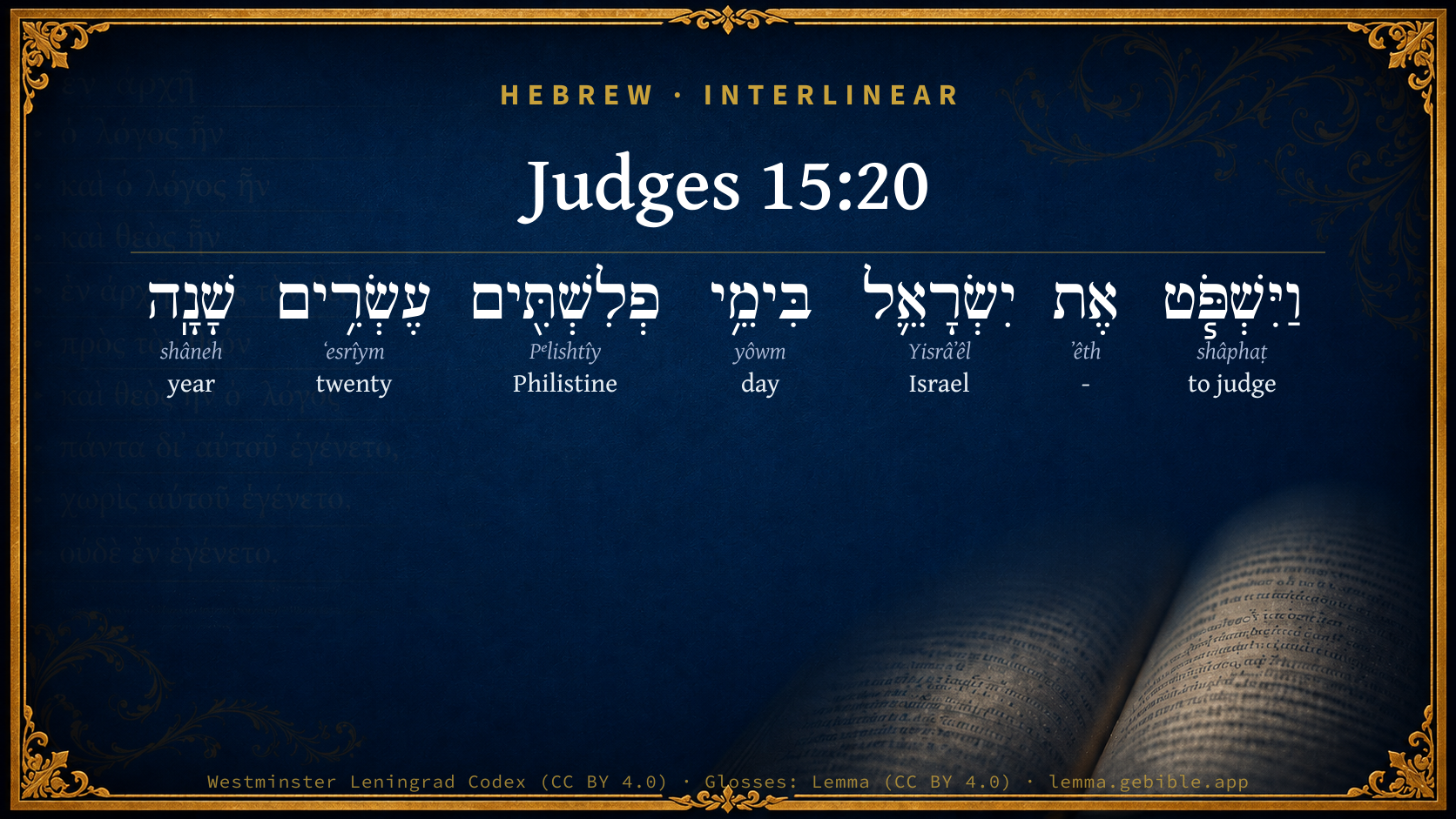
Judges 15:20

Hebrew (Westminster Leningrad Codex) Judges 15:20 appears in the Hebrew Old Testament. The text above is from the Westminster Leningrad Codex. Each word links to its Strong’s number, a concise gloss, and parsing drawn from the Open Scriptures Hebrew Bible morphology. Click any word for its full Brown-Driver-Briggs (BDB) entry.
Download image
Cite this verse

Judges 15:20 (World English Bible). Public Domain. Lemma interlinear Bible study tool, https://lemma.gebible.app/v/judges/15/20.

Show BibTeX & RIS
BibTeX
RIS
English Translation
He judged Israel in the days of the Philistines twenty years.
World English Bible · Public Domain
Download a study sheet

One document with this verse’s original text, its word-by-word gloss line, the meaning frame, cross-references with their text, attributed commentary, and full source and license credits — printable, and it pastes into notes with its structure intact.

This verse Autodidact and up

Study sheet (.html) Plain text (.txt)

A passage Seminary Student

Up to 50 verses in one chapter. A passage sheet keeps up to 6 commentary sources and 12 cross-references per verse, in the order this page ranks them, and says so on the sheet whenever that leaves anything out. Ask for a single verse and you get the Autodidact verse sheet above.

Everything on this page stays free to read, with no account — the sheet is a download of what is already on screen, not access to it.

Want to remove ads? Support Godless Engineer
Compare translations 3

The same verse in 3 English versions, stacked beneath the original-language interlinear above. Click any original word for its lexicon entry.

Each is an independent rendering of the whole verse — the interlinear is not word-aligned to these translations.

Highlighted words mark where these versions differ — a whole-verse word diff, not a word-by-word alignment.

  • World English Bible Public Domain
    He judged Israel in the days of the Philistines twenty years.
  • King James Version Public Domain
    And he judged Israel in the days of the Philistines twenty years.
  • unfoldingWord Literal Text CC BY-SA 4.0
    And he judged Israel in the days of the Philistines 20 years.

unfoldingWord Literal Text — © unfoldingWord, licensed CC BY-SA 4.0. Word-aligned USFM3 via Door43 (git.door43.org/unfoldingWord/en_ult).

Versions to compare (up to 4)

3 of 4 selected

Show all 18 translations

Every available English version of this verse, each an independent rendering of the whole verse.

  • World English Bible Public Domain
    He judged Israel in the days of the Philistines twenty years.
  • Berean Standard Bible Public Domain
    And Samson judged Israel for twenty years in the days of the Philistines.
  • Majority Standard Bible Public Domain
    And Samson judged Israel for twenty years in the days of the Philistines.
  • King James Version Public Domain
    And he judged Israel in the days of the Philistines twenty years.
  • American Standard Version (1901) Public Domain
    And he judged Israel in the days of the Philistines twenty years.
  • Revised Version (1885) Public Domain
    And he judged Israel in the days of the Philistines twenty years.
  • Geneva Bible (1599) Public Domain
    And hee iudged Israel in the dayes of the Philistims twentie yeeres.
  • Douay-Rheims (1899) Public Domain
    And he judged Israel in the days of the Philistines twenty years.
  • Young's Literal Translation Public Domain
    And he judgeth Israel in the days of the Philistines twenty years.
  • Literal Standard Version CC BY-SA 4.0
    And he judges Israel in the days of the Philistines [for] twenty years.
  • Unlocked Literal Bible CC BY-SA 4.0
    Samson judged Israel in the days of the Philistines for twenty years.
  • unfoldingWord Literal Text CC BY-SA 4.0
    And he judged Israel in the days of the Philistines 20 years.
  • Darby Bible Public Domain
    And he judged Israel in the days of the Philistines twenty years.
  • World Messianic Bible Public Domain
    He judged Israel twenty years in the days of the Philistines.
  • Webster's Bible Public Domain
    And he judged Israel, in the days of the Philistines, twenty years.
  • Free Bible Version CC BY-SA 4.0
    Samson led Israel as judge for twenty years during the time of the Philistines.
  • Bible in Basic English Public Domain
    And he was judge of Israel in the days of the Philistines for twenty years.
  • JPS Tanakh (1917) Public Domain
    And he judged Israel in the days of the Philistines twenty years.

Literal Standard Version (2020), Covenant Press — licensed CC BY-SA 4.0. Text via the HelloAO Bible API (eBible.org). Unlocked Literal Bible (unfoldingWord) — licensed CC BY-SA 4.0. Text via the HelloAO Bible API (eBible.org). unfoldingWord Literal Text — © unfoldingWord, licensed CC BY-SA 4.0. Word-aligned USFM3 via Door43 (git.door43.org/unfoldingWord/en_ult). Free Bible Version, Dr. Jonathan Gallagher — licensed CC BY-SA 4.0. Text via the HelloAO Bible API (eBible.org).

Word by word

More ways to search: Search by grammar → Find every occurrence → Compare this word →

Practice this passage: Drill this verse → Learn its vocabulary →

וַיִּשְׁפֹּ֧ט
shâphaṭ
H8199
“and · to judge”
Conjunction + Verb, Qal, Sequential Imperfect, 3rd Person, Masculine, Singular
Part of Speech
Conjunction + Verb
Stem
Qal
Form
Sequential Imperfect
Person
3rd Person
Gender
Masculine
Number
Singular
Full BDB Definition

Origin: a primitive root

TWOT: 2443

to judge, govern, vindicate, punish - (Qal) - to act as law-giver or judge or governor (of God, man) - to rule, govern, judge - to decide controversy (of God, man) - to execute judgment - discriminating (of man) - vindicating - condemning and punishing - at theophanic advent for final judgment - (Niphal) - to enter into controversy, plead, have controversy together - to be judged - (Poel) judge, opponent-at-law (participle)
  1. אֶת ʼêth H853 “-” Particle, Direct Object
  2. יִשְׂרָאֵ֛ל Yisrâʼêl H3478 “Israel” Noun, Proper
  3. בִּימֵ֥י yôwm H3117 “in/at · days of” Preposition + Noun, Common, Masculine, Plural, Construct
  4. פְלִשְׁתִּ֖ים Pᵉlishtîy H6430 “Philistines” Noun, Gentilic, Masculine, Plural, Absolute
  5. עֶשְׂרִ֥ים ʻesrîym H6242 “twenty” Adjective, Cardinal number, Both, Plural, Absolute
  6. שָׁנָֽה shâneh H8141 “year” Noun, Common, Feminine, Singular, Absolute

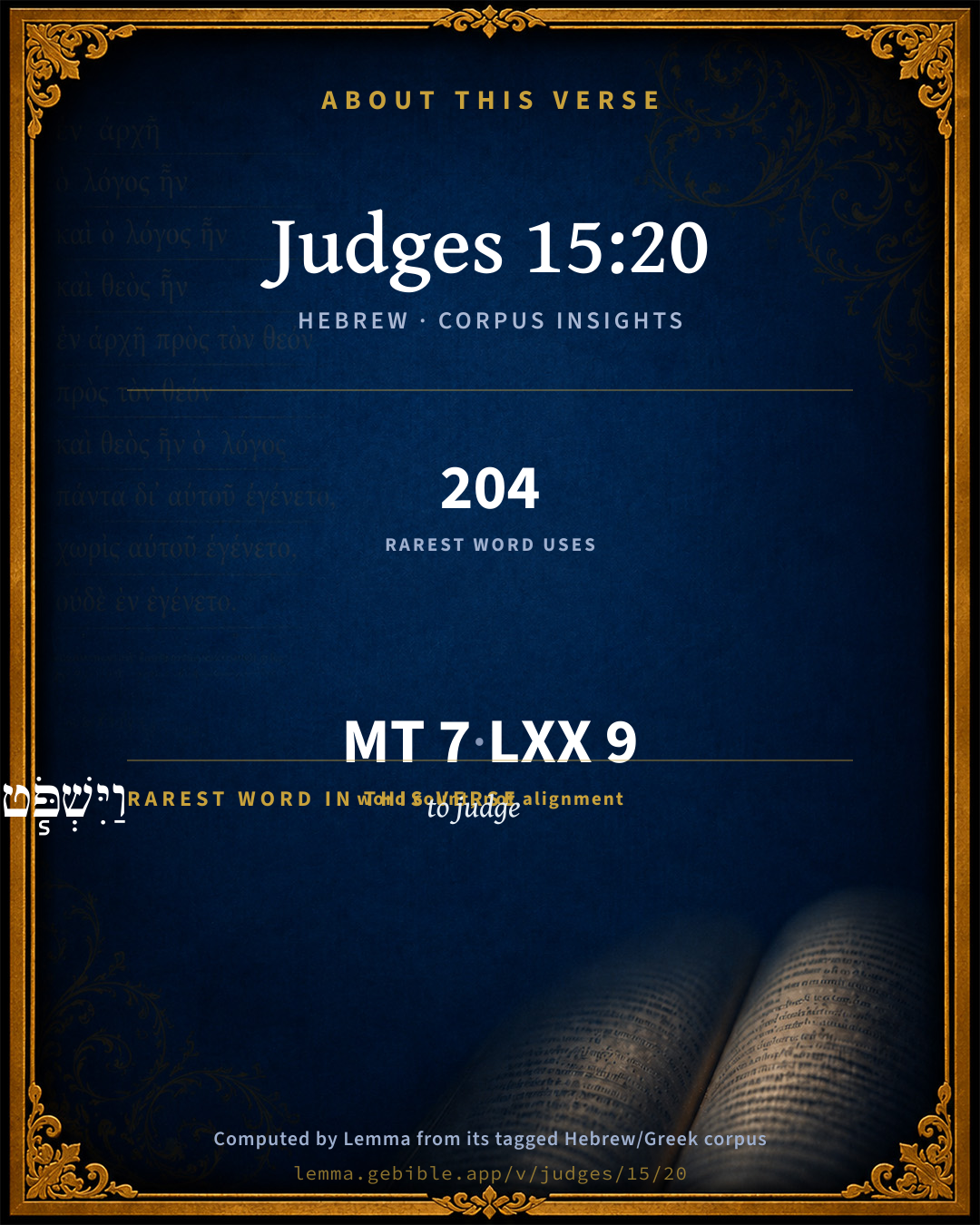
About this verse

These counts appear in no published source. They are computed here, from the morphology-tagged text and Lemma’s own curated glosses. What Lemma adds →

7
words
7
distinct lemmas
Historical
section

Grammatical profile

  • 1 verb
  • 4 nouns
  • 1 adjective
  • 1 particle

Verb forms

  • וַיִּשְׁפֹּ֧ט Qal · Sequential Imperfect

Hebrew & Septuagint length

In English translation the verse runs 11 words from the Hebrew and 12 from the Septuagint (LXX English) — closely comparable.

A rough comparison of the two English renderings, which tokenize alike — not a word-level alignment.

Word counts can differ between the Hebrew and the Greek without any difference in meaning — e.g. the Hebrew direct-object marker אֵת has no separate Greek word, and Greek often adds the article ὁ.

In the original languages it is 7 Hebrew tokens and 9 Greek tokens — but the two are counted differently (Hebrew bundles its prefixes and suffixes into one token; the Greek is in lemma form), so that isn’t a like-for-like length.

Cross-references

4

Topical passages linked to Judges 15:20 in the Treasury of Scripture Knowledge — connected by theme and wording, ordered by reader-vote popularity; previews shown in the World English Bible.

  • Judges 13:1 The children of Israel again did that which was evil in the sight of Yahweh; and Yahweh delivered them into the hand of the Philistines forty years.
  • Judges 16:31 Then his brothers and all the house of his father came down, and took him, and brought him up, and buried him between Zorah and Eshtaol in the burying-place of Manoah his father. He judged Israel twenty years.
  • Judges 13:5 for, behold, you shall conceive, and bear a son; and no razor shall come on his head; for the child shall be a Nazirite to God from the womb: and he shall begin to save Israel out of the hand of the Philistines.
  • Hebrews 11:32 What more shall I say? For the time would fail me if I told of Gideon, Barak, Samson, Jephthah, David, Samuel, and the prophets;

Cross-references courtesy of OpenBible.info (CC BY 4.0).

Hebrew and Greek witnesses Masoretic Hebrew ↔ Greek Septuagint

The same verse in the two great witnesses to the Old Testament, shown verse-for-verse.

These are two independent witnesses, not word-aligned to each other, and the Septuagint is shown in lemma (dictionary) form.

Hebrew Judges 15:20 Masoretic · Westminster Leningrad Codex

וַיִּשְׁפֹּ֧ט אֶת יִשְׂרָאֵ֛ל בִּימֵ֥י פְלִשְׁתִּ֖ים עֶשְׂרִ֥ים שָׁנָֽה

He judged Israel in the days of the Philistines twenty years.

World English Bible · Public Domain

Greek LXX Judges 15:20 Septuagint · lemma form

καί κρίνω ὁ ἰσραήλ ἐν ἡμέρα ἀλλόφυλος εἴκοσι ἔτος

And he judged Israel in the days of the Philistines twenty years.

LXX2012 (modern English Septuagint) · Public Domain

Hebrew: Westminster Leningrad Codex (CC BY 4.0). Greek: Septuagint (public domain); English from LXX2012 (modern English Septuagint) (Public Domain). How the Septuagint differs from the Hebrew →

Targum (Aramaic paraphrase)

1

The Targum is the ancient Jewish Aramaic paraphrase of the Hebrew Scriptures — an interpretive translation, not the Hebrew text itself. Onkelos (literal) and Pseudo-Jonathan (expansive) render the Torah, and Jonathan the Prophets. Coverage is partial: where no permissively-licensed English translation exists for a verse, only the Aramaic is shown. This is verse-level text, not a word-by-word alignment to the Hebrew.

  1. Targum Jonathan Prophets (Joshua–Malachi)
    וְדָן יַת יִשְׂרָאֵל בְּיוֹמֵי פְּלִשְׁתָּאֵי עַסְרִין שְׁנִין:

    (no public-domain English translation for this verse)

    Targum Jonathan — Aramaic: “Mikraot Gedolot” (public domain). English: “Sefaria Community Translation” (CC0 1.0 (public-domain dedication)); “London "Chaldee Paraphrase," 1871” (public domain). Text via Sefaria.

Commentary

Notes on Judges 15:20 from classic Christian and Jewish commentators (each source and its license shown beneath its notes). The classic Christian expositions comment on the surrounding passage and are grouped to its opening verse, so a note may address several verses; the Jewish commentaries on the Tanakh (Rashi and others) are per-verse, so they appear only where the commentator wrote on this verse.

Lemma curates 59 commentaries, every one of them public domain or Creative Commons licensed, each selected and text-cleaned for this edition rather than reprinted as found. About our sources →

Trapp's Complete Commentary

John Trapp

Jdg 15:20 And he judged Israel in the days of the Philistines twenty years.

Ver. 20. And he judged Israel.] Haply after this victory he was publicly accepted and acknowledged as judge of Israel by this people, who before had dealt so unworthily with him:

“ Sic cum fortuna statque caditque fides. ”

John Trapp, A Commentary or Exposition upon All the Books of the Old and New Testament (1647–1656) — public domain. Text from a community e-Sword module.

Joseph Benson's Commentary

Jdg 15:20. He judged Israel — That is, he pleaded their cause, and avenged them against the Philistines. In the days of the Philistines — That is, while the Philistines had the power and dominion, from which he was not able fully to deliver, but only to begin to deliver them. From this place it is manifest that, in the computation of the times of the judges, the years of servitude or oppression are not to be separated from the years of the judges, but are comprehended within them; which proposition is of great importance for clearing this difficult part of Scripture chronology.

Joseph Benson's Commentary on the Old and New Testaments (1811–1818) — public domain. Text from a community e-Sword module.

Adam Clarke's Commentary

Verse 20. He judged Israel-twenty years.] In the margin it is said, He seems to have judged southwest Israel during twenty years of their servitude of the Philistines, Jdg 13:1. Instead of עשרים שנה esrim shanah, twenty years, the Jerusalem Talmud has ארבעים שנה arbaim shanah, forty years; but this reading is not acknowledged by any MS. or version. According to Calmet, the twenty years of the judicature of Samson began the eighteenth year of the subjection of Israel to the Philistines; and these twenty years are included in the judicature of the high priest Eli.

THE burning of the Philistines' corn by the means of foxes and firebrands is a very remarkable circumstance; and there is a story told by Ovid, in the 4th book of his Fasti, that bears a striking similitude to this; and is supposed by some learned men to allude to Samson and his foxes. The poet is at a loss to account for this custom, but brings in an old man of Carseoli, with what must have appeared to himself a very unsatisfactory solution. The passage begins as follows: -

Tertia post Hyadas cum luxerit orta, remotas,

Carcere partitos Circus habebit equos

Cur igitur missae vinctis ardentia taedis

Terga ferant vulpes, causa docenda mihi?

Vid. OVID, Fastor. lib. iv., ver. 679.

The substance of the whole account, which is too long to be transcribed, is this: It was a custom in Rome, celebrated in the month of April to let loose a number of foxes in the circus, with lighted flambeaux on their backs; and the Roman people took pleasure in seeing these animals run about till roasted to death by the flames with which they were enveloped. The poet wishes to know what the origin of this custom was, and is thus informed by an old man of the city of Carseoli: "A frolicksome young lad, about ten years of age, found, near a thicket, a fox that had stolen away many fowls from the neighbouring roosts. Having enveloped his body with hay and straw, he set it on fire, and let the fox loose. The animal, in order to avoid the flames, took to the standing corn which was then ready for the sickle; and the wind, driving the flames with double violence, the crops were everywhere consumed. Though this transaction is long since gone by, the commemoration of it still remains; for, by a law of this city, every fox that is taken is burnt to death. Thus the nation awards to the foxes the punishment of being burnt alive, for the destruction of the ripe corn formerly occasioned by one of these animals."

Both Serrarius and Bochart reject this origin of the custom given by Ovid; and insist that the custom took its rise from the burning of the Philistines' corn by Samson's foxes. The origin ascribed to the custom by the Carseolian they consider as too frivolous and unimportant to be commemorated by a national festival. The time of the observation does not accord with the time of harvest about Rome and in Italy, but it perfectly accords with the time of harvest in Palestine, which was at least as early as April. Nor does the circumstance of the fox wrapped in hay and let loose, the hay being set on fire, bear any proper resemblance to the foxes let loose in the circus with burning brands on their backs.

These learned men therefore conclude that it is much more natural to suppose that the Romans derived the custom from Judea, where probably the burning of the Philistines' corn might, for some time, have been annually commemorated.

The whole account is certainly very singular, and has not a very satisfactory solution in the old man's tale, as related by the Roman poet.

All public institutions have had their origin in facts; and if, through the lapse of time or loss of records, the original facts be lost, we may legitimately look for them in cases where there is so near a resemblance as in that above.

Adam Clarke's Commentary on the Bible (1810–1826) — public domain. Text from a community e-Sword/MySword module.

Ellicott's Commentary for English Readers

(20) And he judged Israel.—Probably, as Jephthah had done, with the sort of vague prerogatives of a military hero. Why the verse is found here, as though to close the narrative (comp. Jdg_12:7, &c.), and is again repeated in Jdg_16:31, we cannot say. The next chapter belongs mainly to Samson’s fall and humiliation. These twenty years probably fell within the contemporary judgeship of Eli.

A Bible Commentary for English Readers, edited by Charles John Ellicott (1878–1897) — public domain. Text from a community e-Sword module.

The Cambridge Bible for Schools and Colleges

gen. ed. J. J. S. Perowne

20. The Dtc. editor’s formula, usually at the close of a judge’s history, comes curiously here before the end; perhaps because the editor felt that the end was not a suitable place for a statement of this kind. The words now standing in Jdg_16:31 b are merely a briefer repetition of the present verse, and may have been added by some later hand. The alternative is to suppose that the Dtc. editor closed the story of Samson here, and left out ch. 16 as contributing nothing to his purpose; ch. 16 was afterwards restored to its place, with the concluding formula (so Budde, Moore, Nowack). See Introduction § 2 C.

twenty years] out of the forty, Jdg_13:1. In the Rabbinic schools it was proposed to correct the reading here to forty, Talm. Jer. Sota Jdg_1:8.

The Cambridge Bible for Schools and Colleges (gen. ed. J. J. S. Perowne; Cambridge University Press, 1878–1918) — public domain. Text from a community e-Sword module.

John Gill's Exposition

And he judged Israel in the days of the Philistines twenty years. While they had the power over the Israelites, who were not entirely delivered out of their hands by Samson, he only began to deliver them, but did not completely do it; though he got many advantages over them, and wrought many salvations and deliverances, yet was not the author of perfect salvation, see Jdg 13:5 however, he was a check upon the Philistines, and protected the Israelites from heavier oppressions, which otherwise they would have come under; and no doubt administered justice and judgment among them, and was an instrument of their reformation, and of preserving them from idolatry; for in such things the work of a judge chiefly lay: some from hence observe, that this shows the years of servitude and bondage are included in the years of the judges.

Next: Judges Chapter 16

John Gill's Exposition of the Whole Bible (1746–1763) — public domain (CC PDM 1.0). Text via the HelloAO Bible API.

Haydock's Catholic Bible Commentary

CHAPTER XV.

Years. Salien gathers from this remark being made here, that the Philistines still asserted their dominion over Israel, but with greater moderation than they had done before: and both nations acknowledged the judicial authority of Samson, who had now been giving them such proofs of his valour for two years, soon after he performed the feat at Gaza, in the year before Christ 1169, being on some business. (Haydock)

George Leo Haydock (1774–1849), Haydock's Catholic Family Bible and Commentary, 1859 edition — public domain. Excludes Psalms (Douay-Rheims chapter numbering differs from Protestant) and Deuterocanonical books (Catholic canon only).

Matthew Poole's English Annotations

i.e. He pleaded their cause, and avenged them against the Philistines.

In the days of the Philistines, i.e. whilst the Philistines had the power and dominion, from which he was not fully to deliver, but only to begin to deliver them, as it was foretold, Jdg 13:5. From this place it is manifest, that in the computation of the times of the judges, the years of servitude or oppression are not to be separated from the years of the judges, and added to them, but are comprehended within them; which proposition is of great importance for clearing this difficult part of Scripture chronology, and for justifying that account of times given 1Ki 6:1.

Matthew Poole's English Annotations on the Holy Bible (1683–1685) — public domain. Text from a community e-Sword/MySword module.

Whedon's Commentary on the Bible

Daniel D. Whedon

20. Judged Israel… twenty years — The same statement is repeated at the close of Samson’s history, (Jdg_16:31,) but seems to have been introduced here to indicate the time when he first became fully recognized as judge in Israel. His previous exploits had not gained him great influence or recognition as judge outside of the tribe of Dan, as Judah’s action (Jdg_15:12) shows. But we may believe when the three thousand men of Judah saw his slaughter of the thousand Philistines, they, too, acknowledged him as judge. He never succeeded, however, in delivering Israel, for his mission was only to begin to deliver them, (Jdg_13:5;) so that the term of his office was wholly in the days of the Philistines. The days of the Philistines’ power extended on through the judgeship of Eli, and though at all times they may not have ruled and oppressed Israel, they were a constant source of trouble and fear. Complete deliverance was wrought by Samuel, the great Nazarite, to whom Samson was a sort of John Baptist. 1Sa_7:13.

Daniel D. Whedon (gen. ed.), Commentary on the Old and New Testaments (1874–1909) — public domain. Text from a community e-Sword module.

The Pulpit Commentary

And he judged Israel, etc. See Jud_1:16:31. It looks as if it had been the intention to close the history of Samson with these Words, but that ch. 16. was subsequently added, possibly from other sources. Compare the close of chs. 20. and 21. of the Gospel of St. John. A possible explanation, however, of this verse being placed here is that it results from the statement in ver. 19, that Samson"s spirit came again, and he revived, or came to life again, after being on the very point of death; and, adds the writer, he judged Israel after this for twenty years.

The Pulpit Commentary (1880–1919), ed. H.D.M. Spence-Jones & Joseph S. Exell — public domain. Text from a community e-Sword module.

John Wesley's Explanatory Notes

He judged - That is, he pleaded their cause, and avenged them against the Philistines. Of the Philistines - That is, whilst the Philistines had the power and dominion, from which he was not fully to deliver, but only to begin to deliver them. From this place it is manifest, that in the computation of the times of the Judges, the years of servitude or oppression are not to be separated from the years of the Judges, but added to them, and are comprehended within them; which proposition is of great importance for clearing this difficult part of scripture-chronology.

John Wesley, Explanatory Notes Upon the Whole Bible (1754–1765) — public domain. Text via the GEBible commentary corpus.

Lesson kit

Teaching starters — assembled from the data on this page, not authored interpretation. Every prompt links to the verse data it draws on. Edit before teaching.

Judges, in the Historical, opens this verse with 7 words (7 distinct Hebrew lemmas). Its most distinctive word is shâphaṭ (“to judge”). A historical commentator’s framing appears above. Read the whole chapter for the surrounding context.

Discussion questions

  1. What does “to judge” (shâphaṭ) contribute to the verse as a whole?
  2. Judges 13:1 shares this passage’s theme. How do the two illuminate each other?
  3. The translations on this page render this verse differently — a whole-verse word diff, not a word-by-word alignment. What might account for the different wordings?
  4. The verb «וַיִּשְׁפֹּ֧ט» is Qal Sequential Imperfect. How does its form color the action?
  5. Reading how Trapp's Complete Commentary and Joseph Benson's Commentary read this verse, where do the two commentators agree and where do they part?

Things to notice

Reading settings

Reading text

Shown beneath each verse's original-language words.

Old Testament
Old Testament edition

Read the OT as the Masoretic Hebrew (MT) or the Greek Septuagint (LXX).

English shown for the Greek Septuagint (in the Hebrew ↔ Greek comparison).

Comparing translations? Open the Compare panel on any verse page to stack up to four side by side.