Ezekiel 33:20

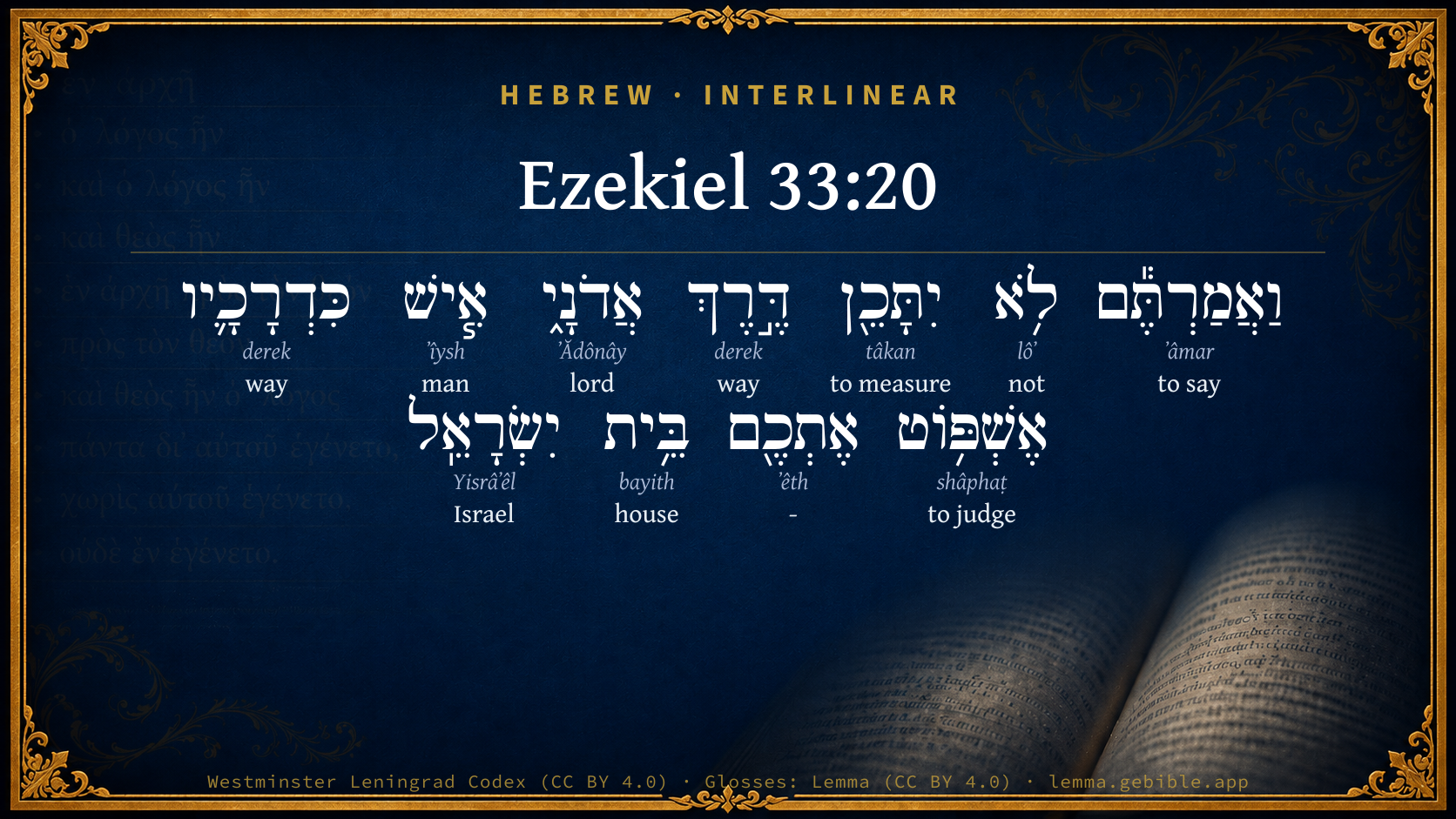
Hebrew (Westminster Leningrad Codex) Ezekiel 33:20 appears in the Hebrew Old Testament. The text above is from the Westminster Leningrad Codex. Each word links to its Strong’s number, a concise gloss, and parsing drawn from the Open Scriptures Hebrew Bible morphology. Click any word for its full Brown-Driver-Briggs (BDB) entry.
Download image
Cite this verse

Ezekiel 33:20 (World English Bible). Public Domain. Lemma interlinear Bible study tool, https://lemma.gebible.app/v/ezekiel/33/20.

Show BibTeX & RIS
BibTeX
RIS
English Translation
Yet you say, The way of the Lord is not equal. House of Israel, I will judge you everyone after his ways.
World English Bible · Public Domain
Download a study sheet

One document with this verse’s original text, its word-by-word gloss line, the meaning frame, cross-references with their text, attributed commentary, and full source and license credits — printable, and it pastes into notes with its structure intact.

This verse Autodidact and up

Study sheet (.html) Plain text (.txt)

A passage Seminary Student

Up to 50 verses in one chapter. A passage sheet keeps up to 6 commentary sources and 12 cross-references per verse, in the order this page ranks them, and says so on the sheet whenever that leaves anything out. Ask for a single verse and you get the Autodidact verse sheet above.

Everything on this page stays free to read, with no account — the sheet is a download of what is already on screen, not access to it.

Want to remove ads? Support Godless Engineer
Compare translations 3

The same verse in 3 English versions, stacked beneath the original-language interlinear above. Click any original word for its lexicon entry.

Each is an independent rendering of the whole verse — the interlinear is not word-aligned to these translations.

Highlighted words mark where these versions differ — a whole-verse word diff, not a word-by-word alignment.

  • World English Bible Public Domain
    Yet you say, The way of the Lord is not equal. House of Israel, I will judge you everyone after his ways.
  • King James Version Public Domain
    Yet ye say, The way of the Lord is not equal. O ye house of Israel, I will judge you every one after his ways.
  • unfoldingWord Literal Text CC BY-SA 4.0
    But you people say, “The way of the Lord is not fair!” I will judge each of you according to his way, house of Israel!’”

unfoldingWord Literal Text — © unfoldingWord, licensed CC BY-SA 4.0. Word-aligned USFM3 via Door43 (git.door43.org/unfoldingWord/en_ult).

Versions to compare (up to 4)

3 of 4 selected

Show all 18 translations

Every available English version of this verse, each an independent rendering of the whole verse.

  • World English Bible Public Domain
    Yet you say, The way of the Lord is not equal. House of Israel, I will judge you everyone after his ways.
  • Berean Standard Bible Public Domain
    Yet you say, ‘The way of the Lord is not just.’ But I will judge each of you according to his ways, O house of Israel.”
  • Majority Standard Bible Public Domain
    Yet you say, ‘The way of the Lord is not just.’ But I will judge each of you according to his ways, O house of Israel.”
  • King James Version Public Domain
    Yet ye say, The way of the Lord is not equal. O ye house of Israel, I will judge you every one after his ways.
  • American Standard Version (1901) Public Domain
    Yet ye say, The way of the Lord is not equal. O house of Israel, I will judge you every one after his ways.
  • Revised Version (1885) Public Domain
    Yet ye say, The way of the Lord is not equal. O house of Israel, I will judge you every one after his ways.
  • Geneva Bible (1599) Public Domain
    Yet yee say, The way of the Lord is not equall. O ye house of Israel, I will iudge you euery one after his waies.
  • Douay-Rheims (1899) Public Domain
    And you say: The way of the Lord is not right, I will judge every one of you according to his ways, O house of Israel.
  • Young's Literal Translation Public Domain
    And ye have said: The way of the Lord is not pondered, Each according to his ways do I judge you, O house of Israel.'
  • Literal Standard Version CC BY-SA 4.0
    And you have said, The way of the Lord is not pondered; I judge each of you according to his ways, O house of Israel.”
  • Unlocked Literal Bible CC BY-SA 4.0
    But you people say, “The way of the Lord is not fair!” I will judge each of you according to his way, house of Israel!'”
  • unfoldingWord Literal Text CC BY-SA 4.0
    But you people say, “The way of the Lord is not fair!” I will judge each of you according to his way, house of Israel!’”
  • Darby Bible Public Domain
    Yet ye say, The way of the Lord is not equal. O house of Israel, I will judge you every one after his ways.
  • World Messianic Bible Public Domain
    Yet you say, “The way of the Lord is not fair.” House of Israel, I will judge every one of you after his ways.’”
  • Webster's Bible Public Domain
    Yet ye say, The way of the Lord is not equal. O ye house of Israel, I will judge you every one after his ways.
  • Free Bible Version CC BY-SA 4.0
    So how can you say, ‘What the Lord does isn't right’? Well, I'm going to judge each of you depending on what you've done, people of Israel.”
  • Bible in Basic English Public Domain
    And still you say, The way of the Lord is not equal. O children of Israel, I will be your judge, giving to everyone the reward of his ways.
  • JPS Tanakh (1917) Public Domain
    Yet ye say: The way of the Lord is not equal. O house of Israel, I will judge you every one after his ways.'

Literal Standard Version (2020), Covenant Press — licensed CC BY-SA 4.0. Text via the HelloAO Bible API (eBible.org). Unlocked Literal Bible (unfoldingWord) — licensed CC BY-SA 4.0. Text via the HelloAO Bible API (eBible.org). unfoldingWord Literal Text — © unfoldingWord, licensed CC BY-SA 4.0. Word-aligned USFM3 via Door43 (git.door43.org/unfoldingWord/en_ult). Free Bible Version, Dr. Jonathan Gallagher — licensed CC BY-SA 4.0. Text via the HelloAO Bible API (eBible.org).

Word by word

More ways to search: Search by grammar → Find every occurrence → Compare this word →

Practice this passage: Drill this verse → Learn its vocabulary →

יִתָּכֵ֖ן
tâkan
H8505
“to measure”
Verb, Niphal, Imperfect, 3rd Person, Masculine, Singular
Part of Speech
Verb
Stem
Niphal
Form
Imperfect
Person
3rd Person
Gender
Masculine
Number
Singular
Full BDB Definition

Origin: a primitive root

TWOT: 2511

to regulate, measure, estimate, ponder, balance, make even, level, weigh, be equal, be weighed out, test, prove - (Qal) estimate (participle) - (Niphal) - to be estimated - to be made even or right, be adjusted to the standard - (Piel) to weigh out, mete out - (Pual) - to be weighed out, be measured out - measured out (participle)
  1. וַאֲמַרְתֶּ֕ם ʼâmar H559 “and · to say” Conjunction + Verb, Qal, Sequential Perfect, 2nd Person, Masculine, Plural
  2. לֹ֥א lôʼ H3808 “not” Particle, Negative
  3. דֶּ֣רֶךְ derek H1870 “way of” Noun, Common, Both, Singular, Construct
  4. אֲדֹנָ֑י ʼĂdônây H136 “Lord · my” Noun, Common, Masculine, Plural, Construct + Suffix, Personal, 1st Person, Common, Singular
  5. אִ֧ישׁ ʼîysh H376 “man” Noun, Common, Masculine, Singular, Absolute
  6. כִּדְרָכָ֛יו derek H1870 “like/as · ways · his” Preposition + Noun, Common, Both, Plural, Construct + Suffix, Personal, 3rd Person, Masculine, Singular
  7. אֶשְׁפּ֥וֹט shâphaṭ H8199 “to judge” Verb, Qal, Imperfect, 1st Person, Common, Singular
  8. אֶתְכֶ֖ם ʼêth H853 “- · you” Particle, Direct Object + Suffix, Personal, 2nd Person, Masculine, Plural
  9. בֵּ֥ית bayith H1004 “house of” Noun, Common, Masculine, Singular, Construct
  10. יִשְׂרָאֵֽל Yisrâʼêl H3478 “Israel” Noun, Proper

About this verse

These counts appear in no published source. They are computed here, from the morphology-tagged text and Lemma’s own curated glosses. What Lemma adds →

11
words
10
distinct lemmas
Prophets
section

Notable vocabulary

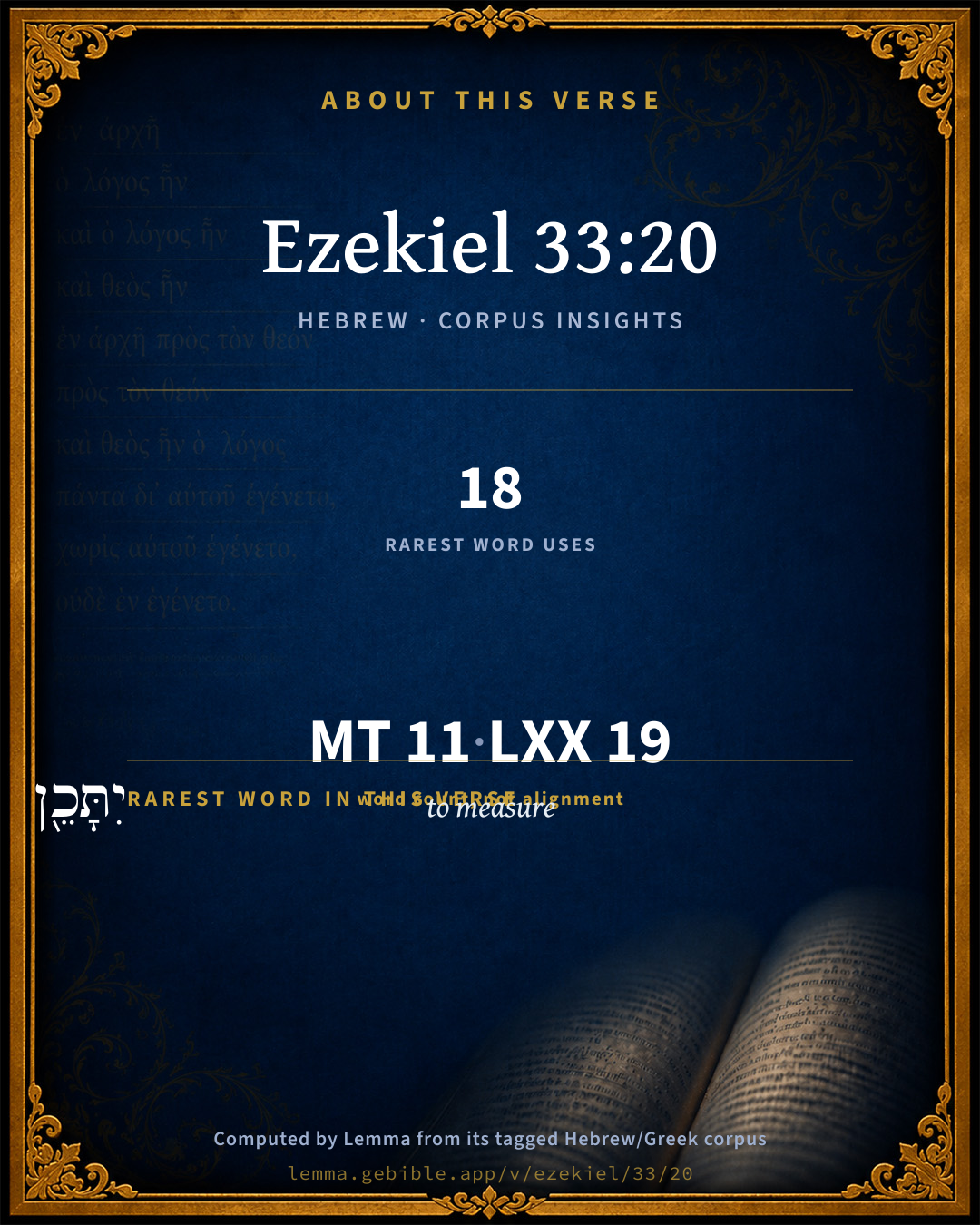
The rarest word here is יִתָּכֵ֖ן to measure H8505 — appearing just 18 times in the whole Hebrew Bible.

Shared distinctive vocabulary

יִתָּכֵ֖ן to measure H8505 occurs in 13 verses of the Hebrew Bible. Also found in:

Grammatical profile

  • 3 verbs
  • 6 nouns
  • 2 particles

Verb forms

  • וַאֲמַרְתֶּ֕ם Qal · Sequential Perfect
  • יִתָּכֵ֖ן Niphal · Imperfect
  • אֶשְׁפּ֥וֹט Qal · Imperfect

Repetition

A word recurs within this verse — often emphatic in Hebrew:

  • דֶּ֣רֶךְ way H1870 ×2

Hebrew & Septuagint length

In English translation the verse runs 22 words from the Hebrew and 28 from the Septuagint (LXX English) — closely comparable.

A rough comparison of the two English renderings, which tokenize alike — not a word-level alignment.

Word counts can differ between the Hebrew and the Greek without any difference in meaning — e.g. the Hebrew direct-object marker אֵת has no separate Greek word, and Greek often adds the article ὁ.

In the original languages it is 11 Hebrew tokens and 19 Greek tokens — but the two are counted differently (Hebrew bundles its prefixes and suffixes into one token; the Greek is in lemma form), so that isn’t a like-for-like length.

Cross-references

11

Topical passages linked to Ezekiel 33:20 in the Treasury of Scripture Knowledge — connected by theme and wording, ordered by reader-vote popularity; previews shown in the World English Bible.

  • Matthew 16:27 For the Son of Man will come in the glory of his Father with his angels, and then he will render to everyone according to his deeds.
  • Ezekiel 18:25 Yet you say, The way of the Lord is not equal. Hear now, house of Israel: Is my way not equal? Aren't your ways unequal?
  • Psalms 62:12 Also to you, Lord, belongs loving kindness, For you reward every man according to his work.
  • Proverbs 19:3 The foolishness of man subverts his way; His heart rages against Yahweh.
  • Ecclesiastes 12:14 For God will bring every work into judgment, with every hidden thing, whether it is good, or whether it is evil.
  • Ezekiel 18:29–30 Yet says the house of Israel, The way of the Lord is not equal. house of Israel, are not my ways equal? are not your ways unequal?
  • Ezekiel 33:17 Yet the children of your people say, The way of the Lord is not equal: but as for them, their way is not equal.
  • John 5:29 and will come out; those who have done good, to the resurrection of life; and those who have done evil, to the resurrection of judgment.
  • 2 Corinthians 5:10 For we must all be revealed before the judgment seat of Christ; that each one may receive the things in the body, according to what he has done, whether good or bad.
  • Revelation 20:12–15 I saw the dead, the great and the small, standing before the throne, and they opened books. Another book was opened, which is the book of life. The dead were judged out of the things which were written in the books, according to their works.
  • Revelation 22:12 "Behold, I come quickly. My reward is with me, to repay to each man according to his work.

Cross-references courtesy of OpenBible.info (CC BY 4.0).

Hebrew and Greek witnesses Masoretic Hebrew ↔ Greek Septuagint

The same verse in the two great witnesses to the Old Testament, shown verse-for-verse.

These are two independent witnesses, not word-aligned to each other, and the Septuagint is shown in lemma (dictionary) form.

Hebrew Ezekiel 33:20 Masoretic · Westminster Leningrad Codex

וַאֲמַרְתֶּ֕ם לֹ֥א יִתָּכֵ֖ן דֶּ֣רֶךְ אֲדֹנָ֑י אִ֧ישׁ כִּדְרָכָ֛יו אֶשְׁפּ֥וֹט אֶתְכֶ֖ם בֵּ֥ית יִשְׂרָאֵֽל

Yet you say, The way of the Lord is not equal. House of Israel, I will judge you everyone after his ways.

World English Bible · Public Domain

Greek LXX Ezekiel 33:20 Septuagint · lemma form

καί οὗτος εἰμί ὅς εἶπον οὐ εὐθύς ὁ ὁδός κύριος ἕκαστος ἐν ὁ ὁδός αὐτός κρίνω σύ οἶκος ἰσραήλ

And this is that which you⌃ said, The way of the Lord is not straight. I will judge you, O house of Israel, every one for his ways.

LXX2012 (modern English Septuagint) · Public Domain

Hebrew: Westminster Leningrad Codex (CC BY 4.0). Greek: Septuagint (public domain); English from LXX2012 (modern English Septuagint) (Public Domain). How the Septuagint differs from the Hebrew →

Targum (Aramaic paraphrase)

1

The Targum is the ancient Jewish Aramaic paraphrase of the Hebrew Scriptures — an interpretive translation, not the Hebrew text itself. Onkelos (literal) and Pseudo-Jonathan (expansive) render the Torah, and Jonathan the Prophets. Coverage is partial: where no permissively-licensed English translation exists for a verse, only the Aramaic is shown. This is verse-level text, not a word-by-word alignment to the Hebrew.

  1. Targum Jonathan Prophets (Joshua–Malachi)
    וַאֲמַרְתּוּן לָא מְפָרְשָׁן לָנָא אוֹרְחַת טוּבָא דַייָ אֱנַשׁ כְּאוֹרְחֵהּ אֶתְפְּרַע מִנְכוֹן בֵּית יִשְׂרָאֵל:

    (no public-domain English translation for this verse)

    Targum Jonathan — Aramaic: “Mikraot Gedolot” (public domain). English: “Sefaria Community Translation” (CC0 1.0 (public-domain dedication)); “London "Chaldee Paraphrase," 1871” (public domain). Text via Sefaria.

Commentary

Notes on Ezekiel 33:20 from classic Christian and Jewish commentators (each source and its license shown beneath its notes). The classic Christian expositions comment on the surrounding passage and are grouped to its opening verse, so a note may address several verses; the Jewish commentaries on the Tanakh (Rashi and others) are per-verse, so they appear only where the commentator wrote on this verse.

Lemma curates 59 commentaries, every one of them public domain or Creative Commons licensed, each selected and text-cleaned for this edition rather than reprinted as found. About our sources →

Trapp's Complete Commentary

John Trapp

Eze 33:20 Yet ye say, The way of the Lord is not equal. O ye house of Israel, I will judge you every one after his ways.

Ver. 20. Yet ye say.] But therein ye lie, which is not the guise of God’s children. {Isa 63:8}

I will judge you every one after his ways.] And so wring a testimony, if not from your mouths, yet from your consciences, of mine impartial justice; such as is that in Deu 32:4, "A God of truth, and without iniquity, just and right is he."

John Trapp, A Commentary or Exposition upon All the Books of the Old and New Testament (1647–1656) — public domain. Text from a community e-Sword module.

John Gill's Exposition

Now the hand of the Lord was upon me in the evening, afore he that was escaped came,.... The prophet felt a divine impulse on his mind; he was under the influence of a spirit of prophecy, and knew before the messenger came to him what his message was, and was prepared to receive it, and to prophesy upon it; for this is to be understood of prophecy, as the Targum,

"prophecy from before the Lord was with me in the evening (k);''

see Isa 8:11,

and had opened my mouth, until he came to me in the morning; the hand of the Lord, or the power of the Lord, had done it, as he promised he would, Eze 3:27 so that he spoke freely and boldly, and continued to do so from the evening, to the time the messenger came to him in the morning, to all those that were with him:

and my mouth was opened, and I was no more dumb: as he had been for three years past; for though he had been prophesying against several nations, yet these prophecies were not delivered, it is very likely, by word of mouth, but by writing, and sent into those countries by proper messengers; but now the prophet's mouth is opened by the Spirit of God, as it was said it should, when this messenger should come to him, Eze 24:27 and from this time he was not silent, but prophesied to his people, the Jews, verbally, as he was bid to do by the Lord.

(k) So R. Sol. Urbin. Ohel Moed, fol. 54. 2.

John Gill's Exposition of the Whole Bible (1746–1763) — public domain (CC PDM 1.0). Text via the HelloAO Bible API.

Matthew Poole's English Annotations

Still blinded prejudice quarrels.

Judge; call you to account, plead with you, and pass sentence.

Every one: this is added to rouse every one up to repent of all sins, and of this particularly.

After his ways; a terrible threat, and I know not how a greater could be denounced against sinners than this. God, infinitely holy and perfectly just, will judge them according to their unequal, unrighteous, sinful ways, and according to his inflexible justice. And if God enter thus into judgment, who can stand in his sight?

Matthew Poole's English Annotations on the Holy Bible (1683–1685) — public domain. Text from a community e-Sword/MySword module.

The Pulpit Commentary

Divine equity.

Ezekiel was well aware that his message would not meet with universal acceptance. But he was also aware that it would meet, not only with indifference and unbelief, but also with hostility and rejection. The very principles of the Divine government would be questioned. Forewarned is forearmed. And the prophet was himself convinced of the Divine justice. For were he not so convinced, the heart would have been taken out of his work, and his personal and ministerial life would have been blighted and weakened.

I THE DIVINE EQUITY CHALLENGED. There were those who, when they listened to the intentions of the Supreme Ruler, as declared by his minister, criticized the principles of God"s administration, affirming, "The way of the Lord is not equal.

1. There is a presumption against this criticism, arising from human ignorance and the limitation of human faculties.

2. And there is a presumption against it, arising from all that we certainly know of the character of the supreme Eternal Judge.

3. Another objection in many cases arises from the character of those who censure the ways of God: they have much to fear from judgment by a righteous and impartial tribunal.

II THE DIVINE EQUITY VINDICATED. It is very remarkable that the method of vindication is not by a labored argument, but by a direct statement of fact and a direct appeal to men"s reason and conscience. "O house of Israel, I will judge every one of you after his ways." That is to say:

1. God"s judgment and the consequent retribution are facts which no objection or skepticism can destroy.

2. The principles of God"s judicial action are such as it is hard for any reasonable man to blame or dispute. Every man is to be judged individually, and every man is to be judged upon his own conduct and his own character. These considerations have only to be amplified and to be pondered, and they afford a convincing and satisfactory reply to the objections of the captions and critical. T.

The Pulpit Commentary (1880–1919), ed. H.D.M. Spence-Jones & Joseph S. Exell — public domain. Text from a community e-Sword module.

Lesson kit

Teaching starters — assembled from the data on this page, not authored interpretation. Every prompt links to the verse data it draws on. Edit before teaching.

Ezekiel, in the Prophets, opens this verse with 11 words (10 distinct Hebrew lemmas). Its most distinctive word is tâkan (“to measure”). A historical commentator’s framing appears above. Read the whole chapter for the surrounding context.

Discussion questions

  1. How does “to measure” (tâkan) shape what this verse is saying?
  2. How does 1 Samuel 2:3, which shares the word «to measure», read alongside this verse?
  3. What does the repetition of “way” (2× in this one verse) do in this verse?
  4. These translations render this verse differently. What is at stake in choosing one wording over another?
  5. «וַאֲמַרְתֶּ֕ם» is a Qal Sequential Perfect verb. How does that grammatical form shape the action described?
  6. Compare how Trapp's Complete Commentary and John Gill's Exposition read this verse. Where do they agree or differ?

Things to notice

Reading settings

Reading text

Shown beneath each verse's original-language words.

Old Testament
Old Testament edition

Read the OT as the Masoretic Hebrew (MT) or the Greek Septuagint (LXX).

English shown for the Greek Septuagint (in the Hebrew ↔ Greek comparison).

Comparing translations? Open the Compare panel on any verse page to stack up to four side by side.