
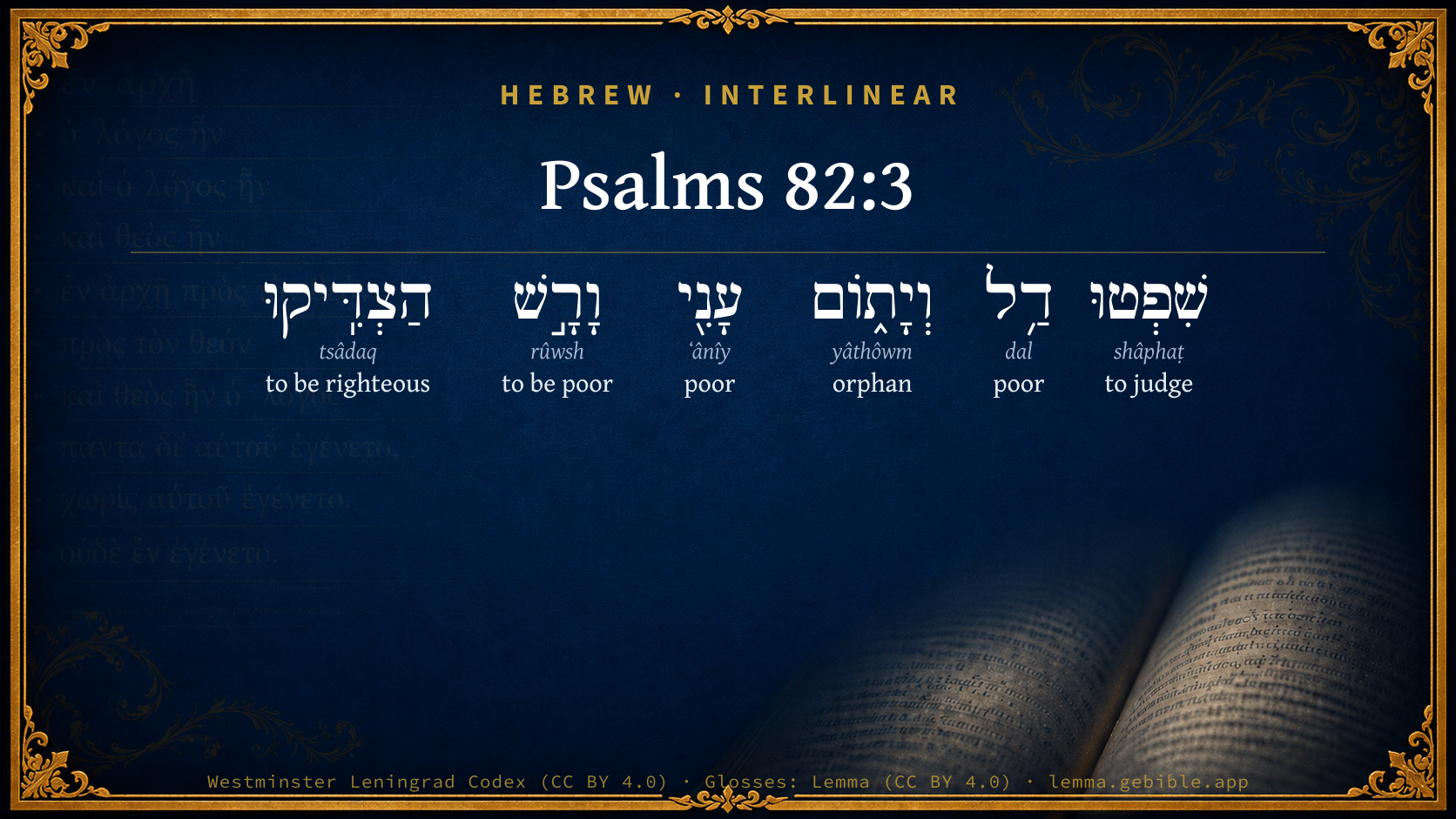
Psalms 82:3

Hebrew (Westminster Leningrad Codex) Psalms 82:3 appears in the Hebrew Old Testament. The text above is from the Westminster Leningrad Codex. Each word links to its Strong’s number, a concise gloss, and parsing drawn from the Open Scriptures Hebrew Bible morphology. Click any word for its full Brown-Driver-Briggs (BDB) entry.
Download image
Cite this verse

Psalms 82:3 (World English Bible). Public Domain. Lemma interlinear Bible study tool, https://lemma.gebible.app/v/psalms/82/3.

Show BibTeX & RIS
BibTeX
RIS
English Translation
"Defend the weak, the poor, and the fatherless. Maintain the rights of the poor and oppressed.
World English Bible · Public Domain
Download a study sheet

One document with this verse’s original text, its word-by-word gloss line, the meaning frame, cross-references with their text, attributed commentary, and full source and license credits — printable, and it pastes into notes with its structure intact.

This verse Autodidact and up

Study sheet (.html) Plain text (.txt)

A passage Seminary Student

Up to 50 verses in one chapter. A passage sheet keeps up to 6 commentary sources and 12 cross-references per verse, in the order this page ranks them, and says so on the sheet whenever that leaves anything out. Ask for a single verse and you get the Autodidact verse sheet above.

Everything on this page stays free to read, with no account — the sheet is a download of what is already on screen, not access to it.

Want to remove ads? Support Godless Engineer
Compare translations 3

The same verse in 3 English versions, stacked beneath the original-language interlinear above. Click any original word for its lexicon entry.

Each is an independent rendering of the whole verse — the interlinear is not word-aligned to these translations.

Highlighted words mark where these versions differ — a whole-verse word diff, not a word-by-word alignment.

  • World English Bible Public Domain
    "Defend the weak, the poor, and the fatherless. Maintain the rights of the poor and oppressed.
  • King James Version Public Domain
    Defend the poor and fatherless: do justice to the afflicted and needy.
  • unfoldingWord Literal Text CC BY-SA 4.0
    Judge the poor and the orphan; vindicate the poor and the destitute.

unfoldingWord Literal Text — © unfoldingWord, licensed CC BY-SA 4.0. Word-aligned USFM3 via Door43 (git.door43.org/unfoldingWord/en_ult).

Versions to compare (up to 4)

3 of 4 selected

Show all 18 translations

Every available English version of this verse, each an independent rendering of the whole verse.

  • World English Bible Public Domain
    "Defend the weak, the poor, and the fatherless. Maintain the rights of the poor and oppressed.
  • Berean Standard Bible Public Domain
    Defend the cause of the weak and fatherless; uphold the rights of the afflicted and oppressed.
  • Majority Standard Bible Public Domain
    Defend the cause of the weak and fatherless; uphold the rights of the afflicted and oppressed.
  • King James Version Public Domain
    Defend the poor and fatherless: do justice to the afflicted and needy.
  • American Standard Version (1901) Public Domain
    Judge the poor and fatherless: Do justice to the afflicted and destitute.
  • Revised Version (1885) Public Domain
    Judge the poor and fatherless: do justice to the afflicted and destitute.
  • Geneva Bible (1599) Public Domain
    Doe right to the poore and fatherlesse: doe iustice to the poore and needie.
  • Douay-Rheims (1899) Public Domain
    Judge for the needy and fatherless: do justice to the humble and the poor.
  • Young's Literal Translation Public Domain
    Judge ye the weak and fatherless, The afflicted and the poor declare righteous.
  • Literal Standard Version CC BY-SA 4.0
    Judge the weak and fatherless, || Declare the afflicted and the poor righteous.
  • Unlocked Literal Bible CC BY-SA 4.0
    Defend the poor and fatherless; maintain the rights of the afflicted and destitute.
  • unfoldingWord Literal Text CC BY-SA 4.0
    Judge the poor and the orphan; vindicate the poor and the destitute.
  • Darby Bible Public Domain
    Judge the poor and the fatherless, do justice to the afflicted and the destitute;
  • World Messianic Bible Public Domain
    “Defend the weak, the poor, and the fatherless. Maintain the rights of the poor and oppressed.
  • Webster's Bible Public Domain
    Defend the poor and fatherless: do justice to the afflicted and needy.
  • Free Bible Version CC BY-SA 4.0
    Defend the poor and orphans; support the rights of those who are oppressed and suffering.
  • Bible in Basic English Public Domain
    Give ear to the cause of the poor and the children without fathers; let those who are troubled and in need have their rights.
  • JPS Tanakh (1917) Public Domain
    Judge the poor and fatherless; do justice to the afflicted and destitute.

Literal Standard Version (2020), Covenant Press — licensed CC BY-SA 4.0. Text via the HelloAO Bible API (eBible.org). Unlocked Literal Bible (unfoldingWord) — licensed CC BY-SA 4.0. Text via the HelloAO Bible API (eBible.org). unfoldingWord Literal Text — © unfoldingWord, licensed CC BY-SA 4.0. Word-aligned USFM3 via Door43 (git.door43.org/unfoldingWord/en_ult). Free Bible Version, Dr. Jonathan Gallagher — licensed CC BY-SA 4.0. Text via the HelloAO Bible API (eBible.org).

Word by word

More ways to search: Search by grammar → Find every occurrence → Compare this word →

Practice this passage: Drill this verse → Learn its vocabulary →

About this verse

These counts appear in no published source. They are computed here, from the morphology-tagged text and Lemma’s own curated glosses. What Lemma adds →

6
words
6
distinct lemmas
Wisdom
section

Notable vocabulary

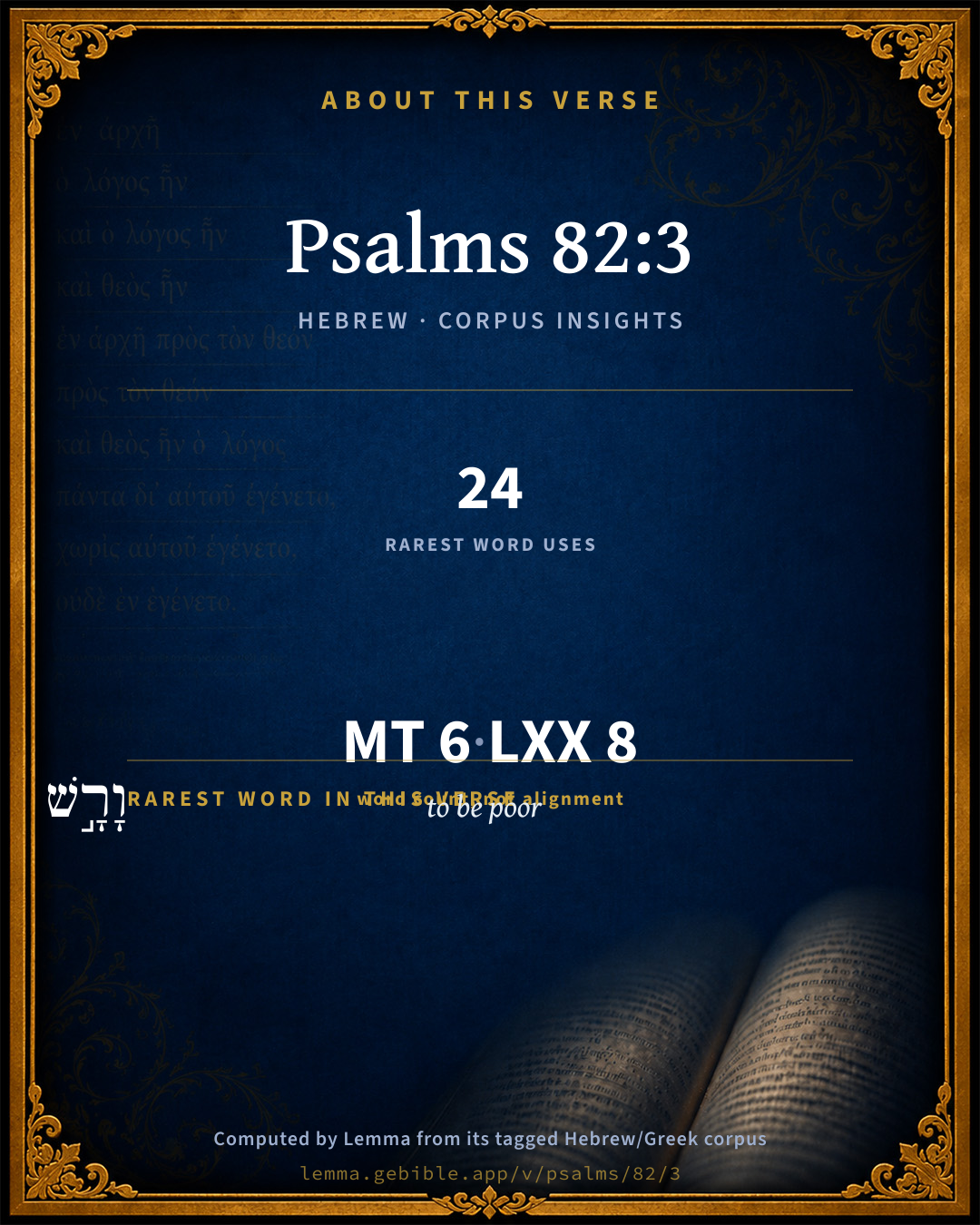
The rarest word here is וָרָ֣שׁ to be poor H7326 — appearing just 24 times in the whole Hebrew Bible.

Shared distinctive vocabulary

וָרָ֣שׁ to be poor H7326 occurs in 24 verses of the Hebrew Bible. Also found in:

Grammatical profile

  • 3 verbs
  • 1 noun
  • 2 adjectives

Verb forms

  • שִׁפְטוּ Qal · Imperative
  • וָרָ֣שׁ Qal · Participle Active
  • הַצְדִּֽיקוּ Hiphil · Imperative

Hebrew & Septuagint length

In English translation the verse runs 16 words from the Hebrew and 12 from the Septuagint (LXX English) — closely comparable.

A rough comparison of the two English renderings, which tokenize alike — not a word-level alignment.

Word counts can differ between the Hebrew and the Greek without any difference in meaning — e.g. the Hebrew direct-object marker אֵת has no separate Greek word, and Greek often adds the article ὁ.

In the original languages it is 6 Hebrew tokens and 8 Greek tokens — but the two are counted differently (Hebrew bundles its prefixes and suffixes into one token; the Greek is in lemma form), so that isn’t a like-for-like length.

Cross-references

9

Topical passages linked to Psalms 82:3 in the Treasury of Scripture Knowledge — connected by theme and wording, ordered by reader-vote popularity; previews shown in the World English Bible.

  • James 1:27 Pure religion and undefiled before our God and Father is this: to visit the fatherless and widows in their affliction, and to keep oneself unstained by the world.
  • Psalms 10:18 To judge the fatherless and the oppressed, That man who is of the earth may terrify no more.
  • Jeremiah 22:3 Thus says Yahweh: Execute you justice and righteousness, and deliver him who is robbed out of the hand of the oppressor: and do no wrong, do no violence, to the foreigner, the fatherless, nor the widow; neither shed innocent blood in this place.
  • Deuteronomy 10:18 He does execute justice for the fatherless and widow, and loves the foreigner, in giving him food and clothing.
  • Deuteronomy 24:17 You shall not wrest the justice [due] to the foreigner, [or] to the fatherless, nor take the widow's clothing to pledge;
  • Isaiah 1:17 Learn to do well. Seek justice, Relieve the oppressed, Judge the fatherless, Plead for the widow."
  • Jeremiah 5:28 They are grew fat, they shine: yes, they overpass in deeds of wickedness; they don't plead the cause, the cause of the fatherless, that they may prosper; and the right of the needy they don't judge.
  • Jeremiah 22:16 He judged the cause of the poor and needy; then it was well. Wasn't this to know me? says Yahweh.
  • Isaiah 1:23 Your princes are rebellious, and companions of thieves. Everyone loves bribes, and follows after rewards. They don't judge the fatherless, Neither does the cause of the widow come to them.

Cross-references courtesy of OpenBible.info (CC BY 4.0).

Hebrew and Greek witnesses Masoretic Hebrew ↔ Greek Septuagint

The same verse in the two great witnesses to the Old Testament, shown verse-for-verse.

You’re reading Greek Psalm 81 (Hebrew Psalm 82). The Septuagint counts the superscription, so verse numbers can differ from the Hebrew — chapter-level alignment, not verse-by-verse. Numbering follows Rahlfs.

These are two independent witnesses, not word-aligned to each other, and the Septuagint is shown in lemma (dictionary) form.

Hebrew Psalms 82:3 Masoretic · Westminster Leningrad Codex

שִׁפְטוּ דַ֥ל וְיָת֑וֹם עָנִ֖י וָרָ֣שׁ הַצְדִּֽיקוּ

"Defend the weak, the poor, and the fatherless. Maintain the rights of the poor and oppressed.

World English Bible · Public Domain

Greek LXX Greek Psalm 81:3 Septuagint · lemma form

κρίνω ὀρφανός καί πτωχός ταπεινός καί πένης δικαιόω

Judge the orphan and poor: do justice to the low and needy.

LXX2012 (modern English Septuagint) · Public Domain

Hebrew: Westminster Leningrad Codex (CC BY 4.0). Greek: Septuagint (public domain); English from LXX2012 (modern English Septuagint) (Public Domain). How the Septuagint differs from the Hebrew →

Commentary

Notes on Psalms 82:3 from classic Christian and Jewish commentators (each source and its license shown beneath its notes). The classic Christian expositions comment on the surrounding passage and are grouped to its opening verse, so a note may address several verses; the Jewish commentaries on the Tanakh (Rashi and others) are per-verse, so they appear only where the commentator wrote on this verse.

Lemma curates 59 commentaries, every one of them public domain or Creative Commons licensed, each selected and text-cleaned for this edition rather than reprinted as found. About our sources →

Trapp's Complete Commentary

John Trapp

Psa 82:3 Defend the poor and fatherless: do justice to the afflicted and needy.

Ver. 3. Defend the poor and fatherless] These are God’s clients, and this is God’s counsel, worthy to be written with letters of gold on the walls of all judicatories, as having in it better direction for a statesman than all Lipsius’ beehive or Machiavel’s spider web. These two Latin verses are said to be written over the judgment seat in Xante,

Hic locus odit, amat, punit, conservat, honorat,

Nequitiam, pacem; crimina, iura, bonos.

John Trapp, A Commentary or Exposition upon All the Books of the Old and New Testament (1647–1656) — public domain. Text from a community e-Sword module.

The Biblical Illustrator

Joseph S. Exell

Psa_82:3-4

Defend the poor and fatherless: do justice to the afflicted and needy.

The magistrates duty

This counsel of God, saith Luther, is worthy to be written in letters of gold on the walls of all judicatories. It may fitly be termed Gods charge to magistrates. As if the Lord had said, This is your main business, and therefore let it be your great care, to defend the poor, succour the afflicted, and support the fatherless, and to help him who hath no helper. As the proper work of the physician is to cure the sick, and of a minister to comfort the weak, so of a magistrate to defend the poor, and vindicate the oppressed from the violence of the oppressor.

1. Magistrates must be a defence to the poor and fatherless, to the afflicted and the needy. They are that great tree which must shelter such as are under them from storms (Dan_4:20-22).

2. As magistrates must administer justice unto all, so especially to the afflicted and distressed. These are most liable for injury; and therefore, if justice incline to any side with favour, it should be towards the poor. This is the very end why rulers are set up, viz., to execute judgment, and do justice amongst the people (Isa_56:1; Hos_12:6; Amo_5:24; Zec_7:9). Do justice--

(1) Discreetly;

(2) Speedily;

(3) Impartially and universally;

(4) Resolutely and courageously;

(5) Righteously and exactly;

(6) Soberly;

(7) Diligently.

3. Good duties need much pressing. Such is the dulness and indisposition of our natures to the best things, that without much pressing they take little or no impression upon us; hence it is that the Lord here calls on judges again and again to defend the poor and fatherless, and to deliver the needy out of trouble.

4. Magistrates must administer justice orderly. They must not go preposterously to work, and condemn a man before he is heard.

(1) They must fully, freely, patiently, with a sedate, quiet, composed spirit, free from passion, prejudice, and precipitancy, hear both parties speak for themselves, for the law doth not use to condemn men till their cause be heard (Joh_7:51; Act_25:15-16).

(2) When, upon hearing, he hath found out the depth and truth of the cause, then he must justify and absolve the innocent, and rescue him out of the jaws of the wicked, by executing justice on him according to his demerits. (T. Hall, B. D.)

The Biblical Illustrator, edited by Joseph S. Exell (c. 1880s–1900s) — public domain. Text from a community e-Sword module.

The Treasury of David

Charles H. Spurgeon

Ver. 3. Defend the poor and fatherless. Cease to do evil, learn to do well. Look not to the interests of the wealthy whose hands proffer you bribes, but protect the rights of the needy, and especially uphold the claims of orphans whose property too often becomes a prey. Do not hunt down the peasant for gathering a few sticks, and allow the gentlemanly swindler to break through the meshes of the law.

Do justice to the afflicted and needy. Even they can claim from you as judge no more than justice; your pity for their circumstances must not make you hold the scales unfairly: but if you give them no more than justice, at least be sure that you give them that to the full. Suffer not the afflicted to be further afflicted by enduring injustice, and let not the needy long stand in need of an equitable hearing.

Whole Psalm. Asaph, who has written so much in the previous Psalms of the coming of Christ in the flesh, now speaks of his second coming to judgment. Josephus Maria Thomasius. 1649-1713.

Ver. 3. It is said of Francis the First, of France, that when a woman kneeled to him to beg justice, he bade her stand up; for, said he, Woman, it is justice that I owe thee, and justice thou shalt have; if thou beg anything of me, let it be mercy. A happy place and people surely, where justice (as it seemeth), was not extorted, but dropt as kindly as honey from the comb; where there was no sale of offices, no exchanging of fees, no subtleties of delay, no trucking for expedition, no making snares of petty and penal statutes: where Justice had scales in her hand, not to weigh gold, but equity: where judges and magistrates were as Noah's ark, to take in weary doves, and as the horns of the altar, for oppressed innocency to betake himself unto; where lawyers, advocates, pleaders, did not call evil good, or good evil, bitter sweet, etc., where plaintiffs and accusers did not inform or persecute through malice, envy, or for advantage; where subordinate officers durst not help potent delinquents out of the briars, nor suffer poor men, tempest tossed in law, to languish in their business within ken of harbour for want of giving a sop to Cerberus, or sacrificing to the great Diana of expedition; where those setting dogs, such as base, promoting informers, were not countenanced, and severely punished upon any false, unjust, or malicious information. To close up all, where the magistrate owed justice to the people, and paid it; where the people begged for mercy and had it. William Price. 1642.

Ver. 3-4. The touchstone of magistrates' justice is in the causes and cases of the poor, fatherless, afflicted, and needy, who are not able to attend long their suits of law, have no friends nor money to deal for them; to whom, therefore, the mighty should be eyes to direct them, and a staff to their weakness, to support and help them in their right. David Dickson.

Ver. 3. A plea for orphans.

Psalms 82:4*

Ver. 3-4. See Psalms on "Ps 82:3" for further information.

None.

Psalms 82:5*

Charles H. Spurgeon's The Treasury of David (1869–1885) — public domain. Psalms only. Text from a community e-Sword/MySword module.

Joseph Benson's Commentary

Psa 82:3-4. Defend the poor and fatherless — As far as justly you may: for so this clause must be limited, as appears by comparing it with Lev 19:15. Do justice to the afflicted and needy — Hebrew, הצדיקו, hatzdiku, justify him, namely, when his cause is good, and he is oppressed by a potent adversary. Deliver the poor and needy — These he recommends to the special care and protection of magistrates, because such are commonly neglected and crushed by men in higher place and power, and are unable to relieve or right themselves.

Joseph Benson's Commentary on the Old and New Testaments (1811–1818) — public domain. Text from a community e-Sword module.

J. A. Alexander on Psalms

Joseph Addison Alexander

3. (Psa 82:3) Judge the weak and fatherless, (to) the sufferer and the poor do justice. The indirect censure of their evil deeds is followed by a direct exhortation to do well. Compare Isa 1:16-17. The verb of the first clause is explained by that of the second, which is a technical forensic term, meaningto make innocent or righteous, i.e. to recognise or declare as such by a judicial act. See Exo 23:7, Deu 25:1, and compare 2Sa 15:4, Isa 5:23; Isa 5:18. The word translated weak is applied to the defect of bodily strength and of property or substance. See above, on Psa 41:1. It is used by Moses in the same connection, Exo 23:3. The fatherless or orphans are continually spoken of, as proper objects both of mercy and of justice. See above, on Psa 10:14; Psa 68:5, and compare Exo 22:22. The word translated poor seems strictly to denote one who has grown poor or become impoverished. See the verbal root in Psa 34:10.

Joseph Addison Alexander, The Psalms Translated and Explained (1850) — public domain. Text from a community e-Sword module.

Adam Clarke's Commentary

Verse 3. Defend the poor] You are their natural protectors under God. They are oppressed: punish their oppressors, however rich or powerful: and deliver them.

Adam Clarke's Commentary on the Bible (1810–1826) — public domain. Text from a community e-Sword/MySword module.

John Calvin's Commentaries

3 Determine the cause of the poor and the orphan. We are here briefly taught that a just and well-regulated government will be distinguished for maintaining the rights of the poor and afflicted. By the figure synecdoche, one part of equitable administration is put for the whole; for it cannot be doubted that rulers are bound to observe justice towards all men without distinction. But the prophet, with much propriety, represents them as appointed to be the defenders of the miserable and oppressed, both because such persons stand in need of the assistance of others, and because they can only obtain this where rulers are free from avarice, ambition, and other vices. The end, therefore, for which judges bear the sword is to restrain the wicked, and thus to prevent violence from prevailing among men, who are so much disposed to become disorderly and outrageous. According as men increase in strength, they become proportionally audacious in oppressing the weak; and hence it is that rich men seldom resort to magistrates for help, except when they happen to fall out among themselves. From these remarks, it is very obvious why the cause of the poor and needy is here chiefly commended to rulers; for those who are exposed an easy prey to the cruelty and wrongs of the rich have no less need of the assistance and protection of magistrates than the sick have of the aid of the physician. Were the truth deeply fixed in the minds of kings and other judges, that they are appointed to be the guardians of the poor, and that a special part of this duty lies in resisting the wrongs which are done to them, and in repressing all unrighteous violence, perfect righteousness would become triumphant through the whole world. Whoever thinks it not beneath him to defend the poor, instead of allowing himself to be carried hither and thither by favor, will have a regard only to what is right. We may farther learn from this passage, that although magistrates may not be solicited for succor, they are accounted guilty before God of negligence, if they do not, of their own accord, succor those who stand in need of their interference. When iniquity openly prevails, and when, on account of it, sighs and lamentations are everywhere heard, it is in vain for them to pretend that they cannot redress wrongs, unless complaints are addressed to them. Oppression utters a sufficiently loud cry of itself; and if the judge, sitting on a high watch-tower, seems to take no notice of it, he is here plainly warned, that such connivance shall not escape with impunity.

John Calvin's Commentaries (1540-1563) — public domain. Text from the Calvin Translation Society English edition (1840s-50s) via the Christian Classics Ethereal Library (ccel.org). Calvin's coverage is partial (roughly two-thirds of the Bible); uncommented books and verses are honest gaps, never fabricated. The 19th-century editor's footnotes and remarks are omitted so the notes are faithfully Calvin's own voice.

Ellicott's Commentary for English Readers

(3) Poor.—Rather, miserable. (See Psa_41:1.) This verse recalls the solemn curse in Deu_27:19.

A Bible Commentary for English Readers, edited by Charles John Ellicott (1878–1897) — public domain. Text from a community e-Sword module.

The Cambridge Bible for Schools and Colleges

gen. ed. J. J. S. Perowne

3. Judge the weak and fatherless:

Do justice to the afflicted and destitute.

The Cambridge Bible for Schools and Colleges (gen. ed. J. J. S. Perowne; Cambridge University Press, 1878–1918) — public domain. Text from a community e-Sword module.

John Gill's Exposition

Defend the poor and fatherless,.... Or, judge (d) them; such as have no money to enter and carry on a suit, and have no friends to assist and advise them, and abide by them; these should be taken under the care and wing of judges; their cause should be attended to, and justice done them; their persons should be protected, and their property defended and secured for, since they are called gods, they ought to imitate him whose name they bear, who is the Father of the fatherless, the Judge of the widows, and the helper of the poor that commit themselves to him, Psa 10:14, such a righteous judge and good magistrate was Job; see Job 29:12,

do justice to the afflicted and needy; or "justify" (e) them, pronounce them righteous, give the cause for them, not right or wrong, nor because they are poor and needy, but because they are in the right; for, if wicked, they are not to be justified, this is an abomination to the Lord; see Lev 19:15.

(d) "judicate", V. L. Pagninus, Montanus, Musculus, Junius & Tremellius, Gejerus, Michaelis. (e) "justificate", V. L. Pagninus, Montanus, Vatablus, Musculus, Cocceius, &c.

John Gill's Exposition of the Whole Bible (1746–1763) — public domain (CC PDM 1.0). Text via the HelloAO Bible API.

Albert Barnes' Notes on the Bible

Defend the poor and fatherless - literally, judge; that is, Pronounce just judgment; see that right is done to them. This is required everywhere in the Scriptures. The meaning is not that judgment is to be pronounced in their favor because they are poor, or because they are orphans, for this would be to do what they had just been charged with as in itself wrong, accepting of persons; that is, showing favor on account of condition or rank, rather than on account of a just claim. The idea is, that the poor and the fatherless, having no natural protectors, were likely to be wronged or oppressed; that they had none to defend their claims; and that magistrates, therefore, as if they were their natural protectors, should see that their rights were maintained. See the notes at Isa 1:17.

Do justice to the afflicted and needy - See that justice is done them; that they are not wronged by persons of wealth, of power, and of rank. Such care does religion take of those who have no natural guardians. The poor and the needy - the widow and the fatherless - owe to the religion of the Bible a debt which no language can express.

Albert Barnes' Notes on the Bible (1834–1885) — public domain. Text from a community e-Sword/MySword module.

Matthew Poole's English Annotations

Defend the poor and fatherless; so far as justly you may; as this clause must be limited, by comparing this with Lev 19:15.

Do justice to, Heb. justify, to wit, when his cause is just, and he is oppressed by a potent adversary.

Matthew Poole's English Annotations on the Holy Bible (1683–1685) — public domain. Text from a community e-Sword/MySword module.

Whedon's Commentary on the Bible

Daniel D. Whedon

3. Defend the poor—Hebrew, Judge the poor; administer to them righteously; give them a fair trial; send them not away unheard because they are poor, and have no gift or bribe to offer, the crying sin of Asiatic governments to this day. The word, שׁפשׂ, (shaphat,) to judge, give judgment, should here be understood generically of the manner of conducting a trial. Their whole code of procedure was corrupt and needed reform. The poor and fatherless describe a temporal condition without reference to moral character; but afflicted, in the next clause, often takes the accessory idea of meek, pious. Psa_72:2; Psa_140:12; Isa_66:2.

Do justice—Hebrew, Make righteous; that is, acquit before the law, justify. This they are commanded to do to the meanest citizen, his cause being right, no less than to the greatest. This was the ideal perfection of the divine government. Psa_72:12-14

Daniel D. Whedon (gen. ed.), Commentary on the Old and New Testaments (1874–1909) — public domain. Text from a community e-Sword module.

The Pulpit Commentary

Defend the poor and fatherless; literally, judge them. "Do not deny them justice; do not refuse to hear their cause". (comp. Isa_1:23 Jer_5:28) Do justice to the afflicted and needy. After consenting to hear their cause, be sure thou doest them justice. These commands are covert reproaches.

The claims of the poor.

This verse suggests four classes. The "poor" are those who have little or no money. The "fatherless" are those who have no defenders and friends. The "afflicted" are those who have to bear actual suffering. And the "needy" are those who have reasonable wants which they cannot satisfy. And in these senses we have the poor always with us; and whensoever we will we may do them good. The immediate application of the passage is to persons in authority who may defend the poor against private injustice or neglect. "They are to cause the benefit of the administration of justice to tend to the advantage of the defenceless, of the destitute, of the helpless, upon whom the Lawgiver of Israel especially keeps his eye." Moses solemnly cursed the man that" perverteth the judgment of the stranger, fatherless, and widow". (Deu_27:19) Matthew Henry has the following striking sentences: "It is bad to rob any man, but most absurd to rob the poor, whom we should relieve; to squeeze those with our power whom we should water with our bounty; to oppress the afflicted, and so add affliction to them; to give judgment against them, and so to patronize those who do rob them, which is as bad as if we robbed them ourselves. Rich men will not suffer themselves to be wronged; poor men cannot help themselves, and, therefore, we ought to be the more careful not to wrong them." What, then, do the poor in every age reasonably claim from every one who has means, or occupies a position of authority or influence? Put under three terms.

I THE POOR CLAIM JUSTICE. That which is their unquestionable right, in every case, and under every circumstance. Not merely a right judicial decision in every disputable question. Not merely fair treatment, if coming under any accusation. But social justice a right share of all citizen privilege, and a righteous reward for all their labour. It is not justice to take any sort of advantage of a man because he is poor. In these days the poor are learning to make their demand for justice, as between man and man, heard and heeded.

II THE POOR CLAIM CONSIDERATION. If anybody is to have an advantage, let it be the poor folk. In every age there has been the tendency of the well to do to claim for themselves all the consideration. The Christian spirit steadily resists this tendency; and the social movements of modern times may well be toned by the Christian spirit.

III THE POOR CLAIM HELP. This brings in the practical side of their claims, and reminds of their actual sufferings and disabilities. See what help is required by the four classes mentioned above. R.T.

The Pulpit Commentary (1880–1919), ed. H.D.M. Spence-Jones & Joseph S. Exell — public domain. Text from a community e-Sword module.

unfoldingWord translationNotes

Door43 World Missions Community

the poor and fatherless

Here "the poor" and "fatherless" are nominal adjectives. They can be stated as adjectives. AT: "those who are poor and those who are orphans" (See: Nominal Adjectives)

maintain the rights of the

"do what is right for the "

the afflicted and destitute

Here "the afflicted" and "destitute" are nominal adjectives. They can be stated as adjectives. AT: "those who are suffering and those who have nothing" (See: Nominal Adjectives)

the poor and needy ... the wicked

These are all nominal adjectives. They can be stated as adjectives. AT: "those who are poor and those who are needy ... those who are wicked" (See: Nominal Adjectives)

take them out of the hand of the wicked

Here the word "hand" represents power or control. AT: "stop the wicked people from harming them" (See: Metonymy)

translationWords

afflicted

hand

unfoldingWord translationNotes — © Distant Shores Media and the Door43 World Missions Community, licensed CC BY-SA 4.0. Source: git.door43.org/Door43/en_tn.

Rashi

Rabbi Shlomo Yitzchaki (Rashi)

justify If he [the poor man] is right in his cause, do not reverse the verdict to condemn him in order to favor the wicked.

Rashi on the Tanakh — English translations: “The Judaica Press complete Tanach with Rashi, translated by A. J. Rosenberg” (CC BY 4.0); “Pentateuch with Rashi's commentary by M. Rosenbaum and A.M. Silbermann, 1929-1934” (public domain); “The Metsudah Tanach series, Lakewood, N.J” (CC BY 4.0); and “The Book of Joshua, Metsudah Publications, 1997” (CC BY 4.0). Text via Sefaria.

Lesson kit

Teaching starters — assembled from the data on this page, not authored interpretation. Every prompt links to the verse data it draws on. Edit before teaching.

Psalms, in the Wisdom, opens this verse with 6 words (6 distinct Hebrew lemmas). Its most distinctive word is rûwsh (“to be poor”). A historical commentator’s framing appears above. Read the whole chapter for the surrounding context.

Discussion questions

  1. How does “to be poor” (rûwsh) shape what this verse is saying?
  2. How does 1 Samuel 18:23, which shares the word «to be poor», read alongside this verse?
  3. These translations render this verse differently; the difference is in the English rendering, not the original. What questions does that raise?
  4. «שִׁפְטוּ» is a Qal Imperative verb. How does that grammatical form shape the action described?
  5. Compare how Trapp's Complete Commentary and The Biblical Illustrator read this verse. Where do they agree or differ?

Things to notice

Reading settings

Reading text

Shown beneath each verse's original-language words.

Old Testament
Old Testament edition

Read the OT as the Masoretic Hebrew (MT) or the Greek Septuagint (LXX).

English shown for the Greek Septuagint (in the Hebrew ↔ Greek comparison).

Comparing translations? Open the Compare panel on any verse page to stack up to four side by side.