
2 Kings 23:22

Hebrew (Westminster Leningrad Codex) 2 Kings 23:22 appears in the Hebrew Old Testament. The text above is from the Westminster Leningrad Codex. Each word links to its Strong’s number, a concise gloss, and parsing drawn from the Open Scriptures Hebrew Bible morphology. Click any word for its full Brown-Driver-Briggs (BDB) entry.
Download image
Cite this verse

2 Kings 23:22 (World English Bible). Public Domain. Lemma interlinear Bible study tool, https://lemma.gebible.app/v/2-kings/23/22.

Show BibTeX & RIS
BibTeX
RIS
English Translation
Surely there was not kept such a Passover from the days of the judges who judged Israel, nor in all the days of the kings of Israel, nor of the kings of Judah;
World English Bible · Public Domain
Download a study sheet

One document with this verse’s original text, its word-by-word gloss line, the meaning frame, cross-references with their text, attributed commentary, and full source and license credits — printable, and it pastes into notes with its structure intact.

This verse Autodidact and up

Study sheet (.html) Plain text (.txt)

A passage Seminary Student

Up to 50 verses in one chapter. A passage sheet keeps up to 6 commentary sources and 12 cross-references per verse, in the order this page ranks them, and says so on the sheet whenever that leaves anything out. Ask for a single verse and you get the Autodidact verse sheet above.

Everything on this page stays free to read, with no account — the sheet is a download of what is already on screen, not access to it.

Want to remove ads? Support Godless Engineer
Compare translations 3

The same verse in 3 English versions, stacked beneath the original-language interlinear above. Click any original word for its lexicon entry.

Each is an independent rendering of the whole verse — the interlinear is not word-aligned to these translations.

Highlighted words mark where these versions differ — a whole-verse word diff, not a word-by-word alignment.

  • World English Bible Public Domain
    Surely there was not kept such a Passover from the days of the judges who judged Israel, nor in all the days of the kings of Israel, nor of the kings of Judah;
  • King James Version Public Domain
    Surely there was not holden such a passover from the days of the judges that judged Israel, nor in all the days of the kings of Israel, nor of the kings of Judah;
  • unfoldingWord Literal Text CC BY-SA 4.0
    Now like this Passover was not done from the days of the judges who judged Israel or all of the days of the kings of Israel or the kings of Judah,

unfoldingWord Literal Text — © unfoldingWord, licensed CC BY-SA 4.0. Word-aligned USFM3 via Door43 (git.door43.org/unfoldingWord/en_ult).

Versions to compare (up to 4)

3 of 4 selected

Show all 18 translations

Every available English version of this verse, each an independent rendering of the whole verse.

  • World English Bible Public Domain
    Surely there was not kept such a Passover from the days of the judges who judged Israel, nor in all the days of the kings of Israel, nor of the kings of Judah;
  • Berean Standard Bible Public Domain
    No such Passover had been observed from the days of the judges who had governed Israel through all the days of the kings of Israel and Judah.
  • Majority Standard Bible Public Domain
    No such Passover had been observed from the days of the judges who had governed Israel through all the days of the kings of Israel and Judah.
  • King James Version Public Domain
    Surely there was not holden such a passover from the days of the judges that judged Israel, nor in all the days of the kings of Israel, nor of the kings of Judah;
  • American Standard Version (1901) Public Domain
    Surely there was not kept such a passover from the days of the judges that judged Israel, nor in all the days of the kings of Israel, nor of the kings of Judah;
  • Revised Version (1885) Public Domain
    Surely there was not kept such a passover from the days of the judges that judged Israel, nor in all the days of the kings of Israel, nor of the kings of Judah;
  • Geneva Bible (1599) Public Domain
    And there was no Passeouer holden like that from the dayes of the Iudges that iudged Israel, nor in all the dayes of the Kinges of Israel, and of the Kings of Iudah.
  • Douay-Rheims (1899) Public Domain
    Now there was no such a phase kept from the days of the judges, who judged Israel, nor in all the days of the kings of Israel, and of the kings of Juda,
  • Young's Literal Translation Public Domain
    Surely there hath not been made like this passover from the days of the judges who judged Israel, even all the days of the kings of Israel, and of the kings of Judah;
  • Literal Standard Version CC BY-SA 4.0
    Surely there has not been made like this Passover from the days of the ones judging who judged Israel, even all the days of the kings of Israel, and of the kings of Judah;
  • Unlocked Literal Bible CC BY-SA 4.0
    Such a Passover celebration had never been held from the days of the judges who ruled Israel, nor in all the days of the kings of Israel or Judah.
  • unfoldingWord Literal Text CC BY-SA 4.0
    Now like this Passover was not done from the days of the judges who judged Israel or all of the days of the kings of Israel or the kings of Judah,
  • Darby Bible Public Domain
    For there was not holden such a passover from the days of the judges that judged Israel, nor in all the days of the kings of Israel, nor of the kings of Judah;
  • World Messianic Bible Public Domain
    Surely there was not kept such a Passover from the days of the judges who judged Israel, nor in all the days of the kings of Israel, nor of the kings of Judah;
  • Webster's Bible Public Domain
    Surely there was not held such a passover from the days of the judges that judged Israel, nor in all the days of the kings of Israel, nor of the kings of Judah.
  • Free Bible Version CC BY-SA 4.0
    Such a Passover as this had not been observed from the days of the judges who ruled Israel on through all the days of the kings of Israel and Judah.
  • Bible in Basic English Public Domain
    Truly, such a Passover had not been kept in all the days of the judges of Israel or of the kings of Israel or the kings of Judah;
  • JPS Tanakh (1917) Public Domain
    For there was not kept such a passover from the days of the judges that judged Israel, nor in all the days of the kings of Israel, nor of the kings of Judah;

Literal Standard Version (2020), Covenant Press — licensed CC BY-SA 4.0. Text via the HelloAO Bible API (eBible.org). Unlocked Literal Bible (unfoldingWord) — licensed CC BY-SA 4.0. Text via the HelloAO Bible API (eBible.org). unfoldingWord Literal Text — © unfoldingWord, licensed CC BY-SA 4.0. Word-aligned USFM3 via Door43 (git.door43.org/unfoldingWord/en_ult). Free Bible Version, Dr. Jonathan Gallagher — licensed CC BY-SA 4.0. Text via the HelloAO Bible API (eBible.org).

Word by word

More ways to search: Search by grammar → Find every occurrence → Compare this word →

Practice this passage: Drill this verse → Learn its vocabulary →

כַּפֶּ֣סַח
peçach
H6453
“like/as the · Passover”
Preposition, Determined + Noun, Common, Masculine, Singular, Absolute
Part of Speech
Preposition + Noun
Type
Common
Gender
Masculine
Number
Singular
State
Absolute
Full BDB Definition

Origin: from H6452

TWOT: 1786a

passover - sacrifice of passover - animal victim of the passover - festival of the passover
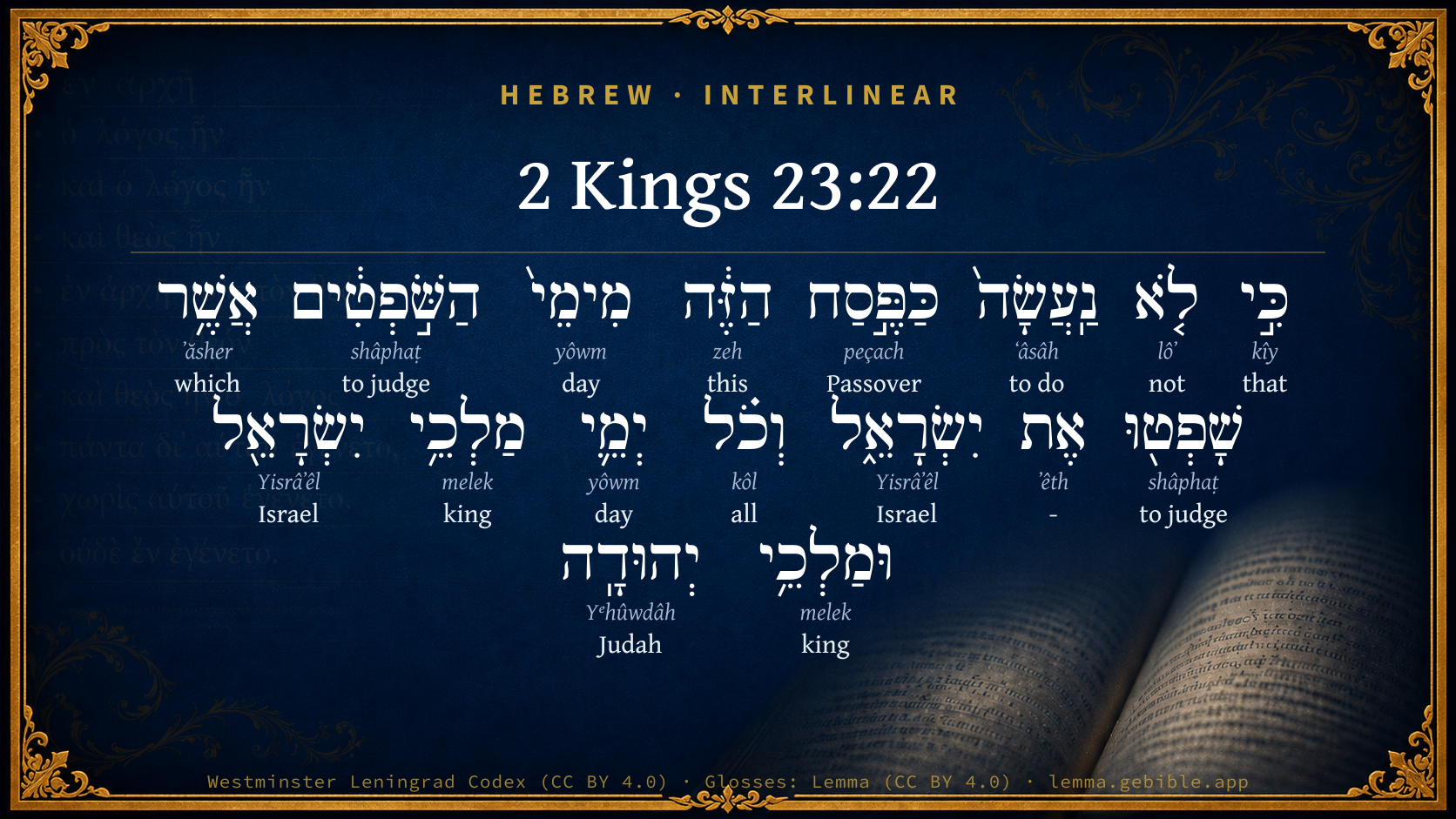
  1. כִּ֣י kîy H3588 “that” Conjunction
  2. לֹ֤א lôʼ H3808 “not” Particle, Negative
  3. נַֽעֲשָׂה֙ ʻâsâh H6213 “to do” Verb, Niphal, Perfect, 3rd Person, Masculine, Singular
  4. הַזֶּ֔ה zeh H2088 “the · this” Particle, Definite Article + Pronoun, Demonstrative, Masculine, Singular
  5. מִימֵי֙ yôwm H3117 “from · days of” Preposition + Noun, Common, Masculine, Plural, Construct
  6. הַשֹּׁ֣פְטִ֔ים shâphaṭ H8199 “the · judging” Particle, Definite Article + Verb, Qal, Participle Active, Masculine, Plural, Absolute
  7. אֲשֶׁ֥ר ʼăsher H834 “which” Particle, Relative
  8. שָׁפְט֖וּ shâphaṭ H8199 “to judge” Verb, Qal, Perfect, 3rd Person, Common, Plural
  9. אֶת ʼêth H853 “-” Particle, Direct Object
  10. יִשְׂרָאֵ֑ל Yisrâʼêl H3478 “Israel” Noun, Proper
  11. וְכֹ֗ל kôl H3605 “and · all of” Conjunction + Noun, Common, Masculine, Singular, Construct
  12. יְמֵ֛י yôwm H3117 “days of” Noun, Common, Masculine, Plural, Construct
  13. מַלְכֵ֥י melek H4428 “kings of” Noun, Common, Masculine, Plural, Construct
  14. יִשְׂרָאֵ֖ל Yisrâʼêl H3478 “Israel” Noun, Proper
  15. וּמַלְכֵ֥י melek H4428 “and · kings of” Conjunction + Noun, Common, Masculine, Plural, Construct
  16. יְהוּדָֽה Yᵉhûwdâh H3063 “Judah” Noun, Proper

About this verse

These counts appear in no published source. They are computed here, from the morphology-tagged text and Lemma’s own curated glosses. What Lemma adds →

17
words
13
distinct lemmas
Historical
section

Shared distinctive vocabulary

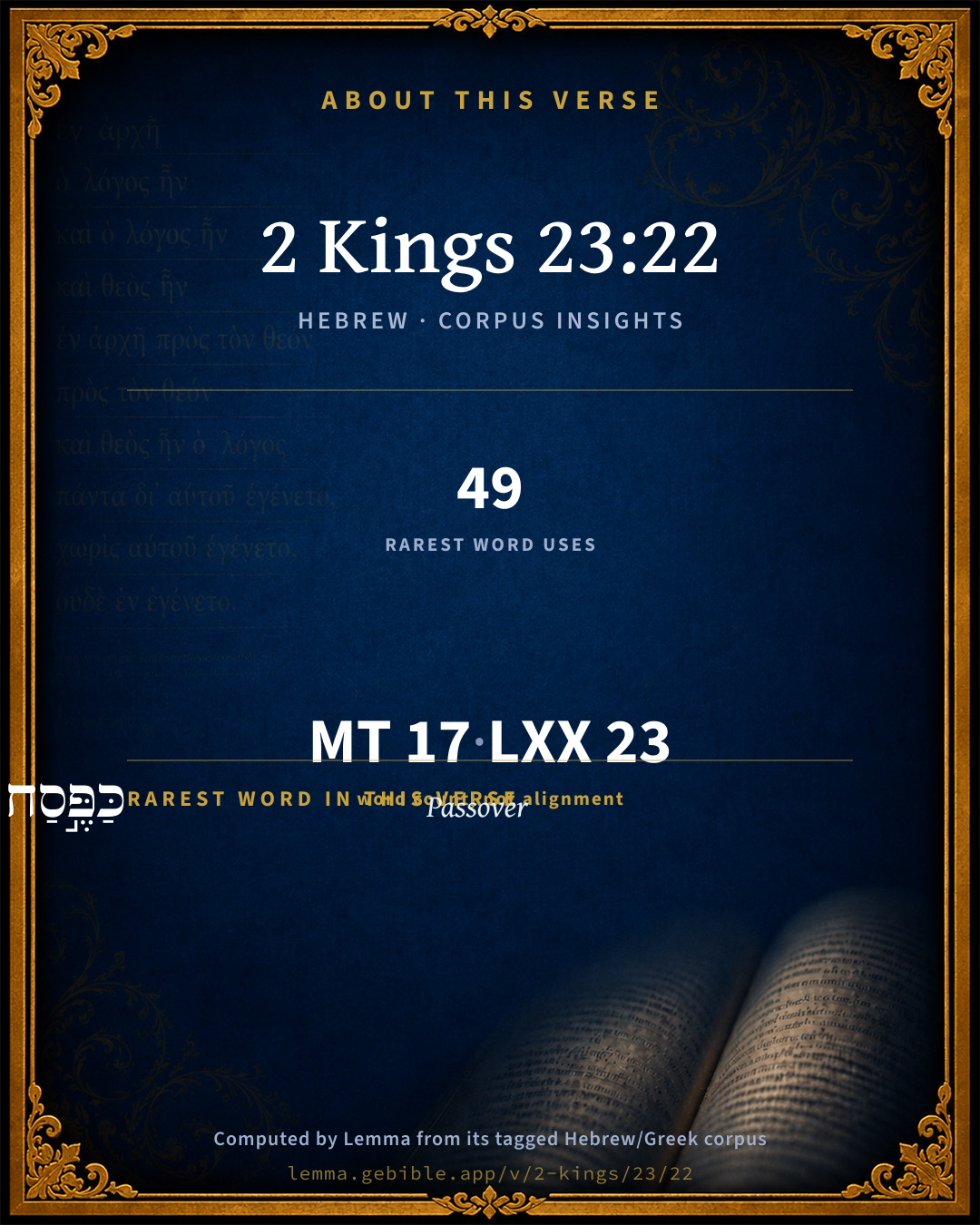
כַּפֶּ֣סַח Passover H6453 occurs in 46 verses of the Hebrew Bible. Also found in:

Grammatical profile

  • 3 verbs
  • 9 nouns
  • 1 pronoun
  • 1 conjunction
  • 3 particles

Verb forms

  • נַֽעֲשָׂה֙ Niphal · Perfect
  • הַשֹּׁ֣פְטִ֔ים Qal · Participle Active
  • שָׁפְט֖וּ Qal · Perfect

Repetition

Words recur within this verse — often emphatic in Hebrew:

  • מִימֵי֙ day H3117 ×2
  • הַשֹּׁ֣פְטִ֔ים to judge H8199 ×2
  • יִשְׂרָאֵ֑ל Israel H3478 ×2
  • מַלְכֵ֥י king H4428 ×2

Hebrew & Septuagint length

In English translation the verse runs 33 words from the Hebrew and 34 from the Septuagint (LXX English) — closely comparable.

A rough comparison of the two English renderings, which tokenize alike — not a word-level alignment.

Word counts can differ between the Hebrew and the Greek without any difference in meaning — e.g. the Hebrew direct-object marker אֵת has no separate Greek word, and Greek often adds the article ὁ.

In the original languages it is 17 Hebrew tokens and 23 Greek tokens — but the two are counted differently (Hebrew bundles its prefixes and suffixes into one token; the Greek is in lemma form), so that isn’t a like-for-like length.

Cross-references

3

Topical passages linked to 2 Kings 23:22 in the Treasury of Scripture Knowledge — connected by theme and wording, ordered by reader-vote popularity; previews shown in the World English Bible.

  • 2 Chronicles 30:1–3 Hezekiah sent to all Israel and Judah, and wrote letters also to Ephraim and Manasseh, that they should come to the house of Yahweh at Jerusalem, to keep the Passover to Yahweh, the God of Israel.
  • 2 Chronicles 30:13–20 There assembled at Jerusalem much people to keep the feast of unleavened bread in the second month, a very great assembly.
  • 2 Chronicles 35:3–19 He said to the Levites who taught all Israel, who were holy to Yahweh, Put the holy ark in the house which Solomon the son of David king of Israel did build; there shall no more be a burden on your shoulders: now serve Yahweh your God, and his people Israel.

Cross-references courtesy of OpenBible.info (CC BY 4.0).

Hebrew and Greek witnesses Masoretic Hebrew ↔ Greek Septuagint

The same verse in the two great witnesses to the Old Testament, shown verse-for-verse.

These are two independent witnesses, not word-aligned to each other, and the Septuagint is shown in lemma (dictionary) form.

Hebrew 2 Kings 23:22 Masoretic · Westminster Leningrad Codex

כִּ֣י לֹ֤א נַֽעֲשָׂה֙ כַּפֶּ֣סַח הַזֶּ֔ה מִימֵי֙ הַשֹּׁ֣פְטִ֔ים אֲשֶׁ֥ר שָׁפְט֖וּ אֶת יִשְׂרָאֵ֑ל וְכֹ֗ל יְמֵ֛י מַלְכֵ֥י יִשְׂרָאֵ֖ל וּמַלְכֵ֥י יְהוּדָֽה

Surely there was not kept such a Passover from the days of the judges who judged Israel, nor in all the days of the kings of Israel, nor of the kings of Judah;

World English Bible · Public Domain

Greek LXX 2 Kings 23:22 Septuagint · lemma form

ὅτι οὐ γίγνομαι ὁ πασχα οὗτος ἀπό ἡμέρα ὁ κριτής ὅς κρίνω ὁ ἰσραήλ καί πᾶς ὁ ἡμέρα βασιλεύς ἰσραήλ καί βασιλεύς ιουδα

For a passover such as this had not been kept from the days of the judges who judged Israel, even all the days of the kings of Israel, and of the kings of Juda.

LXX2012 (modern English Septuagint) · Public Domain

On this verse, Ellicott's Commentary for English Readers discusses the Septuagint’s reading. Read the note in Commentary ↓

Hebrew: Westminster Leningrad Codex (CC BY 4.0). Greek: Septuagint (public domain); English from LXX2012 (modern English Septuagint) (Public Domain). How the Septuagint differs from the Hebrew →

Targum (Aramaic paraphrase)

1

The Targum is the ancient Jewish Aramaic paraphrase of the Hebrew Scriptures — an interpretive translation, not the Hebrew text itself. Onkelos (literal) and Pseudo-Jonathan (expansive) render the Torah, and Jonathan the Prophets. Coverage is partial: where no permissively-licensed English translation exists for a verse, only the Aramaic is shown. This is verse-level text, not a word-by-word alignment to the Hebrew.

  1. Targum Jonathan Prophets (Joshua–Malachi)
    אֲרֵי לָא אִתְעֲבִיד כְּפִסְחָא הָדֵין מִיוֹמֵי נְגִידַיָא דְדָנוּ יַת יִשְׂרָאֵל וְכָל יוֹמֵי מַלְכֵי יִשְׂרָאֵל וּמַלְכַיָא דְבֵית יְהוּדָה:

    (no public-domain English translation for this verse)

    Targum Jonathan — Aramaic: “Mikraot Gedolot” (public domain). English: “Sefaria Community Translation” (CC0 1.0 (public-domain dedication)); “London "Chaldee Paraphrase," 1871” (public domain). Text via Sefaria.

Commentary

Notes on 2 Kings 23:22 from classic Christian and Jewish commentators (each source and its license shown beneath its notes). The classic Christian expositions comment on the surrounding passage and are grouped to its opening verse, so a note may address several verses; the Jewish commentaries on the Tanakh (Rashi and others) are per-verse, so they appear only where the commentator wrote on this verse.

Lemma curates 59 commentaries, every one of them public domain or Creative Commons licensed, each selected and text-cleaned for this edition rather than reprinted as found. About our sources →

Trapp's Complete Commentary

John Trapp

2Ki 23:22 Surely there was not holden such a passover from the days of the judges that judged Israel, nor in all the days of the kings of Israel, nor of the kings of Judah;

Ver. 22. Surely there was not holden such a passover,] viz., For concourse of people, and solemnity of the service. Tremellius rendereth it thus: Although there was not holden such a passover as this, viz., with such preparation, devotion, and reformation of religion; yet, {2Ki 23:26} "God turned not away from his wrath," &c., as being implacably bent and unchangeably resolved upon their utter ruin.

John Trapp, A Commentary or Exposition upon All the Books of the Old and New Testament (1647–1656) — public domain. Text from a community e-Sword module.

The Biblical Illustrator

Joseph S. Exell

2Ki_23:22

Surely there was not holden such a Passover.

Sincerity of repentance

There is something very striking and melancholy in these words. The children of Israel celebrated their last Passover, all being together, and in such a manner as had not been known since the earlier and better days of their possession of the promised land. It was, in fact, the last repentance of Gods people, and a lively repentance it seems to have been, to judge from outward tokens. But, alas! it did not continue. Three times already before this, Gods people had publicly repented, under the direction of pious princes, which were Jehoshaphat, Jehoash, Hezekiah. But now the appointed punisher of their sins was openly manifested to their sight in the terrible King of Babylon. And like the sick man with death before his eyes, they made earnest protestations of repentance and amendment if God would spare them, and sealed them with the celebration of the Sacrament of the Paschal Supper. Here, then, is before us the example of a fourth publicly professed repentance, and as ineffectual as the three that went before. Should it not lead us to take very close and scrutinising views of repentance, and to conclude that there must be something in it besides the present feeling of shame and sorrow, however sharp and lively that may be? There must be some abiding feeling in it, which shame and sorrow naturally are not. For the very sense of them drives us to rid ourselves of them by all means. What then can that be? What does God demand beyond the broken heart? Nothing, if it be indeed broken in His name. But here lies the question. Which does the man think most of, his own personal danger, or Gods damaged glory? Which does he lament most, his own loss, or Gods rejected love? Has he renounced the sinful selfishness of his nature? A man may keep this, and yet be overwhelmed with shame and sorrow; he may retain this, and yet manifest the most lively outward marks of repentance. So did Israel; and was led by it into his sins again, and they led him to the final judgment which came upon his head. Here is the cause of so many apparent repentances in the course of a mans life. Selfish sorrow, selfish shame have wrung his heart, and terrified his conscience. But he has not gone beyond self. He has seen, indeed, the miserable disorder which his sins have wrought in himself in body and in mind. But has he looked out and up to see the miserable disorder which they have also wrought in Gods work of love; how they have obscured the brightness of His glory, how they have shaken the faith of His Church, as far as His sphere extends; and who shall tell how far it extends? Here is the principle that is so commonly wanting; here is that which Israel lacked, the heavenly spirit, and not the earthly dregs only. When the heart has thus been lifted out of itself, divested of its earthliness and carnality, and has risen into heaven to see the majesty which it has affronted, the love which it has rejected, the glory which it has blasphemed, and thence also looks down again upon the scenes of its sin and mischief amongst Gods works and people, and sees them with a clear and sharp eye, and lively and enlightened conscience, as becomes a look from above--then, and not until then, a real repentance has taken place. Such repentance will abide in its effects. In such the heart of the man is changed, so that he has foregone his old appetites, and, therefore, is out of the way of temptation from his old sins. Even though it should force itself upon his sight, he will not allow it to gain his attention, but turn away from it with a stern watchfulness against its ensnaring deceitfulness. He sees in it the art of the enemy of the God whom he serves, of the Redeemer whom he loves, of the Holy Spirit whose guidance he follows. And such repentance, therefore, is both the first and the last. But Israel, we see, made at least four several professions of repentance; and so have many done since. The more frequent they have been, of course the less sincere they have been. And such repentances are more a proof of the folly and selfishness of the man, than of any right and spiritual feeling. They are but the sorrow for having come in for the penalty of his sin at last. And, as soon as the infliction shall have been removed, he is ready to sin again. And, indeed, after each successive fit, he is but the more ready, because he wishes to drown the voice of conscience, which exclaims against his yielding again to the old temptation; and it is drowned amid his shouts of enjoyment, until the hour of penalty comes round again; then the note is that of lamentation again. Why, what affronting of the majesty of God Almighty is here! So little can the penitent himself depend upon a repentance which does not begin until Gods judgment is at hand. How can a heart which he has taught to cheat him continually, and which, at all events, has never been diligently schooled in spiritual discernment; how shall this, at a moment, too, of such confusion, at a time, too, when it is so deeply interested in coming to the more joyful conclusion; how can it, with any certainty, distinguish the sorrow and fear which arose from the love of self, now that he is in Such danger, from the love of God, now that He is resorted to after long forgetfulness? Wilt it not be too glad to mistake the fear for the love? Will not, indeed, the fear most certainly be there? All this tells us, what a broken reed men lean upon who trust in a last sickness to any feeling of repentance which they have not felt and cherished in the time of their health. Then judgment was far off, and God was sought therefore from love rather than from fear. Health is the time of strength, for the spirit no less than for the body. Let health, then, be the season of true repentance, and sickness will be the season of comfort, and the hour of death the season of well-founded hope. (R. W. Evans, B. D.)

The Biblical Illustrator, edited by Joseph S. Exell (c. 1880s–1900s) — public domain. Text from a community e-Sword module.

Joseph Benson's Commentary

2Ki 23:22. Surely there was not holden such a passover, &c. — Celebrated with such solemn care, and great preparation, and numerous sacrifices, and universal joy of all good men; which was much the greater, because of their remembrance of the former wicked and miserable times under Manasseh and Amon; and the good hopes they now had of the happy establishment of their nation, and the true religion; and of the prevention of God’s judgments denounced against them. From the days of the judges — Or, of Samuel, the last of the judges; as it is expressed 2Ch 35:18. None of the kings had taken such care to prepare themselves, the priests, and people, and so accurately to observe all the rites, and diligently to purge out all uncleanness, and to renew their covenant with God. And undoubtedly God was pleased to recompense their zeal in destroying idolatry, with uncommon tokens of his presence and favour. All this concurred to make it such a passover as had not been even in the days of Hezekiah. For in his passover many communicated who were not cleansed according to the purification of the sanctuary, and the Levites were permitted to do the work of the priests.

Joseph Benson's Commentary on the Old and New Testaments (1811–1818) — public domain. Text from a community e-Sword module.

Geneva Bible (1599)

Geneva Bible translators

For the multitude and zeal of the people with the great preparation.

Geneva Bible (1599) marginal notes — public domain. Text via Bolls.life.

Adam Clarke's Commentary

Verse 22. Surely there was not holden such a passover] Not one on purer principles, more heartily joined in by the people present, more literally consecrated, or more religiously observed. The words do not apply to the number present, but to the manner and spirit. See the particulars and mode of celebrating this passover in 2Ch 35:1-18.

Adam Clarke's Commentary on the Bible (1810–1826) — public domain. Text from a community e-Sword/MySword module.

Ellicott's Commentary for English Readers

(22) Surely there was not holden . . .—For there was not holden (a passover) like this passover. This and the next verse constitute a parenthetic remark, in which the historian emphasises the phrase, “As it is written in this book of the covenant.” No passover, from the time of the Judges onward had been celebrated in such strict conformity to the prescriptions of the Law. The LXX. omits the particle of comparison: ὅτι οὐκ ἐγενήθη τὸ πασχα τοῦτο. On the ground of this difference, and the one mentioned in the Note on 2Ki_23:21, Thenius thinks it not improbable that the text of Kings has been altered to bring into harmony with the account in Chronicles about the restoration of the feast of the passover by Hezekiah—a weighty inference from such slight data. The chronicler repeats this very verse at the close of his narrative of Josiah’s passover (2Ch_35:18).

A Bible Commentary for English Readers, edited by Charles John Ellicott (1878–1897) — public domain. Text from a community e-Sword module.

The Cambridge Bible for Schools and Colleges

gen. ed. J. J. S. Perowne

22. Surely there was not holden [R.V. kept] such a passover] The same change is also required in the next verse. The king had said ‘Keep the passover’.

This verse cannot be tortured into the meaning which some have put upon it, that the passover had been wholly neglected since the days of the Judges, or as the Chronicler puts it, ‘the days of Samuel the prophet’, and through all the reigns of the previous kings of Judah, with the exception of the one recorded passover of Hezekiah. That the passovers are not mentioned comes about because they were a part of the life of the nation, which went on its natural round as a matter of course. That there was a relaxation in portions of the observance we can have no doubt, but that passovers ceased is as little to be accepted as that there was no observance of the great day of atonement because we do not read of it in the books of Samuel or Kings. It is not possible to believe that provision should have been regularly made for placing the ark of the covenant in a separate room, and that Solomon should have made the elaborate arrangements which he did for the Most holy place, and yet that there should have been no regard paid to the one solemn service for which alone the ark and the Holy of Holies were provided. Both the passover and the day of atonement were observed, though there were times when insufficient regard was paid to the required ceremonial. The passover of Josiah however went back to the complete form ordained in this book of the covenant, and in that respect was remarkable above all those which had been held since the days of Joshua and the elders that outlived Joshua, after which days (Jdg_2:10) ‘there arose another generation’ and the people fell away, and the ceremonial law was but partially observed, and never so strictly through all that period as in this great passover of king Josiah.

The Cambridge Bible for Schools and Colleges (gen. ed. J. J. S. Perowne; Cambridge University Press, 1878–1918) — public domain. Text from a community e-Sword module.

John Gill's Exposition

But in the eighteenth year of king Josiah, wherein this passover was holden to the Lord in Jerusalem. This shows that Josiah must begin the reformation very early that year, since he did all that is before recorded in this and the preceding chapter by the fourteenth of Nisan, the day on which the passover was kept, which month answers to part of our March and part of April, see Kg2 22:3 and was the same year the repairs of the temple were finished.

and was the same year the repairs of the temple were finished.

2 Kings 23:24

kg2 23:24

kg2 23:24

kg2 23:24Moreover, the workers with familiar spirits, and the wizards,.... Who were not to be allowed among the Israelites, Deu 18:10.

and the images; or teraphim: and the idols, and all the abominations; which were worshipped by the Heathens, and introduced among the Jews, and forbidden by the word of God:

that were spied in the land of Judah, and in Jerusalem, did Josiah put away; for which, it seems, diligent search was made, and wherever they were discovered were removed:

that he might perform the words of the law, which were written in the book that Hilkiah the priest found in the house of the Lord; both with respect to witchcraft and idolatry, see Lev 20:27.

John Gill's Exposition of the Whole Bible (1746–1763) — public domain (CC PDM 1.0). Text via the HelloAO Bible API.

Albert Barnes' Notes on the Bible

The details of the Passover are given by the author of Chronicles (the marginal reference). Its superiority to other Passovers seems to have consisted:

(1) in the multitudes that attended it; and

(2) in the completeness with which all the directions of the Law were observed in the celebration. Compare Neh 8:17.

Albert Barnes' Notes on the Bible (1834–1885) — public domain. Text from a community e-Sword/MySword module.

Haydock's Catholic Bible Commentary

No such, is all respects. (Haydock) --- The number of paschal lambs was certainly greater when all Israel was assembled; but the other victims presented by the king and his officers during the octave is here noticed, (2 Paralipomenon xxxv. 7.; Menochius) as they are also styled the Phase; (Haydock) and this explains John xviii. 28. (Tirinus) --- Neither ought we to push these expressions too far, as they only mean, that this solemnity was very great. See ver. 25., and chap. xviii. 5. (Calmet)

George Leo Haydock (1774–1849), Haydock's Catholic Family Bible and Commentary, 1859 edition — public domain. Excludes Psalms (Douay-Rheims chapter numbering differs from Protestant) and Deuterocanonical books (Catholic canon only).

Matthew Poole's English Annotations

Such a passover, i.e. celebrated with such solemn care, and great preparation, and numerous sacrifices. 2Ch 35:7-9, and universal joy of all good men; which was much the greater, because of their remembrance of the former wicked and miserable times under Manasseh and Amon; and the good hopes they now had of the happy establishment of their nation, and the true religion; and of the prevention of God’s judgments denounced against them.

From the days of the judges, or, from the days of Samuel, the last of the judges, as it is expressed, 2Ch 35:8. None of the kings had taken such care to prepare themselves, the priests, and people, and accurately to observe all the rites, and diligently to purge out all uncleanness, and to renew their covenant with God, so solemnly as Josiah now did.

Matthew Poole's English Annotations on the Holy Bible (1683–1685) — public domain. Text from a community e-Sword/MySword module.

Whedon's Commentary on the Bible

Daniel D. Whedon

22. There was not holden such a passover — Not that Israel had utterly failed to observe any passover from the days of the Judges to this time, for we are expressly told in 2 Chronicles 30 that Hezekiah held a passover, though it was not strictly according to the direction of the law, and it is not supposable that a Festival so prominent in the Israelitish cultus as this had been neglected under David, and Solomon, and other pious kings. But no such a passover had been held, none so strictly conformed in all things to the very letter of the law of Moses.

Daniel D. Whedon (gen. ed.), Commentary on the Old and New Testaments (1874–1909) — public domain. Text from a community e-Sword module.

The Pulpit Commentary

Surely there was not holden such a Passover from the days of the judges that judged Israel, nor in all the days of the kings of Israel, nor of the kings of Judah. Such a Passover, one so numerously attended. (2Ch_35:18) and so exactly kept according to every ordinance of the Law of Moses, (2Ch_35:6) had not been celebrated during all the period of the judges, from Joshua to Samuel, nor under the kings of all Israel, Saul, David, and Solomon, nor under those of the separated kingdom of Judah, from Rehoboam to this year (the eighteenth) of Josiah. It is an extraordinary perversity which concludes (as do De Wette and Thenius), from this comparison of the present with former Passovers under the judges and the kings, that there had been no such former Passovers at all! Two, at any rate, are recorded (Jos_5:10, Jos_5:11; 2Ch_30:13-26) Ewald has the good sense to express his dissent from this view, and to declare the meaning of the writer to be simply that "since the time of the judges there had never been such a celebration of the Passover, in such strict accordance, that is, with the prescriptions of a sacred book as that which now took place" (see his "History of Israel," vol. 4. p. 239, Eng. trans.).

The Pulpit Commentary (1880–1919), ed. H.D.M. Spence-Jones & Joseph S. Exell — public domain. Text from a community e-Sword module.

John Wesley's Explanatory Notes

Such a passover - Celebrated with such solemn care, and great preparation, and numerous sacrifices, and universal joy of all good men; which was much the greater, because of their remembrance of the former wicked and miserable times under Manasseh, and Amon; and the good hopes they now had of the happy establishment of their nation, and the true religion; and of the prevention of God's judgments denounced against them. Judges - Or, from the days of Samuel, the last of the Judges; as it is expressed 2 Chron. xxxv, 18. None of the kings had taken such care to prepare themselves, the priests, and people, and accurately to observe all the rites, and diligently to purge out all uncleanness, and to renew their covenant with God. And undoubtedly God was pleased to recompense their zeal in destroying idolatry with uncommon tokens of his presence and favour. All this concurred to make it such a passover as had not been, even in the days of Hezekiah.

John Wesley, Explanatory Notes Upon the Whole Bible (1754–1765) — public domain. Text via the GEBible commentary corpus.

Rashi

Rabbi Shlomo Yitzchaki (Rashi)

Such a Pesach sacrifice had not been offered. So many people had not assembled at any Pesach sacrifice as had assembled at this one.

Since the time of the Judges. ”Since the time of Shmuel,” In Divrei Hayomim, it is written, because Shmuel, too, led Yisroel to improve their ways, and he assembled them to Mitzpoh. Alternatively, such a Pesach had not been offered to God in Yerusholayim, [i.e.,] (but) when the kings of Yisroel and the kings of Yehudah reigned, all Yisroel did not perform a Pesach sacrifice in Yerusholayim, because the kingdom had been divided in two since Yorovom, and they would go to the calf in Beis Eil and in Dan until now, that the ten tribes were exiled, and Yirmiyohu brought them back, and Yoshiyahu reigned over them, and they all came to Yerusholayim.

Rashi on the Tanakh — English translations: “The Judaica Press complete Tanach with Rashi, translated by A. J. Rosenberg” (CC BY 4.0); “Pentateuch with Rashi's commentary by M. Rosenbaum and A.M. Silbermann, 1929-1934” (public domain); “The Metsudah Tanach series, Lakewood, N.J” (CC BY 4.0); and “The Book of Joshua, Metsudah Publications, 1997” (CC BY 4.0). Text via Sefaria.

Lesson kit

Teaching starters — assembled from the data on this page, not authored interpretation. Every prompt links to the verse data it draws on. Edit before teaching.

2 Kings, in the Historical, opens this verse with 17 words (13 distinct Hebrew lemmas). Its most distinctive word is peçach (“Passover”). A historical commentator’s framing appears above. Read the whole chapter for the surrounding context.

Discussion questions

  1. How does “Passover” (peçach) shape what this verse is saying?
  2. How does Exodus 12:11, which shares the word «Passover», read alongside this verse?
  3. What does the repetition of “day” (2× in this one verse) do in this verse?
  4. These translations render this verse differently; the difference is in the English rendering, not the original. What questions does that raise?
  5. «נַֽעֲשָׂה֙» is a Niphal Perfect verb. How does that grammatical form shape the action described?
  6. Compare how Trapp's Complete Commentary and The Biblical Illustrator read this verse. Where do they agree or differ?

Things to notice

Reading settings

Reading text

Shown beneath each verse's original-language words.

Old Testament
Old Testament edition

Read the OT as the Masoretic Hebrew (MT) or the Greek Septuagint (LXX).

English shown for the Greek Septuagint (in the Hebrew ↔ Greek comparison).

Comparing translations? Open the Compare panel on any verse page to stack up to four side by side.