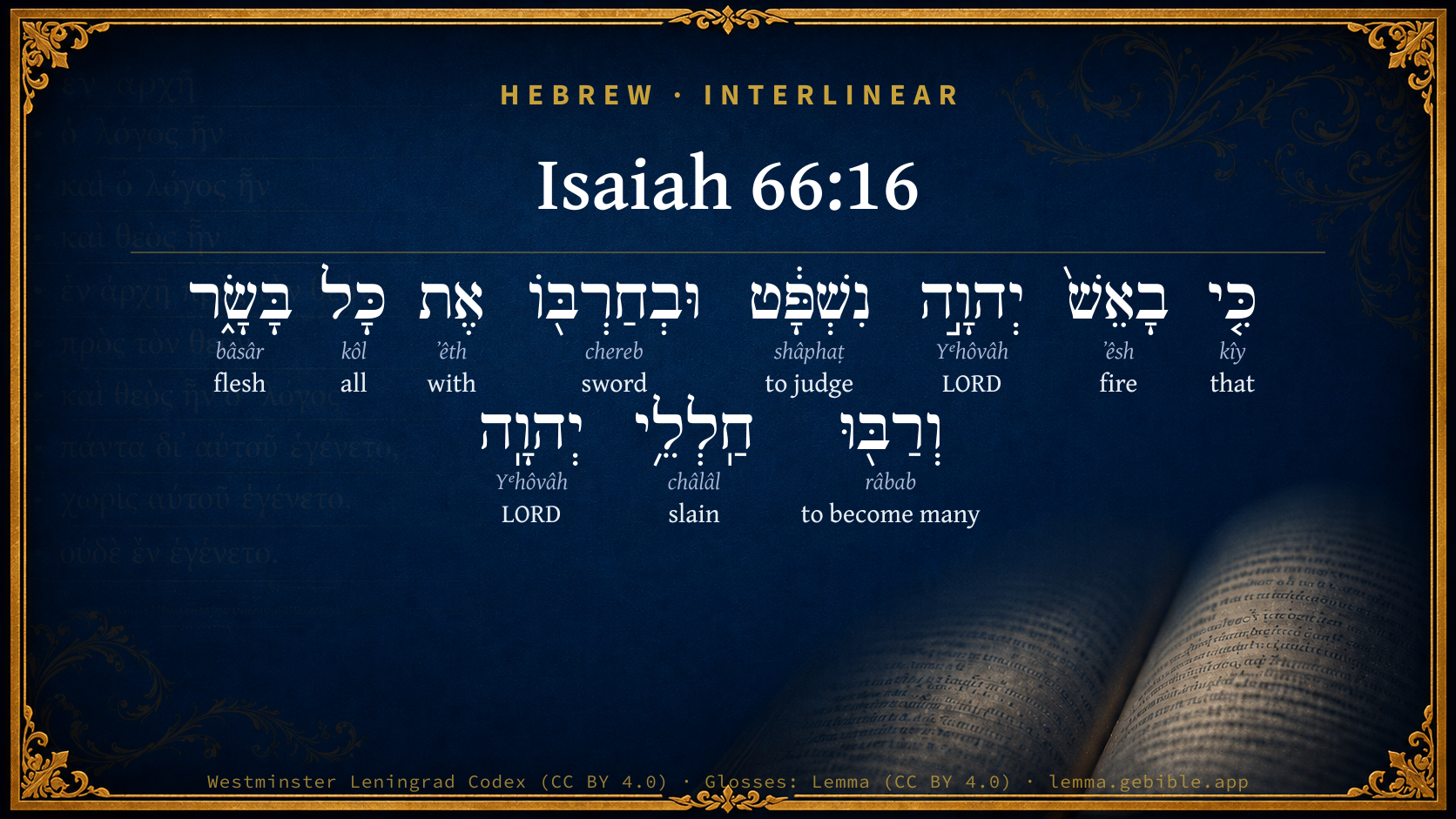
Isaiah 66:16

Hebrew (Westminster Leningrad Codex) Isaiah 66:16 appears in the Hebrew Old Testament. The text above is from the Westminster Leningrad Codex. Each word links to its Strong’s number, a concise gloss, and parsing drawn from the Open Scriptures Hebrew Bible morphology. Click any word for its full Brown-Driver-Briggs (BDB) entry.
Download image
Cite this verse

Isaiah 66:16 (World English Bible). Public Domain. Lemma interlinear Bible study tool, https://lemma.gebible.app/v/isaiah/66/16.

Show BibTeX & RIS
BibTeX
RIS
English Translation
For by fire will Yahweh execute judgment, and by his sword, on all flesh; and the slain of Yahweh shall be many.
World English Bible · Public Domain
Download a study sheet

One document with this verse’s original text, its word-by-word gloss line, the meaning frame, cross-references with their text, attributed commentary, and full source and license credits — printable, and it pastes into notes with its structure intact.

This verse Autodidact and up

Study sheet (.html) Plain text (.txt)

A passage Seminary Student

Up to 50 verses in one chapter. A passage sheet keeps up to 6 commentary sources and 12 cross-references per verse, in the order this page ranks them, and says so on the sheet whenever that leaves anything out. Ask for a single verse and you get the Autodidact verse sheet above.

Everything on this page stays free to read, with no account — the sheet is a download of what is already on screen, not access to it.

Want to remove ads? Support Godless Engineer
Compare translations 3

The same verse in 3 English versions, stacked beneath the original-language interlinear above. Click any original word for its lexicon entry.

Each is an independent rendering of the whole verse — the interlinear is not word-aligned to these translations.

Highlighted words mark where these versions differ — a whole-verse word diff, not a word-by-word alignment.

  • World English Bible Public Domain
    For by fire will Yahweh execute judgment, and by his sword, on all flesh; and the slain of Yahweh shall be many.
  • King James Version Public Domain
    For by fire and by his sword will the LORD plead with all flesh: and the slain of the LORD shall be many.
  • unfoldingWord Literal Text CC BY-SA 4.0
    For Yahweh is judging with fire and by his sword against all flesh, and the slain of Yahweh will be many.

unfoldingWord Literal Text — © unfoldingWord, licensed CC BY-SA 4.0. Word-aligned USFM3 via Door43 (git.door43.org/unfoldingWord/en_ult).

Versions to compare (up to 4)

3 of 4 selected

Show all 18 translations

Every available English version of this verse, each an independent rendering of the whole verse.

  • World English Bible Public Domain
    For by fire will Yahweh execute judgment, and by his sword, on all flesh; and the slain of Yahweh shall be many.
  • Berean Standard Bible Public Domain
    For by fire and by His sword, the LORD will execute judgment on all flesh, and many will be slain by the LORD.
  • Majority Standard Bible Public Domain
    For by fire and by His sword, the LORD will execute judgment on all flesh, and many will be slain by the LORD.
  • King James Version Public Domain
    For by fire and by his sword will the LORD plead with all flesh: and the slain of the LORD shall be many.
  • American Standard Version (1901) Public Domain
    For by fire will Jehovah execute judgment, and by his sword, upon all flesh; and the slain of Jehovah shall be many.
  • Revised Version (1885) Public Domain
    For by fire will the LORD plead, and by his sword, with all flesh: and the slain of the LORD shall be many.
  • Geneva Bible (1599) Public Domain
    For the Lord will iudge with fire, and with his sworde all flesh, and the slaine of the Lord shall be many.
  • Douay-Rheims (1899) Public Domain
    For the Lord shall judge by fire, and by his sword unto all flesh, and the slain of the Lord shall be many.
  • Young's Literal Translation Public Domain
    For by fire and by His sword, Doth Jehovah do judgment with all flesh. And many have been Jehovah's pierced ones.'
  • Literal Standard Version CC BY-SA 4.0
    For by fire and by His sword, || YHWH does judgment with all flesh. And many have been YHWH’s pierced ones.
  • Unlocked Literal Bible CC BY-SA 4.0
    For Yahweh executes judgment on mankind by fire and with his sword. Those killed by Yahweh will be many.
  • unfoldingWord Literal Text CC BY-SA 4.0
    For Yahweh is judging with fire and by his sword against all flesh, and the slain of Yahweh will be many.
  • Darby Bible Public Domain
    For by fire and by his sword will Jehovah enter into judgment with all flesh: and the slain of Jehovah shall be many.
  • World Messianic Bible Public Domain
    For the LORD will execute judgment by fire and by his sword on all flesh; and those slain by the LORD will be many.
  • Webster's Bible Public Domain
    For by fire and by his sword will the LORD plead with all flesh: and the slain of the LORD shall be many.
  • Free Bible Version CC BY-SA 4.0
    The Lord will execute judgment on everyone by fire and by his sword. There will be many killed by the Lord.
  • Bible in Basic English Public Domain
    For with fire and sword will the Lord come, judging all the earth, and his sword will be on all flesh: and great numbers will be put to death by him.
  • JPS Tanakh (1917) Public Domain
    For by fire will the LORD contend, and by His sword with all flesh; and the slain of the LORD shall be many.

Literal Standard Version (2020), Covenant Press — licensed CC BY-SA 4.0. Text via the HelloAO Bible API (eBible.org). Unlocked Literal Bible (unfoldingWord) — licensed CC BY-SA 4.0. Text via the HelloAO Bible API (eBible.org). unfoldingWord Literal Text — © unfoldingWord, licensed CC BY-SA 4.0. Word-aligned USFM3 via Door43 (git.door43.org/unfoldingWord/en_ult). Free Bible Version, Dr. Jonathan Gallagher — licensed CC BY-SA 4.0. Text via the HelloAO Bible API (eBible.org).

Word by word

More ways to search: Search by grammar → Find every occurrence → Compare this word →

Practice this passage: Drill this verse → Learn its vocabulary →

וְרַבּ֖וּ
râbab
H7231
“and · to become many”
Conjunction + Verb, Qal, Sequential Perfect, 3rd Person, Common, Plural
Part of Speech
Conjunction + Verb
Stem
Qal
Form
Sequential Perfect
Person
3rd Person
Gender
Common
Number
Plural
Full BDB Definition

Origin: a primitive root

TWOT: 2099

to be or become many, be or become much, be or become great - (Qal) - to be or become many - to be or become great - to be long (of journey) - (Pual) ten thousands
  1. כִּ֤י kîy H3588 “that” Conjunction
  2. בָאֵשׁ֙ ʼêsh H784 “in/at the · fire” Preposition, Determined + Noun, Common, Both, Singular, Absolute
  3. יְהוָ֣ה Yᵉhôvâh H3068 “LORD” Noun, Proper
  4. נִשְׁפָּ֔ט shâphaṭ H8199 “judging” Verb, Niphal, Participle Active, Masculine, Singular, Absolute
  5. וּבְחַרְבּ֖וֹ chereb H2719 “and · in/at · sword · his” Conjunction + Preposition + Noun, Common, Feminine, Singular, Construct + Suffix, Personal, 3rd Person, Masculine, Singular
  6. אֶת ʼêth H854 “with” Preposition
  7. כָּל kôl H3605 “all of” Noun, Common, Masculine, Singular, Construct
  8. בָּשָׂ֑ר bâsâr H1320 “flesh” Noun, Common, Masculine, Singular, Absolute
  9. חַֽלְלֵ֥י châlâl H2491 “slain of” Adjective, Adjective, Masculine, Plural, Construct
  10. יְהוָֽה Yᵉhôvâh H3068 “LORD” Noun, Proper

About this verse

These counts appear in no published source. They are computed here, from the morphology-tagged text and Lemma’s own curated glosses. What Lemma adds →

11
words
10
distinct lemmas
Prophets
section

Notable vocabulary

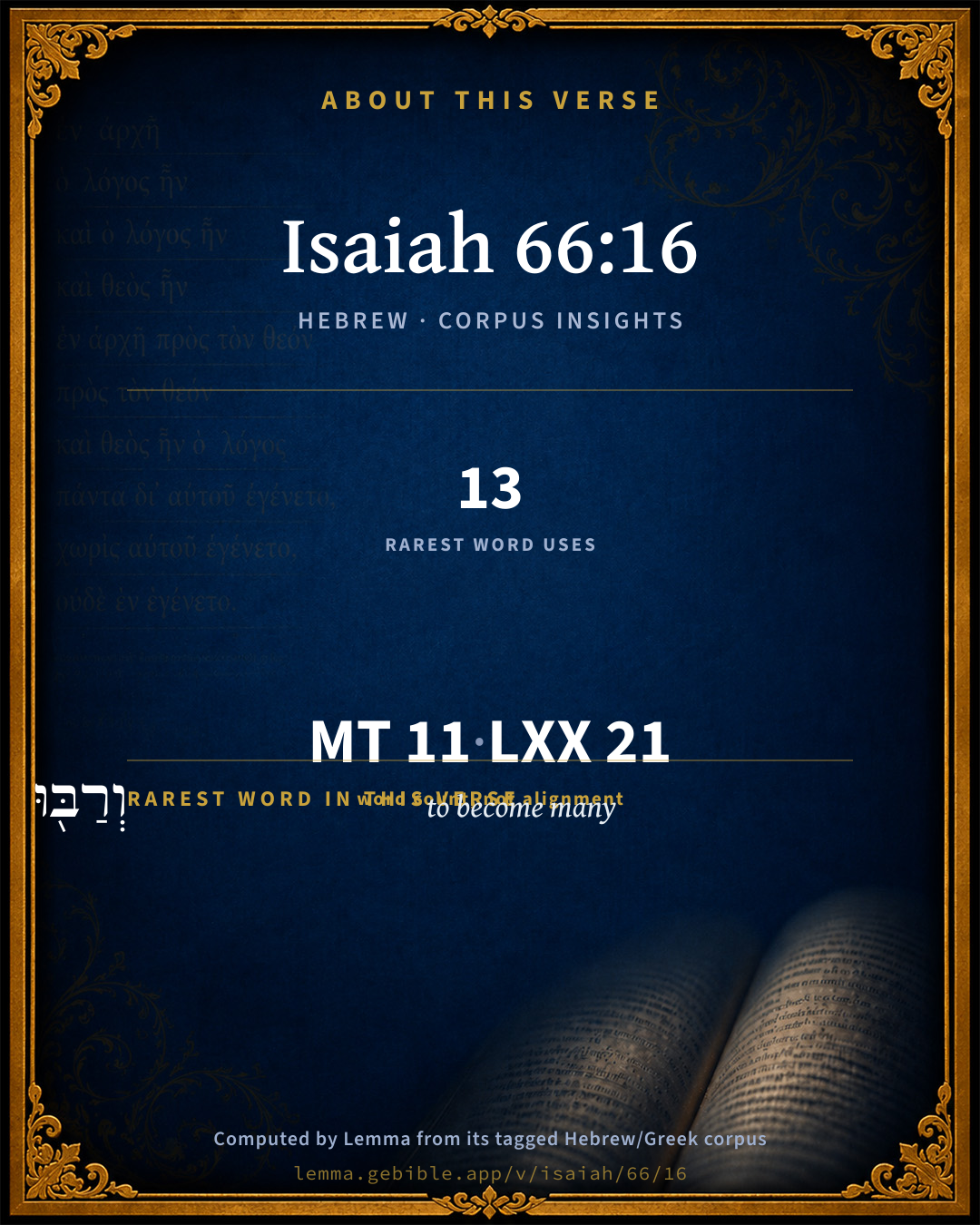
The rarest word here is וְרַבּ֖וּ to become many H7231 — appearing just 13 times in the whole Hebrew Bible.

Shared distinctive vocabulary

וְרַבּ֖וּ to become many H7231 occurs in 13 verses of the Hebrew Bible. Also found in:

Grammatical profile

  • 2 verbs
  • 6 nouns
  • 1 adjective
  • 1 preposition
  • 1 conjunction

Verb forms

  • נִשְׁפָּ֔ט Niphal · Participle Active
  • וְרַבּ֖וּ Qal · Sequential Perfect

Repetition

A word recurs within this verse — often emphatic in Hebrew:

  • יְהוָ֣ה LORD H3068 ×2

Hebrew & Septuagint length

In English translation the verse runs 22 words from the Hebrew and 26 from the Septuagint (LXX English) — closely comparable.

A rough comparison of the two English renderings, which tokenize alike — not a word-level alignment.

Word counts can differ between the Hebrew and the Greek without any difference in meaning — e.g. the Hebrew direct-object marker אֵת has no separate Greek word, and Greek often adds the article ὁ.

In the original languages it is 11 Hebrew tokens and 21 Greek tokens — but the two are counted differently (Hebrew bundles its prefixes and suffixes into one token; the Greek is in lemma form), so that isn’t a like-for-like length.

Cross-references

6

Topical passages linked to Isaiah 66:16 in the Treasury of Scripture Knowledge — connected by theme and wording, ordered by reader-vote popularity; previews shown in the World English Bible.

  • Ezekiel 38:21–22 I will call for a sword against him to all my mountains, says the Lord Yahweh: every man's sword shall be against his brother.
  • Isaiah 30:30 Yahweh will cause his glorious voice to be heard, and will show the lighting down of his arm, with the indignation of [his] anger, and the flame of a devouring fire, with a blast, and tempest, and hailstones.
  • Ezekiel 39:2–10 and I will turn you about, and will lead you on, and will cause you to come up from the uttermost parts of the north; and I will bring you on the mountains of Israel;
  • Isaiah 27:1 In that day Yahweh with his hard and great and strong sword will punish leviathan the swift serpent, and leviathan the crooked serpent; and he will kill the monster that is in the sea.
  • Revelation 19:11–21 I saw the heaven opened, and behold, a white horse, and he who sat on it is called Faithful and True. In righteousness he judges and makes war.
  • Isaiah 34:5–10 For my sword has drunk its fill in the sky: behold, it shall come down on Edom, and on the people of my curse, to judgment.

Cross-references courtesy of OpenBible.info (CC BY 4.0).

Hebrew and Greek witnesses Masoretic Hebrew ↔ Greek Septuagint

The same verse in the two great witnesses to the Old Testament, shown verse-for-verse.

These are two independent witnesses, not word-aligned to each other, and the Septuagint is shown in lemma (dictionary) form.

Hebrew Isaiah 66:16 Masoretic · Westminster Leningrad Codex

כִּ֤י בָאֵשׁ֙ יְהוָ֣ה נִשְׁפָּ֔ט וּבְחַרְבּ֖וֹ אֶת כָּל בָּשָׂ֑ר וְרַבּ֖וּ חַֽלְלֵ֥י יְהוָֽה

For by fire will Yahweh execute judgment, and by his sword, on all flesh; and the slain of Yahweh shall be many.

World English Bible · Public Domain

Greek LXX Isaiah 66:16 Septuagint · lemma form

ἐν γάρ ὁ πῦρ κύριος κρίνω πᾶς ὁ γῆ καί ἐν ὁ ῥομφαία αὐτός πᾶς σάρξ πολύς τραυματίας εἰμί ὑπό κύριος

For with the fire of the Lord all the earth shall be judged, and all flesh with his sword: many shall be slain by the Lord.

LXX2012 (modern English Septuagint) · Public Domain

Hebrew: Westminster Leningrad Codex (CC BY 4.0). Greek: Septuagint (public domain); English from LXX2012 (modern English Septuagint) (Public Domain). How the Septuagint differs from the Hebrew →

Targum (Aramaic paraphrase)

1

The Targum is the ancient Jewish Aramaic paraphrase of the Hebrew Scriptures — an interpretive translation, not the Hebrew text itself. Onkelos (literal) and Pseudo-Jonathan (expansive) render the Torah, and Jonathan the Prophets. Coverage is partial: where no permissively-licensed English translation exists for a verse, only the Aramaic is shown. This is verse-level text, not a word-by-word alignment to the Hebrew.

  1. Targum Jonathan Prophets (Joshua–Malachi)
    אֲרֵי בְּאֶשְׁתָּא עֲתִיד יְיָ לְמִידַן וּבְחַרְבֵּיהּ יַת כָּל בִּשְׂרָא וְסַגִיאִין קְטִילַיָא קֳדָם יְיָ:

    For by fire and by His sword will the Lord judge all flesh, and the slain shall be many before the Lord.

    Targum Jonathan — Aramaic: “Mikraot Gedolot” (public domain). English: “Sefaria Community Translation” (CC0 1.0 (public-domain dedication)); “London "Chaldee Paraphrase," 1871” (public domain). Text via Sefaria.

Commentary

Notes on Isaiah 66:16 from classic Christian and Jewish commentators (each source and its license shown beneath its notes). The classic Christian expositions comment on the surrounding passage and are grouped to its opening verse, so a note may address several verses; the Jewish commentaries on the Tanakh (Rashi and others) are per-verse, so they appear only where the commentator wrote on this verse.

Lemma curates 59 commentaries, every one of them public domain or Creative Commons licensed, each selected and text-cleaned for this edition rather than reprinted as found. About our sources →

Trapp's Complete Commentary

John Trapp

Isa 66:16 For by fire and by his sword will the LORD plead with all flesh: and the slain of the LORD shall be many.

Ver. 16. For with fire.] Than which nothing is more formidable.

And with his sword.] Which is no ordinary one. {Isa 27:1}

John Trapp, A Commentary or Exposition upon All the Books of the Old and New Testament (1647–1656) — public domain. Text from a community e-Sword module.

Keil & Delitzsch

C. F. Keil & F. Delitzsch

Jehovah appears with these warlike terrors because He is coming for a great judgment. "For in the midst of fire Jehovah holds judgment, and in the midst of His sword with all flesh; and great will be the multitude of those pierced through by Jehovah." The fire, which is here introduced as the medium of judgment, points to destructive occurrences of nature, and the sword to destructive occurrences of history. At the same time all the emphasis is laid here, as in Isa 34:5-6 (cf., Isa 27:1), upon the direct action of Jehovah Himself. The parallelism in Isa 66:16 is progressive. Nishpat 'ēth, "to go into judgment with a person," as in Eze 38:22 (cf., עם in Isa 3:14, Joe 3:2; Ch2 22:8; μετά, Luk 11:31-32). We find a resemblance to Isa 66:16 in Zep 2:12, and this is not the only resemblance to our prophecy in that strongly reproductive prophet.

Keil & Delitzsch — Biblical Commentary on the Old Testament (1861–1891) — public domain (CC PDM 1.0). Text via the HelloAO Bible API. (Old Testament only.)

Jamieson, Fausset & Brown

Robert Jamieson, A. R. Fausset & David Brown

Rather, "With fire will Jehovah judge, and with His sword (He will judge) all flesh." The parallelism and collocation of the Hebrew words favor this (Isa 65:12).

all flesh--that is, all who are the objects of His wrath. The godly shall be hidden by the Lord in a place of safety away from the scene of judgment (Isa 26:20-21; Psa 31:20; Th1 4:16-17).

Jamieson, Fausset & Brown — Commentary Critical and Explanatory on the Whole Bible (1871) — public domain (CC PDM 1.0). Text via the HelloAO Bible API.

Ellicott's Commentary for English Readers

(16) Will the Lord plead . . .—Better, will the Lord hold judgment. The thoughts of the seer pass on to the retributive side of the Divine righteousness. Fire and sword have been used by the enemies of God against His people, and shall, in turn, be the instruments of His vengeance. The “sword” may, however, be the symbol of the Divine judgment, apart from any reference to its human instrument (Deu_32:41; Rev_1:16).

A Bible Commentary for English Readers, edited by Charles John Ellicott (1878–1897) — public domain. Text from a community e-Sword module.

The Cambridge Bible for Schools and Colleges

gen. ed. J. J. S. Perowne

16. by his sword] See ch. Isa_27:1, Isa_34:5-6.

plead] i.e. “enter into judgement,” as Eze_38:22; Joe_3:2. the slain of the Lord shall be many] Cf. Jer_25:33; Zep_2:12 (Hebr.)

The Cambridge Bible for Schools and Colleges (gen. ed. J. J. S. Perowne; Cambridge University Press, 1878–1918) — public domain. Text from a community e-Sword module.

John Gill's Exposition

For by fire, and by his sword, will the Lord plead with all flesh,.... With the Mahometans, the Turks, the Ottoman empire, against whom he will call for a sword, and will rain upon them fire and brimstone, signified by Gog and Magog, Eze 38:22 and with the other antichristian powers at the battle of Armageddon; and when the fourth vial will be poured upon the sun, and men will be scorched with fire; see Rev 16:8,

and the slain of the Lord shall be many; that is, those that will be slain by the Lord, both in the attempt of the Turks to recover the land of Canaan out of the hands of the Jews, possessed of it; whose numbers of slain will be so many, that the burying of them will last seven months, Eze 39:12 and in the battle between the Christian princes, Christ at the head of them, and the antichristian armies, led on by the beast and the kings of the earth; when the fowls of the air will be invited to the great supper of the Lord, to eat the flesh of kings, captains, and mighty men, so great will the slaughter be, Rev 19:17, see also Isa 11:13.

John Gill's Exposition of the Whole Bible (1746–1763) — public domain (CC PDM 1.0). Text via the HelloAO Bible API.

Albert Barnes' Notes on the Bible

For by fire and by his sword - The sword is an instrument by which punishment is executed (see the notes at Isa 34:5; compare Rom 13:4).

Will he plead with all flesh - Or rather, he will judge (נשׁפט nı̂shephaṭ), that is, he will execute his purposes of vengeance on all the human race. Of course, only that part is intended who ought to be subject to punishment; that is, all his foes.

And the slain of the Lord shall be many - The number of those who shall be consigned to woe shall be immense - though in the winding up of the great drama at the close of the world, there is reason to hopethat a large proportion of the race, taken as a whole, will be saved. Of past generations, indeed, there is no just ground of such hope; of the present generation there is no such prospect. But brighter and happier times are to come. The true religion is to spread over all the world, and for a long period is to prevail; and the hope is, that during that long period the multitude of true converts will be so great as to leave the whole number who are lost, compared with those who are saved, much less than is commonly supposed. Still the aggregate of those who are lost, ‘the slain of the Lord,’ will be vast. This description I regard as having reference to the coming of the Lord to judgment (compare 2Th 1:8); or if it refer to any other manifestation of Yahweh for judgment, like the destruction of Jerusalem by the Romans, it has a strong resemblance to the final judgment; and, like the description of that by the Saviour Matt. 24, the language is such as naturally to suggest, and to be applicable to, the final judgment of mankind.

Albert Barnes' Notes on the Bible (1834–1885) — public domain. Text from a community e-Sword/MySword module.

Haydock's Catholic Bible Commentary

Many. Few are chosen. (Haydock) --- All the wicked shall perish eternally. (Menochius)

George Leo Haydock (1774–1849), Haydock's Catholic Family Bible and Commentary, 1859 edition — public domain. Excludes Psalms (Douay-Rheims chapter numbering differs from Protestant) and Deuterocanonical books (Catholic canon only).

Matthew Poole's English Annotations

This kind of rebuking is also called a pleading with them; so he threatens to plead against Gog with pestilence and blood, Eze 38:22. God at first pleads with sinners by words; but if he cannot so prevail, he will plead with them in a way by which he will overcome by fire, pestilence, and blood.

With all flesh; thus he threatens to do with all sinners, or with all the wicked Jews.

The slain of the Lord shall be many; to the fire he threatens to add the sword, so as the slain of the Lord, that is, those whom God should cause to be slain, should be many.

Matthew Poole's English Annotations on the Holy Bible (1683–1685) — public domain. Text from a community e-Sword/MySword module.

The Pulpit Commentary

By fire and by his sword (see the introductory paragraph). The "sword of Jehovah" is spoken of also in Isa_27:1 and Isa_34:5, 6 Rev_19:15, Rev_19:21. Will the Lord plead with all flesh; rather, will the Lord judge all flesh. (comp. Jer_25:31, where the same phrase occurs)

"The slain of the Lord.

While it is doubtful as to what special juncture the prophet refers when he says that" the slain of the Lord shall be many," it is painfully and practically certain that at all times these slain ones are many. For

I THE VICTIMS OF SIN ARE THE SLAIN OF THE LORD. The laws which work the penalty they suffer are God"s laws. It is under his administration that pain, weakness, impotence, trouble, sorrow, death, slay guilty souls. These are his sword, and they do his work, his "strange work," but yet his.

II THEIR NUMBER IS TERRIBLY LARGE. Who shall count the number of those that have fallen, or of those that are falling now? In every city, town, village, hamlet, men are to be found who, through their folly, or their vice, or their crime, or their ungodliness, are suffering pitifully from the sword of Divine retribution.

III WE MAY BRING THEM INTO THE PRESENCE OF THE DIVINE HEALER. Many of the slain survive. Our mission is to bring these to that merciful and mighty One who can and will "make them whole. C.

The Pulpit Commentary (1880–1919), ed. H.D.M. Spence-Jones & Joseph S. Exell — public domain. Text from a community e-Sword module.

John Wesley's Explanatory Notes

Plead - God at first pleads with sinners by words, but if he cannot so prevail, he will plead with them in a way by which he will overcome; by fire, pestilence and blood. All flesh - Thus he threatens to do with all the wicked Jews. The slain - Those whom God should cause to be slain.

John Wesley, Explanatory Notes Upon the Whole Bible (1754–1765) — public domain. Text via the GEBible commentary corpus.

J. A. Alexander on Isaiah

Joseph Addison Alexander

“For by fire is Jehovah striving and by His sword with all flesh, and multiplied (or many) are the slain of Jehovah.” Fire and sword are mentioned as customary means of destruction, especially in war. The reflexive form has in the first clause its usual sense of reciprocal judgment, litigation, or contention in general. (See above, Isa 43:26). A sure clue to the primary application of the verse before us is afforded by our Savior’s words in Mat 24:22, where in speaking of the speedy destruction of Jerusalem He says that excepting the elect no flesh should be saved, (i.e., no portion of the Jewish race but those who were ordained to everlasting life through faith in Him). This application of Isaiah’s prophecy agrees exactly with the view already taken of the whole preceding context as relating to that great decisive crisis in the history of the church and of the world, the dissolution of the old economy and the inauguration of the new. According to this view of the passage what is here said of fire, sword, and slaughter, was fulfilled not only as a figurative prophecy of general destruction, but in its strictest sense in the terrific carnage which attended the extinction of the Jewish state, and of which, more emphatically than of any other event outwardly resembling it, it might be said that many were the slain of Jehovah.

Joseph Addison Alexander, The Prophecies of Isaiah (1846–1847; New York: Scribner, 1870–1878) — public domain. Text from a community e-Sword module.

Rashi

Rabbi Shlomo Yitzchaki (Rashi)

For with fire of Gehinnom will the Lord contend with His adversaries, and since He is the plaintiff and the judge, the expression of contending is appropriate for Him, for He, too, presents His claim to find their iniquity and their transgression. Comp. (Ezekiel 38:22) “And I will contend with him (וְנִשְׁפַּטְתִּי)”; (Jer. 2:35) “Behold, I contend with you.” It is an expression of debate. Derajjsner in O.F. [And its simple meaning is: For with the fire of the Lord and with His sword, all flesh shall be judged. Similarly, there are many inverted verses in Scriptures.]

Rashi on the Tanakh — English translations: “The Judaica Press complete Tanach with Rashi, translated by A. J. Rosenberg” (CC BY 4.0); “Pentateuch with Rashi's commentary by M. Rosenbaum and A.M. Silbermann, 1929-1934” (public domain); “The Metsudah Tanach series, Lakewood, N.J” (CC BY 4.0); and “The Book of Joshua, Metsudah Publications, 1997” (CC BY 4.0). Text via Sefaria.

Ibn Ezra

Rabbi Abraham ibn Ezra

נשפט He will plead. It is a figurative expression; meaning he will go with them to judgment; or it is used here in an active sense like נשבע he swore (62:8).

Ibn Ezra on the Tanakh — English translations: “Sefaria Community Translation” (CC0 1.0 (public-domain dedication)); “Yalkut, Sifsei Chachomim Chumash, Metsudah Publications, 2009” (CC BY 4.0); and “Commentary of Ibn Ezra on Isaiah - trans. by M. Friedlander, 1873” (public domain). Text via Sefaria.

Lesson kit

Teaching starters — assembled from the data on this page, not authored interpretation. Every prompt links to the verse data it draws on. Edit before teaching.

Isaiah, in the Prophets, opens this verse with 11 words (10 distinct Hebrew lemmas). Its most distinctive word is râbab (“to become many”). A historical commentator’s framing appears above. Read the whole chapter for the surrounding context.

Discussion questions

  1. What does “to become many” (râbab) contribute to the verse as a whole?
  2. Genesis 6:1 shares the word «to become many» with this verse. How do the two illuminate each other?
  3. “LORD” occurs 2× in this one verse. What is the effect of the repetition?
  4. These translations render this verse differently. What is at stake in choosing one wording over another?
  5. The verb «נִשְׁפָּ֔ט» is Niphal Participle Active. How does its form color the action?
  6. Reading how Trapp's Complete Commentary and Keil & Delitzsch read this verse, where do the two commentators agree and where do they part?

Things to notice

Reading settings

Reading text

Shown beneath each verse's original-language words.

Old Testament
Old Testament edition

Read the OT as the Masoretic Hebrew (MT) or the Greek Septuagint (LXX).

English shown for the Greek Septuagint (in the Hebrew ↔ Greek comparison).

Comparing translations? Open the Compare panel on any verse page to stack up to four side by side.