Ezekiel 34:20

Hebrew (Westminster Leningrad Codex) Ezekiel 34:20 appears in the Hebrew Old Testament. The text above is from the Westminster Leningrad Codex. Each word links to its Strong’s number, a concise gloss, and parsing drawn from the Open Scriptures Hebrew Bible morphology. Click any word for its full Brown-Driver-Briggs (BDB) entry.
Download image
Cite this verse

Ezekiel 34:20 (World English Bible). Public Domain. Lemma interlinear Bible study tool, https://lemma.gebible.app/v/ezekiel/34/20.

Show BibTeX & RIS
BibTeX
RIS
English Translation
Therefore thus says the Lord Yahweh to them: Behold, I, even I, will judge between the fat sheep and the lean sheep.
World English Bible · Public Domain
Highlights
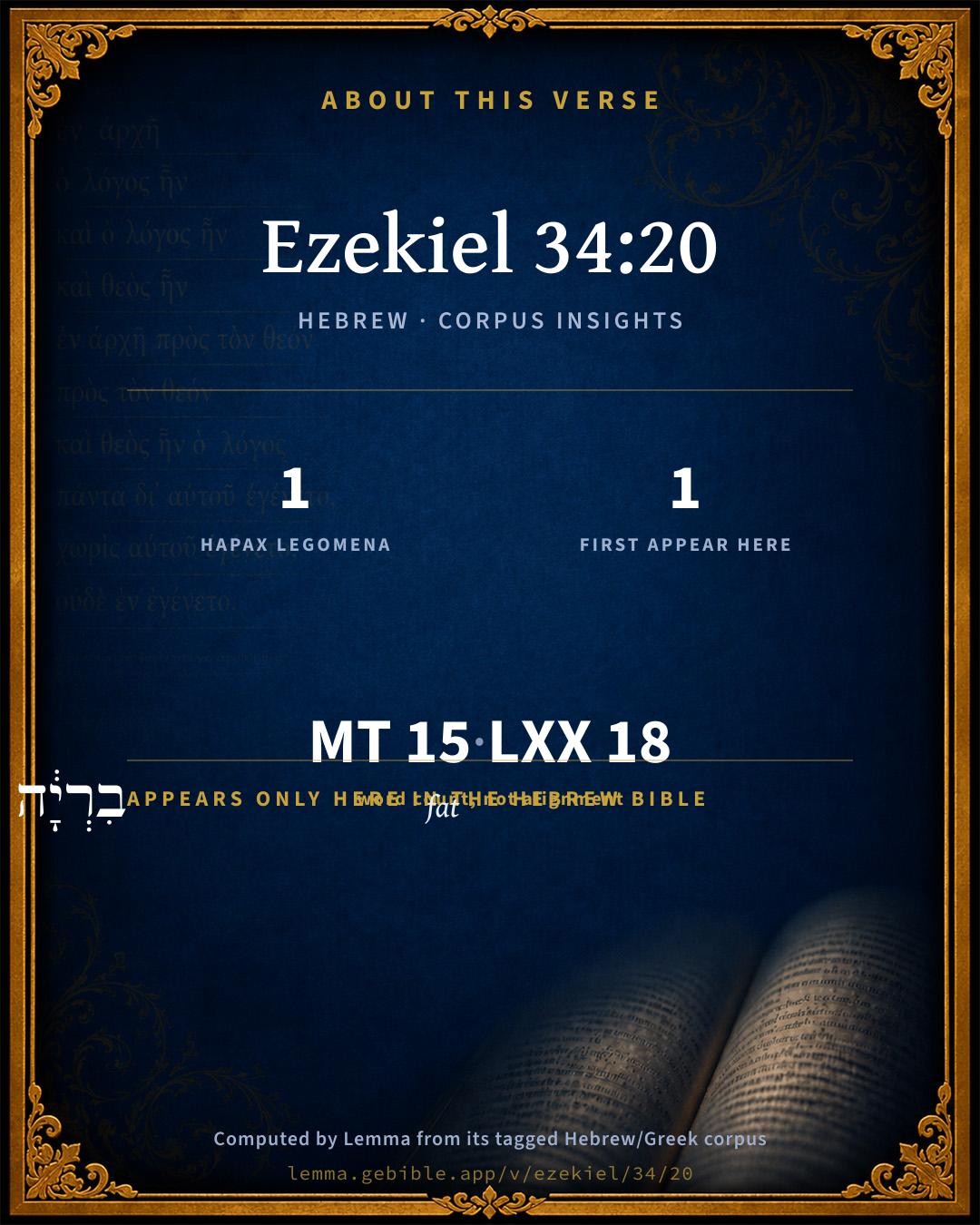
  • 1 hapax legomenon — only here in the Hebrew Bible
  • 1 first appearance in the Hebrew Bible
Full analysis ↓
Download a study sheet

One document with this verse’s original text, its word-by-word gloss line, the meaning frame, cross-references with their text, attributed commentary, and full source and license credits — printable, and it pastes into notes with its structure intact.

This verse Autodidact and up

Study sheet (.html) Plain text (.txt)

A passage Seminary Student

Up to 50 verses in one chapter. A passage sheet keeps up to 6 commentary sources and 12 cross-references per verse, in the order this page ranks them, and says so on the sheet whenever that leaves anything out. Ask for a single verse and you get the Autodidact verse sheet above.

Everything on this page stays free to read, with no account — the sheet is a download of what is already on screen, not access to it.

Want to remove ads? Support Godless Engineer
Compare translations 3

The same verse in 3 English versions, stacked beneath the original-language interlinear above. Click any original word for its lexicon entry.

Each is an independent rendering of the whole verse — the interlinear is not word-aligned to these translations.

Highlighted words mark where these versions differ — a whole-verse word diff, not a word-by-word alignment.

  • World English Bible Public Domain
    Therefore thus says the Lord Yahweh to them: Behold, I, even I, will judge between the fat sheep and the lean sheep.
  • King James Version Public Domain
    Therefore thus saith the Lord GOD unto them; Behold, I, even I, will judge between the fat cattle and between the lean cattle.
  • unfoldingWord Literal Text CC BY-SA 4.0
    Therefore the Lord Yahweh says this to them: Behold! I myself will judge between the fat sheep and the thin ones,

unfoldingWord Literal Text — © unfoldingWord, licensed CC BY-SA 4.0. Word-aligned USFM3 via Door43 (git.door43.org/unfoldingWord/en_ult).

Versions to compare (up to 4)

3 of 4 selected

Show all 18 translations

Every available English version of this verse, each an independent rendering of the whole verse.

  • World English Bible Public Domain
    Therefore thus says the Lord Yahweh to them: Behold, I, even I, will judge between the fat sheep and the lean sheep.
  • Berean Standard Bible Public Domain
    Therefore this is what the Lord GOD says to them: ‘Behold, I Myself will judge between the fat sheep and the lean sheep.
  • Majority Standard Bible Public Domain
    Therefore this is what the Lord GOD says to them: ‘Behold, I Myself will judge between the fat sheep and the lean sheep.
  • King James Version Public Domain
    Therefore thus saith the Lord GOD unto them; Behold, I, even I, will judge between the fat cattle and between the lean cattle.
  • American Standard Version (1901) Public Domain
    Therefore thus saith the Lord Jehovah unto them: Behold, I, even I, will judge between the fat sheep and the lean sheep.
  • Revised Version (1885) Public Domain
    Therefore thus saith the Lord GOD unto them: Behold, I, even I, judge between the fat cattle and the lean cattle.
  • Geneva Bible (1599) Public Domain
    Therefore thus sayth the Lord God vnto them, behold, I, euen I wil iudge betweene the fat sheepe and the leane sheepe.
  • Douay-Rheims (1899) Public Domain
    Therefore thus saith the Lord God to you: Behold, I myself will judge between the fat cattle and the lean.
  • Young's Literal Translation Public Domain
    Therefore, thus said the Lord Jehovah to them: Lo, I -- even I, have judged between fat sheep and lean sheep.
  • Literal Standard Version CC BY-SA 4.0
    Therefore, thus said Lord YHWH to them: Behold, I—even I, have judged between fat sheep and lean sheep.
  • Unlocked Literal Bible CC BY-SA 4.0
    Therefore the Lord Yahweh says this to them: Behold! I myself will judge between the fat sheep and the thin ones,
  • unfoldingWord Literal Text CC BY-SA 4.0
    Therefore the Lord Yahweh says this to them: Behold! I myself will judge between the fat sheep and the thin ones,
  • Darby Bible Public Domain
    Therefore thus saith the Lord Jehovah unto them: Behold, [it is] I, and I will judge between the fat sheep and the lean sheep.
  • World Messianic Bible Public Domain
    “Therefore the Lord GOD says to them: ‘Behold, I, even I, will judge between the fat sheep and the lean sheep.
  • Webster's Bible Public Domain
    Therefore thus saith the Lord GOD to them; Behold, I, even I, will judge between the fat cattle and between the lean cattle.
  • Free Bible Version CC BY-SA 4.0
    That's why the Lord God says to them: Watch, because I myself will judge between the fat sheep and the skinny sheep.
  • Bible in Basic English Public Domain
    For this reason the Lord has said to them, Truly, I, even I, will be judge between the fat sheep and the thin sheep.
  • JPS Tanakh (1917) Public Domain
    Therefore thus saith the Lord GOD unto them: Behold, I, even I, will judge between the fat cattle and the lean cattle.

Literal Standard Version (2020), Covenant Press — licensed CC BY-SA 4.0. Text via the HelloAO Bible API (eBible.org). Unlocked Literal Bible (unfoldingWord) — licensed CC BY-SA 4.0. Text via the HelloAO Bible API (eBible.org). unfoldingWord Literal Text — © unfoldingWord, licensed CC BY-SA 4.0. Word-aligned USFM3 via Door43 (git.door43.org/unfoldingWord/en_ult). Free Bible Version, Dr. Jonathan Gallagher — licensed CC BY-SA 4.0. Text via the HelloAO Bible API (eBible.org).

Word by word

More ways to search: Search by grammar → Find every occurrence → Compare this word →

Practice this passage: Drill this verse → Learn its vocabulary →

בִרְיָ֔ה
bᵉrîy
H1274
“fat”
Adjective, Adjective, Feminine, Singular, Absolute
Part of Speech
Adjective
Type
Adjective
Gender
Feminine
Number
Singular
State
Absolute
Full BDB Definition

Origin: from H1262

TWOT: 279a

fat - (TWOT) fat, fatter, fed, firm, plenteous, rank
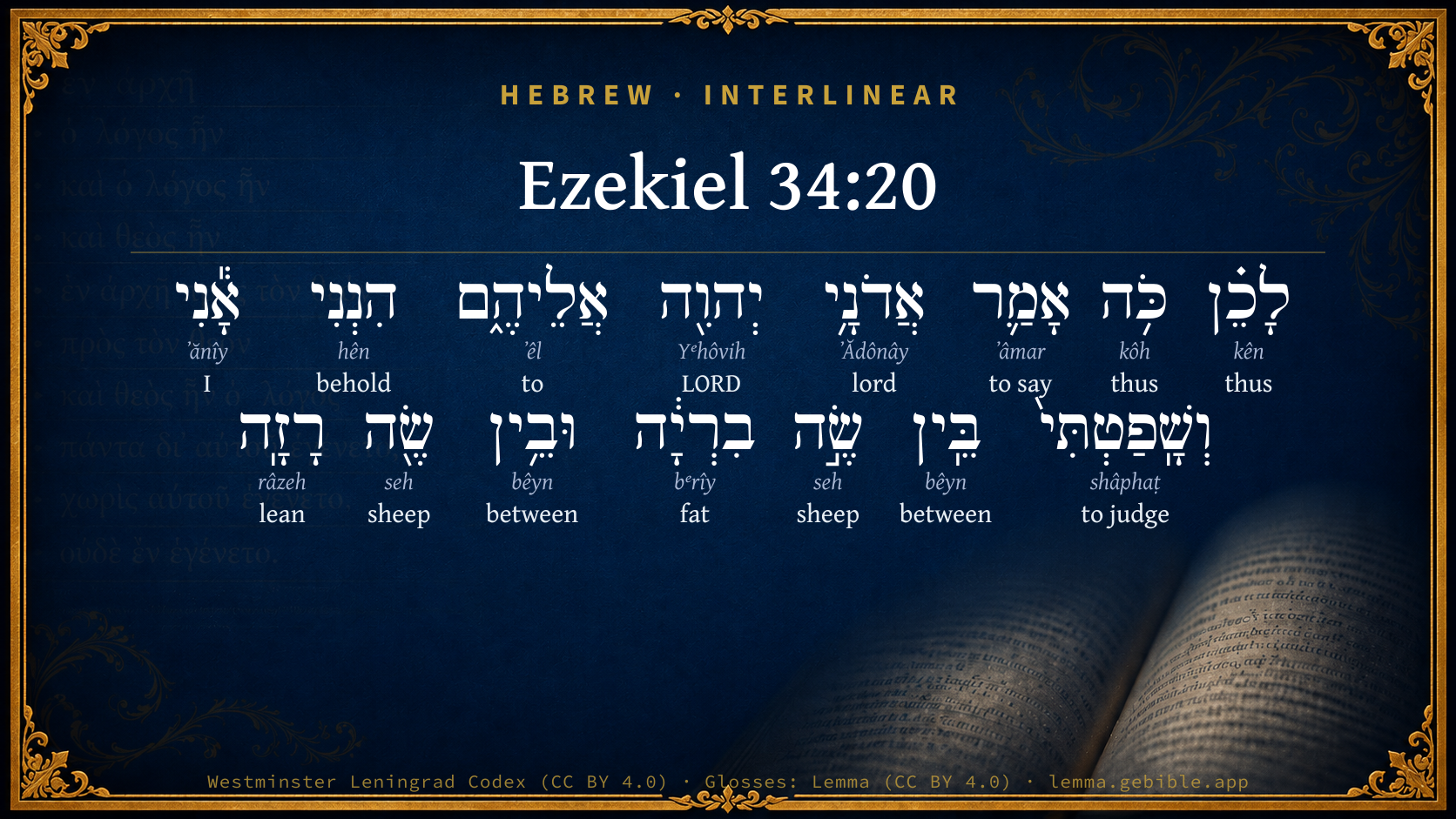
  1. לָכֵ֗ן kên H3651 “to/for · thus” Preposition + Adverb
  2. כֹּ֥ה kôh H3541 “thus” Adverb
  3. אָמַ֛ר ʼâmar H559 “to say” Verb, Qal, Perfect, 3rd Person, Masculine, Singular
  4. אֲדֹנָ֥י ʼĂdônây H136 “Lord · my” Noun, Common, Masculine, Plural, Construct + Suffix, Personal, 1st Person, Common, Singular
  5. יְהוִ֖ה Yᵉhôvih H3069 “LORD” Noun, Proper
  6. אֲלֵיהֶ֑ם ʼêl H413 “to · them” Preposition + Suffix, Personal, 3rd Person, Masculine, Plural
  7. הִנְנִי hên H2005 “behold · me” Particle, Demonstrative + Suffix, Personal, 1st Person, Common, Singular
  8. אָ֕נִי ʼănîy H589 “I” Pronoun, Personal, 1st Person, Common, Singular
  9. וְשָֽׁפַטְתִּי֙ shâphaṭ H8199 “and · to judge” Conjunction + Verb, Qal, Sequential Perfect, 1st Person, Common, Singular
  10. בֵּֽין bêyn H996 “between” Preposition
  11. שֶׂ֣ה seh H7716 “sheep” Noun, Common, Both, Singular, Absolute
  12. וּבֵ֥ין bêyn H996 “and · between” Conjunction + Preposition
  13. שֶׂ֖ה seh H7716 “sheep” Noun, Common, Both, Singular, Absolute
  14. רָזָֽה râzeh H7330 “lean” Adjective, Adjective, Feminine, Singular, Absolute

About this verse

These counts appear in no published source. They are computed here, from the morphology-tagged text and Lemma’s own curated glosses. What Lemma adds →

15
words
13
distinct lemmas
Prophets
section

Notable vocabulary

1 hapax legomenon — a word that appears only here in the entire Hebrew Bible:

  • בִרְיָ֔ה fat H1274

First appearance in Scripture

This word makes its first canonical appearance in the Hebrew Bible here:

  • בִרְיָ֔ה fat H1274

Shared distinctive vocabulary

רָזָֽה lean H7330 occurs in 2 verses of the Hebrew Bible. Also found in:

Grammatical profile

  • 2 verbs
  • 4 nouns
  • 2 adjectives
  • 1 pronoun
  • 3 prepositions
  • 2 adverbs
  • 1 particle

Verb forms

  • אָמַ֛ר Qal · Perfect
  • וְשָֽׁפַטְתִּי֙ Qal · Sequential Perfect

Repetition

Words recur within this verse — often emphatic in Hebrew:

  • בֵּֽין between H996 ×2
  • שֶׂ֣ה sheep H7716 ×2

Hebrew & Septuagint length

In English translation the verse runs 22 words from the Hebrew and 18 from the Septuagint (LXX English) — closely comparable.

A rough comparison of the two English renderings, which tokenize alike — not a word-level alignment.

Word counts can differ between the Hebrew and the Greek without any difference in meaning — e.g. the Hebrew direct-object marker אֵת has no separate Greek word, and Greek often adds the article ὁ.

In the original languages it is 15 Hebrew tokens and 18 Greek tokens — but the two are counted differently (Hebrew bundles its prefixes and suffixes into one token; the Greek is in lemma form), so that isn’t a like-for-like length.

Cross-references

4

Topical passages linked to Ezekiel 34:20 in the Treasury of Scripture Knowledge — connected by theme and wording, ordered by reader-vote popularity; previews shown in the World English Bible.

  • Psalms 22:12–16 Many bulls have surrounded me. Strong bulls of Bashan have encircled me.
  • Ezekiel 34:10 Thus says the Lord Yahweh: Behold, I am against the shepherds; and I will require my sheep at their hand, and cause them to cease from feeding the sheep; neither shall the shepherds feed themselves any more; and I will deliver my sheep from their mouth, that they may not be food for them.
  • Matthew 25:31–46 "But when the Son of Man comes in his glory, and all the holy angels with him, then he will sit on the throne of his glory.
  • Ezekiel 34:17 As for you, O my flock, thus says the Lord Yahweh: Behold, I judge between sheep and sheep, the rams and the male goats.

Cross-references courtesy of OpenBible.info (CC BY 4.0).

Hebrew and Greek witnesses Masoretic Hebrew ↔ Greek Septuagint

The same verse in the two great witnesses to the Old Testament, shown verse-for-verse.

These are two independent witnesses, not word-aligned to each other, and the Septuagint is shown in lemma (dictionary) form.

Hebrew Ezekiel 34:20 Masoretic · Westminster Leningrad Codex

לָכֵ֗ן כֹּ֥ה אָמַ֛ר אֲדֹנָ֥י יְהוִ֖ה אֲלֵיהֶ֑ם הִנְנִי אָ֕נִי וְשָֽׁפַטְתִּי֙ בֵּֽין שֶׂ֣ה בִרְיָ֔ה וּבֵ֥ין שֶׂ֖ה רָזָֽה

Therefore thus says the Lord Yahweh to them: Behold, I, even I, will judge between the fat sheep and the lean sheep.

World English Bible · Public Domain

Greek LXX Ezekiel 34:20 Septuagint · lemma form

διά οὗτος ὅδε λέγω κύριος κύριος ἰδού ἐγώ διακρίνω ἀνά μέσος πρόβατον ἰσχυρός καί ἀνά μέσος πρόβατον ἀσθενής

Therefore thus says the Lord God; Behold, I will separate between the strong sheep and the weak sheep.

LXX2012 (modern English Septuagint) · Public Domain

Hebrew: Westminster Leningrad Codex (CC BY 4.0). Greek: Septuagint (public domain); English from LXX2012 (modern English Septuagint) (Public Domain). How the Septuagint differs from the Hebrew →

Targum (Aramaic paraphrase)

1

The Targum is the ancient Jewish Aramaic paraphrase of the Hebrew Scriptures — an interpretive translation, not the Hebrew text itself. Onkelos (literal) and Pseudo-Jonathan (expansive) render the Torah, and Jonathan the Prophets. Coverage is partial: where no permissively-licensed English translation exists for a verse, only the Aramaic is shown. This is verse-level text, not a word-by-word alignment to the Hebrew.

  1. Targum Jonathan Prophets (Joshua–Malachi)
    בְּכֵן כִּדְנַן אֲמַר יְיָ אֱלֹהִים לְהוֹן הָא אֲנָא מִתְגְלֵי וְאֵידוּן בֵּין גְבַר עַתִּיר וּבֵין גְבַר מִסְכֵּן:

    (no public-domain English translation for this verse)

    Targum Jonathan — Aramaic: “Mikraot Gedolot” (public domain). English: “Sefaria Community Translation” (CC0 1.0 (public-domain dedication)); “London "Chaldee Paraphrase," 1871” (public domain). Text via Sefaria.

Commentary

Notes on Ezekiel 34:20 from classic Christian and Jewish commentators (each source and its license shown beneath its notes). The classic Christian expositions comment on the surrounding passage and are grouped to its opening verse, so a note may address several verses; the Jewish commentaries on the Tanakh (Rashi and others) are per-verse, so they appear only where the commentator wrote on this verse.

Lemma curates 59 commentaries, every one of them public domain or Creative Commons licensed, each selected and text-cleaned for this edition rather than reprinted as found. About our sources →

Trapp's Complete Commentary

John Trapp

Eze 34:20 Therefore thus saith the Lord GOD unto them; Behold, I, [even] I, will judge between the fat cattle and between the lean cattle.

Ver. 20. I, even I, will judge between the fat cattle.] These are, saith Augustine, those that presume of their own strength, and boast of their own righteousness, being proud, insolent, and void of charity.

John Trapp, A Commentary or Exposition upon All the Books of the Old and New Testament (1647–1656) — public domain. Text from a community e-Sword module.

Tyndale Open Study Notes

Tyndale Open Resources

34:20-22 the fat sheep and the scrawny sheep: Those with power and influence in society had taken all the good things for themselves and had left others without resources. God would judge between them and set things right.

Tyndale Open Study Notes — © Tyndale Open Resources, licensed CC BY-SA 4.0. Text via the HelloAO Bible API.

Jamieson, Fausset & Brown

Robert Jamieson, A. R. Fausset & David Brown

fat . . . lean--the rich oppressors . . . the humble poor.

Jamieson, Fausset & Brown — Commentary Critical and Explanatory on the Whole Bible (1871) — public domain (CC PDM 1.0). Text via the HelloAO Bible API.

Adam Clarke's Commentary

Verse 20. I will judge between the fat cattle and between the lean cattle.] Between the rich and the poor; those who fare sumptuously every day and those who have not the necessaries of life.

Adam Clarke's Commentary on the Bible (1810–1826) — public domain. Text from a community e-Sword/MySword module.

John Gill's Exposition

Because ye have thrust with side and with shoulder,.... As the stronger cattle do the lesser:

and pushed all the diseased with your horns; as horned cattle do those they dislike, and bear an antipathy to; which to do to the diseased is great cruelty: sheep, it is said, will take some care of those that are diseased among them, and bring them to places of sunshine and shelter; but here the horned part of the flock, and in health, are represented as acting a barbarous part to the weak and diseased: this may denote such as are in power and authority, using it to the hurt and detriment of those that are under them, and whom they should relieve and protect: it may be applied to the anathemas and excommunications of the Jews, who pronounced those an accursed and ignorant people that believed in Christ, and expelled such out of their synagogues that professed his name; and to their persecutions of the apostles and first Christians:

till he have scattered them abroad; or "without" (s); that is, without the land. The Targum is,

"through the provinces;''

obliged them to quit their country, and go unto other parts, as the first preachers of the word did; who, upon the persecution at the death of Stephen, were scattered abroad everywhere, Act 8:1.

(s) "foras", Junius & Tremellius, Piscator, Polanus, Cocceius, Starckius,

John Gill's Exposition of the Whole Bible (1746–1763) — public domain (CC PDM 1.0). Text via the HelloAO Bible API.

Albert Barnes' Notes on the Bible

Yahweh having promised to be a Ruler of His people, the administration of the divine kingdom is now described, as carried on by One King, the representative of David, whose dominion should fulfill all the promises originally made to the man after God’s own heart. Ezekiel does not so much add to, as explain and develope, the original promise; and as the complete fulfillment of the spiritual blessings, which the prophets were guided to proclaim, was manifestly never realized in any temporal prosperity of the Jews, and never could and never can be realized in any earthly kingdom, we recognize throughout the Sacred Volume the one subject of all prophecy - the Righteous King, the Anointed Prince, the Son and the Lord of David.

Eze 34:23

One shepherd - One, as ruling over an undivided people, the distinction between the kingdoms of Israel and Judah having been done away.

My servant David - David was a fit type of the True King because he was a true and faithful servant of Yahweh. That which David was partially and imperfectly, Christ is in full perfection (compare Mat 12:18; Joh 5:30; Heb 10:7.)

Eze 34:26

The blessings here foretold are especially those of the old covenant. The wilderness (or, pasture-country) and the woods, the places most exposed to beasts and birds of prey, become places of security. Under the new covenant Sion and the hills around are representative of God’s Church; and temporal blessings are typical of the blessings showered down upon Christ’s Church by Him who has vanquished the powers of evil.

Eze 34:29

A plant - Equivalent to the “Branch,” under which name Isaiah and Jeremiah prophesy of the Messiah. The contrast in this verse to hunger seems to favor the idea that the “plant” was for food, i. e., spiritual food, and in this sense also, applicable to the Messiah (compare Joh 6:35.)

The shame of the pagan - The shameful reproaches with which the pagan assail them.

Eze 34:31

Translate “Ye are my flock, the flock of my pasture (compare Jer 23:1); ye are men, and I am your God.”

Albert Barnes' Notes on the Bible (1834–1885) — public domain. Text from a community e-Sword/MySword module.

Matthew Poole's English Annotations

I, even I: see Eze 34:11,17. I am judge by office and I will vindicate and right the poor by judgment.

The fat cattle; the rich, voluptuous, and wanton ones.

The lean cattle; the poor and indigent, that are despised, oppressed, and injured; thus the Chaldee paraphrase, between the rich man and the poor man.

Matthew Poole's English Annotations on the Holy Bible (1683–1685) — public domain. Text from a community e-Sword/MySword module.

John Wesley's Explanatory Notes

I will judge - I will vindicate the poor. The fat cattle - The rich. The lean - The poor.

John Wesley, Explanatory Notes Upon the Whole Bible (1754–1765) — public domain. Text via the GEBible commentary corpus.

unfoldingWord translationNotes

Door43 World Missions Community

General Information:

Yahweh continues speaking of the people of Israel as if they were a flock of sheep and of himself as their shepherd. (See: Metaphor)

the Lord Yahweh says this

This can be stated in first person. AT: "this is what I, the Lord Yahweh, say" (See: First, Second, or Third Person)

to them

"to my flock"

Behold!

The word "Behold" here adds emphasis to what follows. AT: "Indeed!"

I myself

The word "myself" emphasizes that it is Yahweh who will judge. (See: Reflexive Pronouns)

will judge between the fat sheep and the thin ones

"will make sure that the fat sheep and goats and the skinny sheep and goats are treating each other fairly"

the fat sheep and the thin ones

The leaders and strong people in Israel are spoken of as if they were fat and strong animals in the flock. The poor and weak people in Israel are spoken of as if they were the thin and weak animals in the flock. (See: Metaphor)

for you

The word "you" refers to the sheep and goats that were not treating other sheep and goats well.

with your sides

"with the sides of your body"

have gored

Possible meanings are 1) "have pushed" or "have shoved" 2) "have stabbed" or "have pierced"

scattered them

"made them go in many different directions"

away from the land

"away from the land of Israel"

translationWords

judge

unfoldingWord translationNotes — © Distant Shores Media and the Door43 World Missions Community, licensed CC BY-SA 4.0. Source: git.door43.org/Door43/en_tn.

Rashi

Rabbi Shlomo Yitzchaki (Rashi)

a strong lamb [Heb. בְרִיָה,] strong.

lean [Heb. רָזָה,] maigre in French.

Rashi on the Tanakh — English translations: “The Judaica Press complete Tanach with Rashi, translated by A. J. Rosenberg” (CC BY 4.0); “Pentateuch with Rashi's commentary by M. Rosenbaum and A.M. Silbermann, 1929-1934” (public domain); “The Metsudah Tanach series, Lakewood, N.J” (CC BY 4.0); and “The Book of Joshua, Metsudah Publications, 1997” (CC BY 4.0). Text via Sefaria.

Lesson kit

Teaching starters — assembled from the data on this page, not authored interpretation. Every prompt links to the verse data it draws on. Edit before teaching.

Ezekiel, in the Prophets, opens this verse with 15 words (13 distinct Hebrew lemmas). Its most distinctive word is bᵉrîy (“fat”). A historical commentator’s framing appears above. Read the whole chapter for the surrounding context.

Discussion questions

  1. The word bᵉrîy carries the sense “fat.” How does it shape the verse?
  2. This verse holds 1 word here found nowhere else in the Hebrew Bible. What might the rare word draw attention to?
  3. The word “fat” first appears here in Scripture. What is being introduced at this debut?
  4. Numbers 13:20 shares the word «lean» with this verse. How do the two illuminate each other?
  5. “between” occurs 2× in this one verse. What is the effect of the repetition?
  6. The translations on this page render this verse differently — a whole-verse word diff, not a word-by-word alignment. What might account for the different wordings?
  7. The verb «אָמַ֛ר» is Qal Perfect. How does its form color the action?
  8. Reading how Trapp's Complete Commentary and Tyndale Open Study Notes read this verse, where do the two commentators agree and where do they part?

Things to notice

  • 1 word in this verse appears nowhere else in the Hebrew Bible.
  • 1 word makes its first canonical appearance in Scripture here.
  • This verse counts 15 Hebrew ↔ 18 Greek words.
  • These translations choose different wording for 11 words in this verse.
  • “between” occurs 2× in this single verse.

Reading settings

Reading text

Shown beneath each verse's original-language words.

Old Testament
Old Testament edition

Read the OT as the Masoretic Hebrew (MT) or the Greek Septuagint (LXX).

English shown for the Greek Septuagint (in the Hebrew ↔ Greek comparison).

Comparing translations? Open the Compare panel on any verse page to stack up to four side by side.