
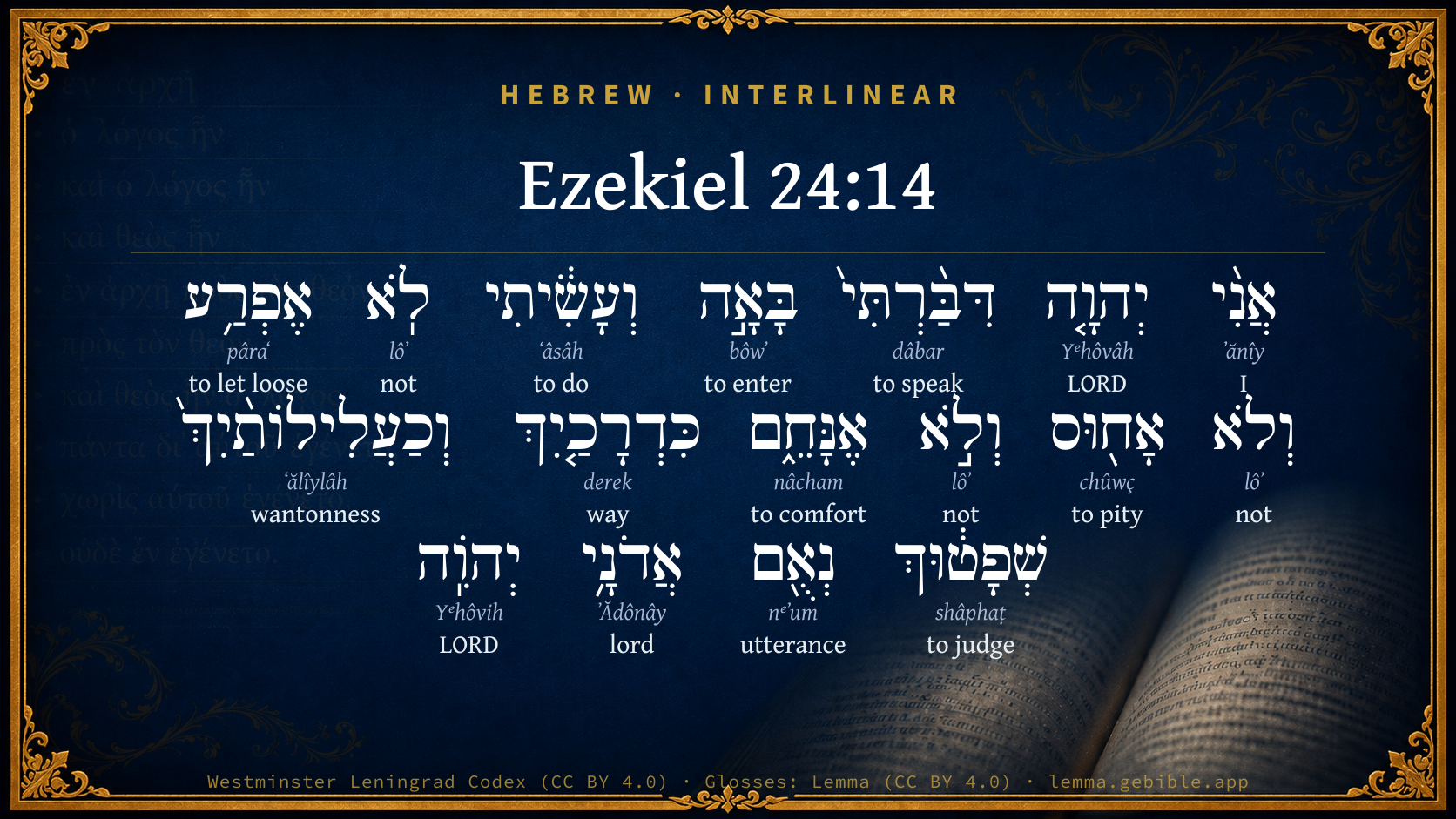
Ezekiel 24:14

Hebrew (Westminster Leningrad Codex) Ezekiel 24:14 appears in the Hebrew Old Testament. The text above is from the Westminster Leningrad Codex. Each word links to its Strong’s number, a concise gloss, and parsing drawn from the Open Scriptures Hebrew Bible morphology. Click any word for its full Brown-Driver-Briggs (BDB) entry.
Download image
Cite this verse

Ezekiel 24:14 (World English Bible). Public Domain. Lemma interlinear Bible study tool, https://lemma.gebible.app/v/ezekiel/24/14.

Show BibTeX & RIS
BibTeX
RIS
English Translation
I, Yahweh, have spoken it: it shall happen, and I will do it: I will not go back, neither will I spare, neither will I repent; according to your ways, and according to your doings, shall they judge you, says the Lord Yahweh.
World English Bible · Public Domain
Download a study sheet

One document with this verse’s original text, its word-by-word gloss line, the meaning frame, cross-references with their text, attributed commentary, and full source and license credits — printable, and it pastes into notes with its structure intact.

This verse Autodidact and up

Study sheet (.html) Plain text (.txt)

A passage Seminary Student

Up to 50 verses in one chapter. A passage sheet keeps up to 6 commentary sources and 12 cross-references per verse, in the order this page ranks them, and says so on the sheet whenever that leaves anything out. Ask for a single verse and you get the Autodidact verse sheet above.

Everything on this page stays free to read, with no account — the sheet is a download of what is already on screen, not access to it.

Want to remove ads? Support Godless Engineer
Compare translations 3

The same verse in 3 English versions, stacked beneath the original-language interlinear above. Click any original word for its lexicon entry.

Each is an independent rendering of the whole verse — the interlinear is not word-aligned to these translations.

Highlighted words mark where these versions differ — a whole-verse word diff, not a word-by-word alignment.

  • World English Bible Public Domain
    I, Yahweh, have spoken it: it shall happen, and I will do it: I will not go back, neither will I spare, neither will I repent; according to your ways, and according to your doings, shall they judge you, says the Lord Yahweh.
  • King James Version Public Domain
    I the LORD have spoken it: it shall come to pass, and I will do it; I will not go back, neither will I spare, neither will I repent; according to thy ways, and according to thy doings, shall they judge thee, saith the Lord GOD.
  • unfoldingWord Literal Text CC BY-SA 4.0
    I, Yahweh, have declared it, and I will do it. I will not relent nor will I rest from it. As your ways were, and as your activities, they will judge you!—this is the Lord Yahweh’s declaration.”

unfoldingWord Literal Text — © unfoldingWord, licensed CC BY-SA 4.0. Word-aligned USFM3 via Door43 (git.door43.org/unfoldingWord/en_ult).

Versions to compare (up to 4)

3 of 4 selected

Show all 18 translations

Every available English version of this verse, each an independent rendering of the whole verse.

  • World English Bible Public Domain
    I, Yahweh, have spoken it: it shall happen, and I will do it: I will not go back, neither will I spare, neither will I repent; according to your ways, and according to your doings, shall they judge you, says the Lord Yahweh.
  • Berean Standard Bible Public Domain
    I, the LORD, have spoken; the time is coming, and I will act. I will not refrain or show pity, nor will I relent. I will judge you according to your ways and deeds,’ declares the Lord GOD.”
  • Majority Standard Bible Public Domain
    I, the LORD, have spoken; the time is coming, and I will act. I will not refrain or show pity, nor will I relent. I will judge you according to your ways and deeds,’ declares the Lord GOD.”
  • King James Version Public Domain
    I the LORD have spoken it: it shall come to pass, and I will do it; I will not go back, neither will I spare, neither will I repent; according to thy ways, and according to thy doings, shall they judge thee, saith the Lord GOD.
  • American Standard Version (1901) Public Domain
    I, Jehovah, have spoken it: it shall come to pass, and I will do it: I will not go back, neither will I spare, neither will I repent; according to thy ways, and according to thy doings, shall they judge thee, saith the Lord Jehovah.
  • Revised Version (1885) Public Domain
    I the LORD have spoken it: it shall come to pass, and I will do it; I will not go back, neither will I spare, neither will I repent; according to thy ways, and according to thy doings, shall they judge thee, saith the Lord GOD.
  • Geneva Bible (1599) Public Domain
    I the Lord haue spoken it: it shall come to passe, and I will doe it: I will not goe backe, neither will I spare, neither will I repent: according to thy wayes, and according to thy workes shall they iudge thee, sayeth the Lord God.
  • Douay-Rheims (1899) Public Domain
    I the Lord have spoken: it shall come to pass, and I will do it: I will not pass by, nor spare, nor be pacified: I will judge thee according to thy ways, and according to thy doings, saith the Lord.
  • Young's Literal Translation Public Domain
    I, Jehovah, hath spoken, It hath come, and I have done `it', I do not free, nor do I spare, nor do I repent, According to thy ways, and according to thine acts, they have judged thee, An affirmation of the Lord Jehovah.'
  • Literal Standard Version CC BY-SA 4.0
    I, YHWH, have spoken, || It has come, and I have done [it], || I do not free, nor do I spare, nor do I regret, || According to your ways, and according to your acts, || They have judged you, || A declaration of Lord YHWH.”
  • Unlocked Literal Bible CC BY-SA 4.0
    I, Yahweh, have declared it, and I will do it. I will not relent nor will I rest from it. As your ways were, and as your activities, they will judge you!—this is the Lord Yahweh's declaration.”
  • unfoldingWord Literal Text CC BY-SA 4.0
    I, Yahweh, have declared it, and I will do it. I will not relent nor will I rest from it. As your ways were, and as your activities, they will judge you!—this is the Lord Yahweh’s declaration.”
  • Darby Bible Public Domain
    I Jehovah have spoken [it]: it shall come to pass, and I will do it; I will not go back, neither will I spare, nor will I repent. According to thy ways, and according to thy doings, shall they judge thee, saith the Lord Jehovah.
  • World Messianic Bible Public Domain
    “‘“I, the LORD, have spoken it. It will happen, and I will do it. I won’t go back. I won’t spare. I won’t repent. According to your ways and according to your doings, they will judge you,” says the Lord GOD.’”
  • Webster's Bible Public Domain
    I the LORD have spoken it; it shall come to pass, and I will do it; I will not go back, neither will I spare, neither will I repent; according to thy ways, and according to thy doings, shall they judge thee, saith the Lord GOD.
  • Free Bible Version CC BY-SA 4.0
    I, the Lord, have spoken. The time is soon coming when I will do what I say. I won't change my mind or show pity, I won't stop. I will judge you by your attitude and actions, declares the Lord God.”
  • Bible in Basic English Public Domain
    I the Lord have said the word and I will do it; I will not go back or have mercy, and my purpose will not be changed; in the measure of your ways and of your evil doings you will be judged, says the Lord.
  • JPS Tanakh (1917) Public Domain
    I the LORD have spoken it; it shall come to pass, and I will do it; I will not go back, neither will I spare, neither will I repent; according to thy ways, and according to thy doings, shall they judge thee, saith the Lord GOD.'

Literal Standard Version (2020), Covenant Press — licensed CC BY-SA 4.0. Text via the HelloAO Bible API (eBible.org). Unlocked Literal Bible (unfoldingWord) — licensed CC BY-SA 4.0. Text via the HelloAO Bible API (eBible.org). unfoldingWord Literal Text — © unfoldingWord, licensed CC BY-SA 4.0. Word-aligned USFM3 via Door43 (git.door43.org/unfoldingWord/en_ult). Free Bible Version, Dr. Jonathan Gallagher — licensed CC BY-SA 4.0. Text via the HelloAO Bible API (eBible.org).

Word by word

More ways to search: Search by grammar → Find every occurrence → Compare this word →

Practice this passage: Drill this verse → Learn its vocabulary →

אֶפְרַ֥ע
pâraʻ
H6544
“to let loose”
Verb, Qal, Imperfect, 1st Person, Common, Singular
Part of Speech
Verb
Stem
Qal
Form
Imperfect
Person
1st Person
Gender
Common
Number
Singular
Full BDB Definition

Origin: a primitive root

TWOT: 1822 , 1823 , 1824

to lead, act as leader - to let go, let loose, ignore, let alone - (Qal) - to let go, let loose - to let alone, avoid, neglect - to loosen - (Niphal) to be let loose, be loosened of restraint - (Hiphil) - to cause to refrain - to show lack of restraint - to let loose restraints
  1. אֲנִ֨י ʼănîy H589 “I” Pronoun, Personal, 1st Person, Common, Singular
  2. יְהוָ֤ה Yᵉhôvâh H3068 “LORD” Noun, Proper
  3. דִּבַּ֨רְתִּי֙ dâbar H1696 “to speak” Verb, Piel, Perfect, 1st Person, Common, Singular
  4. בָּאָ֣ה bôwʼ H935 “entering” Verb, Qal, Participle Active, Feminine, Singular, Absolute
  5. וְעָשִׂ֔יתִי ʻâsâh H6213 “and · to do” Conjunction + Verb, Qal, Sequential Perfect, 1st Person, Common, Singular
  6. לֹֽא lôʼ H3808 “not” Particle, Negative
  7. וְלֹא lôʼ H3808 “and · not” Conjunction + Particle, Negative
  8. אָח֖וּס chûwç H2347 “to pity” Verb, Qal, Imperfect, 1st Person, Common, Singular
  9. וְלֹ֣א lôʼ H3808 “and · not” Conjunction + Particle, Negative
  10. אֶנָּחֵ֑ם nâcham H5162 “to comfort” Verb, Niphal, Imperfect, 1st Person, Common, Singular
  11. כִּדְרָכַ֤יִךְ derek H1870 “like/as · ways · your” Preposition + Noun, Common, Both, Plural, Construct + Suffix, Personal, 2nd Person, Feminine, Singular
  12. וְכַעֲלִילוֹתַ֨יִךְ֙ ʻălîylâh H5949 “and · like/as · deeds · your” Conjunction + Preposition + Noun, Common, Feminine, Plural, Construct + Suffix, Personal, 2nd Person, Feminine, Singular
  13. שְׁפָט֔וּךְ shâphaṭ H8199 “to judge · you” Verb, Qal, Perfect, 3rd Person, Common, Plural + Suffix, Personal, 2nd Person, Feminine, Singular
  14. נְאֻ֖ם nᵉʼum H5002 “utterance of” Noun, Common, Masculine, Singular, Construct
  15. אֲדֹנָ֥י ʼĂdônây H136 “Lord · my” Noun, Common, Masculine, Plural, Construct + Suffix, Personal, 1st Person, Common, Singular
  16. יְהֹוִֽה Yᵉhôvih H3069 “LORD” Noun, Proper

About this verse

These counts appear in no published source. They are computed here, from the morphology-tagged text and Lemma’s own curated glosses. What Lemma adds →

17
words
15
distinct lemmas
Prophets
section

Notable vocabulary

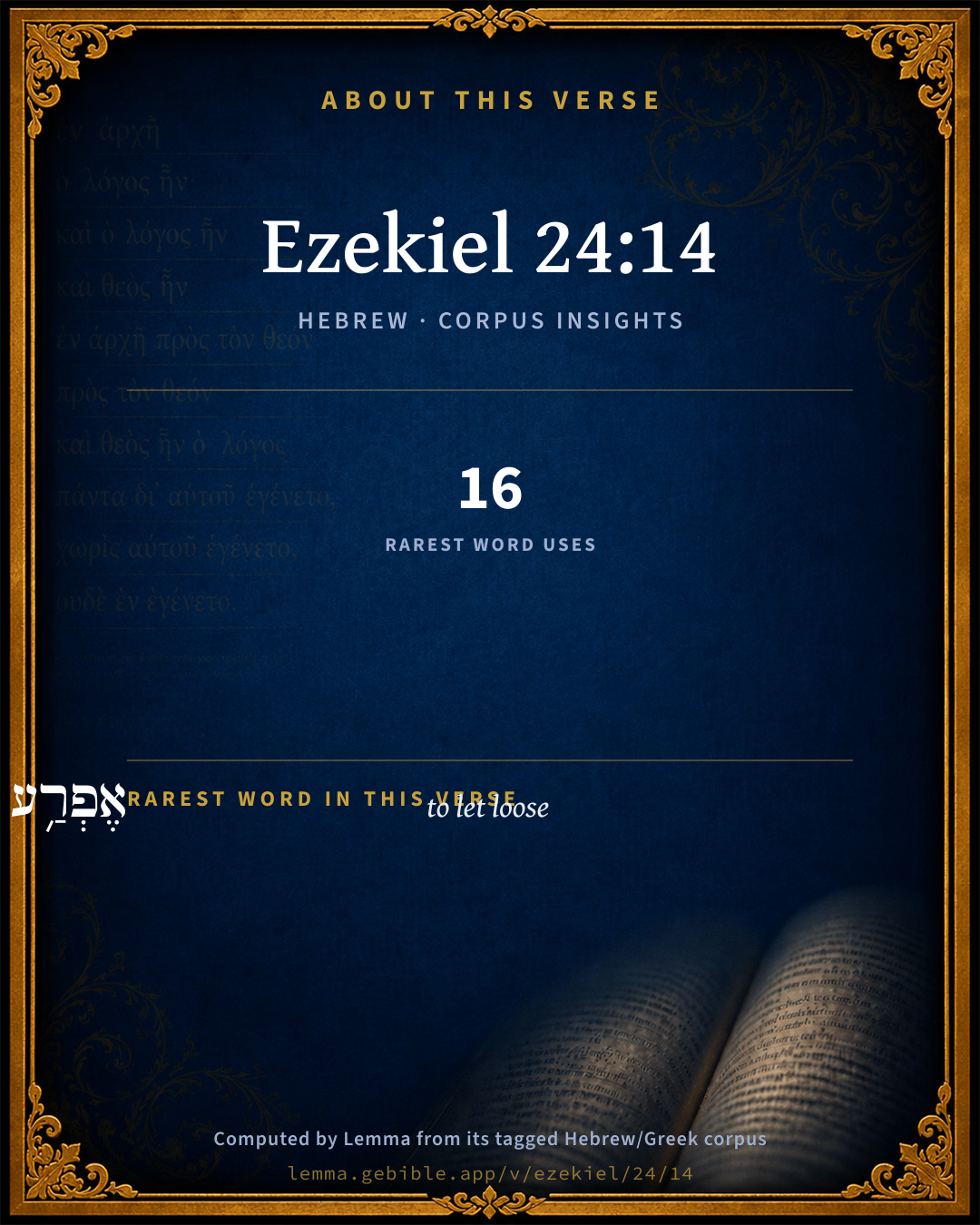
The rarest word here is אֶפְרַ֥ע to let loose H6544 — appearing just 16 times in the whole Hebrew Bible.

Shared distinctive vocabulary

אֶפְרַ֥ע to let loose H6544 occurs in 15 verses of the Hebrew Bible. Also found in:

Grammatical profile

  • 7 verbs
  • 6 nouns
  • 1 pronoun
  • 3 particles

Verb forms

  • דִּבַּ֨רְתִּי֙ Piel · Perfect
  • בָּאָ֣ה Qal · Participle Active
  • וְעָשִׂ֔יתִי Qal · Sequential Perfect
  • אֶפְרַ֥ע Qal · Imperfect
  • אָח֖וּס Qal · Imperfect
  • אֶנָּחֵ֑ם Niphal · Imperfect
  • שְׁפָט֔וּךְ Qal · Perfect

Repetition

A word recurs within this verse — often emphatic in Hebrew:

Hebrew & Septuagint length

In English translation the verse runs 43 words from the Hebrew and 65 from the Septuagint (LXX English) — the Septuagint runs noticeably longer here. See the side-by-side →

A rough comparison of the two English renderings, which tokenize alike — not a word-level alignment.

Word counts can differ between the Hebrew and the Greek without any difference in meaning — e.g. the Hebrew direct-object marker אֵת has no separate Greek word, and Greek often adds the article ὁ.

Cross-references

22

Topical passages linked to Ezekiel 24:14 in the Treasury of Scripture Knowledge — connected by theme and wording, ordered by reader-vote popularity; previews shown in the World English Bible.

  • Matthew 16:27 For the Son of Man will come in the glory of his Father with his angels, and then he will render to everyone according to his deeds.
  • Isaiah 3:11 Woe to the wicked! Disaster is upon them; For the deeds of his hands will be paid back to him.
  • Ezekiel 18:30 Therefore I will judge you, house of Israel, everyone according to his ways, says the Lord Yahweh. Return you, and turn yourselves from all your transgressions; so iniquity shall not be your ruin.
  • Numbers 23:19 God is not a man, that he should lie, Neither the son of man, that he should repent: Has he said, and will he not do it? Or has he spoken, and will he not make it good?
  • 1 Samuel 15:29 Also the Strength of Israel will not lie nor repent; for he is not a man, that he should repent.
  • Psalms 33:9 For he spoke, and it was done. He commanded, and it stood firm.
  • Isaiah 55:11 so shall my word be that goes forth out of my mouth: it shall not return to me void, but it shall accomplish that which I please, and it shall prosper in the thing whereto I sent it.
  • Jeremiah 13:14 I will dash them one against another, even the fathers and the sons together, says Yahweh: I will not pity, nor spare, nor have compassion, that I should not destroy them.
  • Jeremiah 23:20 The anger of Yahweh shall not return, until he has executed, and until he have performed the intents of his heart: in the latter days you shall understand it perfectly.
  • Ezekiel 5:11 Therefore, as I live, says the Lord Yahweh, surely, because you have defiled my sanctuary with all your detestable things, and with all your abominations, therefore will I also diminish [you]; neither shall my eye spare, and I also will have no pity.
  • Ezekiel 7:4 My eye shall not spare you, neither will I have pity; but I will bring your ways on you, and your abominations shall be in the midst of you: and you shall know that I am Yahweh.
  • Ezekiel 9:10 As for me also, my eye shall not spare, neither will I have pity, but I will bring their way on their head.
  • Romans 2:5–6 But according to your hardness and unrepentant heart you are treasuring up for yourself wrath in the day of wrath, revelation, and of the righteous judgment of God;
  • Jeremiah 4:18 Your way and your doings have procured these things to you; this is your wickedness; for it is bitter, for it reaches to your heart.
  • Ezekiel 7:9 My eye shall not spare, neither will I have pity: I will bring on you according to your ways; and your abominations shall be in the midst of you; and you shall know that I, Yahweh, do strike.
  • Ezekiel 8:18 Therefore will I also deal in wrath; my eye shall not spare, neither will I have pity; and though they cry in my ears with a loud voice, yet will I not hear them.
  • Ezekiel 16:43 Because you have not remembered the days of your youth, but have raged against me in all these things; therefore, behold, I also will bring your way on your head, says the Lord Yahweh: and you shall not commit this lewdness with all your abominations.
  • Ezekiel 22:31 Therefore have I poured out my indignation on them; I have consumed them with the fire of my wrath: their own way have I brought on their heads, says the Lord Yahweh.
  • Ezekiel 23:24 They shall come against you with weapons, chariots, and wagons, and with a company of peoples; they shall set themselves against you with buckler and shield and helmet round about; and I will commit the judgment to them, and they shall judge you according to their judgments.
  • Ezekiel 23:29 and they shall deal with you in hatred, and shall take away all your labor, and shall leave you naked and bare; and the nakedness of your prostitution shall be uncovered, both your lewdness and your prostitution.
  • Ezekiel 36:19 and I scattered them among the nations, and they were dispersed through the countries: according to their way and according to their doings I judged them.
  • Matthew 24:35 Heaven and earth will pass away, but my words will not pass away.

Cross-references courtesy of OpenBible.info (CC BY 4.0).

Hebrew and Greek witnesses Masoretic Hebrew ↔ Greek Septuagint

The same verse in the two great witnesses to the Old Testament, shown verse-for-verse.

Here the Septuagint runs noticeably longer than the Hebrew — LXX2012 (modern English Septuagint) 65 words vs World English Bible 43. A rough length comparison of the two English translations, not a word-level alignment — read both below.

These are two independent witnesses, not word-aligned to each other, and the Septuagint is shown in lemma (dictionary) form.

Hebrew Ezekiel 24:14 Masoretic · Westminster Leningrad Codex

אֲנִ֨י יְהוָ֤ה דִּבַּ֨רְתִּי֙ בָּאָ֣ה וְעָשִׂ֔יתִי לֹֽא אֶפְרַ֥ע וְלֹא אָח֖וּס וְלֹ֣א אֶנָּחֵ֑ם כִּדְרָכַ֤יִךְ וְכַעֲלִילוֹתַ֨יִךְ֙ שְׁפָט֔וּךְ נְאֻ֖ם אֲדֹנָ֥י יְהֹוִֽה

I, Yahweh, have spoken it: it shall happen, and I will do it: I will not go back, neither will I spare, neither will I repent; according to your ways, and according to your doings, shall they judge you, says the Lord Yahweh.

World English Bible · Public Domain

Greek LXX Ezekiel 24:14 Septuagint · lemma form

ἐγώ κύριος λαλέω καί ἥκω καί ποιέω οὐ διαστέλλω οὐδέ μή ἐλεέω κατά ὁ ὁδός σύ καί κατά ὁ ἐνθύμημα σύ κρίνω σύ λέγω κύριος διά οὗτος ἐγώ κρίνω σύ κατά ὁ αἷμα σύ καί κατά ὁ ἐνθύμημα σύ κρίνω σύ ὁ ἀκάθαρτος ὁ ὀνομαστός καί πολύς ὁ παραπικραίνω

I the Lord have spoken; and it shall come, and I will do it; I will not delay, neither will I have any mercy: I will judge you, says the Lord, according to your ways, and according to your devices: therefore will I judge you according to your bloodshed, and according to your devices will I judge you, you unclean, notorious, and abundantly provoking one.

LXX2012 (modern English Septuagint) · Public Domain

On this verse, The Cambridge Bible for Schools and Colleges discusses the Septuagint’s reading. Read the note in Commentary ↓

Hebrew: Westminster Leningrad Codex (CC BY 4.0). Greek: Septuagint (public domain); English from LXX2012 (modern English Septuagint) (Public Domain). How the Septuagint differs from the Hebrew →

Targum (Aramaic paraphrase)

1

The Targum is the ancient Jewish Aramaic paraphrase of the Hebrew Scriptures — an interpretive translation, not the Hebrew text itself. Onkelos (literal) and Pseudo-Jonathan (expansive) render the Torah, and Jonathan the Prophets. Coverage is partial: where no permissively-licensed English translation exists for a verse, only the Aramaic is shown. This is verse-level text, not a word-by-word alignment to the Hebrew.

  1. Targum Jonathan Prophets (Joshua–Malachi)
    אֲנָא יְיָ גְזַרֵית בְּמֵימְרִי אֶתְיָא וְתִתְקַיֵם לָא אֶמְנַע וְלָא אֲחוּס וְלָא אֶרְחַם כְּאוֹרְחָתַיִךְ בִּישְׁתָא וּכְעוֹבָדַיִךְ מְקַלְקְלַיָא אִתְפְּרַע מִנִיךְ אֲמַר יְיָ אֱלֹהִים:

    (no public-domain English translation for this verse)

    Targum Jonathan — Aramaic: “Mikraot Gedolot” (public domain). English: “Sefaria Community Translation” (CC0 1.0 (public-domain dedication)); “London "Chaldee Paraphrase," 1871” (public domain). Text via Sefaria.

Commentary

Notes on Ezekiel 24:14 from classic Christian and Jewish commentators (each source and its license shown beneath its notes). The classic Christian expositions comment on the surrounding passage and are grouped to its opening verse, so a note may address several verses; the Jewish commentaries on the Tanakh (Rashi and others) are per-verse, so they appear only where the commentator wrote on this verse.

Lemma curates 59 commentaries, every one of them public domain or Creative Commons licensed, each selected and text-cleaned for this edition rather than reprinted as found. About our sources →

Trapp's Complete Commentary

John Trapp

Eze 24:14 I the LORD have spoken [it]: it shall come to pass, and I will do [it]; I will not go back, neither will I spare, neither will I repent; according to thy ways, and according to thy doings, shall they judge thee, saith the Lord GOD.

Ver. 14. I the Lord have spoken it.] And you may write upon it, Sententia haec stabit. Think not that these are only big words, bugbear terms, devised on purpose to frighten silly people; for do it I will, yea, that I will.

John Trapp, A Commentary or Exposition upon All the Books of the Old and New Testament (1647–1656) — public domain. Text from a community e-Sword module.

Geneva Bible (1599)

Geneva Bible translators

That is, the Babylonians.

Geneva Bible (1599) marginal notes — public domain. Text via Bolls.life.

Jamieson, Fausset & Brown

Robert Jamieson, A. R. Fausset & David Brown

go back--desist; relax [FAIRBAIRN].

Jamieson, Fausset & Brown — Commentary Critical and Explanatory on the Whole Bible (1871) — public domain (CC PDM 1.0). Text via the HelloAO Bible API.

The Cambridge Bible for Schools and Colleges

gen. ed. J. J. S. Perowne

14. shall they judge] Cf. Eze_23:49. LXX. and the versions, I will judge, which LXX. then amplified into an additional verse, somewhat in terms of Eze_22:5. The words, though found by the translator in his MS., are hardly original.

The Cambridge Bible for Schools and Colleges (gen. ed. J. J. S. Perowne; Cambridge University Press, 1878–1918) — public domain. Text from a community e-Sword module.

John Gill's Exposition

I the Lord have spoken it; it shall come to pass,.... What God has said shall be accomplished; his word shall not return void and empty, or be without effect:

and I will do it; being God omnipotent and unchangeable:

I will not go back; from his word, or the thing threatened and denounced; nothing should prevail upon him to act such a part:

neither will I spare; show any mercy or compassion, or abate of the punishment due:

neither will I repent; or change the course and method of Providence; but abide by the decree gone forth, and the sentence pronounced, and thoroughly execute it; a heap of words ascertaining the truth of what is predicted:

according to thy ways and according to thy doings shall they judge thee, saith the Lord God; that is, the Chaldeans shall judge and condemn thee, and execute my judgments on thee in a just and righteous manner, as thy evil ways and works deserve.

John Gill's Exposition of the Whole Bible (1746–1763) — public domain (CC PDM 1.0). Text via the HelloAO Bible API.

Matthew Poole's English Annotations

This verse scarce hath its like I think in the book of God, so fully doth it ratify and confirm all, and prevents all their evasions.

I the Lord have spoken it: this is Ezekiel’s saying, Nay, it is the Lord that hath spoken it.

It shall come to pass. But perhaps it may not be. Yea, but it shall; for I will do it, who have spoken it.

I will not go back. But God hath relaxed, as in Nineveh’s case. But he will not go back from this word.

Neither will I spare. But he will be merciful in the midst of judgment. Nay, but God will not spare, or mitigate his wrath.

Neither will I repent. Yet, ere all are consumed will he not, as Amo 7:3? No, he will not repent, your burnt flesh and city shall be a spiced sacrifice pleasing to his justice. Finally, as thou deservest, God will use thee. But then we shall be in his hand. Nay,

they, thy inveterate enemies, shall judge thee.

Matthew Poole's English Annotations on the Holy Bible (1683–1685) — public domain. Text from a community e-Sword/MySword module.

Whedon's Commentary on the Bible

Daniel D. Whedon

14. Shall they judge — See Eze_23:49; LXX., will I judge. (See notes Eze_20:25; Eze_23:30.)

Daniel D. Whedon (gen. ed.), Commentary on the Old and New Testaments (1874–1909) — public domain. Text from a community e-Sword module.

The Pulpit Commentary

Ver. 14 (first clause). God true to his word.

the Lord have spoken it: it shall come to pass, and I will do it.

I THE SUPPOSITION THAT GOD MAY.NOT BE TRUE TO HIS WORD. Certain observations and considerations shelter that supposition.

1. The changefulness of life. It looks as though things fell out by chance. We do not discern regular, orderly movements in Divine providence.

2. The tardy fulfillment of threat and promise. Both are delayed. Then men lose hold of both, and regard them as inoperative.

3. A false idea of Gods mercy. It is thought that God must be too kind to execute his awful threatenings of wrath.

4. Unbelief. This condition of the souls of men is at the root of the error, and it is only by its existence that other considerations are laid hold of and made occasions for doubting God"s certain performance of what he has foretold.

II THE CERTAINTY THAT GOD WILL BE TRUE TO HIS WORD. This is based on important considerations.

1. The constancy of God. He is "the Eternal." Men vary, but God is changeless. What he wills today, he wills forever.

2. The perfect knowledge of God. We may be forced to change our plans by reason of the discovery of new facts. A change in our circumstances may compel a change in our conduct. But God knows all things, and he has prevision of all future contingencies when he makes his promise. Of course, he acts in regard to changing events and the alteration of the characters of men. But these things are all foreknown, and where his action is concerned with them it is conditioned accordingly from the first. There is no surprise and consequent sudden turn.

3. The power of God. We may fail to keep our word from simple inability. A man may promise to pay a sum of money by a certain day, and, in the mean time, unforeseen misfortunes may rob him of the power to redeem his word. No such chances can happen with the Almighty.

4. The mercy of God. Archbishop Tillotson pointed out that God was not so bound to fulfill his threats as to keep his promises of grace, because men had a claim on the latter, but no one would claim the former. Nevertheless, it would not be merciful in God to torture us with warnings of a doom that was not impending. God does remit penalties. But then, from the first he has promised pardon to the penitent.

III THE CONSEQUENCES OF GOD"S BEING TRUE TO HIS WORD.

1. The vanity of unbelief. It may be with us as it was in the days of Noah. (Mat_24:37-39) But the judgment will not be the less certain because we refuse to expect it.

1. The need of a sure refuge. God has threatened judgment against sin. He will be true to his word. Then we should be prepared to face the day of wrath. Our only refuge is to "flee from God to God.

2. The assurance of true faith. God has given gracious promises of pardon to his returning children. (e.g. Isa_1:18) He will certainly be as trueto those promises as to any threatenings of wrath against the impenitent. The eternal constancy of God is a rock of refuge for his humble, repentant, trusting children.

The Pulpit Commentary (1880–1919), ed. H.D.M. Spence-Jones & Joseph S. Exell — public domain. Text from a community e-Sword module.

Scofield Reference Notes

C. I. Scofield

repent

(See Scofield "Zec 8:14").

The Scofield Reference Bible (1917 edition), notes by C. I. Scofield — public domain. Text from a community e-Sword module.

unfoldingWord translationNotes

Door43 World Missions Community

General Information:

Yahweh continues telling a parable to Ezekiel about a cooking pot that represents Jerusalem. This parable continues through the end of this verse. (See: Parables)

nor will I rest from it

"nor will I rest from punishing you." The word "it" refers to Yahweh punishing the people.

As your ways were, and as your activities, they will judge you

This speaks of Yahweh judging the people for their ways as if their "ways" were actually judging them. AT: "I will judge you by your activities and your ways" (See: Personification)

this is the Lord Yahweh's declaration

Yahweh speaks of himself by name to express the certainty of what he is declaring. See how you translated this in Ezekiel 5:11. AT: "this is what the Lord Yahweh has declared" or "this is what I, the Lord Yahweh, have declared" (See: First, Second, or Third Person)

translationWords

rest

Lord Yahweh

declare

unfoldingWord translationNotes — © Distant Shores Media and the Door43 World Missions Community, licensed CC BY-SA 4.0. Source: git.door43.org/Door43/en_tn.

Rashi

Rabbi Shlomo Yitzchaki (Rashi)

I shall not nullify [Heb. לֹא אֶפְרַע.] I shall not nullify My decree.

nor shall I renege [Heb. וְלֹא אֶנָחֵם,] to turn back from My plans of evil, which I said I would execute upon you.

Rashi on the Tanakh — English translations: “The Judaica Press complete Tanach with Rashi, translated by A. J. Rosenberg” (CC BY 4.0); “Pentateuch with Rashi's commentary by M. Rosenbaum and A.M. Silbermann, 1929-1934” (public domain); “The Metsudah Tanach series, Lakewood, N.J” (CC BY 4.0); and “The Book of Joshua, Metsudah Publications, 1997” (CC BY 4.0). Text via Sefaria.

Lesson kit

Teaching starters — assembled from the data on this page, not authored interpretation. Every prompt links to the verse data it draws on. Edit before teaching.

Ezekiel, in the Prophets, opens this verse with 17 words (15 distinct Hebrew lemmas). Its most distinctive word is pâraʻ (“to let loose”). The Greek Septuagint runs longer here. A historical commentator’s framing appears above. Read the whole chapter for the surrounding context.

Discussion questions

  1. What does “to let loose” (pâraʻ) contribute to the verse as a whole?
  2. Exodus 5:4 shares the word «to let loose» with this verse. How do the two illuminate each other?
  3. “not” occurs 3× in this one verse. What is the effect of the repetition?
  4. Compared with the Hebrew, the Septuagint runs longer here. What questions does that raise?
  5. These translations render this verse differently. What is at stake in choosing one wording over another?
  6. The verb «דִּבַּ֨רְתִּי֙» is Piel Perfect. How does its form color the action?
  7. Reading how Trapp's Complete Commentary and Geneva Bible (1599) read this verse, where do the two commentators agree and where do they part?

Things to notice

Reading settings

Reading text

Shown beneath each verse's original-language words.

Old Testament
Old Testament edition

Read the OT as the Masoretic Hebrew (MT) or the Greek Septuagint (LXX).

English shown for the Greek Septuagint (in the Hebrew ↔ Greek comparison).

Comparing translations? Open the Compare panel on any verse page to stack up to four side by side.