
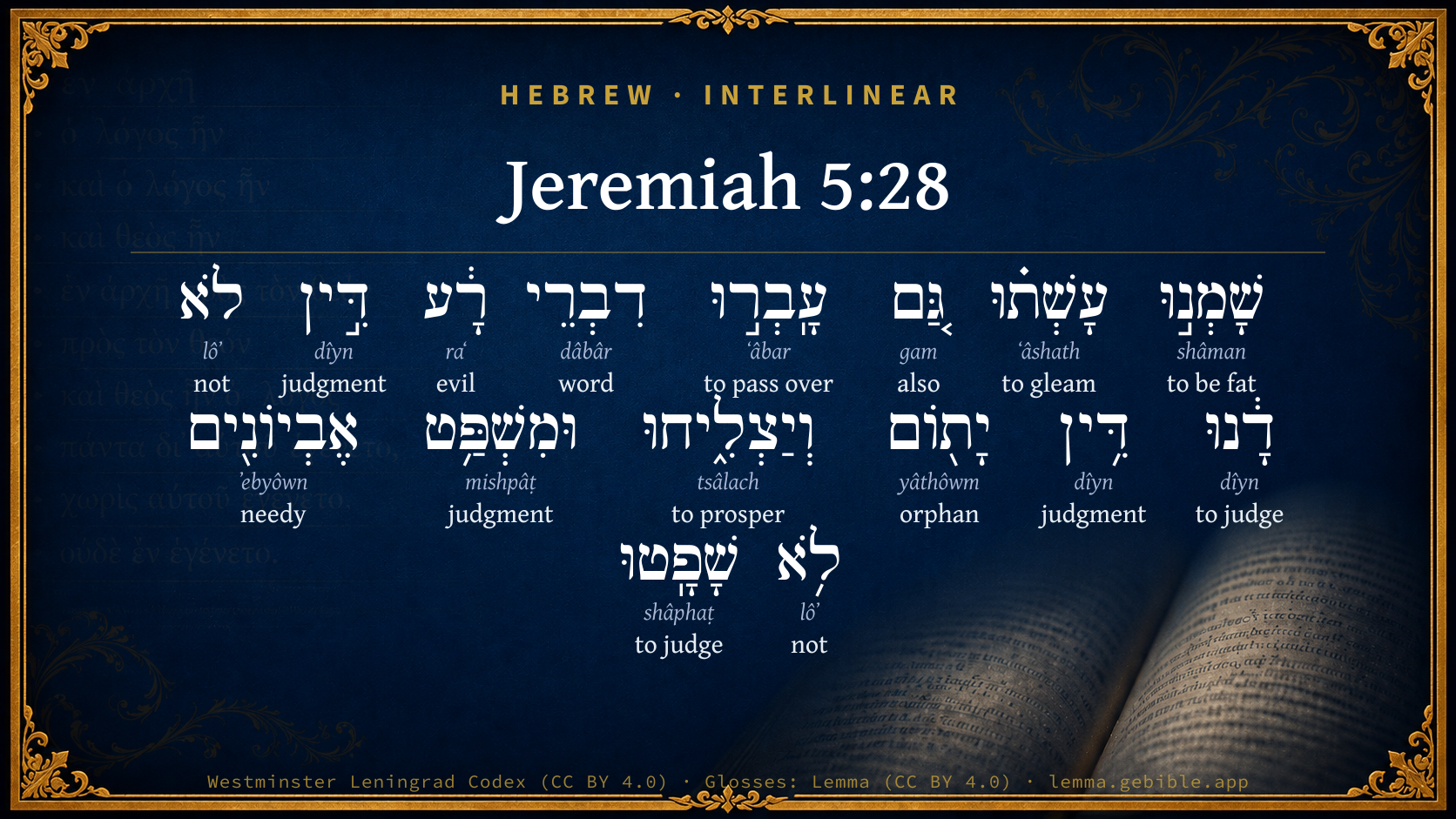
Jeremiah 5:28

Hebrew (Westminster Leningrad Codex) Jeremiah 5:28 appears in the Hebrew Old Testament. The text above is from the Westminster Leningrad Codex. Each word links to its Strong’s number, a concise gloss, and parsing drawn from the Open Scriptures Hebrew Bible morphology. Click any word for its full Brown-Driver-Briggs (BDB) entry.
Download image
Cite this verse

Jeremiah 5:28 (World English Bible). Public Domain. Lemma interlinear Bible study tool, https://lemma.gebible.app/v/jeremiah/5/28.

Show BibTeX & RIS
BibTeX
RIS
English Translation
They are grew fat, they shine: yes, they overpass in deeds of wickedness; they don't plead the cause, the cause of the fatherless, that they may prosper; and the right of the needy they don't judge.
World English Bible · Public Domain
Highlights
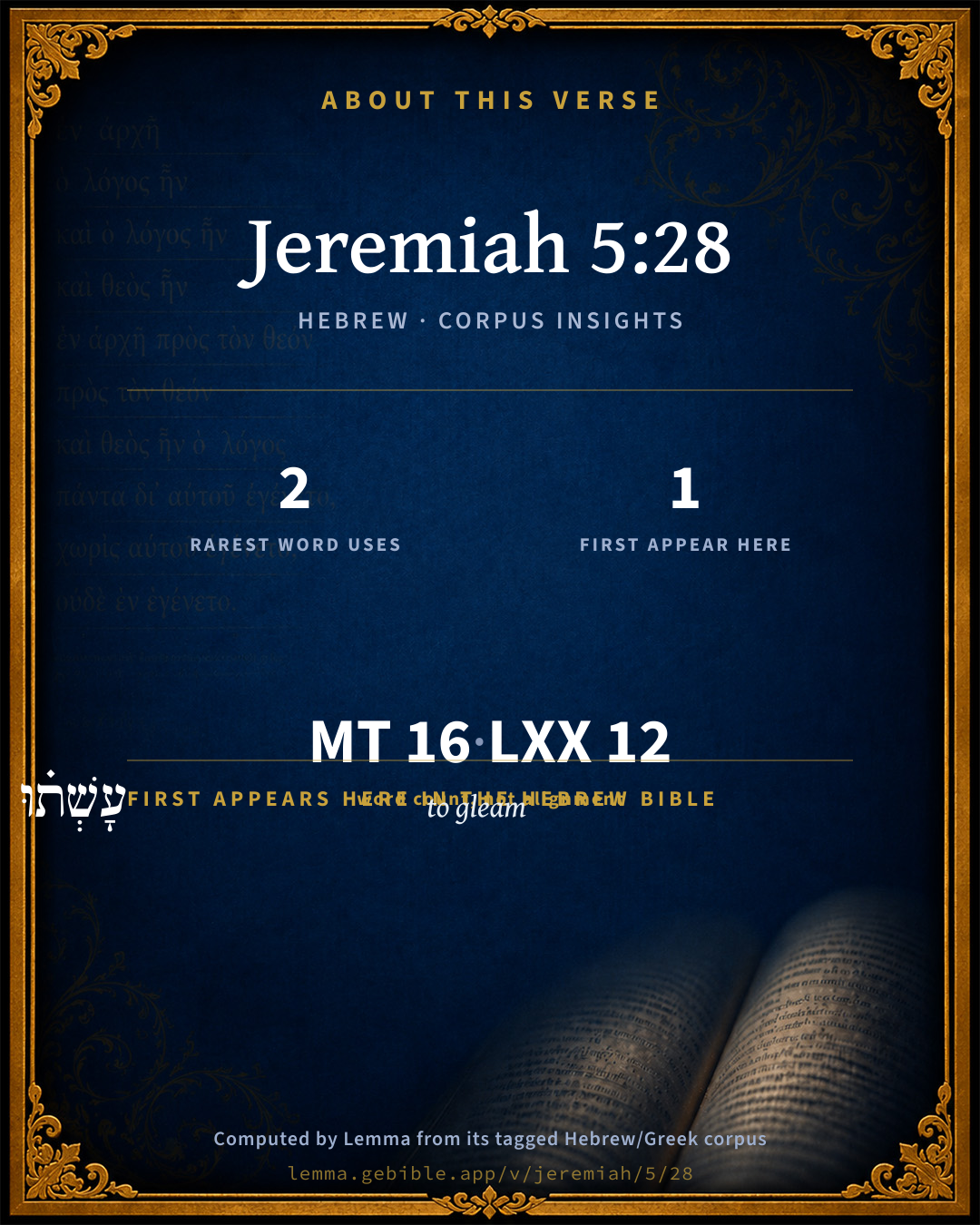
  • 1 first appearance in the Hebrew Bible
Full analysis ↓
Download a study sheet

One document with this verse’s original text, its word-by-word gloss line, the meaning frame, cross-references with their text, attributed commentary, and full source and license credits — printable, and it pastes into notes with its structure intact.

This verse Autodidact and up

Study sheet (.html) Plain text (.txt)

A passage Seminary Student

Up to 50 verses in one chapter. A passage sheet keeps up to 6 commentary sources and 12 cross-references per verse, in the order this page ranks them, and says so on the sheet whenever that leaves anything out. Ask for a single verse and you get the Autodidact verse sheet above.

Everything on this page stays free to read, with no account — the sheet is a download of what is already on screen, not access to it.

Want to remove ads? Support Godless Engineer
Compare translations 3

The same verse in 3 English versions, stacked beneath the original-language interlinear above. Click any original word for its lexicon entry.

Each is an independent rendering of the whole verse — the interlinear is not word-aligned to these translations.

Highlighted words mark where these versions differ — a whole-verse word diff, not a word-by-word alignment.

  • World English Bible Public Domain
    They are grew fat, they shine: yes, they overpass in deeds of wickedness; they don't plead the cause, the cause of the fatherless, that they may prosper; and the right of the needy they don't judge.
  • King James Version Public Domain
    They are waxen fat, they shine: yea, they overpass the deeds of the wicked: they judge not the cause, the cause of the fatherless, yet they prosper; and the right of the needy do they not judge.
  • unfoldingWord Literal Text CC BY-SA 4.0
    They are fat; they are sleek. They also trespass acts of evil. They do not plead the legal cause— the legal cause of the fatherless one, yet they prosper, but the justice of the needy ones— they have not given justice.

unfoldingWord Literal Text — © unfoldingWord, licensed CC BY-SA 4.0. Word-aligned USFM3 via Door43 (git.door43.org/unfoldingWord/en_ult).

Versions to compare (up to 4)

3 of 4 selected

Show all 18 translations

Every available English version of this verse, each an independent rendering of the whole verse.

  • World English Bible Public Domain
    They are grew fat, they shine: yes, they overpass in deeds of wickedness; they don't plead the cause, the cause of the fatherless, that they may prosper; and the right of the needy they don't judge.
  • Berean Standard Bible Public Domain
    They have grown fat and sleek, and have excelled in the deeds of the wicked. They have not taken up the cause of the fatherless, that they might prosper; nor have they defended the rights of the needy.
  • Majority Standard Bible Public Domain
    They have grown fat and sleek, and have excelled in the deeds of the wicked. They have not taken up the cause of the fatherless, that they might prosper; nor have they defended the rights of the needy.
  • King James Version Public Domain
    They are waxen fat, they shine: yea, they overpass the deeds of the wicked: they judge not the cause, the cause of the fatherless, yet they prosper; and the right of the needy do they not judge.
  • American Standard Version (1901) Public Domain
    They are waxed fat, they shine: yea, they overpass in deeds of wickedness; they plead not the cause, the cause of the fatherless, that they may prosper; and the right of the needy do they not judge.
  • Revised Version (1885) Public Domain
    They are waxen fat, they shine: yea, they overpass in deeds of wickedness: they plead not the cause, the cause of the fatherless, that they should prosper; and the right of the needy do they not judge.
  • Geneva Bible (1599) Public Domain
    They are waxen fat and shining: they doe ouerpasse the deedes of the wicked: they execute no iudgement, no not the iudgement of the fatherlesse: yet they prosper, though they execute no iudgement for the poore.
  • Douay-Rheims (1899) Public Domain
    They are grown gross and fat: andhave most wickedly transgressed my words. They have not judged the cause of the widow, they have not managed the cause of the fatherless, they have not judged the judgement of the poor.
  • Young's Literal Translation Public Domain
    They have been fat, they have shone, Yea, they have overpassed the acts of the evil, Judgment they have not judged, The judgment of the fatherless -- and they prosper, And the judgment of the needy they have not judged.
  • Literal Standard Version CC BY-SA 4.0
    They have been fat, they have shone, || Indeed, they have surpassed the acts of the evil, || They have not judged judgment, || The judgment of the fatherless—and they prosper, || And they have not judged the judgment of the needy.
  • Unlocked Literal Bible CC BY-SA 4.0
    They have become fat; they shine with well-being. They crossed over all bounds of wickedness. They do not plead the cause of the people, or the cause of the orphan. They prosper even though they have not given justice to the needy.
  • unfoldingWord Literal Text CC BY-SA 4.0
    They are fat; they are sleek. They also trespass acts of evil. They do not plead the legal cause— the legal cause of the fatherless one, yet they prosper, but the justice of the needy ones— they have not given justice.
  • Darby Bible Public Domain
    They are become fat, they shine, yea, they surpass in deeds of wickedness; they judge not the cause, the cause of the fatherless, and they prosper; and the right of the needy do they not adjudge.
  • World Messianic Bible Public Domain
    They have grown fat. They shine; yes, they excel in deeds of wickedness. They don’t plead the cause, the cause of the fatherless, that they may prosper; and they don’t defend the rights of the needy.
  • Webster's Bible Public Domain
    They have become fat, they shine: yes, they surpass the deeds of the wicked: they judge not the cause, the cause of the fatherless, yet they prosper; and the right of the needy do they not judge.
  • Free Bible Version CC BY-SA 4.0
    They've grown fat and smooth, and have become experts in evil. They deny justice to orphans, and they don't defend the rights of those in need.
  • Bible in Basic English Public Domain
    They have become fat and strong: they have gone far in works of evil: they give no support to the cause of the child without a father, so that they may do well; they do not see that the poor man gets his rights.
  • JPS Tanakh (1917) Public Domain
    They are waxen fat, they are become sleek; yea, they overpass in deeds of wickedness; they plead not the cause, the cause of the fatherless, that they might make it to prosper; and the right of the needy do they not judge.

Literal Standard Version (2020), Covenant Press — licensed CC BY-SA 4.0. Text via the HelloAO Bible API (eBible.org). Unlocked Literal Bible (unfoldingWord) — licensed CC BY-SA 4.0. Text via the HelloAO Bible API (eBible.org). unfoldingWord Literal Text — © unfoldingWord, licensed CC BY-SA 4.0. Word-aligned USFM3 via Door43 (git.door43.org/unfoldingWord/en_ult). Free Bible Version, Dr. Jonathan Gallagher — licensed CC BY-SA 4.0. Text via the HelloAO Bible API (eBible.org).

Word by word

More ways to search: Search by grammar → Find every occurrence → Compare this word →

Practice this passage: Drill this verse → Learn its vocabulary →

עָשְׁת֗וּ
ʻâshath
H6245
“to gleam”
Verb, Qal, Perfect, 3rd Person, Common, Plural
Part of Speech
Verb
Stem
Qal
Form
Perfect
Person
3rd Person
Gender
Common
Number
Plural
Full BDB Definition

Origin: a primitive root

TWOT: 1716 , 1717

(Qal) to be smooth, be shiny, gleam - (Hithpael) to think
  1. שָׁמְנ֣וּ shâman H8080 “to be fat” Verb, Qal, Perfect, 3rd Person, Common, Plural
  2. גַּ֚ם gam H1571 “also” Particle, Accusative
  3. עָֽבְר֣וּ ʻâbar H5674 “to pass over” Verb, Qal, Perfect, 3rd Person, Common, Plural
  4. דִבְרֵי dâbâr H1697 “words of” Noun, Common, Masculine, Plural, Construct
  5. רָ֔ע raʻ H7451 “evil” Adjective, Adjective, Masculine, Singular, Absolute
  6. דִּ֣ין dîyn H1779 “judgment” Noun, Common, Masculine, Singular, Absolute
  7. לֹא lôʼ H3808 “not” Particle, Negative
  8. דָ֔נוּ dîyn H1777 “to judge” Verb, Qal, Perfect, 3rd Person, Common, Plural
  9. דִּ֥ין dîyn H1779 “judgment of” Noun, Common, Masculine, Singular, Construct
  10. יָת֖וֹם yâthôwm H3490 “orphan” Noun, Common, Masculine, Singular, Absolute
  11. וְיַצְלִ֑יחוּ tsâlach H6743 “and · to prosper” Conjunction + Verb, Qal, Sequential Imperfect, 3rd Person, Masculine, Plural
  12. וּמִשְׁפַּ֥ט mishpâṭ H4941 “and · judgment of” Conjunction + Noun, Common, Masculine, Singular, Construct
  13. אֶבְיוֹנִ֖ים ʼebyôwn H34 “needy” Adjective, Adjective, Masculine, Plural, Absolute
  14. לֹ֥א lôʼ H3808 “not” Particle, Negative
  15. שָׁפָֽטוּ shâphaṭ H8199 “to judge” Verb, Qal, Perfect, 3rd Person, Common, Plural

About this verse

These counts appear in no published source. They are computed here, from the morphology-tagged text and Lemma’s own curated glosses. What Lemma adds →

16
words
14
distinct lemmas
Prophets
section

Notable vocabulary

The rarest word here is עָשְׁת֗וּ to gleam H6245 — appearing just 2 times in the whole Hebrew Bible.

First appearance in Scripture

This word makes its first canonical appearance in the Hebrew Bible here:

  • עָשְׁת֗וּ to gleam H6245

Shared distinctive vocabulary

עָשְׁת֗וּ to gleam H6245 occurs in 2 verses of the Hebrew Bible. Also found in:

Grammatical profile

  • 6 verbs
  • 5 nouns
  • 2 adjectives
  • 3 particles

Verb forms

  • שָׁמְנ֣וּ Qal · Perfect
  • עָשְׁת֗וּ Qal · Perfect
  • עָֽבְר֣וּ Qal · Perfect
  • דָ֔נוּ Qal · Perfect
  • וְיַצְלִ֑יחוּ Qal · Sequential Imperfect
  • שָׁפָֽטוּ Qal · Perfect

Repetition

Words recur within this verse — often emphatic in Hebrew:

  • דִּ֣ין judgment H1779 ×2
  • לֹא not H3808 ×2

Hebrew & Septuagint length

In the original languages it is 16 Hebrew tokens and 12 Greek tokens — but the two are counted differently (Hebrew bundles its prefixes and suffixes into one token; the Greek is in lemma form), so that isn’t a like-for-like length.

Cross-references

21

Topical passages linked to Jeremiah 5:28 in the Treasury of Scripture Knowledge — connected by theme and wording, ordered by reader-vote popularity; previews shown in the World English Bible.

  • Isaiah 1:23 Your princes are rebellious, and companions of thieves. Everyone loves bribes, and follows after rewards. They don't judge the fatherless, Neither does the cause of the widow come to them.
  • Deuteronomy 32:15 But Jeshurun grew fat, and kicked: You have grown fat, you are grown thick, you are become sleek; Then he forsook God who made him, Lightly esteemed the Rock of his salvation.
  • Psalms 73:12 Behold, these are the wicked. Being always at ease, they increase in riches.
  • Jeremiah 7:6 if you don't oppress the foreigner, the fatherless, and the widow, and don't shed innocent blood in this place, neither walk after other gods to your own hurt:
  • Zechariah 7:10 Don't oppress the widow, nor the fatherless, the foreigner, nor the poor; and let none of you devise evil against his brother in your heart.'
  • Job 12:6 The tents of robbers prosper, Those who provoke God are secure; Who carry their God in their hands.
  • Job 15:27–28 Because he has covered his face with his fatness, And gathered fat on his loins.
  • Job 21:23–24 One dies in his full strength, Being wholly at ease and quiet.
  • Job 29:12–14 Because I delivered the poor who cried, And the fatherless also, who had none to help him.
  • Psalms 72:4 He will judge the poor of the people. He will save the children of the needy, And will break the oppressor in pieces.
  • Psalms 73:6–7 Therefore pride is like a chain around their neck. Violence covers them like a garment.
  • Psalms 82:2–4 "How long will you judge unjustly, And show partiality to the wicked?" Selah.
  • Psalms 119:70 Their heart is as callous as the fat, But I delight in your law.
  • Jeremiah 2:33 How trimmest you your way to seek love! therefore even the wicked women have you taught your ways.
  • Jeremiah 12:1 Righteous are you, Yahweh, when I contend with you; yet would I reason the cause with you: why does the way of the wicked prosper? why are all they at ease who deal very treacherously?
  • Jeremiah 22:15–19 Shall you reign, because you strive to excel in cedar? Didn't your father eat and drink, and do justice and righteousness? then it was well with him.
  • Ezekiel 5:6–7 She has rebelled against my ordinances in doing wickedness more than the nations, and against my statutes more than the countries that are round about her; for they have rejected my ordinances, and as for my statutes, they have not walked in them.
  • Ezekiel 16:47–52 Yet have you not walked in their ways, nor done after their abominations; but, as [if that were] a very little [thing], you were more corrupt than they in all your ways.
  • Amos 4:1 Listen to this word, you cows of Bashan, who are on the mountain of Samaria, who oppress the poor, who crush the needy, who tell their lords, "Bring, and let us drink."
  • 1 Corinthians 5:1 It is actually reported that there is sexual immorality among you, and such sexual immorality as is not even named among the Gentiles, that one has his father's wife.
  • James 5:4–5 Behold, the wages of the laborers who mowed your fields, which you have kept back by fraud, cry out, and the cries of those who reaped have entered into the ears of the Lord of Hosts.

Cross-references courtesy of OpenBible.info (CC BY 4.0).

Hebrew and Greek witnesses Masoretic Hebrew ↔ Greek Septuagint

The same verse in the two great witnesses to the Old Testament, shown verse-for-verse.

These are two independent witnesses, not word-aligned to each other, and the Septuagint is shown in lemma (dictionary) form.

Hebrew Jeremiah 5:28 Masoretic · Westminster Leningrad Codex

שָׁמְנ֣וּ עָשְׁת֗וּ גַּ֚ם עָֽבְר֣וּ דִבְרֵי רָ֔ע דִּ֣ין לֹא דָ֔נוּ דִּ֥ין יָת֖וֹם וְיַצְלִ֑יחוּ וּמִשְׁפַּ֥ט אֶבְיוֹנִ֖ים לֹ֥א שָׁפָֽטוּ

They are grew fat, they shine: yes, they overpass in deeds of wickedness; they don't plead the cause, the cause of the fatherless, that they may prosper; and the right of the needy they don't judge.

World English Bible · Public Domain

Greek LXX Structure differs

In the Septuagint, Jeremiah is about an eighth shorter than the Hebrew and arranges its material differently — the Oracles Against the Nations (Hebrew chapters 46–51) appear in the middle of the Greek book, after 25:13. Because the chapter and verse boundaries do not line up, a verse-for-verse comparison with the Hebrew is not shown.

A verse-for-verse comparison isn’t shown here because the chapters and verses don’t line up. Switch to the LXX edition with the MT / LXX toggle above to read the Greek directly.

Hebrew: Westminster Leningrad Codex (CC BY 4.0). Greek: Septuagint (public domain); English from a public-domain English Septuagint. How the Septuagint differs from the Hebrew →

Targum (Aramaic paraphrase)

1

The Targum is the ancient Jewish Aramaic paraphrase of the Hebrew Scriptures — an interpretive translation, not the Hebrew text itself. Onkelos (literal) and Pseudo-Jonathan (expansive) render the Torah, and Jonathan the Prophets. Coverage is partial: where no permissively-licensed English translation exists for a verse, only the Aramaic is shown. This is verse-level text, not a word-by-word alignment to the Hebrew.

  1. Targum Jonathan Prophets (Joshua–Malachi)
    עֲתָרוּ אַף קְנוֹ נִכְסִין אַף עֲבָרוּ עַל פִּתְגָמֵי אוֹרַיְתָא עֲבָדוּ דְבִישׁ דִין דִקְשׁוֹט לָא דַיְיָנִין וְאִלּוּ הֲווֹ דַיְיָנִין דִין יַתְמָא הֲווֹ מַצְלִיחִין וְדִין חֲשִׁיכַיָא בְקוּשְׁטָא לֵית אִינּוּן דְיָנִין:

    (no public-domain English translation for this verse)

    Targum Jonathan — Aramaic: “Mikraot Gedolot” (public domain). English: “Sefaria Community Translation” (CC0 1.0 (public-domain dedication)); “London "Chaldee Paraphrase," 1871” (public domain). Text via Sefaria.

Commentary

Notes on Jeremiah 5:28 from classic Christian and Jewish commentators (each source and its license shown beneath its notes). The classic Christian expositions comment on the surrounding passage and are grouped to its opening verse, so a note may address several verses; the Jewish commentaries on the Tanakh (Rashi and others) are per-verse, so they appear only where the commentator wrote on this verse.

Lemma curates 59 commentaries, every one of them public domain or Creative Commons licensed, each selected and text-cleaned for this edition rather than reprinted as found. About our sources →

Trapp's Complete Commentary

John Trapp

Jer 5:28 They are waxen fat, they shine: yea, they overpass the deeds of the wicked: they judge not the cause, the cause of the fatherless, yet they prosper; and the right of the needy do they not judge.

Ver. 28. They are waxen fat, they shine.] Pingues, nitidi sunt; cutem curant ut Epicuri de grege porci; fat they are, and fair-liking, slick, and smooth.

Yea, they overpass the deeds of the wicked.] They outsin others. Or, as some sense it, they escape better than others. {Psa 73:5}

John Trapp, A Commentary or Exposition upon All the Books of the Old and New Testament (1647–1656) — public domain. Text from a community e-Sword module.

Geneva Bible (1599)

Geneva Bible translators

They feel not the plague of God for it.

Geneva Bible (1599) marginal notes — public domain. Text via Bolls.life.

Jamieson, Fausset & Brown

Robert Jamieson, A. R. Fausset & David Brown

shine--the effect of fatness on the skin (Deu 32:15). They live a life of self-indulgence.

overpass . . . the wicked--exceed even the Gentiles in wickedness (Jer 2:33; Eze 5:6-7).

judge not . . . fatherless-- (Isa 1:23).

yet . . . prosper-- (Jer 12:1).

Jamieson, Fausset & Brown — Commentary Critical and Explanatory on the Whole Bible (1871) — public domain (CC PDM 1.0). Text via the HelloAO Bible API.

Adam Clarke's Commentary

Verse 28. They judge not the cause, yet they prosper] Perhaps we might be justified in translating, "And shall they prosper?"

Adam Clarke's Commentary on the Bible (1810–1826) — public domain. Text from a community e-Sword/MySword module.

John Calvin's Commentaries

Here the Prophet reproves those who were high in dignity, station, and wealth, and who wished at the same time to be deemed inviolable, because they were the rulers of the people. He had spoken before generally, but now he assails the higher orders, the king’s counselors, the priests, the judges, and all endowed with authority. He says, that they were swoln with fatness, that they were shining, though they had exceeded, etc We see how he confirms what he had briefly referred to; for as they protected themselves under the pretense of being rich, that they might not be called to an account, he says, by way of concession, “I allow that ye are bright and splendid, and indeed that ye are all over gold; but whence is this splendor? whence is this specious appearance, which dazzles the eyes of the simple? Ye are bright, ye are fat, though ye have surpassed the words of the impious, that is, the ways, the doings, and the designs of the impious.” He means, in short, that it was of no avail to the wicked, that by their aspect they terrified people, that they gained great respect by their riches, and made men afraid of them: the Prophet admits that they had honors, wealth, splendor, repute, dignity, and such things; but he says, at the same time, Ye have surpassed all the doings of the wicked And then he brings this charge against them, that they did not judge judgment

It hence appears that the Prophet was not dealing with the common people nor with private individuals; but that he openly and avowedly reproved the king’s court and the judges. “They judge not judgment, “he says; which means, that they had no care for executing justice, but suffered thefts and robberies to go unpunished: and he still enhances their guilt and says, They judge not the judgment of the fatherless Pity towards young orphans is often found in those who are otherwise cruel; for that age, especially when deprived of all protection, touches our feelings in a peculiar manner. Since then young orphans were plundered with impunity, and found no defense from the judges, their dishonesty appeared most glaringly.

And he says, that they yet prospered. He again repeats, by way of concession, what he had before intimated, — that it was a foolish and vain pretense, that they openly boasted of their wealth, honors, and fortunes. How is this, he says? They prosper; but yet they judge not the judgment of the poor, that is, they help not the poor, but dissemble and connive at all the wrongs done to them. We now then see that he exposes to view the wickedness of the people, so that not even the principal men should be able to hide themselves; for the Lord shews that they had wholly neglected their duties, and were even destitute of all humanity. It afterwards follows —

John Calvin's Commentaries (1540-1563) — public domain. Text from the Calvin Translation Society English edition (1840s-50s) via the Christian Classics Ethereal Library (ccel.org). Calvin's coverage is partial (roughly two-thirds of the Bible); uncommented books and verses are honest gaps, never fabricated. The 19th-century editor's footnotes and remarks are omitted so the notes are faithfully Calvin's own voice.

Ellicott's Commentary for English Readers

(28) They overpass the deeds of the wicked.—Better (the English being ambiguous), they exceed in deeds (literally, words or things) of wickedness. The prophet dwells not only on the prosperity of the wicked, but on their callous indifference to the well-being of the poor.

Yet they prosper.—Better, so that they (the fatherless) may prosper. They do not judge with a view to that result. The words admit, however, in Hebrew as in English, of the sense that they (the wicked themselves) may prosper. That was all they aimed at or cared for.

A Bible Commentary for English Readers, edited by Charles John Ellicott (1878–1897) — public domain. Text from a community e-Sword module.

The Cambridge Bible for Schools and Colleges

gen. ed. J. J. S. Perowne

28. waxen fat] Fatness was looked on as a mark of prosperity. Cp. Deu_32:15; Psa_92:14; Pro_28:25.

shine] referring to their sleekness of skin.

that they should prosper] i.e. that the orphans by their help may receive succour.

The Cambridge Bible for Schools and Colleges (gen. ed. J. J. S. Perowne; Cambridge University Press, 1878–1918) — public domain. Text from a community e-Sword module.

John Gill's Exposition

They are waxen fat, they shine,.... Becoming rich they grew fat, and their faces shone through fatness; so oil, delicious food, and good living, as it fattens men, it makes their faces to shine; see Psa 104:15,

yea, they overpass the deeds of the wicked; though they pretended to religion, the fear and worship of God, yet they committed crimes more heinous than the most abandoned and profligate sinners: or, "they exceed the words of the wicked" (f); either they speak words more wicked than they; or do such actions as are not to be expressed by words, and which even a wicked man would hardly choose to name. The Targum is,

"they transgress the words of the law;''

and the Vulgate Latin version comes pretty near it, "they have passed over my words very badly"; as if they referred to the words of the law and the prophets:

they judge not the cause, the cause of the fatherless; this shows that it was not the common people only that were become so wicked, but the judges and civil magistrates; and who were so far from doing justice between man and man, in all civil cases that came before them, that they would not even exercise right judgment in the case of the fatherless; who not only require justice to be done them, but mercy and pity to be shown them:

yet they prosper; in the world, and increase in riches; have health of body and prosperity in their families; nor are they in trouble, as other men: this sometimes has been trying to good men to observe; see Psa 73:3 and particularly to the Prophet Jeremiah, Jer 12:1, or, "that they may prosper" (g); as Jarchi interprets it; and to the same sense is the Targum,

"if they had judged the judgment of the fatherless they would have prospered;''

but the former sense is best; and which Kimchi gives into, and agrees with what goes before, concerning the riches and prosperous estate of those men:

and the right of the needy do they not judge: because they are poor, and can not fee them, they will not undertake their cause; or, if it comes before them, they will not do them justice, being bribed by the rich that oppose them.

(f) "transcendunt verba mali", Schmidt; "transierunt verba mali", Cocceius. (g) "ut prosperentur", Gataker.

John Gill's Exposition of the Whole Bible (1746–1763) — public domain (CC PDM 1.0). Text via the HelloAO Bible API.

Haydock's Catholic Bible Commentary

Of the widow, is not in Hebrew. (Calmet) --- Fatherless. Protestants add, "yet they prosper, and they," &c. (Haydock)

George Leo Haydock (1774–1849), Haydock's Catholic Family Bible and Commentary, 1859 edition — public domain. Excludes Psalms (Douay-Rheims chapter numbering differs from Protestant) and Deuterocanonical books (Catholic canon only).

Matthew Poole's English Annotations

They are waxen fat, they shine; or, so fat that they shine; by reason.of their wealth and riches they pamper themselves till their eyes stand out with fatness, Psa 73:7; their wrinkles are filled up with fat, which makes their faces shine.

They overpass the deeds of the wicked; either, they go beyond the very heathen themselves in wickedness, Eze 5:6,7; or rather, they escape the hardships and sufferings that others undergo, Psa 73:5-8, they escape better than others; or they slightly pass over judgments threatened.

They judge not the cause of the fatherless; such whom even the law of nature commits to their patronage, they either disregard them, or wrong and injure them, either by refusing them a fair hearing, Isa 1:23, or giving wrong sentence against them in courts of judicature, Zec 7:10, expressly forbidden, Exo 22:22.

Yet they prosper; things go well with them, they live happily, according to their desire, prosperum scelus, Job 21:7, &c.; or, that they might prosper, viz. that God might bless them.

Matthew Poole's English Annotations on the Holy Bible (1683–1685) — public domain. Text from a community e-Sword/MySword module.

The Pulpit Commentary

They overpass the deeds of the wicked; rather, they overpass the common measure of wickedness (literally, the cases of wickedness); or, as others, they exceed in deeds of wickedness. Yet they prosper ; rather, so that they (the fatherless) might prosper; or, that they (the rich) might make it to prosper.

The Pulpit Commentary (1880–1919), ed. H.D.M. Spence-Jones & Joseph S. Exell — public domain. Text from a community e-Sword module.

John Wesley's Explanatory Notes

Overpass - They go beyond the Heathens themselves in wickedness.

John Wesley, Explanatory Notes Upon the Whole Bible (1754–1765) — public domain. Text via the GEBible commentary corpus.

Rashi

Rabbi Shlomo Yitzchaki (Rashi)

they have become thick Heb. עשתו, an expression of “a block (עֶשֶת) of ivory” (Song 5:14), a thick body, and in O.F. enboeront.

they transgressed in deeds of wickedness If evil or a sin came into their hand, they did not turn away from it, but transgressed it and committed it.

they did not plead the cause of the orphan in order that they prosper.

Rashi on the Tanakh — English translations: “The Judaica Press complete Tanach with Rashi, translated by A. J. Rosenberg” (CC BY 4.0); “Pentateuch with Rashi's commentary by M. Rosenbaum and A.M. Silbermann, 1929-1934” (public domain); “The Metsudah Tanach series, Lakewood, N.J” (CC BY 4.0); and “The Book of Joshua, Metsudah Publications, 1997” (CC BY 4.0). Text via Sefaria.

Lesson kit

Teaching starters — assembled from the data on this page, not authored interpretation. Every prompt links to the verse data it draws on. Edit before teaching.

Jeremiah, in the Prophets, opens this verse with 16 words (14 distinct Hebrew lemmas). Its most distinctive word is ʻâshath (“to gleam”). A historical commentator’s framing appears above. Read the whole chapter for the surrounding context.

Discussion questions

  1. How does “to gleam” (ʻâshath) shape what this verse is saying?
  2. The word “to gleam” first appears here in Scripture. What is being introduced at this debut?
  3. Jonah 1:6 shares the word «to gleam» with this verse. How do the two illuminate each other?
  4. “judgment” occurs 2× in this one verse. What is the effect of the repetition?
  5. The translations on this page render this verse differently — a whole-verse word diff, not a word-by-word alignment. What might account for the different wordings?
  6. The verb «שָׁמְנ֣וּ» is Qal Perfect. How does its form color the action?
  7. Reading how Trapp's Complete Commentary and Geneva Bible (1599) read this verse, where do the two commentators agree and where do they part?

Things to notice

Reading settings

Reading text

Shown beneath each verse's original-language words.

Old Testament
Old Testament edition

Read the OT as the Masoretic Hebrew (MT) or the Greek Septuagint (LXX).

English shown for the Greek Septuagint (in the Hebrew ↔ Greek comparison).

Comparing translations? Open the Compare panel on any verse page to stack up to four side by side.