Joel 3:12

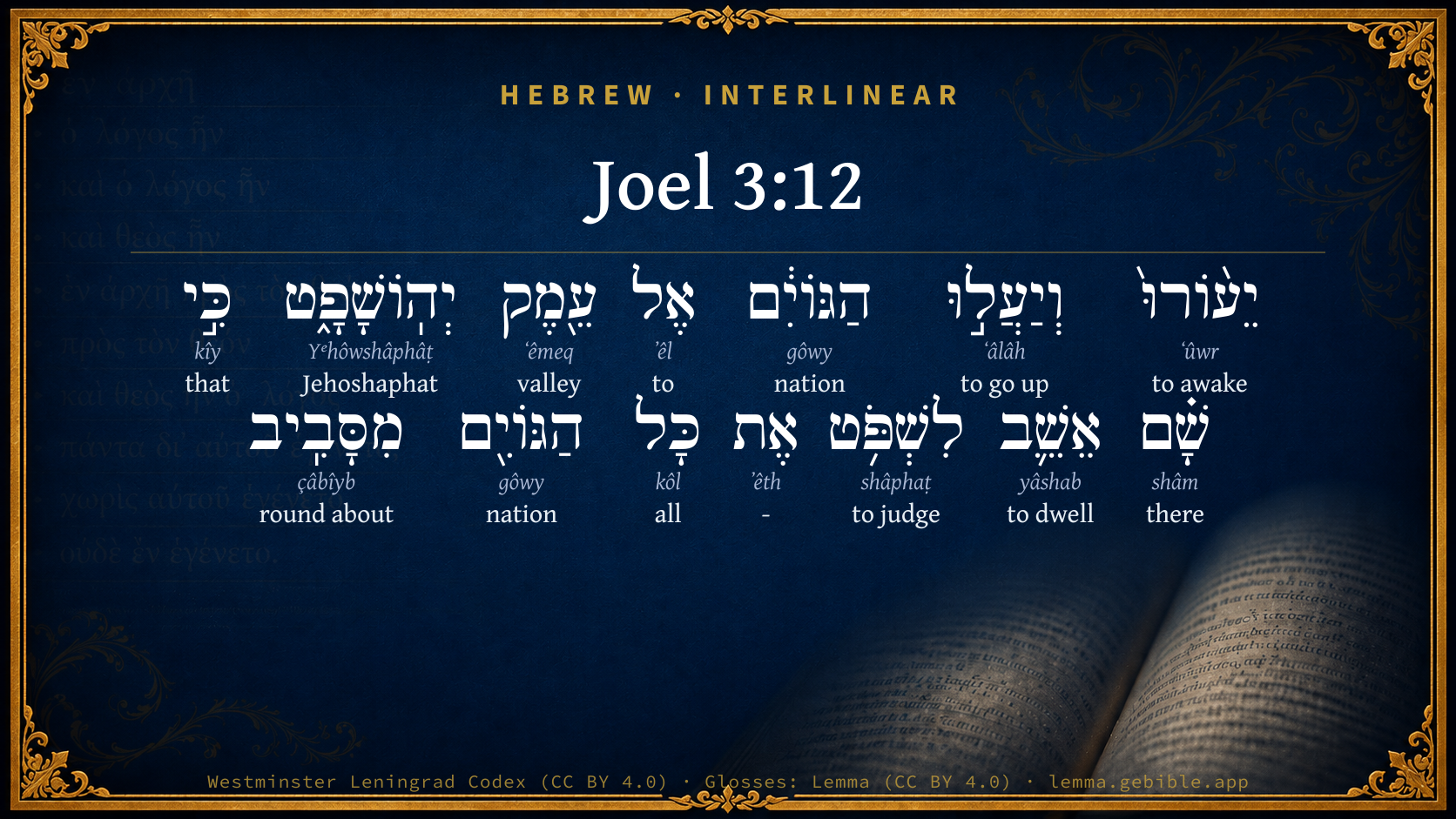
Hebrew (Westminster Leningrad Codex) Joel 3:12 appears in the Hebrew Old Testament. The text above is from the Westminster Leningrad Codex. Each word links to its Strong’s number, a concise gloss, and parsing drawn from the Open Scriptures Hebrew Bible morphology. Click any word for its full Brown-Driver-Briggs (BDB) entry.
Download image
Cite this verse

Joel 3:12 (World English Bible). Public Domain. Lemma interlinear Bible study tool, https://lemma.gebible.app/v/joel/3/12.

Show BibTeX & RIS
BibTeX
RIS
English Translation
"Let the nations arouse themselves, And come up to the valley of Jehoshaphat; For there will I sit to judge all the surrounding nations.
World English Bible · Public Domain
Download a study sheet

One document with this verse’s original text, its word-by-word gloss line, the meaning frame, cross-references with their text, attributed commentary, and full source and license credits — printable, and it pastes into notes with its structure intact.

This verse Autodidact and up

Study sheet (.html) Plain text (.txt)

A passage Seminary Student

Up to 50 verses in one chapter. A passage sheet keeps up to 6 commentary sources and 12 cross-references per verse, in the order this page ranks them, and says so on the sheet whenever that leaves anything out. Ask for a single verse and you get the Autodidact verse sheet above.

Everything on this page stays free to read, with no account — the sheet is a download of what is already on screen, not access to it.

Want to remove ads? Support Godless Engineer
Compare translations 3

The same verse in 3 English versions, stacked beneath the original-language interlinear above. Click any original word for its lexicon entry.

Each is an independent rendering of the whole verse — the interlinear is not word-aligned to these translations.

Highlighted words mark where these versions differ — a whole-verse word diff, not a word-by-word alignment.

  • World English Bible Public Domain
    "Let the nations arouse themselves, And come up to the valley of Jehoshaphat; For there will I sit to judge all the surrounding nations.
  • King James Version Public Domain
    Let the heathen be wakened, and come up to the valley of Jehoshaphat: for there will I sit to judge all the heathen round about.
  • unfoldingWord Literal Text CC BY-SA 4.0
    “Let the nations rouse themselves and come up to the Valley of Jehoshaphat, for there will I sit to judge all of the surrounding nations.

unfoldingWord Literal Text — © unfoldingWord, licensed CC BY-SA 4.0. Word-aligned USFM3 via Door43 (git.door43.org/unfoldingWord/en_ult).

Versions to compare (up to 4)

3 of 4 selected

Show all 18 translations

Every available English version of this verse, each an independent rendering of the whole verse.

  • World English Bible Public Domain
    "Let the nations arouse themselves, And come up to the valley of Jehoshaphat; For there will I sit to judge all the surrounding nations.
  • Berean Standard Bible Public Domain
    Let the nations be roused and advance to the Valley of Jehoshaphat, for there I will sit down to judge all the nations on every side.
  • Majority Standard Bible Public Domain
    Let the nations be roused and advance to the Valley of Jehoshaphat, for there I will sit down to judge all the nations on every side.
  • King James Version Public Domain
    Let the heathen be wakened, and come up to the valley of Jehoshaphat: for there will I sit to judge all the heathen round about.
  • American Standard Version (1901) Public Domain
    Let the nations bestir themselves, and come up to the valley of Jehoshaphat; for there will I sit to judge all the nations round about.
  • Revised Version (1885) Public Domain
    Let the nations bestir themselves, and come up to the valley of Jehoshaphat: for there will I sit to judge all the nations round about.
  • Geneva Bible (1599) Public Domain
    Let the heathen be wakened, and come vp to the valley of Iehoshaphat: for there will I sit to iudge all the heathen round about.
  • Douay-Rheims (1899) Public Domain
    Let them arise, and let the nations come up into the valley of Josaphat: for there I will sit to judge all nations round about.
  • Young's Literal Translation Public Domain
    Wake and come up let the nations unto the valley of Jehoshaphat, For there I sit to judge all the nations around.
  • Literal Standard Version CC BY-SA 4.0
    “Let the nations wake and come up to the Valley of Jehoshaphat, || For there I sit to judge all the nations around.
  • Unlocked Literal Bible CC BY-SA 4.0
    Let the nations wake themselves up and come up to the Valley of Jehoshaphat. For there will I sit to judge all the surrounding nations.
  • unfoldingWord Literal Text CC BY-SA 4.0
    “Let the nations rouse themselves and come up to the Valley of Jehoshaphat, for there will I sit to judge all of the surrounding nations.
  • Darby Bible Public Domain
    Let the nations rouse themselves, and come up to the valley of Jehoshaphat; for there will I sit to judge all the nations round about.
  • World Messianic Bible Public Domain
    “Let the nations arouse themselves, and come up to the valley of Jehoshaphat; for there I will sit to judge all the surrounding nations.
  • Webster's Bible Public Domain
    \\3:7\\Behold, I will raise them out of the place whither ye have sold them, and will return your recompense upon your own head:
  • Free Bible Version CC BY-SA 4.0
    Let the nations get ready, let them come to the valley of Jehoshaphat for there I will sit in judgment on all the nations.
  • Bible in Basic English Public Domain
    See, I will have them moved from the place where you have sent them, and will let what you have done come back on your head;
  • JPS Tanakh (1917) Public Domain
    (4-12) Let the nations be stirred up, and come up to the valley of Jehoshaphat; for there will I sit to judge all the nations round about.

Literal Standard Version (2020), Covenant Press — licensed CC BY-SA 4.0. Text via the HelloAO Bible API (eBible.org). Unlocked Literal Bible (unfoldingWord) — licensed CC BY-SA 4.0. Text via the HelloAO Bible API (eBible.org). unfoldingWord Literal Text — © unfoldingWord, licensed CC BY-SA 4.0. Word-aligned USFM3 via Door43 (git.door43.org/unfoldingWord/en_ult). Free Bible Version, Dr. Jonathan Gallagher — licensed CC BY-SA 4.0. Text via the HelloAO Bible API (eBible.org).

Word by word

More ways to search: Search by grammar → Find every occurrence → Compare this word →

Practice this passage: Drill this verse → Learn its vocabulary →

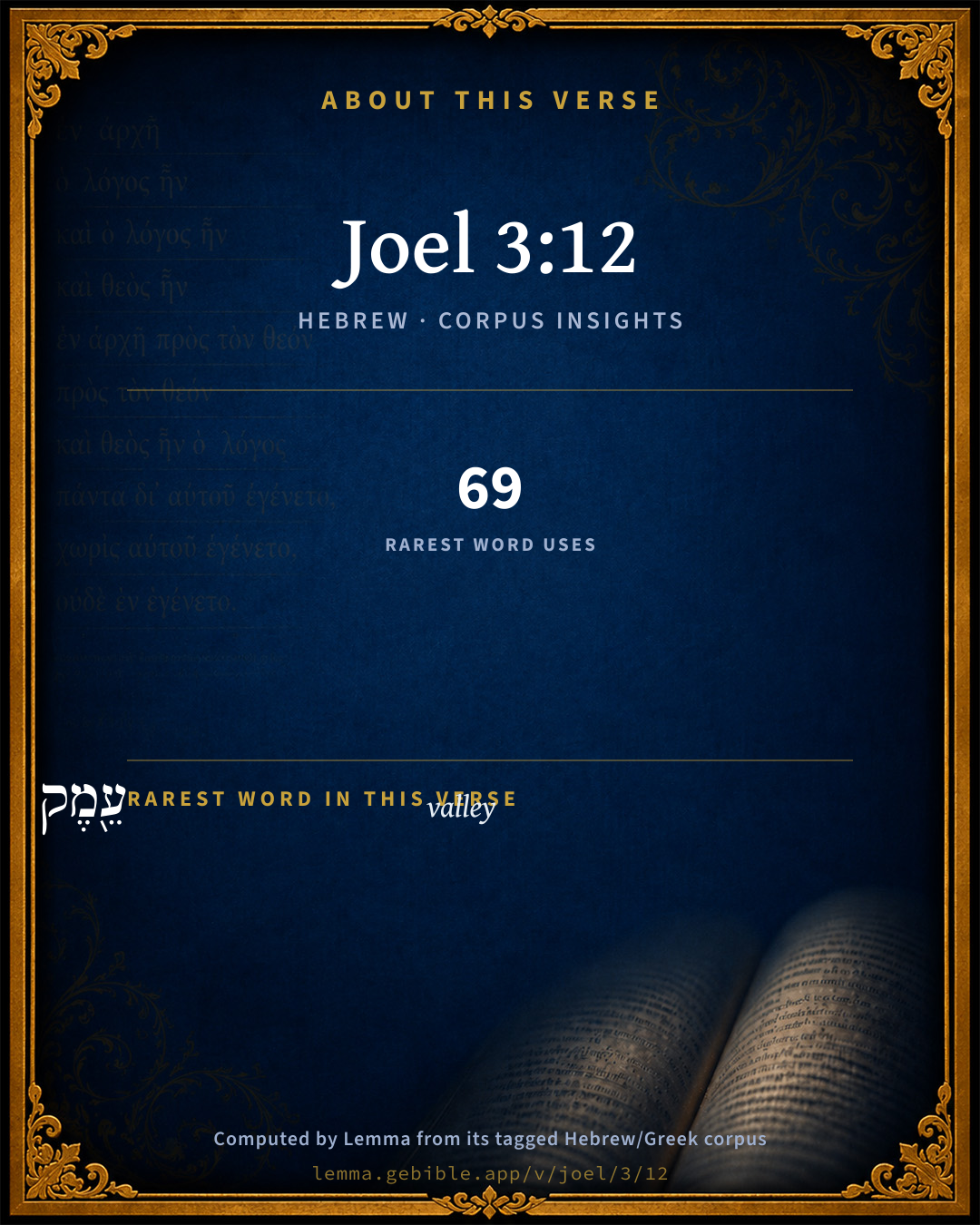
עֵ֖מֶק
ʻêmeq
H6010
“valley of”
Noun, Common, Masculine, Singular, Construct
Part of Speech
Noun
Type
Common
Gender
Masculine
Number
Singular
State
Construct
Full BDB Definition

Origin: from H6009

TWOT: 1644a

valley, vale, lowland, open country
  1. יֵע֨וֹרוּ֙ ʻûwr H5782 “to awake” Verb, Niphal, Jussive, 3rd Person, Masculine, Plural
  2. וְיַעֲל֣וּ ʻâlâh H5927 “and · to go up” Conjunction + Verb, Qal, Jussive, 3rd Person, Masculine, Plural
  3. הַגּוֹיִ֔ם gôwy H1471 “the · nations” Particle, Definite Article + Noun, Common, Masculine, Plural, Absolute
  4. אֶל ʼêl H413 “to” Preposition
  5. יְהֽוֹשָׁפָ֑ט Yᵉhôwshâphâṭ H3092 “Jehoshaphat” Noun, Proper
  6. כִּ֣י kîy H3588 “that” Conjunction
  7. שָׁ֗ם shâm H8033 “there” Adverb
  8. אֵשֵׁ֛ב yâshab H3427 “to dwell” Verb, Qal, Imperfect, 1st Person, Common, Singular
  9. לִשְׁפֹּ֥ט shâphaṭ H8199 “to judge” Preposition + Verb, Qal, Infinitive Construct
  10. אֶת ʼêth H853 “-” Particle, Direct Object
  11. כָּל kôl H3605 “all of” Noun, Common, Masculine, Singular, Construct
  12. הַגּוֹיִ֖ם gôwy H1471 “the · nations” Particle, Definite Article + Noun, Common, Masculine, Plural, Absolute
  13. מִסָּבִֽיב çâbîyb H5439 “from · round about” Preposition + Noun, Common, Both, Singular, Absolute

About this verse

These counts appear in no published source. They are computed here, from the morphology-tagged text and Lemma’s own curated glosses. What Lemma adds →

14
words
13
distinct lemmas
Prophets
section

Grammatical profile

  • 4 verbs
  • 6 nouns
  • 1 preposition
  • 1 conjunction
  • 1 adverb
  • 1 particle

Verb forms

  • יֵע֨וֹרוּ֙ Niphal · Jussive
  • וְיַעֲל֣וּ Qal · Jussive
  • אֵשֵׁ֛ב Qal · Imperfect
  • לִשְׁפֹּ֥ט Qal · Infinitive Construct

Repetition

A word recurs within this verse — often emphatic in Hebrew:

  • הַגּוֹיִ֔ם nation H1471 ×2

Hebrew & Septuagint length

In English translation the verse runs 24 words from the Hebrew and 27 from the Septuagint (LXX English) — closely comparable.

A rough comparison of the two English renderings, which tokenize alike — not a word-level alignment.

Word counts can differ between the Hebrew and the Greek without any difference in meaning — e.g. the Hebrew direct-object marker אֵת has no separate Greek word, and Greek often adds the article ὁ.

Cross-references

16

Topical passages linked to Joel 3:12 in the Treasury of Scripture Knowledge — connected by theme and wording, ordered by reader-vote popularity; previews shown in the World English Bible.

  • Joel 3:2 I will gather all nations, And will bring them down into the valley of Jehoshaphat; And I will execute judgment on them there for my people, And for my heritage, Israel, whom they have scattered among the nations. They have divided my land,
  • Psalms 96:13 Before Yahweh; for he comes, For he comes to judge the earth. He will judge the world with righteousness, The peoples with his truth.
  • Psalms 98:9 Let them sing before Yahweh, For he comes to judge the earth. He will judge the world with righteousness, And the peoples with equity.
  • Isaiah 2:4 He will judge between the nations, And will decide concerning many peoples; And they shall beat their swords into plowshares, And their spears into pruning-hooks. Nation shall not lift up sword against nation, Neither shall they learn war any more.
  • Isaiah 3:13 Yahweh stands up to contend, And stands to judge the peoples.
  • Psalms 7:6 Arise, Yahweh, in your anger. Lift up yourself against the rage of my adversaries. Awake for me. You have commanded judgment.
  • Joel 3:14 Multitudes, multitudes in the valley of decision! For the day of Yahweh is near, in the valley of decision.
  • Micah 4:3 And he will judge between many peoples, And will decide concerning strong nations afar off. They will beat their swords into plowshares, And their spears into pruning hooks. Nation will not lift up sword against nation, Neither will they learn war any more.
  • Zechariah 14:4 His feet will stand in that day on the Mount of Olives, which is before Jerusalem on the east; and the Mount of Olives will be split in two, from east to west, making a very great valley. Half of the mountain will move toward the north, and half of it toward the south.
  • 2 Chronicles 20:26 On the fourth day they assembled themselves in the valley of Beracah; for there they blessed Yahweh: therefore the name of that place was called The valley of Beracah to this day.
  • Psalms 76:8–9 You pronounced judgment from heaven. The earth feared, and was silent,
  • Psalms 110:5–6 The Lord is at your right hand. He will crush kings in the day of his wrath.
  • Ezekiel 30:3 For the day is near, even the day of Yahweh is near; it shall be a day of clouds, a time of the nations.
  • Ezekiel 39:11 It shall happen in that day, that I will give to Gog a place for burial in Israel, the valley of those who pass through on the east of the sea; and it shall stop those who pass through: and there shall they bury Gog and all his multitude; and they shall call it The valley of Hamon Gog.
  • Revelation 19:11 I saw the heaven opened, and behold, a white horse, and he who sat on it is called Faithful and True. In righteousness he judges and makes war.
  • Psalms 2:8–9 Ask of me, and I will give the nations for your inheritance, The uttermost parts of the earth for your possession.

Cross-references courtesy of OpenBible.info (CC BY 4.0).

Hebrew and Greek witnesses Masoretic Hebrew ↔ Greek Septuagint

The same verse in the two great witnesses to the Old Testament, shown verse-for-verse.

These are two independent witnesses, not word-aligned to each other, and the Septuagint is shown in lemma (dictionary) form.

Hebrew Joel 3:12 Masoretic · Westminster Leningrad Codex

יֵע֨וֹרוּ֙ וְיַעֲל֣וּ הַגּוֹיִ֔ם אֶל עֵ֖מֶק יְהֽוֹשָׁפָ֑ט כִּ֣י שָׁ֗ם אֵשֵׁ֛ב לִשְׁפֹּ֥ט אֶת כָּל הַגּוֹיִ֖ם מִסָּבִֽיב

"Let the nations arouse themselves, And come up to the valley of Jehoshaphat; For there will I sit to judge all the surrounding nations.

World English Bible · Public Domain

Greek LXX Joel 3:12 Septuagint · lemma form
Let them be aroused, let all the nations go up to the valley of Josaphat: for there will I sit to judge all the Gentiles round about.

LXX2012 (modern English Septuagint) · Public Domain

Hebrew: Westminster Leningrad Codex (CC BY 4.0). Greek: Septuagint (public domain); English from LXX2012 (modern English Septuagint) (Public Domain). How the Septuagint differs from the Hebrew →

Commentary

Notes on Joel 3:12 from classic Christian and Jewish commentators (each source and its license shown beneath its notes). The classic Christian expositions comment on the surrounding passage and are grouped to its opening verse, so a note may address several verses; the Jewish commentaries on the Tanakh (Rashi and others) are per-verse, so they appear only where the commentator wrote on this verse.

Lemma curates 59 commentaries, every one of them public domain or Creative Commons licensed, each selected and text-cleaned for this edition rather than reprinted as found. About our sources →

Trapp's Complete Commentary

John Trapp

Joe 3:12 Let the heathen be wakened, and come up to the valley of Jehoshaphat: for there will I sit to judge all the heathen round about.

Ver. 12. Let the heathen be awakened] Here begins God’s answer to the prophet’s prayer. The heathen, though at ease, Zec 1:11, and fast asleep, must be aroused and assembled to the valley of Jehoshaphat, where God the righteous Judge (at the prophet’s request reminding him of his promise, "I am come for thy words," saith he to Daniel, Dan 10:12) gets up to the tribunal, and there sits to judge all the heathen round about. Let not us doubt of the like success of our suits; but, when wronged, run to the Judge of heaven and earth, who will do us right. So we pray over the promises, as here, and not faint, though he bear long with us. This our Saviour has taught us, by that famous parable of the uniust judge and the importunate widow, Luk 18:2-3, wherein we may take notice of many excellent encouragements to pray down our enemies. 1. He was a judge only; but God is our Father also. 2. He was an unrighteous judge; but is there unrighteousness with God? Rom 9:14. 3. He, as he feared not God, so he cared not for man; but God is φιλανθρωπος, properly and peculiarly loving to man above other creatures, Tit 3:4 4. He avenged the widow, as wearied out with her, and merely to be rid of her; and shall not God do as much for us, out of his love to righteousness and hatred of wickedness? Psa 45:7 5. It was troublesome to him to be sued unto; but God is displeased with us for nothing more than for our backwardness and bashfulness, Joh 16:24. Quid est cur nihil petis? What meanest thou to ask me nothing? said Severus to his favourite. 6. The unjust judge had no care of his credit; but God is most tender of his glory; and delights much in that title of his, "O thou that hearest prayers."

John Trapp, A Commentary or Exposition upon All the Books of the Old and New Testament (1647–1656) — public domain. Text from a community e-Sword module.

Tyndale Open Study Notes

Tyndale Open Resources

3:12 The battle would take place in the valley of Jehoshaphat (see study note on 3:2-3), where the Lord would pronounce judgment on them all.

Tyndale Open Study Notes — © Tyndale Open Resources, licensed CC BY-SA 4.0. Text via the HelloAO Bible API.

Jamieson, Fausset & Brown

Robert Jamieson, A. R. Fausset & David Brown

See Joe 3:2.

judge all the heathen round about--that is, all the nations from all parts of the earth which have maltreated Israel; not merely, as HENDERSON supposes, the nations round about Jerusalem (compare Psa 110:6; Isa 2:4; Mic 4:3, Mic 4:11-13; Zep 3:15-19; Zac 12:9; Zac 14:3-11; Mal 4:1-3).

Jamieson, Fausset & Brown — Commentary Critical and Explanatory on the Whole Bible (1871) — public domain (CC PDM 1.0). Text via the HelloAO Bible API.

Adam Clarke's Commentary

Verse 12. Let the heathen be wakened] The heathen shall be wakened.

The valley of Jehoshaphat] Any place where God may choose to display his judgments against his enemies.

Adam Clarke's Commentary on the Bible (1810–1826) — public domain. Text from a community e-Sword/MySword module.

John Calvin's Commentaries

The Prophet proceeds with the same subject, — that God will at length become an avenger of the wrongs of his people, when they shall be unjustly harassed by profane men. We indeed know that God does not immediately succor his servants but rests as though he did not regard their troubles; but this he does to try their patience; and then at a suitable time he declares that he had not been indifferent, but had noticed the evils done to them, and deferred punishment until the wickedness of his enemies had been completed. So he says now, that God will at length be the defender of his people against all the nations assembled from every quarter in the valley of Jehoshaphat. Of this valley we have said enough already. But the chief thing is, that the afflictions of the Church shall not go unpunished; for God at the right time will ascend his tribunal, and cause all nations from every part of the earth to assemble and to be there judged. Now it follows —

John Calvin's Commentaries (1540-1563) — public domain. Text from the Calvin Translation Society English edition (1840s-50s) via the Christian Classics Ethereal Library (ccel.org). Calvin's coverage is partial (roughly two-thirds of the Bible); uncommented books and verses are honest gaps, never fabricated. The 19th-century editor's footnotes and remarks are omitted so the notes are faithfully Calvin's own voice.

The Cambridge Bible for Schools and Colleges

gen. ed. J. J. S. Perowne

12. Let the nations be stirred up] corresponding to the stir up of Joe_3:9.

for there will I sit to judge all the nations round about] Another, but a different play on the name Jehoshaphat: Jehovah no longer, as in Joe_3:2, stands (Isa_50:8) to litigate (נשפט) with the nations, but sits (Isa_28:6; Psa_9:4; Exo_18:13) to judge (שפט) them. The sentence which the judge passes follows immediately in Joe_3:13.

12–13. Jehovah’s reply: the nations may assemble; He will be ready to meet them: already (Joe_3:13) He commands His ministers to begin the work of destruction.

The Cambridge Bible for Schools and Colleges (gen. ed. J. J. S. Perowne; Cambridge University Press, 1878–1918) — public domain. Text from a community e-Sword module.

John Gill's Exposition

Let the Heathen be awakened, and come to the valley of Jehoshaphat,.... That is, let the enemies of Christ and his church be aroused from that state of security in which they are, and prepare for their own defence; for in such a state the antichristian powers will be before their destruction; see Rev 18:7; let them bestir themselves, and exert all the rigour and strength they have; let them come in high spirits against the people of God; let them invade the holy land, and come even to the valley of Jehoshaphat; and, when come thither, let them, descend into the place appointed for their ruin: the land of Judea being said to be higher than other countries, going to it is generally expressed by going up to it; otherwise it is more usual to say that men go down a valley than come up to it; and, mention being made again of this valley, shows that the same thing is referred to here as in Joe 3:2; these words are said in answer to the petition in Joe 3:11; for they are spoken by the Lord, as appears by what follows:

for there will I sit to judge all the Heathen round about; thither gathered together from all parts: the allusion is to a judge upon the bench, sitting to hear and try causes, and pass a definitive sentence; and here it signifies the execution of that sentence; such a pleading the cause of his people, as to take vengeance and inflict just punishment upon their enemies; see Psa 9:4.

John Gill's Exposition of the Whole Bible (1746–1763) — public domain (CC PDM 1.0). Text via the HelloAO Bible API.

Albert Barnes' Notes on the Bible

Let the pagan be awakened - This emphatic repetition of the word, “awaken,” seems intended to hint at the great awakening, to Judgment , when they “who sleep in the dust of the earth shall awake, being awakened” from the sleep of death. Another word is used of “awakening” . On the destruction of antichrist it is thought that the general Judgment will follow, and “all who are in the graves shall hear the voice of the Son of Man and shall come forth” Joh 5:27-29 : They are bidden to “come up” into the valley of Jehoshaphat , “for to come into the presence of the most High God, may well be called “a coming up.” For there will I sit to judge all the pagan round about,” (again literally “from round about,) from every side,” all nations from all the four quarters of the world. The words are the same as before. There “all nations from every side” were summoned to come, as they thought, to destroy God’s people and heritage. Here the real end is assigned, for which they were brought together, for God would sit to judge them. In their own blind will and passion they came to destroy; in God’s secret overruling Providence, they were dragged along by their passions - to be judged and to be destroyed. So our Lord says, “When the Son of Man shall come in His Glory, and all the Holy Angels with Him, then shall He sit on the throne of His Glory and before Him shall be gathered all nations” Mat 25:31-32. Our Lord, in that He uses words of Joel, seems to intend to direct our minds to the prophet’s meaning. What follows are nearly His own words;

Albert Barnes' Notes on the Bible (1834–1885) — public domain. Text from a community e-Sword/MySword module.

Matthew Poole's English Annotations

Let the heathen; the several nations in their appointed time; and perhaps the Assyrians are first to awake and stir under Shalmaneser, next under Sennacherib, both which came up against this valley of Jehoshaphat.

Be wakened, by the sins and divisions of God’s own people, by their own ravenous and turbulent disposition, and by a secret hand of Providence.

And come up, in hostile manner, against the church and people of God, intended here by this valley: so Sennacherib did in Hezekiah’s time.

For there, in the midst of my people and church,

will I sit to judge, to plead with, condemn, and punish by the sword,

all the heathen round about; not all the world, but all the heathen round about Judea, which was oppressed by these heathens: there God judged Sennacherib by his own hand; there God punished the Egyptians by Nebuchadnezzar who defeated Necho; and within sight of the Jews were all the punishments God inflicted on the Assyrian, Babylonish, Persian, and Grecian monarchies executed; and God all this while in the midst of his people preserved them as a bush all in a flame, yet not consumed: so did the Lord lead his mighty ones, and limited their power.

Matthew Poole's English Annotations on the Holy Bible (1683–1685) — public domain. Text from a community e-Sword/MySword module.

The Pulpit Commentary

This verse points out the place where the great assemblage of the heathen is to hold, and the final decision in answer to the prophet"s prayer is to take place. Let the heathen he wakened, and come up to the valley of Jehoshaphat. All the nations that have opposed the kingdom of God, as well as those hostile nations from round about Israel and Judah, in their more immediate neighbourhood; though these, no doubt, are primarily meant. The expression, "be wakened," of this verse corresponds to "waken up" of ver. 9. The force of coming up is explained by some

(1) as implying the ascent to Palestine in order to reach the valley of Jehoshaphat. It is rather

(2) to be understood in the general sense of advancing or marching on; otherwise "to come into the presence of the Most High God" may well be called "a coming up." The decision takes the form of a judicial process conducted by Jehovah, who as Judge takes his seat on a throne of judgment.

The Pulpit Commentary (1880–1919), ed. H.D.M. Spence-Jones & Joseph S. Exell — public domain. Text from a community e-Sword module.

John Wesley's Explanatory Notes

The heathen - The several nations in their appointed time, perhaps the Assyrians first under Salmaneser, next under Sennacherib, both of whom came up to the valley of Jehoshaphat. For there - In the midst of my people to plead with, condemn and punish the heathen round about Judea.

John Wesley, Explanatory Notes Upon the Whole Bible (1754–1765) — public domain. Text via the GEBible commentary corpus.

unfoldingWord translationNotes

Door43 World Missions Community

General Information:

Yahweh finishes the speech he began in Joel 2:25, promising good things for the people of Israel.

Let the nations wake themselves ... all the surrounding nations

The words "the nations" and "the surrounding nations" refer to the same nations, those that surround Judah. Yahweh will judge them in the Valley of Jehoshaphat for what they have done to Jerusalem.

Valley of Jehoshaphat

Jehoshaphat, whose name means "Yahweh judges," was king of Judah before Joel lived. There is no known place with this name. It would be best to translate this as the name of a valley that people named after the man Jehoshaphat. See how you translated this in Joel 3:2.

Put in the sickle ... the winepress is full

Possible meanings are that Yahweh speaks of completely destroying the nations as if 1) he were harvesting all the grapes and all the grain or 2) he were harvesting quickly, while the grain and grapes are ripe. (See: Metaphor)

Put in the sickle, for the harvest is ripe

Yahweh speaks of making war against the nations as if he were using a sharp tool to harvest a field of ripe crops. If your readers will not understand the word "sickle," you may use the word for any sharp tool that your people use for harvesting. (See: Metaphor)

Put in the sickle

"Swing the sickle to cut the grain." This is a metaphor for a soldier using a sword to kill people, but it is best to use the word for a sharp tool used in harvesting. (See: Metaphor)

sickle

a long curved knife that people use for cutting grain

the harvest is ripe

"the grain is ready to be harvested"

Come, crush the grapes, for the winepress is full

Yahweh speaks of the nations as if they were many grapes in a winepress, ready for people to crush them by stepping on them. AT: "Come, completely destroy the nations, for they are many, and they are helpless to resist you" (See: Metaphor)

The vats overflow, for their wickedness is enormous

Yahweh speaks of the nations' wickedness as if it were the juice that flows from the winepress into storage containers, and more juice flows into the vats than they can contain. (See: Metaphor)

translationWords

nation

Jehoshaphat

judge

harvest

grape

winepress

evil

unfoldingWord translationNotes — © Distant Shores Media and the Door43 World Missions Community, licensed CC BY-SA 4.0. Source: git.door43.org/Door43/en_tn.

Lesson kit

Teaching starters — assembled from the data on this page, not authored interpretation. Every prompt links to the verse data it draws on. Edit before teaching.

Joel, in the Prophets, opens this verse with 14 words (13 distinct Hebrew lemmas). Its most distinctive word is ʻêmeq (“valley”). A historical commentator’s framing appears above. Read the whole chapter for the surrounding context.

Discussion questions

  1. The word ʻêmeq carries the sense “valley.” How does it shape the verse?
  2. Joel 3:2 shares this passage’s theme. How do the two illuminate each other?
  3. “nation” occurs 2× in this one verse. What is the effect of the repetition?
  4. The translations on this page render this verse differently — a whole-verse word diff, not a word-by-word alignment. What might account for the different wordings?
  5. The verb «יֵע֨וֹרוּ֙» is Niphal Jussive. How does its form color the action?
  6. Reading how Trapp's Complete Commentary and Tyndale Open Study Notes read this verse, where do the two commentators agree and where do they part?

Things to notice

Reading settings

Reading text

Shown beneath each verse's original-language words.

Old Testament
Old Testament edition

Read the OT as the Masoretic Hebrew (MT) or the Greek Septuagint (LXX).

English shown for the Greek Septuagint (in the Hebrew ↔ Greek comparison).

Comparing translations? Open the Compare panel on any verse page to stack up to four side by side.