1 Samuel 8:6

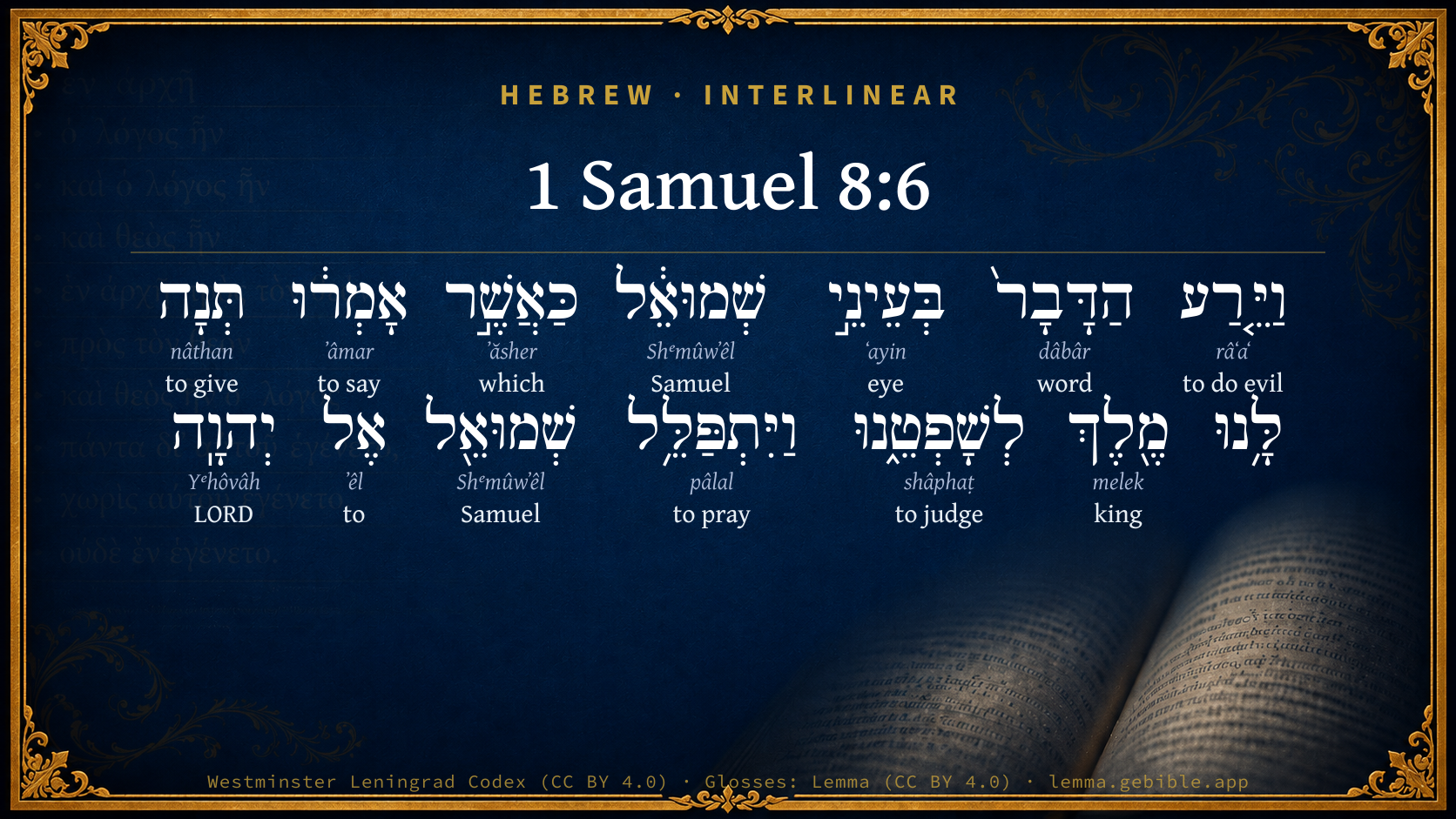
Hebrew (Westminster Leningrad Codex) 1 Samuel 8:6 appears in the Hebrew Old Testament. The text above is from the Westminster Leningrad Codex. Each word links to its Strong’s number, a concise gloss, and parsing drawn from the Open Scriptures Hebrew Bible morphology. Click any word for its full Brown-Driver-Briggs (BDB) entry.
Download image
Cite this verse

1 Samuel 8:6 (World English Bible). Public Domain. Lemma interlinear Bible study tool, https://lemma.gebible.app/v/1-samuel/8/6.

Show BibTeX & RIS
BibTeX
RIS
English Translation
But the thing displeased Samuel, when they said, Give us a king to judge us. Samuel prayed to Yahweh.
World English Bible · Public Domain
Download a study sheet

One document with this verse’s original text, its word-by-word gloss line, the meaning frame, cross-references with their text, attributed commentary, and full source and license credits — printable, and it pastes into notes with its structure intact.

This verse Autodidact and up

Study sheet (.html) Plain text (.txt)

A passage Seminary Student

Up to 50 verses in one chapter. A passage sheet keeps up to 6 commentary sources and 12 cross-references per verse, in the order this page ranks them, and says so on the sheet whenever that leaves anything out. Ask for a single verse and you get the Autodidact verse sheet above.

Everything on this page stays free to read, with no account — the sheet is a download of what is already on screen, not access to it.

Want to remove ads? Support Godless Engineer
Compare translations 3

The same verse in 3 English versions, stacked beneath the original-language interlinear above. Click any original word for its lexicon entry.

Each is an independent rendering of the whole verse — the interlinear is not word-aligned to these translations.

Highlighted words mark where these versions differ — a whole-verse word diff, not a word-by-word alignment.

  • World English Bible Public Domain
    But the thing displeased Samuel, when they said, Give us a king to judge us. Samuel prayed to Yahweh.
  • King James Version Public Domain
    But the thing displeased Samuel, when they said, Give us a king to judge us. And Samuel prayed unto the LORD.
  • unfoldingWord Literal Text CC BY-SA 4.0
    And the thing was bad in the eyes of Samuel when they said, “Give to us a king to judge us.” So Samuel prayed to Yahweh.

unfoldingWord Literal Text — © unfoldingWord, licensed CC BY-SA 4.0. Word-aligned USFM3 via Door43 (git.door43.org/unfoldingWord/en_ult).

Versions to compare (up to 4)

3 of 4 selected

Show all 18 translations

Every available English version of this verse, each an independent rendering of the whole verse.

  • World English Bible Public Domain
    But the thing displeased Samuel, when they said, Give us a king to judge us. Samuel prayed to Yahweh.
  • Berean Standard Bible Public Domain
    But when they said, “Give us a king to judge us,” their demand was displeasing in the sight of Samuel; so he prayed to the LORD.
  • Majority Standard Bible Public Domain
    But when they said, “Give us a king to judge us,” their demand was displeasing in the sight of Samuel; so he prayed to the LORD.
  • King James Version Public Domain
    But the thing displeased Samuel, when they said, Give us a king to judge us. And Samuel prayed unto the LORD.
  • American Standard Version (1901) Public Domain
    But the thing displeased Samuel, when they said, Give us a king to judge us. And Samuel prayed unto Jehovah.
  • Revised Version (1885) Public Domain
    But the thing displeased Samuel; when they said, Give us a king to judge us. And Samuel prayed unto the LORD.
  • Geneva Bible (1599) Public Domain
    But the thing displeased Samuel, when they said, Giue vs a King to iudge vs: and Samuel prayed vnto the Lord.
  • Douay-Rheims (1899) Public Domain
    And the word was displeasing in the eyes of Samuel, that they should say: Give us a king, to judge us. And Samuel prayed to the Lord.
  • Young's Literal Translation Public Domain
    And the thing is evil in the eyes of Samuel, when they have said, `Give to us a king to judge us;' and Samuel prayeth unto Jehovah.
  • Literal Standard Version CC BY-SA 4.0
    And the thing is evil in the eyes of Samuel when they have said, “Give a king to us, to judge us”; and Samuel prays to YHWH.
  • Unlocked Literal Bible CC BY-SA 4.0
    But it displeased Samuel when they said, “Give us a king to judge us.” So Samuel prayed to Yahweh.
  • unfoldingWord Literal Text CC BY-SA 4.0
    And the thing was bad in the eyes of Samuel when they said, “Give to us a king to judge us.” So Samuel prayed to Yahweh.
  • Darby Bible Public Domain
    And the thing displeased Samuel, when they said, Give us a king to judge us. And Samuel prayed to Jehovah.
  • World Messianic Bible Public Domain
    But the thing displeased Samuel when they said, “Give us a king to judge us.” Samuel prayed to the LORD.
  • Webster's Bible Public Domain
    But the thing displeased Samuel, when they said, Give us a king to judge us: and Samuel prayed to the LORD.
  • Free Bible Version CC BY-SA 4.0
    Samuel thought this was a bad idea when they said, “Give us a king to rule over us,” so he prayed to the Lord about it.
  • Bible in Basic English Public Domain
    But Samuel was not pleased when they said to him, Give us a king to be our judge. And Samuel made prayer to the Lord.
  • JPS Tanakh (1917) Public Domain
    But the thing displeased Samuel, when they said: 'Give us a king to judge us.' And Samuel prayed unto the LORD.

Literal Standard Version (2020), Covenant Press — licensed CC BY-SA 4.0. Text via the HelloAO Bible API (eBible.org). Unlocked Literal Bible (unfoldingWord) — licensed CC BY-SA 4.0. Text via the HelloAO Bible API (eBible.org). unfoldingWord Literal Text — © unfoldingWord, licensed CC BY-SA 4.0. Word-aligned USFM3 via Door43 (git.door43.org/unfoldingWord/en_ult). Free Bible Version, Dr. Jonathan Gallagher — licensed CC BY-SA 4.0. Text via the HelloAO Bible API (eBible.org).

Word by word

More ways to search: Search by grammar → Find every occurrence → Compare this word →

Practice this passage: Drill this verse → Learn its vocabulary →

וַיִּתְפַּלֵּ֥ל
pâlal
H6419
“and · to pray”
Conjunction + Verb, Hithpael, Sequential Imperfect, 3rd Person, Masculine, Singular
Part of Speech
Conjunction + Verb
Stem
Hithpael
Form
Sequential Imperfect
Person
3rd Person
Gender
Masculine
Number
Singular
Full BDB Definition

Origin: a primitive root

TWOT: 1776

to intervene, interpose, pray - (Piel) to mediate, judge - (Hithpael) - to intercede - to pray
  1. וַיֵּ֤רַע râʻaʻ H7489 “and · to do evil” Conjunction + Verb, Qal, Sequential Imperfect, 3rd Person, Masculine, Singular
  2. הַדָּבָר֙ dâbâr H1697 “the · word” Particle, Definite Article + Noun, Common, Masculine, Singular, Absolute
  3. בְּעֵינֵ֣י ʻayin H5869 “in/at · eyes of” Preposition + Noun, Common, Both, Dual, Construct
  4. שְׁמוּאֵ֔ל Shᵉmûwʼêl H8050 “Samuel” Noun, Proper
  5. כַּאֲשֶׁ֣ר ʼăsher H834 “like/as · which” Preposition + Particle, Relative
  6. אָמְר֔וּ ʼâmar H559 “to say” Verb, Qal, Perfect, 3rd Person, Common, Plural
  7. תְּנָה nâthan H5414 “give” Verb, Qal, Imperative, 2nd Person, Masculine, Singular + Suffix, h
  8. מֶ֖לֶךְ melek H4428 “king” Noun, Common, Masculine, Singular, Absolute
  9. לְשָׁפְטֵ֑נוּ shâphaṭ H8199 “to judge · us” Preposition + Verb, Qal, Infinitive Construct + Suffix, Personal, 1st Person, Common, Plural
  10. שְׁמוּאֵ֖ל Shᵉmûwʼêl H8050 “Samuel” Noun, Proper
  11. אֶל ʼêl H413 “to” Preposition
  12. יְהוָֽה Yᵉhôvâh H3068 “LORD” Noun, Proper

About this verse

These counts appear in no published source. They are computed here, from the morphology-tagged text and Lemma’s own curated glosses. What Lemma adds →

14
words
12
distinct lemmas
Historical
section

Grammatical profile

  • 5 verbs
  • 6 nouns
  • 2 prepositions
  • 1 particle

Verb forms

  • וַיֵּ֤רַע Qal · Sequential Imperfect
  • אָמְר֔וּ Qal · Perfect
  • תְּנָה Qal · Imperative
  • לְשָׁפְטֵ֑נוּ Qal · Infinitive Construct
  • וַיִּתְפַּלֵּ֥ל Hithpael · Sequential Imperfect

Repetition

A word recurs within this verse — often emphatic in Hebrew:

  • שְׁמוּאֵ֔ל Samuel H8050 ×2

Hebrew & Septuagint length

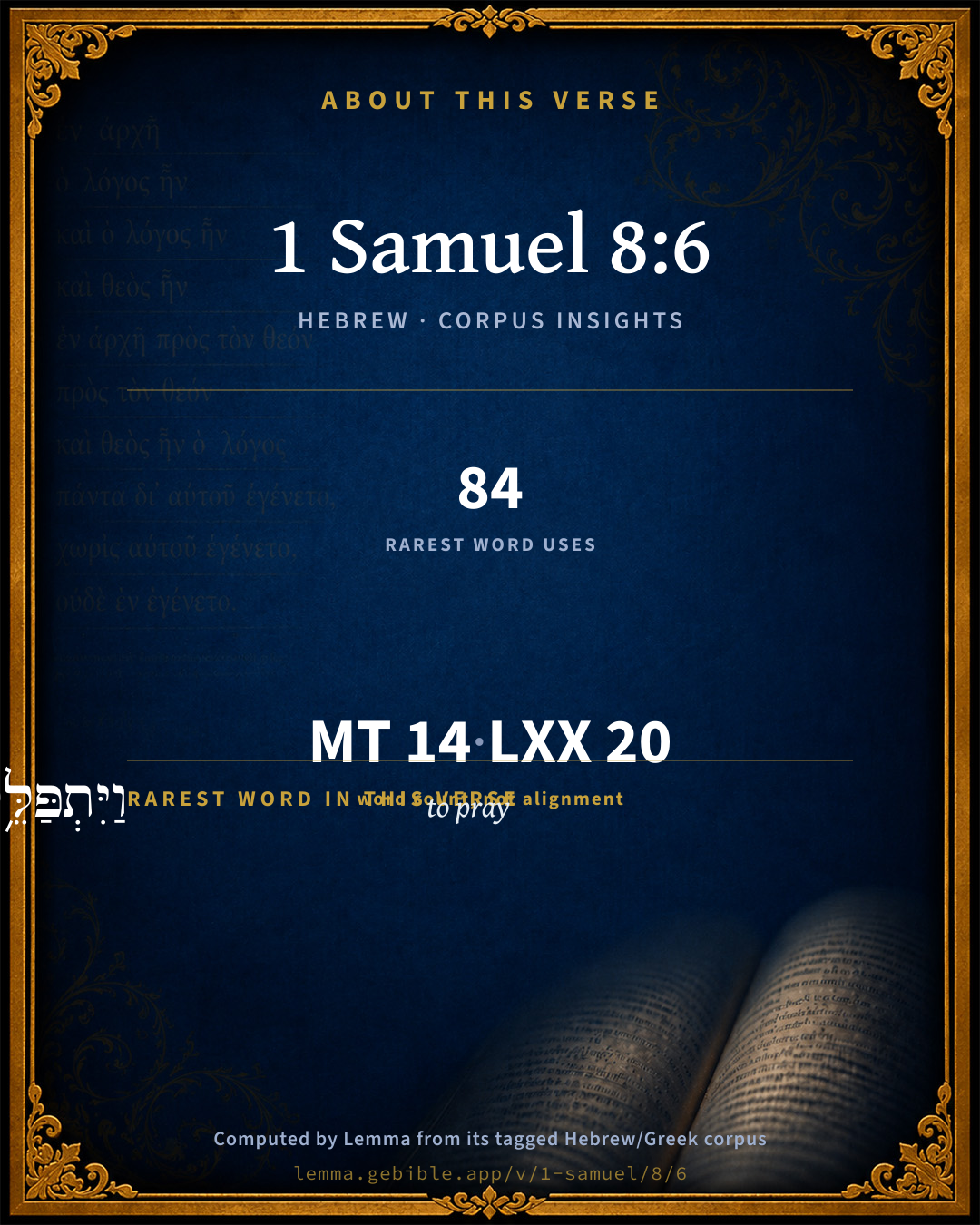
In English translation the verse runs 19 words from the Hebrew and 26 from the Septuagint (LXX English) — closely comparable.

A rough comparison of the two English renderings, which tokenize alike — not a word-level alignment.

Word counts can differ between the Hebrew and the Greek without any difference in meaning — e.g. the Hebrew direct-object marker אֵת has no separate Greek word, and Greek often adds the article ὁ.

In the original languages it is 14 Hebrew tokens and 20 Greek tokens — but the two are counted differently (Hebrew bundles its prefixes and suffixes into one token; the Greek is in lemma form), so that isn’t a like-for-like length.

Cross-references

12

Topical passages linked to 1 Samuel 8:6 in the Treasury of Scripture Knowledge — connected by theme and wording, ordered by reader-vote popularity; previews shown in the World English Bible.

  • 1 Samuel 15:11 It repents me that I have set up Saul to be king; for he is turned back from following me, and has not performed my commandments. Samuel was angry; and he cried to Yahweh all night.
  • 1 Samuel 12:17 Isn't it wheat harvest today? I will call to Yahweh, that he may send thunder and rain; and you shall know and see that your wickedness is great, which you have done in the sight of Yahweh, in asking you a king.
  • James 1:5 But if any of you lacks wisdom, let him ask of God, who gives to all liberally and without reproach; and it will be given to him.
  • Exodus 32:21 Moses said to Aaron, "What did these people do to you, that you have brought a great sin on them?"
  • Exodus 32:32 Yet now, if you will, forgive their sin-- and if not, please blot me out of your book which you have written."
  • Numbers 16:15 Moses was very angry, and said to Yahweh, "Don't respect their offering: I have not taken one donkey from them, neither have I hurt one of them."
  • Numbers 16:22 They fell on their faces, and said, God, the God of the spirits of all flesh, shall one man sin, and will you be angry with all the congregation?
  • Numbers 16:46 Moses said to Aaron, Take your censer, and put fire therein from off the altar, and lay incense thereon, and carry it quickly to the congregation, and make atonement for them: for there is wrath gone out from Yahweh; the plague is begun.
  • Ezra 9:3–5 When I heard this thing, I tore my garment and my robe, and plucked off the hair of my head and of my beard, and sat down confounded.
  • Psalms 109:4 In return for my love, they are my adversaries; But I am in prayer.
  • Luke 6:11–12 But they were filled with rage, and talked with one another about what they might do to Jesus.
  • Philippians 4:6 In nothing be anxious, but in everything, by prayer and petition with thanksgiving, let your requests be made known to God.

Cross-references courtesy of OpenBible.info (CC BY 4.0).

Hebrew and Greek witnesses Masoretic Hebrew ↔ Greek Septuagint

The same verse in the two great witnesses to the Old Testament, shown verse-for-verse.

These are two independent witnesses, not word-aligned to each other, and the Septuagint is shown in lemma (dictionary) form.

Hebrew 1 Samuel 8:6 Masoretic · Westminster Leningrad Codex

וַיֵּ֤רַע הַדָּבָר֙ בְּעֵינֵ֣י שְׁמוּאֵ֔ל כַּאֲשֶׁ֣ר אָמְר֔וּ תְּנָה לָּ֥נוּ מֶ֖לֶךְ לְשָׁפְטֵ֑נוּ וַיִּתְפַּלֵּ֥ל שְׁמוּאֵ֖ל אֶל יְהוָֽה

But the thing displeased Samuel, when they said, Give us a king to judge us. Samuel prayed to Yahweh.

World English Bible · Public Domain

Greek LXX 1 Samuel 8:6 Septuagint · lemma form

καί εἰμί πονηρός ὁ ῥῆμα ἐν ὀφθαλμός σαμουηλ ὡς εἶπον δίδωμι ἐγώ βασιλεύς δικάζω ἐγώ καί προςεὔχομαι σαμουηλ πρός κύριος

And the thing was evil in the eyes of Samuel, when they said, Give us a king to judge us: and Samuel prayed to the Lord.

LXX2012 (modern English Septuagint) · Public Domain

Hebrew: Westminster Leningrad Codex (CC BY 4.0). Greek: Septuagint (public domain); English from LXX2012 (modern English Septuagint) (Public Domain). How the Septuagint differs from the Hebrew →

Targum (Aramaic paraphrase)

1

The Targum is the ancient Jewish Aramaic paraphrase of the Hebrew Scriptures — an interpretive translation, not the Hebrew text itself. Onkelos (literal) and Pseudo-Jonathan (expansive) render the Torah, and Jonathan the Prophets. Coverage is partial: where no permissively-licensed English translation exists for a verse, only the Aramaic is shown. This is verse-level text, not a word-by-word alignment to the Hebrew.

  1. Targum Jonathan Prophets (Joshua–Malachi)
    וּבְאֵישׁ פִּתְגָמָא בְּעֵינֵי שְׁמוּאֵל כַּד אַמַרוּ מַנֵי לָנָא מַלְכָּא לְמִדַיְנָנָא וְצַלֵי שְׁמוּאֵל קֳדָם יְיָ:

    (no public-domain English translation for this verse)

    Targum Jonathan — Aramaic: “Mikraot Gedolot” (public domain). English: “Sefaria Community Translation” (CC0 1.0 (public-domain dedication)); “London "Chaldee Paraphrase," 1871” (public domain). Text via Sefaria.

Commentary

Notes on 1 Samuel 8:6 from classic Christian and Jewish commentators (each source and its license shown beneath its notes). The classic Christian expositions comment on the surrounding passage and are grouped to its opening verse, so a note may address several verses; the Jewish commentaries on the Tanakh (Rashi and others) are per-verse, so they appear only where the commentator wrote on this verse.

Lemma curates 59 commentaries, every one of them public domain or Creative Commons licensed, each selected and text-cleaned for this edition rather than reprinted as found. About our sources →

Trapp's Complete Commentary

John Trapp

1Sa 8:6 But the thing displeased Samuel, when they said, Give us a king to judge us. And Samuel prayed unto the LORD.

Ver. 6. But the thing displeased Samuel.] Chiefly because he knew it was displeasing to God, {1Sa 8:7} and then as an indignity done to himself, by shaking off his government even while he lived. But this is the manner of the many headed multitude, Cui praesentia fastidio, insueta desiderio sunt, {a} to loath things present, and to affect novelties; αει γαρ το παρον βαρυ, saith Thucydides, the present government is ever grievous; neither is the beauty of benefits seen but on the backside, that is, till men are bereft of them.

And Samuel prayed unto the Lord.] {b} He was not so far displeased at the ungrateful people, but that he could, at the same time, pity them and pray for them. So did Moses before him, {Exo 32:19; Exo 32:31} and our Saviour after him. {Mar 3:5} Samuel prayed for the pardon of that sin of theirs, which they afterwards came to a sight of, and confessed against themselves. {1Sa 12:19} He also prayed, doubtless, for direction in that weighty work whereupon the people had put him.

{a} Sulpit. Sever., ibid.

{b} Consuluit Dominum praemissa oratione. - Vat.

John Trapp, A Commentary or Exposition upon All the Books of the Old and New Testament (1647–1656) — public domain. Text from a community e-Sword module.

Joseph Benson's Commentary

1Sa 8:6. The thing displeased Samuel — Because God was hereby dishonoured, through that distrust of him, and that ambition, and itch after changes, which were the manifest causes of this desire; and because of that great misery which he foresaw the people would hereby bring upon themselves. Prayed — For the pardon of their sin, and direction and help from God in this great affair.

Joseph Benson's Commentary on the Old and New Testaments (1811–1818) — public domain. Text from a community e-Sword module.

Tyndale Open Study Notes

Tyndale Open Resources

8:6 Samuel was displeased: He probably felt personally rejected (8:7).

Tyndale Open Study Notes — © Tyndale Open Resources, licensed CC BY-SA 4.0. Text via the HelloAO Bible API.

Geneva Bible (1599)

Geneva Bible translators

Because they were not content with the order that God had appointed, but would be governed as were the Gentiles.

Geneva Bible (1599) marginal notes — public domain. Text via Bolls.life.

Jamieson, Fausset & Brown

Robert Jamieson, A. R. Fausset & David Brown

the thing displeased Samuel when they said, Give us a king to judge us--Personal and family feelings might affect his views of this public movement. But his dissatisfaction arose principally from the proposed change being revolutionary in its character. Though it would not entirely subvert their theocratic government, the appointment of a visible monarch would necessarily tend to throw out of view their unseen King and Head. God intimated, through Samuel, that their request would, in anger, be granted, while at the same time he apprised them of some of the evils that would result from their choice.

Jamieson, Fausset & Brown — Commentary Critical and Explanatory on the Whole Bible (1871) — public domain (CC PDM 1.0). Text via the HelloAO Bible API.

Adam Clarke's Commentary

Verse 6. The thing displeased Samuel] Because he saw that this amounted to a formal renunciation of the Divine government.

Samuel prayed unto the Lord] He begged to know his mind in this important business.

Adam Clarke's Commentary on the Bible (1810–1826) — public domain. Text from a community e-Sword/MySword module.

Ellicott's Commentary for English Readers

(6) The thing displeased Samuel.—It is clear that it was perfectly justifiable in the elders of the people to come to the resolution contained in their petition to Samuel. The Deuteronomy directions contained in 1Sa_17:14-20 are clear and explicit in this matter of an earthly king for the people, and Moses evidently had looked forward to this alteration in the constitution when he framed the Law. No date for the change is specified, but from the terms of the Deuteronomy words no distant period evidently was looked on to. Then, again, though Samuel was naturally displeased, he at once, as prophet and seer, carried the matter to the God-Friend of Israel in prayer, and the Eternal King at once bids His old true servant to comply with the people’s desire.

The displeasure of the prophet-judge was very natural. He felt—this we see from the comforting words his Master addressed to him (see 1Sa_8:7)—that the people, notwithstanding the vast claims he possessed to their gratitude, craved another and a different ruler, and were dissatisfied with his government. Samuel too was conscious that Israel by its request declined the direct sovereignty of the Eternal. The change to an earthly sovereign had been foreseen, foretold, even arranged for, by Moses, but, in spite of all this, to one like Samuel it was very bitter. It seemed to remove the people from that solitary platform which they alone among nations had been allowed to occupy. They had found by sad experience, as Moses,—“their Rabbi,” as the old teachers loved to style him—had predicted, that such a form of government was, alas! unsuited to them, and that they must descend here to the level of ordinary peoples. But though all this was undisputably true, it was very bitter for the hero patriot to give up for ever the splendid Hebrew ideal that his people were the subjects of the Eternal King, ruled directly by Him.

A Bible Commentary for English Readers, edited by Charles John Ellicott (1878–1897) — public domain. Text from a community e-Sword module.

The Cambridge Bible for Schools and Colleges

gen. ed. J. J. S. Perowne

6–9. Jehovah’s answer to the request

6. the thing displeased Samuel] 1Sa_8:7 implies that Samuel’s displeasure arose from a feeling of the ingratitude of the Israelites toward himself in desiring that one who had done so much for them should be superseded by a king. God’s answer, “Not thee (their judge) have they rejected, but me (their true king) have they rejected from reigning over them” (the Heb. order is emphatic) at once consoles him and points out the real sinfulness of the request. This consisted not in the mere desire for a king, which would not necessarily have been wrong, but in the spirit of distrust of the invisible sovereignty of Jehovah and desire for the splendour of a visible monarch which really prompted the request.

Samuel prayed] He does not let his own personal feelings decide, but endeavours to learn what is the Will of God in the matter.

The Cambridge Bible for Schools and Colleges (gen. ed. J. J. S. Perowne; Cambridge University Press, 1878–1918) — public domain. Text from a community e-Sword module.

John Gill's Exposition

But the thing displeased Samuel,.... Not that they called him an old man, and suggested that he was incapacitated for his office, nor for observing the unbecoming walk of his sons, but for what follows:

when they said, give us a king to judge us; what displeased him was, that they were for changing their form of government, not only to remove it from him, and his sons, but from the Lord himself, who was king over them; the ill consequences of which, many of them at least, he easily foresaw, and which gave him great uneasiness, both on account of the glory of God, and their own good; insomuch, as Josephus (y) says, he could neither eat nor sleep, but watched all night, and spent it in prayer, as follows:

and Samuel prayed unto the Lord; to know his mind and will, and what answer he should return unto them.

(y) Ut supra, (Antiqu. l. 6. c. 3.) sect. 3.

John Gill's Exposition of the Whole Bible (1746–1763) — public domain (CC PDM 1.0). Text via the HelloAO Bible API.

Albert Barnes' Notes on the Bible

See the margin which implies that the thing spoken of caused anger, indignation, or some revulsion of feeling (see Gen 21:11-12). The answer of the Lord 1Sa 8:7 shows that Samuel’s personal feelings had been hurt. They were soothed by being reminded of the continued ingratitude of the people to God Himself, upon whom, in fact, a greater slight was put by this very request for a king “like all the nations,” than upon Samuel (compare Mat 10:24; Joh 15:18, Joh 15:20). For a comment on this transaction, see Hos 13:9-11; Act 13:21-22.

Albert Barnes' Notes on the Bible (1834–1885) — public domain. Text from a community e-Sword/MySword module.

Haydock's Catholic Bible Commentary

Samuel. Nothing could be more disrespectful to him, nor more ungrateful to God, who had distinguished them from all other nations, and had taken the government upon himself, and appointed the judges as his lieutenants. The foolish Israelites wished to throw off this sweet yoke, and to be ruled in an arbitrary manner, like the infidels, as if God could not otherwise protect them from their enemies. --- Lord. Josephus says that he passed the night without food or sleep, and the Lord appeared to him. The will or petition "of the people, filled Samuel with great uneasiness, who on account of his innate justice, did not like the regal power, as being to exorbitant. He rather approved of an aristocracy, as more conducive to the welfare of the people." (Antiquities vi. 4.) He means such an aristocracy as the Israelites had been accustomed to, under the guidance of men divinely commissioned, whence he elsewhere very properly styles it a theocracy, or "the government of God." (Haydock)

George Leo Haydock (1774–1849), Haydock's Catholic Family Bible and Commentary, 1859 edition — public domain. Excludes Psalms (Douay-Rheims chapter numbering differs from Protestant) and Deuterocanonical books (Catholic canon only).

Matthew Poole's English Annotations

The thing displeased Samuel; not their complaint of his sons, but their desire of a king, as is apparent from the following words, and from the whole course of the story; which was so grievous to him, partly because of their injustice and ingratitude to himself, whose government, though it had been so sweet and beneficial to them, they plainly show themselves weary of; and principally because God was hereby dishonoured and provoked, by that distrust of God, and that vain-glory and ambition, and that itch after changes, which were the manifest causes of this desire; and because of that great servitude and misery which he wisely foresaw the people would hereby bring upon themselves, as he particularly informs them, 1Sa 8:11, &c.

Samuel prayed unto the Lord, for the pardon of their sin, and desire of direction and help from God in this great affair.

Matthew Poole's English Annotations on the Holy Bible (1683–1685) — public domain. Text from a community e-Sword/MySword module.

Whedon's Commentary on the Bible

Daniel D. Whedon

6. The thing displeased Samuel — The elders presented the matter very skilfully to Samuel, implying (1Sa_8:5) that they would be quite content if they could always have him for their ruler, or be sure that he would have a worthy successor; yet Samuel felt personally affronted, and could not but see that there was among the people a growing disaffection with the manner of their government.

Daniel D. Whedon (gen. ed.), Commentary on the Old and New Testaments (1874–1909) — public domain. Text from a community e-Sword module.

The Pulpit Commentary

But the thing displeased Samuel, and justly so. For, in the first place, they had determined to have a king without consulting the will of God. Granting that it would give them the security necessary for the nation"s welfare and progress, yet so weighty a matter ought not to have been decided without an appeal to Jehovah. Samuel did make it a matter of prayer; the elders were actuated solely by political motives. And, secondly, they undervalued their own religious privileges. They wanted a king such as the heathen had, whereas something far better and higher was possible for them, namely, a king who would be the representative of Jehovah, as the shophet had hitherto been. The nation"s real need was not a new power, but the permanent organisation of what up to this time had been a casual authority. And it was Samuel"s high office to give the nation this, while he also changed the outward form of prophecy, and made it too into an orderly institution. A king to judge us. I.e. to govern us, as the shophet or, judge had done, only in a more regularly constituted manner. And Samuel prayed unto Jehovah. There had been no such submission to the will of God on the part of the elders; but deeply as Samuel must have been hurt by this determination of the nation to take the government out of the hands of himself and his sons, yet he leaves the decision to Jehovah. Moreover, we must note that it was as prophet that he thus acted as mediator between the people and God; and he gave them his services in this his highest capacity as faithfully when the question was one injurious to himself as he had ever done on more pleasing occasions.

The benefit of prayer.

Samuel prayed unto the Lord." The blessings obtained in answer to prayer are real and manifold. Some of them are outward and material daily bread, health, safety, life. God is "in all, above all, and through all," the personal and free Ruler of the universe, and able to grant our petitions for temporal good in harmony with the established order of nature. The mind and will of man can produce changes in the material world without disturbing that order; much more can the eternal mind and will do the same. Other blessings are inward and spiritual wisdom, righteousness, peace, and joy. The "Father of spirits" has access to the human spirit, interpenetrates it as light the atmosphere, holds communion with it, and disposes it to holiness. Spiritual blessings are incomparably more valuable than material. What we are determines our relation to surrounding objects. And beneficial changes wrought within are followed by similar changes in the world without. "In prayer we make the nearest approaches unto God, and lie open to the influences of Heaven. Then it is that the Sun of righteousness doth visit us with his directest rays, and dissipateth our darkness, and imprinteth his image on our souls" (Scougal).

Speak to him, thou, for he hears, and spirit with spirit can meet. Closer is he than breathing, and nearer than hands and feet (Tennyson).

In illustration of the spiritual benefit of prayer let us consider how Samuel, who "prayed unto the Lord" in his trouble, and "rehearsed all the words of the people in the ears of the Lord" (ver. 21), was comforted and helped in time of need. What a different man he was when he came forth from communion with his Almighty Friend to speak to the elders of Israel from what he was when he went from them, "displeased" (ver. 6) and distressed, to pour out his heart before the Lord! "What profit shall we have if we pray unto him?

1. Relief for a burdened heart. It is often a great relief to tell our trouble to an earthly friend; much more is it to pour it forth into the bosom of God. "No other God but the God of the Bible is heart to heart (Niebuhr). "They went and told Jesus". (Mat_14:12)

2. Sympathy under bitter disappointment. Samuel seemed to have "laboured in vain and spent his strength for nought." But God sanctioned his work, identified himself with him, shared his disappointment, and took his burden on himself. In rejecting his faithful servants men reject the Lord. "Why persecutest thou me?". (Act_9:5) He sympathises with them; (Heb_4:5) and one smile of his more than compensates for apparent failure and the frowns of the whole world. "By degrees two thoughts calmed him. The first was the feeling of identification with God"s cause. The other element of consolation was the Divine sympathy. Atheism and revolution here, as elsewhere, went hand in hand. We do not know how this sentence was impressed by the infinite mind on Samuel"s mind; all we know is, he had a conviction that God was a fellow sufferer" (Robertson).

1. Guidance in great perplexity. The will of the Lord, it may be, is at first hidden or obscure, but in fellowship with him the mists and clouds that

2. prevent our seeing it are cleared away, the sun shines forth, and our way is made plain. We see "the light of this world". (Joh_11:9) "The vocationof man is the sun in the heavens of his life." "The secret of the Lord" (the counsel or advice, such as a man gives to his friend) "is with them that fear. (Psa_25:14) God tells his secrets only to his friends. "The meek will he guide in judgment: the meek will he teach his way". (Psa_25:9) "He will guide you into all the truth". (Joh_16:13)

3. Submission to the supreme will. That will is always wisest and best; it cannot be altered or made to bend to ours; and one of the chief benefits of prayer is that thereby we receive grace which disposes us to accept humbly and cheerfully what at first appears evil in our sight. We are made of one mind with God.

4. Strength for painful duty. It may be to "protest solemnly" (ver. 9) against the course resolved upon by others, to alter our own course and expose ourselves to the charge of inconsistency, to face opposition, danger, and death. But, God never appoints us a duty without giving us strength to perform it. Habitual prayer constantly confers decision on the wavering, and energy on the listless, and calmness on the excitable, and disinterestedness on the selfish" (Liddon).

5. Composure amidst general excitement. Whilst the elders clamour, "Nay; but we will have a king over us," Samuel is unmoved. He calmly listens to their decision, takes it back to God in secret prayer, and then comes forth and says, "Go ye every man to his own city." "Thou wilt keep him in perfect peace, whose mind is stayed on thee: because he trusteth in thee". (Isa_26:3) Hurricanes revolve around a centre of perfect calm. Outside the charmed circle the tempest may rage furiously; within it all is peace. Such is the heart and mind kept (garrisoned) by the peace of God. (Php_4:7)

6. Confidence in a glorious future. "The Lord will not forsake his people for his great name"s sake". (1Sa_12:22) He works out his purposes by unexpected methods, overrules human perversity, and makes the wrath of man to praise him. (Psa_76:10) "What will the end he?" it was said at a time of great and general anxiety to an eminent servant of God (Dr. A. Clarke), who replied, with a beaming countenance, "Glory to God in the highest, and on earth peace, good will toward men. D.

The Pulpit Commentary (1880–1919), ed. H.D.M. Spence-Jones & Joseph S. Exell — public domain. Text from a community e-Sword module.

John Wesley's Explanatory Notes

Displeased - Because God was hereby dishonoured by that distrust of him, and that ambition, and itch after changes, which were the manifest causes of this desire; and because of that great misery, which he foresaw the people would hereby bring upon themselves. Prayed - For the pardon of their sin, and direction and help from God in this great affair.

John Wesley, Explanatory Notes Upon the Whole Bible (1754–1765) — public domain. Text via the GEBible commentary corpus.

Keil & Delitzsch

C. F. Keil & F. Delitzsch

Nevertheless "the thing displeased Samuel when they said," etc. This serves to explain הדּבר, and precludes the supposition that Samuel's displeasure had reference to what they had said concerning his own age and the conduct of his sons. At the same time, the reason why the petition for a king displeased the prophet, was not that he regarded the earthly monarchy as irreconcilable with the sovereignty of God, or even as untimely; for in both these cases he would not have entered into the question at all, but would simply have refused the request as ungodly or unseasonable. But "Samuel prayed to the Lord," i.e., he laid the matter before the Lord in prayer, and the Lord said (Sa1 8:7): "Hearken unto the voice of the people in all that they say unto thee." This clearly implies, that not only in Samuel's opinion, but also according to the counsel of God, the time had really come for the establishment of the earthly sovereignty in Israel. In this respect the request of the elders for a king to reign over them was perfectly justifiable; and there is no reason to say, with Calvin, "they ought to have had regard to the times and conditions prescribed by God, and it would no doubt have come to pass that the regal power would have grown up in the nation. Although, therefore, it had not yet been established, they ought to have waited patiently for the time appointed by God, and not to have given way to their own reasons and counsels apart from the will of God." For God had not only appointed no particular time for the establishment of the monarchy; but in the introduction to the law for the king, "When thou shalt say, I will set a king over me," He had ceded the right to the representatives of the nation to deliberate upon the matter. Nor did they err in this respect, that while Samuel was still living, it was not the proper time to make use of the permission that they had received; for they assigned as the reason for their application, that Samuel had grown old: consequently they did not petition for a king instead of the prophet who had been appointed and so gloriously accredited by God, but simply that Samuel himself would give them a king in consideration of his own age, in order that when he should become feeble or die, they might have a judge and leader of the nation. Nevertheless the Lord declared, "They have not rejected thee, but they have rejected me, that I should not reign over them. As they have always done from the day that I brought them up out of Egypt unto this day, that they have forsaken me and served other gods, so do they also unto thee." This verdict on the part of God refers not so much to the desire expressed, as to the feelings from which it had sprung. Externally regarded, the elders of Israel had a perfect right to present the request; the wrong was in their hearts.

(Note: Calvin has correctly pointed out how much would have been warrantable under the circumstances: "They might, indeed, have reminded Samuel of his old age, which rendered him less able to attend to the duties of his office, and also of the avarice of his sons and the corruptness of the judges; or they might have complained that his sons did not walk in his footsteps, and have asked that God would choose suitable men to govern them, and thus have left the whole thing to His will. And if they had done this, there can be no doubt that they would have received a gracious and suitable answer. But they did not think of calling upon God; they demanded that a king should be given them, and brought forward the customs and institutions of other nations.")

They not only declared to the prophet their confidence in his administration of his office, but they implicitly declared him incapable of any further superintendence of their civil and political affairs. This mistrust was founded upon mistrust in the Lord and His guidance. In the person of Samuel they rejected the Lord and His rule. They wanted a king, because they imagined that Jehovah their God-king was not able to secure their constant prosperity. Instead of seeking for the cause of the misfortunes which had hitherto befallen them in their own sin and want of fidelity towards Jehovah, they searched for it in the faulty constitution of the nation itself. In such a state of mind as this, their desire for a king was a contempt and rejection of the kingly government of Jehovah, and was nothing more than forsaking Jehovah to serve other gods. (See Sa1 10:18-19, and Sa1 12:7., where Samuel points out to the people still more fully the wrong that they have committed.)

Keil & Delitzsch — Biblical Commentary on the Old Testament (1861–1891) — public domain (CC PDM 1.0). Text via the HelloAO Bible API. (Old Testament only.)

unfoldingWord translationNotes

Door43 World Missions Community

But it displeased Samuel ... Give us a king to judge us

Samuel was unhappy that the people did not just want him to remove his corrupt sons and to appoint honest judges, but they wanted a king to rule over them like other countries had.

Obey the voice of the people

Here "the voice" is a metonym for the will or the desire of the people. AT: "Do what the people say" (See: Metonymy)

but they have rejected me

Yahweh knew that the people were not just rejecting corrupt judges, but they were rejecting Yahweh as their king.

translationWords

Yahweh

obey

voice

people group

reject

unfoldingWord translationNotes — © Distant Shores Media and the Door43 World Missions Community, licensed CC BY-SA 4.0. Source: git.door43.org/Door43/en_tn.

Rashi

Rabbi Shlomo Yitzchaki (Rashi)

The matter was wrong. Because they said, "to judge us like all the nations."

Rashi on the Tanakh — English translations: “The Judaica Press complete Tanach with Rashi, translated by A. J. Rosenberg” (CC BY 4.0); “Pentateuch with Rashi's commentary by M. Rosenbaum and A.M. Silbermann, 1929-1934” (public domain); “The Metsudah Tanach series, Lakewood, N.J” (CC BY 4.0); and “The Book of Joshua, Metsudah Publications, 1997” (CC BY 4.0). Text via Sefaria.

Lesson kit

Teaching starters — assembled from the data on this page, not authored interpretation. Every prompt links to the verse data it draws on. Edit before teaching.

1 Samuel, in the Historical, opens this verse with 14 words (12 distinct Hebrew lemmas). Its most distinctive word is pâlal (“to pray”). A historical commentator’s framing appears above. Read the whole chapter for the surrounding context.

Discussion questions

  1. How does “to pray” (pâlal) shape what this verse is saying?
  2. 1 Samuel 15:11 shares this passage’s theme. How do the two illuminate each other?
  3. “Samuel” occurs 2× in this one verse. What is the effect of the repetition?
  4. These translations render this verse differently; the difference is in the English rendering, not the original. What questions does that raise?
  5. The verb «וַיֵּ֤רַע» is Qal Sequential Imperfect. How does its form color the action?
  6. Reading how Trapp's Complete Commentary and Joseph Benson's Commentary read this verse, where do the two commentators agree and where do they part?

Things to notice

Reading settings

Reading text

Shown beneath each verse's original-language words.

Old Testament
Old Testament edition

Read the OT as the Masoretic Hebrew (MT) or the Greek Septuagint (LXX).

English shown for the Greek Septuagint (in the Hebrew ↔ Greek comparison).

Comparing translations? Open the Compare panel on any verse page to stack up to four side by side.