
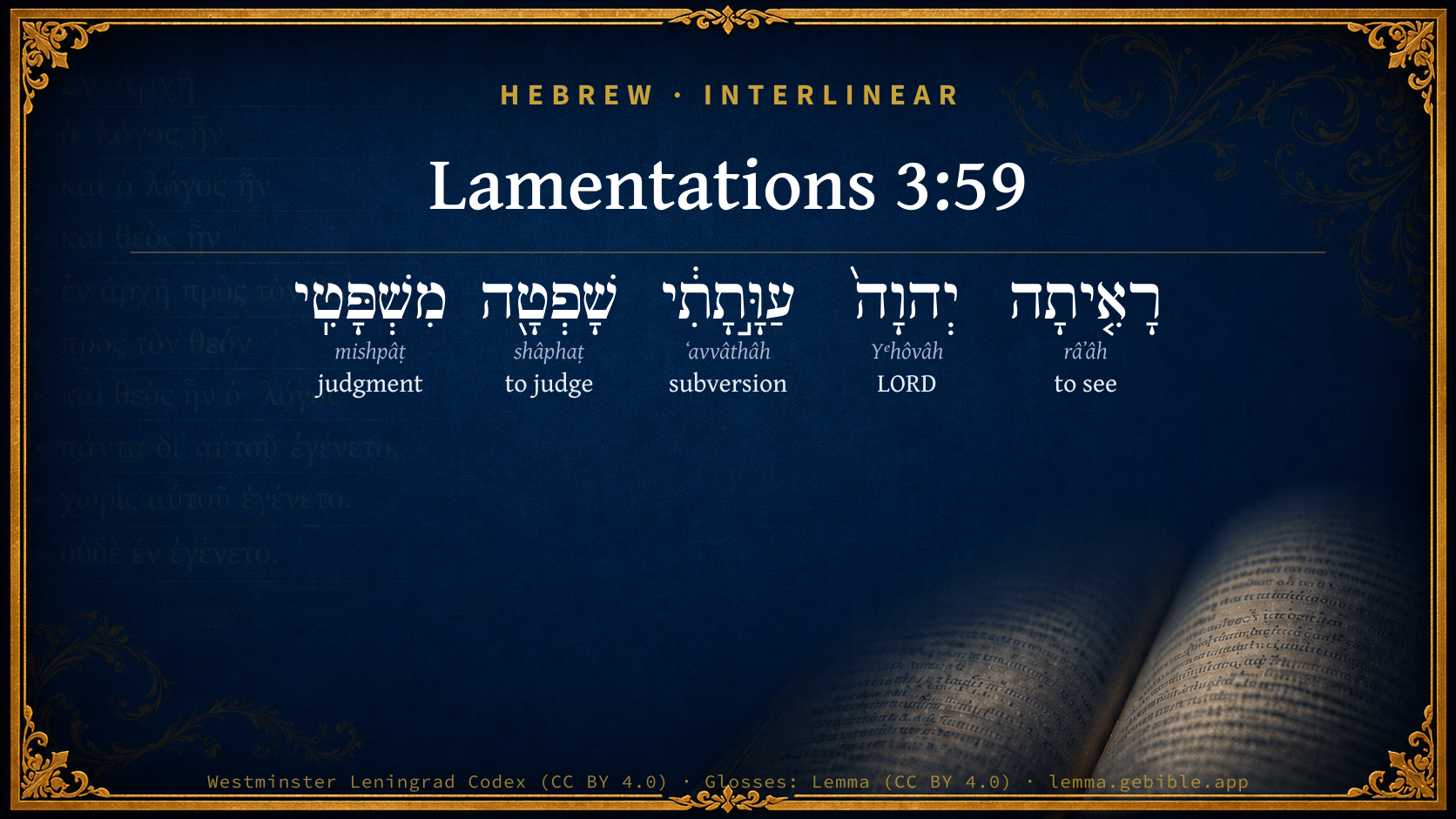
Lamentations 3:59

Hebrew (Westminster Leningrad Codex) Lamentations 3:59 appears in the Hebrew Old Testament. The text above is from the Westminster Leningrad Codex. Each word links to its Strong’s number, a concise gloss, and parsing drawn from the Open Scriptures Hebrew Bible morphology. Click any word for its full Brown-Driver-Briggs (BDB) entry.
Download image
Cite this verse

Lamentations 3:59 (World English Bible). Public Domain. Lemma interlinear Bible study tool, https://lemma.gebible.app/v/lamentations/3/59.

Show BibTeX & RIS
BibTeX
RIS
English Translation
Yahweh, you have seen my wrong; judge you my cause.
World English Bible · Public Domain
Highlights
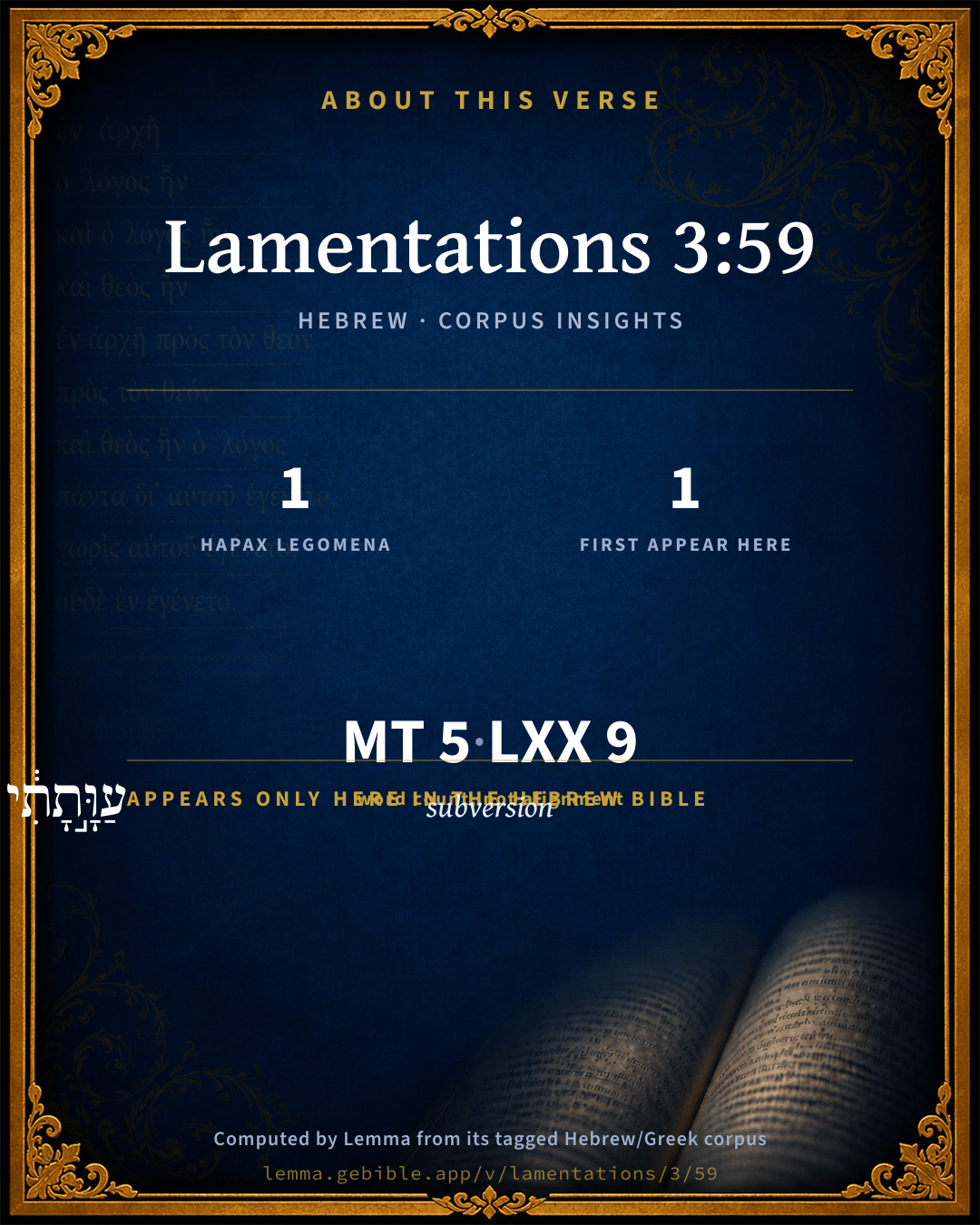
  • 1 hapax legomenon — only here in the Hebrew Bible
  • 1 first appearance in the Hebrew Bible
Full analysis ↓
Download a study sheet

One document with this verse’s original text, its word-by-word gloss line, the meaning frame, cross-references with their text, attributed commentary, and full source and license credits — printable, and it pastes into notes with its structure intact.

This verse Autodidact and up

Study sheet (.html) Plain text (.txt)

A passage Seminary Student

Up to 50 verses in one chapter. A passage sheet keeps up to 6 commentary sources and 12 cross-references per verse, in the order this page ranks them, and says so on the sheet whenever that leaves anything out. Ask for a single verse and you get the Autodidact verse sheet above.

Everything on this page stays free to read, with no account — the sheet is a download of what is already on screen, not access to it.

Want to remove ads? Support Godless Engineer
Compare translations 3

The same verse in 3 English versions, stacked beneath the original-language interlinear above. Click any original word for its lexicon entry.

Each is an independent rendering of the whole verse — the interlinear is not word-aligned to these translations.

Highlighted words mark where these versions differ — a whole-verse word diff, not a word-by-word alignment.

  • World English Bible Public Domain
    Yahweh, you have seen my wrong; judge you my cause.
  • King James Version Public Domain
    O LORD, thou hast seen my wrong: judge thou my cause.
  • unfoldingWord Literal Text CC BY-SA 4.0
    You have seen, Yahweh, my wrong; judge my case.

unfoldingWord Literal Text — © unfoldingWord, licensed CC BY-SA 4.0. Word-aligned USFM3 via Door43 (git.door43.org/unfoldingWord/en_ult).

Versions to compare (up to 4)

3 of 4 selected

Show all 18 translations

Every available English version of this verse, each an independent rendering of the whole verse.

  • World English Bible Public Domain
    Yahweh, you have seen my wrong; judge you my cause.
  • Berean Standard Bible Public Domain
    You have seen, O LORD, the wrong done to me; vindicate my cause!
  • Majority Standard Bible Public Domain
    You have seen, O LORD, the wrong done to me; vindicate my cause!
  • King James Version Public Domain
    O LORD, thou hast seen my wrong: judge thou my cause.
  • American Standard Version (1901) Public Domain
    O Jehovah, thou hast seen my wrong; judge thou my cause.
  • Revised Version (1885) Public Domain
    O LORD, thou hast seen my wrong; judge thou my cause.
  • Geneva Bible (1599) Public Domain
    O Lord, thou hast seene my wrong, iudge thou my cause.
  • Douay-Rheims (1899) Public Domain
    Res. Thou hast seen, O Lord, their iniquity against me: judge thou my judgment.
  • Young's Literal Translation Public Domain
    Thou hast seen, O Jehovah, my overthrow, Judge Thou my cause.
  • Literal Standard Version CC BY-SA 4.0
    You have seen, O YHWH, my overthrow, || Judge my cause.
  • Unlocked Literal Bible CC BY-SA 4.0
    Yahweh, you have seen the wrong they have done to me; judge my case.
  • unfoldingWord Literal Text CC BY-SA 4.0
    You have seen, Yahweh, my wrong; judge my case.
  • Darby Bible Public Domain
    Jehovah, thou hast seen my wrong: judge thou my cause.
  • World Messianic Bible Public Domain
    LORD, you have seen my wrong. Judge my cause.
  • Webster's Bible Public Domain
    O LORD, thou hast seen my wrong: judge thou my cause.
  • Free Bible Version CC BY-SA 4.0
    Lord, you have seen the injustices done to me; please vindicate me!
  • Bible in Basic English Public Domain
    O Lord, you have seen my wrong; be judge in my cause.
  • JPS Tanakh (1917) Public Domain
    O LORD, Thou hast seen my wrong; judge Thou my cause.

Literal Standard Version (2020), Covenant Press — licensed CC BY-SA 4.0. Text via the HelloAO Bible API (eBible.org). Unlocked Literal Bible (unfoldingWord) — licensed CC BY-SA 4.0. Text via the HelloAO Bible API (eBible.org). unfoldingWord Literal Text — © unfoldingWord, licensed CC BY-SA 4.0. Word-aligned USFM3 via Door43 (git.door43.org/unfoldingWord/en_ult). Free Bible Version, Dr. Jonathan Gallagher — licensed CC BY-SA 4.0. Text via the HelloAO Bible API (eBible.org).

Word by word

More ways to search: Search by grammar → Find every occurrence → Compare this word →

Practice this passage: Drill this verse → Learn its vocabulary →

About this verse

These counts appear in no published source. They are computed here, from the morphology-tagged text and Lemma’s own curated glosses. What Lemma adds →

5
words
5
distinct lemmas
Prophets
section

Notable vocabulary

1 hapax legomenon — a word that appears only here in the entire Hebrew Bible:

  • עַוָּ֣תָתִ֔י subversion H5792

First appearance in Scripture

This word makes its first canonical appearance in the Hebrew Bible here:

  • עַוָּ֣תָתִ֔י subversion H5792

Grammatical profile

  • 2 verbs
  • 3 nouns

Verb forms

  • רָאִ֤יתָה Qal · Perfect
  • שָׁפְטָ֖ה Qal · Imperative

Hebrew & Septuagint length

In English translation the verse runs 10 words from the Hebrew and 12 from the Septuagint (LXX English) — closely comparable.

A rough comparison of the two English renderings, which tokenize alike — not a word-level alignment.

Word counts can differ between the Hebrew and the Greek without any difference in meaning — e.g. the Hebrew direct-object marker אֵת has no separate Greek word, and Greek often adds the article ὁ.

In the original languages it is 5 Hebrew tokens and 9 Greek tokens — but the two are counted differently (Hebrew bundles its prefixes and suffixes into one token; the Greek is in lemma form), so that isn’t a like-for-like length.

Cross-references

12

Topical passages linked to Lamentations 3:59 in the Treasury of Scripture Knowledge — connected by theme and wording, ordered by reader-vote popularity; previews shown in the World English Bible.

  • Psalms 43:1 Vindicate me, God, and plead my cause against an ungodly nation. Oh, deliver me from deceitful and wicked men.
  • Genesis 31:42 Unless the God of my father, the God of Abraham, and the fear of Isaac, had been with me, surely now you would have sent me away empty. God has seen my affliction and the labor of my hands, and rebuked you last night."
  • Psalms 9:4 For you have maintained my just cause. You sit on the throne judging righteously.
  • Psalms 26:1 Judge me, Yahweh, for I have walked in my integrity. I have trusted also in Yahweh without wavering.
  • Psalms 35:1 Contend, Yahweh, with those who contend with me. Fight against those who fight against me.
  • 1 Peter 2:23 Who, when he was cursed, didn't curse back. When he suffered, didn't threaten, but committed himself to him who judges righteously;
  • Psalms 35:23 Wake up! Rise up to defend me, my God! My Lord, contend for me!
  • Jeremiah 18:18–23 Then said they, Come, and let us devise devices against Jeremiah; for the law shall not perish from the priest, nor counsel from the wise, nor the word from the prophet. Come, and let us strike him with the tongue, and let us not give heed to any of his words.
  • Jeremiah 20:7–10 Yahweh, you have persuaded me, and I was persuaded; you are stronger than I, and have prevailed: I am become a laughing-stock all the day, every one mocks me.
  • Jeremiah 37:1–21 Zedekiah the son of Josiah reigned as king, instead of Coniah the son of Jehoiakim, whom Nebuchadrezzar king of Babylon made king in the land of Judah.
  • Jeremiah 11:19–21 But I was like a gentle lamb that is led to the slaughter; and I didn't know that they had devised devices against me, [saying], Let us destroy the tree with the fruit of it, and let us cut him off from the land of the living, that his name may be no more remembered.
  • Jeremiah 15:10 Woe is me, my mother, that you have borne me a man of strife and a man of contention to the whole earth! I have not lent, neither have men lent to me; [yet] everyone of them does curse me.

Cross-references courtesy of OpenBible.info (CC BY 4.0).

Hebrew and Greek witnesses Masoretic Hebrew ↔ Greek Septuagint

The same verse in the two great witnesses to the Old Testament, shown verse-for-verse.

These are two independent witnesses, not word-aligned to each other, and the Septuagint is shown in lemma (dictionary) form.

Hebrew Lamentations 3:59 Masoretic · Westminster Leningrad Codex

רָאִ֤יתָה יְהוָה֙ עַוָּ֣תָתִ֔י שָׁפְטָ֖ה מִשְׁפָּטִֽי

Yahweh, you have seen my wrong; judge you my cause.

World English Bible · Public Domain

Greek LXX Lamentations 3:59 Septuagint · lemma form

ὁράω κύριος ὁ ταραχή ἐγώ κρίνω ὁ κρίσις ἐγώ

You have seen, O Lord, my troubles: you have judged my cause.

LXX2012 (modern English Septuagint) · Public Domain

On this verse, John Gill's Exposition discusses the Septuagint’s reading. Read the note in Commentary ↓

Hebrew: Westminster Leningrad Codex (CC BY 4.0). Greek: Septuagint (public domain); English from LXX2012 (modern English Septuagint) (Public Domain). How the Septuagint differs from the Hebrew →

Commentary

Notes on Lamentations 3:59 from classic Christian and Jewish commentators (each source and its license shown beneath its notes). The classic Christian expositions comment on the surrounding passage and are grouped to its opening verse, so a note may address several verses; the Jewish commentaries on the Tanakh (Rashi and others) are per-verse, so they appear only where the commentator wrote on this verse.

Lemma curates 59 commentaries, every one of them public domain or Creative Commons licensed, each selected and text-cleaned for this edition rather than reprinted as found. About our sources →

Trapp's Complete Commentary

John Trapp

Lam 3:59 O LORD, thou hast seen my wrong: judge thou my cause.

Ver. 59. O Lord, thou hast seen my wrong.] Thou hast seen it and art sensible of it; that is my comfort; for

εχει θεος εκδικον δμμα.

Judge thou my cause.] As Psa 43:1.

John Trapp, A Commentary or Exposition upon All the Books of the Old and New Testament (1647–1656) — public domain. Text from a community e-Sword module.

Joseph Benson's Commentary

Lam 3:59-63. O Lord, thou hast seen my wrong — Here the prophet adverts to his present sufferings, and the ill usage he met with, concerning which he appeals to God; as if he had said, Thou hast seen that I have done no wrong at all, but that I suffer a great deal. He that knows all things knew, 1st, The malice they had against him; thou hast seen, says he, all their vengeance — How they desire to do me a mischief, as if it were by way of reprisal for some great injury I had done them. 2d, The designs and projects they had laid to do him a mischief. Thou hast seen, Lam 3:60, and again, Lam 3:61, Thou hast heard, all their imaginations against me, both their desires and their devices to ruin me; these, whether they show themselves in word or deed, are perfectly known to thee. 3d, The contempt and calumny wherewith they loaded him, all that they spoke slightly, and all that they spoke reproachfully of him. Thou hast heard their reproach, Lam 3:61; all the ill characters they give me, laying to my charge things that I know not, all the methods that they use to make me odious and contemptible, even the lips of those that rose up against me, Lam 3:62; the contumelious language they use whenever they speak of me. Behold, their sitting down, &c. — That is, Behold at all times, whether they sit down or rise up, I am made the subject of their merriment, and their laughing-stock.

Joseph Benson's Commentary on the Old and New Testaments (1811–1818) — public domain. Text from a community e-Sword module.

The Preacher's Complete Homiletical Commentary

Joseph S. Exell (gen. ed.)

EXEGETICAL NOTES.—

Lam_3:59. Trials are not things of the past only. Under their continuous pressure endurance is sought for in the truth that the eye and ear of the Lord are ever open for all sights and sounds. Thou, O Jehovah, hast seen my wrong, that which is done to me, and that sight forms a plea for the righteous sentence of Him who sitteth on the throne judging right.

Lam_3:60. There was the keenest of vengeance in the treatment to which the Lord’s servant was subjected, and there were devices against me; but it was a certain fact that the All-seeing One had observed every secret or open scheme.

(ש) Lam_3:61. The revengeful, bad feeling expressed itself in reviling words. Thou hast heard their reproach, O Jehovah, and all the evil machinations they framed against me.

Lam_3:62 is a variant expression of the idea of the former verse, Thou hast heard the words of the lips of those that rose up against me, and their meditation, which occupied their minds all the day.

Lam_3:63. Their downsitting and their uprising behold thou, all their proceedings when at rest, and when they get up to do what they resolve. In hilarious and scornful mood they taunt and deride me; I am their song. It was not a momentary outburst of passion, not one hour’s lapse into jocoseness, but the tenor of the life which was manifested.

(ת) Lam_3:64. The evil life cannot pass without condemnation. Thou wilt render a recompense to them, O Jehovah. A man may pray that revilings and machinations may be thwarted, not from a desire for personal revenge, but from the knowledge that striving with the Maker incurs guilt and fixes the destiny of the striver according to the work of their hands, reaping what they sow (2Ti_4:14).

Lam_3:65. Thou wilt give them blindness [Heb. a covering] of heart, that which is turned into a veil (2Co_3:14) by their not becoming sons of the light, by their walking in darkness into the ditch. Thy curse to them. Cursed be the man who maketh flesh his arm.

Lam_3:66. Evil shall slay the wicked. Thou wilt pursue them in anger and destroy them, so that the wicked may be no more in Thy dominion under the heavens of Jehovah. So let thine enemies perish, O Jehovah, and thy will be done, at in heaven so on earth.

HOMILETICS

A CONFIDENT APPEAL TO DIVINE JUSTICE

(Lam_3:59-66)

I. That Jehovah recognises the wrongs suffered by His servants. “O Lord, Thou has seen ray wrong; judge Thou my cause” (Lam_3:59). It seemed at times as if the chosen people were forgotten and left to the mercy of their oppressors. Years passed away, and still there was no prospect of rescue. The valiant stand made by the prophet involved him in great and unjust suffering, and it seemed as if Heaven was indifferent to the issue. But things are not what they seem. All the time the eye of Jehovah was watching the struggle and noting every act of injustice and wrong. Every pang of suffering is faithfully registered. When the soul is conscious that Jehovah is cognisant of its distress, it is nerved with courage and patiently waits God’s time of deliverance.

II. That Jehovah infallibly observes the cruel plottings and malicious reproaches of His people’s enemies. “Thou hast seen all their vengeance. Thou hast heard their reproach, O Lord, and all their imaginations against me,” &c. (Lam_3:60-63). Not a single movement, not a word of scorn of His enemies escapes the eye and the ear of Jehovah. How vain and foolish their opposition appears to Him! Their cleverest combinations are but the work of helpless imbecility; their wildest rage is but a momentary flash of aimless malignity. In a moment their schemes are shattered and their revilings for ever silenced. God is so strong in conscious righteousness that He can afford to bide His time. It is a mistake to regard His long-suffering patience as a sign of apathy.

III. That Jehovah will vindicate the wrongs of His servants by punishing their oppressors. “Render unto them a recompense, O Lord, according to the work of their hands,” &c. (Lam_3:64-66). The imprecatory form of these words are uttered by Jeremiah in his prophetical character. He calls for the vengeance upon his enemies which their iniquities have deserved, and which Divine Justice is certain to render. The versions and the Targum all render these verses not as imperatives, but as futures—Thou shalt render unto them a recompense, &c. It is an unalterable principle of the Divine government to punish all evil-doers. The sufferings they have inflicted on others shall be meted out to them with swift and terrible retribution. “Under the heavens of the Lord” there is no place of escape for the workers of iniquity. The wrongs of God’s servants shall be redressed, and His honour and justice universally vindicated.

LESSONS.—

1. The Divine patience with evil-doers must not be construed as meaning indifference, 2 It is an aggravation of suffering when we know it is unjust.

3. Vengeance against all workers of iniquity may be safely left in the hands of God.

GERM NOTES ON THE VERSES

Lam_3:59-63. The Divine slowness to punish. I. Does not arise from indifference to human wrongs. “Thou has seen my wrong” (Lam_3:59). II. Is not from want of knowledge of all the actions of the wicked (Lam_3:60-63). III. Indicates that God is so strong and man is so weak. IV. Affords every opportunity for the exercise of mercy to the truly penitent.

Lam_3:63. A godly life the music of society. I. Like music, a godly life is harmonious.

1. It is in harmony with God. A pure manhood is in harmony with all that is Godlike in thought and sentiment, and with all that is Christly in character and work. It is in harmony with the works of God, with all that is beautiful in nature. It is in harmony with the providence of God, with all that is happy or sad in the discipline of life; and supremely it is in harmony with the inspired truth of God as revealed in history, character, and precept.

2. It is in harmony with itself. All the truer sympathies of a devout heart, all the higher faculties of a pure mind exist in a condition of self-harmony. Living in communion with the Supreme Being, the good man obtains true concord in the exercise of prayer. And thus attuned by devotion, every power of his soul joins in the hymn of life.

3. It is in harmony with the highest good of the race. A godly man is ever the foremost to aid any philanthropic enterprise for the real welfare of others. All the strongest impulses of his nature prompt him to sympathetic action for the unfortunate. Consequently his time, money, and influence are made subservient to the common good of men. II. Like music, a godly life is cheering. When we have been oppressed with care, when the great mystery of life has come heavily upon our souls, what hope and comfort have been imparted by contact with a happy, pious spirit. III. Like music, a godly life is inspiring. When men would have given up the conflict of life in despair, how often has the word and life of a Christian filled them with new courage; and how frequently are careless souls awakened to a sense of duty by the moral earnestness of the godly around them. IV. Like music, a godly life is calming. What a quieting influence has the life of a good man upon those around him. His presence subdues anger; by his smile the deepest unrest is removed. He calms the passions of the unholy and soothes the sorrow of the troubled. V. Are our lives morally musical? Are they in harmony with God and all His works? Are our dispositions in the home, in business, and in the varied scenes of life kindly? If so, then are we the joy, the inspiration, and the quietude of many lives around us that might otherwise be sad, monotonous, and unpeaceful.—The Lay Preacher.

Lam_3:64-66. Divine punishment: I. Is proportioned to human sin. “A recompense according to the work of their hands” (Lam_3:64). II. Afflicts the chief instrument of human sin. “Give them sorrow of heart” (Lam_3:65)—blindness of heart, obstinacy, hardness. III. Is an appalling reality. “Persecute and destroy them in anger” (Lam_3:66).

Lam_3:65. God can entangle the head that thinks itself clearest, and sink the heart that thinks itself stoutest.

ILLUSTRATIONS.—It is best always to do justly. Writing on the question of just treatment between the Southern and Northern States of America, and especially of the black race, G. W. Cable said: “But it is sometimes said, Will not this tend eventually to amalgamation? Idle question! Will it help the matter to withhold men’s manifest rights? What can we do better for the remotest future than to be just in the present, and leave the rest to the Divine Rewarder of nations that walk uprightly?”

Justice between man and man. The doctrine which bases all the relations of employer and employed upon self-interest is a doctrine of the pit; it has been bringing hell to earth in large instalments for a great many years. You can have hell in your factory, or you can have heaven there, just as you please. If it is hell that you want, build your business on the law of hell, which is—Every man for himself and the devil take the hindmost. Out of that will come fightings perennial and unrelenting. If it is heaven that you want, then build your business on the law of the kingdom of heaven, which is—Thou shalt love thy neighbour as thyself. That will put you in the path of peace.

Religion and justice. In the year 813 the Doge Angelo Participazio took vigorous means for the enlargement of the small group of buildings which were to be the nucleus of the future Venice. For the offices of religion he built the church of St. Mark, and on or near the spot where the Ducal Palace now stands he built a palace for the administration of justice. Observe that piety towards God and justice towards man have been at least the nominal purposes of every act and institution of ancient Venice.—Ruskin.

Wrong-doing brings its own retribution. Cosimo I., of Florence, was a ferocious, cruel tyrant, murdering his own son in the presence of his mother. After a few years he married a wicked but beautiful woman, who had been a former partner in sin with him, and in his last days, broken with decrepitude, was helpless in her despotic hands. For two years after the palsy had deprived him of speech or movement, he lay dying, bereft of everything but a torturing memory of his cruelty and wickedness.

—The Jews have a tradition that Cain was doomed to carry Abel’s corpse for a hundred years.

The just and the unjust. Such being our unjust man, let us place by his side a man of true simplicity and nobleness, resolved, as Æschylus says, not to seem, but to be good. We must certainly take away the seeming; for if he be thought to be a just man, he will have honours and gifts on the strength of this reputation, so that it will be uncertain whether it is for justice’s sake or for the sake of the gifts and honours that he is what he is. Yes, we must strip him bare of everything but justice, and make his case the reverse of the former. Without being guilty of one unjust act, let him have the worst reputation for injustice, so that his virtue may be thoroughly tested and shown to be proof against infamy and all its consequences; and let him go on to the day of his death steadfast in his justice, but with a lifelong reputation for injustice. They who prefer injustice above justice will say that in such a situation the just man will be scourged, racked, fettered, will have his eyes burnt out, and at last, after suffering every kind of torture, will be crucified; and thus learn that it is best to resolve, not to be, but to seem just.—Plato’s Republic.

Injustice not to be hastily resented. When Aristides, the Athenian general, sat to arbitrate a difference between two persons, one of them said, “This fellow accused thee at such a time.” To whom Aristides answered, “I sit not to hear what he has done against me, but against thee.” That was a noble reply of Philip the Good when urged by his courtiers to punish a prelate who had done him great injustice, he declined, saying, “It is a fine thing to have revenge in one’s power; but it is a finer thing not to use it.”

God frustrates the schemes of the wicked. All the plots and contrivances of wicked men, all their turning of things upside down, are treated as the potter’s clay; for when they think they have brought all to maturity, ripeness, and perfection, when they look upon their business as good as done, on a sudden all their labour is lost; for God, who stands by all the while and looks on, will, with one small touch, with the least breath of His mouth, blast and break all in pieces.—Edlin.

The Preacher's Complete Homiletical Commentary (gen. ed. Joseph S. Exell; Funk & Wagnalls, c. 1892) — public domain (pre-1929). A full-Bible homiletical/sermon-outline anthology covering 65 of 66 books (2 John is absent from the source module). Text from a community e-Sword module.

Jamieson, Fausset & Brown

Robert Jamieson, A. R. Fausset & David Brown

God's past deliverances and His knowledge of Judah's wrongs are made the grounds of prayer for relief.

Jamieson, Fausset & Brown — Commentary Critical and Explanatory on the Whole Bible (1871) — public domain (CC PDM 1.0). Text via the HelloAO Bible API.

John Calvin's Commentaries

The word עותתי, outti, is rendered by some “iniquity,” but in an ironical sense, as though the Prophet had said, “Thou, God, knowest whether I have offended.” But the word is to be taken passively; the verb עות, out, means, to subvert, as we have elsewhere seen, even in this chapter. Then, by his subversion, he means oppression, even when his adversaries unworthily trod him under their feet. And hence he asks God at the same time to judge his judgment, that is, to undertake his cause, and to appear as his defender, as he had formerly done; for he saw his subversion, that is, he saw that he was unjustly cast down and laid prostrate by the wicked. It follows, —

John Calvin's Commentaries (1540-1563) — public domain. Text from the Calvin Translation Society English edition (1840s-50s) via the Christian Classics Ethereal Library (ccel.org). Calvin's coverage is partial (roughly two-thirds of the Bible); uncommented books and verses are honest gaps, never fabricated. The 19th-century editor's footnotes and remarks are omitted so the notes are faithfully Calvin's own voice.

John Gill's Exposition

Render unto them a recompence, O Lord, according to the work of their hands. The Septuagint and Vulgate Latin versions render this, and the following verses, not as petitions, but as prophecies of what should be; but they seem rather to be expressed by way of request; and here, that God would deal with them according to the law of retaliation, and requite them according to what they had done; that he would do to them as they had done to the Lord's people, and others; and this is ordered to be done particularly to the Chaldeans, or Babylonians, Jer 50:15.

.

Lamentations 3:65

lam 3:65

lam 3:65

lam 3:65Give them sorrow of heart,.... That which will cause sorrow of heart; such judgments and punishments as will be grievous to them. Some have observed a likeness between the word here used and that translated "music", Lam 3:63; and think some respect may be had to it; that whereas the people of God had been matter of mirth and music to them, God would give them music, but of another sort; a song, but a doleful one. The Septuagint version renders it, "a covering of the heart"; the word (a) having the signification of a shield, which covers; and may signify blindness, hardness, and stupidity of heart, that they might not see the evils coming upon them, and how to escape them. A modern learned interpreter, Christianus Benedictus Michaelis, would have it compared with the Arabic word , "ganan", which signifies "to be mad", and from whence is "muganah", "madness"; and so the sense be, give them distraction of mind:

lay curse unto them: and what greater curse is there than to be given up to judicial blindness and hardness of heart, or to madness and distraction? it may include all the curses of the law denounced against transgressors.

(a) , "tegumentum cordis", Montanus, Vatablus; "obtegumentum cordis", Stockius, p. 199. so Ben Melech; "scutum cordis", V. L. "clypeum cordis", Munster.

John Gill's Exposition of the Whole Bible (1746–1763) — public domain (CC PDM 1.0). Text via the HelloAO Bible API.

Haydock's Catholic Bible Commentary

Judge what they have judged unjustly. (Worthington)

George Leo Haydock (1774–1849), Haydock's Catholic Family Bible and Commentary, 1859 edition — public domain. Excludes Psalms (Douay-Rheims chapter numbering differs from Protestant) and Deuterocanonical books (Catholic canon only).

Matthew Poole's English Annotations

Thou hast a perfect knowledge of men’s perverse and unrighteous dealings with me at this time; do thou judge betwixt me and mine enemies, and deal with them according to what shall appear just to thee.

Matthew Poole's English Annotations on the Holy Bible (1683–1685) — public domain. Text from a community e-Sword/MySword module.

The Pulpit Commentary

Thou hast seen my wrong. Here the speaker returns to the present. This is clear from the following words: Judge thou my cause.

Vers. 59-66. The great appeal.

We can see the advantage to justice of appealing from a lower to a higher court. Sometimes the process has to be repeated and the case tried again and again until the best attainable verdict is riot from the very highest tribunal. In the East, where justice was commonly neglected by indolence, outraged by violence, or prostituted by bribery, men felt strongly the value of an appeal To the believer in the supreme Judge it was a great satisfaction that he could turn from the corrupt and venal courts of human judicature to the high court of Heaven. It may often be a relief to make this appeal. For absolute justice between man and man is rarely obtained. Three things are wanted to make the result satisfactory clear evidence, a just verdict, and a firm execution of the sentence.

I. CLEAR EVIDENCE. It is difficult to make one"s condition rightly apprehended by men. Frequently there are facts that cannot be explained, or the whole transaction stands on a different ground from what people imagine, or its features are warped by the atmosphere of prejudice through which it is regarded. But God sees clearly and knows all. "Thou God seest me" is the comforting reflection of the vexed soul. "Thou hast seen my wrong," "Thou hast seen all," is the first consolation. But for this assurance to give comfort it is necessary that our cause should be just. God sees truly both the merit and the fault. It is useless to appeal to God with a bad case. There is no deceiving him. Let us see that our cause is always one which we can refer to the thorough investigation of the all-seeing God.

II A JUST VERDICT. The evidence may be clear, yet the decision may be unjust if the judge is partial or corrupt. It is the comfort of one who makes the highest appeal that God not only knows all, but will decide righteously. "Judge thou my cause," says the troubled soul. God will judge all causes at the great tribunal of the judgment day. Injustice can only live till then. Should not the oppressed bear his brief wrongs with calmness when he knows that they will soon be righted? It is interesting to see that "the day of the Eternal," which the Jews anticipated as the great judgment day, was not regarded by them with terror, as it is often regarded by Christians. This fact may be, perhaps, partially due to a duller sense of personal sin. But surely it is chiefly owing to the grand Hebrew love of righteousness. We see strange mysteries of inequality and injustice that are at times perfectly bewildering. The judgment of Heaven will set all right. And even now God may do much for his children by his providence.

III A FIRM EXECUTION. The sufferer prays that God will "render unto them a recompense." A Christian spirit should deliver us from the thirst for vengeance that was too pronounced even in the most devout Hebrew. But we must beware of a weak quasi-humanitarianism that would sacrifice justice and wholesome retribution to a one-sided gentleness.

1. It is necessary that justice should be done in action as well as that a just sentence should be pronounced in word.

2. It is for the good of all concerned the victim, the public, and even the wrong doer, that guilt should be chastised.

3. It is well to transfer vengeful feelings which we cannot utterly destroy into a passive resignation of our case to God. We are not to avenge ourselves, if only because God has said, "Vengeance is mine; I will repay.

Vers. 59-63. The Lord"s knowledge of his people"s sufferings and wrongs.

The first thought which occurs to people when oppressed and afflicted is The Lord takes no heed; he has no compassion; he will not help; my judgment is passed over from my God. But it is afterwards felt that such language is language of impatience and injustice. And the pious soul comes to rest almost satisfied beneath the blows and contempt of men, because a conviction springs up It is all known to the omniscient and sympathizing Lord.

I GOD, IN HIS PROVIDENCE, PERMITS HIS PEOPLE TO SUFFER AND ENDURE CALUMNIES, REPROACHES, AND WRONGS. Their endurance of such, now and again, is an unquestionable fact. And if there be a God, and such a God as revelation declares, it is certain that he suffers his people to pass through much that is painful to flesh and blood.

II GOD DOES NOT ALWAYS AND AT ONCE REMEDY THE ILLS WHICH BEFALL HIS PEOPLE. The thought occurs to the oppressed and wronged Can it be that he sees and hears all that is said and done to us, unmerited as it is on our part? If he does, how mysterious that he withholds his hands from avenging us, from discomfiting our cruel foes!

III DIVINE DELAY IS NO PROOF OF DIVINE INDIFFERENCE. Christ stood upon the mountain top, and by the misty moonlight watched his disciples tossed upon the lake, toiling in rowing, and sorely harassed. But he loved them, and if he did not come forthwith to their relief there was a good reason for his delay. So oftentimes men think God careless because their probation is prolonged; but in truth wisdom and love are the motives of all his acts and of even his apparent tardiness.

IV GOD THUS TRIES HIS PEOPLE"S FAITH AND STEADFASTNESS AND PREPARES THEM FOR HIS SALVATION. After the stormy tempest how grateful is the rainbow! After the black night how welcome is the dawn! The mere contrast, however it might heighten joy, would not account for God"s action in testing his servants. But there are moral ends to be secured. And the furnace alone can separate the dross from the gold. The storm alone can try, can elicit, can perfect, the faith of the mariner and his confidence in the Lord who seems to sleep. T.

The Pulpit Commentary (1880–1919), ed. H.D.M. Spence-Jones & Joseph S. Exell — public domain. Text from a community e-Sword module.

Rashi

Rabbi Shlomo Yitzchaki (Rashi)

You have seen wrong done to me, O Lord In this trouble, that my enemies wronged me.

judge my cause as You have already done [in times past].

Rashi on the Tanakh — English translations: “The Judaica Press complete Tanach with Rashi, translated by A. J. Rosenberg” (CC BY 4.0); “Pentateuch with Rashi's commentary by M. Rosenbaum and A.M. Silbermann, 1929-1934” (public domain); “The Metsudah Tanach series, Lakewood, N.J” (CC BY 4.0); and “The Book of Joshua, Metsudah Publications, 1997” (CC BY 4.0). Text via Sefaria.

Lesson kit

Teaching starters — assembled from the data on this page, not authored interpretation. Every prompt links to the verse data it draws on. Edit before teaching.

Lamentations, in the Prophets, opens this verse with 5 words (5 distinct Hebrew lemmas). Its most distinctive word is ʻavvâthâh (“subversion”). A historical commentator’s framing appears above. Read the whole chapter for the surrounding context.

Discussion questions

  1. What does “subversion” (ʻavvâthâh) contribute to the verse as a whole?
  2. This verse holds 1 word here found nowhere else in the Hebrew Bible. What might the rare word draw attention to?
  3. The word “subversion” first appears here in Scripture. What is being introduced at this debut?
  4. Psalms 43:1 shares this passage’s theme. How do the two illuminate each other?
  5. The translations on this page render this verse differently — a whole-verse word diff, not a word-by-word alignment. What might account for the different wordings?
  6. The verb «רָאִ֤יתָה» is Qal Perfect. How does its form color the action?
  7. Reading how Trapp's Complete Commentary and Joseph Benson's Commentary read this verse, where do the two commentators agree and where do they part?

Things to notice

Reading settings

Reading text

Shown beneath each verse's original-language words.

Old Testament
Old Testament edition

Read the OT as the Masoretic Hebrew (MT) or the Greek Septuagint (LXX).

English shown for the Greek Septuagint (in the Hebrew ↔ Greek comparison).

Comparing translations? Open the Compare panel on any verse page to stack up to four side by side.