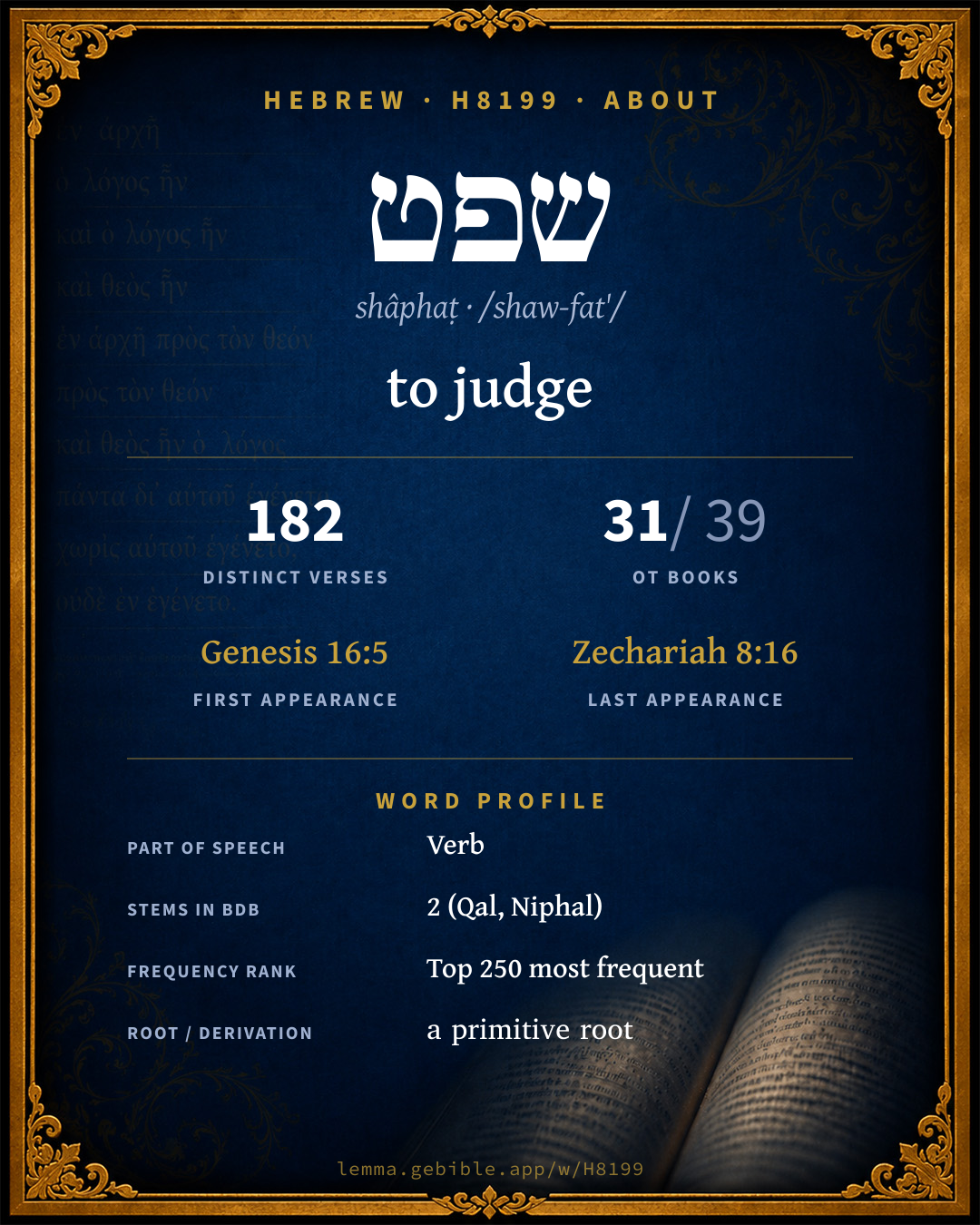
שָׁפַט
to judge
also: govern, vindicate, punish fuller range ↓
Full lexicon entry — Brown-Driver-Briggs (BDB)
From Brown-Driver-Briggs (BDB)
Where this word appears
See every Qal verb in the Hebrew Bible →
Grammar key — what these labels mean
Part of speech
- Verb
- An action or state-of-being word.
Stem
- Qal
- The basic, simple active stem — the plain form of the verb (“he wrote”). Here: ‘act as law-giver’
- Niphal
- Usually the simple passive or reflexive of the Qal (“he was written”). Here: ‘recipr.’
Form
- Sequential Imperfect
- An imperfect with prefixed waw — the standard past-narrative form (waw-consecutive imperfect).
- Imperfect
- An incomplete, ongoing, or future action (“he will / would write”).
- Participle Active
- A verbal adjective expressing ongoing or characteristic action (“writing / one who writes”).
- Infinitive Construct
- A bound verbal noun, frequently with prepositions (“to write / in writing”).
- Imperative
- A direct command (“write!”).
- Sequential Perfect
- A perfect with prefixed waw continuing a preceding imperfect or command (waw-consecutive perfect).
- Perfect
- A completed action or state — Hebrew marks aspect (completeness) more than strict tense (“he wrote”).
- Jussive
- A third- or second-person volitional form expressing wish or command (“let him write”).
- Cohortative
- A first-person volitional form expressing wish or resolve (“let me / let us write”).
- Infinitive Absolute
- An unbound verbal noun, often intensifying or standing in for a finite verb.
State
- Absolute
- The independent form of a noun, not bound to a following word.
- Construct
- A noun bound to a following noun in a possessive / “of” relationship (the construct chain).
Person
- 3rd Person
- The one spoken about (“he / she / it / they”).
- 1st Person
- The speaker (“I / we”).
- 2nd Person
- The one addressed (“you”).
Gender
- Masculine
- Grammatically masculine.
- Common
- Either gender — not distinguished for this form.
- Feminine
- Grammatically feminine.
Number
- Singular
- One.
- Plural
- More than one (in Hebrew, generally three or more).
1 distinct verse where H8199 appears in the Poel stem, across 1 book. Filtered view — show all forms. Click any verse to open its interlinear word-by-word view. Verse text shown in the World English Bible for context — . Each verse’s Hebrew form is shown with its reference; the English is not keyword-highlighted, since the data carries no word-level English alignment. Use “Compare translations” on any verse to read it across multiple English versions. This concordance covers the Hebrew Bible; Septuagint (Greek Old Testament) occurrences are not indexed here.
Job 1 verse
About this entry
At a glance — auto-summarized from this page’s data, not written by a person. Every figure links to its source below. This summary describes the numbers; it doesn’t interpret them.
שפט — transliterated shâphaṭ — is a Hebrew verb carrying the sense “to judge.” It first appears in Genesis 16:5. The Hebrew Bible uses it across 182 verses — common. Read the stem: it spans 2 stems, including Qal and Niphal. Related forms include משפט, שפוט and שפט. Each statement above links to its evidence; the full detail follows below.
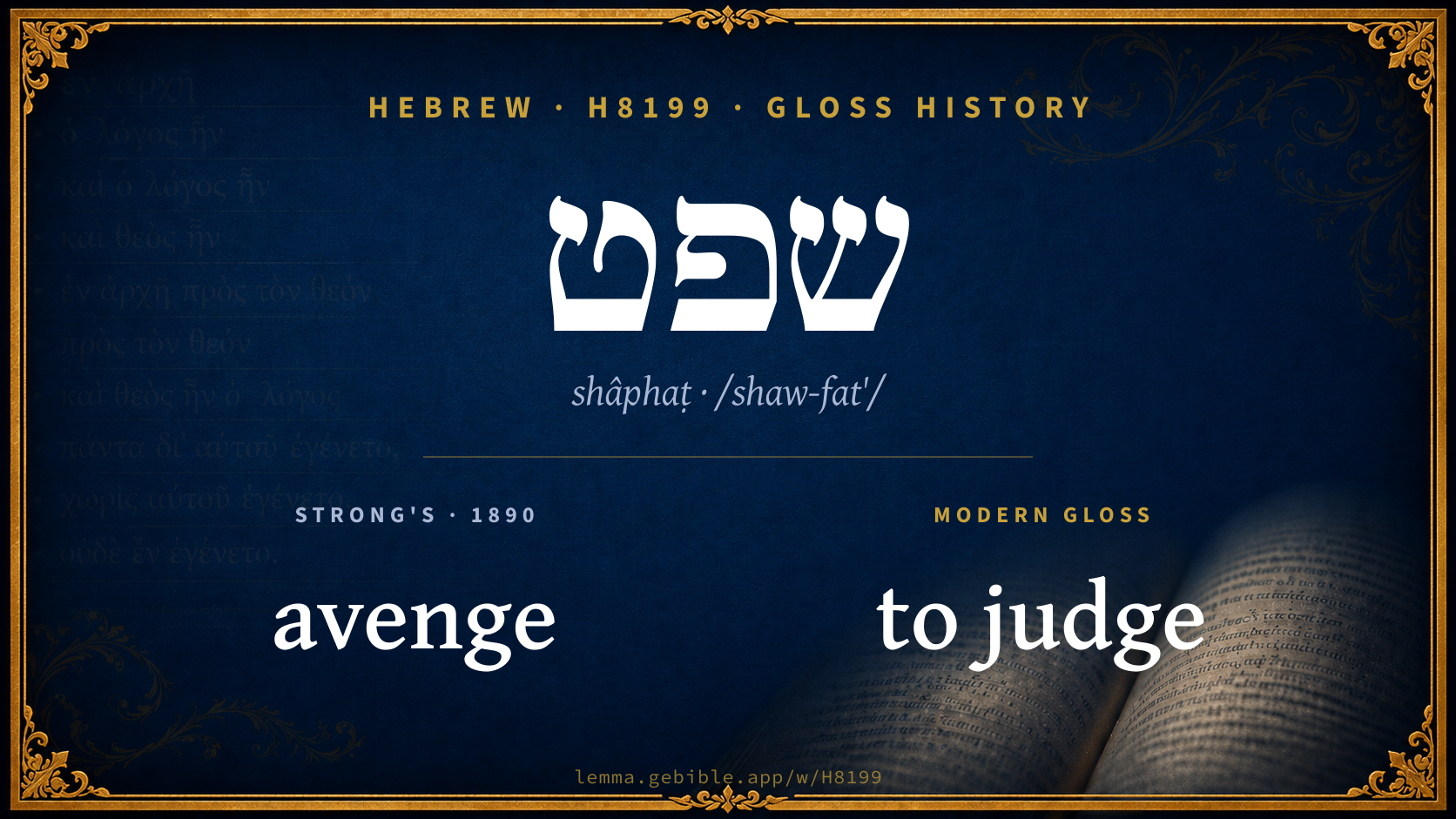
Gloss history
Strong's 1890 vs modern scholarship
About this word
Strong's H8199 catalogs a Hebrew word from the Hebrew Old Testament.
These counts are not copied from any lexicon or concordance. They are computed here, from the morphology-tagged Hebrew Old Testament. What Lemma adds →
- 182
- distinct verses
- The word appears in 182 distinct verses.
- 31 / 39
- OT books
- The word appears in 31 of 39 Old Testament books.
- #235
- by frequency
- Top 250 most frequent Hebrew words (rank 235 of 8,640 Hebrew words by occurrence).
View all 182 occurrences in the concordance →
By section of the Old Testament
By traditional corpus
Conventional, traditional groupings — biblical authorship is debated, so this is a traditional corpus grouping, not an authorship claim. Each share is this word’s portion of its verses in that division of the Hebrew canon. Each figure is a share of the word’s 182 distinct verses.
- Prophets (Nevi'im) 101 verses · 55%
- Writings (Ketuvim) 59 verses · 32%
- Torah (Pentateuch) 22 verses · 12%
How translations render this word
Counts come from each version’s own published word-to-Strong’s tagging or interlinear alignment — an approximate guide to how each version renders this word, not a word-level alignment the data otherwise carries. Because each total is that version’s own tagged count, the per-version totals vary from one another and need not match the appearance or distinct-verse counts above. These counts may also differ from a printed concordance because Lemma counts each distinctly tagged rendering and does not collapse phrase taggings into a single head-word total. This is a fixed set of word-tagged versions (KJV, ASV, BSB, ULT) and does not change with the reading translation you choose elsewhere. Each version’s license is shown beside its name below (and on Sources).
- King James Version: Judge 39×, Judges 30×, Judged 10×
- American Standard Version: Judge 37×, Judges 29×, He judged 9×
- Berean Standard Bible: Judge 36×, Judges 34×, I will judge 8×
- unfoldingWord Literal Text: Judge 41×, Judges 30×, And 9×
King James Version Public Domain
Renders H8199 across 203 tagged occurrences — most commonly:
Plus other, less common renderings. Plus 73 renderings that appear only once — usually multi-word phrases or single function words the recovered tagging swept in, not distinct renderings.
American Standard Version Public Domain
Renders H8199 across 202 tagged occurrences — most commonly:
Plus other, less common renderings. Plus 76 renderings that appear only once — usually multi-word phrases or single function words the recovered tagging swept in, not distinct renderings. Not rendered by a distinct English word in 1 further occurrence.
Berean Standard Bible Public Domain
Renders H8199 across 199 tagged occurrences — most commonly:
Plus other, less common renderings. Plus 57 renderings that appear only once — usually multi-word phrases or single function words the recovered tagging swept in, not distinct renderings. Not rendered by a distinct English word in 4 further occurrences.
unfoldingWord Literal Text CC BY-SA 4.0
Renders H8199 across 225 tagged occurrences — most commonly:
Plus other, less common renderings. Plus 62 renderings that appear only once — usually multi-word phrases or single function words the recovered tagging swept in, not distinct renderings.
15 senses and sub-senses in the full BDB
Hebrew verbs can shift meaning by stem (binyan): Qal is the basic action, Niphal is often passive or reflexive, Piel often intensifies or makes it factitive, and Hiphil is typically causative. The senses below are grouped under the stem BDB assigns to each.
What do BDB’s symbols mean?
BDB uses these scholarly abbreviations:
| Symbol | Meaning |
|---|---|
| 𝔊 | the Septuagint (the ancient Greek translation, LXX) |
| 𝔙 | the Vulgate (the Latin translation) |
| 𝔖 | the Syriac version (the Peshitta) |
| 𝔗 | the Targum (the Aramaic translation) |
| ψ | the Psalms |
| √ | root (the underlying root or stem) |
| ‖ | parallel passage (a synonymous or contrasted parallel) |
| † | the dagger: every passage where the word occurs is cited |
The 15 senses and sub-senses the full Brown-Driver-Briggs lexicon distinguishes for this word, in lexicon order (not ranked by frequency), with BDB’s own verbatim wording and sub-sense lettering. Shown in Hebrew script with BDB’s own scholarly abbreviations. The condensed entry is in the Lexicon Entry tab. See also the Forms in the corpus table below.
Qal
- Pf. 3 ms. שׁ׳ Ju 16:31 +, etc.; Impf. 3 ms. יִשְׁפֹּט Gn 16:5, יִשְׁפּוֹט Is 11:3; 3 mpl. יִשְׁפְּטוּ Gn 31:53 +, יִשְׁפּ֫וּטוּ Ex 18:26 (Ki יִשְׁפּוּט֫וּ; cf. Ges§ 47 g), etc.; Inf. abs. שָׁפוֹט Gn 19:9; cstr. שְׁפֹט Ru 1:1, לִשְׁפֹּט Ex 8:13 +, etc.; Imv. שְׁפָט־ Pr 31:9, שָׁפְטָה ψ 82:8; La 3:59, שִׁפְטוּ Is 1:17 +, שְׁפֹ֑טוּ Zc 7:9, etc.; Pt. שֹׁפֵט 1 S 3:13 +, etc.;— e.g. Judges 16:31
- 1. act as law-giver, judge, governor (giving law, deciding controversies and executing law, civil, religious, political, social; both early and late):
- a. of God only, שֹׁפֵט כל הארץ Gn 18:25 (J), ‖ מֶלֶךְ, מְחֹקֵק Is 33:22. e.g. Genesis 18:25
- b. of man, Gn 19:9(×2) (J), Moses deciding cases Ex 18:13 (E), making known statutes v 16 (E); so his assistants v 22(×2), 26(×2) (E), ‖ Dt 1:16; of שׁפטי ישׂראל Nu 25:5 (executioners); י׳ set שֹׁפְטִים over Isr. Ju 2:16, 18; 2 S 7:11 = 1 Ch 17:10, to deliver Isr., שׁפט ישׂראל Ju 3:10; 4:4; 10:2, 3 + 9 times Ju, 1 S 4:18; 7:15, 16, 17; 2 K 23:22, cf. 1 S 7:6; Pt. שֹׁפֵט as subst. also Ju 2:17, 18, 19; 1 S 8:1, 2; 2 K 23:22; שֹׁפְטֵי יִשׂ׳ 1 Ch 17:6 (‖ 2 S 7:7 שִׁבְטֵי), בִּימֵי שְׁפֹט הַשֹּׁפְטִים Ru 1:1(×2) (cf. מוֹשִׁיעִים Ob 21); שׁפט, ‖ מֶלֶךְ 1 S 8:5, 6, 20; Ho 7:7; 13:10; שֹׁפֶט ישׂראל Mi 4:14 (= king); king judges people 1 K 3:9(×2) = 2 Ch 1:10; 1 K 15:5 = 2 Ch 26:21; 2 Ch 1:11; abs. 1 K 7:7; Is 16:5; ‖ שׂרים Ex 2:14 (E) Am 2:3; Zp 3:3; ‖ יוֹעֵץ Is 1:26; Jb 12:17, cf. Is 3:2; שֹׁפְטֵי אָרֶץ Is 40:23 (‖ רוֹזְנִים), Pr 8:16 (‖ שׂרים), ψ 2:10; 148:11 (‖ מלכים); שׁפטינו אשׁר שׁפטונו Dn 9:12(×2). e.g. Genesis 19:9
- 2. specif. decide controversy, discriminate betw. persons, in civil, political, domestic and religious questions:
- a. of God ψ 82:1: שׁ׳ בֵּין … וּבֵין Gn 16:5 (J; domestic), Ju 11:27(×2); 1 S 24:13, 16 (all of war), Ez 34:20 (relig.); c. בֵּין … לְ Ez 34:17, 22 (relig.); c. בֵּינֵינוּ Gn 31:53 (E; domestic), Is 2:4 = Mi 4:3 (of war); c. בְּ 2 Ch 20:12 (war); c. acc. 1 K 8:32 = 2 Ch 6:23; Ec 3:17, condemning wicked and justifying righteous Jb 21:22 (‖ ידע), 23:7; abs. Ex 5:21 (J) Jb 22:13; שׁ׳ צֶדֶק Je 11:20 ψ 9:5; י׳ is שׁוֹפֵט צַדִּיק 7:12. e.g. Psalms 82:1
- b. of man, שׁ׳ בֵּין … וּבֵין Ex 18:16 (E) Nu 35:24 (P) Dt 1:16 (all civil), Is 5:3 (relig.); c. acc. Lv 19:15 (H) Dt 25:1 (all civil), Ez 20:4(×2); 22:2(×2); 23:36; שׁ׳ מִשְׁפָּט Dt 16:18; 1 K 3:28 (Sol.); במשׁפטים Ez 44:24, c. ל 2 Ch 19:6; abs. Ez 44:24; Is 11:3 (king); influenced by bribes Mi 3:11; 7:3; Jb 9:24; Absalom desires to decide cases as שֹׁפֵט 2 S 15:4 (implying lack of such in his time); according to 2 Ch 19:5, 6 Jehoshaphat set up שׁפטים, appar. for the first as judges in this specific sense; code of Dt recognizes them: הַשֹּׁפֵט declares דְּבַר הַמִּשְׁפָּט Dt 17:9, 12; 25:2; שׁפטים + שֹׁטְרִים 16:18; 1 Ch 23:4; 26:29; Jos 8:33 (+ זְקֵנִים), 23:2; 24:1 (D; both + זקנים, רָאשִׁים), + זקנים only Dt 21:2; Ezr 10:14, + כֹּהֲנִים; Dt 19:17, 18, שׂרים 2 Ch 1:2. e.g. Exodus 18:16
- 3. execute judgment:
- a. discriminating, of man only, משׁפט אמת Zc 7:9, מֵישָׁרִים שׁ׳ ψ 58:2 judge uprightly; משׁפט שׁלום Zc 8:16, צֶדֶק Pr 31:9, עָוֶל ψ 82:2. e.g. Zechariah 7:9
- b. vindicating, c. acc.: (1) subj. God, יתום ψ 10:18, acc. pers. 26:1; 43:1; 58:12 (read שֹׁפְטָם for שׁפטים), שׁ׳ משׁפט La 3:59; מִיַּד vindicate by delivering from hand of 1 S 24:16; 2 S 18:19, 31; שָׁפְטֵנִי י׳ כְּצִדְקִי ψ 7:9; שָׁפְטֵנִי כְּצִדְקְךָ 35:24. (2) subj. man, c. acc. יתום Is 1:17, 23; דל(ים) 11:4; Pr 29:14 ψ 82:3; עניי עם 72:4; משׁפט אביונים Je 5:28. e.g. Psalms 10:18
- c. condemning and punishing, (1) God כְּדַרְכֵי פ׳ acc. to ways of Ez 7:3, 8; 18:30; 24:14; 33:20; 36:19; במשׁפטים 7:27; 23:24; משׁפטי נאפות 16:38 (= 23:45 of human judges); c. acc. 1 S 3:13 ψ 51:6 Is 51:5; Ez 11:10, 11; 21:35; 35:11. (2) of man, only שֹׁפְטֵי נַפְשׁוֹ ψ 109:31 and Ez 23:45 supr., prob. also ψ 141:6 (corrupt). e.g. Ezekiel 7:3
- d. at theophanic advent for final judgment: God is שֹׁפֵט ψ 50:6; 75:8; שׁפט הארץ 94:2, c. acc. בא לשׁפט הארץ 96:13 = 1 Ch 16:33, ψ 98:9; שׁ׳ הארץ 82:8; כל הגוים Jo 4:12; עמים ψ 67:5; תבל 9:9; 96:13 = 98:9; שׁ׳ מישׁרים 75:3. e.g. Psalms 50:6
Niphal
- Pf. 1 s. נִשְׁפַּטְתִּי Ez 20:36 + 4 times; Impf. 1 s. אִשָּׁפֵט Ez 20:36; אִשָּֽׁפְטָה 1 S 12:7, etc.; Inf. cstr. הִשָּׁפֵט 2 Ch 22:8; sf. הִשָּֽׁפְטוֹ ψ 37:33; 109:7; Pt. נִשְׁפָּט Is 59:4 + 4 times;— e.g. Ezekiel 20:36
- 1. recipr., (Ges§ 51 d), enter into controversy, plead: c. אֵת with, of God Je 2:35; Ez 17:20 (+ acc. rei) 20:35, 36(×2); 38:22; of man 1 S 12:7 (+ וְאַגִּידָה לָכֶם 𝔊 We), Pr 29:9; c. עִם, of God Jo 4:2, of man 2 Ch 22:8; c. ל, of God Je 25:31; נשׁ׳ יחד Is 43:26 have controversy together; באשׁ by fire (of God) 66:16; באמונה 59:4. e.g. Jeremiah 2:35
- 2. pass. be judged, ψ 9:20; 37:33; 109:7. Pôʿel Pt. sf. מְשֹׁפְטִי (dub.; Hi Bu מִשְׁפָּטִי), = my opponent-at-law (Ges§ 55 b) Jb 9:15; + Zp 3:15 ψ 109:31 We al. e.g. Psalms 9:20
Senses from the full Brown-Driver-Briggs lexicon (Brown, Driver, Briggs; Oxford 1906 — public domain), digitized via Sefaria, supplemented by the OpenScriptures HebrewLexicon (CC BY 4.0). Full attribution on Sources.
Word origin
vb. judge, govern (NH in deriv.; Ph. שפט = שֹׁפֵט, also in n.pr.; Pun. sufet Lzb381; Biblical Aramaic שָֽׁפְטִין; Assyrian šapâtu (t = ת), syn. dânu (דִּין), judge DlWB 684, šipṭu (ט), prob. judgment [and šapiṭu, captain?] JenZA iv (1889), 278 f.; on poss. connexion with Arabic سفط v. NöZMG xi (1886), 724; on usage of vb. see FergusonJBL viii (1888), 130 ff.);—
— Brown-Driver-Briggs (Oxford 1906, public domain), digitized via Sefaria, supplemented by the OpenScriptures HebrewLexicon (CC BY 4.0). See Sources.
Origin: a primitive root
Jastrow Dictionary
A second Hebrew/Aramaic lexicon for comparison, covering Aramaic and post-biblical (Talmudic, Targumic, Midrashic) usage that the biblical-Hebrew BDB does not. Matched by lemma rather than by Strong’s number, so a lemma may carry more than one Jastrow headword (shown separately below), and the entries cover usage well beyond the Bible.
שָׁפַט
- v. פטט, s. v. פַּטָּטָא) [to divide; cmp. גזר,] to decree, decide, judge. Ruth R. to I, 1 אוי לדור שׁשָׁפְטוּ … צריכין להִשָּׁפט woe to the generation that judge (criticise) their judges, and woe to the generation whose judges need to be judged; B. Bath. 15ᵇ (ref. to Ruth l. c.) דור שׁשׁוֹפֵט וכ׳ it was a generation that judged its judges &c., v. קִיסָּם. Sot. 10ᵃ זכור לי … שׁשָׁפַטְתִּי וכ׳ remember unto me the twenty (-two) years that I judged Israel, and never did I say to them, carry a stick for me from one place to another; a. fr.—V. שׁוֹפֵט.
- to be judged, criticised. Ruth R. l. c., v. supra.
שֶׁפֶט
- , pl. שְׁפָטִים(b. h.; preced.) judgments, punishments. Mekh. B’shall., Shir., s. 8 נעשו ש׳ בע"ז judgment was executed on the idols; a. e.
A Dictionary of the Targumim, the Talmud Babli and Yerushalmi, and the Midrashic Literature (Marcus Jastrow; London, Luzac, 1903) — Public Domain. Digitized via Sefaria. Digitized via Sefaria. Full attribution on Sources.
Forms in the corpus
The 163 distinct written forms H8199 takes in the Hebrew Bible, most frequent first — each parse links to that stem’s occurrences in the concordance. Hebrew forms include their vowel points and cantillation, so a single lemma takes many written forms.
The 60 most common forms are shown; 103 rarer forms follow in the full concordance.
Same root — word family
Other BDB entries built from the same root as H8199, grouped by Strong’s listed origin. These share a root / origin per the lexicon — not necessarily a shared meaning. Each links to that word’s own entry.
Derived from this word
- משפט mishpâṭ H4941 judgment
- שפוט shᵉphôwṭ H8196 judgment
- שפט shᵉphaṭ H8200 to judge
- שפט shepheṭ H8201 judgment
- תפתי tiphtay H8614 magistrate
Proper names from this root
People and places named from this root — a name, not an additional meaning of the word.
Compare all same-root words → Showing 4 of 9 — not the complete family. 3 of the same-root words are proper names (people or places). They share a root, not necessarily a meaning.
Septuagint verse parallels
This word appears in 174 verses that also exist in the Greek Old Testament (Septuagint), out of the 182 Hebrew verses it occurs in. You can read those verses in Greek by switching the Old Testament edition to the Septuagint.
Read these verses in the Septuagint
- Genesis 16:5
- Exodus 2:14
- Leviticus 19:15
- Numbers 25:5
- Deuteronomy 1:16
- Joshua 23:2
- Judges 2:16
- Ruth 1:1
- 1 Samuel 3:13
- 2 Samuel 7:11
- 1 Kings 3:9
- 2 Kings 15:5
This is a verse-level parallel only — the same verses exist in both the Hebrew and Greek Old Testaments. No word-level Hebrew↔Greek correspondence is claimed: the data carries no such alignment, so no Greek word is shown as this Hebrew word’s translation. Coverage is not total — the Septuagint omits the deuterocanon and renumbers the Psalms, so some Hebrew verses have no direct Greek parallel.