Jeremiah 11:20

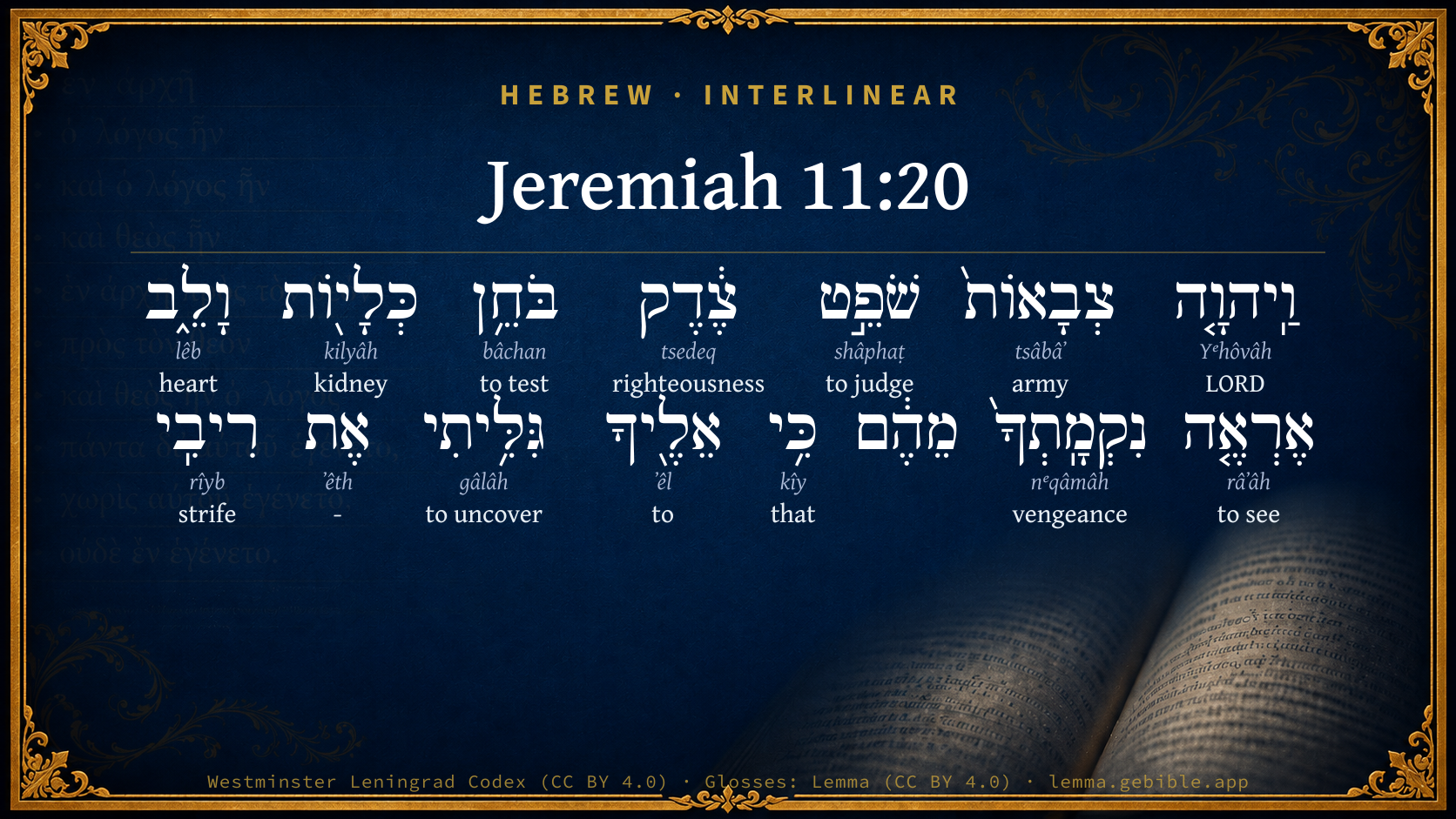
Hebrew (Westminster Leningrad Codex) Jeremiah 11:20 appears in the Hebrew Old Testament. The text above is from the Westminster Leningrad Codex. Each word links to its Strong’s number, a concise gloss, and parsing drawn from the Open Scriptures Hebrew Bible morphology. Click any word for its full Brown-Driver-Briggs (BDB) entry.
Download image
Cite this verse

Jeremiah 11:20 (World English Bible). Public Domain. Lemma interlinear Bible study tool, https://lemma.gebible.app/v/jeremiah/11/20.

Show BibTeX & RIS
BibTeX
RIS
English Translation
But, Yahweh of Hosts, who judge righteously, who try the heart and the mind, I shall see your vengeance on them; for to you have I revealed my cause.
World English Bible · Public Domain
Download a study sheet

One document with this verse’s original text, its word-by-word gloss line, the meaning frame, cross-references with their text, attributed commentary, and full source and license credits — printable, and it pastes into notes with its structure intact.

This verse Autodidact and up

Study sheet (.html) Plain text (.txt)

A passage Seminary Student

Up to 50 verses in one chapter. A passage sheet keeps up to 6 commentary sources and 12 cross-references per verse, in the order this page ranks them, and says so on the sheet whenever that leaves anything out. Ask for a single verse and you get the Autodidact verse sheet above.

Everything on this page stays free to read, with no account — the sheet is a download of what is already on screen, not access to it.

Want to remove ads? Support Godless Engineer
Compare translations 3

The same verse in 3 English versions, stacked beneath the original-language interlinear above. Click any original word for its lexicon entry.

Each is an independent rendering of the whole verse — the interlinear is not word-aligned to these translations.

Highlighted words mark where these versions differ — a whole-verse word diff, not a word-by-word alignment.

  • World English Bible Public Domain
    But, Yahweh of Hosts, who judge righteously, who try the heart and the mind, I shall see your vengeance on them; for to you have I revealed my cause.
  • King James Version Public Domain
    But, O LORD of hosts, that judgest righteously, that triest the reins and the heart, let me see thy vengeance on them: for unto thee have I revealed my cause.
  • unfoldingWord Literal Text CC BY-SA 4.0
    But Yahweh of hosts one judging of righteousness, examining kidneys and the heart. Let me see your vengeance upon them, for to you I have revealed my cause.

unfoldingWord Literal Text — © unfoldingWord, licensed CC BY-SA 4.0. Word-aligned USFM3 via Door43 (git.door43.org/unfoldingWord/en_ult).

Versions to compare (up to 4)

3 of 4 selected

Show all 18 translations

Every available English version of this verse, each an independent rendering of the whole verse.

  • World English Bible Public Domain
    But, Yahweh of Hosts, who judge righteously, who try the heart and the mind, I shall see your vengeance on them; for to you have I revealed my cause.
  • Berean Standard Bible Public Domain
    O LORD of Hosts, who judges righteously, who examines the heart and mind, let me see Your vengeance upon them, for to You I have committed my cause.
  • Majority Standard Bible Public Domain
    O LORD of Hosts, who judges righteously, who examines the heart and mind, let me see Your vengeance upon them, for to You I have committed my cause.
  • King James Version Public Domain
    But, O LORD of hosts, that judgest righteously, that triest the reins and the heart, let me see thy vengeance on them: for unto thee have I revealed my cause.
  • American Standard Version (1901) Public Domain
    But, O Jehovah of hosts, who judgest righteously, who triest the heart and the mind, I shall see thy vengeance on them; for unto thee have I revealed my cause.
  • Revised Version (1885) Public Domain
    But, O LORD of hosts, that judgest righteously, that triest the reins and the heart, let me see thy vengeance on them: for unto thee have I revealed my cause.
  • Geneva Bible (1599) Public Domain
    But O Lord of hostes, that iudgest righteously, and triest the reines and the heart, let me see thy vengeance on them: for vnto thee haue I opened my cause.
  • Douay-Rheims (1899) Public Domain
    But thou, O Lord of Sabaoth, who judgest justly, and triest the reins and hearts, let me see thy revenge on them: for to thee I have revealed my cause.
  • Young's Literal Translation Public Domain
    And O Jehovah of Hosts, judging righteousness, Trying reins and heart, I do see Thy vengeance against them, For unto Thee I have revealed my cause.'
  • Literal Standard Version CC BY-SA 4.0
    And O YHWH of Hosts, judging righteousness, || Trying reins and heart, || I see Your vengeance against them, || For I have revealed my cause to You.
  • Unlocked Literal Bible CC BY-SA 4.0
    Yet Yahweh of hosts is the righteous judge who examines the heart and the mind. I will witness your vengeance against them, for I have presented my case to you.
  • unfoldingWord Literal Text CC BY-SA 4.0
    But Yahweh of hosts one judging of righteousness, examining kidneys and the heart. Let me see your vengeance upon them, for to you I have revealed my cause.
  • Darby Bible Public Domain
    But thou, Jehovah of hosts, who judgest righteously, who triest the reins and the heart, let me see thy vengeance on them: for unto thee have I revealed my cause.
  • World Messianic Bible Public Domain
    But, LORD of Hosts, who judges righteously, who tests the heart and the mind, I will see your vengeance on them; for to you I have revealed my cause.
  • Webster's Bible Public Domain
    But, O LORD of hosts, that judgest righteously, that triest the reins and the heart, let me see thy vengeance on them: for to thee have I revealed my cause.
  • Free Bible Version CC BY-SA 4.0
    I appeal to you, Lord Almighty, you who judge rightly and examine people's thoughts and feelings, let me see how you punish them, because I've left my case in your hands.
  • Bible in Basic English Public Domain
    But, O Lord of armies, judging in righteousness, testing the thoughts and the heart, let me see your punishment come on them: for I have put my cause before you.
  • JPS Tanakh (1917) Public Domain
    But, O LORD of hosts, that judgest righteously, that triest the reins and the heart, let me see Thy vengeance on them; for unto Thee have I revealed my cause.

Literal Standard Version (2020), Covenant Press — licensed CC BY-SA 4.0. Text via the HelloAO Bible API (eBible.org). Unlocked Literal Bible (unfoldingWord) — licensed CC BY-SA 4.0. Text via the HelloAO Bible API (eBible.org). unfoldingWord Literal Text — © unfoldingWord, licensed CC BY-SA 4.0. Word-aligned USFM3 via Door43 (git.door43.org/unfoldingWord/en_ult). Free Bible Version, Dr. Jonathan Gallagher — licensed CC BY-SA 4.0. Text via the HelloAO Bible API (eBible.org).

Word by word

More ways to search: Search by grammar → Find every occurrence → Compare this word →

Practice this passage: Drill this verse → Learn its vocabulary →

נִקְמָֽתְךָ֙
nᵉqâmâh
H5360
“vengeance · your”
Noun, Common, Feminine, Singular, Construct + Suffix, Personal, 2nd Person, Masculine, Singular
Part of Speech
Noun
Type
Common
Gender
Feminine
Number
Singular
State
Construct
Full BDB Definition

Origin: from H5359

TWOT: 1413b

vengeance - vengeance (by God, by Israel, by enemies of Israel)
  1. וַֽיהוָ֤ה Yᵉhôvâh H3068 “and · LORD” Conjunction + Noun, Proper
  2. צְבָאוֹת֙ tsâbâʼ H6635 “armies” Noun, Common, Both, Plural, Absolute
  3. שֹׁפֵ֣ט shâphaṭ H8199 “judging” Verb, Qal, Participle Active, Masculine, Singular, Construct
  4. צֶ֔דֶק tsedeq H6664 “righteousness” Noun, Common, Masculine, Singular, Absolute
  5. בֹּחֵ֥ן bâchan H974 “testing” Verb, Qal, Participle Active, Masculine, Singular, Absolute
  6. כְּלָי֖וֹת kilyâh H3629 “kidneys” Noun, Common, Feminine, Plural, Absolute
  7. וָלֵ֑ב lêb H3820 “and · heart” Conjunction + Noun, Common, Masculine, Singular, Absolute
  8. אֶרְאֶ֤ה râʼâh H7200 “to see” Verb, Qal, Imperfect, 1st Person, Common, Singular
  9. כִּ֥י kîy H3588 “that” Conjunction
  10. אֵלֶ֖יךָ ʼêl H413 “to · you” Preposition + Suffix, Personal, 2nd Person, Masculine, Singular
  11. גִּלִּ֥יתִי gâlâh H1540 “to uncover” Verb, Piel, Perfect, 1st Person, Common, Singular
  12. אֶת ʼêth H853 “-” Particle, Direct Object
  13. רִיבִֽי rîyb H7379 “strife · my” Noun, Common, Both, Singular, Construct + Suffix, Personal, 1st Person, Common, Singular

About this verse

These counts appear in no published source. They are computed here, from the morphology-tagged text and Lemma’s own curated glosses. What Lemma adds →

15
words
14
distinct lemmas
Prophets
section

Shared distinctive vocabulary

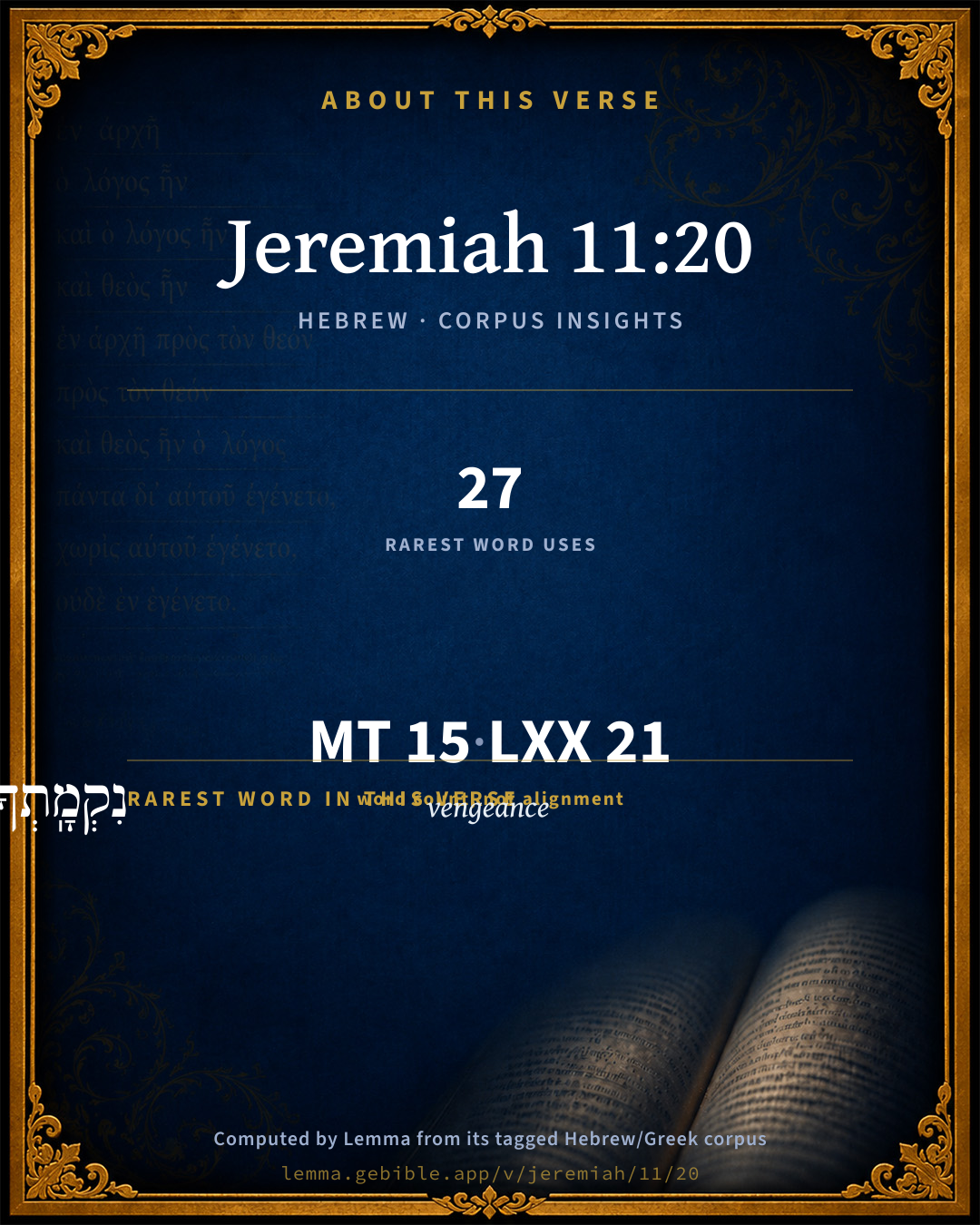
נִקְמָֽתְךָ֙ vengeance H5360 occurs in 22 verses of the Hebrew Bible. Also found in:

Grammatical profile

  • 4 verbs
  • 7 nouns
  • 2 prepositions
  • 1 conjunction
  • 1 particle

Verb forms

  • שֹׁפֵ֣ט Qal · Participle Active
  • בֹּחֵ֥ן Qal · Participle Active
  • אֶרְאֶ֤ה Qal · Imperfect
  • גִּלִּ֥יתִי Piel · Perfect

Hebrew & Septuagint length

In the original languages it is 15 Hebrew tokens and 21 Greek tokens — but the two are counted differently (Hebrew bundles its prefixes and suffixes into one token; the Greek is in lemma form), so that isn’t a like-for-like length.

Cross-references

25

Topical passages linked to Jeremiah 11:20 in the Treasury of Scripture Knowledge — connected by theme and wording, ordered by reader-vote popularity; previews shown in the World English Bible.

  • Jeremiah 20:12 But, Yahweh of Hosts, who tests the righteous, who sees the heart and the mind, let me see your vengeance on them; for to you have I revealed my cause.
  • Jeremiah 17:10 I, Yahweh, search the mind, I try the heart, even to give every man according to his ways, according to the fruit of his doings.
  • 1 Samuel 16:7 But Yahweh said to Samuel, "Don't look on his face, or on the height of his stature; because I have rejected him: for [Yahweh sees] not as man sees; for man looks at the outward appearance, but Yahweh looks at the heart."
  • Psalms 7:9 Oh let the wickedness of the wicked come to an end, But establish the righteous; Their minds and hearts are searched by the righteous God.
  • Genesis 18:25 Be it far from you to do things like that, to kill the righteous with the wicked, that so the righteous should be as the wicked. May that be far from you. Shouldn't the Judge of all the earth do right?"
  • Jeremiah 15:15 Yahweh, you know; remember me, and visit me, and avenge me of my persecutors; don't take me away in your longsuffering: know that for your sake I have suffered reproach.
  • Jeremiah 17:18 Let them be disappointed who persecute me, but let not me be disappointed; let them be dismayed, but don't let me be dismayed; bring on them the day of evil, and destroy them with double destruction.
  • Revelation 2:23 I will kill her children with Death, and all the assemblies will know that I am he who searches the minds and hearts. I will give to each one of you according to your deeds.
  • 1 Chronicles 29:17 I know also, my God, that you try the heart, and have pleasure in uprightness. As for me, in the uprightness of my heart I have willingly offered all these things: and now have I seen with joy your people, that are present here, offer willingly to you.
  • Psalms 10:14–15 But you do see trouble and grief; You consider it to take it into your hand. You help the victim and the fatherless.
  • 1 Samuel 24:15 Yahweh therefore be judge, and give sentence between me and you, and see, and plead my cause, and deliver me out of your hand.
  • 1 Chronicles 28:9 You, Solomon my son, know the God of your father, and serve him with a perfect heart and with a willing mind; for Yahweh searches all hearts, and understands all the imaginations of the thoughts: if you seek him, he will be found of you; but if you forsake him, he will cast you off forever.
  • Job 5:8 "But as for me, I would seek God, To God would I commit my cause;
  • Psalms 35:2 Take hold of shield and buckler, And stand up for my help.
  • Psalms 57:1 Be merciful to me, God, be merciful to me, For my soul takes refuge in you. Yes, in the shadow of your wings, I will take refuge, Until disaster has passed.
  • Psalms 98:9 Let them sing before Yahweh, For he comes to judge the earth. He will judge the world with righteousness, And the peoples with equity.
  • Jeremiah 12:1 Righteous are you, Yahweh, when I contend with you; yet would I reason the cause with you: why does the way of the wicked prosper? why are all they at ease who deal very treacherously?
  • Jeremiah 18:20–23 Shall evil be recompensed for good? for they have dug a pit for my soul. Remember how I stood before you to speak good for them, to turn away your wrath from them.
  • Acts 17:31 because he has appointed a day in which he will judge the world in righteousness by the man whom he has ordained; of which he has given assurance to all men, in that he has raised him from the dead."
  • Philippians 4:6 In nothing be anxious, but in everything, by prayer and petition with thanksgiving, let your requests be made known to God.
  • 2 Timothy 4:14 Alexander, the coppersmith, did much evil to me. The Lord will repay him according to his works,
  • 1 Peter 2:23 Who, when he was cursed, didn't curse back. When he suffered, didn't threaten, but committed himself to him who judges righteously;
  • Revelation 6:9–10 When he opened the fifth seal, I saw underneath the altar the souls of those who had been killed for the Word of God, and for the testimony of the Lamb which they had.
  • Revelation 18:20 Rejoice over her, O heaven, you saints, apostles, and prophets; for God has judged your judgment on her."
  • Psalms 43:1 Vindicate me, God, and plead my cause against an ungodly nation. Oh, deliver me from deceitful and wicked men.

Cross-references courtesy of OpenBible.info (CC BY 4.0).

Hebrew and Greek witnesses Masoretic Hebrew ↔ Greek Septuagint

The same verse in the two great witnesses to the Old Testament, shown verse-for-verse.

These are two independent witnesses, not word-aligned to each other, and the Septuagint is shown in lemma (dictionary) form.

Hebrew Jeremiah 11:20 Masoretic · Westminster Leningrad Codex

וַֽיהוָ֤ה צְבָאוֹת֙ שֹׁפֵ֣ט צֶ֔דֶק בֹּחֵ֥ן כְּלָי֖וֹת וָלֵ֑ב אֶרְאֶ֤ה נִקְמָֽתְךָ֙ מֵהֶ֔ם כִּ֥י אֵלֶ֖יךָ גִּלִּ֥יתִי אֶת רִיבִֽי

But, Yahweh of Hosts, who judge righteously, who try the heart and the mind, I shall see your vengeance on them; for to you have I revealed my cause.

World English Bible · Public Domain

Greek LXX Structure differs

In the Septuagint, Jeremiah is about an eighth shorter than the Hebrew and arranges its material differently — the Oracles Against the Nations (Hebrew chapters 46–51) appear in the middle of the Greek book, after 25:13. Because the chapter and verse boundaries do not line up, a verse-for-verse comparison with the Hebrew is not shown.

A verse-for-verse comparison isn’t shown here because the chapters and verses don’t line up. Switch to the LXX edition with the MT / LXX toggle above to read the Greek directly.

Hebrew: Westminster Leningrad Codex (CC BY 4.0). Greek: Septuagint (public domain); English from a public-domain English Septuagint. How the Septuagint differs from the Hebrew →

Targum (Aramaic paraphrase)

1

The Targum is the ancient Jewish Aramaic paraphrase of the Hebrew Scriptures — an interpretive translation, not the Hebrew text itself. Onkelos (literal) and Pseudo-Jonathan (expansive) render the Torah, and Jonathan the Prophets. Coverage is partial: where no permissively-licensed English translation exists for a verse, only the Aramaic is shown. This is verse-level text, not a word-by-word alignment to the Hebrew.

  1. Targum Jonathan Prophets (Joshua–Malachi)
    וַיָי צְבָאוֹת דַיָין קְשׁוֹט גַלְיָן קֳדָמוֹהִי כּוּלְיָן וָלֵב אֶחְזֵי פוּרְעֲנוּת דִינָךְ מִנְהוֹן אֲרֵי קֳדָמָךְ אֲמָרִית יַת עֶלְבְּנִי:

    (no public-domain English translation for this verse)

    Targum Jonathan — Aramaic: “Mikraot Gedolot” (public domain). English: “Sefaria Community Translation” (CC0 1.0 (public-domain dedication)); “London "Chaldee Paraphrase," 1871” (public domain). Text via Sefaria.

Commentary

Notes on Jeremiah 11:20 from classic Christian and Jewish commentators (each source and its license shown beneath its notes). The classic Christian expositions comment on the surrounding passage and are grouped to its opening verse, so a note may address several verses; the Jewish commentaries on the Tanakh (Rashi and others) are per-verse, so they appear only where the commentator wrote on this verse.

Lemma curates 59 commentaries, every one of them public domain or Creative Commons licensed, each selected and text-cleaned for this edition rather than reprinted as found. About our sources →

Trapp's Complete Commentary

John Trapp

Jer 11:20 But, O LORD of hosts, that judgest righteously, that triest the reins and the heart, let me see thy vengeance on them: for unto thee have I revealed my cause.

Ver. 20. But, O Lord of hosts.] Thou who art potentissimus et liberrimus, a most powerful and free agent.

That triest the reins and the heart.] And so knowest with what mind I make this complaint and request.

Let me see thy vengeance upon them.] A prophetic imprecation guided by God’s Spirit, and not lightly to be imitated. So the Church prayed against Julian the apostate, whom they knew to be a desperate enemy, and to have committed that sin unto death. So perhaps had these men of Anathoth.

John Trapp, A Commentary or Exposition upon All the Books of the Old and New Testament (1647–1656) — public domain. Text from a community e-Sword module.

Joseph Benson's Commentary

Jer 11:20. But, O Lord, thou judgest righteously — It is matter of comfort to us, when men deal unjustly with us, that we have a God to go to, who doth and will plead the cause of injured innocence, and appear against the injurious. God’s justice, which is a terror to the wicked, is a comfort to the godly. That triest the reins and the heart — That perfectly knowest what is in man, that discernest his most secret thoughts, desires, and designs. Let me see thy vengeance on them — That is, do justice between me and them in such a way as thou pleasest. “When men continue implacable in their malice,” says Lowth, “we may lawfully expect and desire that God will plead our cause, and judge us according to our righteousness. For the bringing wicked men to condign punishment tends both to the manifestation of God’s glory and the good government of the world. And to pray against our enemies in this sense, namely, not for the satisfying our private resentments, but the setting forth of God’s justice, is not contrary to the spirit of Christianity. So St. Paul prayed against Alexander the copper-smith, 2Ti 4:14.” It must be observed, however, that, according to the Hebrew text here, the words are merely a prediction; מהם אראה נקמתן, being literally, I shall see thy vengeance on them; that is, I foresee it, and predict it, though I lament they should have given occasion for it.

Joseph Benson's Commentary on the Old and New Testaments (1811–1818) — public domain. Text from a community e-Sword module.

Tyndale Open Study Notes

Tyndale Open Resources

11:20 Jeremiah wanted the Lord to punish his enemies since the Lord knew their deepest thoughts and secrets. As events unfolded, Jeremiah discovered that the Lord had his own way of dealing with his foes.

Tyndale Open Study Notes — © Tyndale Open Resources, licensed CC BY-SA 4.0. Text via the HelloAO Bible API.

Geneva Bible (1599)

Geneva Bible translators

Thus he spake, not for hatred, but being moved with the Spirit of God, he desireth the advancement of God’s glory, and the verifying of his word, which is by the destruction of his enemies.

Geneva Bible (1599) marginal notes — public domain. Text via Bolls.life.

Jamieson, Fausset & Brown

Robert Jamieson, A. R. Fausset & David Brown

triest . . . heart-- (Rev 2:23).

revealed--committed my cause. Jeremiah's wish for vengeance was not personal but ministerial, and accorded with God's purpose revealed to him against the enemies alike of God and of His servant (Psa 37:34; Psa 54:7; Psa 112:8; Psa 118:7).

Jamieson, Fausset & Brown — Commentary Critical and Explanatory on the Whole Bible (1871) — public domain (CC PDM 1.0). Text via the HelloAO Bible API.

Adam Clarke's Commentary

Verse 20. Let me see thy vengeance on them] Rather, I shall see (אראה ereh) thy punishment indicted on them.

Adam Clarke's Commentary on the Bible (1810–1826) — public domain. Text from a community e-Sword/MySword module.

John Calvin's Commentaries

Here the Prophet, after having found that the impiety of the people was so great that he was speaking to the deaf, turns his address to God: O Jehovah of hosts, he says, who art a great Judge, who searchest the reins and the heart, may I see thy vengeance on them The Prophet seems here inconsistent with himself;, for he had before declared that he was like a lamb or a calf, as though he had offered, as they say, his life a wining sacrifice; but here he seems like one made suddenly angry, and he prays for God’s vengeance. These things appear indeed to be very different; for if he had offered himself a victim, why did he not wait calmly for the event; why is he inflamed with so much displeasure? why does he thus imprecate on them the vengeance of God? But these things will well agree together, if we distinguish between private feeling and that pure and discreet zeal by which the meekness of truth can never be disturbed. For though the Prophet disregarded his own life, and was not moved by private wrongs, he was nevertheless not a log of wood; but zeal for God did eat up his heart, according to what is said in common of all the members of Christ,

“Zeal for thine house hath eaten me, and the reproaches of those who upbraided thee have fallen on me.” (Psalm 69:9; John 2:17; Romans 15:3)

The Prophet then had previously freed himself from all suspicion by saying that he was prepared for the slaughter, as though he were a lamb or a calf; but he now shews that he was, notwithstanding, not destitute of zeal for God. Here then he gives vent to this new fervor when he says, “O Jehovah, who searchest the reins and the heart, may I see thy vengeance on them.”

The Prophet, no doubt, was free from every carnal feeling, and pronounced what we read through the influence of the Spirit. Since then the Holy Spirit dictated this prayer to the holy man, he might still have offered himself a voluntary sacrifice, while yet he justly appealed to God’s tribunal to take vengeance on the impiety of a reprobate people; for he did not indiscriminately include them all, but imprecated God’s judgment on the abandoned and irreclaimable.

It is indeed true, that we may regard the Prophet as predicting what he knew would happen to his people: and some give this explanation; they consider it as a prediction only and no prayer. But they are terrified without reason at the appearance of inconsistency, as they think it inconsistent in the Prophet to desire the perdition of his own people: for he might have wished it through the influ ence of that zeal, as I have said, which the Holy Spirit had kindled in his heart, and according to the words which the same Spirit had dictated.

He calls God the Judge of righteousness; and he so called him, that he might wipe away and dissipate the disguises in which the Jews exulted when they sought to prove their own cause. By this then he intimates that they gained no — thing by their evasions, for these would vanish like smoke when they came before God’s tribunal. He, in short, means that they could not stand before the judgment of God. He then adds, that God searches the reins and the heart He says this, not only that he might testify his own integrity, as some suppose, but that he might rouse hypocrites. For he intimates that they stood safe before men, as they concealed their wickedness, but that when they came before God’s tribunal another kind of account must then be given; for God would prove and try them, as the word בחן, bechen, signifies: he would search the ruins and the heart, that is, their most inward feelings; For the Scripture means by reins all the hidden feelings or affections.

He says, For to thee have I made known my judgment The Prophet, no doubt, appeals here to God’s tribunal, because he saw that he was destitute of every patronage — he saw that all were against him. Few pious men indeed were left, as we have elsewhere seen; but the Prophet speaks here of the mass of the people. As then there was no one among the people who did not then openly oppose God, so that there was no defender of equity and justice, he turns to God and says, “I have made known my cause to thee;” as though he had said, “O Lord, thou knowest what my cause is, and I do not act dissemblingly; for I serve thee faithfully and sincerely, as thou knowest. Since it is so, may I see thy vengeance on them.”

Now, we are taught in this passage, that even were the whole world united to suppress the light of truth, Prophets and teachers ought not to despond, nor to rely on the judgment of men, for that is a false and deceptive balance; but that they ought to persevere in the discharge of their office, and to be satisfied with this alone — that they render their office approved of God, and exercise it as in his presence. We may also learn, that the ungodly and hypocrites in vain make shifts and evasions, while they try to elude the authority of the Prophets; for they will at length be led before God’s tribunal. When therefore we find teachers rightly and sincerely discharging their office, let us know that we cannot possibly escape the judgment of God except we submit to their teaching. And Prophets and pastors themselves ought to learn from this passage, that though the whole world, as I have already said, were opposed to them, they ought not yet to cease from their perseverance, nor be changeable, but to consider it enough that God approves of their cause. It afterwards follows —

John Calvin's Commentaries (1540-1563) — public domain. Text from the Calvin Translation Society English edition (1840s-50s) via the Christian Classics Ethereal Library (ccel.org). Calvin's coverage is partial (roughly two-thirds of the Bible); uncommented books and verses are honest gaps, never fabricated. The 19th-century editor's footnotes and remarks are omitted so the notes are faithfully Calvin's own voice.

Ellicott's Commentary for English Readers

(20) Let me see thy vengeance on them.—The prayer, like that of the so-called vindictive Psalms (69, 109), belongs to the earlier stage of the religious life when righteous indignation against evil is not yet tempered by the higher law of forgiveness. As such it is not to be imitated by Christians, but neither is it to be hastily condemned. The appeal to a higher judge, the desire to leave vengeance in His hands, is in itself a victory over the impulse to take vengeance into our own hands. Through it, in most cases, the sufferer from wrong must pass before he can attain to the higher and more Christ-like temper which utters itself in the prayer, “Father, forgive them, for they know not what they do” (Luk_23:34).

Unto thee have I revealed my cause.—i.e., laid it bare before thee. The thought and the phrase were characteristic of Jeremiah, and meet us again in Jer_20:12.

A Bible Commentary for English Readers, edited by Charles John Ellicott (1878–1897) — public domain. Text from a community e-Sword module.

The Cambridge Bible for Schools and Colleges

gen. ed. J. J. S. Perowne

20. that triest the reins and the heart] The reins (kidneys) were held to be the seat of the feelings, the heart that of the understanding. Cp. Jer_5:21. Du. points out that here first in the Bible it is clearly set forth that Jehovah is cognisant of men’s thoughts. Cp. chs. Jer_17:10 and Jer_20:12.

unto thee have I revealed] upon thee have I rolled is the rendering proposed by some. That of the E.VV. however keeps closer to the original.

The Cambridge Bible for Schools and Colleges (gen. ed. J. J. S. Perowne; Cambridge University Press, 1878–1918) — public domain. Text from a community e-Sword module.

John Gill's Exposition

Therefore thus saith the Lord of the men of Anathoth,.... That is, "unto", or "concerning the men of Anathoth", the townsmen of Jeremiah, and who were the persons that combined together to destroy him; of this place; see Gill on Jer 1:1.

that seek thy life; or "soul"; that is, to take it away:

saying, prophesy not in the name of the Lord; without their leave, and such hard things as he did, unless he would prophesy smooth things, and then he might go on, otherwise he must expect to die:

that thou die not by our hand; or means; they intimate, that, should he persist in this way of prophesying, they should not stay to carry on a judicial process against him, to bring him and accuse him before a judge, or the sanhedrim, or any court of judicature; but should do as those called zealots in later times did; lay violent hands upon him, and dispatch him themselves at once; perhaps this they said after they found that the prophet had knowledge of their designs against him.

John Gill's Exposition of the Whole Bible (1746–1763) — public domain (CC PDM 1.0). Text via the HelloAO Bible API.

Haydock's Catholic Bible Commentary

Sabaoth. That is, of hosts or armies; a name frequently given to God, in the Scriptures. --- Thy revenge. This was rather a prediction of what was to happen, with an approbation of the divine justice, than an imprecation. (Challoner) --- He speaks of the impenitent, (St. Jerome) and wishes they may be converted.

George Leo Haydock (1774–1849), Haydock's Catholic Family Bible and Commentary, 1859 edition — public domain. Excludes Psalms (Douay-Rheims chapter numbering differs from Protestant) and Deuterocanonical books (Catholic canon only).

Matthew Poole's English Annotations

The prophet appealeth to God, and appealeth to him as one that knew both the innocency of his heart toward them, and the malice of their hearts toward him, and used to deal out justice impartially, and committeth his cause unto God, (as we are commanded, 1Pe 2:23) and desires that God would avenge him, and that he might see the

vengeance; which words some learned interpreters think spoken not without some passion and mixture of human frailty. Others, not as a prayer so much as a prophecy. Others, not out of a desire of private revenge, but out of a pure zeal for the glory of God, whose prophet he was, and servant, in the delivery of those prophecies that were so ungrateful to them.

Matthew Poole's English Annotations on the Holy Bible (1683–1685) — public domain. Text from a community e-Sword/MySword module.

The Pulpit Commentary

Parallel passage, Jer_20:12 Unto thee have I revealed my cause. This is the literal rendering, but a comparison of Psa_22:8 and Pro_16:3, suggests that the In meaning is Upon thee have I rolled my cause." This expression is certainly not only more forcible, but more appropriate than the other. Jeremiah"s cause was not a secret which needed to be "revealed" to Jehovah, but a burden too heavy for so finely strung a nature to bear alone. Grammatically, the preferred meaning is quite justifiable, though less obvious, as there are other instances of an interchange of meanings between two classes of verbs. (see on Jer_33:6)

The Pulpit Commentary (1880–1919), ed. H.D.M. Spence-Jones & Joseph S. Exell — public domain. Text from a community e-Sword module.

Rashi

Rabbi Shlomo Yitzchaki (Rashi)

Let me see Your vengeance against them He cursed the people of Anathoth.

Rashi on the Tanakh — English translations: “The Judaica Press complete Tanach with Rashi, translated by A. J. Rosenberg” (CC BY 4.0); “Pentateuch with Rashi's commentary by M. Rosenbaum and A.M. Silbermann, 1929-1934” (public domain); “The Metsudah Tanach series, Lakewood, N.J” (CC BY 4.0); and “The Book of Joshua, Metsudah Publications, 1997” (CC BY 4.0). Text via Sefaria.

Lesson kit

Teaching starters — assembled from the data on this page, not authored interpretation. Every prompt links to the verse data it draws on. Edit before teaching.

Jeremiah, in the Prophets, opens this verse with 15 words (14 distinct Hebrew lemmas). Its most distinctive word is nᵉqâmâh (“vengeance”). A historical commentator’s framing appears above. Read the whole chapter for the surrounding context.

Discussion questions

  1. The word nᵉqâmâh carries the sense “vengeance.” How does it shape the verse?
  2. How does Numbers 31:2, which shares the word «vengeance», read alongside this verse?
  3. These translations render this verse differently. What is at stake in choosing one wording over another?
  4. «שֹׁפֵ֣ט» is a Qal Participle Active verb. How does that grammatical form shape the action described?
  5. Compare how Trapp's Complete Commentary and Joseph Benson's Commentary read this verse. Where do they agree or differ?

Things to notice

Reading settings

Reading text

Shown beneath each verse's original-language words.

Old Testament
Old Testament edition

Read the OT as the Masoretic Hebrew (MT) or the Greek Septuagint (LXX).

English shown for the Greek Septuagint (in the Hebrew ↔ Greek comparison).

Comparing translations? Open the Compare panel on any verse page to stack up to four side by side.