Deuteronomy 21:2

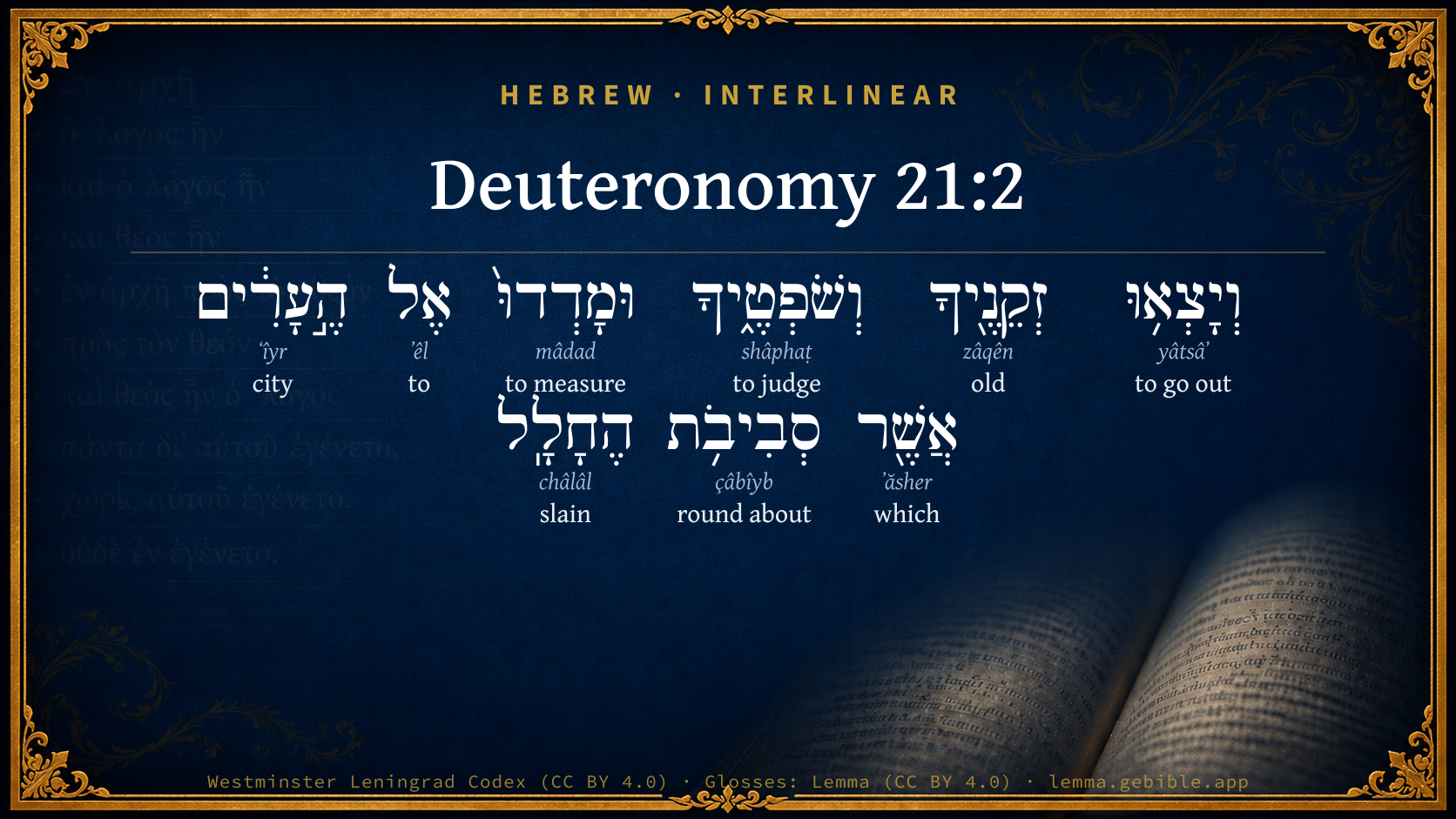
Hebrew (Westminster Leningrad Codex) Deuteronomy 21:2 appears in the Hebrew Old Testament. The text above is from the Westminster Leningrad Codex. Each word links to its Strong’s number, a concise gloss, and parsing drawn from the Open Scriptures Hebrew Bible morphology. Click any word for its full Brown-Driver-Briggs (BDB) entry.
Download image
Cite this verse

Deuteronomy 21:2 (World English Bible). Public Domain. Lemma interlinear Bible study tool, https://lemma.gebible.app/v/deuteronomy/21/2.

Show BibTeX & RIS
BibTeX
RIS
English Translation
then your elders and your judges shall come forth, and they shall measure to the cities which are round about him who is slain:
World English Bible · Public Domain
Download a study sheet

One document with this verse’s original text, its word-by-word gloss line, the meaning frame, cross-references with their text, attributed commentary, and full source and license credits — printable, and it pastes into notes with its structure intact.

This verse Autodidact and up

Study sheet (.html) Plain text (.txt)

A passage Seminary Student

Up to 50 verses in one chapter. A passage sheet keeps up to 6 commentary sources and 12 cross-references per verse, in the order this page ranks them, and says so on the sheet whenever that leaves anything out. Ask for a single verse and you get the Autodidact verse sheet above.

Everything on this page stays free to read, with no account — the sheet is a download of what is already on screen, not access to it.

Want to remove ads? Support Godless Engineer
Compare translations 3

The same verse in 3 English versions, stacked beneath the original-language interlinear above. Click any original word for its lexicon entry.

Each is an independent rendering of the whole verse — the interlinear is not word-aligned to these translations.

Highlighted words mark where these versions differ — a whole-verse word diff, not a word-by-word alignment.

  • World English Bible Public Domain
    then your elders and your judges shall come forth, and they shall measure to the cities which are round about him who is slain:
  • King James Version Public Domain
    Then thy elders and thy judges shall come forth, and they shall measure unto the cities which are round about him that is slain:
  • unfoldingWord Literal Text CC BY-SA 4.0
    then your elders and your judges shall go out, and they shall measure to the cities that surround the slain.

unfoldingWord Literal Text — © unfoldingWord, licensed CC BY-SA 4.0. Word-aligned USFM3 via Door43 (git.door43.org/unfoldingWord/en_ult).

Versions to compare (up to 4)

3 of 4 selected

Show all 18 translations

Every available English version of this verse, each an independent rendering of the whole verse.

  • World English Bible Public Domain
    then your elders and your judges shall come forth, and they shall measure to the cities which are round about him who is slain:
  • Berean Standard Bible Public Domain
    your elders and judges must come out and measure the distance from the victim to the neighboring cities.
  • Majority Standard Bible Public Domain
    your elders and judges must come out and measure the distance from the victim to the neighboring cities.
  • King James Version Public Domain
    Then thy elders and thy judges shall come forth, and they shall measure unto the cities which are round about him that is slain:
  • American Standard Version (1901) Public Domain
    then thy elders and thy judges shall come forth, and they shall measure unto the cities which are round about him that is slain:
  • Revised Version (1885) Public Domain
    then thy elders and thy judges shall come forth, and they shall measure unto the cities which are round about him that is slain:
  • Geneva Bible (1599) Public Domain
    Then thine Elders and thy Iudges shall come forth, and measure vnto the cities that are round about him that is slayne.
  • Douay-Rheims (1899) Public Domain
    Thy ancients and judges shall go out, and shall measure from the place where the body lieth the distance of every city round about:
  • Young's Literal Translation Public Domain
    then have thine elders and thy judges gone out and measured unto the cities which `are' round about the slain one,
  • Literal Standard Version CC BY-SA 4.0
    then your elderly and yours [of those] judging have gone out and measured to the cities which [are] around the slain one,
  • Unlocked Literal Bible CC BY-SA 4.0
    then your elders and your judges must go out, and they must measure to the cities that are around him who has been killed.
  • unfoldingWord Literal Text CC BY-SA 4.0
    then your elders and your judges shall go out, and they shall measure to the cities that surround the slain.
  • Darby Bible Public Domain
    then thine elders and thy judges shall go forth, and they shall measure unto the cities which are round about him that is slain;
  • World Messianic Bible Public Domain
    then your elders and your judges shall come out, and they shall measure to the cities which are around him who is slain.
  • Webster's Bible Public Domain
    Then thy elders and thy judges shall come forth, and they shall measure to the cities which are around him that is slain:
  • Free Bible Version CC BY-SA 4.0
    Your elders and judges must come and measure the distance from the body to the surrounding towns.
  • Bible in Basic English Public Domain
    Then your responsible men and your judges are to come out, and give orders for the distance from the dead body to the towns round about it to be measured;
  • JPS Tanakh (1917) Public Domain
    then thy elders and thy judges shall come forth, and they shall measure unto the cities which are round about him that is slain.

Literal Standard Version (2020), Covenant Press — licensed CC BY-SA 4.0. Text via the HelloAO Bible API (eBible.org). Unlocked Literal Bible (unfoldingWord) — licensed CC BY-SA 4.0. Text via the HelloAO Bible API (eBible.org). unfoldingWord Literal Text — © unfoldingWord, licensed CC BY-SA 4.0. Word-aligned USFM3 via Door43 (git.door43.org/unfoldingWord/en_ult). Free Bible Version, Dr. Jonathan Gallagher — licensed CC BY-SA 4.0. Text via the HelloAO Bible API (eBible.org).

Word by word

More ways to search: Search by grammar → Find every occurrence → Compare this word →

Practice this passage: Drill this verse → Learn its vocabulary →

וּמָדְדוּ֙
mâdad
H4058
“and · to measure”
Conjunction + Verb, Qal, Sequential Perfect, 3rd Person, Common, Plural
Part of Speech
Conjunction + Verb
Stem
Qal
Form
Sequential Perfect
Person
3rd Person
Gender
Common
Number
Plural
Full BDB Definition

Origin: a primitive root

TWOT: 1146

to measure, stretch - (Qal) to measure - (Niphal) to be measured - (Piel) - to extend, continue - to measure, measure off - (Po) measured - (Hithpolel) to extend oneself, stretch oneself
  1. וְיָצְא֥וּ yâtsâʼ H3318 “and · to go out” Conjunction + Verb, Qal, Sequential Perfect, 3rd Person, Common, Plural
  2. זְקֵנֶ֖יךָ zâqên H2205 “old · your” Adjective, Adjective, Masculine, Plural, Construct + Suffix, Personal, 2nd Person, Masculine, Singular
  3. וְשֹׁפְטֶ֑יךָ shâphaṭ H8199 “and · judging · you” Conjunction + Verb, Qal, Participle Active, Masculine, Plural, Construct + Suffix, Personal, 2nd Person, Masculine, Singular
  4. אֶל ʼêl H413 “to” Preposition
  5. הֶ֣עָרִ֔ים ʻîyr H5892 “the · cities” Particle, Definite Article + Noun, Common, Feminine, Plural, Absolute
  6. אֲשֶׁ֖ר ʼăsher H834 “which” Particle, Relative
  7. סְבִיבֹ֥ת çâbîyb H5439 “surroundings of” Noun, Common, Both, Plural, Construct
  8. הֶחָלָֽל châlâl H2491 “the · slain” Particle, Definite Article + Adjective, Adjective, Masculine, Singular, Absolute

About this verse

These counts appear in no published source. They are computed here, from the morphology-tagged text and Lemma’s own curated glosses. What Lemma adds →

9
words
9
distinct lemmas
Pentateuch
section

Shared distinctive vocabulary

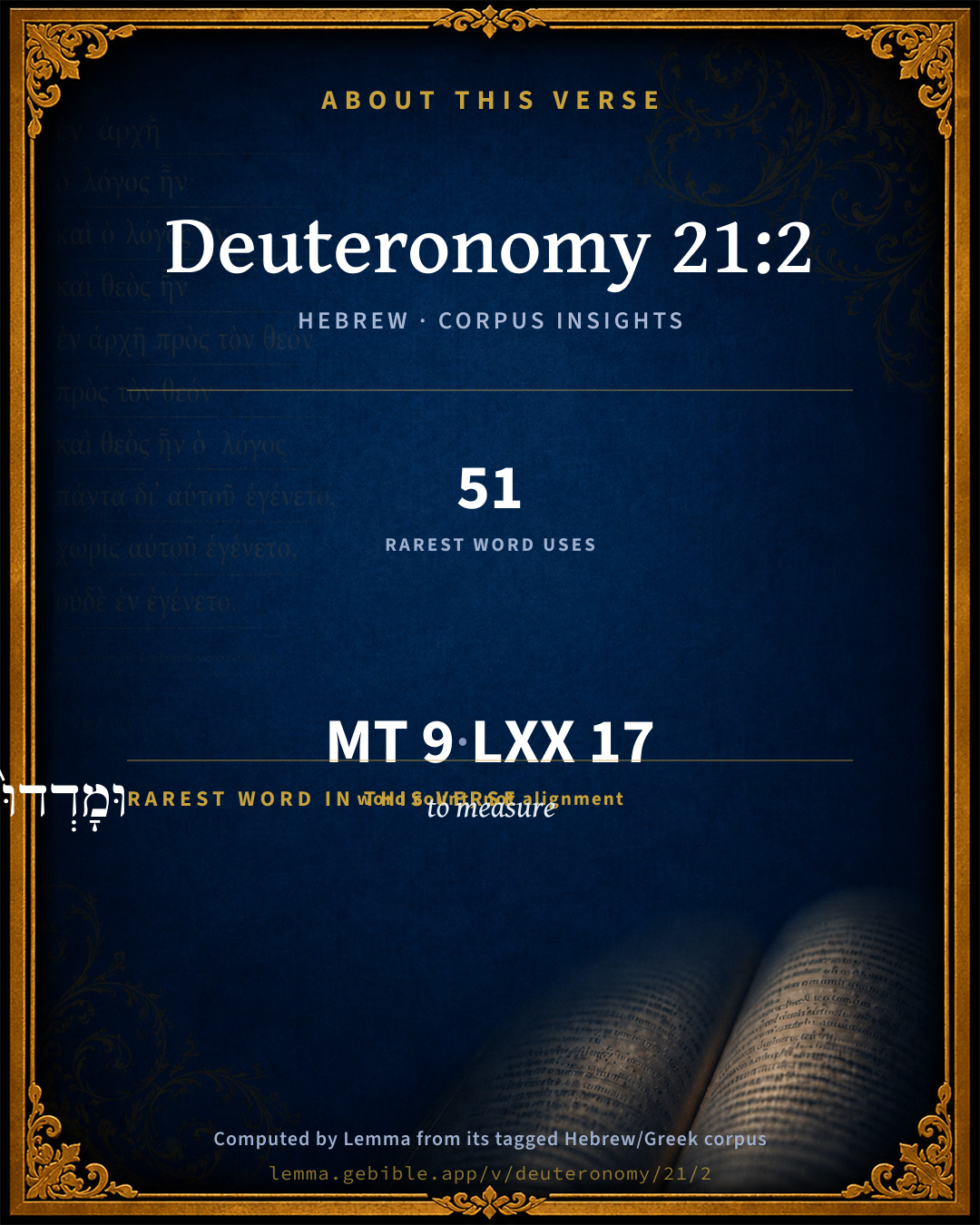
וּמָדְדוּ֙ to measure H4058 occurs in 49 verses of the Hebrew Bible. Also found in:

Grammatical profile

  • 3 verbs
  • 2 nouns
  • 2 adjectives
  • 1 preposition
  • 1 particle

Verb forms

  • וְיָצְא֥וּ Qal · Sequential Perfect
  • וְשֹׁפְטֶ֑יךָ Qal · Participle Active
  • וּמָדְדוּ֙ Qal · Sequential Perfect

Hebrew & Septuagint length

In English translation the verse runs 24 words from the Hebrew and 21 from the Septuagint (LXX English) — closely comparable.

A rough comparison of the two English renderings, which tokenize alike — not a word-level alignment.

Word counts can differ between the Hebrew and the Greek without any difference in meaning — e.g. the Hebrew direct-object marker אֵת has no separate Greek word, and Greek often adds the article ὁ.

In the original languages it is 9 Hebrew tokens and 17 Greek tokens — but the two are counted differently (Hebrew bundles its prefixes and suffixes into one token; the Greek is in lemma form), so that isn’t a like-for-like length.

Cross-references

2

Topical passages linked to Deuteronomy 21:2 in the Treasury of Scripture Knowledge — connected by theme and wording, ordered by reader-vote popularity; previews shown in the World English Bible.

  • Deuteronomy 16:18–19 Judges and officers shall you make you in all your gates, which Yahweh your God gives you, according to your tribes; and they shall judge the people with righteous judgment.
  • Romans 13:3–4 For rulers are not a terror to the good work, but to the evil. Do you desire to have no fear of the authority? Do that which is good, and you will have praise from the same,

Cross-references courtesy of OpenBible.info (CC BY 4.0).

Hebrew and Greek witnesses Masoretic Hebrew ↔ Greek Septuagint

The same verse in the two great witnesses to the Old Testament, shown verse-for-verse.

These are two independent witnesses, not word-aligned to each other, and the Septuagint is shown in lemma (dictionary) form.

Hebrew Deuteronomy 21:2 Masoretic · Westminster Leningrad Codex

וְיָצְא֥וּ זְקֵנֶ֖יךָ וְשֹׁפְטֶ֑יךָ וּמָדְדוּ֙ אֶל הֶ֣עָרִ֔ים אֲשֶׁ֖ר סְבִיבֹ֥ת הֶחָלָֽל

then your elders and your judges shall come forth, and they shall measure to the cities which are round about him who is slain:

World English Bible · Public Domain

Greek LXX Deuteronomy 21:2 Septuagint · lemma form

ἐκἔρχομαι ὁ γερουσία σύ καί ὁ κριτής σύ καί ἐκμετρέω ἐπί ὁ πόλις ὁ κύκλος ὁ τραυματίας

your elders and your judges shall come forth, and shall measure the distances of the cities round about the slain man:

LXX2012 (modern English Septuagint) · Public Domain

Hebrew: Westminster Leningrad Codex (CC BY 4.0). Greek: Septuagint (public domain); English from LXX2012 (modern English Septuagint) (Public Domain). How the Septuagint differs from the Hebrew →

Targum (Aramaic paraphrase)

2

The Targum is the ancient Jewish Aramaic paraphrase of the Hebrew Scriptures — an interpretive translation, not the Hebrew text itself. Onkelos (literal) and Pseudo-Jonathan (expansive) render the Torah, and Jonathan the Prophets. Coverage is partial: where no permissively-licensed English translation exists for a verse, only the Aramaic is shown. This is verse-level text, not a word-by-word alignment to the Hebrew.

  1. Targum Onkelos Torah (Genesis–Deuteronomy)
    וְיִפְּקוּן סָבָיךְ וְדַיָנָיךְ וְיִמְשְׁחוּן לְקִרְוַיָא דִי סַחֲרָנוּת קְטִילָא

    (no public-domain English translation for this verse)

    Targum Onkelos — Aramaic: “Onkelos Genesis” (public domain); “Onkelos Exodus” (public domain); “Onkelos Leviticus” (public domain); “Onkelos Numbers” (public domain); “Onkelos Deuteronomy” (public domain). English: “Sefaria Community Translation” (CC0 1.0 (public-domain dedication)); “J.W. Etheridge. The Targums of Onkelos and Jonathan Ben Uzziel on the Pentateuch. London: Longmans, Green, 1862” (public domain). Text via Sefaria.

  2. Targum Pseudo-Jonathan Torah (Genesis–Deuteronomy)
    וְיִפְקוּן מִבֵּי דִינָא רַבָּא תְּרֵין מִן חַכִּימֵיךְ וּתְלַת מִן דַּיָינָךְ וְיִמְשְׁחוּן מֵאַרְבַּע טְרִיגוֹנִין יַת קִרְוַיָא דִּי בְּחַזְרָנוֹת קְטִילָא

    then two of the sages shall proceed from the chief court of judgment, and three of thy judges, and shall measure to the surrounding cities which lie on the four quarters from the (spot where) the dead man (is found);

    Targum Pseudo-Jonathan — Aramaic: “Targum Jonathan on Genesis” (public domain); “Targum Jonathan on Exodus” (public domain); “Targum Jonathan on Leviticus” (public domain); “Targum Jonathan on Numbers” (public domain); “Targum Jonathan on Deuteronomy” (public domain). English: “The Targum of Jonathan ben Uzziel, trans. J. W. Etheridge, London, 1862” (public domain). Text via Sefaria.

Commentary

Notes on Deuteronomy 21:2 from classic Christian and Jewish commentators (each source and its license shown beneath its notes). The classic Christian expositions comment on the surrounding passage and are grouped to its opening verse, so a note may address several verses; the Jewish commentaries on the Tanakh (Rashi and others) are per-verse, so they appear only where the commentator wrote on this verse.

Lemma curates 59 commentaries, every one of them public domain or Creative Commons licensed, each selected and text-cleaned for this edition rather than reprinted as found. About our sources →

Trapp's Complete Commentary

John Trapp

Deu 21:2 Then thy elders and thy judges shall come forth, and they shall measure unto the cities which [are] round about him that is slain:

Ver. 2. Then thy elders.] Some of the Sanhedrim.

John Trapp, A Commentary or Exposition upon All the Books of the Old and New Testament (1647–1656) — public domain. Text from a community e-Sword module.

The Cambridge Bible for Schools and Colleges

gen. ed. J. J. S. Perowne

2. thy elders and thy judges] The combination is remarkable, and recent commentators take one or the other as secondary. Steuern. retains elders (see introd. note), but Berth. and Marti are right in taking this as editorial since D does not elsewhere speak of the elders of the whole nation as P does.

The Cambridge Bible for Schools and Colleges (gen. ed. J. J. S. Perowne; Cambridge University Press, 1878–1918) — public domain. Text from a community e-Sword module.

John Gill's Exposition

Then thy elders and thy judges shall come forth,.... From the city or cities near to which the murder was committed, to make inquiry about it, and expiation for it; so Aben Ezra interprets it of the elders of the cities near, but others understand it of the elders of the great sanhedrim at Jerusalem; so the Targum of Jonathan,"then shall go out from the great sanhedrim two of thy wise men, and three of thy judges;''and more expressly the Misnah (l),"three go out from the great sanhedrim in Jerusalem;''R. Judah says five,"it is said "thy elders" two, and "thy judges" two,''and there is no sanhedrim or court of judicature equal (or even), therefore they add to them one more:

and they shall measure unto the cities which are round about him that is slain; that is, from the place where the slain lies, as Jarchi rightly interprets it; on all sides of it, from the four corner's, as the Targum of Jonathan, the cities round about the slain. Maimonides (m) says, they do not behead the heifer for, nor measure, but to a city in which there is a sanhedrim: if it is found between two cities (that is, at an equal distance), both bring two heifers (Maimonides (n) says they bring one between them, which is most reasonable); but the city of Jerusalem does not bring an heifer to be beheaded: the reason is, because it was not divided to the tribes (o). This measuring, one would think, should be only necessary when it was not certain which was the nearest city; and yet Maimonides (p) says, even when it was found on the side of a city, which was certainly known to be nearest, they measured; the command, he observes, is to measure.

(l) Sotah, c. 9. sect. 1. (m) Hilchot Rotzeach, c. 9. sect. 4. (n) Ib. sect. 8. (o) Maimon Hilchot Rotzeachs, c. 9. sect. 8. (p) lb. c. 9. sect. 1.

John Gill's Exposition of the Whole Bible (1746–1763) — public domain (CC PDM 1.0). Text via the HelloAO Bible API.

Albert Barnes' Notes on the Bible

The elders represented the citizens at large, the judges the magistracy: priests Deu 21:5 from the nearest priestly town, were likewise to be at hand. Thus, all classes would be represented at the purging away of that blood-guiltiness which until removed attached to the whole community.

Albert Barnes' Notes on the Bible (1834–1885) — public domain. Text from a community e-Sword/MySword module.

Haydock's Catholic Bible Commentary

Ancients and judges. After the strictest inquiry, if the murderer could not be discovered, the magistrates and senate of the neighbouring cities measured which city the corpse was nearest. (Josephus, [Antiquities?] iv. 8.) The Rabbins pretend that five of the Sanhedrim were commissioned to make this enquiry, along with the magistrates of the neighbourhood. Others think that the ancients were only the old men. The measuring took place only when the point was contested, and those cities are probably meant, which were of sufficient importance to have twenty-three judges fixed in them. (Calmet) --- It was presumed that the nearest had been guilty of greater negligence. (Haydock)

George Leo Haydock (1774–1849), Haydock's Catholic Family Bible and Commentary, 1859 edition — public domain. Excludes Psalms (Douay-Rheims chapter numbering differs from Protestant) and Deuterocanonical books (Catholic canon only).

Matthew Poole's English Annotations

Thy elders and thy judges; those of thy elders who are judges; for the latter word explains and restrains the former, the judges or rulers of all the neighbouring cities, who were all concerned in this inquiry.

They shall measure, unless it be evident and confessed which city is nearest, for then measuring was superfluous.

Matthew Poole's English Annotations on the Holy Bible (1683–1685) — public domain. Text from a community e-Sword/MySword module.

Whedon's Commentary on the Bible

Daniel D. Whedon

2. Thy elders and thy judges shall come forth — These are understood to be the elders and judges of the adjacent places. The elders represented the people, the judges the magistracy. It was their first duty to find which city was nearest to the corpse that had been found.

Daniel D. Whedon (gen. ed.), Commentary on the Old and New Testaments (1874–1909) — public domain. Text from a community e-Sword module.

John Wesley's Explanatory Notes

Thy elders and Judges - Those of thy elders who are Judges: the Judges or rulers of all the neighbouring cities. Measure - Unless it be evident which city is nearest; for then measuring was superfluous.

John Wesley, Explanatory Notes Upon the Whole Bible (1754–1765) — public domain. Text via the GEBible commentary corpus.

Rashi

Rabbi Shlomo Yitzchaki (Rashi)

ויצאו זקניך THEN THE ELDERS [AND THE JUDGES] SHALL GO FORTH — i.e. the distinguished amongst thy elders, these are the Great Sanhedrin (Sotah 44b).

ומדדו AND THEY SHALL MEASURE — from the place where the corpse lies,

אל הערים אשר סביבת החלל UNTO THE CITIES WHICH ARE ROUND ABOUT HIM THAT IS SLAIN — in every direction, in order to ascertain which is the nearest.

Rashi on the Tanakh — English translations: “The Judaica Press complete Tanach with Rashi, translated by A. J. Rosenberg” (CC BY 4.0); “Pentateuch with Rashi's commentary by M. Rosenbaum and A.M. Silbermann, 1929-1934” (public domain); “The Metsudah Tanach series, Lakewood, N.J” (CC BY 4.0); and “The Book of Joshua, Metsudah Publications, 1997” (CC BY 4.0). Text via Sefaria.

Lesson kit

Teaching starters — assembled from the data on this page, not authored interpretation. Every prompt links to the verse data it draws on. Edit before teaching.

Deuteronomy, in the Pentateuch, opens this verse with 9 words (9 distinct Hebrew lemmas). Its most distinctive word is mâdad (“to measure”). A historical commentator’s framing appears above. Read the whole chapter for the surrounding context.

Discussion questions

  1. How does “to measure” (mâdad) shape what this verse is saying?
  2. Exodus 16:18 shares the word «to measure» with this verse. How do the two illuminate each other?
  3. These translations render this verse differently; the difference is in the English rendering, not the original. What questions does that raise?
  4. The verb «וְיָצְא֥וּ» is Qal Sequential Perfect. How does its form color the action?
  5. Reading how Trapp's Complete Commentary and The Cambridge Bible for Schools and Colleges read this verse, where do the two commentators agree and where do they part?

Things to notice

Reading settings

Reading text

Shown beneath each verse's original-language words.

Old Testament
Old Testament edition

Read the OT as the Masoretic Hebrew (MT) or the Greek Septuagint (LXX).

English shown for the Greek Septuagint (in the Hebrew ↔ Greek comparison).

Comparing translations? Open the Compare panel on any verse page to stack up to four side by side.