
Psalms 2:10

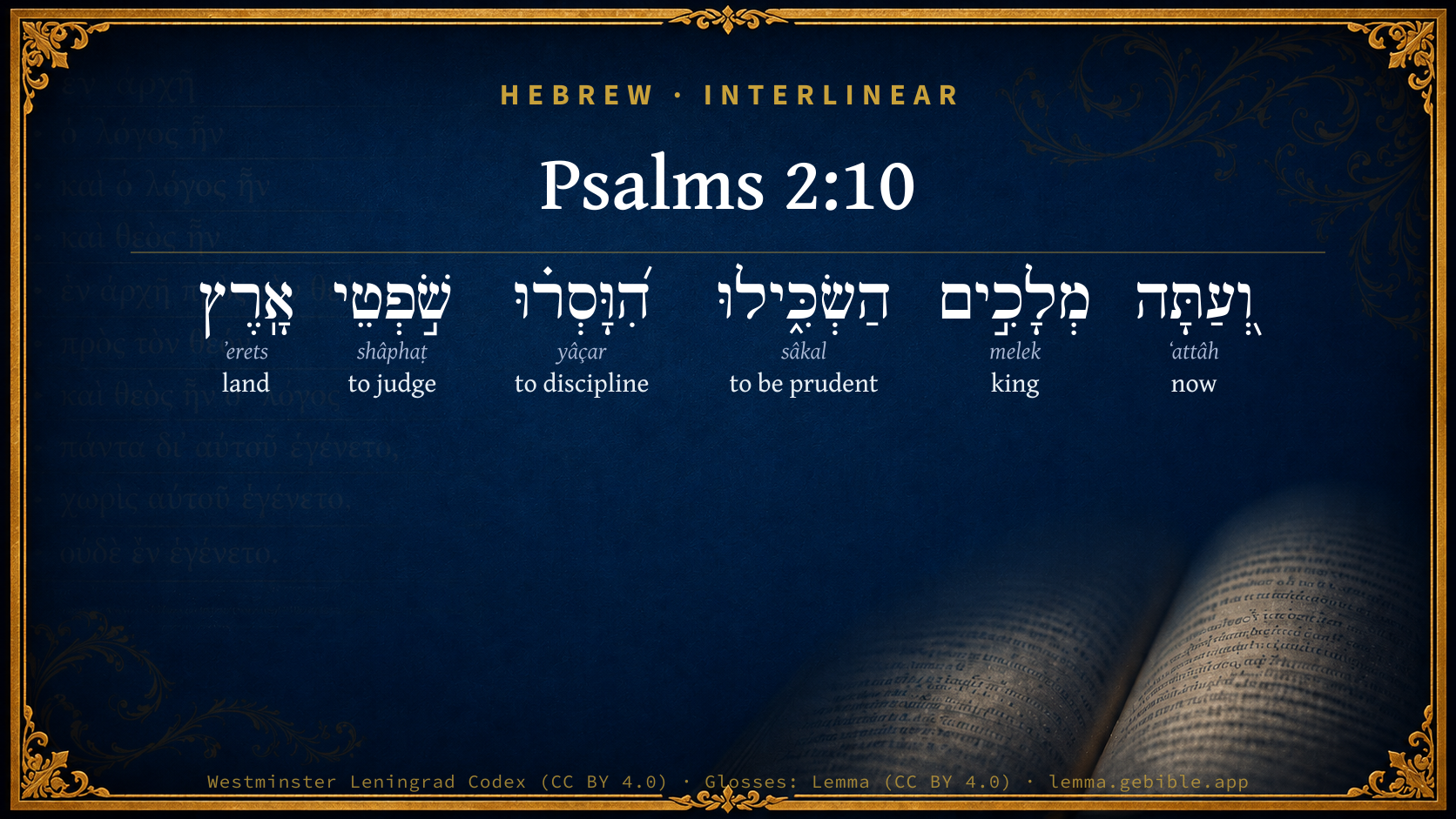
Hebrew (Westminster Leningrad Codex) Psalms 2:10 appears in the Hebrew Old Testament. The text above is from the Westminster Leningrad Codex. Each word links to its Strong’s number, a concise gloss, and parsing drawn from the Open Scriptures Hebrew Bible morphology. Click any word for its full Brown-Driver-Briggs (BDB) entry.
Download image
Cite this verse

Psalms 2:10 (World English Bible). Public Domain. Lemma interlinear Bible study tool, https://lemma.gebible.app/v/psalms/2/10.

Show BibTeX & RIS
BibTeX
RIS
English Translation
Now therefore be wise, you kings. Be instructed, you judges of the earth.
World English Bible · Public Domain
Download a study sheet

One document with this verse’s original text, its word-by-word gloss line, the meaning frame, cross-references with their text, attributed commentary, and full source and license credits — printable, and it pastes into notes with its structure intact.

This verse Autodidact and up

Study sheet (.html) Plain text (.txt)

A passage Seminary Student

Up to 50 verses in one chapter. A passage sheet keeps up to 6 commentary sources and 12 cross-references per verse, in the order this page ranks them, and says so on the sheet whenever that leaves anything out. Ask for a single verse and you get the Autodidact verse sheet above.

Everything on this page stays free to read, with no account — the sheet is a download of what is already on screen, not access to it.

Want to remove ads? Support Godless Engineer
Compare translations 3

The same verse in 3 English versions, stacked beneath the original-language interlinear above. Click any original word for its lexicon entry.

Each is an independent rendering of the whole verse — the interlinear is not word-aligned to these translations.

Highlighted words mark where these versions differ — a whole-verse word diff, not a word-by-word alignment.

  • World English Bible Public Domain
    Now therefore be wise, you kings. Be instructed, you judges of the earth.
  • King James Version Public Domain
    Be wise now therefore, O ye kings: be instructed, ye judges of the earth.
  • unfoldingWord Literal Text CC BY-SA 4.0
    And now kings, act prudently; be admonished, rulers of the earth.

unfoldingWord Literal Text — © unfoldingWord, licensed CC BY-SA 4.0. Word-aligned USFM3 via Door43 (git.door43.org/unfoldingWord/en_ult).

Versions to compare (up to 4)

3 of 4 selected

Show all 18 translations

Every available English version of this verse, each an independent rendering of the whole verse.

  • World English Bible Public Domain
    Now therefore be wise, you kings. Be instructed, you judges of the earth.
  • Berean Standard Bible Public Domain
    Therefore be wise, O kings; be admonished, O judges of the earth.
  • Majority Standard Bible Public Domain
    Therefore be wise, O kings; be admonished, O judges of the earth.
  • King James Version Public Domain
    Be wise now therefore, O ye kings: be instructed, ye judges of the earth.
  • American Standard Version (1901) Public Domain
    Now therefore be wise, O ye kings: Be instructed, ye judges of the earth.
  • Revised Version (1885) Public Domain
    Now therefore be wise, O ye kings: be instructed, ye judges of the earth.
  • Geneva Bible (1599) Public Domain
    Be wise nowe therefore, ye Kings: be learned ye Iudges of the earth.
  • Douay-Rheims (1899) Public Domain
    And now, O ye kings, understand: receive instruction, you that judge the earth.
  • Young's Literal Translation Public Domain
    And now, O kings, act wisely, Be instructed, O judges of earth,
  • Literal Standard Version CC BY-SA 4.0
    And now, O kings, act wisely, || Be instructed, O judges of earth,
  • Unlocked Literal Bible CC BY-SA 4.0
    So now, you kings, be warned; be corrected, you rulers of the earth.
  • unfoldingWord Literal Text CC BY-SA 4.0
    And now kings, act prudently; be admonished, rulers of the earth.
  • Darby Bible Public Domain
    And now, O kings, be ye wise, be admonished, ye judges of the earth.
  • World Messianic Bible Public Domain
    Now therefore be wise, you kings. Be instructed, you judges of the earth.
  • Webster's Bible Public Domain
    Be wise now therefore, O ye kings: be instructed, ye judges of the earth.
  • Free Bible Version CC BY-SA 4.0
    So then you kings, be wise! Be warned, you rulers of the world!
  • Bible in Basic English Public Domain
    So now be wise, you kings: take his teaching, you judges of the earth.
  • JPS Tanakh (1917) Public Domain
    Now therefore, O ye kings, be wise; be admonished, ye judges of the earth.

Literal Standard Version (2020), Covenant Press — licensed CC BY-SA 4.0. Text via the HelloAO Bible API (eBible.org). Unlocked Literal Bible (unfoldingWord) — licensed CC BY-SA 4.0. Text via the HelloAO Bible API (eBible.org). unfoldingWord Literal Text — © unfoldingWord, licensed CC BY-SA 4.0. Word-aligned USFM3 via Door43 (git.door43.org/unfoldingWord/en_ult). Free Bible Version, Dr. Jonathan Gallagher — licensed CC BY-SA 4.0. Text via the HelloAO Bible API (eBible.org).

Word by word

More ways to search: Search by grammar → Find every occurrence → Compare this word →

Practice this passage: Drill this verse → Learn its vocabulary →

הִ֝וָּסְר֗וּ
yâçar
H3256
“discipline”
Verb, Niphal, Imperative, 2nd Person, Masculine, Plural
Part of Speech
Verb
Stem
Niphal
Form
Imperative
Person
2nd Person
Gender
Masculine
Number
Plural
Full BDB Definition

Origin: a primitive root

TWOT: 877

to chasten, discipline, instruct, admonish - (Qal) - to chasten, admonish - to instruct - to discipline - (Niphal) to let oneself be chastened or corrected or admonished - (Piel) - to discipline, correct - to chasten, chastise - (Hiphil) to chasten - (Nithpael) to teach
  1. וְ֭עַתָּה ʻattâh H6258 “and · now” Conjunction + Adverb
  2. מְלָכִ֣ים melek H4428 “kings” Noun, Common, Masculine, Plural, Absolute
  3. הַשְׂכִּ֑ילוּ sâkal H7919 “be prudent” Verb, Hiphil, Imperative, 2nd Person, Masculine, Plural
  4. שֹׁ֣פְטֵי shâphaṭ H8199 “judging” Verb, Qal, Participle Active, Masculine, Plural, Construct
  5. אָֽרֶץ ʼerets H776 “land” Noun, Common, Both, Singular, Absolute

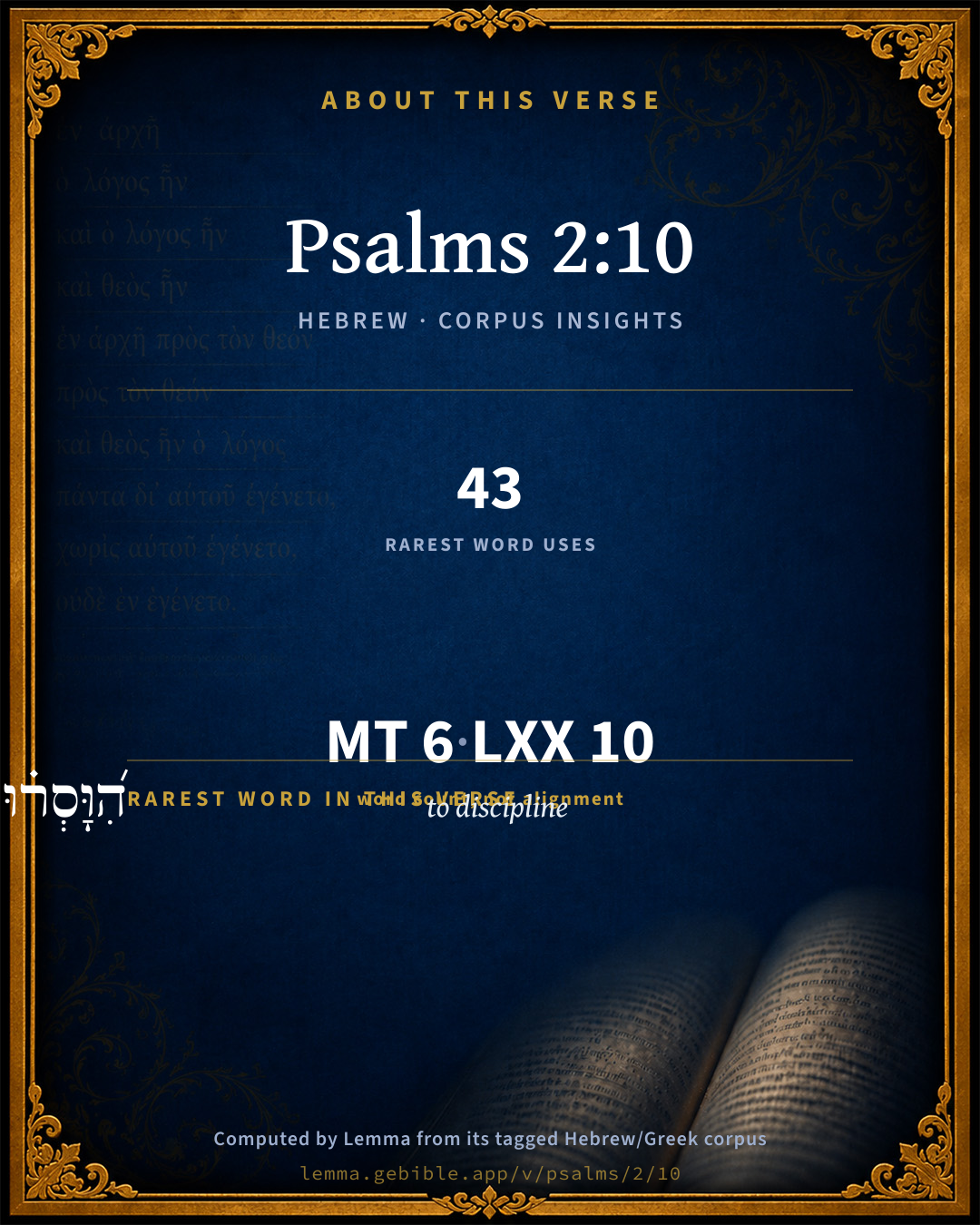
About this verse

These counts appear in no published source. They are computed here, from the morphology-tagged text and Lemma’s own curated glosses. What Lemma adds →

6
words
6
distinct lemmas
Wisdom
section

Shared distinctive vocabulary

הִ֝וָּסְר֗וּ to discipline H3256 occurs in 38 verses of the Hebrew Bible. Also found in:

Grammatical profile

  • 3 verbs
  • 2 nouns
  • 1 adverb

Verb forms

  • הַשְׂכִּ֑ילוּ Hiphil · Imperative
  • הִ֝וָּסְר֗וּ Niphal · Imperative
  • שֹׁ֣פְטֵי Qal · Participle Active

Hebrew & Septuagint length

In English translation the verse runs 13 words from the Hebrew and 13 from the Septuagint (LXX English) — the same length.

A rough comparison of the two English renderings, which tokenize alike — not a word-level alignment.

Word counts can differ between the Hebrew and the Greek without any difference in meaning — e.g. the Hebrew direct-object marker אֵת has no separate Greek word, and Greek often adds the article ὁ.

In the original languages it is 6 Hebrew tokens and 10 Greek tokens — but the two are counted differently (Hebrew bundles its prefixes and suffixes into one token; the Greek is in lemma form), so that isn’t a like-for-like length.

Cross-references

9

Topical passages linked to Psalms 2:10 in the Treasury of Scripture Knowledge — connected by theme and wording, ordered by reader-vote popularity; previews shown in the World English Bible.

  • Hosea 14:9 Who is wise, that he may understand these things? Who is prudent, that he may know them? For the ways of Yahweh are right, And the righteous walk in them; But the rebellious stumble in them.
  • Isaiah 60:10–11 Foreigners shall build up your walls, and their kings shall minister to you: for in my wrath I struck you, but in my favor have I had mercy on you.
  • Psalms 45:12 The daughter of Tyre comes with a gift. The rich among the people entreat your favor.
  • Psalms 72:10–11 The kings of Tarshish and of the isles will bring tribute. The kings of Sheba and Seba shall offer gifts.
  • Psalms 82:1–8 God presides in the great assembly. He judges among the gods.
  • Isaiah 60:3 Nations shall come to your light, and kings to the brightness of your rising.
  • Isaiah 49:23 Kings shall be your nursing fathers, and their queens your nursing mothers: they shall bow down to you with their faces to the earth, and lick the dust of your feet; and you shall know that I am Yahweh; and those who wait for me shall not be disappointed.
  • Isaiah 52:15 so shall he sprinkle many nations; kings shall shut their mouths at him: for that which had not been told them shall they see; and that which they had not heard shall they understand.
  • Jeremiah 6:8 Be instructed, Jerusalem, lest my soul be alienated from you; lest I make you a desolation, a land not inhabited.

Cross-references courtesy of OpenBible.info (CC BY 4.0).

Hebrew and Greek witnesses Masoretic Hebrew ↔ Greek Septuagint

The same verse in the two great witnesses to the Old Testament, shown verse-for-verse.

You’re reading Greek Psalm 2 (Hebrew Psalm 2). The Septuagint counts the superscription, so verse numbers can differ from the Hebrew — chapter-level alignment, not verse-by-verse. Numbering follows Rahlfs.

These are two independent witnesses, not word-aligned to each other, and the Septuagint is shown in lemma (dictionary) form.

Hebrew Psalms 2:10 Masoretic · Westminster Leningrad Codex

וְ֭עַתָּה מְלָכִ֣ים הַשְׂכִּ֑ילוּ הִ֝וָּסְר֗וּ שֹׁ֣פְטֵי אָֽרֶץ

Now therefore be wise, you kings. Be instructed, you judges of the earth.

World English Bible · Public Domain

Greek LXX Greek Psalm 2:10 Septuagint · lemma form

καί νῦν βασιλεύς συνἵημι παιδεύω πᾶς ὁ κρίνω ὁ γῆ

Now therefore understand, you⌃ kings: be instructed, all you⌃ that judge the earth.

LXX2012 (modern English Septuagint) · Public Domain

On this verse, Keil & Delitzsch discusses the Septuagint’s reading. Read the note in Commentary ↓

Hebrew: Westminster Leningrad Codex (CC BY 4.0). Greek: Septuagint (public domain); English from LXX2012 (modern English Septuagint) (Public Domain). How the Septuagint differs from the Hebrew →

Commentary

Notes on Psalms 2:10 from classic Christian and Jewish commentators (each source and its license shown beneath its notes). The classic Christian expositions comment on the surrounding passage and are grouped to its opening verse, so a note may address several verses; the Jewish commentaries on the Tanakh (Rashi and others) are per-verse, so they appear only where the commentator wrote on this verse.

Lemma curates 59 commentaries, every one of them public domain or Creative Commons licensed, each selected and text-cleaned for this edition rather than reprinted as found. About our sources →

Matthew Henry's Commentary

We have here the practical application of this gospel doctrine concerning the kingdom of the Messiah, by way of exhortation to the kings and judges of the earth. They hear that it is in vain to oppose Christ's government; let them therefore be so wise for themselves as to submit to it. He that has power to destroy them shows that he has no pleasure in their destruction, for he puts them into a way to make themselves happy, Psa 2:10. Those that would be wise must be instructed; and those are truly wise that receive instruction from the word of God. Kings and judges stand upon a level with common persons before God; and it is as necessary for them to be religious as for any others. Those that give law and judgment to others must receive law from Christ, and it will be their wisdom to do so. What is said to them is said to all, and is required of every one of us, only it is directed to kings and judges because of the influence which their example will have upon their inferiors, and because they were men of rank and power that opposed the setting up of Christ's kingdom, Psa 2:2. We are exhorted,

I. To reverence God and to stand in awe of him, Psa 2:11. This is the great duty of natural religion. God is great, and infinitely above us, just and holy, and provoked against us, and therefore we ought to fear him and tremble before him; yet he is our Lord and Master, and we are bound to serve him, our friend and benefactor, and we have reason to rejoice in him; and these are very well consistent with each other, for, 1. We must serve God in all ordinances of worship, and all instances of a godly conversation, but with a holy fear, a jealousy over ourselves, and a reverence of him. Even kings themselves, whom others serve and fear, must serve and fear God; there is the same indefinite distance between them and God that there is between the meanest of their subjects and him. 2. We must rejoice in God, and, in subordination to him, we may rejoice in other things, but still with a holy trembling, as those that know what a glorious and jealous God he is, whose eye is always upon us. Our salvation must be wrought out with fear and trembling, Phi 2:12. We ought to rejoice in the setting up of the kingdom of Christ, but to rejoice with trembling, with a holy awe of him, a holy fear for ourselves, lest we come short, and a tender concern for the many precious souls to whom his gospel and kingdom are a savour of death unto death. Whatever we rejoice in, in this world, it must always be with trembling, lest we grow vain in our joy and be puffed up with the things we rejoice in, and because of the uncertainty of them and the damp which by a thousand accidents may soon be cast upon our joy. To rejoice with trembling is to rejoice as though we rejoiced not, Co1 7:30.

II. To welcome Jesus Christ and to submit to him, Psa 2:12. This is the great duty of the Christian religion; it is that which is required of all, even kings and judges, and it is our wisdom and interest to do it. Observe here,

1. The command given to this purport: Kiss the Son. Christ is called the Son because so he was declared (Psa 2:7), Thou art my Son. He is the Son of God by eternal generation, and, upon that account, he is to be adored by us. He is the Son of man (that is, the Mediator, Joh 5:27), and, upon that account, to be received and submitted to. He is called the Son, to include both, as God is often called emphatically the Father, because he is the Father of our Lord Jesus Christ, and in him our Father, and we must have an eye to him under both considerations. Our duty to Christ is here expressed figuratively: Kiss the Son, not with a betraying kiss, as Judas kissed him, and as all hypocrites, who pretend to honour him, but really affront him; but with a believing kiss. (1.) With a kiss of agreement and reconciliation. Kiss, and be friends, as Jacob and Esau; let the quarrel between us and God terminate; let the acts of hostility cease, and let us be at peace with God in Christ, who is our peace. (2.) With a kiss of adoration and religious worship. Those that worshipped idols kissed them, Kg1 19:18; Hos 13:2. Let us study how to do honour to the Lord Jesus, and to give unto him the glory due unto his name. He is thy Lord, and worship thou him, Psa 45:11. We must worship the Lamb, as well as him that sits on the throne, Rev 5:9-13. (3.) With a kiss of affection and sincere love: "Kiss the Son; enter into a covenant of friendship with him, and let him be very dear and precious to you; love him above all, love him in sincerity, love him much, as she did to whom much was forgiven, and, in token of it, kissed his feet," Luk 7:38. (4.) With a kiss of allegiance and loyalty, as Samuel kissed Saul, Sa1 10:1. Swear fealty and homage to him, submit to his government, take his yoke upon you, and give up yourselves to be governed by his laws, disposed of by his providence, and entirely devoted to his interest.

2. The reasons to enforce this command; and they are taken from our own interest, which God, in his gospel, shows a concern for. Consider,

(1.) The certain ruin we run upon if we refuse and reject Christ: "Kiss the Son; for it is at your peril if you do not." [1.] "It will be a great provocation to him. Do it, lest he be angry." The Father is angry already; the Son is the Mediator that undertakes to make peace; if we slight him, the Father's wrath abides upon us (Joh 3:36), and not only so, but there is an addition of the Son's wrath too, to whom nothing is more displeasing than to have the offers of his grace slighted and the designs of it frustrated. The Son can be angry, though a Lamb; he is the lion of the tribe of Judah, and the wrath of this king, this King of kings, will be as the roaring of a lion, and will drive even mighty men and chief captains to seek in vain for shelter in rocks and mountains, Rev 6:16. If the Son be angry, who shall intercede for us? There remains no more sacrifice, no other name by which we can be saved. Unbelief is a sin against the remedy. [2.] It will be utter destruction to yourselves: Lest you perish from the way, or in the way so some, in the way of your sins, and from the way of your vain hopes; lest your way perish (as Psa 1:6), lest you prove to have missed the way to happiness. Christ is the way; take heed lest you be cut off from him as your way to God. It intimates that they were, or at least thought themselves, in the way; but, by neglecting Christ, they perished from it, which aggravates their ruin, that they go to hell from the way to heaven, are not far from the kingdom of God and yet never arrive there.

(2.) The happiness we are sure of if we yield ourselves to Christ. When his wrath is kindled, though but a little, the least spark of that fire is enough to make the proudest sinner miserable if it fasten upon his conscience; for it will burn to the lowest hell: one would think it should therefore follow, "When his wrath is kindled, woe be to those that despise him;" but the Psalmist startles at the thought, deprecates that dreadful doom and pronounces those blessed that escape it. Those that trust in him, and so kiss him, are truly happy; but they will especially appear to be so when the wrath of Christ is kindled against others. Blessed will those be in the day of wrath, who, by trusting in Christ, have made him their refuge and patron; when the hearts of others fail them for fear they shall lift up their heads with joy; and then those who now despise Christ and his followers will be forced to say, to their own greater confusion, "Now we see that blessed are all those, and those only, that trust in him."

In singing this, and praying it over, we should have our hearts filled with a holy awe of God, but at the same time borne up with a cheerful confidence in Christ, in whose mediation we may comfort and encourage ourselves and one another. We are the circumcision, that rejoice in Christ Jesus.

Matthew Henry's Commentary on the Whole Bible (1708–1710) — public domain (CC PDM 1.0). Text via the HelloAO Bible API.

Trapp's Complete Commentary

John Trapp

Psa 2:10 Be wise now therefore, O ye kings: be instructed, ye judges of the earth.

Ver. 10. Be wise now therefore, O ye kings] Redeem your own sorrows by trembling at God’s judgments, while they hang in the threatenings; this is a high point of heavenly wisdom.

Ergo Dei tandem verbo subscribite reges:

Ne rapiant Stygiae vos Acherontis aquae.

These kings were not without wit and learning. Julian the apostate, for instance (who said unto the King Christ, Apostate), but they wanted, godly wisdom, and are therefore here called upon to behave themselves prudently, and to play the wise men. For as wicked men are fools in print; so, on the contrary, in our old English books a righteous man is printed a right wise man, and righteousness right wiseness. For it is the only true both wisdom, Psa 111:10 Pro 1:7, and honour: for the righteous are princes in all lands, Psa 45:16; yea, they are kings. Compare Mat 13:17 Luk 10:25. Many righteous, saith the one, many kings, saith the other evangelist.

Be instructed, ye judges] Be nurtured, ye sages; submit to Christ’s discipline, acknowledge his prophetic office, here, his priestly, Psa 2:11, his kingly, Psa 2:12. Estote ligati, so Aben-Ezra rendereth it, Be ye bound, in opposition to that evil decree of theirs, Psa 2:3, "Let us break their bonds," &c. And this they are advised to do forthwith, while it is called today. Now, therefore, before God the Father vex you, God the Son bruise you, with his iron mace.

John Trapp, A Commentary or Exposition upon All the Books of the Old and New Testament (1647–1656) — public domain. Text from a community e-Sword module.

The Biblical Illustrator

Joseph S. Exell

Psa_2:10

Be wise now therefore, O ye kings.

Heavenly wisdom

Wisdom is the minds eye, by which she wyeth into all the secrets of nature and mysteries of State, and discerneth between good and evil, and prudently guideth all the affairs of life, as the helm doth a ship. She is the chief of the four cardinal virtues; and may rightly be termed the hinge that turns them all about. There are these four virtues--wisdom to direct, justice to correct, temperance to abstain, fortitude to sustain. Wisdom giveth a good relish to virtue. Discretion is the salt of all our actions, without which nothing that is done or spoken is savoury. What doth pregnancy of wit, or maturity of judgment, or felicity of memory, or variety of reading, or multiplicity of observation, or gracefulness of delivery, speed a man that wanteth wisdom and discretion to use them? In Scriptures a fourfold wisdom is mentioned. Godly wisdom is piety. Worldly wisdom is policy. Fleshly wisdom is sensuality. Devilish wisdom is mischievous subtlety. Of this heavenly light, this godly wisdom, we will display four beams--

1. To begin with our end, and to provide for our eternal estate after this life, in the first place.

2. To inform ourselves certainly how we stand in the court of heaven: whether Gods countenance shine upon us, or there be a cloud betwixt it and us.

3. To consider what infirmities or maladies of mind our natural constitution, state, place, or profession, or course of life maketh us most subject unto, and to furnish ourselves with store of remedies against them. To mark where we lie most open to temptation, and there to have our watch ready.

4. To observe the carriage of all affairs in this great city of the world, and to set a mark upon Gods wonderful protection and care over the godly, and His fearful judgments upon the wicked. (D. Featley, D. D.)

The Biblical Illustrator, edited by Joseph S. Exell (c. 1880s–1900s) — public domain. Text from a community e-Sword module.

Joseph Benson's Commentary

Psa 2:10. Be wise now therefore — Understand your true interest while you have time and space for repentance and submission; O ye kings — You and your people. Be instructed, ye judges — Or rulers, you and those that are ruled by you. But he speaks of and to kings and rulers only, 1st, Because they most need the admonition, as presuming upon their own power and greatness; and thinking it below them to submit to him: 2d, Because their authority and example would have great influence on their people and inferiors; and, 3d, To intimate the greatness of this monarch, that he was King of kings, and Lord of lords.

Joseph Benson's Commentary on the Old and New Testaments (1811–1818) — public domain. Text from a community e-Sword module.

Tyndale Open Study Notes

Tyndale Open Resources

2:10 It pleases the Lord when his people submit to him and seek his protection. The wise accept the Lord’s rebuke and desire to repent.

Tyndale Open Study Notes — © Tyndale Open Resources, licensed CC BY-SA 4.0. Text via the HelloAO Bible API.

Geneva Bible (1599)

Geneva Bible translators

He exhorteth all rulers to repent in time.

Geneva Bible (1599) marginal notes — public domain. Text via Bolls.life.

Jamieson, Fausset & Brown

Robert Jamieson, A. R. Fausset & David Brown

kings . . . judges--For rulers generally (Psa 148:11), who have been leaders in rebellion, should be examples of penitent submission, and with fear for His terrible judgments, mingled with trust in His mercy, acknowledge--

Jamieson, Fausset & Brown — Commentary Critical and Explanatory on the Whole Bible (1871) — public domain (CC PDM 1.0). Text via the HelloAO Bible API.

Adam Clarke's Commentary

Verse 10. Be wise - O ye kings] An exhortation of the Gospel to the rulers of all kingdoms, nations, and states, to whom it may be sent. All these should listen to its maxims, be governed by its precepts, and rule their subjects according to its dictates.

Be instructed, ye judges] Rather, Be ye reformed - cast away all your idolatrous maxims; and receive the Gospel as the law, or the basis of the law, of the land.

Adam Clarke's Commentary on the Bible (1810–1826) — public domain. Text from a community e-Sword/MySword module.

John Calvin's Commentaries

David having, as a preacher of the judgments of God, set forth the vengeance which God would take upon his enemies proceeds now, in the character of a prophet and teacher, to exhort the unbelieving to repentance, that they may not, when it is too late, be compelled to acknowledge, from dire experience, that the divine threatenings are neither idle nor ineffectual. And he addresses by name kings and rulers, who are not very easily brought to a submissive state of mind, and who are, besides, prevented from learning what is right by the foolish conceit of their own wisdom with which they are puffed up. And if David spare not even kings themselves, who seem unrestrained by laws, and exempted from ordinary rules, much more does his exhortation apply to the common class of men, in order that all, from the highest to the lowest, may humble themselves before God. By the adverb now, he signifies the necessity of their speedy repentance, since they will not always be favored with the like opportunity. Meanwhile, he tacitly gives them to understand, that it was for their advantage that he warned them, as there was yet room for repentance provided they made haste. When he enjoins them to be wise, he indirectly condemns their false confidence in their own wisdom as if he had said, The beginning of true wisdom is when a man lays aside his pride, and submits himself to the authority of Christ. Accordingly, however good an opinion the princes of the world may have of their own shrewdness, we may be sure they are arrant fools till they become humble scholars at the feet of Christ. Moreover, he declares the manner in which they were to be wise, by commanding them to serve the Lord with fear. By trusting to their elevated station, they flatter themselves that they are loosed from the laws which bind the rest of mankind; and the pride of this so greatly blinds them as to make them think it beneath them to submit even to God. The Psalmist therefore, tells them, that until they have learned to fear him, they are destitute of all right understanding. And certainly, since they are so much hardened by security as to withdraw their obedience from God, strong measures must at the first be employed to bring them to fear him, and thus to recover them from their rebelliousness. To prevent them from supposing that the service to which he calls them is grievous, he teaches them by the word rejoice how pleasant and desirable it is, since it furnishes matter of true gladness. But lest they should, according to their usual way, wax wanton, and, intoxicated with vain pleasures, imagine themselves happy while they are enemies to God, he exhorts them farther by the words with fear to an humble and dutiful submission. There is a great difference between the pleasant and cheerful state of a peaceful conscience, which the faithful enjoy in having the favor of God, whom they fear, and the unbridled insolence to which the wicked are carried, by contempt and forgetfulness of God. The language of the prophet, therefore, implies, that so long as the proud profligately rejoice in the gratification of the lusts of the flesh, they sport with their own destruction, while, on the contrary, the only true and salutary joy is that which arises from resting in the fear and reverence of God.

John Calvin's Commentaries (1540-1563) — public domain. Text from the Calvin Translation Society English edition (1840s-50s) via the Christian Classics Ethereal Library (ccel.org). Calvin's coverage is partial (roughly two-thirds of the Bible); uncommented books and verses are honest gaps, never fabricated. The 19th-century editor's footnotes and remarks are omitted so the notes are faithfully Calvin's own voice.

The Cambridge Bible for Schools and Colleges

gen. ed. J. J. S. Perowne

10. Be wise now therefore] Now therefore should stand first, as in R.V., emphatically introducing the conclusion to be drawn from the statements of the preceding verses.

kings … judges of the earth] Not the rebel leaders of Psa_2:2 exclusively, though the warning has a special significance for them, but all world-rulers, fudges = rulers generally, administration of justice being one of the most important functions of the king in early times. Cp. Psa_148:11; Pro_8:16.

10–12. The poet speaks, drawing the lesson from the great truths which have been set forth. There is a better way. Submission may avert destruction. The leaders of the nations are exhorted to be wise in time, and accept the suzerainty of Jehovah instead of resisting until His wrath is kindled.

The Cambridge Bible for Schools and Colleges (gen. ed. J. J. S. Perowne; Cambridge University Press, 1878–1918) — public domain. Text from a community e-Sword module.

John Gill's Exposition

Be wise now therefore, O ye kings,.... This address is made not so much to the kings of the earth in David's time, as to those who would be under the Gospel dispensation, and times of the Messiah; and particularly who would rise up, and set themselves against the Lord and his Anointed, Psa 2:2; and with these are to be understood their subjects: for if they are to serve the Lord, and be subject to Christ, then much more those that are under them; and they are rather spoken to particularly, because their examples have great influence on those over whom they rule, whether for good or evil these are exhorted to be wise, or to act the wise part; for great men are not always wise; wisdom, riches, and honour, do not always go together; men may be in high places, and yet be of low understandings; however, they do not always act wisely, and particularly those kings did not, when they rose up and set themselves against the Lord and his Messiah; since such opposition must be fruitless, nor is there any counsel against the Lord. And we learn, from the connection of these words with the following, that the truest wisdom in kings and people is to fear God, be subject to Christ, and trust in him. The words are an inference from what goes before; "therefore", since Christ is set as King over Zion, and he is no other than the Son of God, and who has a power over all flesh; one part of the world is his inheritance and possession, and the other part he will in a little time break and dash to pieces; wherefore "now", under the Gospel dispensation, while it is today, and now is the accepted time and day of salvation, before the blow is given; act the wise part and leave off opposing, and become subject to so great and powerful a King;

be instructed, ye judges of the earth; who are under kings, being appointed by them to hear causes and minister justice; they answer to the sanhedrim of the Jews; to the rulers in Psa 2:2. These are exhorted to receive instructions, not in things political and civil they may be well acquainted with; but in things religious and evangelical, in the worship of God, in the Gospel of Christ, and in his ordinances; for persons in such posts should not be above instruction in these things. The word may be rendered, "be ye chastised" or "corrected" (i); that is, suffer reproof, correction, and chastisement at the hand of God, whether by words or deeds; submit to it patiently, and receive instruction from it: for God sometimes reproves kings and princes of the earth, on account of their sins, and for the sake of his people, when they should learn righteousness; see Psa 105:14.

(i) "castigamini", Piscator; so Ainsworth; "corrigimini", Castalio, Gejerus, Michaelis.

John Gill's Exposition of the Whole Bible (1746–1763) — public domain (CC PDM 1.0). Text via the HelloAO Bible API.

Albert Barnes' Notes on the Bible

Be wise now, therefore, O ye kings - This is to be understood as the language of the psalmist. See introduction to the psalm, Section 3. It is an exhortation addressed to the rulers and princes whom the psalmist saw engaged in opposition to the purpose of Yahweh Psa 2:1-3 - and hence, to all rulers and princes - to act the part of wisdom, by not attempting to resist the plans of God, but to submit to him, and secure his friendship. The psalmist cautions them to take warning, in view of what must certainly come upon the enemies of the Messiah; to cease their vain attempts to oppose his reign, and, by a timely submission to him, to ensure his friendship, and to escape the doom that must come upon his foes. The way of wisdom, then, was not to engage in an attempt in which they must certainly be crushed, but to secure at once the friendship of one appointed by God to reign over the earth.

Be instructed - In your duty to Yahweh and his Anointed One; that is, in the duty of submitting to this arrangement, and lending your influence to promote it. The word used here, and rendered “be instructed,” means properly to chastise, chasten, correct; and it here means, be admonished, exhorted, or warned. Compare Pro 9:7; Job 4:3; Psa 16:7.

Ye judges of the earth - Ye who administer justice; that is, ye rulers. This was formerly done by kings themselves, as it is now supposed to be in monarchical governments, where the judges act in the name of the king. In Republics, justice is supposed to be administered by the people through those whom they have appointed to execute it. The word here is equivalent to rulers, and the call is on those who occupy posts of office and honor not to oppose the purposes of Yahweh, but to bring their influence to the promotion of his designs. At the same time, it cannot be doubted that it is implied that they should seek to be interested personally in his reign.

Albert Barnes' Notes on the Bible (1834–1885) — public domain. Text from a community e-Sword/MySword module.

Matthew Poole's English Annotations

Be wise; understand your true interest. Now, whilst you have time and space for repentance and submission.

O ye kings; you and your people. But he speaks of and to kings only; partly, because they most needed the admonition, as presuming upon their own power and greatness, and thinking it below them to submit to him; partly, because their authority and example could do much with their people; and partly, to intimate the greatness of this monarch, and that he was King of kings, and Lord of lords. Ye judges, or rulers, or governors; the same called kings in the former branch.

Matthew Poole's English Annotations on the Holy Bible (1683–1685) — public domain. Text from a community e-Sword/MySword module.

The Treasury of David

Charles H. Spurgeon

Verse 10. The scene again changes, and counsel is given to those who have taken counsel to rebel. They are exhorted to obey, and give the kiss of homage and affection to him whom they have hated.

"Be wise." It is always wise to be willing to be instructed, especially when such instruction tends to the salvation of the soul. "Be wise now, therefore;" delay no longer, but let good reason weigh with you. Your warfare cannot succeed, therefore desist and yield cheerfully to him who will make you bow if you refuse his yoke. O how wise, how infinitely wise is obedience to Jesus, and how dreadful is the folly of those who continue to be his enemies!

Verse 10. "Be wise now, therefore, O ye kings," etc. As Jesus is King of kings and Judge of judges, so the gospel is the teacher of the greatest and wisest. If any are so great as to spurn its admonitions, God will make little of them; and if they are so wise as to despise its teachings, their fancied wisdom shall make fools of them. The gospel takes a high tone before the rulers of the earth, and they who preach it should, like Knox and Melvill, magnify their office by bold rebukes and manly utterances even in the royal presence. A clerical sycophant is only fit to be a scullion in the devil's kitchen.

C. H. S.

Verse 10. True wisdom, fit for kings and judges, lies in obeying Christ.

The gospel, a school for those who would learn how to rule and judge well. They may consider its principles, its exemplar, its spirit, etc.

Charles H. Spurgeon's The Treasury of David (1869–1885) — public domain. Psalms only. Text from a community e-Sword/MySword module.

Whedon's Commentary on the Bible

Daniel D. Whedon

10-12. Be wise now—An admonition to kings and rulers to make peace with King Messiah.

Be instructed—Be corrected, chastened, restrained.

Fear… rejoice… trembling—Reverence for the glory and majesty of Messiah’s character, joy at his benignity toward those who receive him, and trembling for all who disobey because of the terror of his iron sceptre.

Kiss—Submit, pay homage and obedience to the Son. Kissing the hand was a token of homage and respect. 1Sa_10:1.

Trust—Take refuge, in the Son of God. The word “trust,” which is here used, is almost universally applied in the Old Testament to saving faith in God. Here it applies to the Son of God, Messiah. See note on Psa_34:8; and compare Joh_5:21; Joh_5:23-27. Those who believe in God must believe also in Christ. Joh_14:1; Joh_16:3.

Daniel D. Whedon (gen. ed.), Commentary on the Old and New Testaments (1874–1909) — public domain. Text from a community e-Sword module.

The Pulpit Commentary

Be wise now therefore, O ye kings. The remainder of the psalm contains the advice of the psalmist to the rebels of vers. 1-3, and to all who may be inclined to imitate them. "Be wise," he says," be prudent. For your own sakes desist from attempts at rebellion. Jehovah and Messiah are irresistible. Ye will find it "hard to kick against the pricks. Be instructed, ye judges of the earth. "Be taught," i.e. , "by experience, if ye are not wise enough to know beforehand, that opposition to God is futile." Compare the advice of Gamaliel. (Act_5:38, Act_5:39)

The Pulpit Commentary (1880–1919), ed. H.D.M. Spence-Jones & Joseph S. Exell — public domain. Text from a community e-Sword module.

John Wesley's Explanatory Notes

Now - While you have time for repentance and submission.

John Wesley, Explanatory Notes Upon the Whole Bible (1754–1765) — public domain. Text via the GEBible commentary corpus.

Keil & Delitzsch

C. F. Keil & F. Delitzsch

The poet closes with a practical application to the great of the earth of that which he has seen and heard. With ועתּה, καὶ νῦν (Jo1 2:28), itaque, appropriate conclusions are drawn from some general moral matter of face (e.g., Pro 5:7) or some fact connected with the history of redemption (e.g., Isa 28:22). The exhortation is not addressed to those whom he has seen in a state of rebellion, but to kings in general with reference to what he has prophetically seen and heard. שׁפטי ארץ are not those who judge the earth, but the judges, i.e., rulers (Amo 2:3, cf. 1:8), belonging to the earth, throughout its length or breadth. The Hiph. השׂכּיל signifies to show intelligence or discernment; the Niph. נוסר as a so-called Niph. tolerativum, to let one's self be chastened or instructed, like נועץ Pro 13:10, to allow one's self to be advised, נדרשׁ Eze 14:3, to allow one's self to be sought, נמצא to allow one's self to be found, Ch1 28:9, and frequently. This general call to reflection is followed, in Ch1 28:11, by a special exhortation in reference to Jahve, and in Psa 2:12, in reference to the Son. עבדוּ and גּילוּ answer to each other: the latter is not according to Hos 10:5 in the sense of חילוּ Psa 96:9, but, - since "to shake with trembling" (Hitz.) is a tautology, and as an imperative גילו everywhere else signifies: rejoice, - according to Psa 100:2, in the sense of rapturous manifestation of joy at the happiness and honour of being permitted to be servants of such a God. The lxx correctly renders it: ἀγελλιᾶσθε αὐτῷ ἐν τρόμῳ. Their rejoicing, in order that it may not run to the excess of security and haughtiness, is to be blended with trembling (בּ as Zep 3:17), viz., with the trembling of reverence and self-control, for God is a consuming fire, Heb 12:28.

The second exhortation, which now follows, having reference to their relationship to the Anointed One, has been missed by all the ancient versions except the Syriac, as though its clearness had blinded the translators, since they render בר, either בּר purity, chastity, discipline (lxx, Targ., Ital., Vulg.), or בּר pure, unmixed (Aq., Symm., Jer.: adorate pure). Thus also Hupfeld renders it "yield sincerely," whereas it is rendered by Ewald "receive wholesome warning," and by Hitzig "submit to duty" (בּר like the Arabic birr = בּר); Olshausen even thinks, there may be some mistake in בר, and Diestel decides for בו instead of בר. But the context and the usage of the language require osculamini filium. The Piel נשּׁק means to kiss, and never anything else; and while בּר in Hebrew means purity and nothing more, and בּר as an adverb, pure, cannot be supported, nothing is more natural here, after Jahve has acknowledged His Anointed One as His Son, than that בּר (Pro 31:2, even בּרי = בּני) - which has nothing strange about it when found in solemn discourse, and here helps one over the dissonance of פּן בּן - should, in a like absolute manner to חק, denote the unique son, and in fact the Son of God.

(Note: Apart from the fact of בר not having the article, its indefiniteness comes under the point of view of that which, because it combines with it the idea of the majestic, great, and terrible, is called by the Arabian grammarians Arab. 'l-tnkı̂r lt'dı̂m or ltktı̂r or lthwı̂l; by the boundlessness which lies in it it challenges the imagination to magnify the notion which it thus expresses. An Arabic expositor would here (as in Psa 2:7 above) render it "Kiss a son and such a son!" (vid., Ibn Hishâm in De Sacy's Anthol. Grammat. p. 85, where it is to be translated hic est vir, qualis vir!). Examples which support this doctrine are בּיר Isa 28:2 by a hand, viz., God's almighty hand which is the hand of hands, and Isa 31:8 מפּני־חרב before a sword, viz., the divine sword which brooks no opposing weapon.)

The exhortation to submit to Jahve is followed, as Aben-Ezra has observed, by the exhortation to do homage to Jahve's Son. To kiss is equivalent to to do homage. Samuel kisses Saul (Sa1 10:1), saying that thereby he does homage to him.

(Note: On this vid., Scacchi Myrothecium, to. iii. (1637) c. 35.)

The subject to what follows is now, however, not the Son, but Jahve. It is certainly at least quite as natural to the New Testament consciousness to refer "lest He be angry" to the Son (vid., Rev 6:16.), and since the warning against putting trust (חסות) in princes, Psa 118:9; Psa 146:3, cannot be applied to the Christ of God, the reference of בו to Him (Hengst.) cannot be regarded as impossible. But since חסה בּ is the usual word for taking confiding refuge in Jahve, and the future day of wrath is always referred to in the Old Testament (e.g., Psa 110:5) as the day of the wrath of God, we refer the ne irascatur to Him whose son the Anointed One is; therefore it is to be rendered: lest Jahve be angry and ye perish דּרך. This דּרך is the accus. of more exact definition. If the way of any one perish. Psa 1:6, he himself is lost with regard to the way, since this leads him into the abyss. It is questionable whether כּמעט means "for a little" in the sense of brevi or facile. The usus loquendi and position of the words favour the latter (Hupf.). Everywhere else כּמעט means by itself (without such additions as in Ezr 9:8; Isa 26:20; Eze 16:47) "for a little, nearly, easily." At least this meaning is secured to it when it occurs after hypothetical antecedent clauses as in Psa 81:15; Sa2 19:37; Job 32:22. Therefore it is to be rendered: for His wrath might kindle easily, or might kindle suddenly. The poet warns the rulers in their own highest interest not to challenge the wrathful zeal of Jahve for His Christ, which according to Psa 2:5 is inevitable. Well is it with all those who have nothing to fear from this outburst of wrath, because they hide themselves in Jahve as their refuge. The construct state חוסי connects בו, without a genitive relation, with itself as forming together one notion, Ges. 116, 1. חסה the usual word for fleeing confidingly to Jahve, means according to its radical notion not so much refugere, confugere, as se abdere, condere, and is therefore never combined with אל, but always with בּ.

(Note: On old names of towns, which show this ancient חסה. Wetzstein's remark on Job 24:8 [Comm. on Job, en loc.]. The Arabic still has hsy in the reference of the primary meaning to water which, sucked in and hidden, flows under the sand and only comes to sight on digging. The rocky bottom on which it collects beneath the surface of the sand and by which it is prevented from oozing away or drying up is called Arab. hasâ or hisâ a hiding-place or place of protection, and a fountain dug there is called Arab. ‛yn 'l-hy.)

Keil & Delitzsch — Biblical Commentary on the Old Testament (1861–1891) — public domain (CC PDM 1.0). Text via the HelloAO Bible API. (Old Testament only.)

J. A. Alexander on Psalms

Joseph Addison Alexander

10. The description having reached its height in the preceding verse, there is here a sudden change of manner, a transition to the tone of earnest admonition, still addressed, however, to the characters originally brought upon the scene. And n0w ( 0) kings, after all that you have seen and heard, after this demonstration that you cannot escape from the dominion of Messiah, and that if you persist in your rebellion he will certainly destroy you, be icise, act wisely ; be teamed, be admonished of your danger and your duty, (0) judges of the earth! A specific function of the regal office is here used as an equivalent or parallel to kings in the first clause, just as rulers is employed for the same purpose in ver. 2. The change of tone in this last strophe shews that the previous exhibition of l\Iessiah as invested with destroying power was, as it usually is in Scripture, only introductory to another aspect of the same great object, which becomes more clear and bright to the conclusion of the psalm. At the same time the original. dramatic structure is maintained; for the speaker, in this closing stanza, is the Psalmist himself.

Joseph Addison Alexander, The Psalms Translated and Explained (1850) — public domain. Text from a community e-Sword module.

unfoldingWord translationNotes

Door43 World Missions Community

So now, you kings, be warned; be corrected, you rulers of the earth

These two phrases have similar meanings. AT: "So now, you kings and rulers of the earth, be warned and corrected" (See: Parallelism)

be warned

This can be stated with an active form. AT: "listen to this warning" or "be wise" (See: Active or Passive)

be corrected

This can be stated with an active form. AT: "listen to this correction" or "take this correction" (See: Active or Passive)

translationWords

rule

worship

fear

joy

unfoldingWord translationNotes — © Distant Shores Media and the Door43 World Missions Community, licensed CC BY-SA 4.0. Source: git.door43.org/Door43/en_tn.

Rashi

Rabbi Shlomo Yitzchaki (Rashi)

And now, [you] kings, be wise The Jewish prophets are merciful people. They reprove the heathens to turn away from their evil, for the Holy One, blessed be He, extends His hand to the wicked and to the righteous.

Rashi on the Tanakh — English translations: “The Judaica Press complete Tanach with Rashi, translated by A. J. Rosenberg” (CC BY 4.0); “Pentateuch with Rashi's commentary by M. Rosenbaum and A.M. Silbermann, 1929-1934” (public domain); “The Metsudah Tanach series, Lakewood, N.J” (CC BY 4.0); and “The Book of Joshua, Metsudah Publications, 1997” (CC BY 4.0). Text via Sefaria.

Radak

Rabbi David Kimhi (Radak)

Now therefore, O ye kings: – David said to them, to the kings who came to fight him, “O kings!”

be wise: – and know that you have no power to nullify God's work, since He it is who commissioned me to be king. And how have ye dared to meet together against the Lord? Be wise and give heed, for ye are not able to nullify the Lord's work.

Be instructed, ye judges of the earth: – If hitherto ye have been foolish and ill-advised, now be wise and receive instruction, and be not haughty.

Radak on the Tanakh — English translations: “Sefaria Community Translation” (CC0 1.0 (public-domain dedication)); “Eliyahu Munk, HaChut Hameshulash” (CC BY 4.0); “Rabbi Mike Feuer, Jerusalem Anthology” (CC BY 4.0); and “R. David Kimhi on the first book of Psalms, Translated by R.G. Finch, London, 1919” (public domain). Text via Sefaria.

Ibn Ezra

Rabbi Abraham ibn Ezra

And now, O kings (וְ֭עַתָּה מְלָכִ֣ים - ve-attah melakhim): These are the "kings of the earth" [mentioned in verse 2].

Be prudent (הַשְׂכִּ֑ילוּ - haskílu): [This is] the opposite of [acting] "against Ad-nai" [which they did in verse 2].

Accept discipline (הִוָּסְר֗וּ - hivvaseru): [This is] the opposite of [saying in verse 3] "[Let us break] their cords (mosroteimo)."

You rulers/judges of the earth (שֹׁ֣פְטֵי אָֽרֶץ - shoftei aretz): These are the "regents" (roznim) [mentioned in verse 2].

Ibn Ezra on the Tanakh — English translations: “Sefaria Community Translation” (CC0 1.0 (public-domain dedication)); “Yalkut, Sifsei Chachomim Chumash, Metsudah Publications, 2009” (CC BY 4.0); and “Commentary of Ibn Ezra on Isaiah - trans. by M. Friedlander, 1873” (public domain). Text via Sefaria.

Lesson kit

Teaching starters — assembled from the data on this page, not authored interpretation. Every prompt links to the verse data it draws on. Edit before teaching.

Psalms, in the Wisdom, opens this verse with 6 words (6 distinct Hebrew lemmas). Its most distinctive word is yâçar (“to discipline”). A historical commentator’s framing appears above. Read the whole chapter for the surrounding context.

Discussion questions

  1. How does “to discipline” (yâçar) shape what this verse is saying?
  2. How does Leviticus 26:18, which shares the word «to discipline», read alongside this verse?
  3. These translations render this verse differently; the difference is in the English rendering, not the original. What questions does that raise?
  4. «הַשְׂכִּ֑ילוּ» is a Hiphil Imperative verb. How does that grammatical form shape the action described?
  5. Compare how Matthew Henry's Commentary and Trapp's Complete Commentary read this verse. Where do they agree or differ?

Things to notice

Reading settings

Reading text

Shown beneath each verse's original-language words.

Old Testament
Old Testament edition

Read the OT as the Masoretic Hebrew (MT) or the Greek Septuagint (LXX).

English shown for the Greek Septuagint (in the Hebrew ↔ Greek comparison).

Comparing translations? Open the Compare panel on any verse page to stack up to four side by side.