
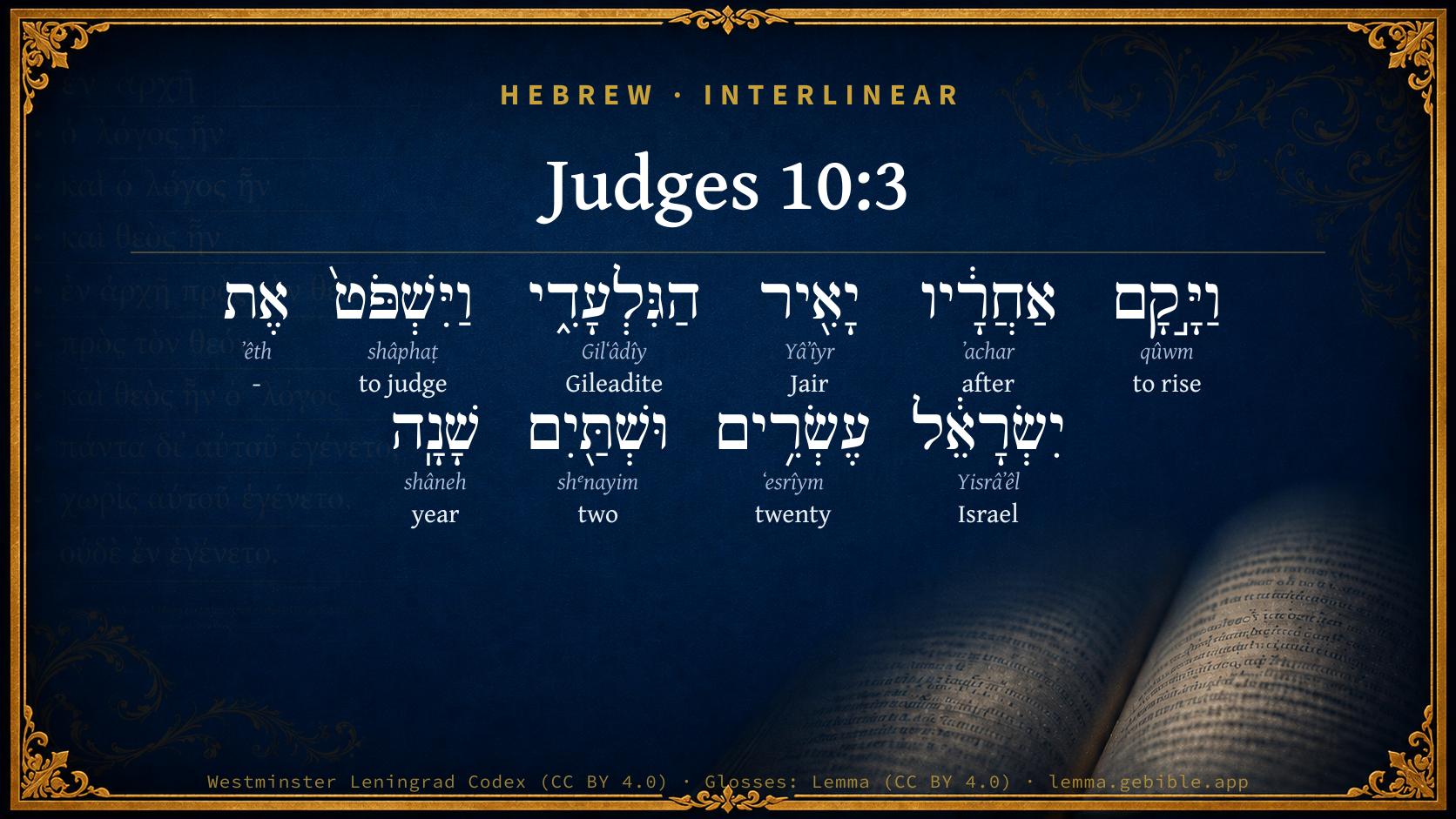
Judges 10:3

Hebrew (Westminster Leningrad Codex) Judges 10:3 appears in the Hebrew Old Testament. The text above is from the Westminster Leningrad Codex. Each word links to its Strong’s number, a concise gloss, and parsing drawn from the Open Scriptures Hebrew Bible morphology. Click any word for its full Brown-Driver-Briggs (BDB) entry.
Download image
Cite this verse

Judges 10:3 (World English Bible). Public Domain. Lemma interlinear Bible study tool, https://lemma.gebible.app/v/judges/10/3.

Show BibTeX & RIS
BibTeX
RIS
English Translation
After him arose Jair, the Gileadite; and he judged Israel twenty-two years.
World English Bible · Public Domain
Download a study sheet

One document with this verse’s original text, its word-by-word gloss line, the meaning frame, cross-references with their text, attributed commentary, and full source and license credits — printable, and it pastes into notes with its structure intact.

This verse Autodidact and up

Study sheet (.html) Plain text (.txt)

A passage Seminary Student

Up to 50 verses in one chapter. A passage sheet keeps up to 6 commentary sources and 12 cross-references per verse, in the order this page ranks them, and says so on the sheet whenever that leaves anything out. Ask for a single verse and you get the Autodidact verse sheet above.

Everything on this page stays free to read, with no account — the sheet is a download of what is already on screen, not access to it.

Want to remove ads? Support Godless Engineer
Compare translations 3

The same verse in 3 English versions, stacked beneath the original-language interlinear above. Click any original word for its lexicon entry.

Each is an independent rendering of the whole verse — the interlinear is not word-aligned to these translations.

Highlighted words mark where these versions differ — a whole-verse word diff, not a word-by-word alignment.

  • World English Bible Public Domain
    After him arose Jair, the Gileadite; and he judged Israel twenty-two years.
  • King James Version Public Domain
    And after him arose Jair, a Gileadite, and judged Israel twenty and two years.
  • unfoldingWord Literal Text CC BY-SA 4.0
    And after him Jair the Gileadite arose. And he judged Israel 22 years.

unfoldingWord Literal Text — © unfoldingWord, licensed CC BY-SA 4.0. Word-aligned USFM3 via Door43 (git.door43.org/unfoldingWord/en_ult).

Versions to compare (up to 4)

3 of 4 selected

Show all 18 translations

Every available English version of this verse, each an independent rendering of the whole verse.

  • World English Bible Public Domain
    After him arose Jair, the Gileadite; and he judged Israel twenty-two years.
  • Berean Standard Bible Public Domain
    Tola was followed by Jair the Gileadite, who judged Israel twenty-two years.
  • Majority Standard Bible Public Domain
    Tola was followed by Jair the Gileadite, who judged Israel twenty-two years.
  • King James Version Public Domain
    And after him arose Jair, a Gileadite, and judged Israel twenty and two years.
  • American Standard Version (1901) Public Domain
    And after him arose Jair, the Gileadite; and he judged Israel twenty and two years.
  • Revised Version (1885) Public Domain
    And after him arose Jair, the Gileadite; and he judged Israel twenty and two years.
  • Geneva Bible (1599) Public Domain
    And after him arose Iair a Gileadite, and iudged Israel two and twenty yeere.
  • Douay-Rheims (1899) Public Domain
    To him succeeded Jair the Galaadite, who judged Israel for two and twenty years.
  • Young's Literal Translation Public Domain
    And there riseth after him Jair the Gileadite, and he judgeth Israel twenty and two years,
  • Literal Standard Version CC BY-SA 4.0
    And there rises Jair the Gileadite after him, and he judges Israel [for] twenty-two years,
  • Unlocked Literal Bible CC BY-SA 4.0
    He was followed by Jair the Gileadite. He judged Israel twenty-two years.
  • unfoldingWord Literal Text CC BY-SA 4.0
    And after him Jair the Gileadite arose. And he judged Israel 22 years.
  • Darby Bible Public Domain
    After him arose Ja'ir the Gileadite, who judged Israel twenty-two years.
  • World Messianic Bible Public Domain
    After him Jair, the Gileadite, arose. He judged Israel twenty-two years.
  • Webster's Bible Public Domain
    And after him arose Jair, a Gileadite, and judged Israel twenty and two years.
  • Free Bible Version CC BY-SA 4.0
    After Tola came Jair from Gilead, who led Israel as a judge for twenty-two years.
  • Bible in Basic English Public Domain
    And after him came Jair the Gileadite, who was judge over Israel for twenty-two years.
  • JPS Tanakh (1917) Public Domain
    And after him arose Jair, the Gileadite; and he judged Israel twenty and two years.

Literal Standard Version (2020), Covenant Press — licensed CC BY-SA 4.0. Text via the HelloAO Bible API (eBible.org). Unlocked Literal Bible (unfoldingWord) — licensed CC BY-SA 4.0. Text via the HelloAO Bible API (eBible.org). unfoldingWord Literal Text — © unfoldingWord, licensed CC BY-SA 4.0. Word-aligned USFM3 via Door43 (git.door43.org/unfoldingWord/en_ult). Free Bible Version, Dr. Jonathan Gallagher — licensed CC BY-SA 4.0. Text via the HelloAO Bible API (eBible.org).

Word by word

More ways to search: Search by grammar → Find every occurrence → Compare this word →

Practice this passage: Drill this verse → Learn its vocabulary →

יָאִ֖יר
Yâʼîyr
H2971
“Jair”
Noun, Proper
Part of Speech
Noun
Type
Proper
Full BDB Definition

Origin: from H215

TWOT: None

Jair = "he enlightens" - a descendant of Manasseh who conquered many towns during the time of the conquest - the Gileadite, a judge of Israel for 22 years during the time of the judges; father of 30 sons - a Benjamite, son of Kish, and father of Mordecai - father of Elhanan, one of David's mighty warriors
  1. וַיָּ֣קָם qûwm H6965 “and · to rise” Conjunction + Verb, Qal, Sequential Imperfect, 3rd Person, Masculine, Singular
  2. אַחֲרָ֔יו ʼachar H310 “after · him” Preposition + Suffix, Personal, 3rd Person, Masculine, Singular
  3. הַגִּלְעָדִ֑י Gilʻâdîy H1569 “the · Gileadite” Particle, Definite Article + Noun, Gentilic, Masculine, Singular, Absolute
  4. וַיִּשְׁפֹּט֙ shâphaṭ H8199 “and · to judge” Conjunction + Verb, Qal, Sequential Imperfect, 3rd Person, Masculine, Singular
  5. אֶת ʼêth H853 “-” Particle, Direct Object
  6. יִשְׂרָאֵ֔ל Yisrâʼêl H3478 “Israel” Noun, Proper
  7. עֶשְׂרִ֥ים ʻesrîym H6242 “twenty” Adjective, Cardinal number, Both, Plural, Absolute
  8. וּשְׁתַּ֖יִם shᵉnayim H8147 “and · two” Conjunction + Adjective, Cardinal number, Feminine, Dual, Absolute
  9. שָׁנָֽה shâneh H8141 “year” Noun, Common, Feminine, Singular, Absolute

About this verse

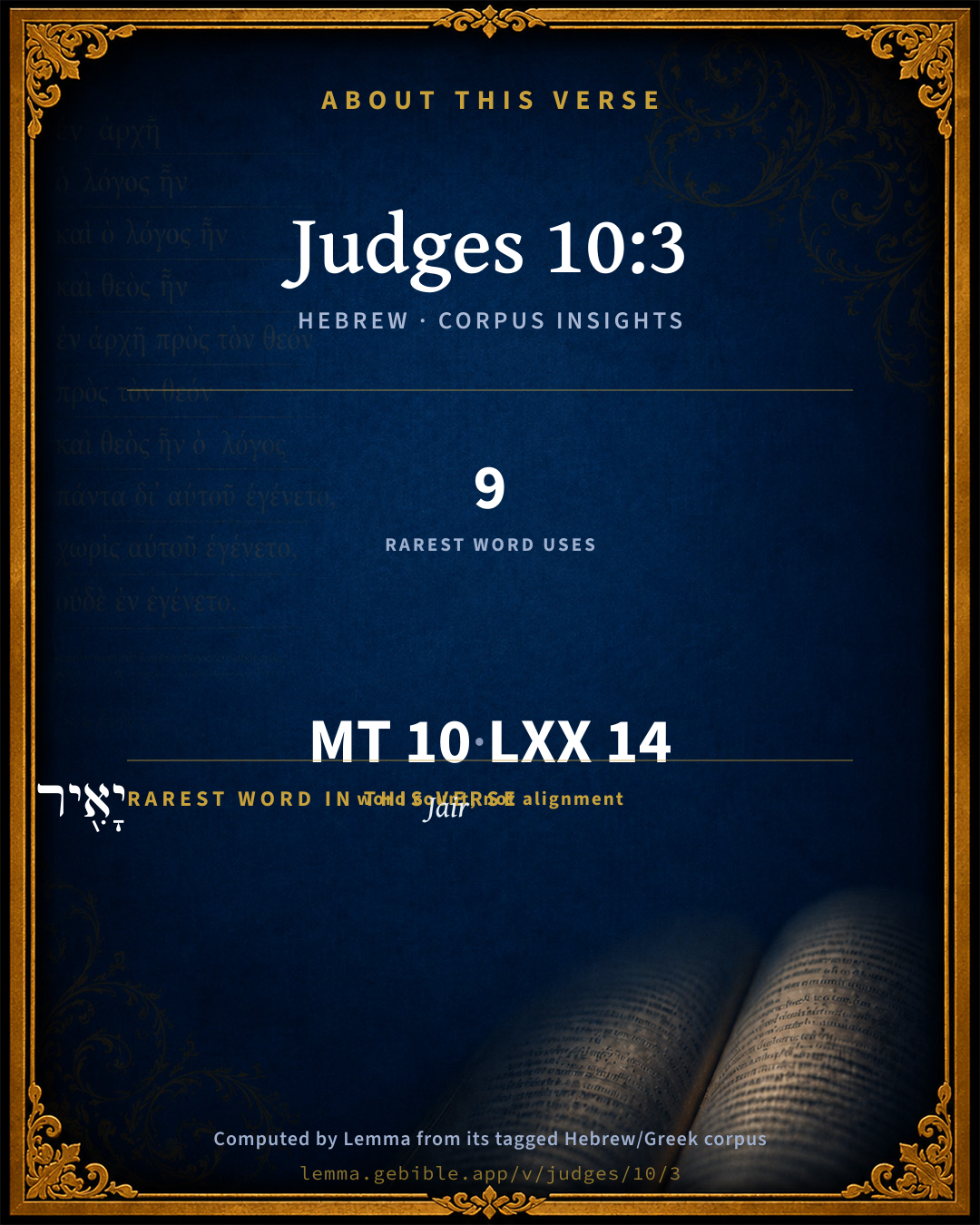
These counts appear in no published source. They are computed here, from the morphology-tagged text and Lemma’s own curated glosses. What Lemma adds →

10
words
10
distinct lemmas
Historical
section

Notable vocabulary

The rarest word here is יָאִ֖יר Jair H2971 — appearing just 9 times in the whole Hebrew Bible.

Shared distinctive vocabulary

יָאִ֖יר Jair H2971 occurs in 9 verses of the Hebrew Bible. Also found in:

Grammatical profile

  • 2 verbs
  • 4 nouns
  • 2 adjectives
  • 1 preposition
  • 1 particle

Verb forms

  • וַיָּ֣קָם Qal · Sequential Imperfect
  • וַיִּשְׁפֹּט֙ Qal · Sequential Imperfect

Hebrew & Septuagint length

In English translation the verse runs 12 words from the Hebrew and 13 from the Septuagint (LXX English) — closely comparable.

A rough comparison of the two English renderings, which tokenize alike — not a word-level alignment.

Word counts can differ between the Hebrew and the Greek without any difference in meaning — e.g. the Hebrew direct-object marker אֵת has no separate Greek word, and Greek often adds the article ὁ.

In the original languages it is 10 Hebrew tokens and 14 Greek tokens — but the two are counted differently (Hebrew bundles its prefixes and suffixes into one token; the Greek is in lemma form), so that isn’t a like-for-like length.

Cross-references

2

Topical passages linked to Judges 10:3 in the Treasury of Scripture Knowledge — connected by theme and wording, ordered by reader-vote popularity; previews shown in the World English Bible.

  • Numbers 32:29 Moses said to them, If the children of Gad and the children of Reuben will pass with you over the Jordan, every man who is armed to battle, before Yahweh, and the land shall be subdued before you; then you shall give them the land of Gilead for a possession:
  • Genesis 31:48 Laban said, "This heap is witness between me and you this day." Therefore it was named Galeed

Cross-references courtesy of OpenBible.info (CC BY 4.0).

Hebrew and Greek witnesses Masoretic Hebrew ↔ Greek Septuagint

The same verse in the two great witnesses to the Old Testament, shown verse-for-verse.

These are two independent witnesses, not word-aligned to each other, and the Septuagint is shown in lemma (dictionary) form.

Hebrew Judges 10:3 Masoretic · Westminster Leningrad Codex

וַיָּ֣קָם אַחֲרָ֔יו יָאִ֖יר הַגִּלְעָדִ֑י וַיִּשְׁפֹּט֙ אֶת יִשְׂרָאֵ֔ל עֶשְׂרִ֥ים וּשְׁתַּ֖יִם שָׁנָֽה

After him arose Jair, the Gileadite; and he judged Israel twenty-two years.

World English Bible · Public Domain

Greek LXX Judges 10:3 Septuagint · lemma form

καί ἀναἵστημι μετά αὐτός ιαϊρ ὁ γαλαάδ καί κρίνω ὁ ἰσραήλ εἴκοσι δύο ἔτος

And after him arose Jair of Galaad, and he judged Israel twenty-two years.

LXX2012 (modern English Septuagint) · Public Domain

Hebrew: Westminster Leningrad Codex (CC BY 4.0). Greek: Septuagint (public domain); English from LXX2012 (modern English Septuagint) (Public Domain). How the Septuagint differs from the Hebrew →

Targum (Aramaic paraphrase)

1

The Targum is the ancient Jewish Aramaic paraphrase of the Hebrew Scriptures — an interpretive translation, not the Hebrew text itself. Onkelos (literal) and Pseudo-Jonathan (expansive) render the Torah, and Jonathan the Prophets. Coverage is partial: where no permissively-licensed English translation exists for a verse, only the Aramaic is shown. This is verse-level text, not a word-by-word alignment to the Hebrew.

  1. Targum Jonathan Prophets (Joshua–Malachi)
    וְקָם בַּתְרוֹהִי יָאִיר גִלְעָדָאָה וְדָן יַת יִשְׂרָאֵל עַסְרִין וְתַרְתֵּין שְׁנִין:

    (no public-domain English translation for this verse)

    Targum Jonathan — Aramaic: “Mikraot Gedolot” (public domain). English: “Sefaria Community Translation” (CC0 1.0 (public-domain dedication)); “London "Chaldee Paraphrase," 1871” (public domain). Text via Sefaria.

Commentary

Notes on Judges 10:3 from classic Christian and Jewish commentators (each source and its license shown beneath its notes). The classic Christian expositions comment on the surrounding passage and are grouped to its opening verse, so a note may address several verses; the Jewish commentaries on the Tanakh (Rashi and others) are per-verse, so they appear only where the commentator wrote on this verse.

Lemma curates 59 commentaries, every one of them public domain or Creative Commons licensed, each selected and text-cleaned for this edition rather than reprinted as found. About our sources →

Trapp's Complete Commentary

John Trapp

Jdg 10:3 And after him arose Jair, a Gileadite, and judged Israel twenty and two years.

Ver. 3. Jair, a Gileadite.] Of whom we may say as one doth of Jesse, the father of David, that he was Vir bonus et probus, sed minus clarus, a good honest man, but there is not much said of him.

John Trapp, A Commentary or Exposition upon All the Books of the Old and New Testament (1647–1656) — public domain. Text from a community e-Sword module.

Joseph Benson's Commentary

Jdg 10:3-4. Jair, a Gileadite — Of Gilead, beyond Jordan. He had thirty sons — Who, it seems, were itinerant judges, and went from place to place, as their father’s deputies, to administer justice. That rode on thirty ass- colts — It was customary for the noblest persons to ride on those beasts, and that not only in Judea, but likewise in Arabia, and other countries, even among the Romans. Thirty cities, called Havoth-jair — That is, the villages of Jair. These villages were so called before this time from another Jair, but the old name was revived and confirmed upon this occasion.

Joseph Benson's Commentary on the Old and New Testaments (1811–1818) — public domain. Text from a community e-Sword module.

Jamieson, Fausset & Brown

Robert Jamieson, A. R. Fausset & David Brown

Jair, a Gileadite--This judge was a different person from the conqueror of that northeastern territory, and founder of Havoth-jair, or "Jair's villages" (Num 32:41; Deu 3:14; Jos 13:3; Ch1 2:22).

Jamieson, Fausset & Brown — Commentary Critical and Explanatory on the Whole Bible (1871) — public domain (CC PDM 1.0). Text via the HelloAO Bible API.

Ellicott's Commentary for English Readers

(3) Jair, a Gileadite.—In Num_32:41 we are told of a Jair, the son of Manasseh, who “took the small towns” of Gilead, and called them Havoth-jair. This earlier Jair, with Nobah, plays a splendid part in Jewish legend, which is only alluded to in Scripture (see Deu_3:14). In what relation the Jair of these verses stood to him we cannot, in the uncertain data of the chronology, decide. The Jair of Num_32:41 was descended from Judah on the father’s side, and on the mother’s was a great-grandson of Manasseh.

A Bible Commentary for English Readers, edited by Charles John Ellicott (1878–1897) — public domain. Text from a community e-Sword module.

The Cambridge Bible for Schools and Colleges

gen. ed. J. J. S. Perowne

3. Jair, the Gileadite] Called ‘the son of Manasseh’ in Num_32:41, Deu_3:14, cf. Jos_13:30; in 1Ch_2:21 ff. he is the great-grandson of Machir. Gilead was the name applied generally to the country E. of the Jordan, between the south end of the Sea of Tiberias and the north end of the Dead Sea.

The Cambridge Bible for Schools and Colleges (gen. ed. J. J. S. Perowne; Cambridge University Press, 1878–1918) — public domain. Text from a community e-Sword module.

John Gill's Exposition

And after him arose Jair, a Gileadite,.... Who was of the half tribe of Manasseh, on the other side Jordan, which inhabited the land of Gilead, and who is the first of the judges that was on that side Jordan; it pleased God, before the government was settled in a particular tribe, to remove it from one to another, and to honour them all, and to show that though the two tribes of Reuben and Gad, and the half tribe of Manasseh, were separated from their brethren by the river Jordan, they were not neglected by the Lord; and generally speaking judges were raised up in all those parts which were most oppressed, and liable to be oppressed by their enemies, as Gilead by the Ammonites; wherefore this, and the next judge that followed him, Jephthah, were of Gilead:

and judged Israel twenty two years; protected them from their enemies, administered justice to them, and preserved them in the true religion.

John Gill's Exposition of the Whole Bible (1746–1763) — public domain (CC PDM 1.0). Text via the HelloAO Bible API.

Matthew Poole's English Annotations

A Gileadite; of Gilead beyond Jordan

Matthew Poole's English Annotations on the Holy Bible (1683–1685) — public domain. Text from a community e-Sword/MySword module.

Whedon's Commentary on the Bible

Daniel D. Whedon

3. Jair, a Gileadite — That is, a native or resident of Gilead, the mountainous country east of the Jordan. On the silence of Scripture respecting the particulars of his life the same may be said as of Tola, in Jdg_10:1.

Daniel D. Whedon (gen. ed.), Commentary on the Old and New Testaments (1874–1909) — public domain. Text from a community e-Sword module.

The Pulpit Commentary

Jair. We read of Jair the son of Segub, the son of Machir"s daughter by Hezron, in 1Ch_2:21-23, and are there told that he had twenty-three cities in the land of Gilead (called Havoth-jair), which were included in the territory of the sons of Machir. The same information is given in Num_32:40-42, and in Deu_3:14, Deu_3:15, in both which passages Jair is styled the son of Manasseh, and is stated to have called the cities after his own name, Havoth-jair. In the present verse we are also told that Jair the judge was a Gileadite, and that he had thirty sons who had thirty cities in Gilead called Havoth-jair. The question arises, Can these two be the same person? If they are, Deu_3:14 must be a later parenthetical insertion, as it has very much the appearance of being. The notice in Num_32:41 must also refer to later times than those of Moses, and we must understand the statement in 1Ch_2:22, that "Segub begat Jair," as meaning that he was his lineal ancestor, just as in Mat_1:8 we read that "Joram begat Ozias," though three generations intervened between them. If, on the other hand, they are not the same, we must suppose that Jair in our text was a descendant of the other Jair, and may compare the double explanation of the name Havothjair with the double explanation of Beer-sheba given Gen_21:31 Gen_26:31-33; the threefold explanation of the name Isaac, Gen_17:17 Gen_18:12 Gen_21:6; and the double explanation of the proverb, "Is Saul among the prophets?" given in 1Sa_10:11, 12 19:23, 24. The Hebrew name Jair is preserved in the New Testament under the Greek form of Jairus. (Mar_5:22)

The Pulpit Commentary (1880–1919), ed. H.D.M. Spence-Jones & Joseph S. Exell — public domain. Text from a community e-Sword module.

John Wesley's Explanatory Notes

A Gileadite - Of Gilead beyond Jordan.

John Wesley, Explanatory Notes Upon the Whole Bible (1754–1765) — public domain. Text via the GEBible commentary corpus.

unfoldingWord translationNotes

Door43 World Missions Community

He was followed by Jair the Gileadite

This can be stated in active form. AT: "Jair the Gileadite was leader after Tola" (See: Active or Passive)

Jair

This is the name of a man. (See: How to Translate Names)

the Gileadite

Jair was from the tribe of Gilead.

He judged Israel

Here "judged" means he led the people of Israel.

Israel

Here "Israel" represents the people of Israel. (See: Metonymy)

twenty-two years

"22 years" (See: Numbers)

thirty sons

"30 sons" (See: Numbers)

Havvoth Jair

This is the name of a region, which is named after a man. (See: How to Translate Names)

to this day

This means to the time when the book of Judges was being written.

was buried

This can be stated in active form. AT: "they buried him" (See: Active or Passive)

Kamon

This is the name of a place. (See: How to Translate Names)

translationWords

Gilead

judge

Israel

year

donkey

unfoldingWord translationNotes — © Distant Shores Media and the Door43 World Missions Community, licensed CC BY-SA 4.0. Source: git.door43.org/Door43/en_tn.

Lesson kit

Teaching starters — assembled from the data on this page, not authored interpretation. Every prompt links to the verse data it draws on. Edit before teaching.

Judges, in the Historical, opens this verse with 10 words (10 distinct Hebrew lemmas). Its most distinctive word is Yâʼîyr (“Jair”). A historical commentator’s framing appears above. Read the whole chapter for the surrounding context.

Discussion questions

  1. How does “Jair” (Yâʼîyr) shape what this verse is saying?
  2. Numbers 32:41 shares the word «Jair» with this verse. How do the two illuminate each other?
  3. These translations render this verse differently. What is at stake in choosing one wording over another?
  4. The verb «וַיָּ֣קָם» is Qal Sequential Imperfect. How does its form color the action?
  5. Reading how Trapp's Complete Commentary and Joseph Benson's Commentary read this verse, where do the two commentators agree and where do they part?

Things to notice

Reading settings

Reading text

Shown beneath each verse's original-language words.

Old Testament
Old Testament edition

Read the OT as the Masoretic Hebrew (MT) or the Greek Septuagint (LXX).

English shown for the Greek Septuagint (in the Hebrew ↔ Greek comparison).

Comparing translations? Open the Compare panel on any verse page to stack up to four side by side.