Ezekiel 20:35

Hebrew (Westminster Leningrad Codex) Ezekiel 20:35 appears in the Hebrew Old Testament. The text above is from the Westminster Leningrad Codex. Each word links to its Strong’s number, a concise gloss, and parsing drawn from the Open Scriptures Hebrew Bible morphology. Click any word for its full Brown-Driver-Briggs (BDB) entry.
Download image
Cite this verse

Ezekiel 20:35 (World English Bible). Public Domain. Lemma interlinear Bible study tool, https://lemma.gebible.app/v/ezekiel/20/35.

Show BibTeX & RIS
BibTeX
RIS
English Translation
and I will bring you into the wilderness of the peoples, and there will I enter into judgment with you face to face.
World English Bible · Public Domain
Download a study sheet

One document with this verse’s original text, its word-by-word gloss line, the meaning frame, cross-references with their text, attributed commentary, and full source and license credits — printable, and it pastes into notes with its structure intact.

This verse Autodidact and up

Study sheet (.html) Plain text (.txt)

A passage Seminary Student

Up to 50 verses in one chapter. A passage sheet keeps up to 6 commentary sources and 12 cross-references per verse, in the order this page ranks them, and says so on the sheet whenever that leaves anything out. Ask for a single verse and you get the Autodidact verse sheet above.

Everything on this page stays free to read, with no account — the sheet is a download of what is already on screen, not access to it.

Want to remove ads? Support Godless Engineer
Compare translations 3

The same verse in 3 English versions, stacked beneath the original-language interlinear above. Click any original word for its lexicon entry.

Each is an independent rendering of the whole verse — the interlinear is not word-aligned to these translations.

Highlighted words mark where these versions differ — a whole-verse word diff, not a word-by-word alignment.

  • World English Bible Public Domain
    and I will bring you into the wilderness of the peoples, and there will I enter into judgment with you face to face.
  • King James Version Public Domain
    And I will bring you into the wilderness of the people, and there will I plead with you face to face.
  • unfoldingWord Literal Text CC BY-SA 4.0
    Then I will bring you into the wilderness of the peoples, and there I will judge you face to face.

unfoldingWord Literal Text — © unfoldingWord, licensed CC BY-SA 4.0. Word-aligned USFM3 via Door43 (git.door43.org/unfoldingWord/en_ult).

Versions to compare (up to 4)

3 of 4 selected

Show all 18 translations

Every available English version of this verse, each an independent rendering of the whole verse.

  • World English Bible Public Domain
    and I will bring you into the wilderness of the peoples, and there will I enter into judgment with you face to face.
  • Berean Standard Bible Public Domain
    And I will bring you into the wilderness of the nations, where I will enter into judgment with you face to face.
  • Majority Standard Bible Public Domain
    And I will bring you into the wilderness of the nations, where I will enter into judgment with you face to face.
  • King James Version Public Domain
    And I will bring you into the wilderness of the people, and there will I plead with you face to face.
  • American Standard Version (1901) Public Domain
    and I will bring you into the wilderness of the peoples, and there will I enter into judgment with you face to face.
  • Revised Version (1885) Public Domain
    and I will bring you into the wilderness of the peoples, and there will I plead with you face to face.
  • Geneva Bible (1599) Public Domain
    And I will bring you into the wildernes of the people, and there wil I pleade with you face to face.
  • Douay-Rheims (1899) Public Domain
    And I will bring you into the wilderness of people, and there will I plead with you face to face.
  • Young's Literal Translation Public Domain
    And I have brought you in unto the wilderness of the peoples, And have been judged with you there face to face.
  • Literal Standard Version CC BY-SA 4.0
    And I have brought you into the wilderness of the peoples, || And have been judged with you there face to face.
  • Unlocked Literal Bible CC BY-SA 4.0
    Then I will bring you into the wilderness of the peoples, and there I will judge you face to face.
  • unfoldingWord Literal Text CC BY-SA 4.0
    Then I will bring you into the wilderness of the peoples, and there I will judge you face to face.
  • Darby Bible Public Domain
    and I will bring you into the wilderness of the peoples, and there will I enter into judgment with you face to face.
  • World Messianic Bible Public Domain
    I will bring you into the wilderness of the peoples, and there I will enter into judgment with you face to face.
  • Webster's Bible Public Domain
    And I will bring you into the wilderness of the people, and there will I plead with you face to face.
  • Free Bible Version CC BY-SA 4.0
    I will bring you before me for judgment face to face in the desert of the nations.
  • Bible in Basic English Public Domain
    And I will take you into the waste land of the peoples, and there I will take up the cause with you face to face.
  • JPS Tanakh (1917) Public Domain
    and I will bring you into the wilderness of the peoples, and there will I plead with you face to face.

Literal Standard Version (2020), Covenant Press — licensed CC BY-SA 4.0. Text via the HelloAO Bible API (eBible.org). Unlocked Literal Bible (unfoldingWord) — licensed CC BY-SA 4.0. Text via the HelloAO Bible API (eBible.org). unfoldingWord Literal Text — © unfoldingWord, licensed CC BY-SA 4.0. Word-aligned USFM3 via Door43 (git.door43.org/unfoldingWord/en_ult). Free Bible Version, Dr. Jonathan Gallagher — licensed CC BY-SA 4.0. Text via the HelloAO Bible API (eBible.org).

Word by word

More ways to search: Search by grammar → Find every occurrence → Compare this word →

Practice this passage: Drill this verse → Learn its vocabulary →

וְנִשְׁפַּטְתִּ֤י
shâphaṭ
H8199
“and · to judge”
Conjunction + Verb, Niphal, Sequential Perfect, 1st Person, Common, Singular
Part of Speech
Conjunction + Verb
Stem
Niphal
Form
Sequential Perfect
Person
1st Person
Gender
Common
Number
Singular
Full BDB Definition

Origin: a primitive root

TWOT: 2443

to judge, govern, vindicate, punish - (Qal) - to act as law-giver or judge or governor (of God, man) - to rule, govern, judge - to decide controversy (of God, man) - to execute judgment - discriminating (of man) - vindicating - condemning and punishing - at theophanic advent for final judgment - (Niphal) - to enter into controversy, plead, have controversy together - to be judged - (Poel) judge, opponent-at-law (participle)
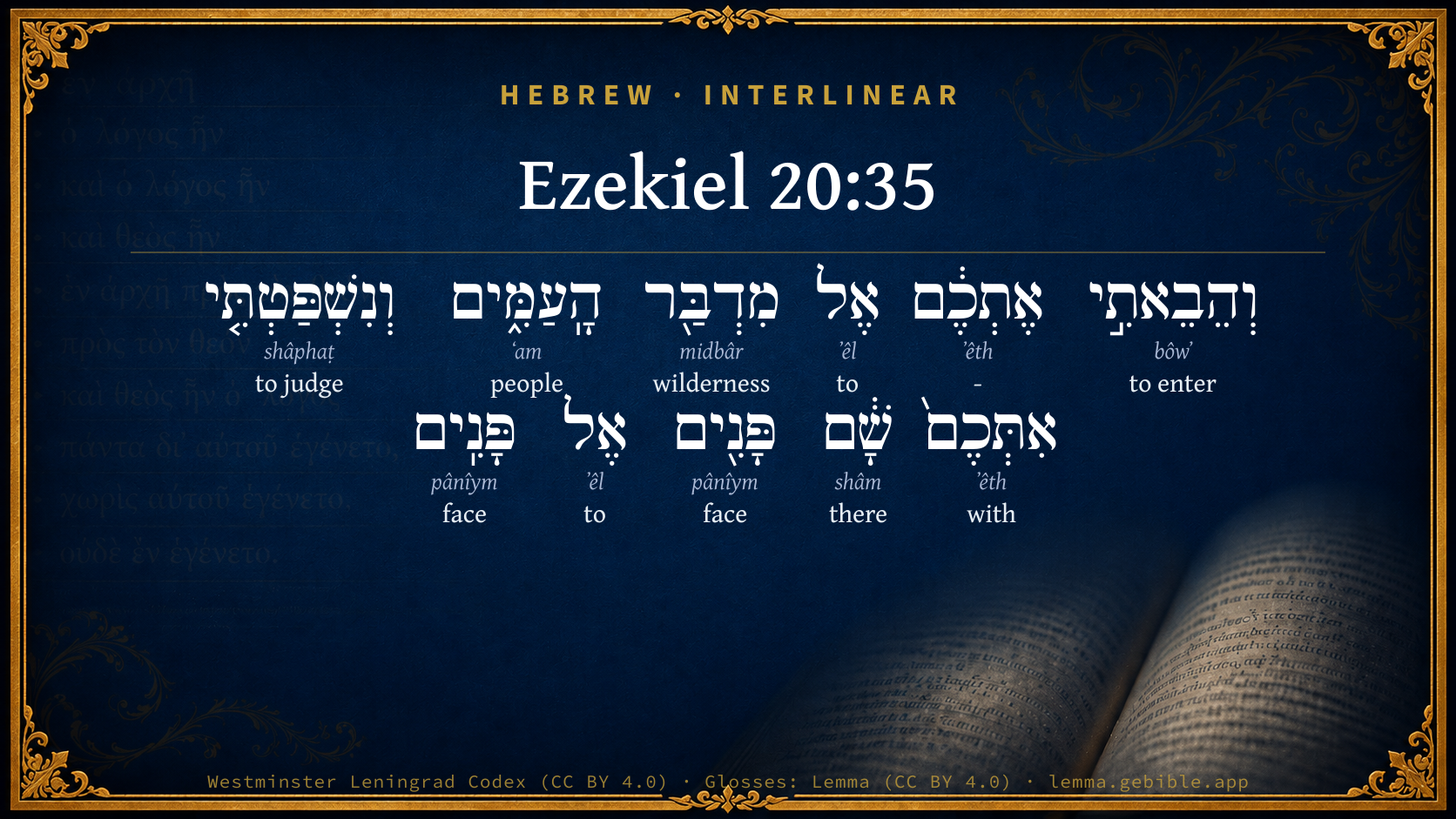
  1. וְהֵבֵאתִ֣י bôwʼ H935 “and · to enter” Conjunction + Verb, Hiphil, Sequential Perfect, 1st Person, Common, Singular
  2. אֶתְכֶ֔ם ʼêth H853 “- · you” Particle, Direct Object + Suffix, Personal, 2nd Person, Masculine, Plural
  3. אֶל ʼêl H413 “to” Preposition
  4. מִדְבַּ֖ר midbâr H4057 “wilderness of” Noun, Common, Masculine, Singular, Construct
  5. הָֽעַמִּ֑ים ʻam H5971 “the · peoples” Particle, Definite Article + Noun, Common, Masculine, Plural, Absolute
  6. אִתְּכֶם֙ ʼêth H854 “with · you” Preposition + Suffix, Personal, 2nd Person, Masculine, Plural
  7. שָׁ֔ם shâm H8033 “there” Adverb
  8. פָּנִ֖ים pânîym H6440 “face(s)” Noun, Common, Both, Plural, Absolute
  9. אֶל ʼêl H413 “to” Preposition
  10. פָּנִֽים pânîym H6440 “face(s)” Noun, Common, Both, Plural, Absolute

About this verse

These counts appear in no published source. They are computed here, from the morphology-tagged text and Lemma’s own curated glosses. What Lemma adds →

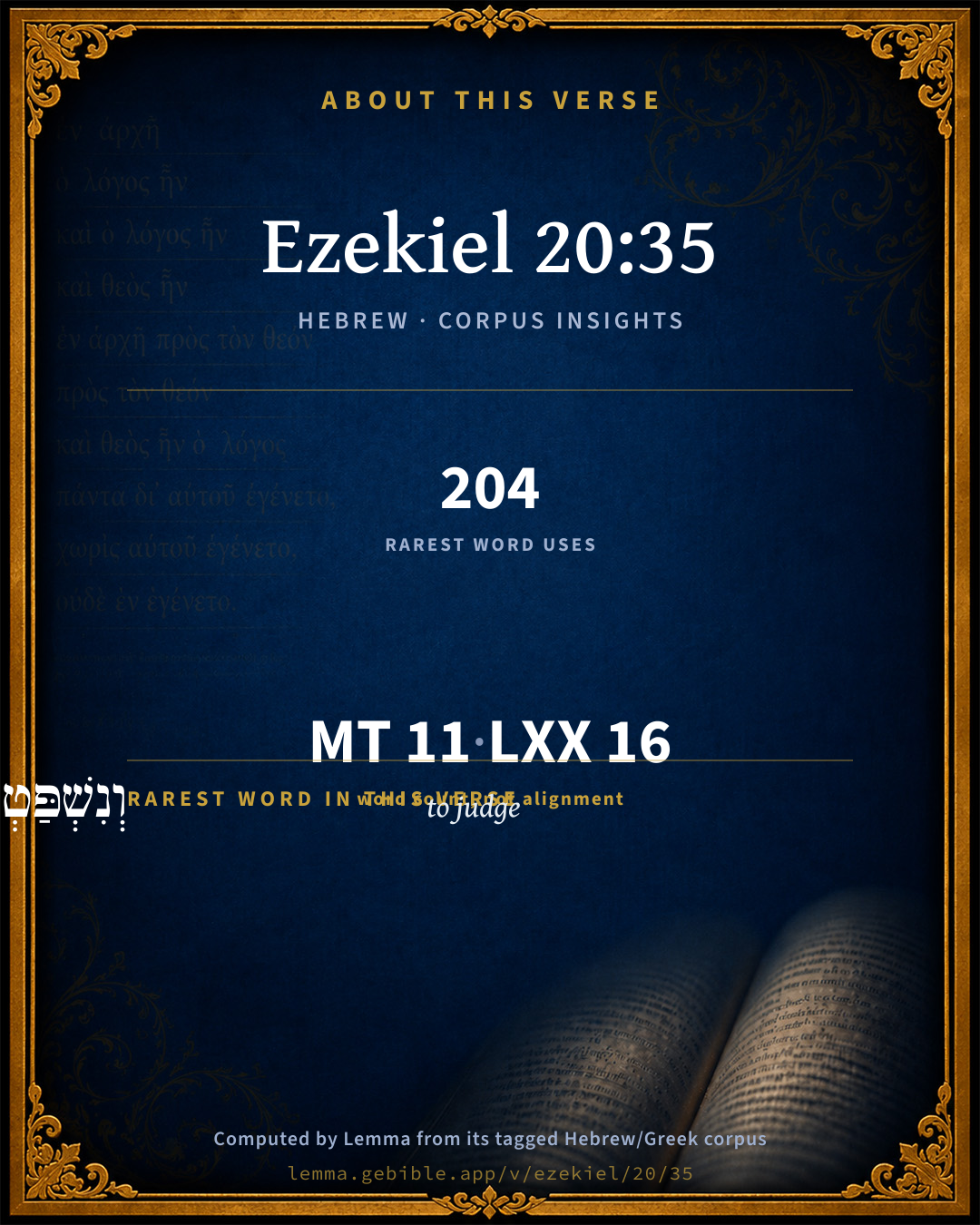
11
words
9
distinct lemmas
Prophets
section

Grammatical profile

  • 2 verbs
  • 4 nouns
  • 3 prepositions
  • 1 adverb
  • 1 particle

Verb forms

  • וְהֵבֵאתִ֣י Hiphil · Sequential Perfect
  • וְנִשְׁפַּטְתִּ֤י Niphal · Sequential Perfect

Repetition

Words recur within this verse — often emphatic in Hebrew:

  • פָּנִ֖ים face H6440 ×2
  • אֶל to H413 ×2

Hebrew & Septuagint length

In English translation the verse runs 23 words from the Hebrew and 20 from the Septuagint (LXX English) — closely comparable.

A rough comparison of the two English renderings, which tokenize alike — not a word-level alignment.

Word counts can differ between the Hebrew and the Greek without any difference in meaning — e.g. the Hebrew direct-object marker אֵת has no separate Greek word, and Greek often adds the article ὁ.

In the original languages it is 11 Hebrew tokens and 16 Greek tokens — but the two are counted differently (Hebrew bundles its prefixes and suffixes into one token; the Greek is in lemma form), so that isn’t a like-for-like length.

Cross-references

14

Topical passages linked to Ezekiel 20:35 in the Treasury of Scripture Knowledge — connected by theme and wording, ordered by reader-vote popularity; previews shown in the World English Bible.

  • Hosea 2:14 "Therefore, behold, I will allure her, And bring her into the wilderness, And speak tenderly to her.
  • Jeremiah 2:35 Yet you said, I am innocent; surely his anger is turned away from me. Behold, I will enter into judgment with you, because you say, I have not sinned.
  • Ezekiel 17:20 I will spread my net on him, and he shall be taken in my snare, and I will bring him to Babylon, and will enter into judgment with him there for his trespass that he has trespassed against me.
  • Ezekiel 19:13 Now it is planted in the wilderness, in a dry and thirsty land.
  • Ezekiel 20:36 Like as I entered into judgment with your fathers in the wilderness of the land of Egypt, so will I enter into judgment with you, says the Lord Yahweh.
  • Revelation 12:14 Two wings of the great eagle were given to the woman, that she might fly into the wilderness to her place, so that she might be nourished for a time, and times, and half a time, from the face of the serpent.
  • Jeremiah 2:9 Therefore I will yet contend with you, says Yahweh, and with your children's children will I contend.
  • Jeremiah 25:31 A noise shall come even to the end of the earth; for Yahweh has a controversy with the nations; he will enter into judgment with all flesh: as for the wicked, he will give them to the sword, says Yahweh.
  • Ezekiel 38:8 After many days you shall be visited: in the latter years you shall come into the land that is brought back from the sword, that is gathered out of many peoples, on the mountains of Israel, which have been a continual waste; but it is brought forth out of the peoples, and they shall dwell securely, all of them.
  • Ezekiel 38:22 With pestilence and with blood will I enter into judgment with him; and I will rain on him, and on his hordes, and on the many peoples who are with him, an overflowing shower, and great hailstones, fire, and sulfur.
  • Hosea 4:1 Hear the word of Yahweh, you children of Israel; For Yahweh has a charge against the inhabitants of the land: "Indeed there is no truth, Nor goodness, Nor knowledge of God in the land.
  • Micah 4:10 Be in pain, and labor to bring forth, daughter of Zion, Like a woman in travail; For now you will go forth out of the city, And will dwell in the field, And will come even to Babylon. There you will be rescued. There Yahweh will redeem you from the hand of your enemies.
  • Micah 6:1–2 Listen now to what Yahweh says: "Arise, plead your case before the mountains, And let the hills hear what you have to say.
  • Micah 7:13–15 Yet the land will be desolate because of those who dwell therein, For the fruit of their doings.

Cross-references courtesy of OpenBible.info (CC BY 4.0).

Hebrew and Greek witnesses Masoretic Hebrew ↔ Greek Septuagint

The same verse in the two great witnesses to the Old Testament, shown verse-for-verse.

These are two independent witnesses, not word-aligned to each other, and the Septuagint is shown in lemma (dictionary) form.

Hebrew Ezekiel 20:35 Masoretic · Westminster Leningrad Codex

וְהֵבֵאתִ֣י אֶתְכֶ֔ם אֶל מִדְבַּ֖ר הָֽעַמִּ֑ים וְנִשְׁפַּטְתִּ֤י אִתְּכֶם֙ שָׁ֔ם פָּנִ֖ים אֶל פָּנִֽים

and I will bring you into the wilderness of the peoples, and there will I enter into judgment with you face to face.

World English Bible · Public Domain

Greek LXX Ezekiel 20:35 Septuagint · lemma form

καί ἄγω σύ εἰς ὁ ἔρημος ὁ λαός καί διακρίνω πρός σύ ἐκεῖ πρόσωπον κατά πρόσωπον

And I will bring you into the wilderness of the nations, and will plead with you there face to face.

LXX2012 (modern English Septuagint) · Public Domain

Hebrew: Westminster Leningrad Codex (CC BY 4.0). Greek: Septuagint (public domain); English from LXX2012 (modern English Septuagint) (Public Domain). How the Septuagint differs from the Hebrew →

Targum (Aramaic paraphrase)

1

The Targum is the ancient Jewish Aramaic paraphrase of the Hebrew Scriptures — an interpretive translation, not the Hebrew text itself. Onkelos (literal) and Pseudo-Jonathan (expansive) render the Torah, and Jonathan the Prophets. Coverage is partial: where no permissively-licensed English translation exists for a verse, only the Aramaic is shown. This is verse-level text, not a word-by-word alignment to the Hebrew.

  1. Targum Jonathan Prophets (Joshua–Malachi)
    וְאָעֵיל יַתְכוֹן לְמִדְבַּר עַמְמַיָא וְאִתְפְּרַע מִנְכוֹן תַּמָן אַפִּין בְּאַפִּין:

    (no public-domain English translation for this verse)

    Targum Jonathan — Aramaic: “Mikraot Gedolot” (public domain). English: “Sefaria Community Translation” (CC0 1.0 (public-domain dedication)); “London "Chaldee Paraphrase," 1871” (public domain). Text via Sefaria.

Commentary

Notes on Ezekiel 20:35 from classic Christian and Jewish commentators (each source and its license shown beneath its notes). The classic Christian expositions comment on the surrounding passage and are grouped to its opening verse, so a note may address several verses; the Jewish commentaries on the Tanakh (Rashi and others) are per-verse, so they appear only where the commentator wrote on this verse.

Lemma curates 59 commentaries, every one of them public domain or Creative Commons licensed, each selected and text-cleaned for this edition rather than reprinted as found. About our sources →

Trapp's Complete Commentary

John Trapp

Eze 20:35 And I will bring you into the wilderness of the people, and there will I plead with you face to face.

Ver. 35. And I will bring you into the wilderness of the people.] Into the most solitary and savage places of the world, for a fulness of misery without the benefit of any good society.

And there will I plead with you face to face,] i.e., Solus cum solis et sine arbitris, Having you there alone, I will punish you to some purpose.

John Trapp, A Commentary or Exposition upon All the Books of the Old and New Testament (1647–1656) — public domain. Text from a community e-Sword module.

The Biblical Illustrator

Joseph S. Exell

Eze_20:35

I will bring you into the wilderness of the people, and there will I plead with you face to face.

The spiritual wilderness

Many awful threatenings and delightful promises are scattered up and down in the Word of God. Our text seems to be of a mixed nature: the threatening and the promise are blended together, to excite a holy fear of God and a humble trust in Him.

I. I will bring you into the wilderness of the people?

1. God often brings His people into the wilderness gradually, by little and little. The terrors and dangers of the wilderness are concealed; slight convictions are at first impressed which afterwards grow stronger; small rumblings precede the loud claps of thunder; sometimes the clouds seem to break, and promise fair weather; then they grow thicker, and wear a more formidable aspect than ever.

2. The Lord brings them in with an high hand and an outstretched arm, as He did the children of Israel of old. However gently He may act, yet He acts powerfully, and the greatest mildness is attended with an irresistible energy. We may be fretful and impatient, unruly and unmanageable; but He who has taken the work in hand will not leave it unfinished. We may stifle our convictions, but God will revive them; may lull conscience asleep, but He will awaken it again.

3. God brings into the wilderness with a design to bring out of it again (Isa_57:16-18; Lam_3:32; Hos_6:1-2).

II. And there will I plead with you face to face. He does not say that He would plead against them, nor yet that He would plead for them; but He would plead with them, and that face to face, so that they should both see and hear Him. And what would He plead with them about? Perhaps the sins they had committed, and the calamities thereby brought upon themselves. He will also plead the equity of His own proceedings, and the unreasonableness of their conduct. He also pleads with them on the futility of their attempts to help themselves, and the necessity of looking to another quarter for relief (Jer_3:17; Jer_3:31; Jer_3:36; Jer_8:22).

1. He pleads powerfully. How forcible are right words, says Job. And such are the words of God: they are founded upon truth, plain and direct, and carry with them an irresistible energy.

2. He pleads convincingly. God will overcome when He judgeth. When He is opponent, no man can be respondent.

3. He pleads tenderly and in love; His appeals are made to the understanding and the heart, and an ingenuous mind must feel their force (Mic_6:3; Isa_1:18). What has been said condemns three sorts of persons--

(1) Those who have always been in the wilderness of sin, but not in that of sorrow; who are merry and jovial, saying, Tomorrow shall be as this day, and much more abundant.

(2) Those who think they are in the wilderness of godly sorrow, but who mistake every transient pang for real conviction, and every motion of the affections for the work of the Holy Spirit on the heart.

(3) Those who are in the wilderness, and struggling to get out of it before the Lords time. It is better to be in the wilderness than in Egypt; yea, it is better, unspeakably better, to be in the wilderness, though we continue there all our days, than to be in hell. (B. Beddome, M. A.)

Gods tireless pleading

Manton says: As one that would gladly open a door, trieth key after key, till he hath tried every key, in the bunch, so doth God try one method after another to work upon mans heart. His persevering grace will not be baffled. He frequently begins with the silver key of a mothers tearful prayers and a fathers tender counsels. In turn He uses the church keys of His ordinances and His ministers, and these are often found to move the bolt; but if they fail He thrusts in the iron key of trouble and affliction, which has been known to succeed after all others have failed. He has, however, a golden master key, which excels all others: it is the operation of His own most gracious Spirit by which entrance is effected into hearts which seemed shut up forever. (C. H. Spurgeon.)

The Biblical Illustrator, edited by Joseph S. Exell (c. 1880s–1900s) — public domain. Text from a community e-Sword module.

Geneva Bible (1599)

Geneva Bible translators

I will bring you among strange nations as into a wilderness, and there will visit you, and so call you to repentance, and then bring the godly home again, Isa. 65:9.

Geneva Bible (1599) marginal notes — public domain. Text via Bolls.life.

Jamieson, Fausset & Brown

Robert Jamieson, A. R. Fausset & David Brown

wilderness of the people--rather, "peoples," the various peoples among whom they were to be scattered, and about whom God saith (Eze 20:34), "I will bring you out." In contrast to the literal "wilderness of Egypt" (Eze 20:36), "the wilderness of the peoples" is their spiritual wilderness period of trial, discipline, and purification while exiled among the nations. As the state when they are "brought into the wilderness of the peoples" and that when they were among the peoples "from" which God was to "bring them out" (Eze 20:34) are distinguished, the wilderness state probably answers partially to the transition period of discipline from the first decree for their restoration by Cyrus to the time of their complete settlement in their land, and the rebuilding of Jerusalem and the temple. But the full and final fulfilment is future; the wilderness state will comprise not only the transition period of their restoration, but the beginning of their occupancy of Palestine, a time in which they shall endure the sorest of all their chastisements, to "purge out the rebels" (Eze 20:38; Dan 12:1); and then the remnant (Zac 13:8-9; Zac 14:2-3) shall "all serve God in the land" (Eze 20:40). Thus the wilderness period does not denote locality, but their state intervening between their rejection and future restoration.

plead--bring the matter in debate between us to an issue. Image is from a plaintiff in a law court meeting the defendant "face to face." Appropriate, as God in His dealings acts not arbitrarily, but in most righteous justice (Jer 2:9; Mic 6:2).

Jamieson, Fausset & Brown — Commentary Critical and Explanatory on the Whole Bible (1871) — public domain (CC PDM 1.0). Text via the HelloAO Bible API.

Adam Clarke's Commentary

Verse 35. I will bring you into the wilderness of the people] I will bring you out of your captivity, and bring you into your own land, which you will find to be a wilderness, the consequence of your crimes.

There will I plead with you] There I will be your king, and rule you with a sovereign rule; and the dispensations of my justice and mercy shall either end you or mend you.

Adam Clarke's Commentary on the Bible (1810–1826) — public domain. Text from a community e-Sword/MySword module.

John Calvin's Commentaries

He specially marks this reason here, which is a medium between rejection and reconciliation to favor: for God’s bringing the Israelites out of Chaldaea might seem a sign of favor, as if he were again their deliverer. But he here defines why he intended to bring them forth, namely, to plead with them in the desert as with their fathers. We know that when the people came out of Egypt they did not possess the promised land, because they shut the door against themselves by their ingratitude: but if there had been no hope left, it was better for the people to spend their time under the tyranny of Egypt than to pine away in the desert. For it was a kind of life scarcely human to wander in a wilderness and to behold nothing pleasant or agreeable; a mere solitude instead of cultivated fields, and nothing but discomfort instead of beautiful flowers and trees and undulating ground: and besides this, to feed on nothing but manna, to taste no wine, to drink only water from the rock, and to endure heat and cold in the, open air. Such freedom then was by no means agreeable, unless they had hoped to become possessors of the land of Canaan. But a whole generation was deprived of that advantage through their ingratitude. God therefore appositely compares them to their fathers, who had gone forth into the wilderness, and he says, I will make you pass into the desert of the nations. Here he compares the desert of Egypt to that of the Gentiles. Although the passage from the land of Canaan to Chaldaea is partly across an unfruitful wilderness, yet I do not doubt that God here metaphorically points out the state of the people after their return from exile.

The complete meaning is, as he surrounded their fathers throughout their whole life in the wilderness, so after they were brought back from Chaldaea their life should be as solitary as if they were banished to an obscure corner of the world, and to a miserable and deserted land. Here, therefore, another region is not intended, but the state of the people when dwelling in the land of Canaan; although he speaks not only of that small band which returned to their country, but of the liberty promiscuously given to all. He calls that state a desert of the Gentiles, to which all were subjected, whether they remained in distant regions or returned home. We must hold, then, that God would be so far the deliverer of the people that the benefit would reach only a few, since, when the multitude wandered in the desert, they perished there, and did not enjoy the promised inheritance. We now see how God established his sway over the Israelites, when he did not suffer them to be perpetually captive, and yet did not show himself appeased when he brought them back, since he still remained a severe judge. I will bring you, therefore, into the desert of the nations; this is the heat of anger of which he had spoken, and I will judge you, or plead with you, face to face. He signifies by these words, that although their return to Judea was evident, yet he was not propitious, since he met them as an adversary. There, says he, I will meet with you face to face, as when contention is rife, adversaries become opposed, and contend hand to hand: thus God here points out the extremity of rigor when he says, that he will dispute with them face to face. But he says, that he was a pleader in the desert of Egypt, and the sense extends to the future; not that it ought to be understood that God descended to plead a cause, and place himself at another’s tribunal; still it was a kind of pleading when the people were compelled to feel that their impiety and obstinacy was not excusable; and also when experience at the same time taught them that God was by no means appeased, since his wrath was again stirred up. Isaiah’s language is slightly different: Come you, says he, let us reason together, I will plead with you. (Isaiah 1.) He is there prepared to argue his cause, as if with an equal. But the case is soon closed and the sentence passed, since it is evident that the people are deservedly punished by God on account of their sins. Thus he pleaded with their fathers in the Egyptian desert when he deprived them all of entrance into the promised land. And afterwards he often punished them for their murmurs, perverse cravings, lusts, idolatries, and other crimes. Hence, let us learn that God is pleading with us whenever any signs of his anger appear; for we cannot derive any advantage from obstinate resistance: and hence nothing remains but to accuse ourselves for our faults. It follows —

John Calvin's Commentaries (1540-1563) — public domain. Text from the Calvin Translation Society English edition (1840s-50s) via the Christian Classics Ethereal Library (ccel.org). Calvin's coverage is partial (roughly two-thirds of the Bible); uncommented books and verses are honest gaps, never fabricated. The 19th-century editor's footnotes and remarks are omitted so the notes are faithfully Calvin's own voice.

Ellicott's Commentary for English Readers

(35) Into the wilderness of the people.—As in the past there was a period of probation and discipline in the wilderness, so shall there be in the future. The similarity is insisted upon in Eze_20:36, and the phrase “face to face” is taken from Deu_5:4, not to show that the Lord will interpose again with the same sensible manifestations, but will plead with them in ways equally adapted, in their more advanced condition, to show them His overruling hand. As this phrase is plainly to be understood according to its sense, and not according to the letter, so it is quite idle to attempt to locate “the wilderness of the people” as any material wilderness, as that of Arabia, or that between Babylonia and Palestine. The phrase must mean that wilderness condition of the people, scattered among the nations, in which the Lord will plead with them as He did with their fathers. This might refer, as some commentators think, to the state of the Jews in our own time, dispersed among all nations; but there is nothing in the connection to indicate so distant a future, and it may quite as well refer to the then approaching condition of the people. Already many thousands of them had been carried captive to Babylon; others (see Jer_10:12; Jer_43:5) had been scattered among all the surrounding nations; the mass of the ten tribes had long before been carried by the king of Assyria to other regions; and the large remnant still left in Judæa, influenced by their own fears, soon afterwards went down to Egypt. In Ezekiel’s own life-time, Israel was scattered widely among all the prominent nations of the earth, and thus brought into the “wilderness of the people.”

A Bible Commentary for English Readers, edited by Charles John Ellicott (1878–1897) — public domain. Text from a community e-Sword module.

The Cambridge Bible for Schools and Colleges

gen. ed. J. J. S. Perowne

35. of the people] peoples. This wilderness of the peoples is the Syro-Babylonian wilderness, adjoining the peoples among whom they were dispersed; as that into which their fathers were brought was the wilderness of Egypt, i.e. adjoining Egypt. Isa_40:1-11 also represents Jehovah as marching at the head of his people, redeemed from exile, through the wilderness from Babylon to Jerusalem. Ezek. may follow Hos_2:14-15, but cf. Jer_31:2 seq.

plead … face to face] With no intermediaries, no heathen people on whose fellowship they could stay themselves, absolutely cut off from men and alone with their God (Hos_2:4). Jehovah’s “pleading” or litigating is sometimes in terrible deeds (ch. Eze_17:20), sometimes in words of reason (Isa_1:18; Mic_6:2 seq.). Gathered out from the nations and far from their seductive influences Israel will respond to the discipline of her God as in former days (Hos_2:15).

The Cambridge Bible for Schools and Colleges (gen. ed. J. J. S. Perowne; Cambridge University Press, 1878–1918) — public domain. Text from a community e-Sword module.

John Gill's Exposition

And I will bring you into the wilderness of the people,.... Into Babylon, and into captivity there, which they thought to avoid by fleeing to other countries. Some think that those inhospitable nations are meant, Syro-media, Caspia, Hyrcania, Iberia, and others, into which many of the Jews were brought, who sought to live elsewhere than at Babylon; and others are of opinion that this respects the time of their return from Babylon to their own land, between which lay a wilderness, here referred to; but perhaps the prophecy respects the present state of the Jews, in which they have continued ever since their destruction by the Romans; through whom they have been brought among the several nations of the world, particularly the Roman empire, compared to a wilderness; and represented as a populous one, as it is, and in which the beast, or antichrist, now is; see Rev 17:3 and there will I plead with you face to face; judge, condemn, and take vengeance, or inflict punishment on them in the most public manner, as he now does. The Targum is, "and I will take vengeance on you face to face".

and there will I plead with you face to face; judge, condemn, and take vengeance, or inflict punishment on them in the most public manner, as he now does. The Targum is, "and I will take vengeance on you face to face".

Ezekiel 20:36

eze 20:36

eze 20:36

eze 20:36Like as I pleaded with your fathers in the wilderness of the land of Egypt,.... Which was opposite the land of Egypt, near unto it, on the borders of it; and into which the people immediately went, when they came out of Egypt, and passed the Red sea; and the Arabic version is,

"when I brought them out of the land of Egypt.''

This refers to the controversy the Lord had with the Israelites for murmuring upon the report of the spies; and the sentence he passed upon them, that they should not enter into the land of Canaan, but their carcasses should fall in the wilderness, Num 14:29,

so will I plead with you, saith the Lord God; take vengeance on them, as the Targum; who disbelieve the Messiah, reject him, and will not have him to reign over them; these are now punished, by a dispersion of them in the wilderness of the nations, where they die and perish, and see not their own land.

John Gill's Exposition of the Whole Bible (1746–1763) — public domain (CC PDM 1.0). Text via the HelloAO Bible API.

Haydock's Catholic Bible Commentary

Of people. That is, a desert, in which there are no people; (Challoner) meaning Judea, to which they should return.

George Leo Haydock (1774–1849), Haydock's Catholic Family Bible and Commentary, 1859 edition — public domain. Excludes Psalms (Douay-Rheims chapter numbering differs from Protestant) and Deuterocanonical books (Catholic canon only).

Matthew Poole's English Annotations

Bring you; drive you; and since you think of such a course of ease to yourselves by casting me off among the nations, I will bring you among such as you shall be soon weary of.

Into the wilderness; into the most horrid, barbarous, and savage parts of the inhabited world; into the mountainous barren parts of Media, Hyrcania, Iberia, Caspia, and Albania, and Scythia, inhospitable nations, and mortal enemies to strangers.

Plead; debate, pass sentence, and execute it also on you.

Face to face; not, as the rabbins dream, to conceal the dishonour of the Jews, but indeed plainly, openly, and so as my hand shall be seen.

Matthew Poole's English Annotations on the Holy Bible (1683–1685) — public domain. Text from a community e-Sword/MySword module.

Whedon's Commentary on the Bible

Daniel D. Whedon

35. The wilderness of the people — The Israelites are now wandering among the nations as formerly their forefathers, because of their sins, wandered in the wilderness after leaving Egypt; but they shall yet heed the pleading of Jehovah, as did their fathers, and be brought to their own land (Isa_40:1-11; Hos_2:14-15; Jer_31:24).

Daniel D. Whedon (gen. ed.), Commentary on the Old and New Testaments (1874–1909) — public domain. Text from a community e-Sword module.

The Pulpit Commentary

A human wilderness.

I WHAT IT IS. Israel is to be brought "into the wilderness of the peoples." The wanderings of their fathers was in "a waste howling wilderness", (Deu_32:10) among the wild beasts and far from the cities and homes of men; but the exile of the nation in Ezekiel"s day was a transportation into the midst of the settled populous country of Babylon. ChaLdea was no Siberia. Banishment from Canaan did not lead to a return to the freedom and the hardships of a nomadic life. The captive Jews were planted among other nations. Although a strange blight has since fallen upon the scene of the exile, and the ruins of the great cities of the Euphrates have now become a veritable wilderness, haunted by lions and hyenas, those cities were at the height of their prosperity and splendour when the prophet lived and wrote. How, then, could he speak of them as a wilderness?

1. A great city is a human wilderness. The greater the city, the more desolate is the wilderness. The social life of small cities like Jerusalem and Athens must have been strong and pleasant. But this life is swamped in the myriads of unknown faces that one sees in a vast city. Great Babylon, Rome, and London the modern Babylon have the character of a wilderness.

2. There is no banishment so terrible as that of being lost in a human wilderness. People who could be tracked over Dartmoor and among the fells of Yorkshire may be utterly lost in London. Every year there are many broken lives that go down in the awful misery that floods the lower parts of a great city, and no one misses them. Their individuality has been drowned in a sea of humanity. The most heart-rending loneliness is that of a friendless man in a crowd so many fellow beings, and not a spark of fellow feeling!

II HOW IT IS USED. The city wilderness is used for the punishment of the Jews; but not for that only.

1. God meets his people in the wilderness. Success blinds us to the presence of God. Society makes us deaf to his voice. Adversity and solitude prepare us to remember him and to hearken to his Word. We need not flee to the wilderness of a John the Baptist to the seclusion of a hermitage among the silent rocks in order to meet with God. He will visit us in the crowded city. When the heart sinks, sad and faint at its own loneliness amid the din of a crowded life in which the lost wanderer has no share, God is ready to whisper words of comfort. He can find his poor suffering child in the crowd, and draw near to him there as well as in the field, the chamber, or the temple. God comes into most intimate relations with his people in their hour of desolation. He meets them "face to face." In the old wilderness of Sinai the Jews shrank from such near contact with God, so that it was reserved for Moses alone. (Exo_33:11) Now it is to be for all Israel. Thus deep distress has its privileges.

2. God pleads with his people. He desires to save; he urges repentance. "Come now, and let us reason together, saith the Lord". When (Isa_1:18) men are most cold and repellant, perhaps our heart may be open to the sympathy of God. Then we can see that he seeks us in a great, undying love.

Note, it is a shame to Christendom that there should be a human wilderness among us. Heathen cities were cruel. But brotherhood is essential to Christianity. May we not say that, after pleading with us for our own sakes, God also pleads with us that we may save our lost brothers and sisters?

The Pulpit Commentary (1880–1919), ed. H.D.M. Spence-Jones & Joseph S. Exell — public domain. Text from a community e-Sword module.

John Wesley's Explanatory Notes

Bring you - Drive you. The wilderness - Into the most horrid parts of the world; into the mountainous parts of Media, Hyrcania, Iberia, Caspia, Albania, and Scythia. Plead with you - Pass sentence, and execute it on you.

John Wesley, Explanatory Notes Upon the Whole Bible (1754–1765) — public domain. Text via the GEBible commentary corpus.

Rashi

Rabbi Shlomo Yitzchaki (Rashi)

the wilderness of the peoples That is the wilderness through which they [the children of Israel] traveled for forty years, and so did Hosea prophesy (2:16): “and I will...lead her into the desert.” That is the desert of Sihon and Og. Ezekiel called it the wilderness of the peoples because many nations bordered upon it.

Rashi on the Tanakh — English translations: “The Judaica Press complete Tanach with Rashi, translated by A. J. Rosenberg” (CC BY 4.0); “Pentateuch with Rashi's commentary by M. Rosenbaum and A.M. Silbermann, 1929-1934” (public domain); “The Metsudah Tanach series, Lakewood, N.J” (CC BY 4.0); and “The Book of Joshua, Metsudah Publications, 1997” (CC BY 4.0). Text via Sefaria.

Lesson kit

Teaching starters — assembled from the data on this page, not authored interpretation. Every prompt links to the verse data it draws on. Edit before teaching.

Ezekiel, in the Prophets, opens this verse with 11 words (9 distinct Hebrew lemmas). Its most distinctive word is shâphaṭ (“to judge”). A historical commentator’s framing appears above. Read the whole chapter for the surrounding context.

Discussion questions

  1. How does “to judge” (shâphaṭ) shape what this verse is saying?
  2. How does Hosea 2:14, which shares this passage’s theme, read alongside this verse?
  3. What does the repetition of “face” (2× in this one verse) do in this verse?
  4. These translations render this verse differently; the difference is in the English rendering, not the original. What questions does that raise?
  5. «וְהֵבֵאתִ֣י» is a Hiphil Sequential Perfect verb. How does that grammatical form shape the action described?
  6. Compare how Trapp's Complete Commentary and The Biblical Illustrator read this verse. Where do they agree or differ?

Things to notice

Reading settings

Reading text

Shown beneath each verse's original-language words.

Old Testament
Old Testament edition

Read the OT as the Masoretic Hebrew (MT) or the Greek Septuagint (LXX).

English shown for the Greek Septuagint (in the Hebrew ↔ Greek comparison).

Comparing translations? Open the Compare panel on any verse page to stack up to four side by side.