
Isaiah 1:23

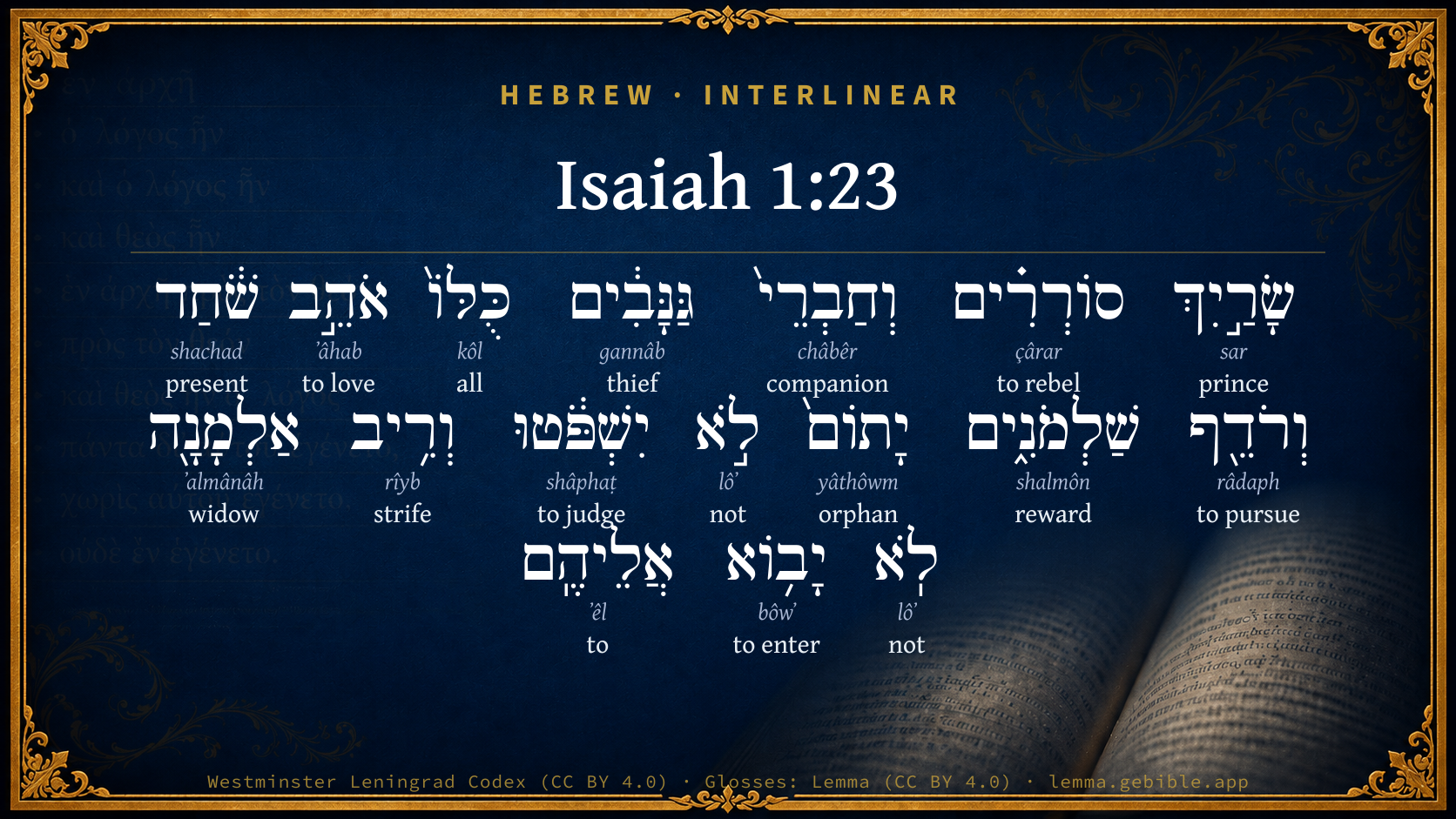
Hebrew (Westminster Leningrad Codex) Isaiah 1:23 appears in the Hebrew Old Testament. The text above is from the Westminster Leningrad Codex. Each word links to its Strong’s number, a concise gloss, and parsing drawn from the Open Scriptures Hebrew Bible morphology. Click any word for its full Brown-Driver-Briggs (BDB) entry.
Download image
Cite this verse

Isaiah 1:23 (World English Bible). Public Domain. Lemma interlinear Bible study tool, https://lemma.gebible.app/v/isaiah/1/23.

Show BibTeX & RIS
BibTeX
RIS
English Translation
Your princes are rebellious, and companions of thieves. Everyone loves bribes, and follows after rewards. They don't judge the fatherless, Neither does the cause of the widow come to them.
World English Bible · Public Domain
Highlights
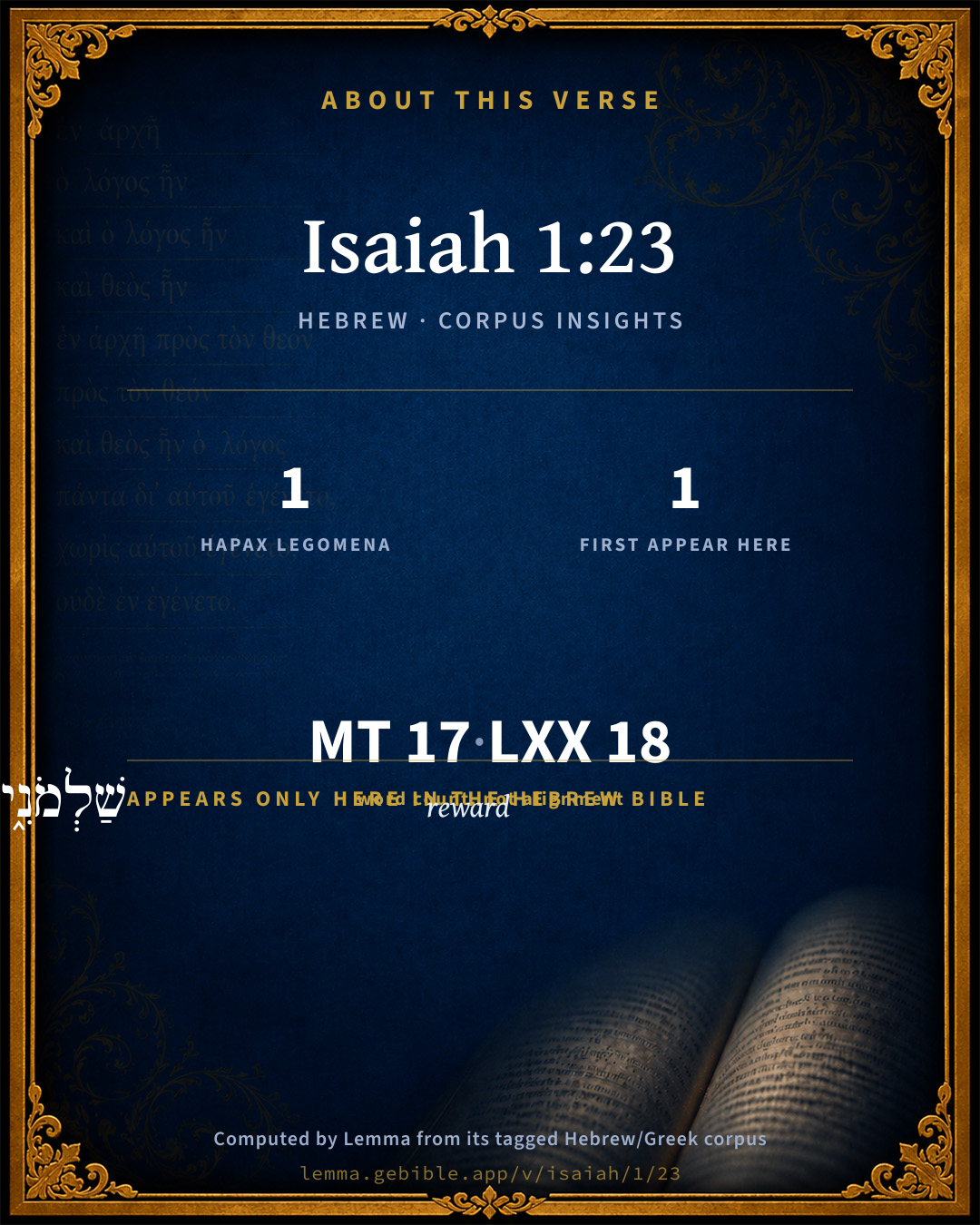
  • 1 hapax legomenon — only here in the Hebrew Bible
  • 1 first appearance in the Hebrew Bible
Full analysis ↓
Download a study sheet

One document with this verse’s original text, its word-by-word gloss line, the meaning frame, cross-references with their text, attributed commentary, and full source and license credits — printable, and it pastes into notes with its structure intact.

This verse Autodidact and up

Study sheet (.html) Plain text (.txt)

A passage Seminary Student

Up to 50 verses in one chapter. A passage sheet keeps up to 6 commentary sources and 12 cross-references per verse, in the order this page ranks them, and says so on the sheet whenever that leaves anything out. Ask for a single verse and you get the Autodidact verse sheet above.

Everything on this page stays free to read, with no account — the sheet is a download of what is already on screen, not access to it.

Want to remove ads? Support Godless Engineer
Compare translations 3

The same verse in 3 English versions, stacked beneath the original-language interlinear above. Click any original word for its lexicon entry.

Each is an independent rendering of the whole verse — the interlinear is not word-aligned to these translations.

Highlighted words mark where these versions differ — a whole-verse word diff, not a word-by-word alignment.

  • World English Bible Public Domain
    Your princes are rebellious, and companions of thieves. Everyone loves bribes, and follows after rewards. They don't judge the fatherless, Neither does the cause of the widow come to them.
  • King James Version Public Domain
    Thy princes are rebellious, and companions of thieves: every one loveth gifts, and followeth after rewards: they judge not the fatherless, neither doth the cause of the widow come unto them.
  • unfoldingWord Literal Text CC BY-SA 4.0
    Your princes rebels and companions of thieves; each of him is loving a bribe and pursuing rewards. They do not judge the orphan, and the case of the widow does not come to them.

unfoldingWord Literal Text — © unfoldingWord, licensed CC BY-SA 4.0. Word-aligned USFM3 via Door43 (git.door43.org/unfoldingWord/en_ult).

Versions to compare (up to 4)

3 of 4 selected

Show all 18 translations

Every available English version of this verse, each an independent rendering of the whole verse.

  • World English Bible Public Domain
    Your princes are rebellious, and companions of thieves. Everyone loves bribes, and follows after rewards. They don't judge the fatherless, Neither does the cause of the widow come to them.
  • Berean Standard Bible Public Domain
    Your rulers are rebels, friends of thieves. They all love bribes and chasing after rewards. They do not defend the fatherless, and the plea of the widow never comes before them.
  • Majority Standard Bible Public Domain
    Your rulers are rebels, friends of thieves. They all love bribes and chasing after rewards. They do not defend the fatherless, and the plea of the widow never comes before them.
  • King James Version Public Domain
    Thy princes are rebellious, and companions of thieves: every one loveth gifts, and followeth after rewards: they judge not the fatherless, neither doth the cause of the widow come unto them.
  • American Standard Version (1901) Public Domain
    Thy princes are rebellious, and companions of thieves; every one loveth bribes, and followeth after rewards: they judge not the fatherless, neither doth the cause of the widow come unto them.
  • Revised Version (1885) Public Domain
    Thy princes are rebellious, and companions of thieves; every one loveth gifts, and followeth after rewards: they judge not the fatherless, neither doth the cause of the widow come unto them.
  • Geneva Bible (1599) Public Domain
    Thy Princes are rebellious and companions of theeues: euery one loueth giftes, and followeth after rewards: they iudge not the fatherlesse, neither doeth the widowes cause come before them.
  • Douay-Rheims (1899) Public Domain
    Thy princes are faithless, companions of thieves: they all love bribes, the run after rewards. They judge not for the fatherless: and the widow's cometh not in to them.
  • Young's Literal Translation Public Domain
    Thy princes `are' apostates, and companions of thieves, Every one loving a bribe, and pursuing rewards, The fatherless they judge not, And the plea of the widow cometh not to them.
  • Literal Standard Version CC BY-SA 4.0
    Your princes [are] apostates, and companions of thieves, || Everyone loving a bribe, and pursuing rewards, || They do not judge the fatherless, || And the plea of the widow does not come to them.
  • Unlocked Literal Bible CC BY-SA 4.0
    Your princes are rebels and companions of thieves; everyone loves bribes and runs after payoffs. They do not defend the fatherless, nor does the widow's legal plea come before them.
  • unfoldingWord Literal Text CC BY-SA 4.0
    Your princes rebels and companions of thieves; each of him is loving a bribe and pursuing rewards. They do not judge the orphan, and the case of the widow does not come to them.
  • Darby Bible Public Domain
    thy princes are rebellious, and companions of thieves; every one loveth presents, and hunteth after rewards; they judge not the fatherless, and the cause of the widow cometh not unto them.
  • World Messianic Bible Public Domain
    Your princes are rebellious and companions of thieves. Everyone loves bribes and follows after rewards. They don’t defend the fatherless, neither does the cause of the widow come to them.
  • Webster's Bible Public Domain
    Thy princes are rebellious, and companions of thieves: every one loveth gifts, and followeth after rewards: they judge not the fatherless, neither doth the cause of the widow come to them.
  • Free Bible Version CC BY-SA 4.0
    Your leaders are rebels, friends of thieves. They all love bribes and want to get kickbacks. They don't defend the rights of orphans, and refuse to take cases to help widows.
  • Bible in Basic English Public Domain
    Your chiefs have gone against the Lord, they have become friends of thieves; every one of them is looking for profit and going after rewards; they do not give right decisions for the child who has no father, and they do not let the cause of the widow come before them.
  • JPS Tanakh (1917) Public Domain
    Thy princes are rebellious, and companions of thieves; every one loveth bribes, and followeth after rewards; they judge not the fatherless, neither doth the cause of the widow come unto them.

Literal Standard Version (2020), Covenant Press — licensed CC BY-SA 4.0. Text via the HelloAO Bible API (eBible.org). Unlocked Literal Bible (unfoldingWord) — licensed CC BY-SA 4.0. Text via the HelloAO Bible API (eBible.org). unfoldingWord Literal Text — © unfoldingWord, licensed CC BY-SA 4.0. Word-aligned USFM3 via Door43 (git.door43.org/unfoldingWord/en_ult). Free Bible Version, Dr. Jonathan Gallagher — licensed CC BY-SA 4.0. Text via the HelloAO Bible API (eBible.org).

Word by word

More ways to search: Search by grammar → Find every occurrence → Compare this word →

Practice this passage: Drill this verse → Learn its vocabulary →

שַׁלְמֹנִ֑ים
shalmôn
H8021
“rewards”
Noun, Common, Masculine, Plural, Absolute
Part of Speech
Noun
Type
Common
Gender
Masculine
Number
Plural
State
Absolute
Full BDB Definition

Origin: from H7999

TWOT: 2401f

reward, bribe
  1. שָׂרַ֣יִךְ sar H8269 “princes · your” Noun, Common, Masculine, Plural, Construct + Suffix, Personal, 2nd Person, Feminine, Singular
  2. סוֹרְרִ֗ים çârar H5637 “rebelling” Verb, Qal, Participle Active, Masculine, Plural, Absolute
  3. וְחַבְרֵי֙ châbêr H2270 “and · companions of” Conjunction + Noun, Common, Masculine, Plural, Construct
  4. גַּנָּבִ֔ים gannâb H1590 “thieves” Noun, Common, Masculine, Plural, Absolute
  5. כֻּלּוֹ֙ kôl H3605 “all · his” Noun, Common, Masculine, Singular, Construct + Suffix, Personal, 3rd Person, Masculine, Singular
  6. אֹהֵ֣ב ʼâhab H157 “loving” Verb, Qal, Participle Active, Masculine, Singular, Absolute
  7. שֹׁ֔חַד shachad H7810 “present” Noun, Common, Masculine, Singular, Absolute
  8. וְרֹדֵ֖ף râdaph H7291 “and · pursuing” Conjunction + Verb, Qal, Participle Active, Masculine, Singular, Absolute
  9. יָתוֹם֙ yâthôwm H3490 “orphan” Noun, Common, Masculine, Singular, Absolute
  10. לֹ֣א lôʼ H3808 “not” Particle, Negative
  11. יִשְׁפֹּ֔טוּ shâphaṭ H8199 “to judge” Verb, Qal, Imperfect, 3rd Person, Masculine, Plural
  12. וְרִ֥יב rîyb H7379 “and · strife of” Conjunction + Noun, Common, Both, Singular, Construct
  13. אַלְמָנָ֖ה ʼalmânâh H490 “widow” Noun, Common, Feminine, Singular, Absolute
  14. לֹֽא lôʼ H3808 “not” Particle, Negative
  15. יָב֥וֹא bôwʼ H935 “to enter” Verb, Qal, Imperfect, 3rd Person, Masculine, Singular
  16. אֲלֵיהֶֽם ʼêl H413 “to · them” Preposition + Suffix, Personal, 3rd Person, Masculine, Plural

About this verse

These counts appear in no published source. They are computed here, from the morphology-tagged text and Lemma’s own curated glosses. What Lemma adds →

17
words
16
distinct lemmas
Prophets
section

Notable vocabulary

1 hapax legomenon — a word that appears only here in the entire Hebrew Bible:

  • שַׁלְמֹנִ֑ים reward H8021

First appearance in Scripture

This word makes its first canonical appearance in the Hebrew Bible here:

  • שַׁלְמֹנִ֑ים reward H8021

Shared distinctive vocabulary

וְחַבְרֵי֙ companion H2270 occurs in 11 verses of the Hebrew Bible. Also found in:

Grammatical profile

  • 5 verbs
  • 9 nouns
  • 1 preposition
  • 2 particles

Verb forms

  • סוֹרְרִ֗ים Qal · Participle Active
  • אֹהֵ֣ב Qal · Participle Active
  • וְרֹדֵ֖ף Qal · Participle Active
  • יִשְׁפֹּ֔טוּ Qal · Imperfect
  • יָב֥וֹא Qal · Imperfect

Repetition

A word recurs within this verse — often emphatic in Hebrew:

Hebrew & Septuagint length

In English translation the verse runs 30 words from the Hebrew and 23 from the Septuagint (LXX English) — closely comparable.

A rough comparison of the two English renderings, which tokenize alike — not a word-level alignment.

Word counts can differ between the Hebrew and the Greek without any difference in meaning — e.g. the Hebrew direct-object marker אֵת has no separate Greek word, and Greek often adds the article ὁ.

In the original languages it is 17 Hebrew tokens and 18 Greek tokens — but the two are counted differently (Hebrew bundles its prefixes and suffixes into one token; the Greek is in lemma form), so that isn’t a like-for-like length.

Cross-references

27

Topical passages linked to Isaiah 1:23 in the Treasury of Scripture Knowledge — connected by theme and wording, ordered by reader-vote popularity; previews shown in the World English Bible.

  • Micah 7:3 Their hands are on that which is evil to do it diligently. The ruler and judge ask for a bribe; And the powerful man dictates the evil desire of his soul. Thus they conspire together.
  • Exodus 23:8 You shall take no bribe, for a bribe blinds those who have sight and perverts the words of the righteous.
  • Zechariah 7:10 Don't oppress the widow, nor the fatherless, the foreigner, nor the poor; and let none of you devise evil against his brother in your heart.'
  • Luke 18:2–5 saying, "There was a judge in a certain city who didn't fear God, and didn't respect man.
  • Acts 4:5–11 It happened in the morning, that their rulers, elders, and scribes were gathered together in Jerusalem.
  • Isaiah 3:14 Yahweh will enter into judgment with the elders of his people, And their leaders: "It is you who have eaten up the vineyard. The spoil of the poor is in your houses.
  • Isaiah 10:1–2 Woe to those who decree unrighteous decrees, and to the writers who write perverseness;
  • Jeremiah 5:28–29 They are grew fat, they shine: yes, they overpass in deeds of wickedness; they don't plead the cause, the cause of the fatherless, that they may prosper; and the right of the needy they don't judge.
  • Malachi 3:5 I will come near to you to judgment; and I will be a swift witness against the sorcerers, and against the adulterers, and against the perjurers, and against those who oppress the hireling in his wages, the widow, and the fatherless, and who deprive the foreigner of justice, and don't fear me," says Yahweh of Hosts.
  • Luke 19:46 saying to them, "It is written, 'My house is a house of prayer,' but you have made it a 'den of robbers'!"
  • Deuteronomy 16:19 You shall not wrest justice: you shall not respect persons; neither shall you take a bribe; for a bribe does blind the eyes of the wise, and pervert the words of the righteous.
  • 2 Chronicles 24:17–21 Now after the death of Jehoiada came the princes of Judah, and made obeisance to the king. Then the king listened to them.
  • 2 Chronicles 36:14 Moreover all the chiefs of the priests, and the people, trespassed very greatly after all the abominations of the nations; and they polluted the house of Yahweh which he had made holy in Jerusalem.
  • Proverbs 17:23 A wicked man receives a bribe in secret, To pervert the ways of justice.
  • Proverbs 29:24 Whoever is an accomplice of a thief is an enemy of his own soul. He takes an oath, but dares not testify.
  • Isaiah 33:15 He who walks righteously, and speaks blamelessly; he who despises the gain of oppressions, who shakes his hands from taking a bribe, who stops his ears from hearing of blood, and shuts his eyes from looking on evil:
  • Jeremiah 5:5 I will get me to the great men, and will speak to them; for they know the way of Yahweh, and the law of their God. But these with one accord have broken the yoke, and burst the bonds.
  • Jeremiah 22:17 But your eyes and your heart are not but for your covetousness, and for shedding innocent blood, and for oppression, and for violence, to do it.
  • Ezekiel 22:6–12 Behold, the princes of Israel, everyone according to his power, have been in you to shed blood.
  • Daniel 9:5–6 we have sinned, and have dealt perversely, and have done wickedly, and have rebelled, even turning aside from your precepts and from your ordinances;
  • Hosea 4:18 Their drink has become sour. They play the prostitute continually. Her rulers dearly love their shameful way.
  • Hosea 7:3–5 They make the king glad with their wickedness, And the princes with their lies.
  • Hosea 9:15 "All their wickedness is in Gilgal; For there I hated them. Because of the wickedness of their deeds I will drive them out of my house! I will love them no more. All their princes are rebels.
  • Micah 3:1–3 I said, "Please listen, you heads of Jacob, And rulers of the house of Israel: Isn't it for you to know justice?
  • Matthew 21:13 He said to them, "It is written, 'My house shall be called a house of prayer,' but you have made it a den of robbers!"
  • Mark 11:17 He taught, saying to them, "Isn't it written, 'My house will be called a house of prayer for all the nations?' But you have made it a den of robbers!"
  • Micah 3:11 Her leaders judge for bribes, And her priests teach for a price, And her prophets of it tell forturnes for money: Yet they lean on Yahweh, and say, Isn't Yahweh in the midst of us? No disaster will come on us.

Cross-references courtesy of OpenBible.info (CC BY 4.0).

Hebrew and Greek witnesses Masoretic Hebrew ↔ Greek Septuagint

The same verse in the two great witnesses to the Old Testament, shown verse-for-verse.

These are two independent witnesses, not word-aligned to each other, and the Septuagint is shown in lemma (dictionary) form.

Hebrew Isaiah 1:23 Masoretic · Westminster Leningrad Codex

שָׂרַ֣יִךְ סוֹרְרִ֗ים וְחַבְרֵי֙ גַּנָּבִ֔ים כֻּלּוֹ֙ אֹהֵ֣ב שֹׁ֔חַד וְרֹדֵ֖ף שַׁלְמֹנִ֑ים יָתוֹם֙ לֹ֣א יִשְׁפֹּ֔טוּ וְרִ֥יב אַלְמָנָ֖ה לֹֽא יָב֥וֹא אֲלֵיהֶֽם

Your princes are rebellious, and companions of thieves. Everyone loves bribes, and follows after rewards. They don't judge the fatherless, Neither does the cause of the widow come to them.

World English Bible · Public Domain

Greek LXX Isaiah 1:23 Septuagint · lemma form

ὁ ἄρχων σύ ἀπειθέω κοινωνός κλέπτης ἀγαπάω δῶρον διώκω ἀνταπόδομα ὀρφανός οὐ κρίνω καί κρίσις χήρα οὐ προςἔχω

Your princes are rebellious, companions of thieves, loving bribes, seeking after rewards; not pleading for orphans, and not heeding the cause of widows.

LXX2012 (modern English Septuagint) · Public Domain

On this verse, Adam Clarke's Commentary discusses the Septuagint’s reading. Read the note in Commentary ↓

Hebrew: Westminster Leningrad Codex (CC BY 4.0). Greek: Septuagint (public domain); English from LXX2012 (modern English Septuagint) (Public Domain). How the Septuagint differs from the Hebrew →

Targum (Aramaic paraphrase)

1

The Targum is the ancient Jewish Aramaic paraphrase of the Hebrew Scriptures — an interpretive translation, not the Hebrew text itself. Onkelos (literal) and Pseudo-Jonathan (expansive) render the Torah, and Jonathan the Prophets. Coverage is partial: where no permissively-licensed English translation exists for a verse, only the Aramaic is shown. This is verse-level text, not a word-by-word alignment to the Hebrew.

  1. Targum Jonathan Prophets (Joshua–Malachi)
    רַבְרְבַיִךְ מָרְדִין וְשׁוּתָּפִין לְגַנָבִין כּוּלְהוֹן רְחִימִין לְקַבָּלָא שׁוֹחֲדָא אָמְרִין גְבַר לְחַבְרֵיהּ עֲבֵיד לִי טַב בְּדִינִי וַאֲשַׁלֵם לָךְ בְּדִינָךְ דִין יַתְמָא לָא דַיְנִין וּקְבֵילַת אַרְמַלְתָּא לָא עֲלַת לָקֳדָמֵיהוֹן:

    Thy princes are rebellious, and companions of thieves: all of them love gifts. One saith to the other, Show me kindness in my cause, and I will repay thee in thy cause. The fatherless they judge not, and the cry of the widow does not come before them.

    Targum Jonathan — Aramaic: “Mikraot Gedolot” (public domain). English: “Sefaria Community Translation” (CC0 1.0 (public-domain dedication)); “London "Chaldee Paraphrase," 1871” (public domain). Text via Sefaria.

Commentary

Notes on Isaiah 1:23 from classic Christian and Jewish commentators (each source and its license shown beneath its notes). The classic Christian expositions comment on the surrounding passage and are grouped to its opening verse, so a note may address several verses; the Jewish commentaries on the Tanakh (Rashi and others) are per-verse, so they appear only where the commentator wrote on this verse.

Lemma curates 59 commentaries, every one of them public domain or Creative Commons licensed, each selected and text-cleaned for this edition rather than reprinted as found. About our sources →

Trapp's Complete Commentary

John Trapp

Isa 1:23 Thy princes [are] rebellious, and companions of thieves: every one loveth gifts, and followeth after rewards: they judge not the fatherless, neither doth the cause of the widow come unto them.

Ver. 23. Thy princes are rebellious.] Or, Revolters, apostates. There is an elegance in the original, such as this prophet is full of: Ac si dicas primi sunt pravi vel perversi. So saith Calvin here: Episcopi may be called Aposcopi, Cardinales Carnales vel Carpinales, carpet men; Canonici Cenonici, Praepositi praeposteri, &c. This note A Lapide is very angry at - et lapides loquitur.

And companions of thieves.] While they not only suffered such to go unpunished, but also shared with them. {as Psa 50:18} Cato complained that in his time some thieves stood at the bar in cold irons, when others, and worse, sat on the bench with gold chains about their necks. The bold pirate told Alexander to his teeth that he was the arch-pirate of the world. And what shall we think of Pope Alexander, who, in 1505 AD, sent a bull of pardons for many, dispensing thereby with such as kept away, or by any fraud had gotten the goods of other men, which they should now retain still, without scruple of conscience, so as they paid a rateable portion thereof to his Holiness’s receivers? {a} And at this day Popish priests will absolve a thief of his wickedness, if they may have half with him of the stolen goods. {b}

Every one loveth gifts.] Not only taketh; although in taking also the Greek proverb saith, ουτε παντα, ουτε παντη, ουτε παρα παντων, great care and caution should be used. Olim didici quid sint munera, said a grave man. See Deu 16:19.

And followeth after rewards.] As a hunter his game, or a merchant his gain, or a martialist his enemy. Sectantur retributiones - i.e., Collidunt inter se indices, saith the Chaldee paraphrast: The judges conspire, saying one to another, Help thou me in judging against the poor, and I will do as much for thee another time.

They judge not the fatherless.] Because friendless, penniless. Sed pupillos laedere, est pupillam oculi Dei contingere.

Neither doth the cause of the widow come before them.] The widow cannot speak for herself (in the original she hath her name from dumbness), and hath no money to make room for her. Hence her cause is slighted.

{a} Speed, 992.

{b} Scultet. in loc.

John Trapp, A Commentary or Exposition upon All the Books of the Old and New Testament (1647–1656) — public domain. Text from a community e-Sword module.

The Biblical Illustrator

Joseph S. Exell

Isa_1:23

Thy princes are rebellious . . . everyone loveth gifts

Rebellious princes

Instead of suppressing rebellion, they were rebels themselves.

(J. A. Alexander.)

The rebellious princes

I. THE PROFIT OF THEIR PLACES IS ALL THEIR AIM. They love gifts, and follow after rewards; they set their hearts upon their salary, the fees and perquisites of their offices, and are greedy of them, and never think they can get enough. Presents and gratuities will blind their eyes at any time, and make them pervert judgment (Hos_4:18).

II. THE DUTY OF THEM PLACES IS NONE OF THEIR CARE. They ought to protect those that are injured, and take cognisance of the appeals made to them; why else were they preferred? But they judge not the fatherless, take no care to guard the orphans, nor doth the cause of the widow come unto them, because the poor widow has no bribe to give. Those will have a great deal to answer for, who when they should be the patrons of the oppressed are their greatest oppressors. (M. Henry.)

Audacious corruption

Catiline, being prosecuted for some great offence, corrupted the judges. When they had given their verdict, though he was acquitted only by a majority of two, he said he had put himself to a needless expense in bribing one of those judges, for it would have been sufficient to have had a majority of one. (Plutarch.)

Political corruption in England

The machinery of both sides [Whig and Tory] was unlimited bribery. The degradation of the briber was as great as that of the bribed. Berkeley writes in 1721:--This corruption has become a national crime, having infected the lowest as well as the highest amongst us. (Knights England.)

Francis Bacon

He was charged by the Commons before the Lords, with twenty-two acts of bribery and corruption. He attempted no defence. He made a distinct confession in writing of the charges brought against him. And when a deputation of peers asked if that confession was his own voluntary act, he replied: It is my act, my hand, my heart. O my lords, spare a broken reed. (Knights England.)

Corruption in the reign of James I.

It was an age of universal abuses. Local magistrates were influenced by the pettiest gifts, and were called basket justices. (Knights England.)

Corruption checked by Act of Parliament

[In 1275 Parliament enacted] that no kings officer should take any reward to do his office, such enactment being one of the many proofs of the inefficiency of law to restrain corruption; for within fourteen years there were only two judges out of fifteen who were not found guilty of the grossest extortions. (Knights England.)

The Biblical Illustrator, edited by Joseph S. Exell (c. 1880s–1900s) — public domain. Text from a community e-Sword module.

Keil & Delitzsch

C. F. Keil & F. Delitzsch

In Isa 1:23 the prophet says this without a figure: "Thy rulers are rebellious, and companions of thieves; every one loveth presents, and hunteth after payment; the orphan they right not, and the cause of the widow has no access to them." In two words the prophet depicts the contemptible baseness of the national rulers (sârim). He describes first of all their baseness in relation to God, with the alliterative sorerim: rebellious, refractory; and then, in relation to men, companions of thieves, inasmuch as they allowed themselves to be bribed by presents of stolen goods to acts of injustice towards those who had been robbed. They not only willingly accepted such bribes, and that not merely a few of them, but every individual belonging to the rank of princes (Cullo, equivalent to haccol, the whole: every one loveth gifts); but they went eagerly in pursuit of them (rodeph). It was not peace (shâlom) that they hunted after (Psa 34:16), but shalmonimshalmonim, things that would pacify their avarice; not what was good, but compensation for their partiality. - This was the existing state of Jerusalem, and therefore it would hardly be likely to take the way of mercy opened before it in Isa 1:18; consequently Jehovah would avail himself of other means of setting it right.

Keil & Delitzsch — Biblical Commentary on the Old Testament (1861–1891) — public domain (CC PDM 1.0). Text via the HelloAO Bible API. (Old Testament only.)

Geneva Bible (1599)

Geneva Bible translators

That is, they maintain the wicked and the extortioners: and not only do not punish them, but are themselves such.

Geneva Bible (1599) marginal notes — public domain. Text via Bolls.life.

Jamieson, Fausset & Brown

Robert Jamieson, A. R. Fausset & David Brown

companions of thieves--by connivance (Pro 29:24).

gifts-- (Eze 22:12). A nation's corruption begins with its rulers.

Jamieson, Fausset & Brown — Commentary Critical and Explanatory on the Whole Bible (1871) — public domain (CC PDM 1.0). Text via the HelloAO Bible API.

Adam Clarke's Commentary

Verse 23. Companions of thieves - "Associates"] The Septuagint, Vulgate, and four MSS., read חברי chabrey without the conjunction ו vau.

Adam Clarke's Commentary on the Bible (1810–1826) — public domain. Text from a community e-Sword/MySword module.

Ellicott's Commentary for English Readers

(23) Thy princes are rebellious.—The Hebrew words present an alliterative paronomasia (sârim, sôrerîm), which may be represented by “Thy rulers are rebels.” Here, as before, we note the “influence of Hosea (Hos_9:15), from whom the words are cited.

Companions of thieves.—We seem almost to be reading a report of the state of police in a provincial city under the government of Turkey as it is, or of Naples or Sicily as they were. The kadi himself is in secret partnership with the brigands who infest the highways. Nothing can be done without baksheesh, and the robbers who have the plunder can bribe more heavily than the man whom they have robbed. (Comp. Mic_7:3.) To the complaints of the widow and the orphan the judges turned a deaf ear, and put off the hearing of their cause with indefinite procrastination. There is, perhaps, a touch of irony in the word for “bribes” (shalmônîm, as if “peace gifts”), which were sought after, instead of shalôm, the true peace itself.

A Bible Commentary for English Readers, edited by Charles John Ellicott (1878–1897) — public domain. Text from a community e-Sword module.

The Cambridge Bible for Schools and Colleges

gen. ed. J. J. S. Perowne

23. Thy princes are rebellious] In the Heb. a paronomasia, borrowed from Hos_9:15. The “princes” (sârîm) are the civil and military officials of the monarchical constitution, as distinguished from the zìqçnîm (sheikhs or elders) of the old tribal system. The charge brought against them is that as a class they are corrupted by systematic bribery. They are companions of thieves, conniving at extortion and receiving in return a share of the spoil. Hence the fatherless and widows, having no bribes to offer, can obtain no redress; they cannot even find access to the seat of judgment.

The Cambridge Bible for Schools and Colleges (gen. ed. J. J. S. Perowne; Cambridge University Press, 1878–1918) — public domain. Text from a community e-Sword module.

John Gill's Exposition

Thy princes are rebellious,.... Stubborn and obstinate, refused to receive and acknowledge the Messiah; such were the Jewish rulers, civil and ecclesiastical, in the times of Christ.

And companions of thieves: who devoured widows' houses; made the temple, which was a house of prayer, a den of thieves; and took away the key of knowledge from the people, and would not suffer them to attend the ministry of the Gospel, Mat 21:13.

everyone loveth gifts, and followeth after rewards. The Targum paraphrases it,

"everyone says to his neighbour, do me a favour in my cause, I will return "it" to thee in thy cause;''

and so justice was perverted:

they judge not the fatherless; that is, either they do not take their cause in hand at all, or, if they do, do not do them justice, but wrong them of their goods and estates, which, of right, belong to them:

neither doth the cause of the widow come unto them; there being no money to be got by undertaking it; see the case of the unjust judge, a picture of judges in those times, Luk 18:2.

John Gill's Exposition of the Whole Bible (1746–1763) — public domain (CC PDM 1.0). Text via the HelloAO Bible API.

Albert Barnes' Notes on the Bible

Thy princes ... - This is an explanation of the previous verse. Princes mean here those attached to the royal family; those who by rank, or office, had an influence over the people.

Rebellious - Against God. The corruption of a nation commonly begins with the rulers.

Companions of thieves - That is, they connive at the doings of robbers; they do not bring them to justice; they are their accomplices, and are easily bribed to acquit them.

Every one loveth gifts - Every magistrate can be bribed.

Followeth afar rewards - רדף rodēph. This word denotes the act of pursuing after in order to obtain something; and means here that they made it an object to obtain rewards by selling or betraying justice They sell justice to the highest bidder. No more distressing condition of a people can be conceived than this, where justice could not be secured between man and man, and where the wicked could oppress the poor, the widow, and the orphan, as much as they pleased, because they knew they could bribe the judge.

They judge not - They do not render justice to; Isa 1:17. The Chaldee has well expressed the sense of a part of this verse: ‘They say, each one to his neighbor, Favour me in my judgment, or do me good in it, and I will recompense you in your cause.’

The cause of the widow come unto them - Or, rather, come before them. They would not take up her cause, but rather the cause of those who were esteemed able to offer a bribe, and from whom a gift might be expected, if a decision was made in their favor.

Albert Barnes' Notes on the Bible (1834–1885) — public domain. Text from a community e-Sword/MySword module.

Matthew Poole's English Annotations

Thy princes are rebellious against me, their sovereign Lord; they cast off my yoke, and make their own wills and lusts the rule of their life and government.

Companions of thieves; partly by giving them connivance and countenance, and receiving a recompence from them for it; and partly by practising the same violence, and cruelty, and injustice that thieves use.

Loveth gifts, i.e. bribes given to pervert justice, which are severely forbidden, Deu 10:17; 27:25.

Followeth after rewards; pursuing them with all eagerness, and by all means possible.

They judge not the fatherless, & c.; they are so far from doing them justice, that they will not so much as give them a fair hearing of their cause, because they cannot make their way to them by gifts.

Matthew Poole's English Annotations on the Holy Bible (1683–1685) — public domain. Text from a community e-Sword/MySword module.

The Pulpit Commentary

Thy princes are rebellious; i.e. "rebels against their true King, Jehovah." Companions of thieves. Leagued with those who are engaged in filching away the inheritance of the widow and the orphan by chicane in the law courts (see above, vers. 15-17; and compare the Homiletics on vers. 16-20). Gifts... rewards; i.e. "bribes, "given and taken on the condition of their perverting justice. (comp. Jer_22:17 Eze_22:12 Mic_3:11 Mic_7:3) They judge not the fatherless, etc. They dismiss the orphan"s complaint without hearing it, and are so noted for perversion of justice that the widow does not even bring her cause before them.

The Pulpit Commentary (1880–1919), ed. H.D.M. Spence-Jones & Joseph S. Exell — public domain. Text from a community e-Sword module.

John Wesley's Explanatory Notes

Rebellious - Against me their sovereign Lord. Companions of thieves - Partly by giving them connivance and countenance, and partly by practicing the same violence, and cruelty, and injustice that thieves used to do. Gifts - That is, bribes given to pervert justice.

John Wesley, Explanatory Notes Upon the Whole Bible (1754–1765) — public domain. Text via the GEBible commentary corpus.

J. A. Alexander on Isaiah

Joseph Addison Alexander

The same idea is now expressed in literal terms, and with special application to magistrates and rulers. They who were bound officially to suppress disorder and protect the helpless, were themselves greedy of gain, rebellious against God, and tyrannical towards man. “Thy rulers are rebels and fellows of thieves” (not merely like them or belonging to the same class, but accomplices, partakers of their sin), “every one of them loving a bribe” (the participle denoting present and habitual action) “and pursuing rewards. The fatherless” (as being unable to reward them, or as an object of cupidity to others) “they judge not, and the cause of the widow cometh not unto them,” or before them; they will not hear it; they will not act as judges for their benefit. They are not simply unjust judges, they are no judges at all, they will not act as such, except when they can profit by it.

Joseph Addison Alexander, The Prophecies of Isaiah (1846–1847; New York: Scribner, 1870–1878) — public domain. Text from a community e-Sword module.

unfoldingWord translationNotes

Door43 World Missions Community

General Information:

Isaiah speaks Yahweh's words to the people of Judah in the form of a poem. (See: Parallelism)

Your princes are rebels

"Your leaders rebel against God"

companions of thieves

"they are friends with people who steal from others"

bribes ... payoffs

People give "bribes" as gifts to dishonest rulers so the rulers will then act unjustly. Rulers receive "payoffs" as gifts from those who make profits from unjust laws that the ruler has passed.

runs after payoffs

A person eagerly desiring for someone to give him a bribe is spoken of as if the payoff were running away and the person were running after it. AT: "everyone desires for someone to pay money to them to make dishonest decisions" (See: Metaphor)

They do not defend the fatherless

"they do not protect those who do not have fathers"

nor does the widow's legal plea come before them

"nor do they listen when widows go to them for help against those who break the law" or "and they do not help widows who go to them for help against those who break the law"

translationWords

prince

rebel

bribe

unfoldingWord translationNotes — © Distant Shores Media and the Door43 World Missions Community, licensed CC BY-SA 4.0. Source: git.door43.org/Door43/en_tn.

Rashi

Rabbi Shlomo Yitzchaki (Rashi)

rebellious Deviating from the straight path.

and runs after payments This word is similar to the Talmudic תַּשְׁלוּמִין. Jonathan paraphrases: One man says to another, Do me a favor in my case, and I will repay you in your case. This refers to a judge who was a robber, and the robbery victim complains about him before another judge. This one says to him, Declare me innocent today, and I will repay you when they complain about you before me. This is the meaning of running after payments.

and the quarrel of the widow does not come to them The widow comes to complain, and the orphan is coming out, when this one meets him and asks him, What did you accomplish in your case? He replies, All day long I toiled at work, but I did not accomplish anything. And this one turns around and says, If this one, who is a man, did not accomplish anything, surely I will not. This is the meaning of, “the orphan they do not judge, and the quarrel of the widow does not come to them” at all.

Rashi on the Tanakh — English translations: “The Judaica Press complete Tanach with Rashi, translated by A. J. Rosenberg” (CC BY 4.0); “Pentateuch with Rashi's commentary by M. Rosenbaum and A.M. Silbermann, 1929-1934” (public domain); “The Metsudah Tanach series, Lakewood, N.J” (CC BY 4.0); and “The Book of Joshua, Metsudah Publications, 1997” (CC BY 4.0). Text via Sefaria.

Ibn Ezra

Rabbi Abraham ibn Ezra

שלמנים Rewards. (Comp. Exod. 22:5). They perverted judgment; the judge said, Give me such and such a sum, and it shall stand thee in good part in thy lawsuit with thy neighbour.

To the orphan—of whom they are not afraid. They judge not. That is, they do not render justice.

The cause of the widow—which she has to bring forward. Doth not come unto them: they do not like to hear her cause, therefore it does not come before them.

Ibn Ezra on the Tanakh — English translations: “Sefaria Community Translation” (CC0 1.0 (public-domain dedication)); “Yalkut, Sifsei Chachomim Chumash, Metsudah Publications, 2009” (CC BY 4.0); and “Commentary of Ibn Ezra on Isaiah - trans. by M. Friedlander, 1873” (public domain). Text via Sefaria.

Lesson kit

Teaching starters — assembled from the data on this page, not authored interpretation. Every prompt links to the verse data it draws on. Edit before teaching.

Isaiah, in the Prophets, opens this verse with 17 words (16 distinct Hebrew lemmas). Its most distinctive word is shalmôn (“reward”). A historical commentator’s framing appears above. Read the whole chapter for the surrounding context.

Discussion questions

  1. What does “reward” (shalmôn) contribute to the verse as a whole?
  2. 1 word here appears nowhere else in the Hebrew Bible. Why might the author reach for such rare wording?
  3. This is the first place “reward” appears in Scripture (first appears here). What does its debut here establish?
  4. How does Judges 20:11, which shares the word «companion», read alongside this verse?
  5. What does the repetition of “not” (2× in this one verse) do in this verse?
  6. These translations render this verse differently; the difference is in the English rendering, not the original. What questions does that raise?
  7. «סוֹרְרִ֗ים» is a Qal Participle Active verb. How does that grammatical form shape the action described?
  8. Compare how Trapp's Complete Commentary and The Biblical Illustrator read this verse. Where do they agree or differ?

Things to notice

  • 1 word in this verse appears nowhere else in the Hebrew Bible.
  • 1 word makes its first canonical appearance in Scripture here.
  • This verse counts 17 Hebrew ↔ 18 Greek words.
  • These translations choose different wording for 25 words in this verse.
  • “not” occurs 2× in this single verse.

Reading settings

Reading text

Shown beneath each verse's original-language words.

Old Testament
Old Testament edition

Read the OT as the Masoretic Hebrew (MT) or the Greek Septuagint (LXX).

English shown for the Greek Septuagint (in the Hebrew ↔ Greek comparison).

Comparing translations? Open the Compare panel on any verse page to stack up to four side by side.