
Ezekiel 35:11

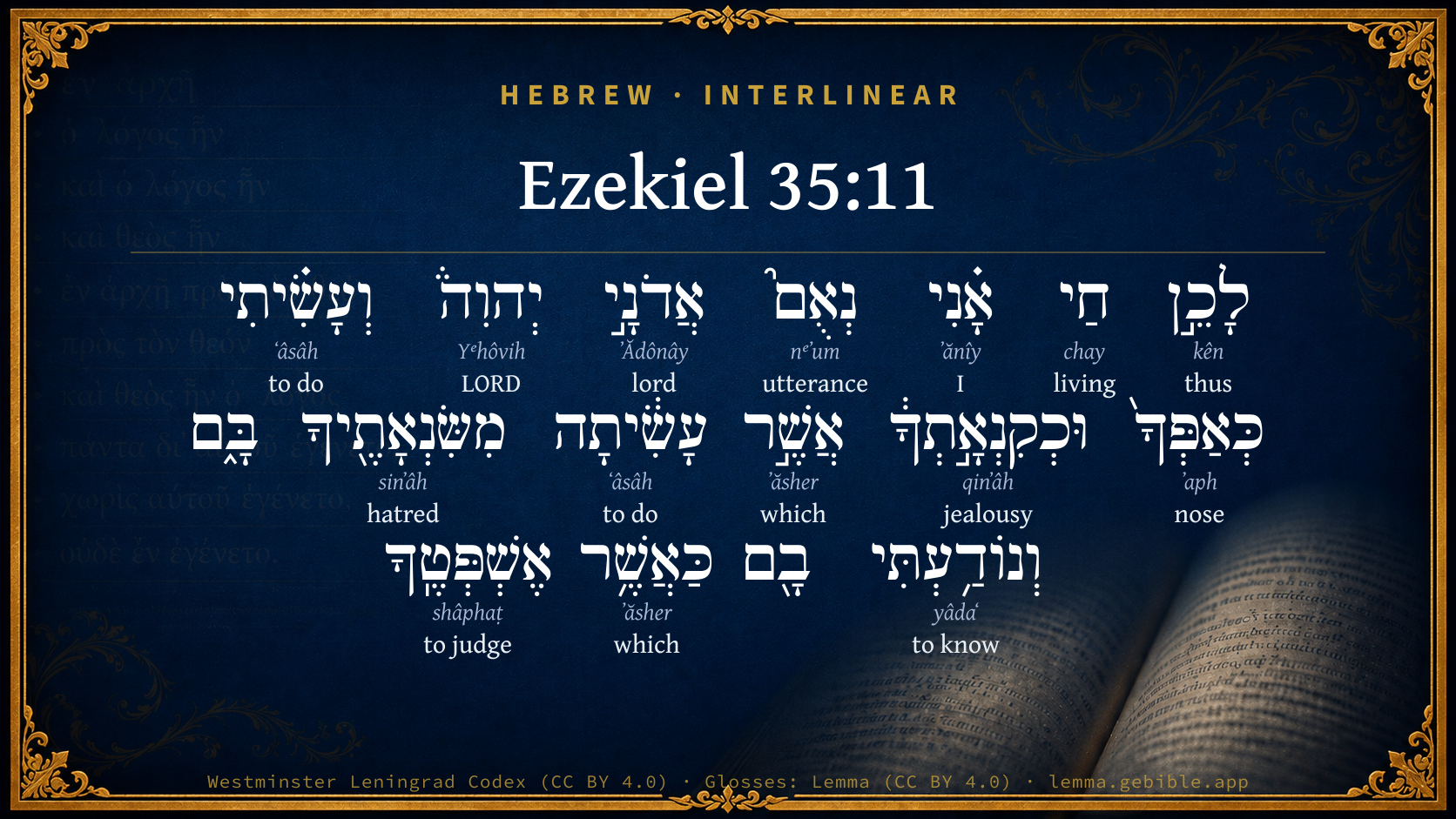
Hebrew (Westminster Leningrad Codex) Ezekiel 35:11 appears in the Hebrew Old Testament. The text above is from the Westminster Leningrad Codex. Each word links to its Strong’s number, a concise gloss, and parsing drawn from the Open Scriptures Hebrew Bible morphology. Click any word for its full Brown-Driver-Briggs (BDB) entry.
Download image
Cite this verse

Ezekiel 35:11 (World English Bible). Public Domain. Lemma interlinear Bible study tool, https://lemma.gebible.app/v/ezekiel/35/11.

Show BibTeX & RIS
BibTeX
RIS
English Translation
therefore, as I live, says the Lord Yahweh, I will do according to your anger, and according to your envy which you have shown out of your hatred against them; and I will make myself known among them, when I shall judge you.
World English Bible · Public Domain
Download a study sheet

One document with this verse’s original text, its word-by-word gloss line, the meaning frame, cross-references with their text, attributed commentary, and full source and license credits — printable, and it pastes into notes with its structure intact.

This verse Autodidact and up

Study sheet (.html) Plain text (.txt)

A passage Seminary Student

Up to 50 verses in one chapter. A passage sheet keeps up to 6 commentary sources and 12 cross-references per verse, in the order this page ranks them, and says so on the sheet whenever that leaves anything out. Ask for a single verse and you get the Autodidact verse sheet above.

Everything on this page stays free to read, with no account — the sheet is a download of what is already on screen, not access to it.

Want to remove ads? Support Godless Engineer
Compare translations 3

The same verse in 3 English versions, stacked beneath the original-language interlinear above. Click any original word for its lexicon entry.

Each is an independent rendering of the whole verse — the interlinear is not word-aligned to these translations.

Highlighted words mark where these versions differ — a whole-verse word diff, not a word-by-word alignment.

  • World English Bible Public Domain
    therefore, as I live, says the Lord Yahweh, I will do according to your anger, and according to your envy which you have shown out of your hatred against them; and I will make myself known among them, when I shall judge you.
  • King James Version Public Domain
    Therefore, as I live, saith the Lord GOD, I will even do according to thine anger, and according to thine envy which thou hast used out of thy hatred against them; and I will make myself known among them, when I have judged thee.
  • unfoldingWord Literal Text CC BY-SA 4.0
    Therefore, as I live—this is the Lord Yahweh’s declaration—so I will do according to your anger and according to your jealousy that you had in your hatred of Israel, and I will show myself to them when I judge you.

unfoldingWord Literal Text — © unfoldingWord, licensed CC BY-SA 4.0. Word-aligned USFM3 via Door43 (git.door43.org/unfoldingWord/en_ult).

Versions to compare (up to 4)

3 of 4 selected

Show all 18 translations

Every available English version of this verse, each an independent rendering of the whole verse.

  • World English Bible Public Domain
    therefore, as I live, says the Lord Yahweh, I will do according to your anger, and according to your envy which you have shown out of your hatred against them; and I will make myself known among them, when I shall judge you.
  • Berean Standard Bible Public Domain
    therefore as surely as I live, declares the Lord GOD, I will treat you according to the anger and jealousy you showed in your hatred against them, and I will make Myself known among them when I judge you.
  • Majority Standard Bible Public Domain
    therefore as surely as I live, declares the Lord GOD, I will treat you according to the anger and jealousy you showed in your hatred against them, and I will make Myself known among them when I judge you.
  • King James Version Public Domain
    Therefore, as I live, saith the Lord GOD, I will even do according to thine anger, and according to thine envy which thou hast used out of thy hatred against them; and I will make myself known among them, when I have judged thee.
  • American Standard Version (1901) Public Domain
    therefore, as I live, saith the Lord Jehovah, I will do according to thine anger, and according to thine envy which thou hast showed out of thy hatred against them; and I will make myself known among them, when I shall judge thee.
  • Revised Version (1885) Public Domain
    therefore, as I live, saith the Lord GOD, I will do according to thine anger, and according to thine envy which thou hast shewed out of thy hatred against them; and I will make myself known among them, when I shall judge thee.
  • Geneva Bible (1599) Public Domain
    Therefore as I liue, sayth the Lord God, I wil euen do according to thy wrath, and according to thine indignation which thou hast vsed in thine hatred against them: and I wil make my selfe knowen among them whe I haue iudged thee.
  • Douay-Rheims (1899) Public Domain
    Therefore as I live, saith the Lord God, I will do according to thy wrath, and according to thy envy, which thou hast exercised in hatred to them: and I will be made known by them, when I shall have judged thee.
  • Young's Literal Translation Public Domain
    Therefore, I live -- an affirmation of the Lord Jehovah, And I have done according to thine anger, And according to thine envy, With which thou hast wrought, Because of thy hatred against them, And I have been known among them when I judge thee.
  • Literal Standard Version CC BY-SA 4.0
    Therefore, [as] I live—a declaration of Lord YHWH, || And I have done according to your anger, || And according to your envy, || With which you have worked, || Because of your hatred against them, || And I have been known among them when I judge you.
  • Unlocked Literal Bible CC BY-SA 4.0
    Therefore, as I live—this is the Lord Yahweh's declaration—so I will do according to your anger and according to your jealousy that you had in your hatred of Israel, and I will show myself to them when I judge you.
  • unfoldingWord Literal Text CC BY-SA 4.0
    Therefore, as I live—this is the Lord Yahweh’s declaration—so I will do according to your anger and according to your jealousy that you had in your hatred of Israel, and I will show myself to them when I judge you.
  • Darby Bible Public Domain
    therefore, [as] I live, saith the Lord Jehovah, I will even do according to thine anger and according to thine envy, as thou hast done out of thy hatred against them; and I will make myself known among them, when I shall judge thee.
  • World Messianic Bible Public Domain
    therefore, as I live,” says the Lord GOD, “I will do according to your anger, and according to your envy which you have shown out of your hatred against them; and I will make myself known among them when I judge you.
  • Webster's Bible Public Domain
    Therefore, as I live, saith the Lord GOD, I will even do according to thy anger, and according to thy envy which thou hast used out of thy hatred against them; and I will make myself known among them, when I have judged thee.
  • Free Bible Version CC BY-SA 4.0
    then as I live, declares the Lord God, I will deal with you in the same way that you showed anger and jealousy to them in your hatred of them. They will realize that I'm punishing you because of the way you treated them.
  • Bible in Basic English Public Domain
    For this cause, by my life, says the Lord, I will do to you as you have done in your wrath and in your envy, which you have made clear in your hate for them; and I will make clear to you who I am when you are judged by me.
  • JPS Tanakh (1917) Public Domain
    therefore, as I live, saith the Lord GOD, I will do according to thine anger and according to thine envy, which thou hast used out of thy hatred against them; and I will make Myself known among them, when I shall judge thee.

Literal Standard Version (2020), Covenant Press — licensed CC BY-SA 4.0. Text via the HelloAO Bible API (eBible.org). Unlocked Literal Bible (unfoldingWord) — licensed CC BY-SA 4.0. Text via the HelloAO Bible API (eBible.org). unfoldingWord Literal Text — © unfoldingWord, licensed CC BY-SA 4.0. Word-aligned USFM3 via Door43 (git.door43.org/unfoldingWord/en_ult). Free Bible Version, Dr. Jonathan Gallagher — licensed CC BY-SA 4.0. Text via the HelloAO Bible API (eBible.org).

Word by word

More ways to search: Search by grammar → Find every occurrence → Compare this word →

Practice this passage: Drill this verse → Learn its vocabulary →

מִשִּׂנְאָתֶ֖יךָ
sinʼâh
H8135
“from · hatred · your”
Preposition + Noun, Common, Feminine, Plural, Construct + Suffix, Personal, 2nd Person, Masculine, Singular
Part of Speech
Preposition + Noun
Type
Common
Gender
Feminine
Number
Plural
State
Construct
Full BDB Definition

Origin: from H8130

TWOT: 2272b

hating, hatred, hate - hatred - of man, God
  1. לָכֵ֣ן kên H3651 “to/for · thus” Preposition + Adverb
  2. חַי chay H2416 “living” Adjective, Adjective, Masculine, Singular, Absolute
  3. אָ֗נִי ʼănîy H589 “I” Pronoun, Personal, 1st Person, Common, Singular
  4. נְאֻם֮ nᵉʼum H5002 “utterance of” Noun, Common, Masculine, Singular, Construct
  5. אֲדֹנָ֣י ʼĂdônây H136 “Lord · my” Noun, Common, Masculine, Plural, Construct + Suffix, Personal, 1st Person, Common, Singular
  6. יְהוִה֒ Yᵉhôvih H3069 “LORD” Noun, Proper
  7. וְעָשִׂ֗יתִי ʻâsâh H6213 “and · to do” Conjunction + Verb, Qal, Sequential Perfect, 1st Person, Common, Singular
  8. כְּאַפְּךָ֙ ʼaph H639 “like/as · nose · your” Preposition + Noun, Common, Masculine, Singular, Construct + Suffix, Personal, 2nd Person, Masculine, Singular
  9. וּכְקִנְאָ֣תְךָ֔ qinʼâh H7068 “and · like/as · jealousy · your” Conjunction + Preposition + Noun, Common, Feminine, Singular, Construct + Suffix, Personal, 2nd Person, Masculine, Singular
  10. אֲשֶׁ֣ר ʼăsher H834 “which” Particle, Relative
  11. עָשִׂ֔יתָה ʻâsâh H6213 “to do” Verb, Qal, Perfect, 2nd Person, Masculine, Singular
  12. וְנוֹדַ֥עְתִּי yâdaʻ H3045 “and · to know” Conjunction + Verb, Niphal, Sequential Perfect, 1st Person, Common, Singular
  13. כַּאֲשֶׁ֥ר ʼăsher H834 “like/as · which” Preposition + Particle, Relative
  14. אֶשְׁפְּטֶֽךָ shâphaṭ H8199 “to judge · you” Verb, Qal, Imperfect, 1st Person, Common, Singular + Suffix, Personal, 2nd Person, Masculine, Singular

About this verse

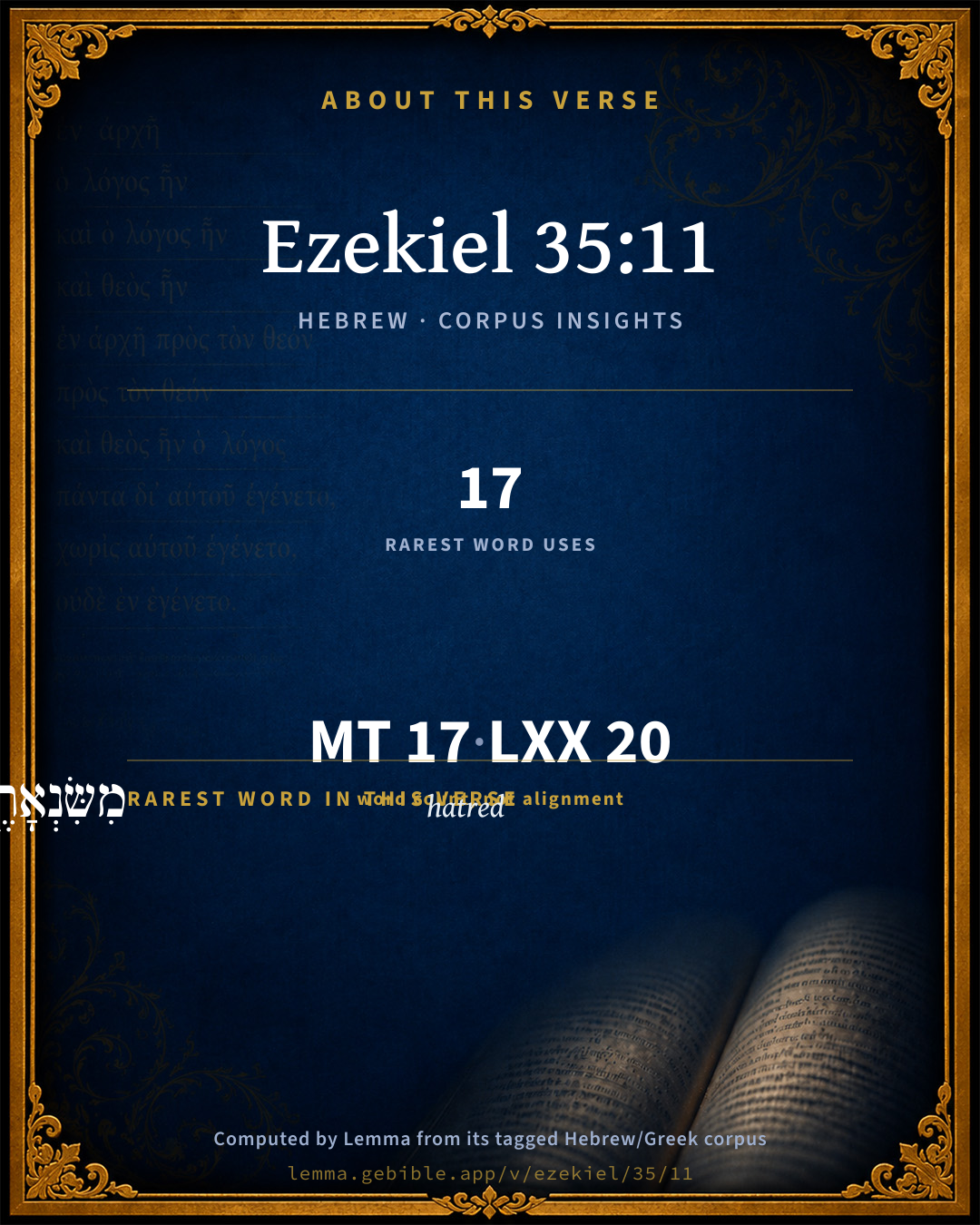
These counts appear in no published source. They are computed here, from the morphology-tagged text and Lemma’s own curated glosses. What Lemma adds →

17
words
13
distinct lemmas
Prophets
section

Notable vocabulary

The rarest word here is מִשִּׂנְאָתֶ֖יךָ hatred H8135 — appearing just 17 times in the whole Hebrew Bible.

Shared distinctive vocabulary

מִשִּׂנְאָתֶ֖יךָ hatred H8135 occurs in 16 verses of the Hebrew Bible. Also found in:

Grammatical profile

  • 4 verbs
  • 6 nouns
  • 1 adjective
  • 1 pronoun
  • 2 prepositions
  • 1 adverb
  • 2 particles

Verb forms

  • וְעָשִׂ֗יתִי Qal · Sequential Perfect
  • עָשִׂ֔יתָה Qal · Perfect
  • וְנוֹדַ֥עְתִּי Niphal · Sequential Perfect
  • אֶשְׁפְּטֶֽךָ Qal · Imperfect

Repetition

Words recur within this verse — often emphatic in Hebrew:

  • וְעָשִׂ֗יתִי to do H6213 ×2
  • אֲשֶׁ֣ר which H834 ×2

Hebrew & Septuagint length

In English translation the verse runs 43 words from the Hebrew and 30 from the Septuagint (LXX English) — the Septuagint runs noticeably shorter here. See the side-by-side →

A rough comparison of the two English renderings, which tokenize alike — not a word-level alignment.

Word counts can differ between the Hebrew and the Greek without any difference in meaning — e.g. the Hebrew direct-object marker אֵת has no separate Greek word, and Greek often adds the article ὁ.

In the original languages it is 17 Hebrew tokens and 20 Greek tokens — but the two are counted differently (Hebrew bundles its prefixes and suffixes into one token; the Greek is in lemma form), so that isn’t a like-for-like length.

Cross-references

7

Topical passages linked to Ezekiel 35:11 in the Treasury of Scripture Knowledge — connected by theme and wording, ordered by reader-vote popularity; previews shown in the World English Bible.

  • Psalms 9:16 Yahweh has made himself known. He has executed judgment. The wicked is snared by the work of his own hands. Meditation. Selah.
  • Matthew 7:2 For with whatever judgment you judge, you will be judged; and with whatever measure you measure, it will be measured to you.
  • Psalms 73:17–18 Until I entered God's sanctuary, And considered their latter end.
  • Psalms 137:7 Remember, Yahweh, against the children of Edom, The day of Jerusalem; Who said, "Raze it! Raze it even to its foundation!"
  • Amos 1:11 Thus says Yahweh: "For three transgressions of Edom, yes, for four, I will not turn away its punishment; Because he pursued his brother with the sword, And cast off all pity, And his anger raged continually, And he kept his wrath forever;
  • Ezekiel 25:14 I will lay my vengeance on Edom by the hand of my people Israel; and they shall do in Edom according to my anger and according to my wrath; and they shall know my vengeance, says the Lord Yahweh.
  • James 2:13 For judgment is without mercy to him who has shown no mercy. Mercy triumphs over judgment.

Cross-references courtesy of OpenBible.info (CC BY 4.0).

Hebrew and Greek witnesses Masoretic Hebrew ↔ Greek Septuagint

The same verse in the two great witnesses to the Old Testament, shown verse-for-verse.

Here the Septuagint runs noticeably shorter than the Hebrew — LXX2012 (modern English Septuagint) 30 words vs World English Bible 43. A rough length comparison of the two English translations, not a word-level alignment — read both below.

These are two independent witnesses, not word-aligned to each other, and the Septuagint is shown in lemma (dictionary) form.

Hebrew Ezekiel 35:11 Masoretic · Westminster Leningrad Codex

לָכֵ֣ן חַי אָ֗נִי נְאֻם֮ אֲדֹנָ֣י יְהוִה֒ וְעָשִׂ֗יתִי כְּאַפְּךָ֙ וּכְקִנְאָ֣תְךָ֔ אֲשֶׁ֣ר עָשִׂ֔יתָה מִשִּׂנְאָתֶ֖יךָ בָּ֑ם וְנוֹדַ֥עְתִּי בָ֖ם כַּאֲשֶׁ֥ר אֶשְׁפְּטֶֽךָ

therefore, as I live, says the Lord Yahweh, I will do according to your anger, and according to your envy which you have shown out of your hatred against them; and I will make myself known among them, when I shall judge you.

World English Bible · Public Domain

Greek LXX Ezekiel 35:11 Septuagint · lemma form

διά οὗτος ζάω ἐγώ λέγω κύριος καί ποιέω σύ κατά ὁ ἔχθρα σύ καί γιγνώσκω σύ ἡνίκα ἄν κρίνω σύ

therefore, as I live, says the Lord, I will even deal with you according to your enmity, and I will be made known to you when I shall judge you:

LXX2012 (modern English Septuagint) · Public Domain

On this verse, The Cambridge Bible for Schools and Colleges discusses the Septuagint’s reading. Read the note in Commentary ↓

Hebrew: Westminster Leningrad Codex (CC BY 4.0). Greek: Septuagint (public domain); English from LXX2012 (modern English Septuagint) (Public Domain). How the Septuagint differs from the Hebrew →

Targum (Aramaic paraphrase)

1

The Targum is the ancient Jewish Aramaic paraphrase of the Hebrew Scriptures — an interpretive translation, not the Hebrew text itself. Onkelos (literal) and Pseudo-Jonathan (expansive) render the Torah, and Jonathan the Prophets. Coverage is partial: where no permissively-licensed English translation exists for a verse, only the Aramaic is shown. This is verse-level text, not a word-by-word alignment to the Hebrew.

  1. Targum Jonathan Prophets (Joshua–Malachi)
    בְּכֵן קַיָם אֲנָא אֲמַר יְיָ אֱלֹהִים וְאַעְבֵּד כְּרוּגְזָךְ וּכְחֵמְיתָךְ וַעֲבַדְתָּא מִדְסְנֵיתָא לְהוֹן וְאִתְגְלֵי לְאֵיטָבָא לְהוֹן כַּד אִתְפְּרַע מִנָךְ:

    (no public-domain English translation for this verse)

    Targum Jonathan — Aramaic: “Mikraot Gedolot” (public domain). English: “Sefaria Community Translation” (CC0 1.0 (public-domain dedication)); “London "Chaldee Paraphrase," 1871” (public domain). Text via Sefaria.

Commentary

Notes on Ezekiel 35:11 from classic Christian and Jewish commentators (each source and its license shown beneath its notes). The classic Christian expositions comment on the surrounding passage and are grouped to its opening verse, so a note may address several verses; the Jewish commentaries on the Tanakh (Rashi and others) are per-verse, so they appear only where the commentator wrote on this verse.

Lemma curates 59 commentaries, every one of them public domain or Creative Commons licensed, each selected and text-cleaned for this edition rather than reprinted as found. About our sources →

Trapp's Complete Commentary

John Trapp

Eze 35:11 Therefore, [as] I live, saith the Lord GOD, I will even do according to thine anger, and according to thine envy which thou hast used out of thy hatred against them; and I will make myself known among them, when I have judged thee.

Ver. 11. I will do even according to thine anger.] Let the Romish Edomites expect the like punishment: their malice and mischief will come home to them.

And according to thine envy.] That quicksighted and sharp fanged malignity which none can stand before. {Pro 27:4}

John Trapp, A Commentary or Exposition upon All the Books of the Old and New Testament (1647–1656) — public domain. Text from a community e-Sword module.

Geneva Bible (1599)

Geneva Bible translators

As thou hast done cruelly, so shalt thou be cruelly handled.

Showing that when God punisheth the enemies, the godly ought to consider that he hath a care over them, and so praise his Name: and also that the wicked rage as though there were no God, till they feel his hand to their destruction.

Geneva Bible (1599) marginal notes — public domain. Text via Bolls.life.

Jamieson, Fausset & Brown

Robert Jamieson, A. R. Fausset & David Brown

according to thine anger-- (Jam 2:13). As thou in anger and envy hast injured them, so I will injure thee.

I will make myself known among them--namely, the Israelites. I will manifest My favor to them, after I have punished thee.

Jamieson, Fausset & Brown — Commentary Critical and Explanatory on the Whole Bible (1871) — public domain (CC PDM 1.0). Text via the HelloAO Bible API.

The Cambridge Bible for Schools and Colleges

gen. ed. J. J. S. Perowne

11. Amo_1:11 also uses the word “anger” of Edom’s demeanour. LXX. reads the verse in a shorter form.

amongst them] i.e. Israel, or, those who behold it. LXX. in thee (Edom, changing one letter), which is more pointed, cf Eze_35:12. For “have judged,” better, shall judge.

The Cambridge Bible for Schools and Colleges (gen. ed. J. J. S. Perowne; Cambridge University Press, 1878–1918) — public domain. Text from a community e-Sword module.

John Gill's Exposition

Therefore, as I live, saith the Lord,.... An oath, as before in Eze 35:6,

I will do according to thine anger, and according to thine envy which thou hast used out of thy hatred against them: as thou hast been angry with them, and hated them, and done mischief to them, so will I be angry with thee, and hate thee, and inflict punishment on thee; I will retaliate all the anger, envy, and hatred showed unto my people, and punish thee according to thy just demerits. So the Romish antichrist shall be dealt with; he who has led into captivity shall go into it, and he that has killed with the sword shall be killed by it. Babylon shall be rewarded double, as she has rewarded, others, Rev 13:10.

And I will make myself known among them, when I have judged thee; the Targum is,

"and I will reveal myself to do good unto them, when I shall have taken vengeance on thee:''

after the destruction of antichrist, the knowledge of God, and of Christ, will be spread among Jews and Gentiles, even all the world over, so universally, so clearly and distinctly, as never was before, Dan 12:4.

John Gill's Exposition of the Whole Bible (1746–1763) — public domain (CC PDM 1.0). Text via the HelloAO Bible API.

Haydock's Catholic Bible Commentary

Wrath. The Jews shall treat you as you have threatened to do unto them. --- By them, my people. Septuagint, "to thee."

George Leo Haydock (1774–1849), Haydock's Catholic Family Bible and Commentary, 1859 edition — public domain. Excludes Psalms (Douay-Rheims chapter numbering differs from Protestant) and Deuterocanonical books (Catholic canon only).

Matthew Poole's English Annotations

I will even do, deal with thee, O Mount Seir,

according to thine anger; I will take my measures from thy using of Israel. Thou wast angry, and that very fiercely, in which anger thou didst smite: in fierce anger against thee I will smite thee. Thou thoughtest with an envious heart all Israel had was too good for him, and wouldst spoil him of all; and I know thee unworthy of all thou hast, and I will take it from thee. Thy hatred edged both thine anger and thine envy to extirpate and root them out; and in my hatred against such sins and obstinate sinners I will utterly destroy thee and root thee out.

When I have judged thee: so God is known by the judgments that he executeth, when such wicked ones are taken in their own works, as snares which themselves have laid.

Matthew Poole's English Annotations on the Holy Bible (1683–1685) — public domain. Text from a community e-Sword/MySword module.

The Pulpit Commentary

Vers. 11-13. I will make myself known among them Israel and Judah; not to thee (LXX, Hitzig, Ewald)when I have judged thee. Edom"s wickedness should be requited by his being made to suffer the indignities he designed to heap on Israel. In him the lextalionis should have full sway. Edom"s misconception as to Jehovah"s relation to the land and people should be corrected when Jehovah should rise up in judgment against him. Those judgments should in the first instance be a revelation to Israel and Judah, who should discern therefrom that they had not been utterly abandoned by Jehovah; (ver. 11; cf. Eze_20:5) and in the second instance should open Edom"s eyes to perceive that Jehovah had been a silent listener to all the blasphemies she had uttered against the mountains of Israel (ver. 12), and had reckoned these as blasphemies uttered against himself (ver. 13).

Vers. 11-15. The Lord"s identification of himself with Israel.

A careless reader might possibly consider that a passage like this exemplifies prophetic partiality; that Ezekiel, because himself a Jew by birth and by sentiment, was disposed to represent the Supreme as upon his side and against his countrymen"s enemies; that the view given of the Eternal is of a Ruler whose government is distinguished by favoritism. But further consideration will show that this is not the case. The cause of Israel was the cause of monotheism in religion, of spirituality in worship, and of purity and righteousness in morals. It is true that the Hebrew people did not actually, as a matter of fact, attain the standard which as a nation they adopted; and for this reason their leaders and thinkers were at this very time enduring the purifying humiliation of the Captivity. But the highest interest and the fairest prospects of mankind were bound up with the preservation of Israel as God"s witness concerning himself to the world, and as God"s preparation for the advent of the Messiah.

I THE INIQUITOUS CONDUCT OF SEIR. They were guilty:

1. Of anger and enmity against Israel.

2. Of evil speech, of blasphemy, against Israel.

3. Of rejoicing over the sorrows, calamities, and desolations of Israel.

II THE LORD"S IDENTIFICATION OF HIMSELF WITH ISRAEL IN THE WRONG THEY SUSTAINED AT THE HAND OF SEIR. The fact is that Israel was his people, and he, Jehovah, was Israel"s God. This is said with the recollection that Israel had transgressed his Law, rebelled against his authority, despised the privileges he had bestowed; with the recollection that their God had chastened them sorely, and at this very time was causing them to pass through the furnace of affliction. All this does not interfere with our belief of the close identification between the Lord and the sons of Jacob. It was not for their goodness, but for his purposes, that they were chosen. They were a consecrated nation, i.e. a nation set apart to fulfill a deliberate intention of the most high and holy God. Therefore, in a special manner, the Lord took the part of Israel, resented the wrongs done to them, the indignities put upon them, and the blasphemies uttered concerning them. Therefore the Lord avenged them of their adversaries. Other nations might be destroyed, but it did not consist with God"s purposes that Israel should perish. He was against those who were against his people.

III THE LORD"S AVENGING OF ISRAEL"S WRONGS AS DONE TO HIMSELF.

1. He heard with displeasure all the evil words uttered against those whom he had set apart for himself.

2. He judged with a righteous and severe judgment all who injured his servants.

3. For Mount Seir, as a flagrant offender, was reserved an especial punishment: "When the whole earth rejoiceth, I will make thee desolate." Let it be observed that this was a reversal of what had formerly taken place; for when Israel was desolated, Mount Seir had rejoiced. T.

The Pulpit Commentary (1880–1919), ed. H.D.M. Spence-Jones & Joseph S. Exell — public domain. Text from a community e-Sword module.

John Wesley's Explanatory Notes

Judged - Punished thee.

John Wesley, Explanatory Notes Upon the Whole Bible (1754–1765) — public domain. Text via the GEBible commentary corpus.

Rashi

Rabbi Shlomo Yitzchaki (Rashi)

I shall commit [acts] like your [acts of] wrath like the [acts of] wrath that you exerted against Israel, I will exert against you.

and I shall be known among them when I judge you Then they will recognize My might.

Rashi on the Tanakh — English translations: “The Judaica Press complete Tanach with Rashi, translated by A. J. Rosenberg” (CC BY 4.0); “Pentateuch with Rashi's commentary by M. Rosenbaum and A.M. Silbermann, 1929-1934” (public domain); “The Metsudah Tanach series, Lakewood, N.J” (CC BY 4.0); and “The Book of Joshua, Metsudah Publications, 1997” (CC BY 4.0). Text via Sefaria.

Lesson kit

Teaching starters — assembled from the data on this page, not authored interpretation. Every prompt links to the verse data it draws on. Edit before teaching.

Ezekiel, in the Prophets, opens this verse with 17 words (13 distinct Hebrew lemmas). Its most distinctive word is sinʼâh (“hatred”). The Greek Septuagint runs shorter here. A historical commentator’s framing appears above. Read the whole chapter for the surrounding context.

Discussion questions

  1. How does “hatred” (sinʼâh) shape what this verse is saying?
  2. How does Numbers 35:20, which shares the word «hatred», read alongside this verse?
  3. What does the repetition of “to do” (2× in this one verse) do in this verse?
  4. The Septuagint runs shorter here than the Hebrew. What might account for the difference?
  5. The translations on this page render this verse differently — a whole-verse word diff, not a word-by-word alignment. What might account for the different wordings?
  6. «וְעָשִׂ֗יתִי» is a Qal Sequential Perfect verb. How does that grammatical form shape the action described?
  7. Compare how Trapp's Complete Commentary and Geneva Bible (1599) read this verse. Where do they agree or differ?

Things to notice

Reading settings

Reading text

Shown beneath each verse's original-language words.

Old Testament
Old Testament edition

Read the OT as the Masoretic Hebrew (MT) or the Greek Septuagint (LXX).

English shown for the Greek Septuagint (in the Hebrew ↔ Greek comparison).

Comparing translations? Open the Compare panel on any verse page to stack up to four side by side.